
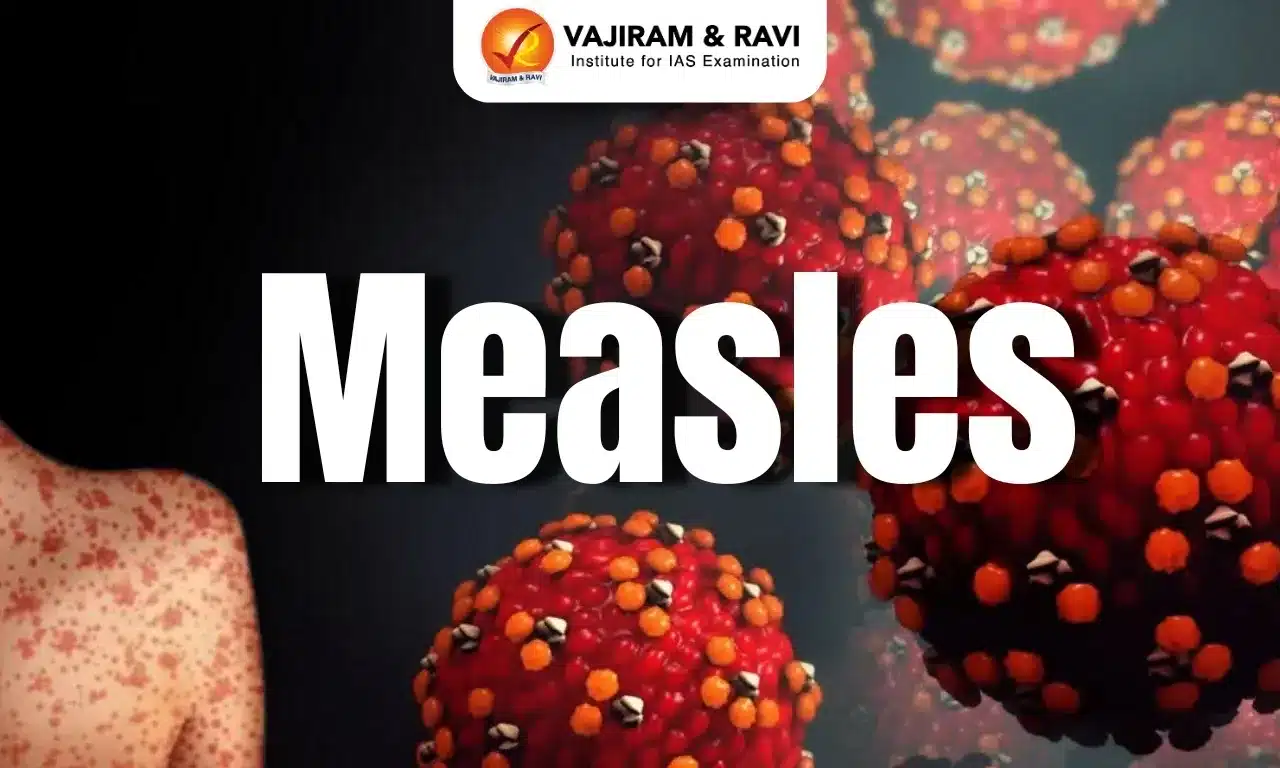
Measles Latest News
Despite a highly effective vaccine, measles caused approximately 95,000 deaths globally in 2024, primarily among unvaccinated children under five.
About Measles
- Measles is a highly contagious, serious airborne disease caused by a virus.
- It is caused by a virus in the paramyxovirus family.
Measles Transmission
- It is one of the world’s most contagious diseases, spread by contact with infected nasal or throat secretions (coughing or sneezing) or breathing the air that was breathed by someone with measles.
- The virus remains active and contagious in the air or on infected surfaces for up to two hours.
- For this reason, it is very infectious.
- The virus infects the respiratory tract, then spreads throughout the body, causing severe disease, complications, and even death.
Measles Symptoms
- The first sign of measles is usually high fever, beginning about 10 to 14 days after exposure to the virus and lasting four to seven days.
- A runny nose, cough, red and watery eyes, and small white spots inside the cheeks can develop in the initial stage.
- A rash erupts after several days, usually on the face and upper neck. The rash spreads over about three days, eventually reaching the hands and feet, and lasts five to six days before fading.
Who is at Risk of Measles?
- Any non-immune person (not vaccinated or vaccinated but did not develop immunity) can become infected.
- Unvaccinated young children and pregnant persons are at the highest risk of severe measles complications.
- Measles is still common, particularly in parts of Africa, the Middle East, and Asia.
Measles Treatment
- No specific antiviral treatment exists for measles.
- It can be prevented with a safe and effective measles-rubella (MR) vaccine that gives long-term immunity.
- The Government of India (GoI) introduced the measles vaccine in its Universal Immunization Programme in 1985.
Source: TOI
Measles FAQs
Q1: Measles is caused by which type of organism?
Ans: It is caused by a virus.
Q2: Who is at the highest risk of severe measles complications?
Ans: Unvaccinated young children and pregnant persons are at the highest risk of severe measles complications.
Q3: How is measles transmitted from one person to another?
Ans: It spread by contact with infected nasal or throat secretions (coughing or sneezing) or breathing the air that was breathed by someone with measles.
Q4: Is there any specific antiviral treatment available for measles?
Ans: No specific antiviral treatment exists for measles.
Q5: How measles can be prevented?
Ans: It can be prevented with a safe and effective measles-rubella (MR) vaccine.

