Cosmic Filament

Cosmic Filament

Cosmic Filament Latest News

Recently, the University of Oxford researchers reported a roughly 50-million-lightyear-long cosmic Filament traced by at least 14 galaxies. 

About Cosmic Filament

  • Cosmic or galaxy filaments are the largest ‘threads’ in the universe’s cosmic web.
  • Size: A single cosmic filament is a structure spanning hundreds of millions of lightyears.
  • These filaments are the largest known structures in the Universe which are vast, thread-like formations of galaxies and dark matter that form a cosmic scaffolding. 
  • These cosmic web filaments serve as the nurseries where galaxies grow by accreting pristine gas that fuels their star formation.
  • Formation
    • It is formed as a result of gravity pulling in gas, dark matter, and galaxies into long, thin strands that link giant clusters of galaxies.
    • These filaments also surround large, empty regions of space called voids.
    • A filament forms where sheets of matter intersect and collapse; they’re also highways along which gas and smaller galaxies ‘flow’ towards big clusters.
  • Significance: These filaments help decide where galaxies form, how fast they grow, and how much fresh gas they receive over billions of years.

Source: TH

Cosmic Filament FAQs

Q1: What are Cosmic Filaments?

Ans: Vast, thread-like formations of galaxies and dark matter.

Q2: How are Cosmic Filaments formed?

Ans: Through gravity pulling in gas, dark matter, and galaxies.

Haemorrhagic Septicaemia

Haemorrhagic Septicaemia

Haemorrhagic Septicaemia Latest News

Recently, ten blackbucks have died in Jharkhand's Jamshedpur in Zoological Park due to suspected Haemorrhagic Septicaemia.

About Haemorrhagic Septicaemia

  • It is also known as Pasteurellosis.
  • It is a bacterial disease caused by certain serotypes of Pasteurella multocida.
    • The two common serotypes of P. multocida associated with the disease in these species are types B:2 (in Asia ) and E:2 (in Africa )
  • These are geographically restricted to some areas of Asia, Africa, the Middle East and southern Europe.
  • It is a major disease of cattle and buffaloes characterised by an acute, highly fatal septicaemia with high morbidity and mortality.
  •  In both species, young animals and young adults are more susceptible than older animals.
  • Germs of this disease survive longer in humid and waterlogged conditions.
  • Transmission:  It can be transmitted by ingestion or inhalation, either during direct contact or via fomites such as contaminated feed and water.
  • Symptoms of Haemorrhagic Septicaemia
    • Animals become dull and have high fever.  They refuse to eat and salivate more than normally. 
    • Swellings develop typically and quickly, especially around the throat, the brisket, the dewlap and sometimes around the head.
  • Treatment:  Vaccines are available; Antimicrobial treatment administered intravenously soon after the onset of disease can reduce mortality.

Source: TH

Haemorrhagic Septicaemia FAQs

Q1: What is Haemorrhagic Septicaemia?

Ans: A bacterial disease affecting cattle and buffaloes

Q2: Which bacterium causes Haemorrhagic Septicaemia?

Ans: Pasteurella multocida

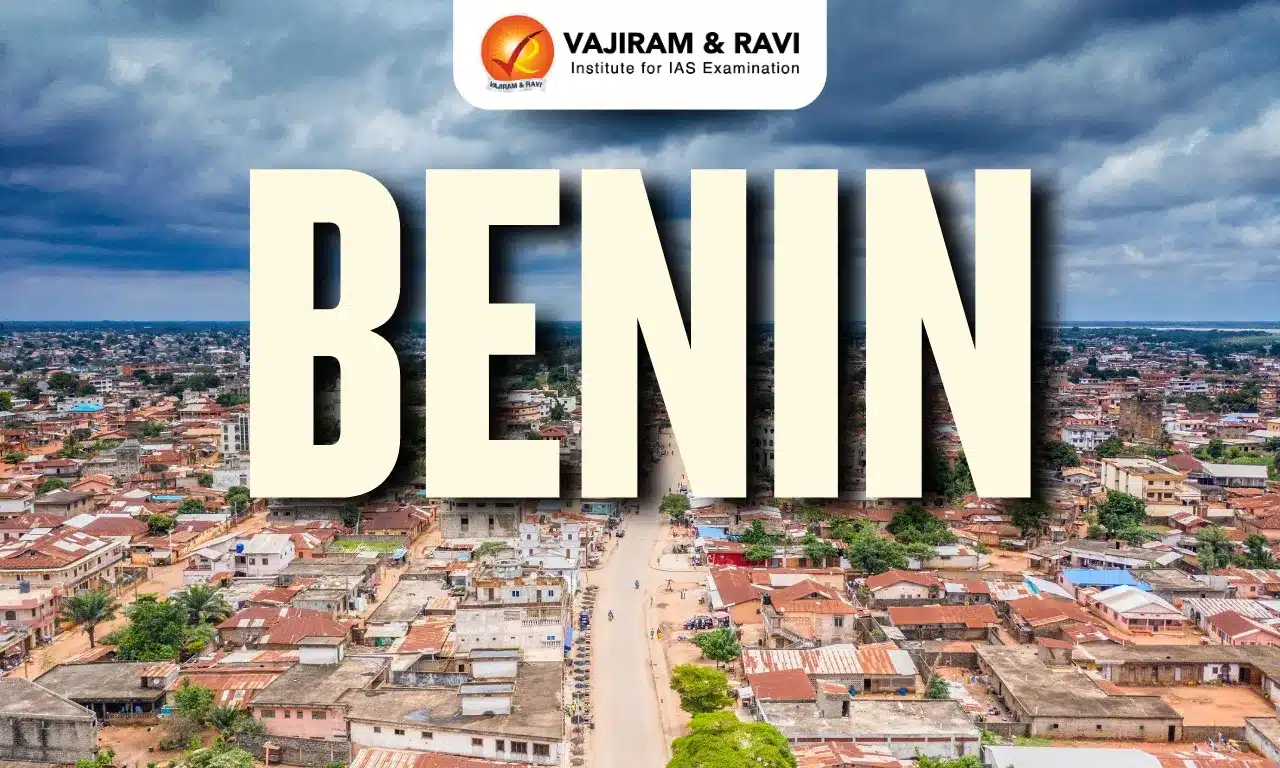
Benin

Benin

Benin Latest News

Benin President recently said that the West African nation's government and armed forces had thwarted a coup attempt by a group of soldiers and vowed to punish them.

About Benin

  • It is a country in West Africa.
  • It encompasses an area of 112,622 sq. km.
  • Four countries border Benin. These are Niger to the northeast, Nigeria to the east, Togo to the west, and Burkina Faso to the northeast. 
  • To the south, Benin has a small stretch of coastline on the Bight of Benin, which is part of the Gulf of Guinea in the Atlantic Ocean.
  • Drainage: Apart from the Niger River, which, with its tributaries the Mékrou, Alibori, and Sota, drains the northeastern part of the country, the three principal rivers in Benin are the Mono, the Couffo, and the Ouémé.
  • The official capital is Porto-Novo, but Cotonou is Benin’s largest city, its chief port, and its de facto administrative capital. 
  • Its population in 2016 was estimated to be approximately 10.87 million.
  • Language
    • The official language of Benin is French
    • However, indigenous languages such as Fon and Yoruba are commonly spoken. 
  • Currency: Communaute Financiere Africaine francs (XOF)
  • Benin was a French colony from the late 19th century until 1960. 
  • Type of Government:
    • It is a Presidential Republic.
      It follows a multi-party democratic system.

Source: CNBC

Benin FAQs

Q1: Benin is located in which region of Africa?

Ans: West Africa

Q2: Benin has a coastline along which water body?

Ans: Benin has a small stretch of coastline on the Bight of Benin, which is part of the Gulf of Guinea in the Atlantic Ocean.

Q3: Which city is Benin’s official capital?

Ans: Porto-Novo

Q4: Which city is Benin’s largest city and de facto administrative capital?

Ans: Cotonou

Q5: What is the official language of Benin?

Ans: The official language of Benin is French.

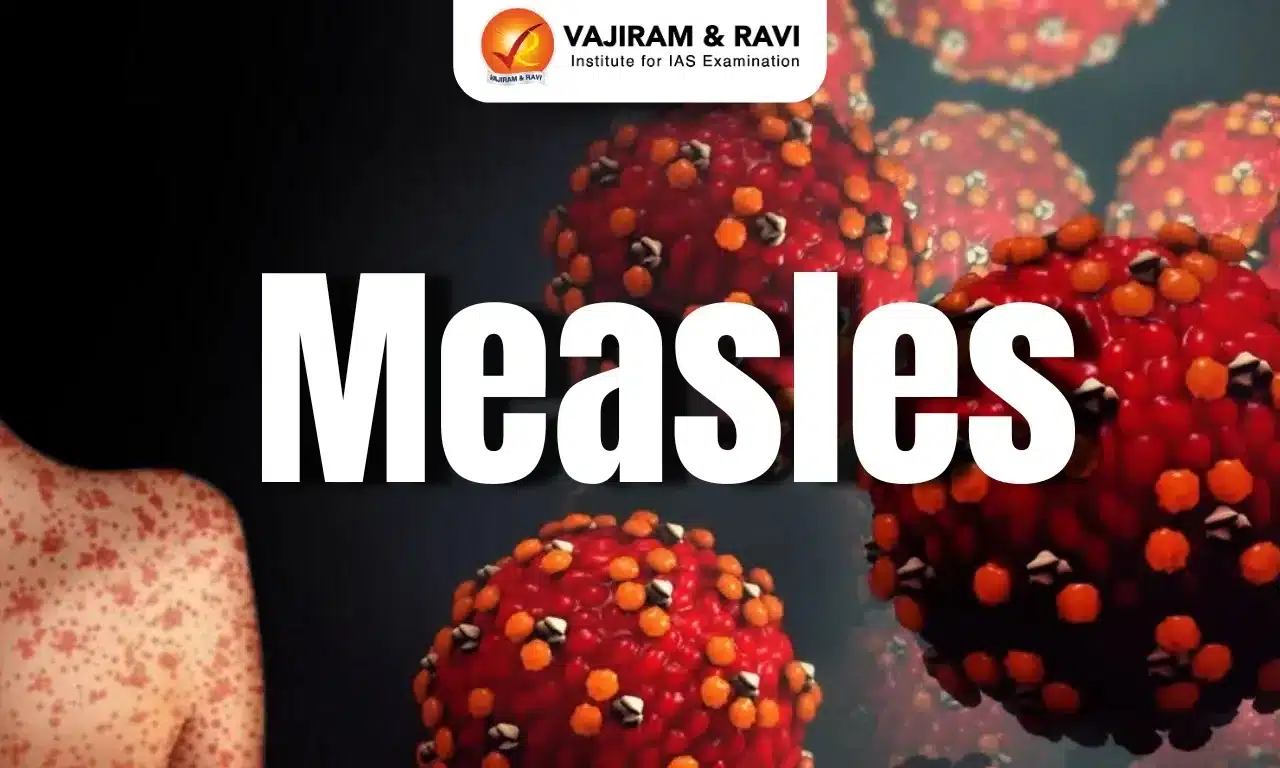
Measles

Key Facts about Measles

Measles Latest News

Despite a highly effective vaccine, measles caused approximately 95,000 deaths globally in 2024, primarily among unvaccinated children under five.

About Measles

  • Measles is a highly contagious, serious airborne disease caused by a virus.
  • It is caused by a virus in the paramyxovirus family.

Measles Transmission

  • It is one of the world’s most contagious diseases, spread by contact with infected nasal or throat secretions (coughing or sneezing) or breathing the air that was breathed by someone with measles. 
  • The virus remains active and contagious in the air or on infected surfaces for up to two hours. 
  • For this reason, it is very infectious. 
  • The virus infects the respiratory tract, then spreads throughout the body, causing severe disease, complications, and even death.

Measles Symptoms

  • The first sign of measles is usually high fever, beginning about 10 to 14 days after exposure to the virus and lasting four to seven days.
  • A runny nose, cough, red and watery eyes, and small white spots inside the cheeks can develop in the initial stage.
  • A rash erupts after several days, usually on the face and upper neck. The rash spreads over about three days, eventually reaching the hands and feet, and lasts five to six days before fading. 

Who is at Risk of Measles?

  • Any non-immune person (not vaccinated or vaccinated but did not develop immunity) can become infected.
  • Unvaccinated young children and pregnant persons are at the highest risk of severe measles complications.
  • Measles is still common, particularly in parts of Africa, the Middle East, and Asia.

Measles Treatment

  • No specific antiviral treatment exists for measles.
  • It can be prevented with a safe and effective measles-rubella (MR) vaccine that gives long-term immunity.
  • The Government of India (GoI) introduced the measles vaccine in its Universal Immunization Programme in 1985.

Source: TOI

Measles FAQs

Q1: Measles is caused by which type of organism?

Ans: It is caused by a virus.

Q2: Who is at the highest risk of severe measles complications?

Ans: Unvaccinated young children and pregnant persons are at the highest risk of severe measles complications.

Q3: How is measles transmitted from one person to another?

Ans: It spread by contact with infected nasal or throat secretions (coughing or sneezing) or breathing the air that was breathed by someone with measles.

Q4: Is there any specific antiviral treatment available for measles?

Ans: No specific antiviral treatment exists for measles.

Q5: How measles can be prevented?

Ans: It can be prevented with a safe and effective measles-rubella (MR) vaccine.

Hoolock Gibbon

Hoolock Gibbon

Hoolock Gibbon Latest News

Recently, a stranded family of Hoolock gibbons was rescued in Arunachal Pradesh’s Lower Dibang Valley district by officials.

About Hoolock Gibbon

  • Gibbons, the smallest and fastest of all apes, live in tropical and subtropical forests in the southeastern part of Asia.
  • The hoolock gibbon is one of 20 species of gibbons on Earth. 

Distribution of Hoolock Gibbon

  • Its distribution in Southeast Asia spans India, Myanmar, Bangladesh, and southern China.
  • It is the only ape found in India.
  • In India, it is found in Assam, Meghalaya, Arunachal Pradesh, Nagaland, Manipur, Mizoram, and Tripura, south of the Brahmaputra.
    • Hollongapar Gibbon Sanctuary in Assam has the largest concentration of the hoolock gibbon.
  • It is categorised into Eastern Hoolock Gibbon (Hoolock leuconedys) found in a specific region of Arunachal Pradesh and Western Hoolock Gibbon (Hoolock hoolock) distributed elsewhere in the northeast. 

Characteristics of Hoolock Gibbon

  • They are diurnal and arboreal, brachiating through the trees with their long arms.
  • They are monogamous (same partner throughout life).
  • They live in small families and communicate with other gibbons by vocalisation.
  • Life span: 25 years

Conservation Status of Hoolock Gibbon

  • IUCN Red List
    • Eastern Hoolock Gibbon: Vulnerable 
    • Western Hoolock Gibbon: Endangered
  • Both are on Schedule I of the Wildlife (Protection) Act of India, 1972.

Source: The Print

Hoolock Gibbon FAQs

Q1: What is the scientific name of Hoolock Gibbon?

Ans: Hylobates hoolock

Q2: What is unique about Hoolock Gibbons?

Ans: They are known for their distinctive vocalizations

National Intelligence Grid

National Intelligence Grid

National Intelligence Grid Latest News

Recently, officials said that the National Intelligence Grid (NATGRID) is slowly gathering pace and receiving 45k requests a month.

About National Intelligence Grid

  • It is a platform for the police and investigating agencies to securely access government and private databases in real time.
  • It is conceptualised as a seamless and secure database for information on terrorists, economic crimes and similar incidents to help bolster India’s capabilities.
  • Background
    • The project was started in 2009 in the aftermath of the 26/11 Mumbai terror attacks.
    • NATGRID was set up as an attached Office of the Ministry of Home Affairs with effect from December 1, 2010.
    • It started its operations on December 31, 2020.
  • NATGRID database is available to 
    • Intelligence Bureau (IB), the Research and Analysis Wing (R&AW), the National Investigation Agency (NIA), the Enforcement Directorate (ED), the Financial Intelligence Unit (FIU), the Narcotics Control Bureau (NCB) and the Directorate of Revenue Intelligence (DRI).
    • Superintendent of Police (SP) rank officers.

Operation of National Intelligence Grid

  • It has been mandated to maintain a repository of intelligence databases.
  • It works as an integrated intelligence grid that connects databases of core security agencies of the government of India.
  • It will have data related to all immigration entry and exit, banking and financial transactions, credit card purchases, telecom, individual taxpayers, air flyers, train travellers besides others to generate intelligence inputs.
  • It will utilise Big Data and Analytics to study huge amounts of data generated to analyse events in order to get a better picture as well as to trail suspects.

Source: TH

National Intelligence Grid FAQs

Q1: When was NATGRID established?

Ans: 2010

Q2: Which ministry is responsible for NATGRID?

Ans: Ministry of Home Affairs

Investor Education and Protection Fund Authority

Investor Education and Protection Fund Authority (IEPFA)

Investor Education and Protection Fund Authority Latest News

Recently, the Investor Education and Protection Fund Authority (IEPFA) collaborated with the Securities and Exchange Board of India (SEBI) organised a “Niveshak Shivir” in Jaipur 

About Investor Education and Protection Fund Authority

  • It was established in 2016 under the Companies Act, 2013.
  • Purpose: It is dedicated to promoting investor awareness and protection through sustained outreach, education, and strategic collaborations.
  • Functions 
    • It manages the Investor Education and Protection Fund (IEPF) and promotes investor awareness and financial protection.
    • It makes refunds of shares, unclaimed dividends, matured deposits/debentures etc. to investors and promotes awareness among investors.
    • It is dedicated to safeguarding investor interests by facilitating the return of unclaimed shares and dividends and advancing financial literacy nationwide.
  • Nodal Ministry: Ministry of Corporate Affairs
  • Initiatives: Through flagship initiatives such as Niveshak Didi, Niveshak Panchayat, and Niveshak Shivir, IEPFA empowers individuals to make informed financial choices and fosters a financially aware citizenry.
  • The IEPF consists of amounts that remained unclaimed for 7 years, including:
    • Unpaid dividends,
    • Application money is due for refund,
    • Matured deposits and debentures,
    • Interest on investments from the fund,
    • Grants or donations received from the government or other entities.

Source: PIB

Investor Education and Protection Fund Authority FAQs

Q1: Under which ministry does IEPF operate?

Ans: Ministry of Corporate Affairs

Q2: Which act established IEPF?

Ans: Companies Act, 2013

Kilauea Volcano

Kilauea Volcano

Kīlauea Volcano Latest News

Fresh lava fountains recently erupted from Hawaii’s Kilauea volcano nearly a year after one of the world’s most active volcanoes began its current eruptive phase.

About Kīlauea Volcano

  • It is one of the world’s most active volcanoes. 
  • It is a shield-type volcano located in the southeastern part of the island of Hawaii, Hawaii State, United States.
    • Hawaii is the southernmost and largest of the island chain, which owes its existence to the very active Hawaiian hot spot.
  • Kīlauea volcano’s 1,250-metre summit has collapsed to form a caldera, a broad shallow depression nearly 5 km long and 3.2 km wide with an area of more than 10 sq.km.
  • The summit caldera contains a lava lake known as Halema`uma`u that is said to be the home of the Hawaiian volcano goddess, Pele.
  • Kilauea’s slopes merge with those of the nearby volcano Mauna Loa on the west and north.
  • Kilauea has been erupting on a continuous basis since 1983.
  • Kilauea’s frequent eruptions are usually nonexplosive and are contained within Halema‘uma‘u, which sometimes rises and overflows along the floor and flanks of the caldera proper.

Source: HT

Kīlauea Volcano FAQs

Q1: Kīlauea is what type of volcano?

Ans: Kīlauea is a Shield volcano.

Q2: Where is Kīlauea Volcano located?

Ans: It located in the southeastern part of the island of Hawaii, Hawaii State, United States.

Q3: What is the approximate height of Kīlauea’s summit?

Ans: 1,250 metres

Q4: Kīlauea’s slopes merge with which nearby volcano?

Ans: Mauna Loa volcano

Border Roads Organisation (BRO)

Border Roads Organisation (BRO)

Border Roads Organisation Latest News

The Defence Minister recently dedicated 125 newly completed Border Roads Organisation (BRO) infrastructure projects to the nation, marking the highest number and value of inaugurations undertaken by the agency in a single day.

About Border Roads Organisation 

  • It is a road construction executive force in India that provides support to the Indian Armed Forces.
  • BRO was entirely brought under the Ministry of Defence in 2015.
  • Establishment: It was formed on 7 May 1960 to secure India’s borders and develop infrastructure in remote areas of the north and northeastern states of the country.
  • It develops and maintains road networks in India’s border areas and friendly neighboring countries.
    • This includes infrastructure operations in 19 states and three union territories (including Andaman and Nicobar Islands) and neighboring countries such as Afghanistan, Bhutan, Myanmar, Tajikistan, and Sri Lanka.
    • BRO specialises in constructing and maintaining Roads, Bridges, Tunnels, Airfields and Marine Works across some of the world’s most challenging terrains.
  • The BRO also has an operational role during national emergencies and the outbreak of hostilities, when it provides direct support to the Army in the maintenance of roads in the forward zones and executes other functions specified by the government.
  • It also provides the workforce for the rehabilitation of certain forward airfields of the Indian Air Force during operations.
  • BRO is also included in the Order of Battle of the Armed Forces, ensuring their support at any time.
  • In order to ensure coordination and expeditious execution of projects, the Government of India set up the Border Roads Development Board (BRDB) with the Prime Minister as Chairman of the Board and the Defence Minister as Deputy Chairman.
  • The executive head of the BRO is the Director General of Border Roads (DGBR), who holds the rank of Lieutenant General. 
  • Officers and personnel from the General Reserve Engineer Force (GREF) form the parent cadre of the BRO.
  • It is also staffed by officers and troops drawn from the Indian Army’s Corps of Engineers on extra-regimental employment (on deputation).
  • BRO also employs more than two lakh (200,000) local workers in the task of ensuring employment in far-flung areas.
  • Motto: Shramena Sarvam Sadhyam (everything is achievable through hard work).

Source: DDN

Border Roads Organisation FAQs

Q1: The Border Roads Organisation (BRO) functions under which ministry?

Ans: Ministry of Defence

Q2: What was the purpose behind the creation of the Border Roads Organisation (BRO) in 1960?

Ans: To secure borders and develop infrastructure in remote northern and northeastern regions.

Q3: Who chairs the Border Roads Development Board (BRDB)?

Ans: Prime Minister

Q4: What is the motto of the Border Roads Organisation (BRO)?

Ans: Shramena Sarvam Sadhyam (everything is achievable through hard work).

Enquire Now