
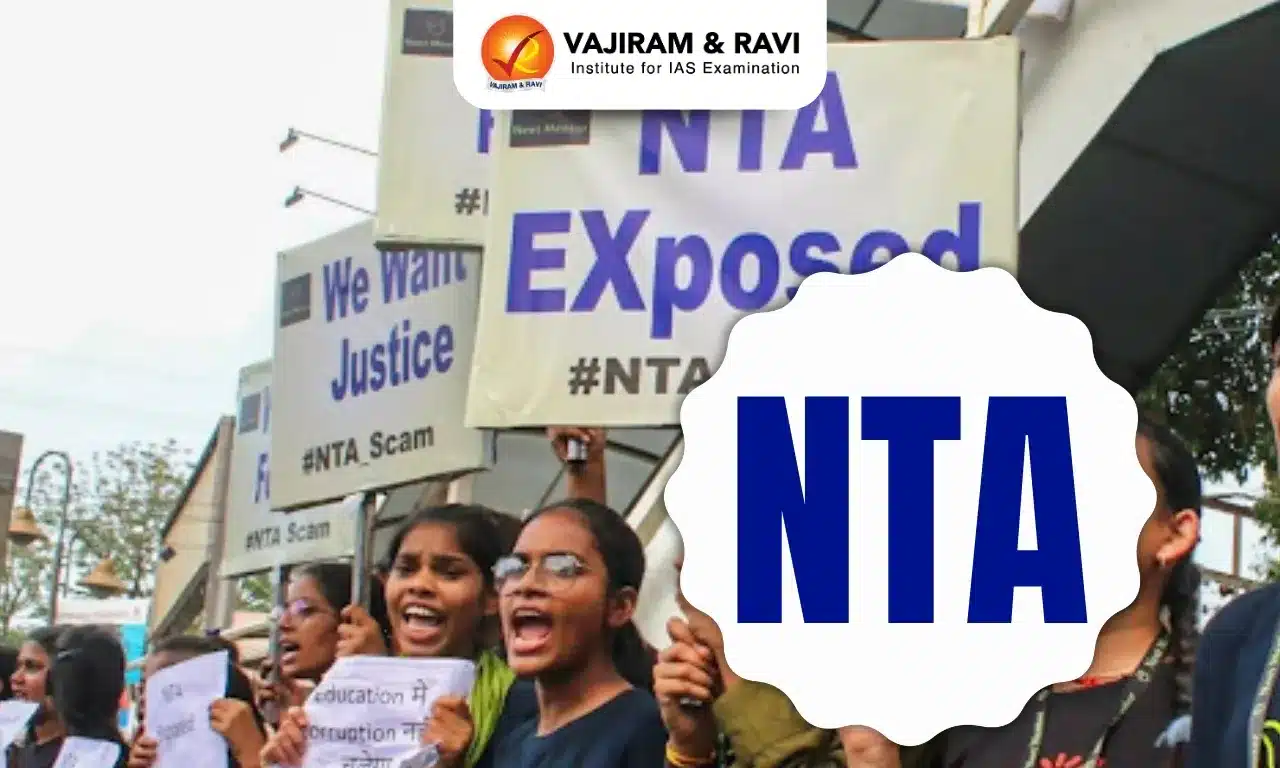
NTA Latest News
- A Parliamentary Standing Committee has sharply criticised the National Testing Agency (NTA), stating that it “has not inspired much confidence” and must urgently improve its functioning.
- The panel highlighted repeated delays in exam results, especially CUET, and noted that despite collecting a surplus of ₹448 crore over six years, the NTA has not built adequate in-house capacity to conduct tests independently.
- The committee urged the agency to strengthen its systems, infrastructure, and accountability mechanisms to ensure reliable and timely examinations.
About National Testing Agency
- The National Testing Agency (NTA) was established in 2017 as an autonomous, self-sustaining organisation under the Education Ministry (formerly HRD Ministry).
- It is registered under the Societies Registration Act, 1860 and comes under the RTI Act.
- Before its creation, UGC, CBSE, and central universities like DU and JNU conducted their own entrance exams.
Origins: When Was NTA First Envisioned
- The idea for a national exam-conducting body dates back to the 1992 Programme of Action under NEP 1986.
- In 2010, a committee of IIT directors recommended establishing such an agency through legislation, inspired by the Educational Testing Service (ETS), USA.
- The government formally announced NTA in 2017, and the Cabinet approved its creation soon after.
Exams Conducted by NTA
- NTA conducts India’s major entrance examinations, including:
- Top Undergraduate Entrance Exams
- JEE Main – Engineering admissions
- NEET-UG – Medical admissions
- CUET-UG – Admissions to undergraduate programmes in central universities
- Over 50 lakh candidates appear for these three exams annually.
- Other Major Exams
- CUET-PG – Postgraduate admissions
- UGC-NET – Eligibility for assistant professor, JRF, and PhD
- CSIR UGC-NET – PhD admission in science disciplines
- CMAT, Hotel Management JEE, GPATEntrance exams for DU, JNU, IIFT, ICAR, and others
- Top Undergraduate Entrance Exams
House Panel Flags Serious Concerns Over NTA’s Functioning
- The Parliamentary Standing Committee on Education has sharply criticised the National Testing Agency (NTA), stating that it has “not inspired much confidence” and must urgently improve its performance.
- The panel noted chronic delays, errors, and administrative lapses in major national examinations.
Repeated Delays and Exam Irregularities
- The committee observed that NTA delayed CUET results for multiple years, disrupting university admissions and academic calendars.
- Out of 14 exams conducted in 2024, at least five faced major issues:
- UGC-NET, CSIR-NET, NEET-PG were postponed
- NEET-UG faced paper leaks
- CUET results were delayed
- JEE Main 2025 had 12 incorrect questions withdrawn after answer key errors
- The panel warned that such incidents erode students’ trust in the testing system.
NTA’s Financial Surplus Should Be Used for Capacity Building
- NTA collected ₹3,512.98 crore in six years and spent ₹3,064.77 crore, leaving a surplus of ₹448 crore.
- The committee recommended that this money be used to:
- Build in-house capability to conduct exams independently
- Strengthen regulatory oversight of outsourced vendors
Preference for Pen-and-Paper Exams
- Citing CBSE and UPSC’s decades-long track record, the panel expressed support for pen-and-paper exams, noting they have been “leak-proof for several years” — implying computer-based testing may be more vulnerable.
Recommendation to Recognise Sonam Wangchuk’s Institute
- The committee encouraged the UGC to evaluate Sonam Wangchuk’s Himalayan Institute of Alternatives, Ladakh, noting its innovative model and potential for replication across India.
Observation Regarding UGC
- Draft UGC Regulations 2025
- Opposition fears they increase the Chancellor/Visitor’s control over Vice-Chancellor appointments.
- Committee recommended detailed discussions with CABE (Central Advisory Board of Education) before finalising rules.
- UGC Leadership Vacuum
- The UGC Chairperson post has remained vacant since April 2025
- Committee urges urgent appointment
- UGC Equity Regulations 2025
- Panel noted delays and recommended:
- Inclusion of OBC harassment under caste-based discrimination
- Addition of disability as a discrimination axis
- Clear categorisation of discriminatory acts to avoid subjective interpretation
NTA FAQs
Q1: Why did the House Committee criticise the NTA?
Ans: The committee cited repeated exam delays, paper leaks, answer key errors, and mismanagement, concluding that NTA has “not inspired much confidence” in recent years.
Q2: What financial recommendation did the panel make to NTA?
Ans: It urged the NTA to use its ₹448-crore surplus to build in-house testing capability and improve vendor oversight for more reliable exam administration.
Q3: Which major exams faced issues under NTA recently?
Ans: UGC-NET, CSIR-NET and NEET-PG were postponed, NEET-UG saw paper leaks, and CUET results were delayed; JEE Main had errors needing question withdrawal.
Q4: What reforms were suggested regarding UGC regulations?
Ans: The panel advised wider consultations via CABE, urgent appointment of a UGC Chairperson, and clearer anti-discrimination provisions including OBC and disability inclusion.
Q5: Why did the committee highlight pen-and-paper exams?
Ans: It argued that CBSE and UPSC paper-based exams have remained leak-proof for years, suggesting greater reliability compared to computer-based testing vulnerabilities.

