Deepavali

Deepavali

Deepavali Latest News

Recently, Deepavali has been inscribed on UNESCO’s List of the Intangible Cultural Heritage of Humanity.

About Deepavali

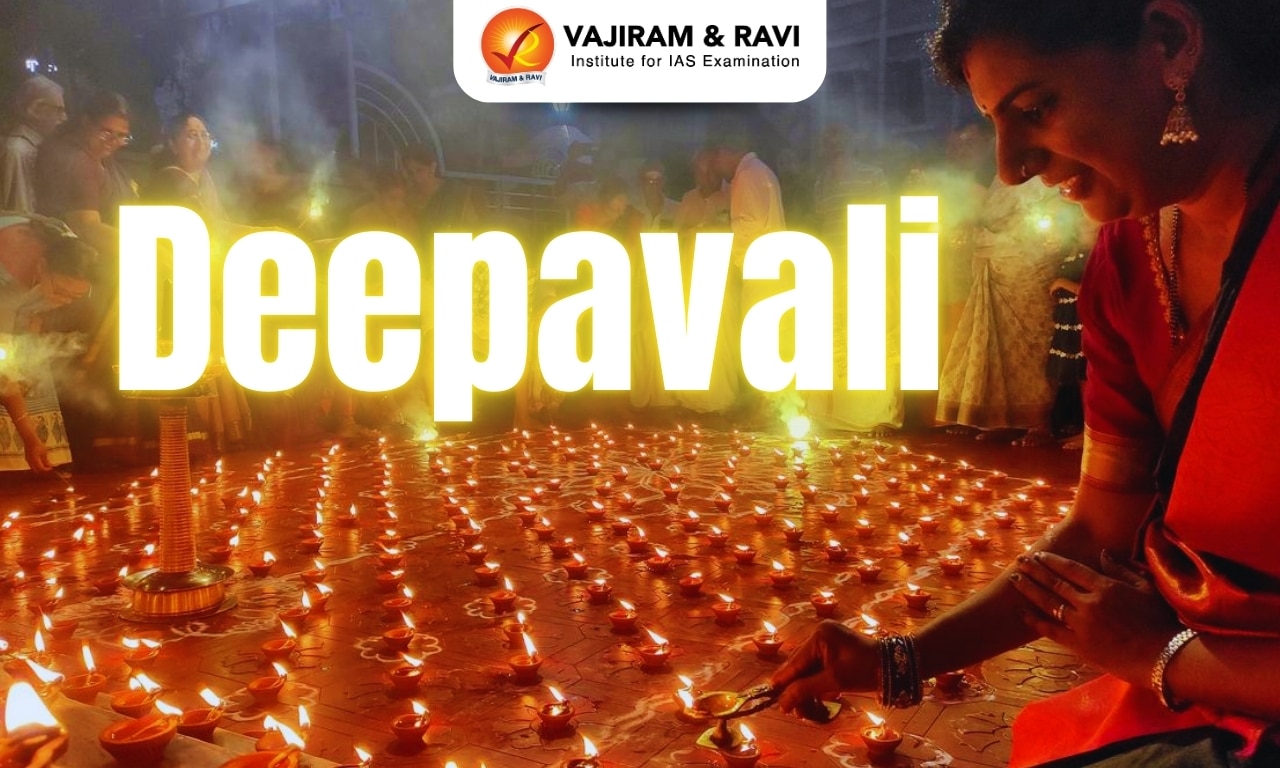
  • Deepavali, also known as Diwali, is the festival of lights celebrated across India.
  • ‘Deepa’ means lamp or light and‘Vali’ means string or row, and Deepavali means rows of lights.
  • It is celebrated on Kartik Amaavasya, which typically falls in October or November.
  • The fundamental philosophy of Deepavali encompasses the celebration of prosperity, renewal, and abundance for all individuals.
  • It is added as the 16th Indian element on UNESCO’s List of the Intangible Cultural Heritage of Humanity.

Celebration of Deepavali

  • It begins with Dhanteras, a day of auspicious beginnings when families buy new metalware or essentials that symbolise prosperity.
  • The second day marks Naraka Chaturdashi, observed with rituals and lighting lamps to dispel negativity and welcome positive energy.
  • The third day is the highlight of Deepavali- the sacred Lakshmi-Ganesha Puja.
  • On the fourth day, families and friends visit one another, exchange gifts, and reconnect, strengthening their bonds and shared happiness.
  • The celebrations conclude with Bhai Dooj, a heartfelt tribute to the bond between brothers and sisters, observed with prayers, blessings, and meaningful rituals.

Source:  PIB

Deepavali FAQs

Q1: On which day is Deepavali typically celebrated?

Ans: Kartik Amaavasya

Q2: What is the significance of Deepavali?

Ans: Celebration of prosperity, renewal, and abundance

Deepavali in UNESCO Intangible Heritage List: Significance, Criteria & India’s Living Traditions

Deepavali

Deepavali Latest News

  • Deepavali, the Festival of Lights, has been inscribed on UNESCO’s List of the Intangible Cultural Heritage of Humanity during the 20th Intergovernmental Committee session held at New Delhi’s Red Fort. 
  • It is now the 16th Indian cultural element on the prestigious list. 
  • The inscription recognises Deepavali as a living tradition continuously recreated by communities, fostering social cohesion and contributing to cultural continuity and development.

Understanding UNESCO’s Intangible Cultural Heritage List

  • UNESCO’s Intangible Cultural Heritage List recognises living traditions and skills — unlike monuments or archaeological sites. 
  • It includes oral traditions, performing arts, festivals, social practices, traditional craftsmanship, and knowledge of nature. 
  • These practices, such as India’s Garba and Kumbh Mela or France’s baguette-making, are passed across generations, strengthen cultural identity, and preserve humanity’s shared heritage.

How a Tradition Gets Inscribed on UNESCO’s Intangible Heritage List

  • For a cultural practice to be inscribed, UNESCO requires it to be inclusive, representative, and rooted in the community. 
  • The aim is to recognise living traditions that embody shared identity and social habits — such as France’s baguette-making, which UNESCO says reflects everyday rituals and conviviality.
  • To include an element on UNESCO’s Representative List of ICH, states must submit a nomination dossier for evaluation. Each country can nominate one element every two years. 
    • India nominated the ‘Deepavali’ Festival for the 2024–25 cycle.
  • As globalisation and conflict threaten cultural diversity, UNESCO emphasises preserving these social histories. 
  • The list also highlights traditions at risk: in 2022, four elements were marked for urgent safeguarding, including Vietnam’s Chăm pottery-making, Chile’s Santa Cruz de Cuca pottery, Albania’s Xhubleta garment craft, and Türkiye’s traditional Ahlat stonework.

India’s Cultural Heritages Recognised by UNESCO

  • Apart from Deepavali added in 2025, India has several cultural traditions inscribed on UNESCO’s Intangible Cultural Heritage list. 
  • These include:
    • Festivals & Rituals: Durga Puja in Kolkata (2021), Kumbh Mela (2017), Nowruz (2016), Ramman festival of Garhwal (2009).
    • Performing Arts & Theatre: Sankirtana of Manipur (2013); Chhau dance, Kalbelia dance of Rajasthan, Mudiyettu of Kerala (2010); Kutiyattam Sanskrit theatre and Ramlila (2008).
    • Oral & Spiritual Traditions: Buddhist chanting of Ladakh (2012); Vedic chanting (2008).
    • Traditional Craftsmanship: Brass and copper utensil-making of the Thatheras of Jandiala Guru, Punjab (2014).
  • These entries reflect the diversity and richness of India’s living heritage.

Deepavali in UNESCO Intangible Heritage List

  • Deepavali, India’s iconic festival of lights, has been inscribed on UNESCO’s Representative List of the Intangible Cultural Heritage of Humanity, alongside 19 other global traditions in 2025. 
  • This came a year after West Bengal’s Durga Puja made it to the prestigious list. The decision was taken during a key meeting of UNESCO being hosted at the Red Fort. 

What UNESCO Recognition Means for Deepavali

  • Deepavali’s inscription enhances the festival’s global stature, strengthens efforts to preserve its traditions, and supports India’s cultural diplomacy, including among the diaspora. 
  • The Intergovernmental Committee guiding the 2003 Convention promotes safeguarding measures, best practices, and funding support. 
  • The recognition also boosts tourism, fosters cultural exchange, and helps sustain the artisans and communities who keep Deepavali’s living traditions vibrant.

UNESCO Intangible Cultural Heritage List 2025: Key Additions

  • The 2025 Representative List features a diverse set of cultural traditions from across the world. 
  • Highlights include:
    • Performing Arts & Music: Amateur theatre of Czechia; Cuarteto music of Argentina; Cuban Son; Joropo of Venezuela; Mvet Oyeng musical art of Central Africa.
    • Festivals & Rituals: Deepavali (India); Gifaataa New Year festival (Ethiopia); Festivity of the Virgen of Guadalupe (Bolivia); Christmas Bram and Sambai (Belize).
    • Crafts & Traditional Skills: Brussels’ rod marionettes; Behzad’s miniature art (Afghanistan); Bisht weaving and practices across West Asia; Tangail saree weaving (Bangladesh); zaffa wedding tradition in parts of the Arab world.
    • Culinary Heritage: Commandaria wine (Cyprus); Koshary dish traditions (Egypt).
    • Community Practices: Guruna pastoral retreats (Chad–Cameroon); family circus tradition (Chile); Confraternity of flowers and palms (El Salvador); bagpipe craftsmanship in Bulgaria.

Source: IE | IE | PIB

Deepavali FAQs

Q1: What is UNESCO’s Intangible Cultural Heritage List?

Ans: It is a global list recognising living traditions—festivals, performing arts, oral traditions and craftsmanship—passed across generations to preserve cultural identity and diversity.

Q2: How does a cultural tradition get inscribed on the UNESCO list?

Ans: A tradition must be community-rooted, inclusive and representative. Countries submit detailed nominations showing cultural value, continuity, and safeguarding measures.

Q3: Why was Deepavali chosen for the UNESCO Representative List?

Ans: Deepavali represents a vibrant living tradition fostering social cohesion, cultural continuity, communal participation, and global recognition of India’s diverse cultural expressions.

Q4: What benefits does UNESCO listing bring to Deepavali?

Ans: The inscription enhances global visibility, supports safeguarding efforts, encourages tourism, strengthens cultural diplomacy, and helps artisans sustain traditional crafts linked to the festival.

Q5: Which other Indian traditions are recognised on UNESCO’s ICH list?

Ans: India’s entries include Durga Puja, Kumbh Mela, Sankirtana, Vedic chanting, Chhau dance, Garhwal’s Ramman festival, Buddhist chanting of Ladakh, and traditional metal-craft of Thatheras.

Enquire Now
