
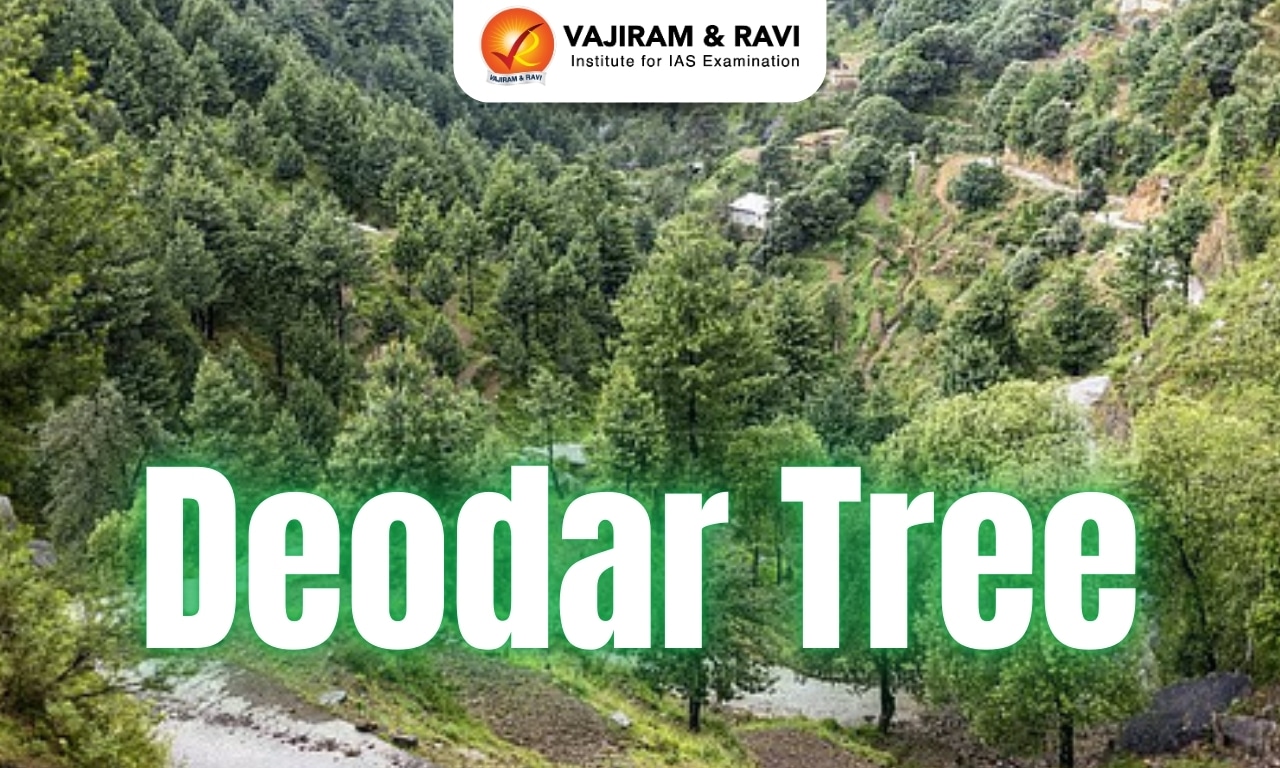
Deodar Tree Latest News
Deodar trees in Himachal Pradesh’s Sangla Valley have revealed the process of climatic shifts from wetter spring conditions that prevailed during pre-historic times to drier conditions from the year 1757 onwards.
About Deodar Tree
- It is also known as the Himalayan Cedar, is one of the most revered and iconic tree species in the Western Himalayas.
- The name Deodar is derived from the Sanskrit word Devadāru, meaning “wood of the gods,” highlighting the tree’s cultural and spiritual importance.
- Distribution: It is mainly found in the western Himalayan region.
- Applications: Traditionally, its wood has been used in temple construction, religious ceremonies, and Ayurvedic medicine.
- Threats: It faced threats from logging, habitat loss, and climate change.
Characteristics of Deodar Tree
- It is native to high-altitude forests, this majestic conifer plays a critical ecological and cultural role.
- Soil and climate: It thrives in well-drained soils and moist temperate climates.
- It is a large evergreen tree found between 1800-3000m altitude. Branches are brown-reddish. Cones are solitary, erect, ovoid, dark brown.
- Male and female cones are on the same tree.
- Growth: It reaches heights of up to 50 meters and is characterized by its tall, pyramidal shape, drooping branches, and needle-like bluish-green leaves.
- Its bark is dark gray and becomes deeply fissured with age, adding to their stately presence in alpine and subalpine forest zones.
Source: PIB
Deodar Tree FAQs
Q1: Where is Deodar Tree mainly found?
Ans: Western Himalayas
Q2: What is the scientific name of Deodar Tree?
Ans: Cedrus deodara

