
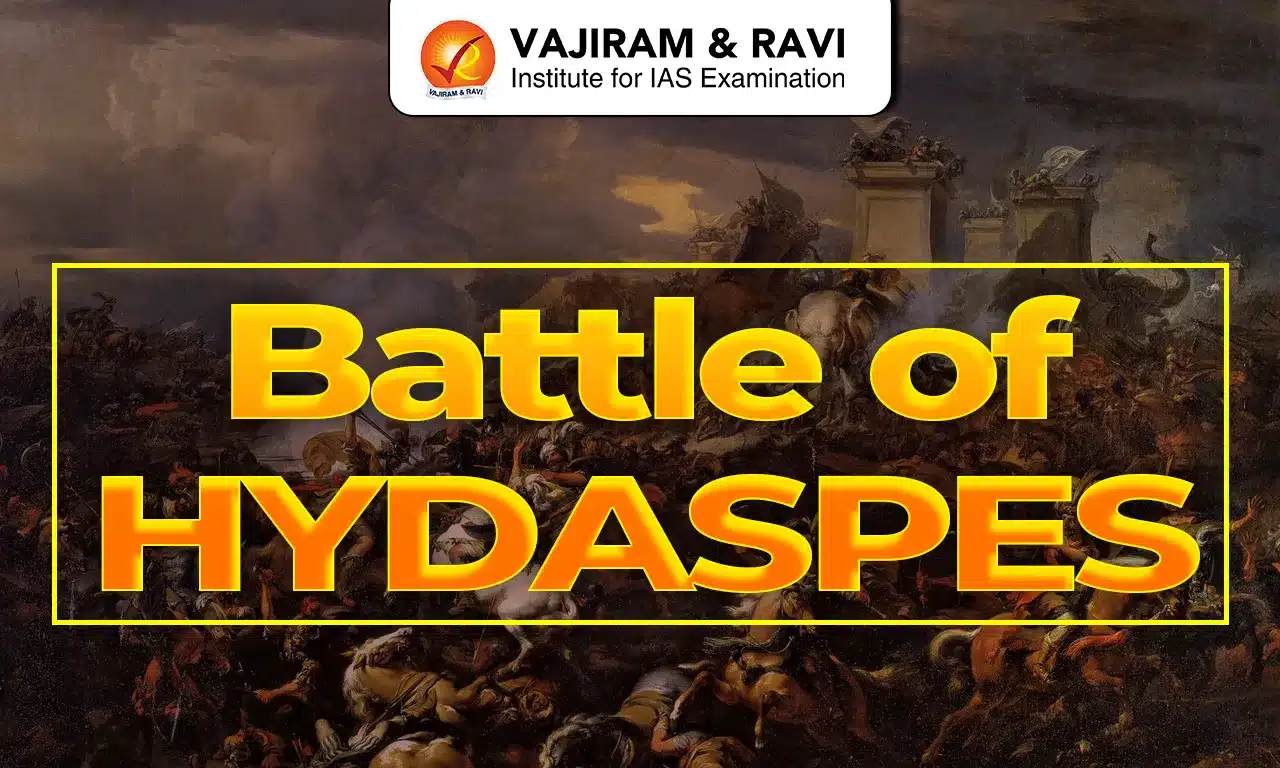
The Battle of Hydaspes, fought in May 326 BCE on the banks of the Hydaspes River (present day Jhelum in Pakistan) was one of the most challenging and significant military engagements of Alexander. It stands out as Alexander’s toughest battlefield victory and the first major encounter between Greek and Indian military systems with Hydaspes marking the easternmost reach of his conquests. The battle is remembered for its complex river-crossing strategy, large-scale use of war elephants, and its long-term political and cultural impact on the Indian subcontinent.
Battle of Hydaspes
The Battle of Hydaspes was fought between the Macedonian Empire under Alexander and the Paurava forces led by King Porus. Despite being outnumbered and facing formidable war elephants, the Macedonian army achieved a decisive victory through superior tactics, discipline and leadership. The battle resulted in the annexation of large parts of Punjab into Alexander’s empire. Unlike many defeated rulers, Porus was spared, reinstated as a Satrap, and allowed to govern his territory under Macedonian overlordship.
Also Read: Battle of Wandiwash
Battle of Hydaspes Causes
The Battle of Hydaspes occurred due to Alexander’s eastward expansion and Porus’ refusal to submit to Macedonian authority.
- Indian campaign objective: Alexander aimed to extend his empire beyond Persia into the Indian subcontinent.
- Strategic location: Porus ruled the region between the Hydaspes and Acesines rivers, blocking Alexander’s advance.
- Refusal to surrender: Porus rejected Alexander’s demand for submission, choosing armed resistance.
- Alliance politics: Alexander allied with Taxiles of Taxila against his rival Porus.
- Imperial credibility: Leaving Porus undefeated would have threatened Alexander’s control over subdued Indian rulers.
Battle of Hydaspes Course
The Battle of Hydaspes unfolded through careful planning, deception and a decisive combined-arms assault by Alexander.
- Initial deployment: Porus stationed his army on the south bank of the Hydaspes during the monsoon, using the swollen river as defense.
- Strategic deception: Alexander used repeated feints and night movements to confuse Porus about the crossing point.
- River crossing: Around 27 km upstream, Alexander crossed the river at night using boats and skin floats during a storm.
- First engagement: Porus’ son led cavalry and chariots to block the crossing but was defeated and killed.
- Battle formation: Porus deployed infantry supported by 85-200 war elephants, with cavalry on flanks.
- Cavalry attacks: Macedonian cavalry under Alexander and Coenus broke the Indian cavalry through flanking maneuvers.
- Elephant phase: War elephants inflicted heavy casualties but were neutralized by Macedonian infantry attacks on mahouts.
- Final rout: A hammer-and-anvil tactic by infantry and cavalry shattered Porus’ army.
Also Read: Battle of Plassey
Battle of Hydaspes Outcomes
The victory at the Battle of Hydaspes strengthened Alexander’s control in northwest India but marked the limits of his eastward expansion.
- Territorial gains: Macedon annexed territories from the Hydaspes to the Hyphasis (Beas) River.
- Capture of Porus: King Porus was captured but treated with honor and reinstated as ruler.
- Status of Porus: Porus was restored as king and appointed Macedonian satrap.
- Foundation of cities: Alexander founded Nikaia to commemorate victory and Bucephala in memory of his horse Bucephalus.
- Military exhaustion: Macedonian casualties were higher than previous battles, weakening troop morale.
- Advance halted: At the Hyphasis River, troops refused to march further east, forcing Alexander to turn back.
- Indirect rule model: Alexander adopted governance through local rulers instead of direct annexation.
- Strategic impact: This arrangement stabilized Macedonian control in Punjab without prolonged resistance.
- Alexander’s Death: Although Alexander died in Babylon (in present-day Iraq) in June 323 during his return journey from India to Greece.
Why was Porus Defeated at the Battle of Hydaspes?
The result of the defeat of Porus in the Battle of Hydaspes was due to tactical disadvantages and following reasons:
- Superior Macedonian tactics: Alexander’s flanking cavalry maneuvers outmatched Porus’ static formation.
- River-crossing mastery: Successful monsoon crossing nullified Porus’ defensive advantage.
- Elephant limitations: War elephants caused disorder within Porus’ own ranks when wounded.
- Inferior equipment: Indian infantry lacked armor and long spears like the Macedonian sarissa.
- Chariot failure: Muddy terrain rendered Indian chariots ineffective.
Command coordination: Macedonian units operated with higher discipline and battlefield coordination.
Battle of Hydaspes FAQs
Q1: When and where was the Battle of Hydaspes fought?
Ans: The Battle of Hydaspes was fought in May 326 BCE on the banks of the Hydaspes River, modern Jhelum, in present-day Pakistan.
Q2: Who fought the Battle of Hydaspes?
Ans: The battle was fought between Alexander the Great of the Macedonian Empire and King Porus of the Paurava kingdom.
Q3: Why is the Battle of Hydaspes historically important?
Ans: It marked Alexander’s most difficult victory and led to Greek political and cultural influence reaching the Indian subcontinent.
Q4: What role did war elephants play in the Battle of Hydaspes?
Ans: Porus used 85-200 war elephants, which caused heavy Macedonian casualties but were eventually neutralized by disciplined infantry tactics.
Q5: What happened to King Porus after the Battle of Hydaspes?
Ans: Porus was captured but reinstated as ruler and appointed a satrap by Alexander, retaining control over his kingdom.

