
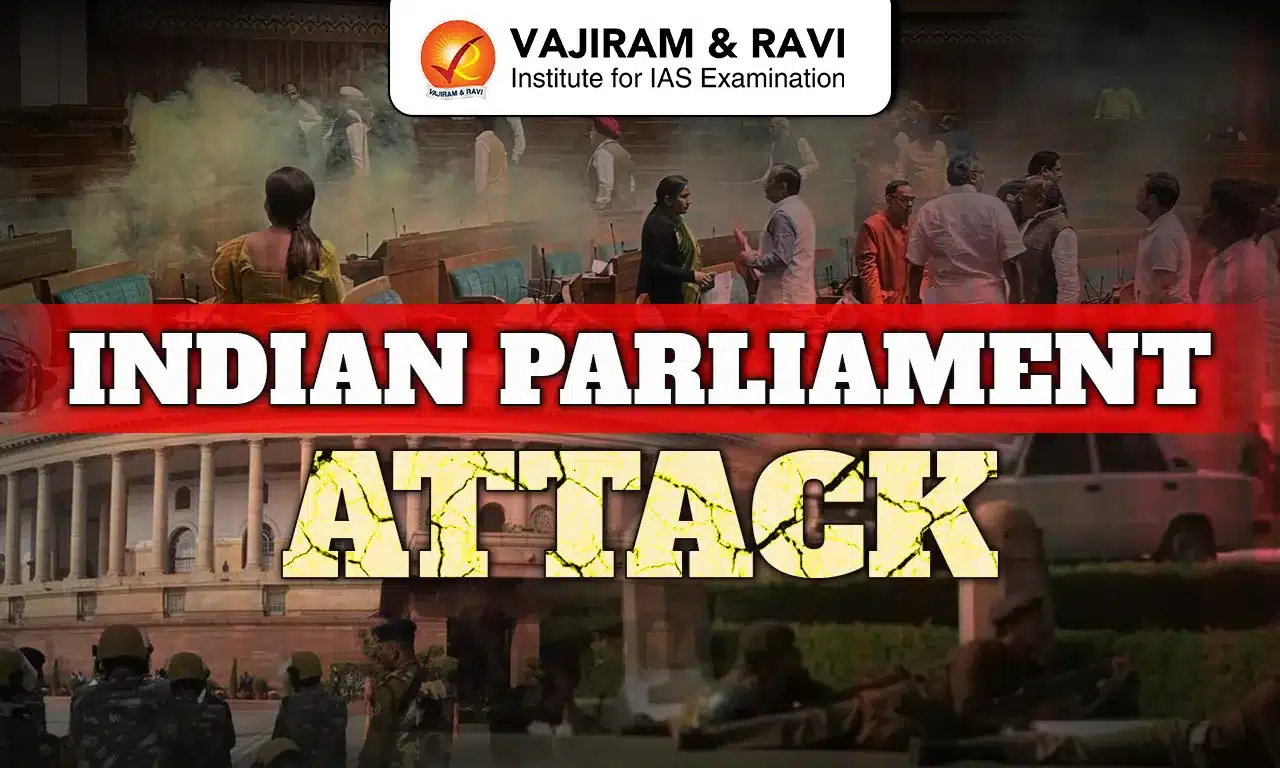
The Indian Parliament Attack of 13 December 2001 was a major terrorist strike on India’s democratic core, exposing grave internal security threats. Five heavily armed terrorists breached the Parliament complex in New Delhi using forged government markings. Although Parliament had adjourned with over 100 officials present. The assault killed 14 people, including security personnel and terrorists, and injured 18, triggering a decisive security, legal, and diplomatic response with long-term national implications.
Indian Parliament Attack 2001
The Indian Parliament Attack occurred amid heightened militancy, regional instability, and cross-border terrorism, marking a turning point in India’s counter-terror framework.
- Date and location: 13 December 2001, Parliament House, New Delhi
- Attack type: Mass shooting using AK-47s, grenades, and explosive vests
- Perpetrators: Five Jaish-e-Mohammed terrorists, all neutralized on site
- Casualties: 14 killed including 9 security staff; 18 injured
- Security breach enabled by forged Home Ministry and Parliament vehicle labels
- Immediate linkage drawn with earlier October 2001 Srinagar Assembly attack
Indian Parliament Attack Revealing Challenges in Security
The Indian Parliament Attack highlighted systemic gaps in access control, intelligence coordination, and high-value institutional protection mechanisms.
- Vehicle-based deception bypassed layered security checks
- Inadequate real-time intelligence sharing on imminent threats
- Absence of advanced biometric and RFID-based access systems
- Limited perimeter hardening against armed vehicle intrusion
- High dependence on manual verification at sensitive installations
- Delayed institutionalization of centralized counter-terror response
Indian Parliament Attack Government Initiatives
The Indian Parliament Attack prompted immediate military, diplomatic, legal, and institutional reforms to deter terrorism and strengthen national security architecture.
- Operation Parakram: Largest troop mobilization since 1971, lasting nearly 10 months
- POTA 2002: To counter terrorism, the government passed the act- Prevention of Terrorism Act (POTA) 2002, later repealed.
- Diplomatic action: India recalled its envoy and demanded action against JeM and LeT
- International outreach: Engagement with US, Russia, UK for counter-terror pressure
- Judicial process: Special court trials concluded within six months; convictions secured
- Key neutralization: JeM chief Ghazi Baba eliminated in 2003 in Srinagar
- Parliament complex fortified with CCTV grids, biometric access, RFID vehicle tagging
- Installation of hydraulic bollards, tyre deflators, and electric fencing
- Creation of Parliament Duty Group under CRPF with NSG support and specialized SWAT units for rapid counter-terror response.
- Expansion of Multi-Agency Centre for real-time intelligence coordination
- Establishment of National Investigation Agency in 2009 for federal terror probes
- Development of NATGRID to integrate security databases across agencies
Indian Parliament Attack FAQs
Q1: When did the Indian Parliament attack take place?
Ans: The Indian Parliament attack occurred on 13 December 2001 in New Delhi.
Q2: Who carried out the Indian Parliament attack?
Ans: The attack was carried out by five terrorists belonging to Jaish-e-Mohammed.
Q3: What was the main target of the attack?
Ans: The main target was the Parliament of India, the supreme legislative institution.
Q4: How many people were killed in the Indian Parliament attack?
Ans: Fourteen people were killed, including security personnel and the terrorists.
Q5: What was the major outcome of the attack?
Ans: The attack led to major security reforms and heightened India-Pakistan tensions.

