
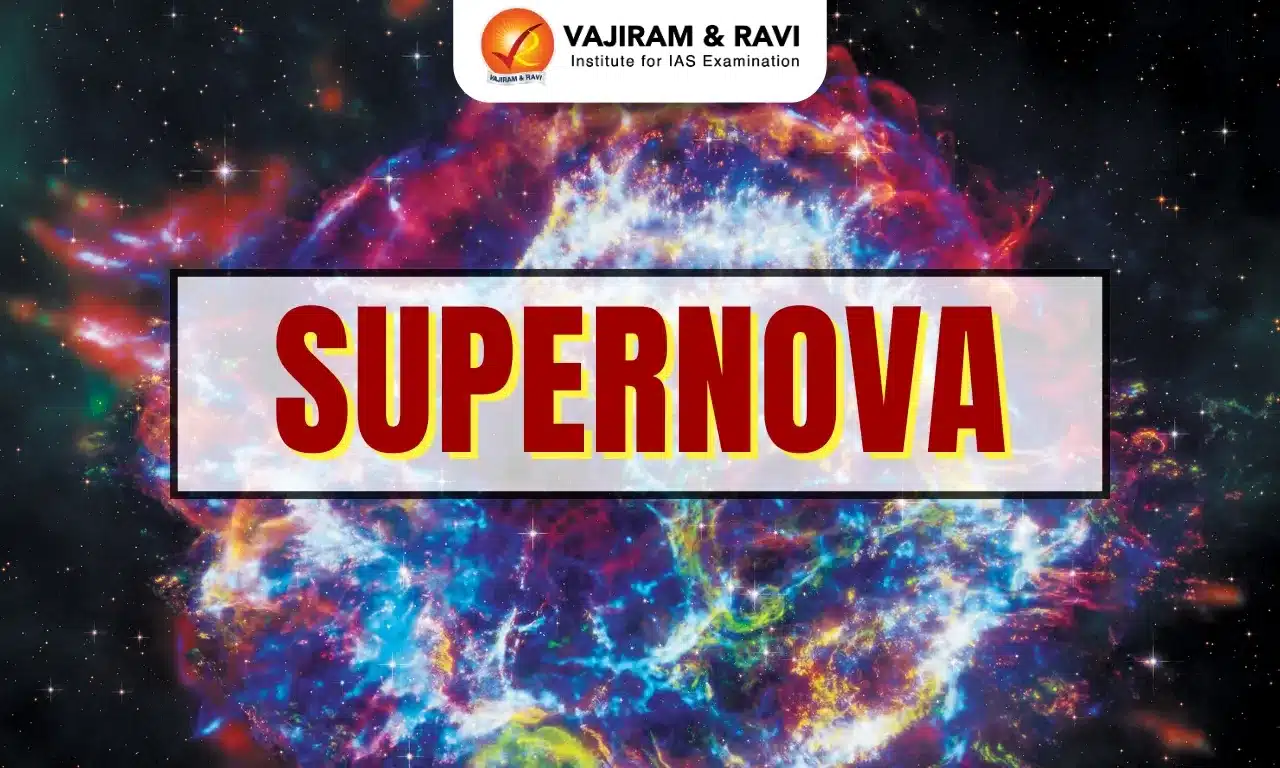
Supernova Latest News
A distant gamma-ray burst has led astronomers to a rare supernova from the Universe’s early years, revealed recently by the James Webb Space Telescope (JWST).
About Supernova
- A supernova is the name given to the cataclysmic explosion of a massive star.
- They are the largest explosions that take place in space.
- A star can go supernova in one of two ways:
- Type I Supernova: A star accumulates matter from a nearby neighbor until a runaway nuclear reaction ignites.
- Type II Supernova: A star runs out of nuclear fuel and collapses under its own gravity.
- It can emit more energy in a few seconds than our sun will radiate in its lifetime of billions of years.
- These spectacular events can be so bright that they outshine their entire galaxies for a few days or even months.
- They can be seen across the universe.
- They’re also the primary source of heavy elements in the universe.
- How Common are Supernovas?
- Astronomers believe that about two or three supernovas occur each century in galaxies like our own Milky Way.
- Because the universe contains so many galaxies, astronomers observe a few hundred supernovas per year outside our galaxy.
Source: MC
Supernova FAQs
Q1: What is a supernova?
Ans: A supernova is the name given to the cataclysmic explosion of a massive star.
Q2: Why are supernovae considered the largest explosions in space?
Ans: Because they release enormous amounts of energy and matter in a very short time.
Q3: How can a star go supernova?
Ans: Either by accumulating matter from a companion star (Type I) or by collapsing after exhausting nuclear fuel (Type II).
Q4: How much energy can a supernova emit compared to the Sun?
Ans: More energy in a few seconds than the Sun will emit over its entire lifetime.

