
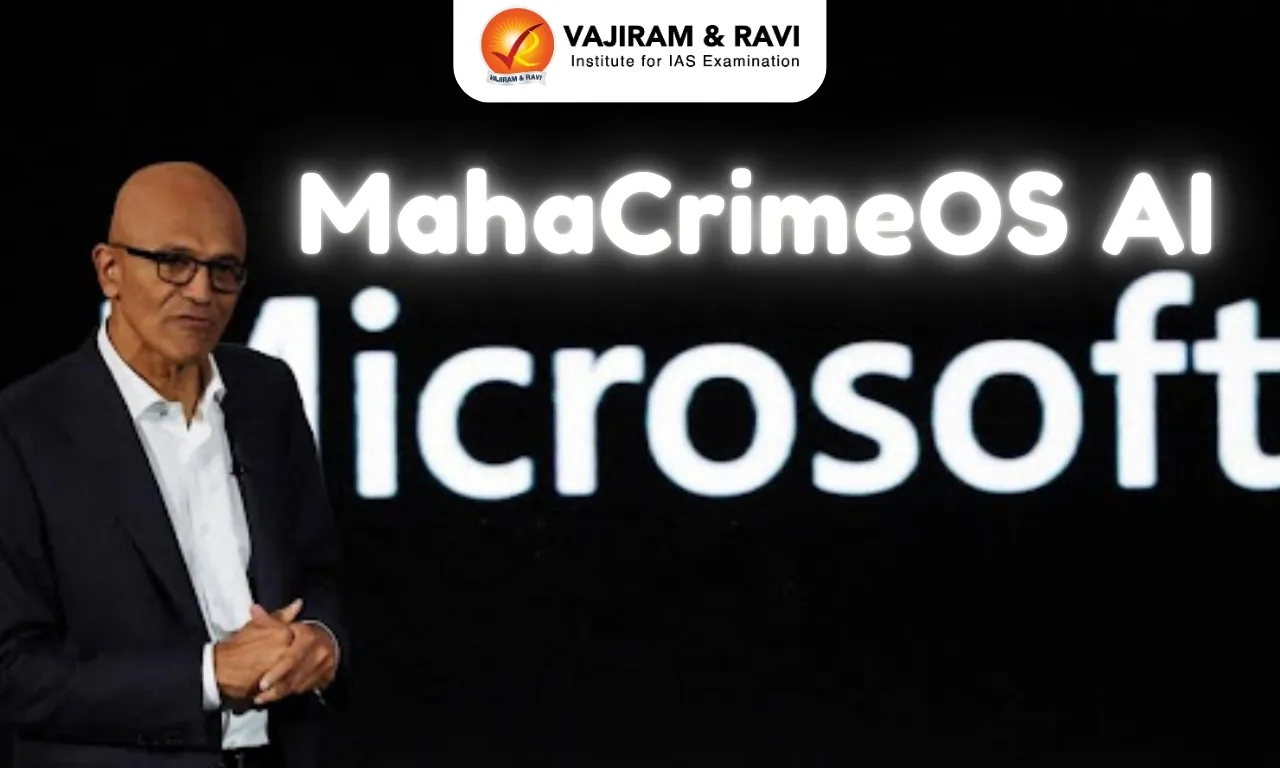
MahaCrimeOS AI: How Maharashtra Police Is Using AI to Fight Cybercrime

MahaCrimeOS AI

MahaCrimeOS AI Latest News

  • Microsoft CEO Satya Nadella announced the statewide rollout of MahaCrimeOS AI, an advanced AI-driven investigation platform for the Maharashtra Police. 
  • Developed in partnership with the Maharashtra Government and its AI policing initiative MARVEL, the platform will equip all 1,100 police stations with next-generation cybercrime tools. 
  • The initiative marks a shift beyond traditional policing, reflecting how law enforcement and the judiciary are embracing AI as a transformative force to enhance investigation, vigilance, and justice delivery.

MahaCrimeOS AI: Transforming Crime Investigation in Maharashtra

  • MahaCrimeOS AI is an AI-powered crime investigation platform developed using Microsoft Foundry. 
  • First deployed in Nagpur Rural in April 2025, it helps police process complaints faster, analyse complex data, and streamline investigative procedures—especially in cybercrime cases. 
  • Recognising its effectiveness, the Maharashtra government and Microsoft announced recently that the platform will be rolled out across all 1,100 police stations in the state.

MARVEL: Maharashtra’s AI Vision for Policing

  • MARVEL (Maharashtra Research and Vigilance for Enhanced Law Enforcement) is a government-owned AI initiative created to integrate advanced technologies into policing. 
  • Established in 2024 as a special-purpose vehicle (SPV), MARVEL aims to modernise investigations, strengthen police intelligence, and improve crime prediction. 
  • Maharashtra is the first Indian state to set up an independent AI body dedicated to law enforcement.

From CrimeOS to MahaCrimeOS AI

  • Working with Microsoft, MARVEL adapted CrimeOS AI—developed by CyberEye, a Microsoft AI partner—into MahaCrimeOS AI, fine-tuned to comply with Maharashtra’s investigation protocols. 
  • The system was also configured in Marathi to ensure easy adoption across the police force. 
  • An MoU between the Maharashtra government and Microsoft includes setting up three AI Centres of Excellence.

Advanced Capabilities of MahaCrimeOS AI

  • MahaCrimeOS AI can ingest complaints in multiple formats, including PDFs, audio files, handwritten notes, and images. 
  • Using multimodal intelligence, it extracts key information in any language, automates analysis, adapts investigation pathways, and rapidly profiles persons of interest, significantly enhancing investigative efficiency.

Transforming Governance Through AI

  • MARVEL’s goal is to collaborate with global technology leaders to build AI copilots that fundamentally transform governance. 
  • The initiative positions Maharashtra as a national leader in AI-driven, future-ready policing.

Benefits of MahaCrimeOS AI

  • MahaCrimeOS AI automates routine administrative tasks, allowing investigating officers to focus more on solving crimes and assisting victims. 
  • Officers access a dashboard showing active cases, updates, and pending actions, improving case management and efficiency.
  • In one case involving a ₹38 lakh bank fraud, the system helped analyse telecom data and open-source intelligence to trace and arrest accused across multiple states.

AI-Generated Investigation Plans

  • A key feature of MahaCrimeOS AI is its ability to read FIRs in Marathi and automatically generate detailed investigation plans. 
  • These are based on Maharashtra Police protocols and guidelines issued by the High Court and Supreme Court for different crime categories.

Investigation Copilot for Faster Decision-Making

  • Developed with CyberEye and Microsoft, the AI-powered investigation copilot analyses case details, creates automated workflows, and suggests investigation pathways. 
  • This reduces delays that earlier arose when officers waited for senior approvals in complex cases.

Advanced Data Analysis and Court Readiness

  • The platform analyses telecom data to identify interlinkages, gathers open-source intelligence by tracing phone numbers across digital platforms, and prepares time-stamped, date-wise case diaries for court submissions, embedding judicial best practices into investigations.

Improved Experience for Complainants

  • By speeding up investigations and reducing bottlenecks, MahaCrimeOS AI delivers quicker, more consistent outcomes for complainants. 
  • Faster response times and smoother case handling enhance public trust and improve overall access to justice.

Key Features of MahaCrimeOS AI

  • MahaCrimeOS AI has been designed primarily in Marathi, ensuring that even constables can use it with ease. 
  • Tasks such as drafting letters to banks and telecom companies, which earlier took 30–45 minutes, are now completed in seconds. 
  • The system can also directly email these documents, significantly cutting investigation time and administrative delays.
  • The platform democratises advanced investigative capabilities. 
    • Previously limited to specialised cybercrime officers, open-source intelligence and data analysis can now be performed by all 3,000 officers in Nagpur Rural, eliminating dependence on a small expert pool.

Handling Complex Crime Categories

  • The system currently supports investigations in four complex crime areas: narcotics, cybercrime, crimes against women, and financial fraud
  • Additional AI models are being developed to extend its application to other types of crimes.

Tailored, Protocol-Based Investigations

  • A key strength of MahaCrimeOS AI is its ability to incorporate best-practice protocols, apply crime-specific knowledge, and generate customised investigation plans, enabling more precise and efficient law enforcement outcomes.

Supporting Faster Investigations Under New Criminal Laws

  • With the Bharatiya Nyaya Sanhita mandating charge sheets within 60–90 days, police officers handling multiple cases face tight deadlines. 
  • MahaCrimeOS AI enables faster, structured investigations, helping officers meet legal timelines and adapt effectively to the new criminal law framework.

Source: IE | TH

MahaCrimeOS AI FAQs

Q1: What is MahaCrimeOS AI and why is it significant?

Ans: MahaCrimeOS AI is an AI-powered investigation platform that helps Maharashtra Police analyse data, automate workflows, and investigate complex crimes, especially cybercrime, more efficiently.

Q2: Who developed MahaCrimeOS AI?

Ans: It was jointly developed by the Maharashtra Government, Microsoft, and MARVEL, with CyberEye as a Microsoft AI partner, using Microsoft Foundry and Azure OpenAI services.

Q3: How does MahaCrimeOS AI assist investigators?

Ans: It automates routine tasks, generates investigation plans from FIRs, analyses telecom and open-source data, and prepares court-ready case diaries aligned with judicial guidelines.

Q4: Which crime categories does MahaCrimeOS AI currently support?

Ans: The platform currently supports cybercrime, financial fraud, narcotics cases, and crimes against women, with plans to expand to other crime categories.

Q5: How does MahaCrimeOS AI align with new criminal laws?

Ans: By enabling faster, structured investigations, it helps police meet Bharatiya Nyaya Sanhita deadlines of filing charge sheets within 60–90 days.

New Insurance Bill 2025 Explained: 100% FDI, IRDAI Powers and Key Omissions

New Insurance Bill 2025

New Insurance Bill 2025 Latest News

  • The Union Cabinet has approved the Sabka Bima Sabki Raksha (Amendment of Insurance Laws) Bill, 2025, paving the way for its introduction in Parliament during the Winter Session.
  • The Bill proposes major reforms to India’s insurance framework by amending the Insurance Act, 1938, LIC Act, 1956, and IRDAI Act, 1999, aiming at modernisation, expanded insurance coverage, and stronger regulatory oversight. 
  • Key positives include the long-awaited provision for 100% FDI in insurance
  • However, several industry demands—such as the introduction of a composite licence—have been excluded or diluted, leading to mixed reactions from stakeholders. 
  • Overall, the Bill seeks to balance industry growth, consumer protection, and broader financial sector reforms, and is expected to generate significant parliamentary debate.

Key Provisions of the New Insurance Bill

  • The Union Cabinet has approved a major change in India’s insurance rules by allowing full foreign ownership in insurance companies. 
  • The decision aims to bring more capital, improve competition, and strengthen customer services across the sector.
  • The Bill advances liberalisation, regulatory capacity, and ease of doing business in insurance, while strengthening policyholder protection.

100% Foreign Direct Investment (FDI) in Insurance

  • Raises FDI cap from 74% to 100% in Indian insurance companies.
  • Aims to attract long-term foreign capital, enhance insurance penetration, promote technology transfer, and support the goal of ‘Insurance for All by 2047’.
  • Expected impacts: greater competition, product innovation, customer-centric services, and adoption of global best practices in underwriting, risk management, and digital claims.

Easing Entry for Foreign Reinsurers

  • Reduces Net Owned Funds (NOF) requirement for foreign reinsurers from ₹5,000 crore to ₹1,000 crore.
  • Addresses a long-standing demand to widen participation beyond the public sector GIC Re.
  • Expected to boost reinsurance capacity, competition, and risk diversification in India.

Enhanced Powers for IRDAI 

  • Grants IRDAI disgorgement powers to recover wrongful gains—bringing it closer to SEBI’s enforcement toolkit.
  • Introduces a one-time registration for insurance intermediaries to simplify compliance.
  • Raises the threshold for IRDAI approval of equity transfers from 1% to 5%, easing business operations.
  • Mandates a formal SOP for regulation-making and clear penalty criteria to improve transparency, predictability, and consistency.

Greater Operational Autonomy for LIC

  • Allows LIC to set up new zonal offices without prior government approval, enabling faster expansion and administrative efficiency.
  • Permits restructuring of overseas operations in line with host-country laws, strengthening LIC’s global footprint.
  • Overall goal: modernise LIC’s governance and enhance competitiveness domestically and internationally.

What the Insurance Amendment Bill Leaves Out

  • No Composite Licence: A Major Miss
    • The Bill is expected to exclude composite licences, a long-pending industry demand.
    • Currently, insurers are confined to strict silos: life insurers cannot sell non-life products and vice versa.
    • A composite licence would have allowed a single insurer to offer life, health, and general insurance under one roof.
    • Its absence preserves long-standing structural rigidities, limits bundled offerings, and curbs competition, despite global best practices favouring integrated models.
  • No Reduction in Capital Norms for New Entrants
    • The Bill is unlikely to lower minimum capital requirements (₹100 crore for insurers, ₹200 crore for reinsurers).
    • High entry barriers continue to deter small, niche, regional, and specialised insurers.
    • Lower capital norms could have boosted insurance penetration, especially in rural areas, among gig workers, MSMEs, and low-income households.
    • The omission is seen as a setback for financial inclusion and innovation.
  • Dropped Proposals from Earlier Drafts
    • Several reforms discussed in earlier versions appear missing:
      • Permission for insurers to distribute other financial products (mutual funds, loans, credit cards).
      • Greater flexibility in investment norms to improve policyholder returns.
      • Allowing individual agents to sell policies of multiple insurers, beyond the current one-life–one-general restriction.
  • No Provision for Captive Insurance Companies
    • The Bill is silent on allowing large corporations to set up captive insurers.
    • A captive insurance company is a wholly-owned subsidiary created by a parent company to insure its own risks.
    • Captives are widely used globally to manage complex risks, reduce insurance costs, and improve underwriting control.
    • Their exclusion delays modernisation of India’s corporate risk-management ecosystem.

Conclusion

  • While the Bill delivers key reforms like 100% FDI and stronger regulation, it stops short of deeper structural changes. 
  • The absence of composite licences, lower capital norms, and captives represents missed opportunities to accelerate competition, inclusion, and innovation in India’s insurance sector.

Source: IE | IT

New Insurance Bill 2025 FAQs

Q1: What is the Sabka Bima Sabki Raksha Bill, 2025?

Ans: It is an amendment bill reforming insurance laws to modernise the sector, expand coverage, strengthen regulation, and align with the goal of Insurance for All by 2047.

Q2: What is the biggest reform introduced in the Bill?

Ans: The Bill raises the FDI limit in insurance companies from 74% to 100%, enabling full foreign ownership and attracting long-term global capital and technology.

Q3: How does the Bill strengthen IRDAI?

Ans: It grants IRDAI disgorgement powers, simplifies intermediary registration, raises equity transfer thresholds, and mandates transparent rule-making and penalty frameworks.

Q4: What operational changes does the Bill make for LIC?

Ans: LIC can open zonal offices without government approval and restructure overseas operations, improving administrative efficiency and strengthening its global presence.

Q5: What are the major omissions in the Bill?

Ans: The Bill excludes composite licences, reduced capital norms for new insurers, captive insurance companies, and multi-insurer agency permissions, limiting deeper structural reform.

Higher Education Overhaul – Viksit Bharat Shiksha Adhishthan Bill 2025

Higher Education

Higher Education Latest News

  • The Union Government has proposed the Viksit Bharat Shiksha Adhishthan Bill, 2025, aimed at overhauling India’s higher education regulatory system by replacing the UGC, AICTE, and NCTE with a new umbrella commission. 
  • This Bill was listed in the Winter Session of Parliament. 

Reform of India’s Higher Education Regulatory Framework

  • India’s higher education sector has long operated with multiple regulatory bodies, often resulting in overlapping mandates, fragmented standards, and inconsistent approval mechanisms. 
  • To address these structural challenges and align with the National Education Policy (NEP) 2020 vision, the government has introduced the Viksit Bharat Shiksha Adhishthan (VBSA) Bill, 2025.
  • The Bill aims to improve academic quality, streamline regulation, and modernise governance in universities and higher educational institutions across India. 
  • It marks one of the most significant policy interventions in the higher education domain in recent years.

Core Objectives of the VBSA Bill

  • The Bill states that its primary purpose is to enable and empower universities to achieve excellence in teaching, learning, research, and innovation. This is to be achieved through:
    • Better coordination between regulatory bodies
    • Clear determination of academic and institutional standards
    • A unified governance mechanism for higher education
  • The Statement of Objects and Reasons emphasises the NEP 2020 principle of a “light but tight” regulatory structure, ensuring reduced bureaucratic complexity while maintaining strong accountability. 

Structure of the VBSA Commission

  • At the centre of the proposed reforms is the Viksit Bharat Shiksha Adhishthan (VBSA), a 12-member umbrella commission that functions as the apex authority. 
  • It will oversee three specialised councils:
  • Viksit Bharat Viniyaman Parishad (Regulatory Council)
    • Responsible for maintaining regulatory standards
    • Coordinates governance norms in universities and colleges
  • Viksit Bharat Gunvatta Parishad (Accreditation Council)
    • Supervises accreditation processes
    • Builds an independent ecosystem for institutional and program accreditation
  • Viksit Bharat Manak Parishad (Standards Council)
    • Establishes academic standards
    • Ensures harmonisation of policies and quality benchmarks
  • Each council can have up to 14 members. The VBSA will include members from the Education Ministry, State higher education institutions, and eminent experts. 

Institutions Covered Under the Bill

  • The proposed law applies to:
    • All Central and State universities
    • Colleges and Higher Educational Institutions (HEIs)
    • Institutions of national importance
    • Institutions of eminence
    • Technical and teacher education institutions
  • However, professional programmes such as Medicine, Dentistry, Nursing, Law, Pharmacology, and Veterinary Sciences are exempted and will continue under their respective regulators. 
  • The Council of Architecture will remain the professional standards-setting body for architecture but will not have regulatory powers. 

Key Changes Proposed Under the Bill

  • Replacing Existing Bodies
    • The VBSA Bill seeks to subsume the UGC, AICTE, and NCTE, integrating their regulatory, accreditation, and standardisation functions under one framework.
  • Separation of Funding from Regulation
    • A major shift is the removal of grant-disbursal powers from the UGC. Funding functions will now be performed through mechanisms devised by the Ministry of Education.
    • This separation aligns with NEP-2020’s recommendation to delink academic regulation from financial control. 
  • Enabling Foreign Universities and Global Outreach
    • The Regulatory Council will:
      • Set standards for foreign universities to operate in India
      • Facilitate high-performing Indian universities to set up offshore campuses
      • Prevent the commercialisation of higher education
  • Strengthening Accreditation
    • The Accreditation Council must develop an outcome-based framework, encouraging institutions to improve learning outputs rather than merely compliance inputs.

Criticism and Concerns

  • Earlier attempts to reform the higher education framework, such as the 2018 Higher Education Commission of India (HECI) Bill, faced strong criticism for placing excessive central control and weakening the role of States. Similar concerns have resurfaced.
  • Key criticisms include:
    • The possibility of the Centre having disproportionate influence in appointments
    • Removal of grant-disbursal powers from an autonomous body
    • Risk of over-centralisation in standard-setting functions
  • However, unlike the HECI Bill, the VBSA Bill includes State representation in all three councils, partly addressing federal concerns. 

Graded Penalties and Enforcement Mechanisms

  • The VBSA will have significant punitive powers, including:
    • Fines beginning at Rs. 10 lakh and going up to Rs. 75 lakh
    • Possible closure of institutions for repeated non-compliance
    • Power to suspend an institution’s authority to grant degrees or diplomas
    • Institutions operating without accreditation may face fines of Rs. 2 crore or more
  • These provisions aim to improve accountability and discourage substandard educational practices. 

Implications for India’s Higher Education System

  • If implemented, the VBSA Bill could:
    • Streamline regulatory processes
    • Ensure uniform academic standards nationwide
    • Enhance India’s global competitiveness in higher education
    • Promote transparency in accreditation and governance
    • Reduce fragmentation among regulators
  • However, concerns about autonomy, funding clarity, and centralisation will require careful implementation and stakeholder dialogue.

Source: TH | IE

Higher Education FAQs

Q1: What is the VBSA Bill 2025?

Ans: It is a proposed law to overhaul India’s higher education regulation through a unified umbrella commission.

Q2: Which bodies will be replaced under the Bill?

Ans: The UGC, AICTE, and NCTE will be subsumed under the new VBSA framework.

Q3: Who will handle grants under the new system?

Ans: The Ministry of Education will take over grant-disbursal functions from the UGC.

Q4: What are the three major councils under the VBSA?

Ans: Regulatory, Accreditation, and Standards Councils.

Q5: What penalties does the Bill propose?

Ans: Fines up to Rs. 75 lakh or closure for violations, with Rs. 2 crore penalties for operating without accreditation.

Enquire Now