
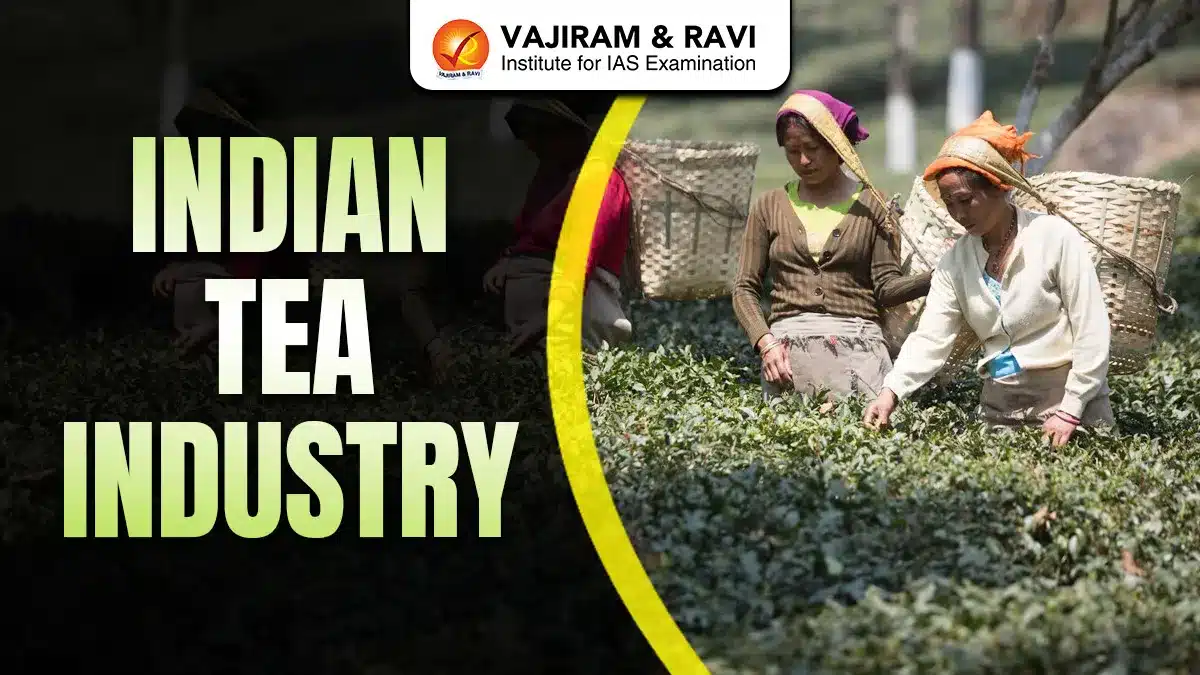
The Indian tea industry is one of the oldest and most important agro-based industries in the country, providing livelihood to millions of people. India is among the world’s largest producers and consumers of tea, with strong domestic demand and a steady export market. Tea cultivation depends heavily on specific climatic conditions such as temperature, rainfall, and soil quality. To support the sector, the government has introduced various policies and schemes to improve productivity, sustainability, and farmer welfare.
Historical Evolution of Tea Cultivation in India
Tea cultivation in India began in the early 19th century during British rule, after Robert Bruce discovered wild tea plants in Assam in 1823. The first Indian tea was exported from Assam to the United Kingdom in 1838, marking the start of India’s tea industry.
- 1823: Discovery of Camellia sinensis in the Upper Brahmaputra Valley, Assam
- Early plantations started in Assam and later in Saharanpur near Kumaon
- 1833: Charter Act ended East India Company’s monopoly with China
- 1834: Tea Committee set up under Governor-General William Bentinck
- 1838: First Indian tea from Assam sent to the UK for public sale
- 1850s: India emerged as one of the world’s leading tea producers
- Post-independence: Growth of Indian tea brands and mass domestic consumption
Major Tea-Producing Regions of India
Tea cultivation in India is region-specific due to its dependence on climate and soil conditions. Nearly 96% of India’s tea production comes from a few key states.
Major tea-producing regions:
- Assam: Assam Valley and Cachar; the largest producer, known for strong and malty tea
- West Bengal: Darjeeling, Dooars, and Terai regions
- Tamil Nadu: Nilgiri hills, famous for fragrant and smooth teas
- Kerala: Produces high-range teas with bright liquor
- Karnataka: Smaller but quality-focused production
Other states such as Tripura, Himachal Pradesh, Uttarakhand, Arunachal Pradesh, Sikkim, and Bihar produce tea on a smaller scale. The Kangra Valley in Himachal Pradesh is especially known for its green teas.
India ranks as the second-largest producer and consumer of tea in the world and is also the third-largest exporter. In comparison, Kenya, the world’s leading tea exporter, exports almost its entire production, while China stands as the second-largest tea exporter globally.
Climatic Conditions Required for Tea Cultivation
Tea is a climate-sensitive crop that thrives in tropical and sub-tropical regions. Any deviation in weather patterns directly affects yield and quality.
Ideal growing conditions for tea:
- Temperature range of 15°C–23°C (optimal growth)
- Warm and humid climate with at least 5 hours of sunlight daily
- Annual rainfall of 150–300 cm, evenly distributed
- Slightly acidic, calcium-free soil with porous sub-soil
- Sloping terrain to ensure proper drainage
Types of Tea Produced in India
India produces a wide variety of teas, catering to both domestic consumption and international markets. Differences in climate, altitude, processing methods, and tea varieties give Indian teas their distinct taste, aroma, and quality.
- Black Tea: The most widely produced and consumed tea in India; forms the largest share of production and exports
- CTC Tea: Processed using Crush–Tear–Curl method; commonly used for regular tea and tea bags
- Orthodox Tea: Handcrafted using traditional methods; known for superior quality and mainly exported
- Green Tea: Minimally processed and rich in antioxidants; demand is rising due to health awareness
- White Tea: Made from young tea buds; rare, delicate, and produced in limited quantities
Oolong Tea: Partially oxidized tea; produced in small volumes for niche markets
Role of Tea Board of India
The Tea Board of India is the apex regulatory and promotional body for the tea sector. It was established under the Tea Act, 1953 and functions under the Ministry of Commerce.
- Established in 1953; operational since 1954
- Headquarters in Kolkata with 17 domestic offices
- Overseas offices in Dubai and Moscow
- Board consists of 31 members representing producers, traders, governments, and workers
- The Tea Board is reconstituted every three years.
Major functions:
- Promote tea cultivation, production, and exports
- Provide financial and technical assistance
- Ensure quality control and certification
- Support research and development
- Protect the identity of Indian teas
Government Policies and Schemes for Tea Development
The Government of India supports the tea industry through policy interventions and targeted schemes to improve productivity, quality, and sustainability.
- Tea Development and Promotion Scheme (2021–26): Aims to enhance productivity, quality, and sustainability of tea cultivation across India.
- Plantation Development Support: Financial assistance for replantation, rejuvenation of old tea bushes, and expansion of tea areas, especially for small growers.
- Market Promotion and Export Support: Subsidies for participation in international fairs, exhibitions, and branding of Indian tea abroad.
- Worker Welfare Measures: Support for housing, healthcare, education, and skill development of plantation workers.
- Research and Development Initiatives: Funding for scientific research to improve yield, quality, and climate resilience.
- Digital and Regulatory Reforms: Introduction of online licensing systems with auto-renewal and simplified compliance procedures.
- Chai Sahyog Mobile App: A digital platform to address issues faced by small tea growers and improve access to information and services.
Tea Industry and Women Workforce Participation
Women play a vital role in the Indian tea industry and form a large share of the plantation workforce, particularly in leaf plucking, sorting, and processing activities. In many tea-growing regions, women account for nearly half or more of the total workforce, making the sector an important source of rural female employment.
The tea industry provides women with regular income, contributing to household financial stability and social empowerment in economically backward areas.
However, challenges such as wage disparities, limited leadership opportunities, lack of adequate healthcare, and poor working conditions persist.
Challenges Faced by the Indian Tea Industry
- Climate Change Impact: Erratic rainfall, rising temperatures, droughts, and floods are reducing tea yield and quality, especially in major producing regions like Assam.
- Rising Input Costs: Costs of labour, fertilizers, pesticides, fuel, and electricity have increased significantly, while tea prices have not risen proportionately.
- Aging Tea Bushes: A large portion of tea plantations have old bushes, leading to low productivity and higher maintenance costs.
- Stagnant and Low Prices: Tea auction prices remain largely stagnant, affecting profitability for both estates and small tea growers.
- Global Competition: Strong competition from countries like Kenya, Sri Lanka, China, and Indonesia in CTC, orthodox, and green tea segments.
- Small Tea Growers’ Vulnerability: Many small growers lack land ownership, access to credit, modern technology, and organized markets.
- Labour Issues: Shortage of skilled labour, rising wages, and welfare-related challenges increase operational costs.
- Export Dependence on Black Tea: Over-reliance on black tea limits diversification and value realization in exports.
Way Forward
- Shift from Quantity to Quality: Promote GI-tagged, specialty, organic, and orthodox teas to improve value realization in domestic and export markets.
- Climate-Resilient Practices: Encourage climate-smart agriculture, drought-resistant varieties, and sustainable farming to reduce climate-related risks.
- Support Small Tea Growers: Strengthen Farmer Producer Organizations (FPOs), improve access to credit, technology, and transparent auction systems.
- Value Addition and Branding: Expand processing, packaging, and branding of Indian tea to capture premium global markets.
- Diversify Export Markets: Reduce dependence on traditional markets by targeting South America, Middle East, Africa, and emerging economies.
- Modernisation and Mechanisation: Adopt modern machinery and digital tools to reduce costs and improve efficiency.
- Skill Development and Worker Welfare: Invest in training, healthcare, housing, and social security for plantation workers, especially women.
- Learning from Global Best Practices: Adopt successful models like Kenya’s farmer training systems to improve quality and sustainability.
Indian Tea Industry FAQs
Q1: Why is the tea industry important for India?
Ans: The tea industry generates large-scale employment, supports rural livelihoods, and contributes significantly to export earnings.
Q2: Which state is the largest producer of tea in India?
Ans: Assam is the largest tea-producing state, contributing more than half of India’s total production.
Q3: What makes Darjeeling tea unique?
Ans: Darjeeling tea has a distinctive aroma and flavor and was India’s first product to receive a GI tag.
Q4: How much tea does India consume domestically?
Ans: Around 80% of India’s tea production is consumed within the country.
Q5: What is the future outlook of the Indian tea industry?
Ans: With emphasis on quality, sustainability, and value addition, the Indian tea industry has strong long-term growth potential.
