
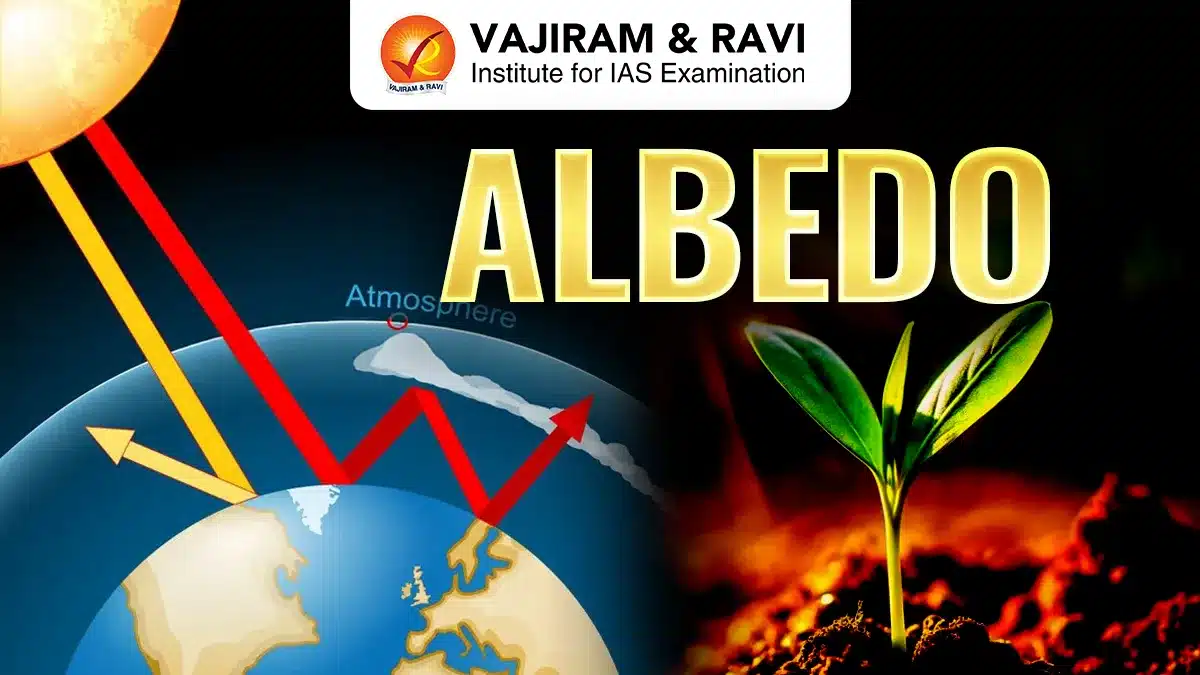
Albedo refers to the ability of a surface to reflect sunlight back into space. It is measured on a scale from 0 to 1 or expressed as a percentage. A higher albedo means more reflection, while a lower albedo means more absorption of solar energy.
Bright surfaces like snow and ice have high albedo because they reflect most sunlight. Dark surfaces like oceans, forests, and roads have low albedo as they absorb more heat. Albedo plays a key role in controlling Earth’s temperature and climate system.
Types of Albedo
Albedo can be broadly classified into the following types:
1. Terrestrial Albedo
Terrestrial albedo refers to the measurement of Earth’s reflectivity. It indicates how much of the incoming solar radiation is reflected back into space by the Earth’s surface and atmosphere.
- The average terrestrial albedo of Earth is about 0.31.
- This means around 31% of incoming solar radiation is reflected, while the remaining is absorbed.
- Terrestrial albedo depends on several factors such as:
- Oceans
- Forests
- Clouds
- Ice and snow
- Deserts and land surfaces
2. Astronomical Albedo
Astronomical albedo measures the reflectivity of celestial bodies other than Earth, such as planets, moons, asteroids, and comets.
- It helps scientists understand the surface composition and atmospheric features of these bodies.
- A high astronomical albedo usually indicates a bright or icy surface.
- A low astronomical albedo suggests dark, rocky, or dusty surfaces.
Factors Affecting Albedo
Albedo is influenced by natural conditions and human activities that determine how much sunlight a surface reflects or absorbs. Changes in surface characteristics or atmospheric conditions can increase or decrease albedo, directly affecting temperature and climate.
- Surface Colour: Light-coloured surfaces reflect more sunlight, while dark surfaces absorb more heat.
- Surface Type: Snow, ice, sand, forests, and water bodies have different reflectivity levels.
- Cloud Cover: Thick and bright clouds increase albedo by reflecting solar radiation.
- Snow and Ice Cover: Presence of snow greatly increases albedo, especially in polar regions.
- Vegetation Cover: Dense forests lower albedo, whereas grasslands and croplands reflect more.
- Human Activities: Urbanisation, deforestation, and land-use changes modify natural reflectivity.
Albedo of Different Earth Surfaces
Albedo of different Earth surfaces varies based on colour, texture, and material, which determines how much sunlight is reflected or absorbed. Bright surfaces like snow reflect most solar radiation, while dark surfaces such as oceans and forests absorb more heat, influencing regional and global climate patterns.
| Albedo of Different Earth Surfaces | ||
| Surface Type | Typical Albedo Range (Reflectivity) | Notes |
|
Fresh Snow |
0.80 - 0.95 |
Very high reflectivity; reflects most sunlight. |
|
Old/Melting Snow |
0.40 - 0.70 |
Lower than fresh snow as impurities and melting reduce reflectivity. |
|
Sea Ice |
0.50 - 0.70 |
High reflectivity but lower than fresh snow. |
|
Desert Sand |
0.30 - 0.45 |
Moderately high reflectivity due to light colour. |
|
Grasslands |
0.18 - 0.30 |
Moderate reflectivity; varies with vegetation type. |
|
Bare Soil |
0.10 - 0.20 |
Depends on moisture and colour of the soil. |
|
Forests |
0.06 - 0.20 |
Low reflectivity because dense vegetation absorbs more sunlight. |
|
Open Ocean (Water) |
0.06 - 0.10 |
Very low reflectivity; most sunlight is absorbed. |
|
Urban Areas / Asphalt |
0.04 - 0.18 |
Low reflectivity due to dark surfaces like roads and roofs. |
|
Whole Earth Average (Planetary Albedo) |
0.30 - 0.31 |
Earth reflects about ~30% of incoming sunlight overall. |
Role of Albedo in Climate and Weather
- Controls Earth’s energy balance by deciding how much solar radiation is reflected or absorbed.
- High albedo surfaces keep regions cooler, while low albedo surfaces cause warming.
- Creates temperature differences between land, sea, and ice-covered areas.
- Influences wind circulation and pressure systems due to uneven heating of Earth’s surface.
- Affects rainfall and weather patterns by altering surface heating.
- Plays a key role in the ice-albedo feedback, where melting ice leads to more warming.
- Impacts seasonal climate variations, especially in polar and temperate regions.
Albedo and Global Warming
Albedo has a direct connection with global warming because it determines how much solar energy is absorbed by the Earth. A decrease in albedo leads to higher heat absorption, which accelerates the warming of the planet.
- Melting glaciers and polar ice reduce Earth’s reflectivity.
- Darker surfaces absorb more heat, increasing surface temperatures.
- Deforestation lowers albedo by replacing bright surfaces with darker vegetation.
- Urbanisation increases heat absorption due to concrete and asphalt.
- Reduced albedo creates a positive feedback loop, intensifying global warming.
Importance of Albedo for Climate Change Mitigation
- Plays a crucial role in maintaining Earth’s energy balance by reflecting a significant portion of incoming solar radiation back into space.
- Helps in slowing global warming by reducing heat absorption, especially in polar and high-altitude regions.
- Improves the accuracy of climate models and projections, which are essential for long-term climate planning.
- Supports urban climate mitigation through the use of high-albedo materials such as cool roofs, reflective roads, and lighter building surfaces.
- Reduces the urban heat island effect, lowering energy demand for cooling in cities.
- Encourages protection of ice sheets, glaciers, and snow cover, preventing rapid temperature rise due to ice–albedo feedback.
- Promotes sustainable land-use practices, including afforestation and climate-sensitive agriculture.
- Assists governments and planners in designing effective climate policies and adaptation strategies.
Albedo FAQs
Q1: What is albedo?
Ans: Albedo is the measure of how much sunlight a surface reflects back into space.
Q2: In what form is albedo expressed?
Ans: Albedo is expressed as a value between 0 and 1 or as a percentage.
Q3: Which surface has the highest albedo on Earth?
Ans: Fresh snow has the highest albedo as it reflects most of the incoming solar radiation.
Q4: What is the average albedo of the Earth?
Ans: The average terrestrial (planetary) albedo of Earth is about 0.31.
Q5: How does albedo affect climate?
Ans: Higher albedo leads to cooling by reflecting sunlight, while lower albedo causes warming by absorbing heat.
