UPSC Daily Quiz 19 December 2025

UPSC Daily Quiz

[WpProQuiz 50]

UPSC Daily Quiz FAQs

Q1: What is the Daily UPSC Quiz?

Ans: The Daily UPSC Quiz is a set of practice questions based on current affairs, static subjects, and PYQs that help aspirants enhance retention and test conceptual clarity regularly.

Q2: How is the Daily Quiz useful for UPSC preparation?

Ans: Daily quizzes support learning, help in revision, improve time management, and boost accuracy for both UPSC Prelims and Mains through consistent practice.

Q3: Are the quiz questions based on the UPSC syllabus?

Ans: Yes, all questions are aligned with the UPSC Syllabus 2025, covering key areas like Polity, Economy, Environment, History, Geography, and Current Affairs.

Q4: Are solutions and explanations provided with the quiz?

Ans: Yes, each quiz includes detailed explanations and source references to enhance conceptual understanding and enable self-assessment.

Q5: Is the Daily UPSC Quiz suitable for both Prelims and Mains?

Ans: Primarily focused on Prelims (MCQ format), but it also indirectly helps in Mains by strengthening subject knowledge and factual clarity.

State Government, Constitutional Provisions, Structure, Functions

State Government

The State Government is the governing authority at the regional level in India, responsible for law and order, administration, and socio-economic development within a state. It functions under the framework of the Indian Constitution and ensures decentralised governance to meet local needs. 

State Governments implement policies, deliver public services, and act as a bridge between citizens and the Union Government. A detailed article on the structure, functions, challenges, and role of State Governments has been discussed below.

State Government Formation

The formation of a State Government takes place after elections to the State Legislative Assembly, reflecting the parliamentary system at the state level. The executive is drawn from the legislature and remains accountable to it.

  • State Assembly elections are conducted by the Election Commission of India.
  • The party or coalition securing a majority is invited to form the government.
  • The Governor appoints the leader of the majority party as the Chief Minister.
  • Other ministers are appointed by the Governor on the advice of the Chief Minister.
  • The Council of Ministers is collectively responsible to the Legislative Assembly.
  • A floor test may be conducted to prove majority support.

State Government Constitutional Provisions

The constitutional provisions related to the State Government are mainly contained in Part VI (Articles 152–237) of the Indian Constitution. They form the legal backbone for the functioning of federal governance in India.

State Government Constitutional Provisions
Aspect Articles Provisions

Definition & Scope

Article 152

Defines the term “State” for the purposes of Part VI of the Constitution.

Governor

Articles 153–162

Provides for a Governor for each state, his appointment, powers, tenure, executive authority, and discretionary powers.

Council of Ministers

Articles 163–164

Establishes the Council of Ministers headed by the Chief Minister to aid and advise the Governor; ensures collective responsibility to the Legislative Assembly.

Advocate General

Article 165

Appointment, qualifications, duties, and rights of the Advocate General of the state.

State Legislature (General)

Articles 168–177

Composition of State Legislature, membership, sessions, powers of presiding officers, and legislative procedures.

Legislative Assembly

Articles 170–174

Composition, duration, sessions, dissolution, and functioning of the Legislative Assembly.

Legislative Council

Articles 169, 171–172

Creation or abolition of Legislative Council, composition, and tenure of members.

Legislative Procedure

Articles 196–201

Procedure for passing bills, Money Bills, and assent of the Governor and President.

Financial Provisions

Articles 202–207

State Budget, Consolidated Fund, Contingency Fund, and financial procedures.

High Court

Articles 214–231

Establishment, jurisdiction, powers, and independence of High Courts.

Subordinate Courts

Articles 233–237

Appointment and control of district judges and subordinate judiciary.

Administrative Relations

Articles 256–263

Centre–State administrative relations, compliance with Union laws, and Inter-State Council.

Legislative Relations

Articles 245–246 & Seventh Schedule

Distribution of legislative powers between Union and States.

Emergency Provisions (State Impact)

Articles 356, 365

President’s Rule and failure of constitutional machinery in states.

Structure of State Government

The Structure of the State Government is broadly similar to that of the Union Government and is based on the principle of separation of powers. It consists of three organs: Executive, Legislature, and Judiciary, each performing distinct functions while maintaining checks and balances.

1. State Executive

The State Executive is responsible for the administration and implementation of laws and policies within the state. It consists of the Governor, Chief Minister, and the Council of Ministers, where real executive power lies with the elected government.

(a) Governor

  • The Governor is the constitutional head of the state, appointed by the President (Article 153).
  • Acts as the nominal executive, while functioning mainly on the aid and advice of the Council of Ministers (Article 163).
  • Appoints the Chief Minister, Council of Ministers, Advocate General, and members of the State Public Service Commission.
  • Possesses legislative, executive, and discretionary powers, including reserving bills for the President.

(b) Chief Minister

  • The Chief Minister is the real executive authority and head of the State Government.
  • Appointed by the Governor, usually the leader of the majority party in the Legislative Assembly.
  • Leads the Council of Ministers and coordinates the work of various departments.
  • Acts as the link between the Governor and the Council of Ministers.

(c) Council of Ministers

  • Comprises Cabinet Ministers, Ministers of State, and Deputy Ministers.
  • Collectively responsible to the State Legislative Assembly (Article 164).
  • Formulates policies and ensures their execution through the bureaucracy.
  • Holds office as long as it enjoys the confidence of the Legislative Assembly.

2. State Legislature

The State Legislature is responsible for law-making, budget approval, and executive oversight at the state level. It may be unicameral or bicameral, depending on the state.

(a) Legislative Assembly (Vidhan Sabha)

  • The lower and more powerful house of the state legislature.
  • Members are directly elected by the people.
  • Has control over the Council of Ministers through questions, motions, and no-confidence motions.
  • Money Bills can be introduced only in the Legislative Assembly.

(b) Legislative Council (Vidhan Parishad) – Where Applicable

  • The upper house in bicameral states.
  • Members are partly elected and partly nominated.
  • Acts as a revising and advisory body.
  • Cannot reject Money Bills but can delay them for a limited period.

3. State Judiciary

The State Judiciary ensures the interpretation of laws, protection of fundamental rights, and independence of justice. It functions independently of the executive and legislature.

(a) High Court

  • The highest judicial authority in the state (Article 214).
  • Exercises original, appellate, and writ jurisdiction.
  • Acts as the guardian of the Constitution at the state level.
  • Supervises subordinate courts and tribunals.

(b) Subordinate Courts

  • Include District Courts, Sessions Courts, and lower civil and criminal courts.
  • Deal with the administration of justice at the grassroots level.
  • Function under the administrative control of the High Court.

State Government Functions and Responsibilities

State Governments are responsible for regional administration, law enforcement, and implementation of policies within the state. They ensure public service delivery and socio-economic development tailored to local needs.

  • Maintain law and order, including police and public safety.
  • Administer healthcare and education systems and welfare schemes.
  • Promote agriculture, irrigation, and rural development.
  • Develop infrastructure such as roads, transport, and housing.
  • Implement social welfare programs for vulnerable communities.
  • Levy and collect state taxes like SGST, excise, and stamp duty.
  • Regulate businesses, professions, and state industries.
  • Manage forests, wildlife, and environmental conservation.

Centre-State Relations and Role of States

Centre–State Relations form a critical aspect of Indian federalism, ensuring coordination between the Union and state governments. States exercise autonomy over local matters while cooperating with the Centre in areas of shared responsibility to promote balanced national development.

  • States have exclusive powers over subjects in the State List.
  • Both Centre and States share responsibilities on Concurrent List subjects like education, forests, and criminal law.
  • Financial dependence exists through tax devolution, grants-in-aid, and centrally sponsored schemes.
  • Mechanisms like Inter-State Council and Finance Commission facilitate coordination and dispute resolution.
  • States act as partners in cooperative federalism, implementing national policies at the regional level.
  • Centre–State tensions may arise but are managed through constitutional provisions and legal frameworks.
  • States play a role in regional planning, local governance, and policy adaptation to local needs.

Role of State Government in Local Self Governance

State Governments play an important role in strengthening local self-governance by empowering Panchayati Raj Institutions (rural) and Municipal Bodies (urban).

  • Delegation of Powers: State Governments devolve authority, responsibilities, and funds to local bodies under the 73rd and 74th Constitutional Amendments.
  • Financial Support: Provision of grants-in-aid, tax-sharing, and budget allocations to ensure local bodies can function effectively.
  • Capacity Building: Training elected representatives and officials for efficient administration and planning at the grassroots level.
  • Regulatory Oversight: Ensuring local bodies adhere to legal, financial, and administrative norms.
  • Program Implementation: Supervising local execution of schemes in health, education, sanitation, and rural development.
  • Participatory Governance: Encouraging citizen involvement through Gram Sabhas, Ward Committees, and public consultations.
  • Monitoring & Evaluation: Assessing the performance of local institutions and ensuring accountability and transparency in governance.

Challenges Faced by State Governments in India

State Governments in India face multiple challenges that affect their ability to deliver effective governance and promote regional development. These challenges are financial, administrative, political, and environmental in nature, often limiting their autonomy and efficiency.

  • Fiscal Constraints: Dependence on Centre for funds and limited revenue sources.
  • Centre-State Tensions: Conflicts over legislative, administrative, and financial powers.
  • Administrative Inefficiency: Bureaucratic delays and lack of capacity in governance.
  • Regional Disparities: Unequal development between districts and urban–rural areas.
  • Infrastructure Deficits: Inadequate transport, health, and education facilities in some states.
  • Urbanisation and Population Pressure: Rapid growth strains resources and services.
  • Environmental Challenges: Climate change, natural disasters, and resource depletion impact planning and development.

Reforms Needed in State Governance

To strengthen State Governments and improve governance outcomes, comprehensive reforms are necessary. These reforms should focus on enhancing autonomy, accountability, efficiency, and coordination with the Centre, ensuring responsive and inclusive governance.

  • Financial Autonomy: Greater tax devolution and fiscal independence from the Centre.
  • Administrative Reforms: Streamlining bureaucracy, reducing delays, and improving service delivery.
  • Strengthening Legislatures: Enhancing the oversight role of State Assemblies and Councils.
  • Cooperative Federalism: Promoting collaboration between Centre and States on policy and implementation.
  • E-Governance & Technology: Using digital tools for transparency, monitoring, and citizen services.
  • Capacity Building: Training officials and improving institutional efficiency.
  • Policy Innovation: Encouraging states to adopt region-specific solutions and best practices.

State Government FAQs

Q1: What is a State Government?

Ans: A State Government is the governing authority of a state in India, responsible for administration, law enforcement, and socio-economic development.

Q2: How is a State Government formed?

Ans: It is formed after State Legislative Assembly elections, with the majority party or coalition leader appointed as the Chief Minister by the Governor.

Q3: Who is the constitutional head of a state?

Ans: The Governor acts as the constitutional head, while real executive power lies with the Chief Minister and Council of Ministers.

Q4: Can a state have two houses in its legislature?

Ans: Yes, some states have a bicameral legislature with a Legislative Assembly and a Legislative Council.

Q5: What are the main functions of a State Government?

Ans: State Governments handle law and order, health, education, agriculture, infrastructure, welfare programs, taxation, and environmental management. 

National Parks in Andhra Pradesh, Sanctuaries, Tiger Reserves

National Parks in Andhra Pradesh

National Parks in Andhra Pradesh are the regions established to conserve wildlife, forests, landscapes and ecological systems. In India, they are governed under the Wild Life Protection Act 1972. These areas restrict human activities to protect endangered species, fragile habitats, and biodiversity hotspots. National Parks in India offer the highest protection level, while sanctuaries allow limited human use. Protected areas also support climate regulation, water security, ecological balance, scientific research, and long-term conservation of flora and fauna.

Protected Areas in Andhra Pradesh

Andhra Pradesh hosts diverse protected ecosystems across Eastern Ghats, coastal wetlands, riverine forests, and dry deciduous landscapes.

  • National Parks: Strictly protected ecosystems conserving core biodiversity and endangered species.
  • Tiger Reserves: Large landscapes managed under Project Tiger for Bengal tiger conservation.
  • Wildlife Sanctuaries: Protected habitats allowing regulated human activities for conservation.
  • Ramsar Sites: Internationally important wetlands conserving migratory birds and freshwater ecosystems.

National Parks in Andhra Pradesh

Andhra Pradesh has three National Parks representing hill forests, river valleys, and dry deciduous ecosystems. These parks are located in Eastern Ghats and central plains, protecting rare flora, large mammals, reptiles, birds, and endemic species. They play a critical role in conserving fragile hill ecosystems, wildlife corridors, riverine biodiversity, and endemic plant species. The National Parks include Papikonda National Park, Sri Venkateswara National Park, and Rajiv Gandhi National Park, each unique in geography, biodiversity, and ecological importance.

Papikonda National Park

Papikonda National Park lies in the northern Eastern Ghats along the Godavari River, covering rugged hills, valleys, and rich forest ecosystems with high biodiversity significance.

  1. Location and Area: Situated in East and West Godavari districts, covering 1,012.86 square kilometres.
  2. Elevation Gradient: Altitude ranges from 20 to 850 metres, creating diverse micro-habitats.
  3. River System: Godavari River bisects the park, acting as a major biogeographic divider.
  4. Climate Conditions: Annual rainfall averages 1,168 mm with temperatures rising to 47°C in summer.
  5. Forest Types: Southern tropical moist deciduous, semi-evergreen, and dry deciduous forests dominate.
  6. Floral Diversity: Home to 31 red-listed plant species and 96 wild crop relatives.
  7. Unique Fauna: Hosts the rare dwarf goat breed locally known as “kanchu mekha”.
  8. Mammals: Supports tiger, leopard, hyena, gaur, sambar, chital, barking deer, and chowsingha.
  9. Avifauna: Records 92 bird species including peacock and red jungle fowl.
  10. Reptiles: Includes king cobra, Indian python, freshwater crocodile, and golden gecko.

Rajiv Gandhi National Park

Rajiv Gandhi National Park, also called Rameswaram National Park, is a small urban-proximate protected forest located in Kadapa district.

  1. Geographic Location: Located within Proddatur town amidst Veligonda and Yerramala hill extensions.
  2. Area Coverage: Spreads across only 2.3 square kilometres, making it Andhra Pradesh’s smallest park.
  3. Forest Type: Dominated by tropical dry deciduous vegetation with sandy soils.
  4. Plant Diversity: Contains over 25 plant species including Dalbergia sissoo and Gymnema sylvestre.
  5. Invertebrates: Rich insect life including scorpions, spiders, butterflies, and grasshoppers.
  6. Amphibians: Supports bullfrogs and common Indian toads.
  7. Reptiles: Includes Russell’s viper, earth boa, and common skink.
  8. Birds: Over 50 species like peacocks, parakeets, and little egrets.
  9. Mammals: Hosts spotted deer, common mongoose, and black-naped hare.

Sri Venkateswara National Park

Sri Venkateswara National Park protects ancient Eastern Ghats hill ecosystems and is Andhra Pradesh’s first declared National Park.

  1. Location: Spread across Seshachalam and Tirumala hills in Kadapa and Chittoor districts.
  2. Area Extent: Covers 353.62 square kilometres carved from a larger wildlife sanctuary.
  3. Declaration Status: Notified as National Park in 1989 after sanctuary declaration in 1985.
  4. Geological Importance: Features Nagari Quartzite and ancient Cuddapah rock formations.
  5. Rainfall Pattern: Receives average rainfall of 1,190 mm annually.
  6. Forest Types: Includes dry deciduous, moist deciduous, and red sanders-bearing forests.
  7. Endemic Flora: Supports red sanders, sandalwood, Cycas beddomei, and Terminalia pallida.
  8. Mammals: Inhabited by tiger, leopard, wolf, sloth bear, chinkara, and four-horned antelope.
  9. Rare Species: Golden gecko rediscovered here after nearly 100 years.
  10. Avifauna: Over 150 bird species recorded across valleys and hill ranges.

Tiger Reserves in Andhra Pradesh

Andhra Pradesh has one notified Tiger Reserve conserving large forest landscapes of Eastern Ghats under Project Tiger. Nagarjunsagar-Srisailam Tiger Reserve is the only tiger reserve in the state. It is dominated by dry deciduous forests, deep valleys, gorges, and plateaus and Krishna River flows through the reserve supporting aquatic biodiversity. It plays a major role in protecting Bengal tigers and prey species.

Nagarjunsagar-Srisailam Tiger Reserve

This tiger reserve is among India’s largest, spread across Eastern Ghats hill ranges of Nallamalais.

  1. Total Area: Covers 5,937 square kilometres including core and buffer zones.
  2. Core Habitat: Critical tiger habitat spans 3,721 square kilometres.
  3. Biodiversity Richness: Hosts over 80 mammals, 303 birds, and 54 reptiles.
  4. Tiger Population: Estimated between 53 and 67 tigers during 2010 assessment.
  5. Flora Diversity: Records 1,581 plant taxa including several endemic medicinal species.
  6. Conservation Measures: Uses camera traps, M-STrIPES patrolling, and tribal participation.

Wildlife Sanctuaries in Andhra Pradesh

Wildlife sanctuaries in Andhra Pradesh protect diverse ecosystems including mangroves, lakes, forests, grasslands, and river deltas. These sanctuaries conserve migratory birds, endangered mammals, reptiles, and plant species while allowing regulated human use. Spread across coastal Andhra, Rayalaseema, and Eastern Ghats, they play a vital role in wetland conservation, coastal protection, forest regeneration, and biodiversity preservation under national conservation laws.

List of Major Wildlife Sanctuaries in Andhra Pradesh

Andhra Pradesh hosts multiple wildlife sanctuaries covering wetlands, mangroves, dry forests, and hill ecosystems.

  • Coringa Wildlife Sanctuary: Mangrove ecosystem in East Godavari protecting estuarine birds and crocodiles.
  • Gundla Brahmeswaram Sanctuary: Largest sanctuary conserving Eastern Ghats dry deciduous forests.
  • Kambalakonda Sanctuary: Urban forest near Visakhapatnam protecting hill ecosystems and wildlife.
  • Koundinya Sanctuary: Only Asian elephant habitat in Andhra Pradesh located in Chittoor.
  • Kolleru Sanctuary: Freshwater wetland supporting millions of resident and migratory birds.
  • Krishna Sanctuary: Deltaic wetland conserving mangroves and riverine biodiversity.
  • Nagarjunsagar-Srisailam Sanctuary: Part of tiger reserve protecting large mammals.
  • Nelapattu Bird Sanctuary: Critical pelican breeding ground near Tirupati.
  • Pulicat Lake Sanctuary: Coastal lagoon supporting migratory waterbirds.
  • Rollapadu Sanctuary: Grassland habitat conserving blackbuck populations.
  • Sri Lankamalleswara Sanctuary: Hill forest supporting endemic plant species.
  • Sri Penusila Narasimha Sanctuary: Large forest area preserving Eastern Ghats biodiversity.
  • Sri Venkateswara Sanctuary: Buffer ecosystem supporting National Park wildlife.

Ramsar Site in Andhra Pradesh

Kolleru Lake is a globally significant freshwater wetland located between Krishna and Godavari deltas. It is the only Ramsar Site present in Andhra Pradesh. 

  1. Ramsar Status: Designated Ramsar Site in 2002 for international wetland importance.
  2. Lake Area: Covers 245 square kilometres with Ramsar wetland area of 302 square kilometres.
  3. Bird Habitat: Supports nearly 20 million migratory and resident birds seasonally.
  4. Migratory Species: Hosts Siberian cranes, painted storks, pelicans, flamingos, and ibises.
  5. Hydrology: Fed by Budameru and Tammileru streams and irrigation canals.
  6. Conservation Issues: Impacted by aquaculture encroachment and pollution.
  7. Restoration Efforts: Addressed through Operation Kolleru and Operation Kolleru-2.0 initiatives.

National Parks in Andhra Pradesh FAQs

Q1: How many National Parks are there in Andhra Pradesh?

Ans: Andhra Pradesh has three National Parks: Papikonda National Park, Sri Venkateswara National Park, and Rajiv Gandhi National Park.

Q2: Which is the largest National Park in Andhra Pradesh?

Ans: Papikonda National Park is the largest, covering 1,012.86 square kilometres across the Eastern Ghats along the Godavari River.

Q3: Which was the first National Park of Andhra Pradesh?

Ans: Sri Venkateswara National Park was the first National Park of Andhra Pradesh, officially notified in 1989.

Q4: Which National Parks in Andhra Pradesh are located in an urban area?

Ans: Rajiv Gandhi National Park is located within Proddatur town in Kadapa district and is the smallest National Park in the state.

Q5: Why are National Parks important in Andhra Pradesh?

Ans: National Parks in Andhra Pradesh conserve Eastern Ghats biodiversity, protect endangered species, preserve river ecosystems, and support ecological balance and climate regulation.

National Parks in Arunachal Pradesh, Sanctuaries, Tiger Reserves

National Parks in Arunachal Pradesh

The National Parks in Arunachal Pradesh are legally recognised regions that are created to conserve ecosystems, wildlife, and natural habitats. They restrict human activities like hunting, logging, and land conversion. In India, these areas include National Parks, Wildlife Sanctuaries, Tiger Reserves, Elephant Reserves, Biosphere Reserves, and Community Reserves. They aim to protect biodiversity, maintain ecological balance, conserve endangered species, and preserve genetic diversity for future generations, while also supporting scientific research, environmental education, and climate resilience.

Protected Areas in Arunachal Pradesh

Protected areas are officially notified zones created to conserve wildlife, forests, and fragile ecosystems through legal protection and regulated human use. The Protected Areas include:

  1. National Parks: Fully protected ecosystems with strict restrictions on human activities.
  2. Wildlife Sanctuaries: Areas allowing limited human use while conserving wildlife habitats.
  3. Tiger Reserves: Landscapes managed specifically for long term tiger conservation.
  4. Biosphere Reserves: Large regions balancing conservation, livelihoods, and sustainable development.

National Parks in Arunachal Pradesh

Arunachal Pradesh hosts two National Parks in India within the Eastern Himalayan global biodiversity hotspot. These parks protect vast altitudinal ranges, tropical to alpine forests, and highly diverse flora and fauna. The state has nearly 79.63% forest and tree cover, making it India’s second highest in forest cover percentage. National Parks form the core of its Protected Area Network, safeguarding rare species, endemic plants, and critical river systems, while contributing to biodiversity conservation, climate stability, and ecological research across northeastern India.

Namdapha National Park

Namdapha National Park is India’s largest eastern Himalayan protected area, located near the India Myanmar border in Changlang district.

  1. Location: Situated between Mishmi Hills and Patkai range along Noa Dihing river.
  2. Area: Covers about 1,985.24 square kilometres of dense forest landscape.
  3. Biodiversity: Part of Eastern Himalayan global biodiversity hotspot with exceptional species richness.
  4. Big Cats: Only park globally hosting tiger, leopard, snow leopard, clouded leopard.
  5. Flora: Contains over 150 timber species including rare Pinus merkusii.
  6. Endemism: Home to critically endangered Namdapha flying squirrel.
  7. Birds: Supports over 450 bird species including white winged wood duck.

Mouling National Park

Mouling National Park lies in Upper Siang district and protects diverse altitudinal forest ecosystems along the Siang river basin.

  1. Establishment: Declared National Park in 1986 to conserve fragile mountain ecosystems.
  2. Area: Covers about 483 square kilometres of forested terrain.
  3. Vegetation: Ranges from tropical evergreen to alpine conifer forests.
  4. Fauna: Supports takin, red panda, tiger, serow, and barking deer.
  5. Rivers: Drained by Siyom, Siring, Subong rivers feeding the Siang.

Tiger Reserves in Arunachal Pradesh

Arunachal Pradesh has three notified Tiger Reserves forming crucial corridors in the Eastern Himalaya. These reserves support tigers, elephants, and diverse prey species while conserving forests, rivers, and tribal landscapes. Together, they cover extensive forest tracts and strengthen India’s tiger conservation network by protecting breeding habitats, ensuring genetic connectivity, and supporting community based conservation in ecologically sensitive border regions.

  1. Namdapha: Largest tiger reserve with exceptional altitudinal and habitat diversity.
  2. Pakke: Foothill reserve linking Assam and Arunachal forest landscapes.
  3. Kamlang: Eastern reserve connecting Namdapha and Lohit river forests.

Namdapha Tiger Reserve

Namdapha Tiger Reserve overlaps fully with Namdapha National Park in Changlang district.

  1. Area: Spans approximately 1,985.24 square kilometres of protected forest.
  2. Significance: Supports four big cat species and intact rainforest habitats.
  3. Fauna: Includes tiger, elephant, gaur, red panda, Asiatic black bear.

Pakke Tiger Reserve

Pakke Tiger Reserve lies in the foothills of the Eastern Himalaya along Kameng basin.

  1. Area: Covers about 861.95 square kilometres of forest landscape.
  2. Connectivity: Links Nameri National Park, Eaglenest, and Sessa Orchid Sanctuary.
  3. Conservation: Known for Hornbill Nest Adoption Programme success.

Kamlang Tiger Reserve

Kamlang Tiger Reserve is located between Lohit River and Namdapha landscape.

  1. Area: Encompasses around 783 square kilometres of protected forests.
  2. Habitat: Ranges from wet evergreen forests to alpine vegetation.
  3. Species: Hosts tiger, clouded leopard, snow leopard, Asian elephant.

Wildlife Sanctuaries in Arunachal Pradesh

Arunachal Pradesh has 13 Wildlife Sanctuaries forming the backbone of its Protected Area Network. Together, they cover nearly 9,779 square kilometres, around 11.90% of the state’s geographical area, far above the national average. These sanctuaries conserve tropical rainforests, alpine meadows, riverine habitats, and orchid rich landscapes. They support about 20% of India’s fauna and nearly 25% of its floral diversity, including mammals, birds, reptiles, amphibians, fishes, butterflies, orchids, rhododendrons, bamboo, and medicinal plants.

Wildlife Sanctuaries in Arunachal Pradesh List

The major wildlife sanctuaries protect diverse habitats, species, and ecological corridors across the state.

  1. Pakke Wildlife Sanctuary: Foothill forests supporting tigers, hornbills, elephants, and rich bird diversity.
  2. Kamlang Wildlife Sanctuary: Eastern forests with alpine to evergreen vegetation and rare big cats.
  3. Eaglenest Wildlife Sanctuary: Montane forests famous for exceptional bird diversity and altitudinal range.
  4. Mehao Wildlife Sanctuary: Forested lake ecosystem supporting mammals, birds, and freshwater biodiversity.
  5. Dibang Wildlife Sanctuary: Largest sanctuary conserving high altitude landscapes and takin populations.
  6. Daying Ering Memorial Sanctuary: River island habitat supporting migratory birds and aquatic species.
  7. Kane Wildlife Sanctuary: Small sanctuary protecting local forest biodiversity and community landscapes.
  8. Yordi Rabe Supse Sanctuary: Forest corridor important for mammals and avifauna movement.
  9. Itanagar Wildlife Sanctuary: Urban fringe forest protecting wildlife near state capital.
  10. Tale Wildlife Sanctuary: High altitude forests known for orchids, birds, and endemic species.
  11. Sessa Orchid Wildlife Sanctuary: Specialized habitat conserving rich orchid diversity.
  12. Ringba Roba Wildlife Sanctuary: Small forest patch preserving local flora and fauna.
  13. Kamala Wildlife Sanctuary: Riverine forest ecosystem supporting birds, reptiles, and mammals.

National Parks in Arunachal Pradesh FAQs

Q1: How many National Parks are there in Arunachal Pradesh?

Ans: Arunachal Pradesh has two National Parks- Namdapha National Park and Mouling National Park.

Q2: Which is the largest National Park in Arunachal Pradesh?

Ans: Namdapha National Park is the largest, covering about 1,985 square kilometres.

Q3: Why is Namdapha National Park globally important?

Ans: It is the only park in the world hosting tiger, leopard, snow leopard, and clouded leopard together.

Q4: Where is Mouling National Park located?

Ans: Mouling National Park is located in Upper Siang district along the Siang river basin.

Q5: Why are National Parks important in Arunachal Pradesh?

Ans: They conserve Eastern Himalayan biodiversity, protect endangered species, and preserve vital forest ecosystems.

National Parks in West Bengal, Sanctuaries, Reserves, Ramsar Sites

National Parks in West Bengal

National Parks in West Bengal are legally protected areas created to conserve ecosystems, wildlife species, and natural landscapes with minimal human interference. The Protected areas include National Parks in India, Wildlife Sanctuaries, Tiger Reserves, Biosphere Reserves, and Ramsar Sites. These categories differ in management intensity, allowed activities, and conservation objectives. In India, protected areas support biodiversity conservation, climate regulation, and ecological security. The Protected Areas in West Bengal conserve mangroves, Himalayan forests, floodplains, wetlands, and grasslands, safeguarding endangered species like the Royal Bengal Tiger, Indian rhinoceros, red panda, and several migratory birds.

Protected Areas in West Bengal

Protected areas cover around 4% of the total area of West Bengal. These areas are rich in Mangroves, Himalayan forests, Terai grasslands, etc. These areas support eastern India’s biodiversity security through the conservation of flagship species such as Bengal tiger, Indian rhinoceros, red panda, etc. The Protected Areas in West Bengal include:

  • National Parks
  • Wildlife Sanctuaries
  • Tiger Reserves.
  • Ramsar Sites, etc.

National Parks in West Bengal

West Bengal has six National Parks forming the backbone of its biodiversity conservation framework. These parks represent varied ecosystems, from tidal mangrove forests of the Sundarbans to alpine habitats of the Eastern Himalayas. They protect flagship species such as the Royal Bengal Tiger, Indian one-horned rhinoceros, red panda, Asian elephant, and clouded leopard. They are considered crucial for tiger conservation, wetland ecology, Himalayan biodiversity, and international designations like UNESCO World Heritage Sites and Biosphere Reserves.

Sunderban National Park

Sundarbans National Park forms part of the world’s largest mangrove delta, shaped by tidal rivers and islands, and supports globally unique estuarine biodiversity. 

  • Location: Southern West Bengal in Ganga delta, bordering Bangladesh mangroves.
  • Global Status: UNESCO World Heritage Site, Biosphere Reserve, Tiger Reserve, Ramsar Site.
  • Ecosystem type: Mangrove-dominated delta with constant tidal inundation and saline influence.
  • Vegetation: Dominated by Sundari mangrove trees with pneumatophores aiding respiration.
  • Flagship species: Royal Bengal Tiger adapted to swimming and estuarine hunting. 
  • Other Fauna: Saltwater crocodile, river terrapin, dolphins, olive ridley turtle.
  • Hydrology: Network of rivers (Ganga-Brahmaputra), creeks, and tidal channels shaping islands.
  • Ecological role: Acts as natural cyclone barrier and fish nursery for Bay of Bengal.

Gorumara National Park

Gorumara National Park lies in the Terai-Dooars region and is known for grasslands and rhinoceros conservation.

  • Geographic setting: Located in Eastern Himalayan foothills between Teesta and Jaldhaka rivers.
  • River system: Jaldhaka River (tributary of Brahmaputra) shapes floodplain grasslands and wildlife movement corridors.
  • Vegetation type: Sal forests, savannah grasslands, and moist deciduous formations
  • Flagship Species: Indian one-horned rhinoceros population.
  • Other fauna: Gaur, Asian elephant, sloth bear, sambar, hog deer.
  • Habitat: Riverine grasslands and moist deciduous forests.
  • Ecological Value: Supports Terai ecosystem continuity with Jaldapara and Chapramari.

Jaldapara National Park

Jaldapara National Park protects extensive grasslands supporting India’s second-largest rhinoceros population.

  • Location: Situated along Torsa River in Eastern Himalayan foothills.
  • Habitat type: Savannah grasslands with tall elephant grasses and seasonal wetlands.
  • Rhinoceros Population: Second-largest after Kaziranga National Park
  • Elephant Corridor: Chilapata Forest connects Buxa and Jaldapara.
  • Major fauna: Rhinoceros, Asian elephant, leopard, gaur, hog deer.
  • Ecological importance: Critical for grassland-dependent megafauna conservation.

Neora Valley National Park

Neora Valley National Park protects pristine Himalayan biodiversity in Kalimpong region, known for minimal human interference.

  • Location: Situated in Kalimpong district along Eastern Himalayan ranges.
  • Biodiversity status: One of the least disturbed forest tracts in West Bengal.
  • Vegetation: Himalayan broadleaf forests with bamboo and oak dominance.
  • Altitude: Ranges from subtropical to temperate forests.
  • Flagship species: Red panda, classified as endangered globally.
  • Mammalian diversity: Leopard, black bear, golden cat, Himalayan flying squirrel.
  • Floral richness: Rhododendron, ferns, sal, and diverse understory plants.

Singalila National Park

Singalila National Park protects high-altitude ecosystems along the Singalila Ridge.

  • Location: Spread across Darjeeling district along India-Nepal border.
  • Altitudinal range: Includes alpine meadows and temperate forest belts.
  • Vegetation types: Coniferous, broadleaf, and mixed Himalayan forests.
  • Unique Species: Pangolin and yellow-throated marten.
  • Iconic fauna: Red panda, clouded leopard, Himalayan black bear.
  • Floral diversity: Famous for seasonal rhododendron blooms.
  • Ecological role: Protects fragile montane ecosystems, migratory corridors and counter endemism.

Buxa National Park

Buxa National Park combines plains and hill ecosystems along the Indo-Bhutan border.

  • Location: Lies in Alipurduar region along Indo-Bhutan international boundary.
  • Habitat diversity: Evergreen, semi-evergreen, deciduous forests and grasslands.
  • Major mammals: Bengal tiger, Asian elephant, gaur, sambar.
  • Carnivore diversity: Leopard, clouded leopard, fishing cat present.
  • Avifauna richness: Hornbills, floricans, migratory falcons recorded.
  • Conservation threats: Flooding, habitat fragmentation, elephant poaching risks.

Tiger Reserves in West Bengal

West Bengal has two official Tiger Reserves under Project Tiger, vital for Bengal tiger survival. India has 58 tiger reserves managed by NTCA. The reserves in West Bengal are mangrove based Sundarbans and forested Buxa landscape. They focus on long term protection of Royal Bengal Tiger populations and maintaining predator-prey balance and ecosystem stability.

Sunderban Tiger Reserve

Sundarban Tiger Reserve protects the world’s only mangrove tiger population.

  • Area coverage: Total area about 2584.89 square kilometres including core and buffer.
  • Global uniqueness: Only mangrove forest with significant tiger population.
  • Tiger status: Minimum 79 tigers recorded through camera trapping.
  • Biodiversity richness: Dolphins, crocodiles, terrapins, marine turtles.

Buxa Tiger Reserve

Buxa Tiger Reserve conserves diverse forest ecosystems across plains and hills.

  • Area coverage: Total area 760.87 square kilometres including core and buffer.
  • Floral diversity: Over 350 tree species and rich orchid diversity.
  • Faunal range: Tigers, leopards, elephants, pangolins, diverse birds.
  • Conservation status: Low tiger density with intensive monitoring initiatives.

Wildlife Sanctuaries in West Bengal

West Bengal has sixteen Wildlife Sanctuaries that complement National Parks and Tiger Reserves. These sanctuaries protect riverine forests, wetlands, grasslands, mangroves, and urban biodiversity pockets. They support endangered species like fishing cat, Indian rhinoceros, elephants, migratory birds, and amphibians. Sanctuaries such as Sundarbans, Mahananda, Chapramari, and Senchal play a key role in landscape connectivity, ecological stability, and conservation education across the state’s diverse ecological zones.

Wildlife Sanctuaries in West Bengal List

Major Wildlife Sanctuaries of West Bengal represent diverse habitats and species protection priorities. There are 16 sanctuaries in West Bengal:

  1. Sundarbans Wildlife Sanctuary: Mangrove habitat protecting tigers, crocodiles, dolphins, and estuarine biodiversity.
  2. Mahananda Wildlife Sanctuary: Himalayan foothill forests sheltering elephants, leopards, and rich birdlife.
  3. Jaldapara Wildlife Sanctuary: Grassland ecosystem supporting Indian rhinoceros and migratory ungulates.
  4. Buxa Wildlife Sanctuary: Forest corridors linking Bhutan landscapes and North Bengal biodiversity.
  5. Chapramari Wildlife Sanctuary: Contiguous with Gorumara, supporting elephants and grassland fauna.
  6. Senchal Wildlife Sanctuary: Highland forests near Darjeeling protecting montane flora and birds.
  7. Sajnekhali Wildlife Sanctuary: Northern Sundarbans zone supporting otters, reptiles, and birds.
  8. Haliday Island Wildlife Sanctuary: Island ecosystem within Sundarbans Biosphere Reserve.
  9. Lothian Island Wildlife Sanctuary: Coastal island protecting mangrove and estuarine species.
  10. Jorepokhri Salamander Sanctuary: Last refuge of Himalayan salamander in Darjeeling.
  11. Ballavpur Wildlife Sanctuary: Small forest patch conserving dry deciduous species.
  12. Bethuadahari Wildlife Sanctuary: Forest reserve supporting deer and small carnivores.
  13. Bibhutibhushan Wildlife Sanctuary: Wetland forest supporting avifauna and amphibians.
  14. Chintamani Kar Bird Sanctuary: Urban bird sanctuary preserving local and migratory species.
  15. Pakhi Bitan Bird Sanctuary: Riverine bird habitat near Teesta Barrage.
  16. Raiganj Bird Sanctuary: Important nesting ground for migratory birds in North Bengal.

Ramsar Sites in West Bengal

Ramsar Sites in West Bengal highlight internationally significant wetlands supporting biodiversity and livelihoods.

  • East Kolkata Wetlands: World’s largest sewage-fed aquaculture system maintaining urban ecological balance.
  • Sundarban Wetland: India’s largest Ramsar Site with extensive mangrove biodiversity and ecosystem services.

National Parks in West Bengal FAQs

Q1: How many National Parks are there in West Bengal?

Ans: West Bengal has six national parks, including Sundarbans, Gorumara, Jaldapara, Neora Valley, Singalila, and Buxa National Park.

Q2: Which is the most famous National Parks in West Bengal?

Ans: Sundarbans National Park is the most famous, known globally for mangrove forests and Royal Bengal Tigers.

Q3: Which National Parks in West Bengal are famous for one-horned rhinoceros?

Ans: Jaldapara National Park is famous for having the largest population of Indian one-horned rhinoceros after Kaziranga.

Q4: Which National Parks in West Bengal are known for Red Pandas?

Ans: Singalila National Park and Neora Valley National Park are known habitats of the endangered red panda.

Q5: Are there Tiger Reserves within National Parks in West Bengal?

Ans: Yes, Sundarbans and Buxa are designated Tiger Reserves under Project Tiger while also having national park status.

Karewas, Types, Formation, Significance, Threats, Conservation

Karewas

What are Karewas?

Karewas are elevated flat-topped plateaus found mainly in the Kashmir Valley, lying above the present-day floodplains of the Jhelum River and its tributaries. They consist largely of lacustrine (lake-deposited) sediments such as clays, silts, sands, and gravels.

These landforms were formed during the Quaternary period when the Kashmir Valley was occupied by large freshwater lakes. Over time, tectonic uplift and river erosion drained these lakes, leaving behind flat terraces known as Karewas.

Types of Karewas

Karewas can be broadly classified based on their location, elevation, and composition. The major types include:

  1. Lower Karewas
  • Found closer to river floodplains.
  • Composed mainly of fine sediments like clay and silt.
  • Highly fertile and extensively used for agriculture.
  1. Higher Karewas
  • Located at higher elevations above the valley floor.
  • Contain coarser materials such as gravel and sand.
  • Less fertile but ideal for horticulture and saffron cultivation.
  1. Fluvio-lacustrine Karewas
  • Formed due to combined action of lakes and rivers.
  • Show layered deposits of lake sediments and river alluvium.

Formation of Karewas

The Formation of Karewas is closely linked to the geological evolution of the Kashmir Valley.

  • Tectonic Activity: Uplift of the Himalayas led to the formation of a closed basin in the Kashmir region.
  • Ancient Lake System: The basin was filled with large freshwater lakes, notably the Karewa Lake.
  • Sedimentation: Fine sediments like clay, silt, and sand settled at the lake bottom over thousands of years.
  • Drainage of Lakes: River capture and down-cutting by the Jhelum River drained the lakes.
  • Erosion and Terrace Formation: Differential erosion left behind flat-topped terraces, now known as Karewas.

Karewas Significance

  1. Agricultural Value - Karewas have well-drained lacustrine soils ideal for saffron cultivation and dryland crops like almonds, walnuts, and pulses, with low flood risk.
  2. Economic Importance - High-value saffron and horticulture from Karewas provide sustainable livelihoods, support agro-based industries, and boost the regional economy of Kashmir.
  3. Ecological Role - They act as groundwater recharge zones, support plateau-specific vegetation, and help maintain local micro-climatic balance.
  4. Geomorphological Significance - Karewas are classic lacustrine depositional landforms, offering evidence of ancient lakes, Himalayan uplift, and past climatic conditions.
  5. Hydrological Function - Elevated terraces regulate surface runoff, enhance rainwater percolation, and help reduce flooding in adjacent low-lying areas.
  6. Cultural-Historical Importance - Historically preferred for settlements due to flood safety and central to Kashmiri cultural identity through saffron cultivation.

Threat to Karewas

  • Unregulated Urbanisation - Rapid expansion of towns and cities in the Kashmir Valley has led to large-scale encroachment and conversion of Karewa land for housing and commercial use.
  • Brick Kilns and Clay Mining - Excessive extraction of Karewa clay for brick-making causes irreversible soil loss, land degradation, and destruction of ancient lacustrine deposits.
  • Infrastructure Development - Construction of roads, railways, and industrial projects fragments Karewas, disrupts natural drainage, and accelerates erosion.
  • Agricultural Mismanagement - Overuse of chemical fertilisers, poor irrigation practices, and monocropping (especially saffron) reduce soil fertility and long-term productivity.
  • Climate Change Impacts - Altered rainfall patterns, frequent droughts, and rising temperatures negatively affect soil moisture and saffron yield on Karewas.
  • Deforestation and Vegetation Loss - Removal of natural vegetation cover increases wind and water erosion, making Karewas more vulnerable to degradation.
  • Weak Regulation and Enforcement - Lack of strict land-use policies and poor enforcement allow illegal mining, construction, and land conversion to continue unchecked.

Conservation and Sustainable Management of Karewas

  • Grant strict legal protection to Karewas by regulating land-use change, construction, and mining through effective enforcement mechanisms.
  • Completely restrict brick kilns and clay mining to prevent irreversible soil and geomorphological damage.
  • Promote sustainable and low-input farming practices to conserve soil fertility and productivity.
  • Implement efficient water management measures such as rainwater harvesting and micro-irrigation.
  • Involve local communities and farmers in conservation through awareness and incentive-based programmes.
  • Use GIS and remote sensing for continuous monitoring of land degradation and encroachment.
  • Integrate Karewa protection with climate-resilient planning and sustainable development strategies.

Karewas FAQs

Q1: What are Karewas?

Ans: Karewas are flat-topped elevated plateaus of lacustrine origin found mainly in the Kashmir Valley.

Q2: Where are Karewas located in India?

Ans: They are primarily found in the Kashmir Valley, especially in Pampore, Budgam, and Baramulla regions.

Q3: How were Karewas formed?

Ans: Karewas were formed by deposition of sediments in ancient lakes, later shaped by tectonic uplift and river erosion.

Q4: Which crop is most closely associated with Karewas?

Ans: Saffron is the most important crop grown on Karewas.

Q5: What are the major threats to Karewas?

Ans: Urbanisation, brick kilns, clay mining, infrastructure development, and climate change.

Bharatanatyam, History, Elements, Features, Famous Exponents

Bharatanatyam

Bharatanatyam is one of the oldest classical dance forms of India, originating in the state of Tamil Nadu. It is known for its graceful movements, fixed upper body, bent legs, expressive hand gestures, and powerful facial expressions. Traditionally performed in temples, Bharatanatyam combines dance, music, devotion, and storytelling into a single artistic expression.

Bharatanatyam Historical Evolution

The historical evolution of Bharatanatyam spans over 2,000 years, making it one of the most ancient living art forms. It developed from temple traditions and was initially known as Sadir Attam. Over time, it evolved through royal patronage, social reforms, and modern revival.

  • Bharatanatyam was originally nurtured in temples of South India as a sacred art form.
  • It was performed by Devadasis, who were women dedicated to temple service and worship of the deity.
  • Dance was considered a medium of devotion, storytelling, and ritual expression.
  • The Chola and Pallava kings were among the greatest patrons of this dance form.
  • Bharatanatyam draws strong inspiration from Shaivite traditions.
  • Many dance postures are reflected in ancient Shiva sculptures found in Hindu temples.
  • The depiction of Nataraja (dancing Shiva) symbolizes cosmic rhythm and balance.
  • Cave 1 of the Badami Cave Temples (7th century) shows Shiva performing the Tandava, closely resembling Bharatanatyam poses.

Also Read: Folk Dances of India

Elements of Bharatnatyam

Bharatanatyam is built on a well-defined and systematic framework that combines rhythm, movement, expression, and music. Each element plays an important role in conveying emotions, stories, and spiritual ideas. Together, these elements create a balanced and complete classical dance performance.

Elements of Bharatanatyam:

  • Nritta - Pure dance movements performed without expression, focusing on rhythm, posture, and technique.
  • Nritya - Expressive dance that combines movements with emotions and meaning.
  • Natya - Dramatic storytelling through dance, often depicting mythological themes.
  • Bhava - Expression of emotions such as love, devotion, anger, and compassion.
  • Raga - The melodic framework of the accompanying music.
  • Tala - The rhythmic cycle that guides footwork and movements.
  • Abhinaya - The art of expression using facial movements, eyes, hand gestures, and body language.
  • Mudras (Hastas) - Symbolic hand gestures used to communicate ideas and narratives.

Bharatanatyam in Ancient Texts and Inscriptions

  1. Natya Shastra (Bharata Muni, 200 BCE-200 CE) outlines Tandava, Rasa, Bhava, Abhinaya, Mudras, and 108 fundamental dance poses (Karanas).
  2. Abhinaya Darpana (Nandikesvara, 4th-5th century BCE) details techniques of gestures, body movements, and facial expressions.
  3. Tamil epics like Silappatikaram and Manimegalai describe training and performances of Sadir/Devadasi dancers.
  4. Chidambaram Temple (12th century) gopuram features 108 karana sculptures reflecting Natya Shastra.
  5. Badami, Kanchipuram, and Thanjavur temples showcase sculptures of dance poses, mudras, and Nataraja (cosmic dance of Shiva).
  6. Arachalur Cave Inscription (200-250 CE) records rhythmic syllables matching Bharatanatyam footwork patterns.

Bharatanatyam in UNESCO and Global Recognition

Bharatanatyam itself is not listed as a separate entry on UNESCO’s primary heritage lists, but its foundational text, the Natya Shastra, has received global recognition through inclusion in the UNESCO Memory of the World Register.

  • In April 2025, manuscripts of the Natya Shastra (along with the Bhagavad Gita) were inscribed in the UNESCO Memory of the World Register.
  • The Memory of the World Register recognizes documentary heritage of universal significance and seeks to preserve it for future generations.
  • The Natya Shastra, attributed to Bharata Muni (compiled c. 500 BCE-500 CE), is the world’s oldest surviving encyclopedia on drama, dance, and music.
  • It provides a systematic guide to stage design, music theory, facial expressions (bhava), body movements, and the concept of rasa (aesthetic experience).
  • UNESCO recognition emphasizes the global cultural and historical importance of Bharatanatyam as an art form.

Also Read: Performing Arts

Bharatnatyam Features

Bharatanatyam is distinguished by its unique combination of rhythm, expression, and precision, making it one of India’s most structured classical dance forms. Its features emphasise both technical skill and emotional expression, allowing dancers to convey stories and devotion effectively.

  • Known as Ekaharya, where a single dancer performs multiple roles in one performance.
  • Involves transitional movements of legs, hips, and arms.
  • Uses expressive eye movements and hand gestures (mudras) to convey emotions.
  • Incorporates the core elements: Bhava (expression), Raga (melody), Rasa (aesthetic emotion), and Tala (rhythm).
  • Dance can be slow and graceful or fast and fluid, earning the nickname “Fire Dance”.
  • Accompanied by an orchestra consisting of:
    • Vocalist - sings and guides mood
    • Mridangam player - provides rhythm
    • Violinist or Veena player - adds melody
    • Flautist - enhances musical depth
    • Cymbal player - marks beats
  • Performance coordinated by the Nattuvanar, who recites rhythmic syllables and signals movements.

Famous Exponents

Bharatanatyam has been preserved and popularized by several legendary dancers whose dedication and mastery have brought this classical art form to national and global audiences.

  • Rukmini Devi Arundale - Pioneered the modern revival of Bharatanatyam and established Kalakshetra in Chennai.
  • Balasaraswati - Renowned for her expressive abhinaya and devotion-centered performances.
  • Yamini Krishnamurthy - Famous for her strong technique and vibrant stage presence.
  • Padma Subrahmanyam - Scholar and dancer known for reconstructing the 108 Karanas of Bharatanatyam.
  • Alarmel Valli - Celebrated for lyrical style and emotive storytelling.
  • Mallika Sarabhai - Promoted Bharatanatyam internationally and blended it with contemporary themes.
  • Adyar K. Lakshman - Noted for his rhythmic precision and teaching legacy.

Bharatanatyam FAQs

Q1: Where did Bharatanatyam originate?

Ans: Bharatanatyam originated in Tamil Nadu, India, as a temple dance form.

Q2: What was Bharatanatyam earlier called?

Ans: It was previously known as Sadir Attam, performed by Devadasis in temples.

Q3: Which ancient text forms the foundation of Bharatanatyam?

Ans: The Natya Shastra by Bharata Muni provides the theoretical basis for Bharatanatyam.

Q4: What are the main elements of Bharatanatyam?

Ans: The key elements include Nritta (pure dance), Nritya (expressive dance), Natya (dramatic storytelling), Bhava (emotions), Raga (melody), Tala (rhythm), and Abhinaya (expressions).

Q5: What themes are depicted in Bharatanatyam performances?

Ans: Performances primarily depict devotion, mythology, moral stories, and human emotions.

SabhaSaar Initiative

SabhaSaar Initiative

SabhaSaar Initiative Latest News

Recently, the Union Minister informed the Rajya Sabha about the SabhaSaar initiative.

About SabhaSaar Initiative

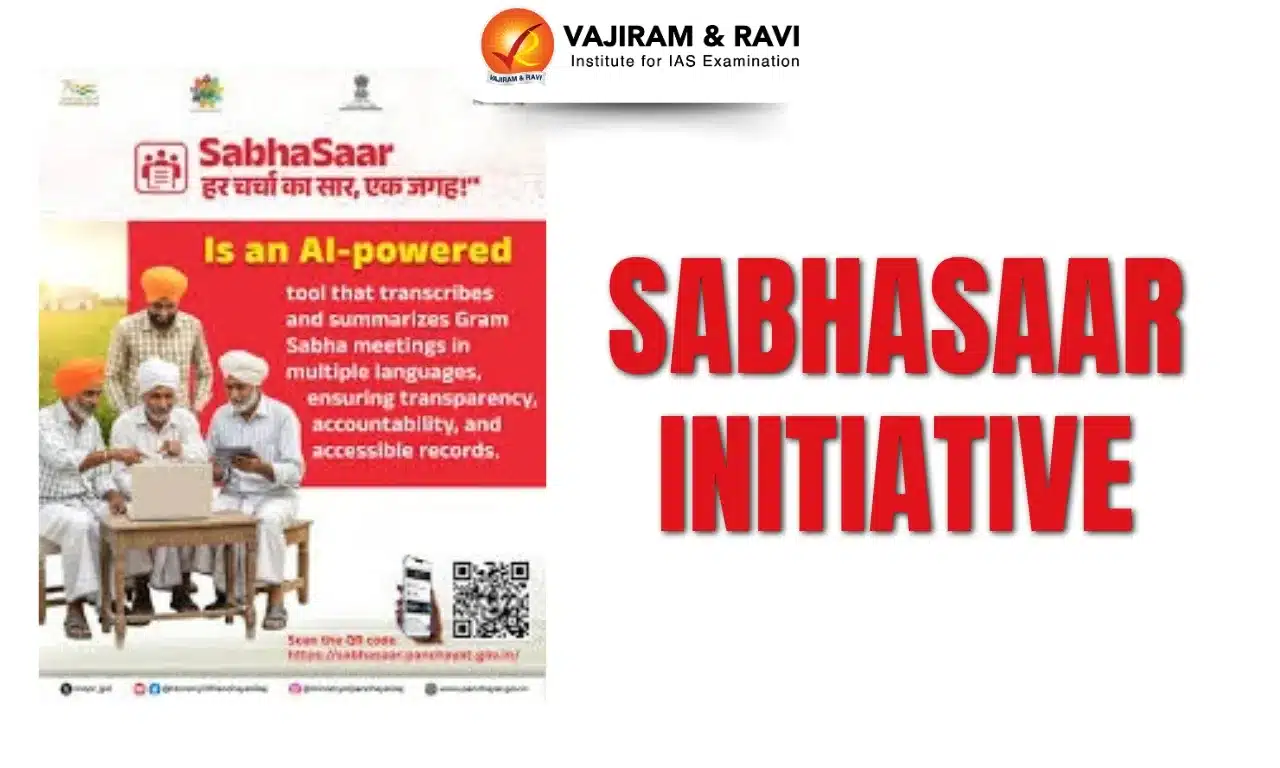
  • It is an AI-enabled voice-to-text meeting summarisation tool.
  • It is launched by the Ministry of Panchayati Raj.
  • SabhaSaar has been made available to all States/UTs, and Gram Panchayats are progressively adopting it for routine Gram Sabha and Panchayat meetings.
  • The AI model used in SabhaSaar operates on AI and cloud infrastructure provisioned through the India AI Compute Portal under the India AI Mission of MeitY. 

Features of SabhaSaar Initiative

  • It leverages the power of AI to generate structured minutes of meetings from gram sabha videos and audio recordings.
  • It will bring uniformity in minutes of the gram sabha meetings across the country.
  • Panchayat officials can use their e-GramSwaraj login credentials to upload video/audio recordings on ‘SabhaSaar’.
  • It is built on Bhashini, an AI-powered language translation platform launched by the government to bridge literacy, language, and digital divides.
  • The tool generates transcription from a video or audio, translates it into a chosen output language and prepares a summary.
  • It enables transcription in all major Indian languages like Hindi, Bengali, Tamil, Telugu, Marathi and Gujarati, in addition to English.
  • Significance: It is ideal for panchayats, administrative bodies, and rural development projects as it streamlines documentation and empowers stakeholders with instant access to meeting insights.

Source: PIB

SabhaSaar Initiative FAQs

Q1: What is SabhaSaar?

Ans: An AI-powered tool for Gram Sabha meetings

Q2: What is the primary purpose of SabhaSaar?

Ans: To enhance transparency and accountability in Gram Sabhas

Development Communication and Information Dissemination Scheme

Development Communication and Information Dissemination Scheme

Development Communication and Information Dissemination Scheme Latest News

Recently, the Minister of State for Information and Broadcasting informed the Lok Sabha about the Development Communication and Information Dissemination Scheme.

About Development Communication and Information Dissemination Scheme

  • It is a Central Sector Scheme of the Ministry of Information and Broadcasting.
  • It supports the information dissemination and citizen outreach of Government programmes/ schemes/initiatives.
  • It emphasizes on reaching out to the rural, tribal, remote and urban populations across the country.
  • Implementation: The scheme is implemented by the Ministry of Information and Broadcasting through its media units - Central Bureau of Communication (CBC), Press Information Bureau (PIB), and New Media Wing (NMW).
    • CBC carries out a number of public multimedia campaigns for information dissemination about the various schemes of the Government like Swacch Bharat Mission, Pradhan Mantri Awas Yojana- Rural & Urban, Jal Jeevan Mission etc.

What is the Central Bureau of Communication (CBC)?

  • It is a unit of the Ministry of Information and Broadcasting.
  • Mandate: It has a mandate of providing 360 degrees communication solutions to Ministries, Departments, Public Sector Undertakings (PSUs), and autonomous bodies.
  • Background: It was set up on 8th December 2017 by the integration of the erstwhile Directorate of Advertising and Visual Publicity (DAVP), Directorate of Field Publicity (DFP), and Song & Drama Division (S&DD).
  • Function: It is engaged in the process of educating people, both rural and urban, about the Government’s policies and programmes to evoke their participation in developmental activities.

Source: PIB

Development Communication and Information Dissemination Scheme FAQs

Q1: What is the primary objective of the Development Communication and Information Dissemination Scheme?

Ans: To disseminate information about government schemes

Q2: Which ministry is responsible for implementing the Development Communication and Information Dissemination Scheme?

Ans: Ministry of Information and Broadcasting

Freshwater Sponge

Freshwater Sponge

Freshwater Sponge Latest News

Recently, scientists from Bose Institute studied freshwater sponges from the Sundarban delta and identified their potential to act as bioindicators of toxic metal pollution.

About Freshwater Sponge

  • Freshwater sponges are the earliest multicellular eukaryotes.
  • They filter large volumes of water and are vital for ecosystem health.
  • Habitat: They grow on sturdy submerged objects in clean streams, lakes, and rivers.
  • Sponges are filter feeders. They obtain food from the flow of water through their bodies and from symbiotic algae. 
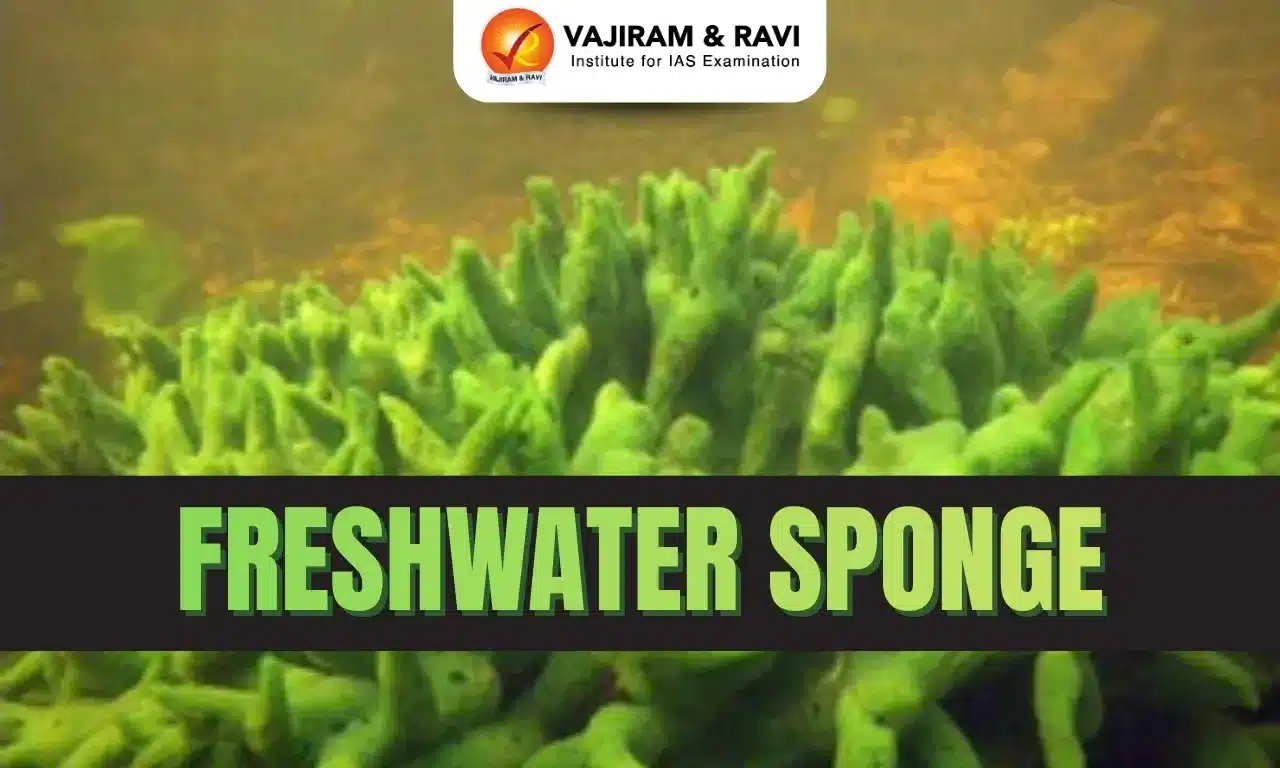
  • Appearance: Many freshwater sponges appear green because they contain algae, which live on sponges in a symbiotic relationship.
  •  Reproduction: They can reproduce sexually, or asexually.
    • When a small piece is broken off and grows into new sponges.
    • The sponge forms gemmules—tiny reproductive spheres that can overwinter and later hatch and form new sponges.
  • Ecological Role: They act both as bioindicators and absorbents of toxic metals like arsenic, lead, and cadmium and can be a promising solution for bioremediation.
  • They are effective bio indicators for monitoring water quality and pollution levels in estuarine and freshwater ecosystems.

Source: PIB

Freshwater Sponge FAQs

Q1: What is the habitat of Freshwater Sponge?

Ans: Freshwater lakes and rivers

Q2: Which phylum do Freshwater Sponges belong to?

Ans: Porifera

Kheoni Wildlife Sanctuary

Kheoni Wildlife Sanctuary

Kheoni Wildlife Sanctuary Latest News

Recently, the forest department officially recorded sightings of two Wild Dogs (Dholes) in Kheoni wildlife sanctuary.

About Kheoni Wildlife Sanctuary

  • Location: It is located in the state of Madhya Pradesh.
  • It is joined through the Ratapani Tiger Reserve corridors with.
  • Vegetation: The sanctuary’s habitat consists of dry deciduous forests.
  • Fauna: Its wildlife includes jackals, palm civets, Leopards, Sloth bears, Hyenas, Nilgai, and many bird species.
  • Flora: Teak, Tendu, Bamboo, Kusum, Kanak Champa, Ber, Karanj, Kaim, Kadamb etc.

Key Facts about Dhole

  • It is a wild canid carnivorous species.
  • Other Names: Indian wild dog, whistling dog, red wolf, red dog and mountain wolf.
  • Habitat:  Dholes are animals that inhabit dense jungles, steppes, mountains, scrub forests, and pine forests.

Distribution of Asiatic Wild Dog

  • They are found throughout Central, Eastern Asia and Southeastern Asia. 
  • In India, the Western and Eastern Ghats is a stronghold region for dholes.

Conservation status of Asiatic Wild Dog

  • IUCN Red List: Endangered
  • CITES: Appendix II
  • Wildlife Protection Act 1972: Schedule II.

Source: TOI

Kheoni Wildlife Sanctuary FAQs

Q1: Where is Kheoni Wildlife Sanctuary located?

Ans: Madhya Pradesh

Q2: What is the primary habitat of Kheoni Wildlife Sanctuary?

Ans: Tropical dry deciduous forest

105th Constitutional Amendment Act, Important Dates, Significance

105th Constitutional Amendment Act

The 105th Constitutional Amendment Act, 2021 officially titled the Constitution (One Hundred and Fifth Amendment) Act restored the authority of State governments to identify Socially and Educationally Backward Classes (SEBCs), including Other Backward Classes (OBCs). This amendment was introduced in response to a Supreme Court ruling in 2021, which interpreted the 102nd Amendment as having taken away this power from the States. To address the issue promptly, the amendment was passed by both Houses of Parliament and received Presidential assent on August 18, 2021.

105th Constitutional Amendment Act

The Constitution (One Hundred and Fifth Amendment) Act, 2021 reaffirmed the authority of state governments to identify and notify Socially and Educationally Backward Classes (SEBCs), which include communities such as Other Backward Classes (OBCs). This amendment clarified the state’s power to prepare and maintain their own list of SEBCs, following concerns raised after a Supreme Court judgment. It was enacted after receiving the assent of the President of India on August 18, 2021. As of September 28, 2023, the Indian Constitution has undergone a total of 106 amendments since it came into effect in 1950.

105 Constitutional Amendment Act

The 105th Constitutional Amendment Act, 2021 is the most recent amendment to the Indian Constitution. Its purpose is to restore the power of state governments to identify and list Other Backward Classes (OBCs) who are socially and educationally backward.

This amendment modifies clauses (1) and (2) of Article 342A and introduces a new clause (3). It also amends Articles 366(26C) and 338B. The key takeaway is that states retain the authority to maintain their own OBC lists.

The 102nd Amendment had created a Central List of OBCs controlled solely by the Centre, without affecting the state’s powers. However, confusion over its interpretation raised concerns that states might lose the right to identify backward communities.

It ensures that around 671 OBC communities can continue to access reservation benefits in state-run education and employment benefits they might have lost if the state lists were invalidated.

Also Check: 103rd Constitutional Amendment Act

Prime Reasons for Latest Amendment of the Indian Constitution (105th)

The 105th Constitutional Amendment Act was enacted to restore the authority of states and Union Territories to maintain their own lists of Other Backward Classes (OBCs). Under Articles 15(4), 15(5), and 16(4) of the Indian Constitution, states are empowered to identify and declare socially and educationally backward classes. In practice, both the Centre and individual states maintain separate OBC lists. The need for this amendment arose following the Supreme Court's judgment in the Maratha reservation case, which upheld the 102nd Constitutional Amendment Act. That amendment had introduced Articles 338B and 342A, placing the power to specify backward classes with the President, in consultation with Governors, thereby limiting the role of states. The 105th Amendment sought to clarify and reinstate the state’s legislative competence in this domain.

Important Dates & Events Directing to the 105th Amendment of the Indian Constitution

The table below includes the Important Dates & Events Directing to the 105th Amendment of the Indian Constitution:

Important Dates & Events Directing to the 105th Amendment of the Indian Constitution
Name of the Act/Report Year Effectiveness

Mandal Commission Report

1980

  • The Mandal Commission submitted its report in 1980. It was established in 1979.
  • Suggested reservations for OBCs for employment and education, impacting prospective amendments and lawful actions, including the 105th Amendment.

Supreme Court Judgment in Indra Sawhney Case

1992

  • On November 16, 1992, the Mandal recommendations introduced a 50% cap on reservations and excluded the "creamy layer" of OBCs.
  • Set legal precedents that influenced the 105th Amendment of the Indian Constitution.

Maharashtra SEBC Act


2018

  • On November 30, 2018, Maharashtra law provided reservations for Marathas under SEBC.
  • Highlighted a constitutional amendment to clarify states in determining SEBCs.

Supreme Court Judgment in Maratha Quota Case


2021

  • On May 5, 2021, the Maharashtra SEBC Act was struck down, stating that states couldn't identify SEBCs after the 102nd Amendment.
  • Demonstrated the need for the 105th Amendment of the Indian Constitution to restore states' powers.

Introduction of the 105th Amendment of the Indian Constitution Bill


2021

  • On August 9, 2021, introduced in the Lok Sabha.
  • Aimed to amend the Constitution to restore states' power to identify SEBCs.

Passage of the 105th Amendment of Indian Constitution Bill


2021

  • On August 10-11, 2021, Passed by Lok Sabha and Rajya Sabha.
  • Demonstrated broad consensus and urgency.

Presidential Assent


2021

  • The President gave assent on August 18, 2021, making it official.
  •  Restored states' power to identify and notify SEBCs.

105th Constitutional Amendment Significance

The 105th Constitutional Amendment Act, 2021 is one of the most recent additions to the Indian Constitution. Its primary objective is to restore and clarify the authority of State Governments in identifying and notifying Other Backward Classes (OBCs) who are socially and educationally disadvantaged. Enacted on August 18, 2021, this Amendment marks a significant step in reinforcing the federal structure and the legislative process through which social justice is implemented across India.

  • The Act reinforces the State’s exclusive power to identify OBCs for their respective territories, ensuring the continuation of state-specific welfare measures.
  • It establishes that the Central List of OBCs will only be applicable to the Central Government and its institutions.
  • The Amendment does not interfere with State Lists or limit the State’s authority to recognize or notify backward communities.
  • Nearly 671 OBC communities stood to lose reservation benefits in education and employment if the State List had been abolished. This Amendment safeguards their rights.
  • It reflects the government's commitment to social justice, equality, and inclusive development, particularly for historically marginalised communities.

Also Check: 104th Constitutional Amendment Act

105th Constitutional Amendment Impact

The 105th Constitutional Amendment Act brought notable changes by amending Clauses (1) and (2) of Article 342A and inserting a new Clause (3). It made corresponding amendments to Articles 366 and 338B. The primary objective of this Amendment was to restore the authority of state governments to identify and notify Socially and Educationally Backward Classes (SEBCs) for their respective states.

By modifying the above-mentioned provisions, the Amendment reinstated the power of states to maintain their own list of SEBCs, an authority that had been reduced following the Supreme Court’s interpretation in the Maratha reservation judgment. This legislative intervention aimed to strike a balance between the centralised framework of backward class identification and the federal structure of governance.

The debate over reservations both in support and opposition has been ongoing for decades. Despite several decades of independence, India continues to grapple with socio-economic disparities. The 105th Amendment marks another legislative effort towards achieving social justice and equal opportunity by enabling states to better address the specific needs of underrepresented communities within their jurisdictions.

105th Constitutional Amendment Act FAQs

Q1: What is the 105th Constitutional Amendment Act, 2021?

Ans: The 105th Amendment restores state’s power to identify and notify socially and educationally backward classes (SEBCs) for their respective lists.

Q2: When was the 105th Constitutional Amendment enacted?

Ans: It received Presidential assent on 18 August 2021 and came into effect retrospectively from 15 August 2021.

Q3: Why was the 105th Amendment necessary?

Ans: It was enacted following the Supreme Court’s interpretation in the Maratha reservation case, which limited state powers on OBC identification.

Q4: Which Articles were amended by the 105th Amendment?

Ans: The amendment changed Articles 338B and 342A and added a new clause to Article 366 of the Constitution.

Q5: What does Article 342A deal with after the 105th Amendment?

Ans: Article 342A allows the President to notify the central list of SEBCs and empowers states to maintain their own SEBC lists.

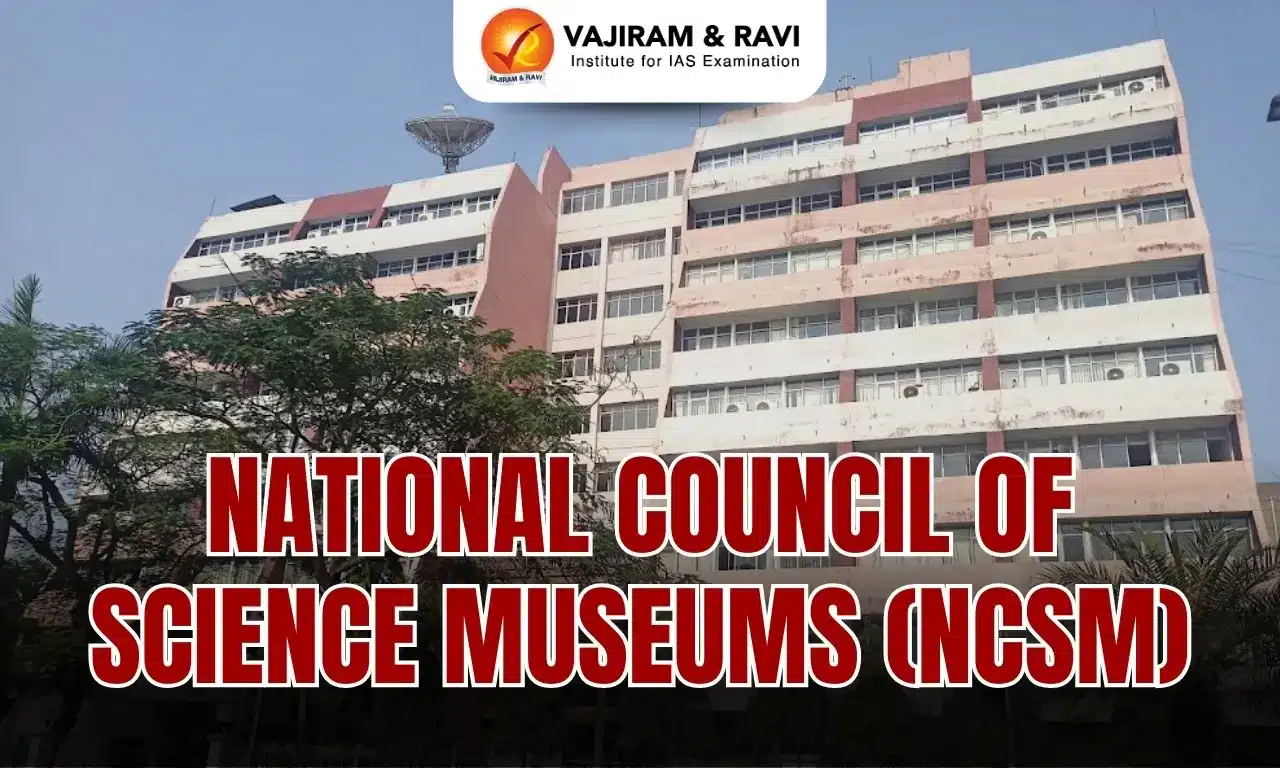
National Council of Science Museums (NCSM)

National Council of Science Museums (NCSM)

National Council of Science Museums Latest News

The National Council of Science Museums (NCSM) recently received two prestigious PRSI National Awards 2025 from the Public Relations Society of India (PRSI).

About National Council of Science Museums

  • It is an autonomous society under the Ministry of Culture, Government of India.
  • It was formed on April 4, 1978.
  • NCSM, with its headquarters in Kolkata, has its own network of 26 science museums/centres spread across the country and a Central Research & Training Laboratory (CRTL) in Kolkata. 
  • CRTL is the Council’s central hub for professional training, research, and development. 
  • National-Level Centres of NCSM:
    • Science City, Kolkata
    • Birla Industrial and Technological Museum (BITM), Kolkata 
    • Nehru Science Centre, Mumbai
    • Visvesvaraya Industrial and Technological Museum (VITM), Bangalore 
    • National Science Centre, Delhi
    • National Science Centre, Guwahati 
  • Except for Science City, Kolkata, all have regional and sub-regional/district science centres called Satellite Units (SUs).
  • In addition, NCSM develops Science Centres/museums for different States and Union Territories.
  • NCSM has also developed several centres and galleries for different Govt. organisations such as ONGC, BEL, ICAR, etc.
  • It has also collaborated internationally for the development of Museum/Science Centres or for galleries such as the Rajiv Gandhi Science Centre, Mauritius; ‘India’ gallery on Buddhism at the ‘International Buddhist Museum’, Kandy, Sri Lanka; etc.
  • It also strives to communicate science to empower people through its Mobile Science Exhibitions, Lectures and Demonstrations, Training and Workshops, Publications, etc. 
  • Today, NCSM forms the largest network of science centres and museums in the world under a single administrative umbrella.

Source: PIB

National Council of Science Museums (NCSM) FAQs

Q1: What is the National Council of Science Museums (NCSM)?

Ans: It is an autonomous society under the Ministry of Culture, Government of India.

Q2: Where is the headquarters of the National Council of Science Museums (NCSM) located?

Ans: Kolkata

Q3: How many science museums/centres are currently operated by National Council of Science Museums (NCSM) across India?

Ans: 26

Q4: What makes National Council of Science Museums (NCSM) unique globally?

Ans: It forms the largest network of science centres and museums under a single administrative body.

Three New Moth Species

Three New Moth Species

Three New Moth Species Latest News

Researchers recently identified three previously unknown species of moths that had remained hidden in the high-altitude landscapes of the Himalayas.

About Three New Moth Species

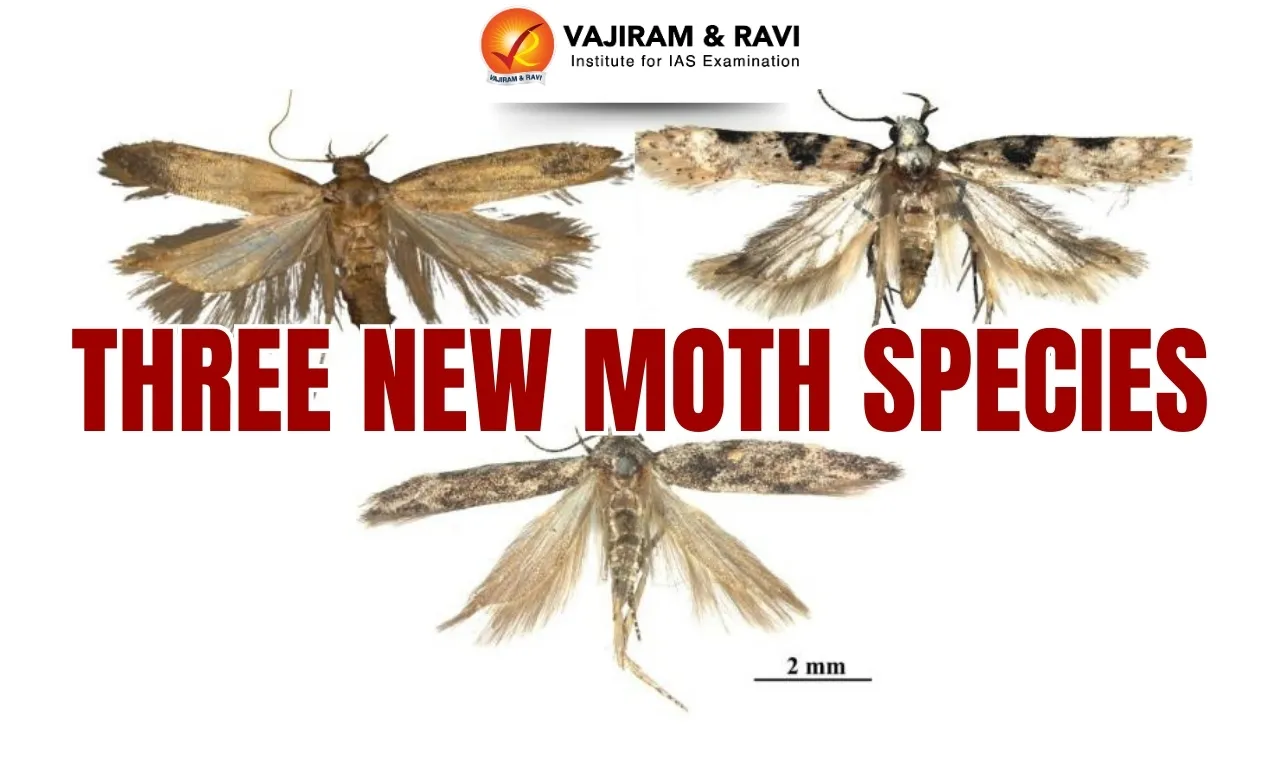
  • The three species are Gelechia bilobuncusa, Gelechia adi, and Istrianis ladakhensis.
  • They were discovered in the high-altitude landscapes of the Himalayas. 
  • Gelechia bilobuncusa:
    • It was found in Himachal Pradesh. 
    • Its name is a scientific nod to the unique bilobed shape of its uncus, a part of the male genitalia. 
    • It is characterised by pale brown wings with irregularly scattered black scales.
  • Gelechia adi:
    • It was discovered in the Ramsing area of Arunachal Pradesh.
    • It is named in honour of the local Adi tribe inhabiting the Upper Siang district. 
    • It is visually distinct, featuring ivory-white forewings interrupted by a dramatic black streak across the base and triangular spots.
  • Istrianis ladakhensis:
    • It is named after its type locality in Ladakh. 
    • This moth is adapted to the high-altitude environment, sporting light brown wings mottled with dark grey, white, and orange scales, distinguishing it from its closest relatives in the genus.

What are Moths?

  • Moths are insects that belong to the order Lepidoptera, which they share with butterflies.
  • There are around 160,000 known species of moths, far outnumbering butterfly species.
  • Highly adapted, they live in all but polar habitats. 
  • Moths vary greatly in size, ranging in wingspan from about 4 mm (0.16 inch) to nearly 30 cm (about 1 foot).
  • They often have duller colors compared to butterflies, which helps with camouflage. Some, like the luna moth or atlas moth, are vividly colored.
  • Moth antennae are often feathery, unlike the thin and clubbed antennae of butterflies.
  • Most moths are active at night, but some are diurnal.
  • The larvae and adults of most moth species are plant eaters.

Source: RM

Three New Moth Species FAQs

Q1: Gelechia bilobuncusa was discovered in which Indian state?

Ans: Himachal Pradesh

Q2: Gelechia adi is named in honour of which indigenous group?

Ans: It is named in honour of the local Adi tribe inhabiting the Upper Siang district of Arunachal Pradesh

Q3: What is the wing coloration of Istrianis ladakhensis?

Ans: It has light brown wings mottled with dark grey, white, and orange scales.

Q4: What type of environment is Istrianis ladakhensis adapted to?

Ans: It is adapted to high-altitude Himalayan environments.

Hormuz Island

Hormuz Island

Hormuz Island Latest News

A breathtaking natural phenomenon recently turned Iran's Hormuz Island into a global talking point, as its coastlines transformed into a surreal blood-red landscape overnight.

About Hormuz Island

  • It is a hilly island of Iran on the Strait of Hormuz, between the Persian Gulf and the Gulf of Oman, 8 km off the coast.
  • It covers an area of 41.9 sq. km. 
  • It is known for its unique scenery and colorful soil, which has earned it the nickname, “Rainbow Island”.
  • It is covered by sedimentary rock and volcanic ash.
  • Because of the lack of precipitation, the soil and water on the island are salty
  • The landscape of Hormuz Island is mostly red in color. This is due to a high concentration of iron oxide, especially a mineral called hematite
  • Whenever waves from the ocean hit the sands of Hormuz Island, those waves turn pink. 
  • But although the island is well-known for its red landscape, it is also known for various other colors.
  • Colors to be seen in the island’s sand and soil include red, gold, silver, and white. 
  • It is mostly barren. Hormuz village is the only permanent settlement. 
  • Fishing is the main source of income on the island.
  • People native to the island belong to an ethnic group known as the Bandari.

Source: NDTV

Hormuz Island FAQs

Q1: Where is Hormuz Island located?

Ans: It is located in Iran, on the Strait of Hormuz between the Persian Gulf and the Gulf of Oman.

Q2: Why is Hormuz Island referred to as the “Rainbow Island”?

Ans: Because of its colorful soil and sands, which display shades like red, gold, silver, and white.

Q3: Which mineral is primarily responsible for the red color of Hormuz Island’s landscape?

Ans: Hematite (iron oxide).

Q4: Which ethnic group is native to Hormuz Island?

Ans: The Bandari people.

Regional Rural Banks (RRBs)

Regional Rural Banks (RRBs)

Regional Rural Banks (RRBs) Latest News

The Finance Ministry recently unveiled a new logo for Regional Rural Banks (RRBs) to signify a single and unified brand identity.

About Regional Rural Banks (RRBs)

  • RRBs were established in India to promote financial inclusion in rural areas. 
  • They are formed in collaboration by the Central Government, State Governments, and Sponsoring Commercial Banks to give loans to rural areas.
  • Their mission is to fulfill the credit needs of the relatively unserved sections in rural areas: small and marginal farmers, agricultural labourers, and socio-economically weaker sections.
  • Origin:
    • It was established under the Regional Rural Banks Act, 1976, on the recommendation of the Narasimham Committee on Rural Credit (1975). 
    • Rathama Grameen Bank was the first RRB bank and was established on 2nd October 1975.
  • RRBs were configured as hybrid microbanking institutions, combining the local orientation and small-scale lending culture of the cooperatives with the business culture of commercial banks.
  • The RRBs mobilize financial resources from rural/semi-urban areas and grant loans and advances mostly to small and marginal farmers, agricultural labourers, artisans, and small entrepreneurs. 
  • RRBs perform various functions in the following heads:
    • Providing banking facilities to rural and semi-urban areas.
    • Carrying out government operations like the disbursement of wages of MGNREGA workers, distribution of pension, etc.
    • Providing Para-Banking facilities like locker facilities, debit and credit cards, mobile banking, internet banking, UPI, etc.
  • The RBI has set a Priority Sector Lending (PSL) target of 75% of total outstanding advances for RRBs as against 40% for Scheduled Commercial Banks. 
  • Ownership: Sponsored by the Commercial Banks, the equity of RRBs is held by the central government, concerned state government, and the sponsor bank in the proportion of 50:15:35. 
  • The area of operation of RRBs is limited to the area as notified by the Government of India, covering one or more districts in the State. 
  • Regulation: Regional Rural Banks are regulated by the RBI and supervised by the National Bank for Agriculture and Rural Development (NABARD).
  • Sources of Funds: It comprises owned funds, deposits, borrowings from NABARD, sponsor banks and other sources, including SIDBI and the National Housing Bank.
  • Management: The Board of Directors manages these banks, overall affairs, which consists of one Chairman, three Directors as nominated by the Central Government, a maximum of two Directors as nominated by the concerned State Government, and a maximum of three Directors as nominated by the sponsor bank.
  • At present, 28 RRBs operate across the country with a vast network of over 22 thousand branches in more than 700 districts.

Source: TH

Regional Rural Banks (RRBs) FAQs

Q1: Why were Regional Rural Banks (RRBs) established in India?

Ans: To promote financial inclusion and provide credit to rural and underserved sections of society.

Q2: On whose recommendation were Regional Rural Banks (RRBs) established?

Ans: The Narasimham Committee on Rural Credit (1975).

Q3: Which was the first Regional Rural Bank in India?

Ans: Prathama Grameen Bank (established on 2nd October 1975).

Q4: What is the main mission of RRBs?

Ans: To meet the credit needs of small and marginal farmers, agricultural labourers, and socio-economically weaker sections in rural areas.

Q5: Who owns the equity of Regional Rural Banks (RRBs) and in what ratio?

Ans: Central Government (50%), State Government (15%), and Sponsor Bank (35%).

Physiographic Divisions of India, Formation, Geographical Importance

Physiographic Divisions of India

The Physiographic Divisions of India have a great diversity of relief features. These physiographic divisions help in understanding the geography of the country, its ecology, agriculture and socio-economic development. In this article, we are going to cover the Physiography divisions of India, its formation, geomorphology and importance. 

Physiography 

Physiography is the study of the physical features of the earth’s surface and  its relations to the geological structure. The physiography of a place helps in the understanding of the physical characteristics of a place, including river, valleys, mountains, plains and plateaus. 

Physiographic Divisions of India

The Physiographic divisions of India are sub-divided into 5 physiographic divisions: 

  1. The Himalayas
  2. The Indo-Gangetic Plains
  3. The Peninsular Plateau of India
  4. The Coastal Plains of India
  5. The Indian Islands

A brief description of each of the 5 physiographic divisions of India is given in the sections that follow.

The Himalayas

The Himalayas are young fold mountains that were formed by the collision of the Indo-Australian Plate with the Eurasian Plate many years ago. They form a natural boundary in between the Tibetan Plateau in the north and the Indian Subcontinent in the south. This acts like a watershed in the indo-gangetic and tibetan river systems. 

Latitudinal Divisions of the Himalayas

  1. Trans-Himalayas
  2. The Himalayan Mountain Ranges
  3. The Eastern Hills or Purvanchal

Longitudinal Divisions of the Himalayas

  1. Punjab Himalayas
  2. Kumaon Himalayas
  3. Nepal Himalayas
  4. Assam Himalayas

The Great Plains of North India

The Great Plains of North India are also known as the Indo-Gangetic Brahmaputra Plains and are present south of the Himalayas and stretch from the mouth of the Indus in the west to the mouth of Ganga in the east. Formed by alluvial deposits from the Indus, Ganga and Brahmaputra rivers as well as their tributaries, the great plains of North India occupy the depression between the Peninsular Plateau and the Himalayas. 

Regional Divisions of the Indo-Gangetic Plains

  1. The Rajasthan Plain
  2. The Punjab-Haryana Plain
  3. The Ganga Plain
  4. The Brahmaputra Plain

The Peninsular Plateau of India 

The Peninsular Plateau happens to be the oldest and the largest physiographic divisions of India. Located in the southern part of the country, the plateau is covered by water on three sides. There are many small plateaus all separated by river valleys and hill ranges. 

Major Plateaus

  • Marwar Upland
  • Central Highlands (Madhya Bharat Pathar)
  • Bundelkhand Upland
  • Malwa Plateau
  • Baghelkhand
  • Chotanagpur Plateau
  • Meghalaya (Shillong) Plateau
  • Deccan Plateau
  • Chhattisgarh Plain

Major Hill Ranges

  • Aravali Range
  • Vindhyan Range
  • Satpura Range
  • Western Ghats (Sahyadris)
  • Eastern Ghats

The Coastal Plains of India

The Coastal Plains of India consists of a narrow stretch between the Peninsular Plateau and India’s coastline, extending about 6,000 km along the Arabian Sea and the Bay of Bengal. 

  1. Western Coastal Plains
  2. Eastern Coastal Plains

The Indian Islands

India’s islands are scattered in the Indian Ocean, Arabian Sea, and Bay of Bengal, and are classified into two main groups:

  1. Andaman and Nicobar Islands
  2. Lakshadweep Islands

Physiographic Divisions of India FAQs

Q1: What is the physiographic division of India?

Ans: India is divided into six major physiographic divisions - The Himalayas, The Indo-Gangetic Plains, The Peninsular Plateau, The Coastal Plains, The Indian Desert, and The Islands.

Q2: What is physiography in short notes?

Ans: Physiography is the study of the physical features, landforms, and terrain of the Earth’s surface.

Q3: Where are the Coastal Plains of India located?

Ans: The Coastal Plains lie between the Peninsular Plateau and the coastlines along the Arabian Sea (west) and Bay of Bengal (east).

Q4: Which states are covered by the Aravalli hill range?

Ans: The Aravalli Range passes through Rajasthan, Haryana, Gujarat, and Delhi.

Q5: What do you mean by physiographic divisions?

Ans: Physiographic divisions are distinct natural regions of land classified based on their physical features, geology, and relief.

White Spot Disease

White Spot Disease

White Spot Disease Latest News

Recently, the Minister of Fisheries, Animal Husbandry and Dairying, Government of India informed the Rajya  Sabha about the white spot disease.

About White Spot Disease

  • It is a highly contagious viral infection that affects crustaceans such as prawns, yabbies and crabs.
  • Causative Agent:  It is caused by a virus called as White Spot Syndrome Virus (WSSV). This is a double stranded DNA virus of the genus Whispovirus and family Nimaviridae.
  • Host range: All decapod crustaceans (order Decapoda), including prawns, lobsters and crabs from marine, brackish or freshwater environments, are considered susceptible to infection.
  • Symptoms: The affected shrimp exhibit anorexia, lethargy, reddish discoloration and presence of circular white spots on the carapace and other exoskeletal parts.
  • Transmission: It can be transmitted both horizontally as well as vertically.
    • Vertical transmission: It occurs from infected brood stock to postlarvae.
    • Horizontal transmission: It is through carrier animals or through cannibalism of infected organisms.
  • It has been officially reported from Bangladesh, Burma (Myanmar), Cambodia, China, Hong Kong, India, Indonesia, Iran, Japan, Malaysia, the Philippines, the Republic of Korea, Singapore, Thailand and Vietnam.

Source: PIB

White Spot Disease FAQs

Q1: What is the primary symptom of White Spot Disease?

Ans: hite spots on the skin and gills on species.

Q2: Which fishes are susceptible to White Spot Disease?

Ans: Both Freshwater fish and Marine fish

Goa Liberation Day 2025, History, Operation Vijay, Significance

Goa Liberation Day 2025

Goa Liberation Day 2025 is observed every year on 19 December to commemorate the historic liberation of Goa from Portuguese colonial rule. On this day in 1961, Goa officially became free after more than 450 years of foreign domination, marking the final phase of India’s decolonization process. The day holds immense national, historical, and emotional significance for the people of Goa and the entire country.

Goa Liberation Day 2025 History

Goa Liberation Day marks the end of Portuguese colonial rule in Goa, which lasted for over 450 years from 1510. Despite India’s independence in 1947, Goa remained under Portuguese control due to their refusal to withdraw. After prolonged resistance and failed diplomacy, Goa was finally liberated on 19 December 1961.

  • Portuguese captured Goa in 1510, making it one of their longest-held colonies.
  • Goa, Daman, and Diu were termed “overseas provinces” by Portugal, not colonies.
  • Several Goan freedom fighters led protests against colonial repression.
  • India tried diplomatic and peaceful means between 1947 and 1961 to resolve the issue.
  • Portugal rejected UN resolutions calling for decolonization.
  • Growing public unrest in Goa strengthened the demand for integration with India.
  • India launched Operation Vijay in December 1961 after diplomacy failed.
  • Goa was formally liberated on 19 December 1961, ending Portuguese rule in India.

Operation Vijay 1961

Operation Vijay was the military operation launched by India to liberate Goa, Daman, and Diu from Portuguese colonial rule in December 1961. The operation began on 18 December 1961 after repeated diplomatic efforts failed.

  • Launched on 18 December 1961 to end Portuguese rule in Goa.
  • Conducted jointly by the Indian Army, Navy, and Air Force.
  • Indian forces advanced through land, sea, and air routes.
  • Portuguese troops were poorly equipped and heavily outnumbered.
  • The Portuguese Governor-General Manuel António Vassalo e Silva surrendered.
  • The surrender took place on 19 December 1961.
  • Operation Vijay led to the peaceful integration of Goa, Daman, and Diu with India.
  • It marked the final phase of India’s territorial integration after independence.

Contribution of Freedom Fighters in Goa Liberation

The liberation of Goa was the result of sustained efforts by freedom fighters who opposed Portuguese colonial rule through protests, underground movements, and political mobilization.

  • Goan freedom fighters organized anti-colonial movements against Portuguese rule.
  • T.B. Cunha is regarded as the father of the Goan freedom struggle.
  • Leaders like Tristão de Bragança Cunha raised awareness at national and international levels.
  • Dr. Ram Manohar Lohia inspired mass protests in Goa in 1946.
  • Underground groups carried out resistance despite harsh colonial laws.
  • Many activists faced imprisonment, exile, and censorship.
  • Popular support strengthened the demand for merger with India.
  • Their long struggle laid the foundation for Operation Vijay in 1961.

Goa Liberation Day 2025 Significance

Goa Liberation Day 2025 holds great national and historical importance as it marks the liberation of Goa from Portuguese colonial rule on 19 December 1961. The day symbolizes the completion of India’s freedom struggle and the end of the last remaining European colonial presence in the country.

  • Symbolizes the final phase of India’s decolonization process.
  • Highlights the success of India’s diplomatic efforts backed by decisive action.
  • Honors the sacrifices of Goan freedom fighters and Indian armed forces.
  • Strengthens the sense of national unity and integration.
  • Reinforces the values of freedom, sovereignty, and self-rule.

Goa Liberation Day 2025 FAQs

Q1: When is Goa Liberation Day celebrated?

Ans: Goa Liberation Day is celebrated every year on 19 December.

Q2: Why is Goa Liberation Day important?

Ans: It marks the liberation of Goa from Portuguese rule and the end of colonialism in India.

Q3: Which operation led to the liberation of Goa?

Ans: Goa was liberated through Operation Vijay in 1961.

Q4: Who ruled Goa before its liberation?

Ans: Goa was ruled by the Portuguese for over 450 years.

Q5: When did Goa become a state of India?

Ans: Goa became a full-fledged state in 1987.

Daily Editorial Analysis 19 December 2025

Daily Editorial Analysis

Cutting off a Rural Lifeline and the Directive Principles

Context

  • The central government’s move to replace the Mahatma Gandhi Rural Employment Guarantee Act (MGNREGA) represents a fundamental attack on India’s constitutional vision of social and economic justice.
  • Passed using the government’s majority in the Lok Sabha, the proposed Bill alters the very nature of MGNREGA by dismantling its rights-based and democratic framework.
  • This is not a routine policy reform but a serious erosion of the Directive Principles of State Policy and a direct assault on the rural working poor, warranting scrutiny by the Standing Committee of Parliament.

Constitutional Foundations of the Right to Work

  • Article 41 of the Constitution directs the State to make effective provision for securing the right to work within its economic capacity.
  • During the Constituent Assembly debates, this provision emerged as a compromise between socialist members, who sought to make the right to work a fundamental right, and capitalist interests, who opposed such an obligation.
  • As a result, the right to work was placed among the Directive Principles, non-justiciable but central to economic democracy.
  • B.R. Ambedkar described the Directive Principles as instruments of instruction essential for economic democracy, while K.T. Shah dismissed them as pious wishes.
  • Decades of unemployment and exclusion under capitalist development have shown how fragile this constitutional promise remained until political circumstances forced a shift.

MGNREGA Act

  • The Act guaranteed 100 days of work per rural household, was universal, and open to all adults willing to perform manual labour.
  • Crucially, it was demand-driven, responding to actual need rather than fixed bureaucratic targets.
  • This structure gave MGNREGA deep democratic content. Households retained freedom to seek better employment while relying on MGNREGA as a fallback.
  • Equal wages for men and women, full central funding of wages, and meaningful roles for States and panchayats strengthened its inclusive and federal character.
  • It was among the first such laws in the capitalist world.

Concerns Surrounding the Proposed Viksit Bharat- G RAM G Bill 2025

  • Dismantling the Core Features of MGNREGA

    • The proposed Bill under the Modi government scraps these foundational principles.
    • The demand-driven mechanism is replaced by normative financial allocations fixed by the Centre, absolving it of legal responsibility once funds are exhausted.
    • At the same time, States are burdened with 40% of costs, despite ongoing fiscal stress and denial of their fair share of tax revenues.
    • The Bill introduces extreme centralisation, transferring control over project design, implementation, and audits to the Union government.
  • Undermining the Federal Structure

    • This undermines the federal structure of the Constitution and marginalises States and panchayats, which earlier had authority to design projects based on local needs.
    • A clear class bias is evident in the prohibition of work during peak agricultural seasons. With increased mechanisation, agricultural employment has shrunk sharply.
    • Evidence shows that workers opt for MGNREGA during peak seasons only when agricultural wages fall below MGNREGA rates or work is unavailable.
    • The ban weakens workers’ bargaining power, forcing them into exploitative conditions imposed by large landowners, disproportionately harming women.
  • Digital Exclusion and Symbolic Politics

    • The Bill legalises Aadhaar linkage and mandatory digital attendance for eligibility and wage payments, despite widespread evidence of exclusion due to poor connectivity and technical failures.
    • These measures transform a rights-based guarantee into a bureaucratic hurdle.
    • Renaming the scheme as the Viksit Bharat–G RAM G Bill 2025 reflects symbolic politics rather than substantive reform and risks provoking widespread resistance from those whose livelihoods are threatened.

Social Realities and Agrarian Distress

  • The harsh working conditions under MGNREGA highlight persistent rural distress.
  • Women often lift up to 3,000 kilograms of mud per day to meet productivity norms.
  • Their participation, over 50% in most States, signals not choice but the absence of better alternatives.
  • The social composition of workers underscores the law’s constitutional importance. Adivasis (18%) and Scheduled Castes (19%) are vastly overrepresented relative to their population share, together forming over two-thirds of the workforce.
  • Rolling back their rights constitutes an attack on constitutionally protected communities, worsened by their removal from advisory and grievance redress mechanisms in the draft law.

Starvation of Funds and Manufactured Failure

  • Since 2014, MGNREGA has been systematically underfunded, even as corporate tax concessions and write-offs have expanded.
  • Worker participation has risen to over 7.7 crore, yet expenditure has stagnated below 2% of GDP.
  • In 2024–25, nearly one crore workers were denied work, wage arrears ran into thousands of crores, and households received less than 50 days of work on average.
  • Promises of 125 days of work in the new Bill appear cynical and hollow.

Conclusion

  • MGNREGA remains an indispensable lifeline for India’s rural poor amid agrarian distress and unemployment.
  • The proposed Bill dismantles its rights-based, democratic, and federal foundations, bulldozing the Directive Principles of the Constitution and undermining the vision of economic democracy.
  • Strengthening, not weakening, the right to work is the true constitutional mandate, and the proposed replacement fails that test decisively.

Cutting off a Rural Lifeline and the Directive Principles FAQs 

Q1. What constitutional principle does MGNREGA seek to uphold?
Ans. MGNREGA seeks to uphold the constitutional principle of the right to work under Article 41 of the Directive Principles.

Q2. Why was the role of the Left crucial in the enactment of MGNREGA?
Ans. The Left was crucial because its parliamentary support enabled the adoption of a rights-based, demand-driven employment law.

Q3. How does the proposed Bill alter the nature of MGNREGA?
Ans. The proposed Bill replaces the demand-driven guarantee with centrally fixed financial allocations, removing the State’s obligation to provide work.

Q4. Why is the prohibition of work during peak agricultural seasons criticised?
Ans. The prohibition is criticised because it weakens workers’ bargaining power and forces them into exploitative agricultural employment.

Q5. What does the social composition of MGNREGA workers indicate?
Ans. The social composition indicates that Adivasis and Scheduled Castes disproportionately depend on MGNREGA, reflecting deep structural inequality.

Source: The Hindu


A Bold Step Amid an Ambitious Nuclear Energy Target

Context

  • Human development is closely linked to rising energy consumption. Earl Cook’s 1971 Scientific American study showed that as societies evolved—from primitive to digital stages—their energy needs expanded steadily.
  • Today’s digital economy adds new, significant energy demands.
  • This article highlights how India’s pursuit of higher human development is inseparable from a massive expansion and decarbonisation of energy supply, placing nuclear power—and the SHANTI Bill, 2025—at the centre of its long-term development strategy.

Energy Growth Required for India’s Human Development Goals

  • Human Development Index (HDI) closely correlates with per capita Final Energy Consumption (FEC), linking development outcomes with energy availability.
  • As a G20-member aspiring to an HDI of 0.9 or higher, India would need to generate around 24,000 TWh of energy annually, even after accounting for improvements in energy efficiency and electrification.
  • Of this, about 60% would be used as electricity, while the remaining would go into hydrogen production via electrolysers, essential for decarbonising hard-to-abate sectors such as steel, fertilisers and plastics.
  • If alternative low-energy hydrogen production methods mature, electricity demand could reduce.
  • India’s electricity generation in 2023-24 was about 1,950 TWh, with a compound annual growth rate (CAGR) of ~4.8% in recent years. At this pace, reaching 24,000 TWh would take four to five decades.
  • However, two major challenges
    • First, India must decarbonise its energy mix while scaling generation.
    • Second, electrification of end uses must expand sharply, as electricity currently accounts for only about 22% of FEC.
  • Achieving development goals therefore requires not just higher generation, but a transition away from fossil fuels towards hydro, nuclear, solar and wind power, alongside systemic energy redesign.

Nuclear Power and India’s Decarbonised Energy Mix

  • Limits of Renewable Energy Sources

    • India’s hydro and wind potential is inherently limited, while high population density restricts the availability of land for large-scale solar photovoltaic deployment.
    • Although hydro, solar and wind must be fully utilised, their combined potential is insufficient to meet the energy levels required for India to achieve an HDI above 0.9.
    • As a result, nuclear power must be significantly expanded, and fossil fuels will remain necessary in the interim.
  • Need for Reliable Baseload Power

    • Solar and wind are intermittent energy sources, with output varying by time of day and season.
    • Large-scale electricity storage to balance this variability is costly and often economically unviable, especially for seasonal fluctuations.
    • To ensure affordable and reliable power, India’s energy mix requires baseload generation that is independent of weather or time.
    • Nuclear power plants provide stable baseload electricity, making them essential for a decarbonised system.
  • Indigenous Nuclear Capability

    • India has built strong indigenous capacity across the nuclear energy supply chain.
    • While uranium must be imported due to limited domestic reserves, the country has developed technologies for fuel fabrication, heavy water production, and equipment manufacturing.
    • The Nuclear Power Corporation of India Limited (NPCIL) has mastered the design and operation of Pressurised Heavy Water Reactors (PHWRs), including the 700 MW class.
  • Expansion of Nuclear Power

    • Currently, three 700 MW PHWR units are operational, a fourth is nearing completion, and two more are under advanced construction.
    • In 2017, the government approved the construction of 10 additional 700 MW PHWRs, with work progressing steadily, signalling a major scale-up of nuclear capacity.
  • Safety, Regulation and Waste Management

    • India established a nuclear regulatory body in the 1980s with robust oversight capabilities.
    • The Bhabha Atomic Research Centre (BARC) has developed technologies for reprocessing spent fuel and managing nuclear waste.
    • Together, these efforts make nuclear power a technically feasible, safe, and cost-effective pillar of India’s long-term decarbonised energy strategy.

The SHANTI Bill, 2025: A New Push for Nuclear Energy

  • Ambitious Nuclear Expansion Target

    • Building on recent successes in nuclear power, the Union government has set a target of 100 GW of installed nuclear capacity by mid-century.
    • It is planning for a major expansion of the sector to support long-term development and decarbonisation goals.
  • Consolidated Legal Framework

    • Parliament has passed the Sustainable Harnessing and Advancement of Nuclear Energy for Transforming India (SHANTI) Bill, 2025.
    • It is an overarching legislation that consolidates and harmonises provisions of the Atomic Energy Act, 1962 and the Civil Liability for Nuclear Damage Act, 2010.
  • Regulatory and Safety Provisions

    • The Bill provides continuity in regulation by stating that the Atomic Energy Regulatory Board (AERB) “shall be deemed to have been constituted under this Act.”
    • It clearly assigns the primary responsibility for safety, security and safeguards to the licensee of the nuclear facility, strengthening accountability.
  • Strategic Significance

    • With its ambitious capacity target and streamlined legal framework, the SHANTI Bill represents a bold policy step.
    • Such decisive measures, coupled with long-term vision, are viewed as essential for India’s transition to a developed, energy-secure and low-carbon economy.

A Bold Step Amid an Ambitious Nuclear Energy Target FAQs

Q1. Why is energy consumption closely linked to human development?

Ans. Human development rises with energy availability, as higher energy consumption supports income growth, education, healthcare, industrialisation and digitalisation across successive stages of societal advancement.

Q2. How much energy does India need to reach an HDI of 0.9?

Ans. Estimates suggest India must generate around 24,000 TWh annually, even with efficiency gains, to achieve an HDI of 0.9 comparable to advanced economies.

Q3. Why are renewables alone insufficient for India’s long-term energy needs?

Ans. Limited hydro and wind potential, land constraints for solar, and intermittency make renewables inadequate alone, necessitating reliable baseload sources like nuclear power.

Q4. What makes nuclear power essential in a decarbonised energy mix?

Ans. Nuclear provides stable, low-carbon baseload electricity, avoiding costly large-scale storage and ensuring reliable supply independent of weather or time-of-day variations.

Q5. What is the significance of the SHANTI Bill, 2025?

Ans. The SHANTI Bill consolidates nuclear laws, strengthens regulatory clarity, assigns safety responsibility to licensees, and supports India’s ambitious target of 100 GW nuclear capacity.

Source: TH

Daily Editorial Analysis 19 December 2025 FAQs

Q1: What is editorial analysis?

Ans: Editorial analysis is the critical examination and interpretation of newspaper editorials to extract key insights, arguments, and perspectives relevant to UPSC preparation.

Q2: What is an editorial analyst?

Ans: An editorial analyst is someone who studies and breaks down editorials to highlight their relevance, structure, and usefulness for competitive exams like the UPSC.

Q3: What is an editorial for UPSC?

Ans: For UPSC, an editorial refers to opinion-based articles in reputed newspapers that provide analysis on current affairs, governance, policy, and socio-economic issues.

Q4: What are the sources of UPSC Editorial Analysis?

Ans: Key sources include editorials from The Hindu and Indian Express.

Q5: Can Editorial Analysis help in Mains Answer Writing?

Ans: Yes, editorial analysis enhances content quality, analytical depth, and structure in Mains answer writing.

Telecom Technology Development Fund (TTDF) Scheme

Telecom Technology Development Fund (TTDF) scheme

Telecom Technology Development Fund (TTDF) Scheme Latest News

The Minister of State for Communications and Rural Development recently said that as of 10.12.2025, 136 projects amounting to Rs 542.22 crores have been approved under the Telecom Technology Development Fund (TTDF) Scheme to different IITs, NITs, MSMEs, startups, and research institutions.

About Telecom Technology Development Fund (TTDF) Scheme

  • It is a flagship scheme of the Department of Telecommunications (DoT) launched in 2022.
  • It aims to fund research and development (R&D) in rural-specific communication technology applications.
  • It encourages collaboration among academia, startups, research institutes, and industry stakeholders to drive innovation.
  • The scheme provides milestone-based financial assistance to eligible entities, ensuring ease of compliance and adequate funding.
  • It supports the development of state-of-the-art telecom solutions in key sectors such as education, agriculture, health, and water management. 
  • Funding under the scheme is provided through the Digital Bharat Nidhi (formerly known as the Universal Service Obligation Fund (USOF)).
    • It facilitates the development, pilot testing, and adoption of new telecom technologies, particularly for deployment in rural and remote areas.
  • Eligibility Criteria for TTDF:
    • Domestic Company(ies) with a focus on telecom R&D, Use case development.
    • Startups/MSMEs
    • Academic institutions.
    • R&D institutions, Section 8 companies/societies, Central & State government entities/PSUs/Autonomous Bodies/SPVs/Limited liability partnerships- with a focus on telecom R&D.
    • Collaborative consortium of the above entities.
    • For Pilots: The above entities may partner, inter alia, with PSUs, TSPs, Central/State Government entities, government autonomous bodies, SPVs, etc.
    • For Pilot application: Minimum Technology Readiness Level (TRL) 7 is required.
  • Some exclusions also exist:
    • Domestic companies receiving grants must maintain their ‘Domestic Company’ status for at least two years after project completion.
    • If a foreign investor or foreign Successor-in-Interest acquires a majority stake in the company within two years post-project, they must repay double the grant amount.
    • Expenditures on items like land and buildings are not eligible under the fund.
    • Preference is given to projects with minimum TTRLs, so very early-stage or theoretical research without clear application may be excluded.

Source: PIB

Telecom Technology Development Fund (TTDF) Scheme FAQs

Q1: When was the Telecom Technology Development Fund (TTDF) Scheme launched?

Ans: It was launched in 2022.

Q2: What is the primary objective of the Telecom Technology Development Fund (TTDF) Scheme?

Ans: To fund R&D in rural-specific communication technology applications.

Q3: Through which fund is Telecom Technology Development Fund (TTDF) Scheme financially supported?

Ans: Digital Bharat Nidhi (formerly Universal Service Obligation Fund).

Q4: Are expenditures on land and buildings eligible under Telecom Technology Development Fund (TTDF) Scheme?

Ans: No, they are not eligible.

Identifying BS-VI Vehicles: How India Is Separating Clean Cars from Polluting Ones

BS-VI

BS-VI Latest News

  • The Delhi government has tightened vehicular pollution controls amid severe air quality, bringing renewed focus on Bharat Stage (BS) emission norms. 
  • Non-BS VI private vehicles registered outside Delhi have been barred from entering the city.
  • Fuel stations will now sell fuel only to vehicles with a valid Pollution Under Control Certificate (PUCC). 
  • Non-compliant vehicles face a fine of ₹20,000, while even BS-VI vehicles can be fined ₹10,000 if they lack a valid PUCC.
  • These measures target emissions from older, more polluting vehicles as part of efforts to curb worsening air pollution in the Capital.

Bharat Stage (BS) Emission Norms

  • Bharat Stage (BS) emission norms are India’s legally enforced standards to regulate air pollutants emitted by motor vehicles. 
  • Framed by the Ministry of Environment, Forest and Climate Change (MoEFCC) and implemented by the Central Pollution Control Board (CPCB), these norms are broadly aligned with European emission standards (Euro norms) and apply to all new vehicles manufactured and sold in the country.

Evolution of Bharat Stage Norms

  • India has progressively tightened vehicular emission standards to address worsening urban air pollution:
    • BS I – Introduced nationwide in 2000
    • BS II – 2001 (Delhi first), nationwide by 2005
    • BS III – Nationwide by 2010
    • BS IV – Nationwide by 2017
    • BS VI – Implemented directly from BS IV in April 2020, skipping BS V

Pollutants Regulated

  • BS norms prescribe upper limits for key vehicular pollutants, including:
    • Carbon Monoxide (CO)
    • Hydrocarbons (HC)
    • Nitrogen Oxides (NOx)
    • Particulate Matter (PM)
  • Each successive BS standard tightens these limits significantly.

Other Features

  • Advanced emission-control technologies, such as:
    • Diesel Particulate Filters (DPF)
    • Selective Catalytic Reduction (SCR)
    • On-board diagnostics (OBD)
  • More realistic testing aligned closer to real driving conditions.

Significance of Bharat Stage Norms

  • Public health protection by reducing pollutants linked to respiratory and cardiovascular diseases.
  • Environmental benefits, including lower smog formation and black carbon emissions.
  • Technological upgradation of India’s automobile industry.
  • Global alignment, improving export competitiveness of Indian vehicles.

Why Delhi Has Mixed-Standard Vehicles

  • Delhi’s mixed BS fleet exists because the Capital adopted stricter norms earlier than the rest of India due to severe air pollution. 
  • Delhi implemented BS II in 2001, BS III in 2005 and BS IV in 2010—well ahead of national timelines. 
  • Although BS VI became mandatory nationwide in April 2020, vehicles from other states with older standards continue to enter the city, resulting in a mix of emission norms on Delhi’s roads.

Why Older Vehicles Contribute More to Air Pollution

  • Older vehicles emit significantly higher levels of harmful pollutants because they lack advanced emission-control technologies. 
  • Diesel vehicles, in particular, release large amounts of nitrogen oxides and fine particulate matter, major contributors to smog and respiratory and cardiovascular diseases.
  • They also emit volatile organic compounds that form secondary pollutants in the atmosphere. 
  • In addition, black carbon from diesel exhaust not only damages public health but also accelerates climate warming, making older vehicles especially polluting.

Scale of Older, High-Polluting Vehicles in Delhi-NCR

  • A significant share of vehicles in Delhi-NCR remains highly polluting. 
  • Government assessments indicate that nearly 37% of vehicles in the region comply only with older Bharat Stage I, II or III norms, making them major contributors to the air quality crisis.

BS VI vs BS IV: What Changed in Emission Standards

  • BS VI emission norms impose far tighter pollution limits than BS IV. 
  • For petrol vehicles, nitrogen oxide (NOx) limits are reduced by about 25%. 
  • For diesel vehicles, NOx emissions must fall by nearly 68%, while particulate matter (PM) emissions are cut by around 82%.
  • BS VI vehicles also run on much cleaner, low-sulphur fuel, enabling advanced emission-control technologies to operate effectively. 
  • In addition, BS VI introduces more stringent testing procedures, closer to real-world driving conditions, to ensure lower on-road emissions.

Source: IE | HT

BS-VI FAQs

Q1: What are Bharat Stage (BS) emission norms?

Ans: Bharat Stage emission norms are India’s vehicle pollution standards, aligned with European norms, regulating emissions like NOx, CO and particulate matter to protect public health.

Q2: When did BS-VI norms become mandatory in India?

Ans: BS-VI norms were implemented nationwide from April 1, 2020, skipping BS-V, marking a major leap toward cleaner fuels and advanced emission-control technologies.

Q3: How can vehicle owners check BS-VI compliance?

Ans: BS-VI compliance can be verified on the vehicle’s Registration Certificate, owner’s manual, authorised service centres, or through the VAHAN portal using the number plate.

Q4: Why are older vehicles more polluting?

Ans: Older vehicles lack modern emission-control systems, emitting higher nitrogen oxides, particulate matter and black carbon, which worsen smog and increase respiratory and cardiovascular risks.

Q5: Why does Delhi still have mixed-standard vehicles?

Ans: Delhi adopted stricter BS norms earlier than the rest of India, but vehicles from other states still enter daily, resulting in a mix of BS-I to BS-VI vehicles.

India–Oman CEPA Explained: Tariff-Free Access, Services Boost and Strategic Gains

India-Oman CEPA

India-Oman CEPA Latest News

  • India has signed a trade deal with Oman to expand export opportunities in West Asia amid growing trade barriers in the US and EU, including tariffs and carbon taxes.
  • The signing of the India-Oman Comprehensive Economic Partnership Agreement (CEPA) aligns with India’s strategy of accelerating free trade agreements to diversify markets as uncertainty persists over a US trade deal. 
  • The deal gains added significance as negotiations with the broader Gulf Cooperation Council stalled, making Oman the second GCC member, after the UAE, to conclude a trade agreement with India.

Strategic Context of the CEPA

  • Oman’s first FTA in nearly two decades.
  • India’s second comprehensive Gulf FTA, after the UAE (2022).
    • India’s sixth free trade pact in the past five years, following deals with Mauritius, the UAE, Australia, the EFTA bloc and the UK. 
  • Bilateral trade at around $10.5 billion, dominated by energy imports.
  • The agreement focuses on durable economic integration, not short-term trade spikes.

India–Oman CEPA: Key Features

  • Recently, India and Oman signed a Comprehensive Economic Partnership Agreement (CEPA), in Muscat.
  • Under this agreement, Oman will grant duty-free access on 98.08% of tariff lines, covering 99.38% of India’s exports to Oman.
  • India will liberalise tariffs on 77.79% of its tariff lines, covering 94.81% of imports from Oman.
  • Oman’s strategic location positions it as a hub for: Wider GCC markets; Eastern Europe, Central Asia, and Africa.
  • Oman already has duty-free access to the US under its FTA, enhancing indirect opportunities.

Market Access and Tariff Liberalisation

  • For Indian Exports
    • Full tariff elimination for labour-intensive sectors, including:
      • Gems & jewellery, textiles, leather, footwear
      • Sports goods, plastics, furniture
      • Agriculture and food products
      • Engineering goods, pharmaceuticals, medical devices, automobiles
    • Expected to boost MSMEs, artisans, women-led enterprises, and employment.
  • Sensitive Products Excluded by India
    • Agricultural products (dairy, tea, coffee, rubber, tobacco)
    • Gold and silver bullion, jewellery
    • Certain labour-intensive items like footwear and sports goods
    • Scrap of several base metals

Enhanced Mobility of Professionals (Mode 4)

  • This is a major highlight of the CEPA.
  • Intra-Corporate Transferees quota increased from 20% to 50%.
  • Contractual Service Suppliers’ stay extended: From 90 days → 2 years, extendable by another 2 years.
  • More liberal entry and stay for skilled professionals in:
    • Accountancy, taxation, architecture
    • Medical and allied services

Boost to the Services Sector

  • Oman offers substantial commitments across key services, including:
    • Computer and IT services
    • Business and professional services
    • Audio-visual services
    • R&D, education, and health services
  • CEPA allows 100% FDI by Indian companies in major services sectors in Oman via commercial presence.
  • Future discussions agreed on social security coordination, once Oman’s contributory system is operational.

India–Oman Trade: Strategic Gateway and Market Access

  • Oman, though smaller and less diversified than the UAE, holds strategic importance for India as a trade hub connecting West Asia and Africa. 
  • With annual imports of about $40 billion, Oman relies heavily on imported machinery while remaining a major energy exporter.
  • India exported $4.06 billion worth of merchandise to Oman in 2024-25, which made up 0.93% of India’s total exports that year. 
  • It imported $6.5 billion worth of goods from Oman, comprising 0.91% of India’s total imports in 2024-25.

Export Opportunities for India

  • Indian exports to Oman have doubled over the past five years. 
  • Key exports include machinery and parts, aircraft, rice, iron and steel articles, beauty and personal care products, ceramics, and petroleum products such as naphtha and petrol. 
  • Zero-duty access on 98% of Oman’s tariff lines under the CEPA is expected to boost competitiveness, especially for industrial goods, though sustained growth will depend on quality upgrades and product differentiation.

Oman’s Trade Profile and Energy Linkages

  • Oman’s main exports include crude oil, LNG, fertilisers, and chemical inputs like methanol and anhydrous ammonia—critical for India’s energy and industrial sectors and already subject to low tariffs under existing FTAs. 
  • Oman also has a US FTA (since 2009), enabling duty-free access for many products into the American market.

Services Trade and Professional Mobility

  • India stands to gain significantly in services. Oman’s global services imports total $12.52 billion, with India holding a 5.31% share
  • The CEPA includes strong commitments across IT, business and professional services, R&D, education, health, and audio-visual sectors.

Petroleum and Mineral-Based Trade

  • India’s Exports to Oman
    • Petroleum products: 35.1%
    • Processed minerals: 9.2%
    • Aircraft and parts, cosmetics, basmati rice together form major shares.
  • India’s Imports from Oman
    • Crude oil and petroleum gases: 38%
    • Fertilisers: 16.3%
    • Acyclic alcohols and ammonia are key imports.
    • Over two-thirds of imports concentrated in energy and fertiliser-related products.

Source: IE | TH | IT

India-Oman CEPA FAQs

Q1: What is the India–Oman CEPA?

Ans: The India–Oman Comprehensive Economic Partnership Agreement is a bilateral free trade pact providing extensive tariff liberalisation, services access and investment facilitation between the two countries.

Q2: How much tariff access has Oman offered India?

Ans: Oman has granted duty-free access on 98.08% of tariff lines, covering 99.38% of India’s exports, significantly improving market access for Indian goods.

Q3: Which Indian sectors benefit most from the CEPA?

Ans: Labour-intensive sectors such as textiles, gems and jewellery, leather, pharmaceuticals, engineering goods, automobiles and agricultural products gain full tariff elimination.

Q4: Why is Mode-4 mobility significant in this agreement?

Ans: Oman expanded Mode-4 commitments, raising intra-corporate transferee quotas to 50% and extending service suppliers’ stay to up to four years.

Q5: Why is Oman strategically important for India’s trade?

Ans: Oman serves as a gateway to GCC markets, Africa and Central Asia, complementing India’s UAE FTA and strengthening regional supply chains.

Strengthening India’s Semiconductor Self-Reliance – DHRUV64

Semiconductor

Semiconductor Latest News

  • In December 2025, the Ministry of Electronics and Information Technology (MeitY) announced the launch of DHRUV64, a fully indigenous microprocessor developed by the Centre for Development of Advanced Computing (C-DAC). 
  • The processor is projected as a critical milestone in India’s efforts to build a domestic semiconductor and processor ecosystem and reduce dependence on imported chip technologies.

Background: India and the Semiconductor Challenge

  • India is one of the world’s largest consumers of electronic devices and processors, yet it remains heavily dependent on foreign-designed chips and global supply chains. 
  • Microprocessors form the core of modern digital infrastructure, powering telecommunications, industrial automation, defence systems, automobiles, and consumer electronics. 
  • Dependence on imported processors exposes India to supply disruptions, export controls, and cybersecurity vulnerabilities.
  • Recognising this strategic vulnerability, the Government of India has consistently pushed for “homegrown processor technology” as part of its broader vision of technological sovereignty and digital resilience.

About DHRUV64

  • DHRUV64 is a 64-bit, dual-core general-purpose microprocessor developed by C-DAC under MeitY’s Microprocessor Development Programme
  • Operating at a clock speed of 1 GHz, it is designed to strike a balance between computational capability and energy efficiency.
  • Unlike simple microcontrollers used for basic sensing tasks, DHRUV64 is capable of running modern operating systems and handling more complex workloads. 
  • Its intended applications range from consumer electronics to industrial automation and embedded systems, where reliability and integration matter more than peak computing power.

Technical Significance of the Processor

  • From a technological perspective, DHRUV64 does not compete with high-end smartphone or laptop processors that feature multiple cores, advanced GPUs, and high clock speeds. 
  • Instead, it targets sectors such as telecommunications equipment, industrial controllers, routers, and automotive modules, where stable performance, long lifecycle support, and secure architectures are crucial.
  • Such sectors value hardware-software integration and predictable behaviour rather than raw speed. 
  • This makes DHRUV64 relevant for strategic and infrastructure-related applications rather than mass consumer devices.

Role of RISC-V and the DIR-V Programme

  • A key feature of DHRUV64 is that it is based on the RISC-V instruction set architecture. 
    • RISC-V is an open-source instruction set, meaning that its design rules are publicly available and can be used without paying licensing fees.
  • This openness allows countries like India to design processors without dependence on proprietary architectures controlled by foreign companies. 
  • RISC-V is also modular, enabling designers to customise processors for specific tasks such as security, performance, or energy efficiency.
  • DHRUV64 is part of the Digital India RISC-V (DIR-V) programme, which aims to develop a portfolio of indigenous processors for civilian, industrial, and strategic uses. 
  • Earlier processors under this ecosystem include SHAKTI (IIT-Madras), AJIT (IIT-Bombay), VIKRAM (ISRO-SCL), and THEJAS processors developed by C-DAC.

Concerns and Information Gaps

  • Despite its strategic importance, MeitY’s announcement leaves several critical questions unanswered. 
  • The government has not provided detailed performance benchmarks, memory architecture details, or power efficiency metrics, which are essential for industrial adoption.
  • There is also limited clarity on fabrication details, such as the manufacturing foundry, process node, yields, and long-term reliability. 
  • Additionally, the term “fully indigenous” remains ambiguous, as it can refer to different aspects such as design, toolchains, fabrication, or ownership of intellectual property.
  • The absence of a clear deployment roadmap, operating system support, and government procurement plans may slow industry adoption in the short term.

Way Forward for India’s Chip Ecosystem

  • DHRUV64 must be viewed as a foundational step rather than a finished solution. 
  • Its success will depend on the creation of a supporting ecosystem that includes developer boards, software tools, skilled manpower, and anchor government demand.
  • Complementary initiatives such as Chips to Startup Programme, Design Linked Incentive Scheme, and the India Semiconductor Mission are critical to building fabrication capacity, nurturing startups, and expanding semiconductor talent in India.
  • The long-term goal is to enable Indian consumers and industries to adopt indigenous processors without compromising on cost, security, or reliability.

Source: TH

Semiconductor FAQs

Q1: What is DHRUV64?

Ans: DHRUV64 is a 64-bit indigenous microprocessor developed by C-DAC under MeitY.

Q2: Which architecture does DHRUV64 use?

Ans: It is based on the open-source RISC-V instruction set architecture.

Q3: Why is DHRUV64 important for India?

Ans: It reduces dependence on imported processors and strengthens technological sovereignty.

Q4: What are the main applications of DHRUV64?

Ans: Telecommunications equipment, industrial automation, embedded systems, and strategic sectors.

Q5: Which programme does DHRUV64 belong to?

Ans: It is part of the Digital India RISC-V (DIR-V) programme.

Securities Markets Code Bill 2025 – Towards a Unified, Principle-Based Securities Regulation

Securities Markets Code Bill 2025

Securities Markets Code Bill 2025 Latest News

  • The Union Finance Minister recently tabled the Securities Markets Code Bill 2025 in the Lok Sabha, as announced earlier in the Union Budget 2021–22. The Bill has been referred to the Standing Committee on Finance for detailed examination. 
  • It seeks to consolidate, rationalise and modernise India’s securities market laws to enhance investor protection, ease of doing business, and capital mobilisation in a technology-driven financial ecosystem.

Securities Market in India

  • It is a vital part of the nation's financial system, facilitating the flow of capital from savers to those who need it for productive investments. 
  • It is a sophisticated, technology-driven ecosystem regulated primarily by the Securities and Exchange Board of India (SEBI).

Core Features of the Bill

  • Consolidation of securities laws:
    • The Bill replaces three major legislations - the Securities Contracts (Regulation) Act (SCRA), 1956; the SEBI Act, 1992; and the Depositories Act, 1996.
      • SEBI Act, 1992: It established SEBI as an independent statutory body and endowed it with regulatory and enforcement authority.
      • SCRA, 1956: It provides the legal framework for the regulation of stock exchanges and contracts in securities, aiming to prevent undesirable speculation.
      • Depositories Act, 1996: It legalises the electronic (dematerialized) holding and transfer of securities, reducing the risks associated with physical certificates.
    • The objective is to eliminate overlap, duplication, and obsolete provisions and create a uniform securities law framework.
  • Expanded and strengthened SEBI board:
    • Board strength increased from 9 to 15 members.
    • Composition - Chairperson, 2 Central Government nominees, 1 RBI nominee (ex-officio), and 11 other members (minimum 5 whole-time members, up from 3).
    • The objective is institutional capacity enhancement and improved regulatory governance.
  • Decriminalisation and rationalisation of offences:
    • Minor, procedural and technical violations shifted to civil penalties.
    • Criminal punishment restricted to serious offences such as insider trading and trading on material non-public information.
    • It aligns with ease of doing business and compliance burden reduction.
  • Classification of contraventions:
    • Category I – Fraudulent and unfair trade practices - No criminal liability, civil penalties applicable.
    • Category II – “Market Abuse” - Serious violations affecting market integrity and public interest. May attract civil penalties and criminal liability.
  • Time limitation on inspection: No inspection permitted if 8 years have elapsed since the date of contravention. It ensures legal certainty and closure.
  • Conflict of interest and accountability:
    • Mandatory disclosure of direct and indirect interests, including those of family members.
    • Members must recuse themselves in case of conflict.
    • SEBI empowered to remove board members for non-compliance or conflict of interest.
    • This provision strengthens ethical governance and transparency.
  • Investor protection measures:
    • Mandatory investor charter by SEBI.
    • Establishment of investor grievance redressal mechanism.
    • Direction to market intermediaries and issuers to adopt similar mechanisms.
    • It will reinforce trust and retail participation.
  • Delegation and regulatory coordination: 
    • SEBI is empowered to delegate registration-related functions to Market Infrastructure Institutions (MIIs) and Self-Regulatory Organisations (SROs).
    • Framework for inter-regulatory coordination for listing of “other regulated instruments”, interoperability across market platforms.
    • The provision supports market deepening and innovation.

Key Challenges and Way Forward

  • Opposition raised concerns over: 
    • Excessive concentration of powers in SEBI, potential violation of the principle of separation of powers.
    • Government response: Issues can be examined by the Standing Committee on Finance.
  • Risk of over-centralisation of regulatory authority: Clear articulation of checks and balances on SEBI’s powers.
  • Ambiguity regarding subordinate legislation: Transparent and consultative framing of subordinate legislation (SEBI rules, regulations, circulars).
  • Balancing: Faster adjudication with effective deterrence. Capacity building for effective enforcement under the new code.
  • Ensuring accountability: While delegating powers to MIIs and SROs. Periodic review to align with evolving fintech and digital markets.

Conclusion

  • The Securities Markets Code Bill 2025 represents a major structural reform aimed at creating a simplified, coherent and future-ready securities regulatory framework. 
  • While the Bill seeks to balance market efficiency with integrity, its ultimate success will depend on robust parliamentary scrutiny, transparent rule-making, and effective institutional safeguards against regulatory overreach.

Source: TH | IE

Securities Markets Code Bill 2025 FAQs

Q1: What is the rationale behind the Securities Markets Code Bill 2025?

Ans: To create a uniform, principle-based regulatory framework by eliminating duplication, and reducing compliance burden.

Q2: How does the Bill attempt to balance ease of doing business with market integrity?

Ans: By decriminalising minor procedural violations while retaining stringent penalties for market abuse and insider trading affecting public interest.

Q3: What is the significance of expanding the SEBI Board under the Securities Markets Code Bill, 2025?

Ans: Increasing the board strength with more whole-time members enhances institutional capacity, regulatory governance, etc.

Q4: Why are conflict-of-interest provisions under the Bill important for regulatory credibility?

Ans: Mandatory disclosure, recusal, and removal provisions ensure transparency, ethical governance, and independence of the regulator.

Q5: How does the Bill strengthen investor protection in India’s capital markets?

Ans: Through a mandated Investor Charter, structured grievance redressal mechanisms, and improved regulatory coordination across market institutions.

Enquire Now