BS-VI Latest News
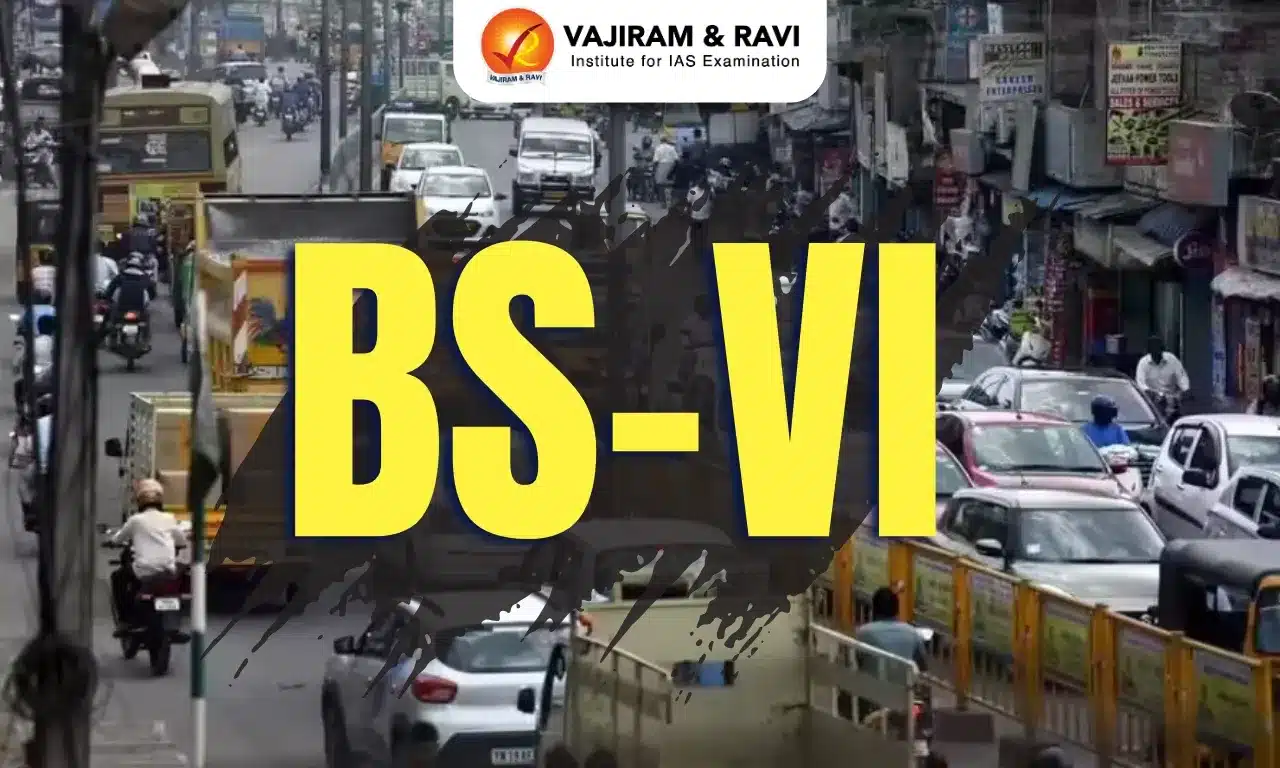
- The Delhi government has tightened vehicular pollution controls amid severe air quality, bringing renewed focus on Bharat Stage (BS) emission norms.
- Non-BS VI private vehicles registered outside Delhi have been barred from entering the city.
- Fuel stations will now sell fuel only to vehicles with a valid Pollution Under Control Certificate (PUCC).
- Non-compliant vehicles face a fine of ₹20,000, while even BS-VI vehicles can be fined ₹10,000 if they lack a valid PUCC.
- These measures target emissions from older, more polluting vehicles as part of efforts to curb worsening air pollution in the Capital.
Bharat Stage (BS) Emission Norms
- Bharat Stage (BS) emission norms are India’s legally enforced standards to regulate air pollutants emitted by motor vehicles.
- Framed by the Ministry of Environment, Forest and Climate Change (MoEFCC) and implemented by the Central Pollution Control Board (CPCB), these norms are broadly aligned with European emission standards (Euro norms) and apply to all new vehicles manufactured and sold in the country.
Evolution of Bharat Stage Norms
- India has progressively tightened vehicular emission standards to address worsening urban air pollution:
- BS I – Introduced nationwide in 2000
- BS II – 2001 (Delhi first), nationwide by 2005
- BS III – Nationwide by 2010
- BS IV – Nationwide by 2017
- BS VI – Implemented directly from BS IV in April 2020, skipping BS V
Pollutants Regulated
- BS norms prescribe upper limits for key vehicular pollutants, including:
- Carbon Monoxide (CO)
- Hydrocarbons (HC)
- Nitrogen Oxides (NOx)
- Particulate Matter (PM)
- Each successive BS standard tightens these limits significantly.
Other Features
- Advanced emission-control technologies, such as:
- Diesel Particulate Filters (DPF)
- Selective Catalytic Reduction (SCR)
- On-board diagnostics (OBD)
- More realistic testing aligned closer to real driving conditions.
Significance of Bharat Stage Norms
- Public health protection by reducing pollutants linked to respiratory and cardiovascular diseases.
- Environmental benefits, including lower smog formation and black carbon emissions.
- Technological upgradation of India’s automobile industry.
- Global alignment, improving export competitiveness of Indian vehicles.
Why Delhi Has Mixed-Standard Vehicles
- Delhi’s mixed BS fleet exists because the Capital adopted stricter norms earlier than the rest of India due to severe air pollution.
- Delhi implemented BS II in 2001, BS III in 2005 and BS IV in 2010—well ahead of national timelines.
- Although BS VI became mandatory nationwide in April 2020, vehicles from other states with older standards continue to enter the city, resulting in a mix of emission norms on Delhi’s roads.
Why Older Vehicles Contribute More to Air Pollution
- Older vehicles emit significantly higher levels of harmful pollutants because they lack advanced emission-control technologies.
- Diesel vehicles, in particular, release large amounts of nitrogen oxides and fine particulate matter, major contributors to smog and respiratory and cardiovascular diseases.
- They also emit volatile organic compounds that form secondary pollutants in the atmosphere.
- In addition, black carbon from diesel exhaust not only damages public health but also accelerates climate warming, making older vehicles especially polluting.
Scale of Older, High-Polluting Vehicles in Delhi-NCR
- A significant share of vehicles in Delhi-NCR remains highly polluting.
- Government assessments indicate that nearly 37% of vehicles in the region comply only with older Bharat Stage I, II or III norms, making them major contributors to the air quality crisis.
BS VI vs BS IV: What Changed in Emission Standards
- BS VI emission norms impose far tighter pollution limits than BS IV.
- For petrol vehicles, nitrogen oxide (NOx) limits are reduced by about 25%.
- For diesel vehicles, NOx emissions must fall by nearly 68%, while particulate matter (PM) emissions are cut by around 82%.
- BS VI vehicles also run on much cleaner, low-sulphur fuel, enabling advanced emission-control technologies to operate effectively.
- In addition, BS VI introduces more stringent testing procedures, closer to real-world driving conditions, to ensure lower on-road emissions.
BS-VI FAQs
Q1: What are Bharat Stage (BS) emission norms?
Ans: Bharat Stage emission norms are India’s vehicle pollution standards, aligned with European norms, regulating emissions like NOx, CO and particulate matter to protect public health.
Q2: When did BS-VI norms become mandatory in India?
Ans: BS-VI norms were implemented nationwide from April 1, 2020, skipping BS-V, marking a major leap toward cleaner fuels and advanced emission-control technologies.
Q3: How can vehicle owners check BS-VI compliance?
Ans: BS-VI compliance can be verified on the vehicle’s Registration Certificate, owner’s manual, authorised service centres, or through the VAHAN portal using the number plate.
Q4: Why are older vehicles more polluting?
Ans: Older vehicles lack modern emission-control systems, emitting higher nitrogen oxides, particulate matter and black carbon, which worsen smog and increase respiratory and cardiovascular risks.
Q5: Why does Delhi still have mixed-standard vehicles?
Ans: Delhi adopted stricter BS norms earlier than the rest of India, but vehicles from other states still enter daily, resulting in a mix of BS-I to BS-VI vehicles.

