
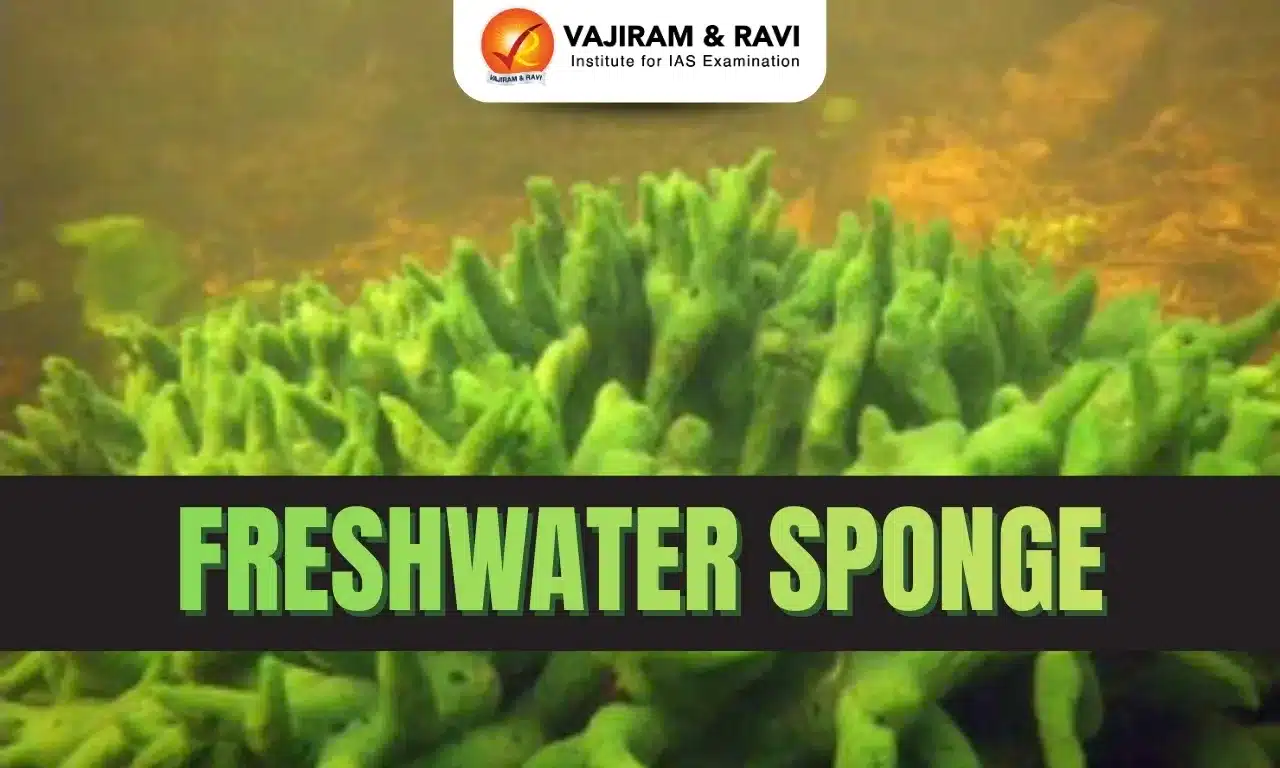
Freshwater Sponge Latest News
Recently, scientists from Bose Institute studied freshwater sponges from the Sundarban delta and identified their potential to act as bioindicators of toxic metal pollution.
About Freshwater Sponge
- Freshwater sponges are the earliest multicellular eukaryotes.
- They filter large volumes of water and are vital for ecosystem health.
- Habitat: They grow on sturdy submerged objects in clean streams, lakes, and rivers.
- Sponges are filter feeders. They obtain food from the flow of water through their bodies and from symbiotic algae.
- Appearance: Many freshwater sponges appear green because they contain algae, which live on sponges in a symbiotic relationship.
- Reproduction: They can reproduce sexually, or asexually.
- When a small piece is broken off and grows into new sponges.
- The sponge forms gemmules—tiny reproductive spheres that can overwinter and later hatch and form new sponges.
- Ecological Role: They act both as bioindicators and absorbents of toxic metals like arsenic, lead, and cadmium and can be a promising solution for bioremediation.
- They are effective bio indicators for monitoring water quality and pollution levels in estuarine and freshwater ecosystems.
Source: PIB
Freshwater Sponge FAQs
Q1: What is the habitat of Freshwater Sponge?
Ans: Freshwater lakes and rivers
Q2: Which phylum do Freshwater Sponges belong to?
Ans: Porifera
