
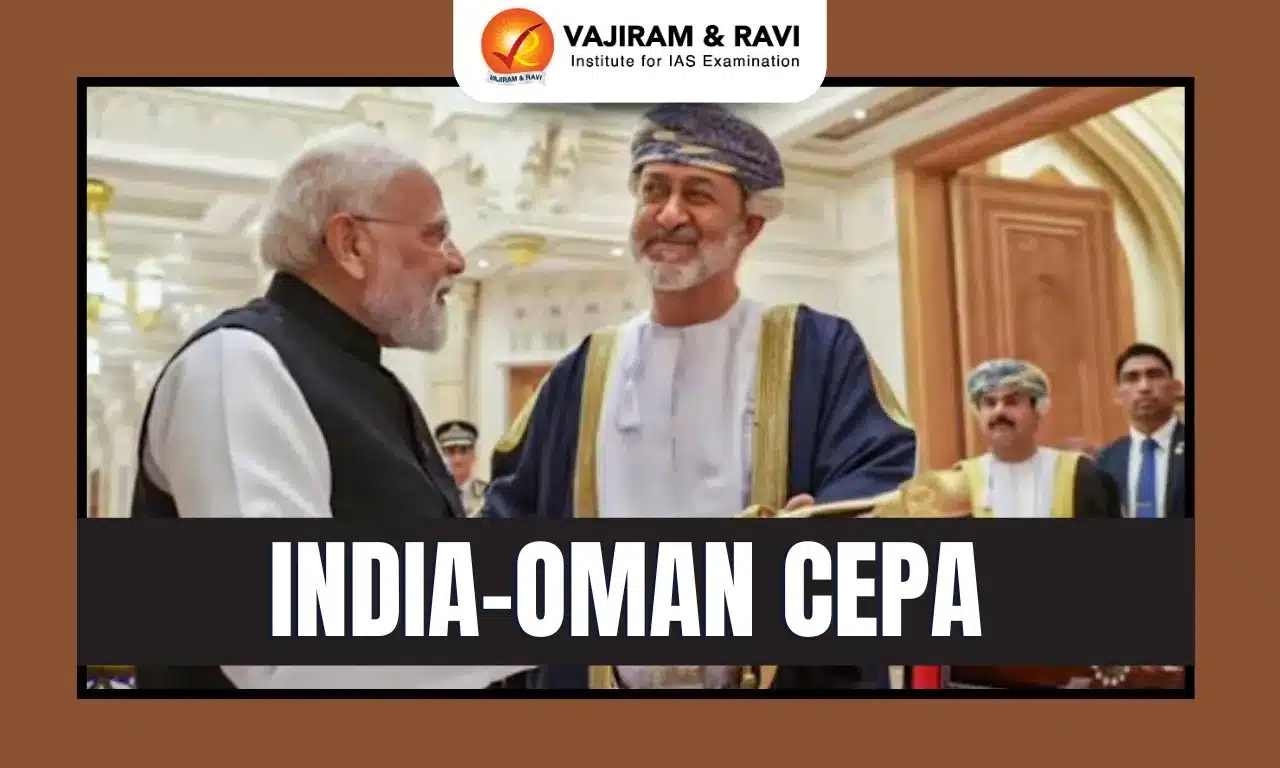
India-Oman CEPA Latest News
- India has signed a trade deal with Oman to expand export opportunities in West Asia amid growing trade barriers in the US and EU, including tariffs and carbon taxes.
- The signing of the India-Oman Comprehensive Economic Partnership Agreement (CEPA) aligns with India’s strategy of accelerating free trade agreements to diversify markets as uncertainty persists over a US trade deal.
- The deal gains added significance as negotiations with the broader Gulf Cooperation Council stalled, making Oman the second GCC member, after the UAE, to conclude a trade agreement with India.
Strategic Context of the CEPA
- Oman’s first FTA in nearly two decades.
- India’s second comprehensive Gulf FTA, after the UAE (2022).
- India’s sixth free trade pact in the past five years, following deals with Mauritius, the UAE, Australia, the EFTA bloc and the UK.
- Bilateral trade at around $10.5 billion, dominated by energy imports.
- The agreement focuses on durable economic integration, not short-term trade spikes.
India–Oman CEPA: Key Features
- Recently, India and Oman signed a Comprehensive Economic Partnership Agreement (CEPA), in Muscat.
- Under this agreement, Oman will grant duty-free access on 98.08% of tariff lines, covering 99.38% of India’s exports to Oman.
- India will liberalise tariffs on 77.79% of its tariff lines, covering 94.81% of imports from Oman.
- Oman’s strategic location positions it as a hub for: Wider GCC markets; Eastern Europe, Central Asia, and Africa.
- Oman already has duty-free access to the US under its FTA, enhancing indirect opportunities.
Market Access and Tariff Liberalisation
- For Indian Exports
- Full tariff elimination for labour-intensive sectors, including:
- Gems & jewellery, textiles, leather, footwear
- Sports goods, plastics, furniture
- Agriculture and food products
- Engineering goods, pharmaceuticals, medical devices, automobiles
- Expected to boost MSMEs, artisans, women-led enterprises, and employment.
- Full tariff elimination for labour-intensive sectors, including:
- Sensitive Products Excluded by India
- Agricultural products (dairy, tea, coffee, rubber, tobacco)
- Gold and silver bullion, jewellery
- Certain labour-intensive items like footwear and sports goods
- Scrap of several base metals
Enhanced Mobility of Professionals (Mode 4)
- This is a major highlight of the CEPA.
- Intra-Corporate Transferees quota increased from 20% to 50%.
- Contractual Service Suppliers’ stay extended: From 90 days → 2 years, extendable by another 2 years.
- More liberal entry and stay for skilled professionals in:
- Accountancy, taxation, architecture
- Medical and allied services
Boost to the Services Sector
- Oman offers substantial commitments across key services, including:
- Computer and IT services
- Business and professional services
- Audio-visual services
- R&D, education, and health services
- CEPA allows 100% FDI by Indian companies in major services sectors in Oman via commercial presence.
- Future discussions agreed on social security coordination, once Oman’s contributory system is operational.
India–Oman Trade: Strategic Gateway and Market Access
- Oman, though smaller and less diversified than the UAE, holds strategic importance for India as a trade hub connecting West Asia and Africa.
- With annual imports of about $40 billion, Oman relies heavily on imported machinery while remaining a major energy exporter.
- India exported $4.06 billion worth of merchandise to Oman in 2024-25, which made up 0.93% of India’s total exports that year.
- It imported $6.5 billion worth of goods from Oman, comprising 0.91% of India’s total imports in 2024-25.
Export Opportunities for India
- Indian exports to Oman have doubled over the past five years.
- Key exports include machinery and parts, aircraft, rice, iron and steel articles, beauty and personal care products, ceramics, and petroleum products such as naphtha and petrol.
- Zero-duty access on 98% of Oman’s tariff lines under the CEPA is expected to boost competitiveness, especially for industrial goods, though sustained growth will depend on quality upgrades and product differentiation.
Oman’s Trade Profile and Energy Linkages
- Oman’s main exports include crude oil, LNG, fertilisers, and chemical inputs like methanol and anhydrous ammonia—critical for India’s energy and industrial sectors and already subject to low tariffs under existing FTAs.
- Oman also has a US FTA (since 2009), enabling duty-free access for many products into the American market.
Services Trade and Professional Mobility
- India stands to gain significantly in services. Oman’s global services imports total $12.52 billion, with India holding a 5.31% share.
- The CEPA includes strong commitments across IT, business and professional services, R&D, education, health, and audio-visual sectors.
Petroleum and Mineral-Based Trade
- India’s Exports to Oman
- Petroleum products: 35.1%
- Processed minerals: 9.2%
- Aircraft and parts, cosmetics, basmati rice together form major shares.
- India’s Imports from Oman
- Crude oil and petroleum gases: 38%
- Fertilisers: 16.3%
- Acyclic alcohols and ammonia are key imports.
- Over two-thirds of imports concentrated in energy and fertiliser-related products.
India-Oman CEPA FAQs
Q1: What is the India–Oman CEPA?
Ans: The India–Oman Comprehensive Economic Partnership Agreement is a bilateral free trade pact providing extensive tariff liberalisation, services access and investment facilitation between the two countries.
Q2: How much tariff access has Oman offered India?
Ans: Oman has granted duty-free access on 98.08% of tariff lines, covering 99.38% of India’s exports, significantly improving market access for Indian goods.
Q3: Which Indian sectors benefit most from the CEPA?
Ans: Labour-intensive sectors such as textiles, gems and jewellery, leather, pharmaceuticals, engineering goods, automobiles and agricultural products gain full tariff elimination.
Q4: Why is Mode-4 mobility significant in this agreement?
Ans: Oman expanded Mode-4 commitments, raising intra-corporate transferee quotas to 50% and extending service suppliers’ stay to up to four years.
Q5: Why is Oman strategically important for India’s trade?
Ans: Oman serves as a gateway to GCC markets, Africa and Central Asia, complementing India’s UAE FTA and strengthening regional supply chains.

