
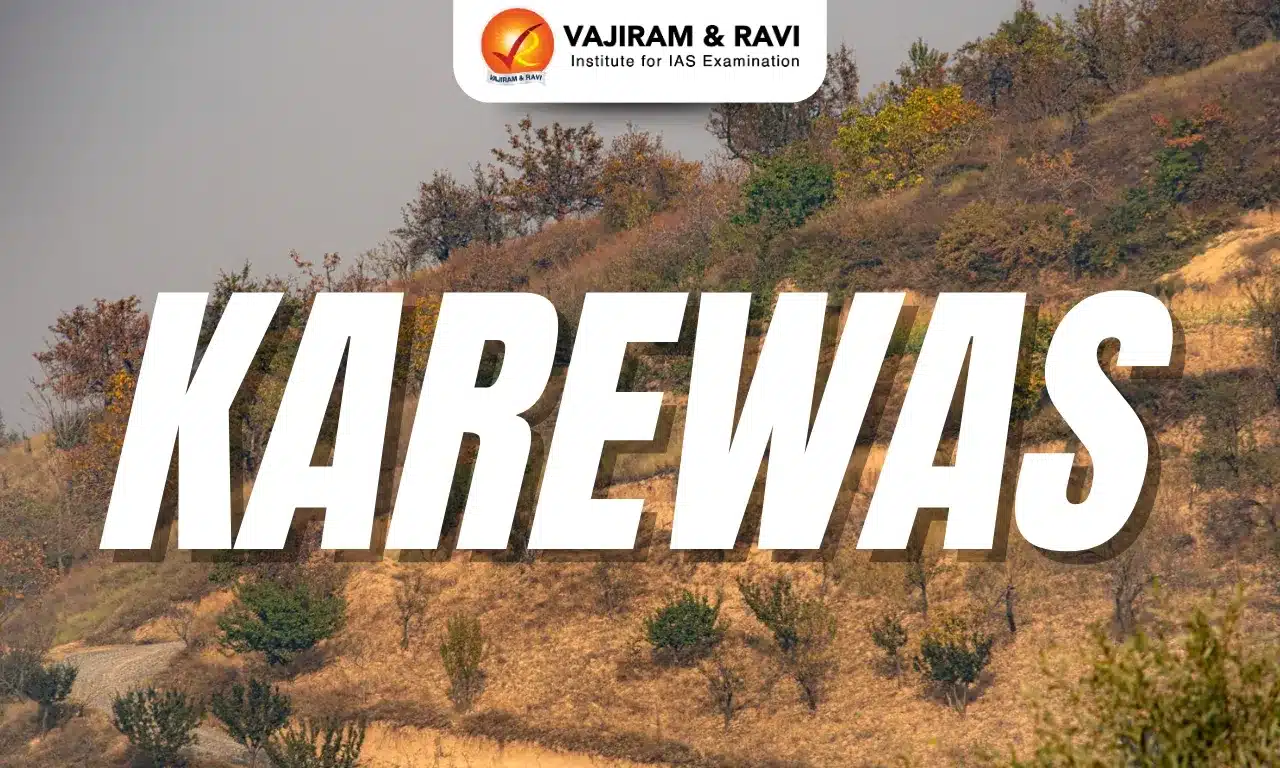
What are Karewas?
Karewas are elevated flat-topped plateaus found mainly in the Kashmir Valley, lying above the present-day floodplains of the Jhelum River and its tributaries. They consist largely of lacustrine (lake-deposited) sediments such as clays, silts, sands, and gravels.
These landforms were formed during the Quaternary period when the Kashmir Valley was occupied by large freshwater lakes. Over time, tectonic uplift and river erosion drained these lakes, leaving behind flat terraces known as Karewas.
Types of Karewas
Karewas can be broadly classified based on their location, elevation, and composition. The major types include:
- Lower Karewas
- Found closer to river floodplains.
- Composed mainly of fine sediments like clay and silt.
- Highly fertile and extensively used for agriculture.
- Higher Karewas
- Located at higher elevations above the valley floor.
- Contain coarser materials such as gravel and sand.
- Less fertile but ideal for horticulture and saffron cultivation.
- Fluvio-lacustrine Karewas
- Formed due to combined action of lakes and rivers.
- Show layered deposits of lake sediments and river alluvium.
Formation of Karewas
The Formation of Karewas is closely linked to the geological evolution of the Kashmir Valley.
- Tectonic Activity: Uplift of the Himalayas led to the formation of a closed basin in the Kashmir region.
- Ancient Lake System: The basin was filled with large freshwater lakes, notably the Karewa Lake.
- Sedimentation: Fine sediments like clay, silt, and sand settled at the lake bottom over thousands of years.
- Drainage of Lakes: River capture and down-cutting by the Jhelum River drained the lakes.
- Erosion and Terrace Formation: Differential erosion left behind flat-topped terraces, now known as Karewas.
Karewas Significance
- Agricultural Value - Karewas have well-drained lacustrine soils ideal for saffron cultivation and dryland crops like almonds, walnuts, and pulses, with low flood risk.
- Economic Importance - High-value saffron and horticulture from Karewas provide sustainable livelihoods, support agro-based industries, and boost the regional economy of Kashmir.
- Ecological Role - They act as groundwater recharge zones, support plateau-specific vegetation, and help maintain local micro-climatic balance.
- Geomorphological Significance - Karewas are classic lacustrine depositional landforms, offering evidence of ancient lakes, Himalayan uplift, and past climatic conditions.
- Hydrological Function - Elevated terraces regulate surface runoff, enhance rainwater percolation, and help reduce flooding in adjacent low-lying areas.
- Cultural-Historical Importance - Historically preferred for settlements due to flood safety and central to Kashmiri cultural identity through saffron cultivation.
Threat to Karewas
- Unregulated Urbanisation - Rapid expansion of towns and cities in the Kashmir Valley has led to large-scale encroachment and conversion of Karewa land for housing and commercial use.
- Brick Kilns and Clay Mining - Excessive extraction of Karewa clay for brick-making causes irreversible soil loss, land degradation, and destruction of ancient lacustrine deposits.
- Infrastructure Development - Construction of roads, railways, and industrial projects fragments Karewas, disrupts natural drainage, and accelerates erosion.
- Agricultural Mismanagement - Overuse of chemical fertilisers, poor irrigation practices, and monocropping (especially saffron) reduce soil fertility and long-term productivity.
- Climate Change Impacts - Altered rainfall patterns, frequent droughts, and rising temperatures negatively affect soil moisture and saffron yield on Karewas.
- Deforestation and Vegetation Loss - Removal of natural vegetation cover increases wind and water erosion, making Karewas more vulnerable to degradation.
- Weak Regulation and Enforcement - Lack of strict land-use policies and poor enforcement allow illegal mining, construction, and land conversion to continue unchecked.
Conservation and Sustainable Management of Karewas
- Grant strict legal protection to Karewas by regulating land-use change, construction, and mining through effective enforcement mechanisms.
- Completely restrict brick kilns and clay mining to prevent irreversible soil and geomorphological damage.
- Promote sustainable and low-input farming practices to conserve soil fertility and productivity.
- Implement efficient water management measures such as rainwater harvesting and micro-irrigation.
- Involve local communities and farmers in conservation through awareness and incentive-based programmes.
- Use GIS and remote sensing for continuous monitoring of land degradation and encroachment.
- Integrate Karewa protection with climate-resilient planning and sustainable development strategies.
Karewas FAQs
Q1: What are Karewas?
Ans: Karewas are flat-topped elevated plateaus of lacustrine origin found mainly in the Kashmir Valley.
Q2: Where are Karewas located in India?
Ans: They are primarily found in the Kashmir Valley, especially in Pampore, Budgam, and Baramulla regions.
Q3: How were Karewas formed?
Ans: Karewas were formed by deposition of sediments in ancient lakes, later shaped by tectonic uplift and river erosion.
Q4: Which crop is most closely associated with Karewas?
Ans: Saffron is the most important crop grown on Karewas.
Q5: What are the major threats to Karewas?
Ans: Urbanisation, brick kilns, clay mining, infrastructure development, and climate change.
