Semiconductor Latest News
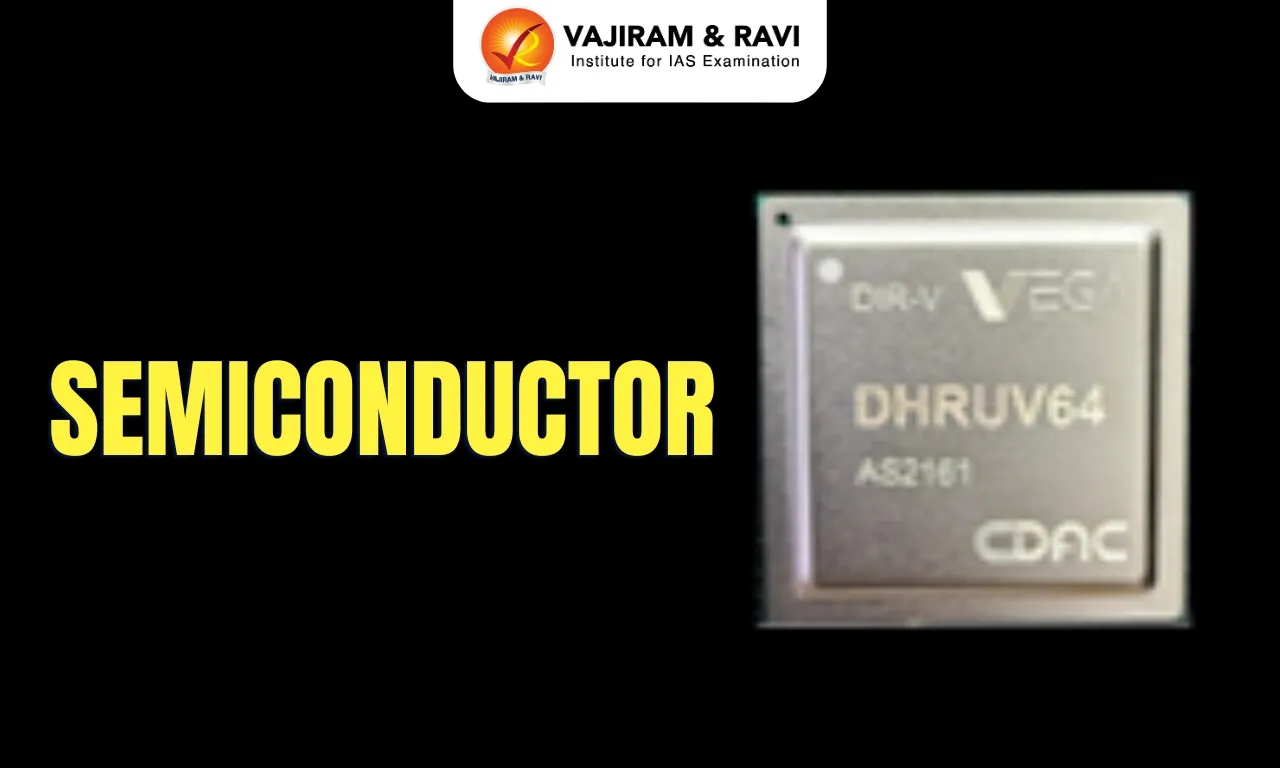
- In December 2025, the Ministry of Electronics and Information Technology (MeitY) announced the launch of DHRUV64, a fully indigenous microprocessor developed by the Centre for Development of Advanced Computing (C-DAC).
- The processor is projected as a critical milestone in India’s efforts to build a domestic semiconductor and processor ecosystem and reduce dependence on imported chip technologies.
Background: India and the Semiconductor Challenge
- India is one of the world’s largest consumers of electronic devices and processors, yet it remains heavily dependent on foreign-designed chips and global supply chains.
- Microprocessors form the core of modern digital infrastructure, powering telecommunications, industrial automation, defence systems, automobiles, and consumer electronics.
- Dependence on imported processors exposes India to supply disruptions, export controls, and cybersecurity vulnerabilities.
- Recognising this strategic vulnerability, the Government of India has consistently pushed for “homegrown processor technology” as part of its broader vision of technological sovereignty and digital resilience.
About DHRUV64
- DHRUV64 is a 64-bit, dual-core general-purpose microprocessor developed by C-DAC under MeitY’s Microprocessor Development Programme.
- Operating at a clock speed of 1 GHz, it is designed to strike a balance between computational capability and energy efficiency.
- Unlike simple microcontrollers used for basic sensing tasks, DHRUV64 is capable of running modern operating systems and handling more complex workloads.
- Its intended applications range from consumer electronics to industrial automation and embedded systems, where reliability and integration matter more than peak computing power.
Technical Significance of the Processor
- From a technological perspective, DHRUV64 does not compete with high-end smartphone or laptop processors that feature multiple cores, advanced GPUs, and high clock speeds.
- Instead, it targets sectors such as telecommunications equipment, industrial controllers, routers, and automotive modules, where stable performance, long lifecycle support, and secure architectures are crucial.
- Such sectors value hardware-software integration and predictable behaviour rather than raw speed.
- This makes DHRUV64 relevant for strategic and infrastructure-related applications rather than mass consumer devices.
Role of RISC-V and the DIR-V Programme
- A key feature of DHRUV64 is that it is based on the RISC-V instruction set architecture.
- RISC-V is an open-source instruction set, meaning that its design rules are publicly available and can be used without paying licensing fees.
- This openness allows countries like India to design processors without dependence on proprietary architectures controlled by foreign companies.
- RISC-V is also modular, enabling designers to customise processors for specific tasks such as security, performance, or energy efficiency.
- DHRUV64 is part of the Digital India RISC-V (DIR-V) programme, which aims to develop a portfolio of indigenous processors for civilian, industrial, and strategic uses.
- Earlier processors under this ecosystem include SHAKTI (IIT-Madras), AJIT (IIT-Bombay), VIKRAM (ISRO-SCL), and THEJAS processors developed by C-DAC.
Concerns and Information Gaps
- Despite its strategic importance, MeitY’s announcement leaves several critical questions unanswered.
- The government has not provided detailed performance benchmarks, memory architecture details, or power efficiency metrics, which are essential for industrial adoption.
- There is also limited clarity on fabrication details, such as the manufacturing foundry, process node, yields, and long-term reliability.
- Additionally, the term “fully indigenous” remains ambiguous, as it can refer to different aspects such as design, toolchains, fabrication, or ownership of intellectual property.
- The absence of a clear deployment roadmap, operating system support, and government procurement plans may slow industry adoption in the short term.
Way Forward for India’s Chip Ecosystem
- DHRUV64 must be viewed as a foundational step rather than a finished solution.
- Its success will depend on the creation of a supporting ecosystem that includes developer boards, software tools, skilled manpower, and anchor government demand.
- Complementary initiatives such as Chips to Startup Programme, Design Linked Incentive Scheme, and the India Semiconductor Mission are critical to building fabrication capacity, nurturing startups, and expanding semiconductor talent in India.
- The long-term goal is to enable Indian consumers and industries to adopt indigenous processors without compromising on cost, security, or reliability.
Source: TH
Semiconductor FAQs
Q1: What is DHRUV64?
Ans: DHRUV64 is a 64-bit indigenous microprocessor developed by C-DAC under MeitY.
Q2: Which architecture does DHRUV64 use?
Ans: It is based on the open-source RISC-V instruction set architecture.
Q3: Why is DHRUV64 important for India?
Ans: It reduces dependence on imported processors and strengthens technological sovereignty.
Q4: What are the main applications of DHRUV64?
Ans: Telecommunications equipment, industrial automation, embedded systems, and strategic sectors.
Q5: Which programme does DHRUV64 belong to?
Ans: It is part of the Digital India RISC-V (DIR-V) programme.

