
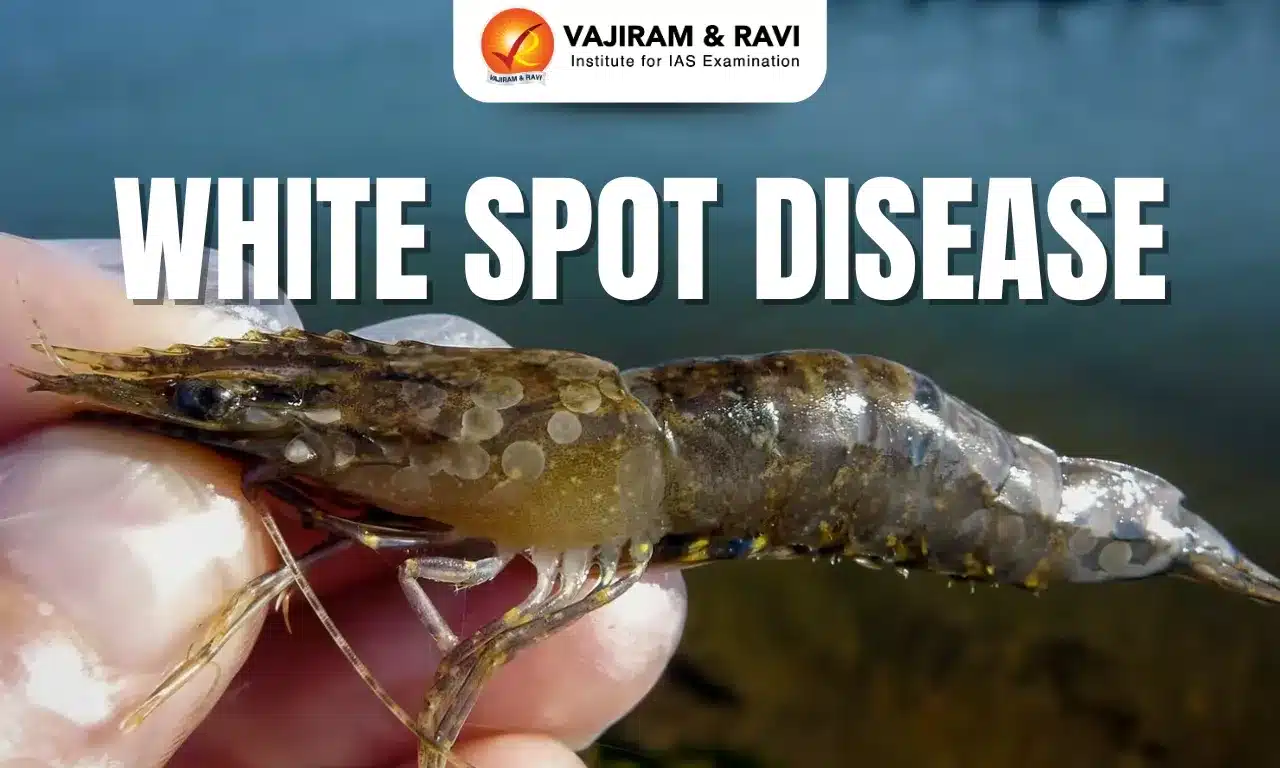
White Spot Disease Latest News
Recently, the Minister of Fisheries, Animal Husbandry and Dairying, Government of India informed the Rajya Sabha about the white spot disease.
About White Spot Disease
- It is a highly contagious viral infection that affects crustaceans such as prawns, yabbies and crabs.
- Causative Agent: It is caused by a virus called as White Spot Syndrome Virus (WSSV). This is a double stranded DNA virus of the genus Whispovirus and family Nimaviridae.
- Host range: All decapod crustaceans (order Decapoda), including prawns, lobsters and crabs from marine, brackish or freshwater environments, are considered susceptible to infection.
- Symptoms: The affected shrimp exhibit anorexia, lethargy, reddish discoloration and presence of circular white spots on the carapace and other exoskeletal parts.
- Transmission: It can be transmitted both horizontally as well as vertically.
- Vertical transmission: It occurs from infected brood stock to postlarvae.
- Horizontal transmission: It is through carrier animals or through cannibalism of infected organisms.
- It has been officially reported from Bangladesh, Burma (Myanmar), Cambodia, China, Hong Kong, India, Indonesia, Iran, Japan, Malaysia, the Philippines, the Republic of Korea, Singapore, Thailand and Vietnam.
Source: PIB
White Spot Disease FAQs
Q1: What is the primary symptom of White Spot Disease?
Ans: hite spots on the skin and gills on species.
Q2: Which fishes are susceptible to White Spot Disease?
Ans: Both Freshwater fish and Marine fish
