Startup India, Definition, Objectives, Roles, Issues, Way Forward

Startup India

What is Startup India Scheme?

Startup India is a comprehensive government initiative designed to foster a conducive environment for startups to achieve sustainable economic growth and large-scale job creation. The scheme is implemented and coordinated by the Department for Promotion of Industry and Internal Trade (DPIIT) under the Ministry of Commerce and Industry.

Definition of a Startup (As per DPIIT)

An entity is recognized as a Startup for government purposes if it fulfills the following conditions:

  • Incorporated as a Private Limited Company, Partnership Firm, or Limited Liability Partnership (LLP) in India
  • Age of the entity should not exceed 10 years from the date of registration
  • Annual turnover must not exceed ₹100 crore in any financial year
  • Focused on innovation, improvement of products/services, or scalable business models
  • Has the potential for wealth creation or employment generation
  • Must not be formed by splitting or restructuring an existing business

Startup India Objectives

  • Promote Entrepreneurship by encouraging risk-taking, innovation, and enterprise creation across sectors
  • Build a Startup-Friendly Ecosystem that supports startups from ideation to scaling
  • Improve Ease of Doing Business through simplified regulations, self-certification, and digital governance
  • Encourage Innovation and Technology Development in products, services, and business models
  • Provide Access to Finance through seed funding, venture capital support, and credit guarantees
  • Generate Employment Opportunities by fostering new businesses and self-employment
  • Support Inclusive Growth by expanding startups to tier-2, tier-3, rural, and semi-urban regions
  • Strengthen Industry-Academia Collaboration for research, incubation, and skill development
  • Promote Global Competitiveness of Indian startups through market access and exposure
  • Foster Sustainable Economic Growth by supporting scalable and innovation-driven enterprises

Pillars of the Startup India Action Plan

  1. Simplification and Handholding
  • Self-certification under selected labour and environmental laws
  • Digital registration and single-window clearance system
  • Faster approvals and continuous mentoring support
  1. Funding Support and Incentives
  • Government-backed funding through venture and seed funds
  • Tax exemptions and fiscal incentives for eligible startups
  • Credit guarantee mechanisms to improve access to loans
  1. Industry-Academia Partnership and Incubation
  • Establishment of incubators and research parks
  • Collaboration between universities, research institutions, and industry
  • Mentorship, innovation support, and technology commercialization

Financial Support Mechanisms under Startup India

  • Fund of Funds for Startups (₹10,000 crore) to provide venture capital through SEBI-registered funds
  • Startup India Seed Fund Scheme (₹945 crore) for proof of concept, prototype development, and market entry
  • Credit Guarantee Fund for Startups to enable collateral-free loans from banks and financial institutions
  • Income Tax Exemption on profits for three consecutive years for eligible startups
  • Capital Gains Tax Exemption on investments made in eligible startups and government-notified funds
  • Angel Tax Exemption subject to prescribed eligibility and compliance norms
  • Fast-track IPR Support with fee rebates to reduce innovation-related costs

Role of Startups in Employment Generation

  • Large-Scale Direct Employment: DPIIT-recognised startups have generated over 10 lakh direct jobs since the launch of Startup India, spanning technology, manufacturing, healthcare, education, and services sectors.
  • Youth-Centric Job Creation: A significant share of startup employment is created for the 20-35 age group, supporting India’s demographic dividend through high-skill and innovation-led jobs.
  • Indirect Employment Multiplier Effect: Each startup generates multiple indirect jobs in supply chains, logistics, marketing, legal services, and platform-based work, amplifying overall employment impact.
  • Regional Employment Expansion: Nearly 50% of recognised startups are located in Tier-2 and Tier-3 cities, contributing to decentralised job creation and reducing migration pressure on metros.
  • Women Workforce Participation: Around 45% of startups have at least one woman founder, leading to higher participation of women in formal and flexible employment structures.
  • High-Growth Employment via Unicorns: India has crossed 100+ unicorns, many of which employ thousands of workers directly and create large-scale ecosystem jobs through vendors and partners.
  • Promotion of Self-Employment and Entrepreneurship: Startup India supports first-generation entrepreneurs, encouraging self-employment and enterprise-led livelihoods, especially among educated youth.
  • Skill Development and New-Age Jobs: Startups drive demand for skills in AI, fintech, biotech, renewable energy, and deep-tech, contributing to workforce upskilling and future-ready employment.

Issues Related to Startup in India

  • Regulatory and Compliance Complexity: Despite ease-of-doing-business reforms, startups face compliance under multiple laws. India ranked 63rd in Ease of Doing
  • Business (World Bank, last edition): indicating persistent procedural and regulatory challenges, especially at state and local levels.
  • Funding Gap at Early Stages: While India attracted large venture capital, nearly 70% of startup funding is concentrated in late-stage startups and metro cities, leaving seed and early-stage startups, particularly in Tier-2 and Tier-3 cities, underfunded.
  • Taxation and Policy Uncertainty: Issues related to angel tax, valuation scrutiny, and delayed tax exemptions have affected investor sentiment. Many eligible startups face delays in availing the 3-year income tax holiday due to stringent certification norms.
  • High Failure Rate and Sustainability Issues: Studies indicate that around 80-90% of startups fail within the first five years, mainly due to poor market fit, cash flow constraints, and lack of scalable business models.
  • Skilled Workforce and Talent Retention Challenges: India produces a large graduate base, yet less than 50% are considered industry-ready, leading to skill mismatches.

Way Forward

  • Simplify Rules - Make startup regulations and compliance easier to follow.
  • Increase Funding - Provide more money for early-stage startups, especially in smaller cities.
  • Improve Incubation - Set up more incubators, research hubs, and mentorship programs.
  • Develop Skills - Train youth with industry-ready skills and retain talent in startups.
  • Support Regional Growth - Promote startups in tier-2, tier-3, and rural areas.
  • Global Expansion - Help startups access international markets and investors.

Startup India FAQs

Q1: What is Startup India?

Ans: Startup India is a government initiative launched to promote entrepreneurship, innovation, and employment through a supportive startup ecosystem.

Q2: When was Startup India launched?

Ans: It was launched on 16 January 2016.

Q3: Who implements Startup India?

Ans: The initiative is implemented by the Department for Promotion of Industry and Internal Trade.

Q4: What types of support are provided under Startup India?

Ans: Support includes financial assistance, tax incentives, simplified compliance, incubation, mentorship, and access to markets.

Q5: Why is Startup India important for economic development?

Ans: It promotes innovation, job creation, regional development, and global competitiveness of the economy.


European Union (EU), Evolution, Objectives, Powers, Member Countries

European Union

The European Union (EU) is a political and economic union of 27 European countries that function together through common institutions, laws, and policies. It represents one of the most advanced forms of regional integration in the world, combining economic cooperation with political coordination. The headquarters are based in Brussels and Luxembourg.

European Union Background and Evolution

The European Union emerged from the ruins of World War II, when European nations sought lasting peace by replacing rivalry with cooperation. Economic integration was viewed as the most effective way to prevent future conflicts and rebuild devastated economies.

  • Post-World War II Context: Excessive nationalism and repeated wars convinced European leaders that shared institutions were essential for peace and stability.
  • 1946 Vision: The idea of a unified Europe gained momentum with calls for a “United States of Europe.”
  • 1951 - Treaty of Paris: Established the European Coal and Steel Community (ECSC) to place key war industries under joint control.
  • 1957 - Treaty of Rome: Created the European Economic Community (EEC) and Euratom, promoting a common market and nuclear cooperation.
  • 1965 - Merger Treaty: Unified the institutions of ECSC, EEC, and Euratom into a single administrative framework.
  • 1985 - Schengen Agreement: Laid the foundation for passport-free travel among participating states.
  • 1986 - Single European Act: Set a clear roadmap for completing the single market and deepening integration.
  • 1992 - Maastricht Treaty: Formally established the European Union, introduced EU citizenship, and initiated a common foreign and security policy.
  • 1999-2002 - Monetary Union: The euro was introduced, marking a major step toward economic and monetary integration.
  • 2007 - Lisbon Treaty: Strengthened democratic governance, enhanced the role of the Parliament, and improved institutional efficiency.
  • Expansion Phase: Membership grew from six founding states to 27 countries, reflecting the EU’s widening influence and integration.

European Union Objectives

The European Union seeks to create a peaceful, prosperous, and integrated Europe by promoting shared values, economic cooperation, and social justice. Its objectives are rooted in EU treaties and guide all common policies and institutional actions.

  • Promote peace and stability by fostering cooperation among member states and preventing conflict.
  • Uphold common values such as democracy, rule of law, human rights, equality, and freedom.
  • Ensure freedom, security, and justice for citizens through open internal borders and coordinated law enforcement.
  • Develop a single market with free movement of goods, services, capital, and people.
  • Achieve sustainable development based on balanced economic growth, price stability, and environmental protection.
  • Promote full employment and social progress through inclusive economic policies.
  • Combat social exclusion and discrimination and strengthen social protection systems.
  • Encourage scientific research and technological innovation to enhance global competitiveness.
  • Respect cultural and linguistic diversity while fostering a shared European identity.
  • Establish an economic and monetary union, with the euro as a common currency for participating members.

European Union Membership

The European Union consists of 27 member countries that have voluntarily joined the Union by accepting its treaties, laws, and shared values. Membership requires fulfilling strict political and economic criteria, including democracy, rule of law, and a functioning market economy.

European Union Membership
Country Year of Joining

Belgium

1957 (Founding Member)

France

1957 (Founding Member)

Germany

1957 (Founding Member)

Italy

1957 (Founding Member)

Luxembourg

1957 (Founding Member)

Netherlands

1957 (Founding Member)

Denmark

1973

Ireland

1973

United Kingdom

1973 (Left in 2020)

Greece

1981

Spain

1986

Portugal

1986

Austria

1995

Finland

1995

Sweden

1995

Cyprus

2004

Czech Republic

2004

Estonia

2004

Hungary

2004

Latvia

2004

Lithuania

2004

Malta

2004

Poland

2004

Slovakia

2004

Slovenia

2004

Bulgaria

2007

Romania

2007

Croatia

2013

European Union Institutional Structure

The European Union has a well-defined institutional framework designed to ensure democratic representation, effective decision-making, and uniform application of EU laws. Its structure balances supranational authority with intergovernmental cooperation, allowing both EU citizens and member states to participate in governance.

  • European Council: It provides overall political direction and sets long-term priorities of the EU. It consists of heads of state or government of member countries, along with the Presidents of the European Council and the European Commission.
  • European Parliament: It is the only EU institution directly elected by citizens and represents their interests. The Parliament shares legislative and budgetary powers with the Council of the European Union.
  • Council of the European Union: It represents the governments of member states and works jointly with the Parliament to debate, amend, and adopt EU laws. Ministers participate based on policy areas under discussion.
  • European Commission: It acts as the executive body of the EU, proposing legislation, implementing policies, and ensuring compliance with EU treaties. Each member state is represented by one Commissioner.
  • Court of Justice of the European Union (CJEU): It ensures uniform interpretation and application of EU law across all member states and resolves disputes between EU institutions and member governments.
  • European Central Bank (ECB): It manages monetary policy for euro-using countries and works to maintain price stability and financial security within the eurozone.
  • European Court of Auditors: It monitors the proper use of EU funds and ensures financial transparency and accountability.

Powers and Functions of the European Union

The European Union exercises shared and exclusive powers that enable deep economic integration, common policymaking, and coordinated external action among its 27 member states. It functions as a supranational entity while respecting national sovereignty in non-exclusive areas.

  • Economic Integration: Ensures free movement of goods, services, capital, and people through the Single Market and manages the Eurozone for monetary stability.
  • Trade and External Commerce: Negotiates trade agreements and represents member states collectively in global trade forums.
  • Legislative Authority: Formulates and enforces EU laws through regulations and directives applicable across member states.
  • Common Policy Making: Implements joint policies in agriculture, environment, energy, transport, research, and climate action.
  • Freedom, Security, and Justice: Maintains border-free movement under Schengen and coordinates asylum, migration, and criminal justice cooperation.
  • Foreign and Security Policy: Develops unified diplomatic positions, supports peace operations, and provides global humanitarian assistance.
  • Budgetary and Financial Role: Manages the EU budget, cohesion funds, and financial support mechanisms to reduce regional disparities.
  • Protection of Values: Upholds democracy, human rights, rule of law, equality, and anti-discrimination norms.

Strategic and Security Cooperation India-EU

  1. India and the EU maintain a growing strategic partnership focused on peace, stability, and sustainable development.
  2. Cooperation evolved from traditional financial assistance to a partnership based on shared priorities, following India’s rise to a medium-income country.
  3. At the 2017 EU-India Summit, leaders reaffirmed collaboration on the 2030 Agenda for Sustainable Development and continued the EU-India Development Dialogue.
  4. The EU was India’s largest trading partner in goods (2019–20), with total trade close to USD 90 billion, surpassing China and the US.
  5. The Bilateral Trade and Investment Agreement (BTIA, 2007) aims to remove trade barriers, promote investment, and deepen sectoral cooperation.
  6. India and the EU conduct regular negotiations under BTIA to enhance trade, investment, and economic integration between the two partners.
  7. Beyond economics, the partnership includes maritime security, counter-terrorism, climate action, and regional stability, reflecting a shared vision for a rules-based international order.

Challenges Associated with European Union

  • The Russia-Ukraine war, regional instability, and great-power rivalry intensify security threats, energy risks, and test EU unity.
  • Managing US-China tensions, potential US protectionism, and dependence on external powers in energy, defence, and critical technologies remains a major concern.
  • High energy costs, weak productivity growth, rising public debt, and global competition undermine long-term economic resilience.
  • Achieving climate neutrality and digital leadership requires massive investment, innovation, and coordinated policies across member states.
  • An ageing population, shrinking workforce, irregular migration, and integration challenges strain social welfare systems and cohesion.
  • Rising nationalism, Euroscepticism, and cost-of-living pressures weaken public trust and shared EU values.
  • Consensus-based decision-making among 27 members slows responses and complicates policy coherence in foreign policy, defence, and crisis management.

European Union FAQs

Q1: What is the European Union (EU)?

Ans: The EU is a political and economic union of 27 European countries that collaborate on trade, laws, security, and foreign policy while maintaining national sovereignty in non-exclusive areas.

Q2: When was the EU established?

Ans: The EU was formally established by the Maastricht Treaty in 1992, evolving from earlier communities like the ECSC (1951) and EEC (1957).

Q3: Which countries are founding members of the EU?

Ans: The six founding members are Belgium, France, Germany, Italy, Luxembourg, and the Netherlands.

Q4: What is the purpose of the EU?

Ans: Its primary goals are peace, economic integration, free movement, social progress, environmental sustainability, human rights, and global influence.

Q5: What is the EU’s currency?

Ans: The common currency is the euro, used by 19 of the 27 member states, while others like Poland and Sweden retain their national currencies.

UPSC Daily Quiz 20 December 2025

UPSC Daily Quiz

[WpProQuiz 51]

UPSC Daily Quiz FAQs

Q1: What is the Daily UPSC Quiz?

Ans: The Daily UPSC Quiz is a set of practice questions based on current affairs, static subjects, and PYQs that help aspirants enhance retention and test conceptual clarity regularly.

Q2: How is the Daily Quiz useful for UPSC preparation?

Ans: Daily quizzes support learning, help in revision, improve time management, and boost accuracy for both UPSC Prelims and Mains through consistent practice.

Q3: Are the quiz questions based on the UPSC syllabus?

Ans: Yes, all questions are aligned with the UPSC Syllabus 2025, covering key areas like Polity, Economy, Environment, History, Geography, and Current Affairs.

Q4: Are solutions and explanations provided with the quiz?

Ans: Yes, each quiz includes detailed explanations and source references to enhance conceptual understanding and enable self-assessment.

Q5: Is the Daily UPSC Quiz suitable for both Prelims and Mains?

Ans: Primarily focused on Prelims (MCQ format), but it also indirectly helps in Mains by strengthening subject knowledge and factual clarity.

National Parks in Karnataka, Wildlife Sanctuaries, Ramsar Sites

National Parks in Karnataka

Karnataka, located in southern India, is home to five prominent national parks: Bandipur, Nagarhole, Anshi, Bannerghatta, and Kudremukh. Each park features distinct ecosystems, from dense forests to rich wildlife habitats, playing a crucial role in biodiversity conservation and maintaining the ecological balance of the region. The detailed description of all the five National Parks in Karnataka along with wildlife sanctuaries and Ramsar sites is discussed below.

5 National Parks in Karnataka

Karnataka is home to five well-known national parks that showcase the state’s ecological diversity and natural heritage. From the dense forests of the Western Ghats to dry deciduous landscapes, these parks support a wide range of flora and fauna. They are crucial for protecting endangered species and promoting sustainable wildlife conservation. The details about 5 National Parks in Karnataka have been shared below.

[my_image src="https://vajiramandravi.com/current-affairs/wp-content/uploads/2025/12/National-Parks-in-Karnataka-Map.webp" size="full" align="none" width="auto" height="399px" alt="National Parks in Karnataka" title="National Parks in Karnataka Map"]

1. Anshi National Park and Dandeli-Anshi (Kali) Tiger Reserve

Anshi National Park, located in the Uttara Kannada district of Karnataka, lies along the banks of the Kali River in the Western Ghats. It is part of the Dandeli Wildlife Sanctuary and together they were declared a Project Tiger Tiger Reserve, now renamed as Kali Tiger Reserve.

  • Vegetation: Deciduous forest and montane rainforest.
  • Major Flora: Cinnamon, bamboo, eucalyptus.
  • Major Fauna: Bengal tiger (EN), elephants (EN), black panther (VU), wild boars, bonnet macaque, Malabar civet, Malabar giant squirrel.
  • Major Avifauna: Adjutant stork, great hornbill.

The reserve plays a significant role in preserving endangered species and supporting ecological connectivity in the Western Ghats.

2. Bandipur National Park and Tiger Reserve

Bandipur National Park is located in Chamarajnagar district of Karnataka and was established as a tiger reserve under Project Tiger in 1973. It forms part of the Nilgiri Biosphere Reserve, along with Nagarhole National Park, Mudumalai National Park (Tamil Nadu), and Wayanad Wildlife Sanctuary (Kerala).

  • Vegetation: Dry and moist deciduous forests with shrubs.
  • Major Flora: Teak, rosewood, sandalwood, clumping bamboo, Indian laurel, kadam tree.
  • Major Fauna: Tigers, Indian elephants, gaurs, sloth bears, chausinghas, dholes, chital, sambar, gray langurs.
  • Threats: Wildlife fatalities due to speeding vehicles, habitat fragmentation, deforestation, invasive species (Lantana, Parthenium), and disease transmission from cattle.

3. Bannerghatta National Park

Located near Bangalore, Bannerghatta National Park is an important part of an elephant wildlife corridor connecting Biligirirangana Hills and Sathyamangalam forests.

  • Vegetation: Moist deciduous forest and scrubland.
  • Major Flora: Sandalwood, bamboo, eucalyptus.
  • Major Fauna: Elephants, Bengal tiger, leopard, gaur, sloth bear, Indian gazelle, spotted deer, bonnet macaque.
  • Major Avifauna: Flamingo, pelican.
  • Threats: Illegal granite mining near critical elephant corridors.

4. Kudremukh National Park

Kudremukh National Park, in Chikkamagaluru district, derives its name from Kudremukh Peak (1,892 m), which resembles a horse’s face. The Tunga and Bhadra Rivers flow through the park.

  • Vegetation: Semi-evergreen and moist deciduous forests, shola grasslands.
  • Major Fauna: Malabar civets, lion-tailed macaques (EN), Malabar giant squirrels, chevrotain, bonnet macaque.
  • Threats: Iron ore mining, tourism, and construction activities.

5. Nagarahole (Rajiv Gandhi) National Park and Tiger Reserve

Located in the foothills of the Western Ghats, Nagarahole is part of the Nilgiri Biosphere Reserve. The Nagarahole River joins the Kabini River, which separates Nagarahole from Bandipur National Park.

  • Vegetation: Moist and dry deciduous forests, bamboo, swamp forests.
  • Major Flora: Teak, rosewood, sandalwood, silver oak.
  • Major Fauna: Bengal tiger, leopard, Indian elephant, gaur, chital, chausingha, marsh crocodile.
  • Special Notes: The park is home to the indigenous Jenu Kuruba tribe. Rare black panther sightings have been documented.
  • Threats: Tourism, forest fragmentation, poaching.

Also Read: National Parks in India

Wildlife Sanctuaries of Karnataka

Karnataka is home to numerous wildlife sanctuaries that protect a wide range of flora and fauna across diverse habitats, including forests, grasslands, and riverine ecosystems. These sanctuaries play a vital role in conserving endangered species and supporting ecological balance. They also serve as important sites for research, eco-tourism, and environmental education.

Bhimgad Wildlife Sanctuary

Located in Belgaum district, near Jamboti Village, it is contiguous with Madei, Bhagwan Mahaveer, Mollem National Park, and Dandeli Wildlife Sanctuary.

  • Unique Feature: Barapede caves, breeding site of Wroughton’s free-tailed bat.

Brahmagiri Wildlife Sanctuary

In Kodagu district, it is contiguous with Kerala’s Aralam Wildlife Sanctuary.

  • Major Fauna: Lion-tailed macaque (EN), Malabar giant squirrel, Nilgiri marten.

Bukkapatna Wildlife Sanctuary

Located in Sira Taluk, Tumakuru district.

  • Specialty: Second chinkara sanctuary in Karnataka, also houses four-horned and blackbuck antelopes.

Cauvery Wildlife Sanctuary

Spans Mandya, Chamarajanagar, and Ramanagar districts.

  • Fauna: Tigers, elephants, Malabar giant squirrels, grizzled giant squirrels, mugger crocodiles.

Daroji Sloth Bear Sanctuary

Located in Ballari district, Asia’s first sloth bear sanctuary.

Gudekote Sloth Bear Wildlife Sanctuary

South of Daroji, protects sloth bears and includes prehistoric sites, rock paintings, and temples.

Other Sanctuaries

  • Ranganathittu Bird Sanctuary: Largest bird sanctuary in Karnataka; migratory birds from Siberia and Latin America.
  • Ramadevara Betta Vulture Sanctuary: India’s first vulture sanctuary; houses critically endangered species.
  • Sharavathi Valley Wildlife Sanctuary: Encompasses Jog Falls and Linganamakki Reservoir.
  • Yadahalli Chinkara Sanctuary: Protects Indian gazelle; first chinkara sanctuary in Karnataka.
  • Adichunchanagiri Peacock Sanctuary: Focus on peacock conservation.
  • Melkote Temple Wildlife Sanctuary: Protects Grey Wolf habitat.

Ramsar Sites of Karnataka

Karnataka is home to four Ramsar Sites, wetlands of international importance, that play a crucial role in conserving the state’s aquatic ecosystems. These include Ranganathittu Bird Sanctuary, Ankasamudra Bird Conservation Reserve, Magadi Kere Conservation Reserve, and Aghanashini Estuary.

The Four Ramsar Sites of Karnataka:

  1. Ranganathittu Bird Sanctuary: Situated near Srirangapatna on the Kaveri River, it is known as Karnataka’s ‘Pakshi Kashi’ due to its rich bird diversity and was the state’s first Ramsar site.
  2. Ankasamudra Bird Conservation Reserve: A human-made irrigation tank in Vijayanagara district, it supports biodiversity including species like Painted Storks and Black-headed Ibises.
  3. Magadi Kere Conservation Reserve: Located near Gadag, this human-made wetland is an important wintering ground for migratory waterfowl such as the Bar-headed Goose.
  4. Aghanashini Estuary: Where the Aghanashini River meets the Arabian Sea, this estuarine system is rich in mangroves and supports a variety of fish and bird species.
Also Check
National Parks in Uttar Pradesh National Parks in Bihar
National Parks in Assam National Parks in Uttarakhand
National Parks in West Bengal National Parks in Arunachal Pradesh
National Parks in Andhra Pradesh

National Parks in Karnataka FAQs

Q1: How many national parks are there in Karnataka?

Ans: Karnataka has five national parks: Bandipur, Nagarhole, Anshi, Bannerghatta, and Kudremukh.

Q2: Which is the largest national park in Karnataka?

Ans: Bandipur National Park is the largest, covering about 874 km², and is part of the Nilgiri Biosphere Reserve.

Q3: Which national park is famous for tigers in Karnataka?

Ans: Both Bandipur and Nagarhole National Parks are renowned for their tiger populations and are designated Project Tiger reserves.

Q4: What is special about Anshi National Park?

Ans: Anshi National Park, part of the Kali Tiger Reserve, is known for its dense Western Ghats rainforest, endangered Bengal tigers, elephants, and rare black panthers.

Q5: Can visitors go on safaris in Karnataka’s national parks?

Ans: Yes, parks like Bandipur, Nagarhole, and Bannerghatta offer safari tours for wildlife observation, with guidelines to ensure minimal disturbance to animals.

National Parks in Bihar, Tiger Reserve, Wildlife Sanctuaries

National Parks in Bihar

National Parks and other protected areas are legally designated regions created to conserve wildlife, forests, wetlands, rivers and unique ecosystems. In India, these areas are notified under the Wildlife Protection Act 1972, to ensure long term protection of biodiversity. National Parks receive the highest level of protection with strict limits on human activity, while Wildlife Sanctuaries, Tiger Reserves and Ramsar wetlands allow regulated conservation based use. These protected areas help maintain ecological balance, protect endangered species, conserve genetic diversity and support climate resilience through forests and wetlands.

Protected Areas of Bihar

Bihar’s protected areas include national parks, wildlife sanctuaries, tiger reserves, bird sanctuaries and riverine conservation zones, covering forests, wetlands and rivers.

  • National Park: Valmiki National Park is the only national park in the state.
  • Tiger Reserves: Valmiki Tiger Reserve is currently  identified for tiger conservation with the proposal of a new Kaimur Reserve.
  • Wildlife Sanctuaries: Large forest and wetland sanctuaries across plains and plateaus.
  • Bird Sanctuaries: Oxbow lakes, dams and wetlands protecting migratory birds.
  • River Sanctuaries: Ganga stretch conserved for Gangetic dolphins and aquatic fauna.

National Parks in Bihar

Bihar has only one National Park- Valmiki National Park, located in the northernmost part of the state along the Indo Nepal border. Despite limited forest cover compared to central India, Bihar’s protected areas are ecologically significant due to their location in the Gangetic Plains, Himalayan foothills and Vindhyan landscapes. Valmiki National Park forms the core of Bihar’s tiger conservation efforts and connects with forest landscapes of Nepal. The state also supports wildlife through sanctuaries, tiger reserves, bird habitats and riverine protected zones.

[my_image src="https://vajiramandravi.com/current-affairs/wp-content/uploads/2025/12/National-Parks-in-Bihar-Map.webp" size="full" align="none" width="auto" height="408px" alt="National Parks in Bihar" title="National Parks in Bihar Map"]

Valmiki National Park

Valmiki National Park is Bihar’s only National Park in India, located in West Champaran district along the Indo Nepal border.

  1. Geographical Location: Situated in Shivalik foothills, bordered by Nepal and Gandak River.
  2. Area Coverage: Forms core zone of Valmiki Tiger Reserve spread over nearly 900 sq km.
  3. River Systems: Harha and Masan rivers originate here, forming Burhi Gandak downstream.
  4. Vegetation Types: Moist deciduous forests, semi evergreen patches, grasslands and wetlands.
  5. Major Mammals: Bengal tiger, leopard, sloth bear, black bear, Indian gaur and rhinoceros.
  6. Deer Species: Spotted deer, sambar, barking deer and hog deer widely distributed.
  7. Tribal Presence: Tharu tribe is the dominant indigenous community around the park.
  8. Bird Diversity: Himalayan terai birds, migratory waterfowl and forest species recorded.

Tiger Reserves in Bihar

Bihar has important tiger landscapes supporting conservation of big cats and forest corridors. Currently Bihar has only one recognised Tiger Reserve at Valmiki National Park with confirmed Breeding of Tigers. Although the state is set to get the second Tiger reserve within the Kaimur Wildlife Sanctuary which has received the permit from the Government and remains for the NTCA approval.

Valmiki Tiger Reserve

Valmiki Tiger Reserve is Bihar’s flagship conservation area and the 18th tiger reserve of India.

  1. Location: Situated in West Champaran along Nepal border in Shivalik foothills.
  2. Total Area: About 899 sq km including core and buffer zones.
  3. Core Habitat: Nearly 598 sq km notified as critical tiger habitat.
  4. Forest Types: Sal forests, mixed deciduous forests, swamps and grasslands.
  5. River Network: Gandak, Pandai, Manor, Harha and Masan rivers flow through reserve.
  6. Tiger Population: Tiger numbers increased from single digits to over 20 recently.
  7. Mammal Diversity: Over 50 mammal species recorded by Zoological Survey of India.
  8. Reptiles and Amphibians: Crocodiles, gharials, pythons, king cobra and hill turtles present.
  9. Bird Species: More than 240 bird species including vultures and Himalayan terai birds.

Wildlife Sanctuaries in Bihar

Bihar has a diverse network of wildlife sanctuaries protecting forests, wetlands, rivers and bird habitats. These sanctuaries are spread across Gangetic plains, Chota Nagpur plateau edges and Vindhyan ranges. They support mammals, birds, reptiles and aquatic species, many of which are endangered. Wetland sanctuaries like Kanwar Jheel are internationally important, while river sanctuaries protect India’s national aquatic animal. Forest sanctuaries such as Bhimbandh and Kaimur maintain ecological stability and act as wildlife corridors in eastern India.

Wildlife Sanctuaries in Bihar List

Bihar’s major sanctuaries conserve unique ecosystems ranging from forests to oxbow lakes and rivers. The list of major wildlife sanctuaries in Bihar has been given below:

  • Bhimbandh Wildlife Sanctuary: Large forest sanctuary south of Ganges with geothermal hot springs.
  • Gautam Buddha Wildlife Sanctuary: Cross state sanctuary with sal forests and large carnivores.
  • Kaimur Wildlife Sanctuary: Bihar’s largest sanctuary and important tiger corridor.
  • Kanwar Jheel Wildlife Sanctuary: Asia’s largest freshwater oxbow lake and Ramsar site.
  • Udaipur Wildlife Sanctuary: Wetland sanctuary on Gandaki floodplain supporting migratory birds.
  • Vikramshila Gangetic Dolphin Sanctuary: 60 km Ganga stretch protecting endangered dolphins.
  • Pant Rajgir Wildlife Sanctuary: Hill forest sanctuary around ancient Rajgir landscape.
  • Nagi Nakti Bird Sanctuaries: Important bird area supporting thousands of migratory birds.

Ramsar Sites in Bihar

Bihar’s Ramsar wetlands are internationally important oxbow lakes and bird sanctuaries that support migratory birds, endangered species, flood regulation and local livelihoods across the Gangetic plains. There are total 6 Ramsar Sites in Bihar including recently recognised areas:

  1. Kanwar Taal (Begusarai): Asia’s largest freshwater oxbow lake supporting critically endangered vultures and waterbirds.
  2. Nagi Bird Sanctuary (Jamui): Man made wetland hosting large congregations of bar headed geese.
  3. Nakti Bird Sanctuary (Jamui): Dam reservoir evolved into a major habitat for migratory ducks.
  4. Gokul Jalashay (Bhagalpur): Oxbow lake along Ganga supporting birds and local fisheries.
  5. Udaipur Jheel (Bhagalpur): Wetland within wildlife sanctuary aiding groundwater recharge.

Gogabeel Lake (Katihar): Floodplain wetland important for local biodiversity and fisheries.

Also Check
National Parks in Uttar Pradesh National Parks in Bihar
National Parks in Assam National Parks in Uttarakhand
National Parks in West Bengal National Parks in Arunachal Pradesh
National Parks in Andhra Pradesh

National Parks of Bihar FAQs

Q1: How many National Parks are there in Bihar?

Ans: Bihar has only one National Park, Valmiki National Park, located in West Champaran district.

Q2: Why is Valmiki National Park important?

Ans: It is Bihar’s only National Park and a major habitat for Bengal tigers and rich forest biodiversity.

Q3: Is Valmiki National Park also a Tiger Reserve?

Ans: Yes, Valmiki National Park forms the core area of the Valmiki Tiger Reserve.

Q4: Where is Valmiki National Park situated?

Ans: It is located along the Indo Nepal border in the Shivalik foothills of northern Bihar.

Q5: What type of wildlife is found in Valmiki National Park?

Ans: The park hosts tigers, leopards, bears, deer species, reptiles and over 240 bird species.

National Parks in Uttar Pradesh, Tiger Reserves, Wildlife Sanctuaries

National Parks in Uttar Pradesh

National Parks in Uttar Pradesh and other protected areas are legally notified regions meant for long term conservation of wildlife, forests, wetlands, and ecological balance. National Parks offer the highest protection, prohibiting human activities like grazing and resource extraction, while Wildlife Sanctuaries allow limited human use under regulation. Biosphere reserves, tiger reserves, and conservation reserves together protect habitats, migration corridors, river systems, and endangered species. In Uttar Pradesh, these protected areas safeguard grasslands, wetlands, forests, and dry deciduous ecosystems, supporting biodiversity and ecological security.

Protected Areas of Uttar Pradesh

Uttar Pradesh has an extensive protected area network covering forests, wetlands, rivers, and grasslands.

  1. National Parks: Only one National Park exists within state boundaries.
  2. Wildlife Sanctuaries: The state has 25 notified wildlife sanctuaries.
  3. Tiger Reserves: Six tiger reserves notified under Project Tiger framework.
  4. Safari Parks: In Uttar Pradesh Etawah Safari Park is one of the major areas.
  5. Wetland Protection: Multiple Ramsar sites protect migratory bird habitats.
  6. River Conservation: Chambal, Ganga, Yamuna wetlands safeguard aquatic fauna.
  7. Corridor Importance: Several sanctuaries act as tiger and elephant corridors.

National Parks in Uttar Pradesh

There is only one notified National Parks in Uttar Pradesh which makes it unique among large Indian states. Despite limited National Parks, the state compensates through an extensive network of wildlife sanctuaries, tiger reserves, bird sanctuaries, and Ramsar wetlands. These areas collectively protect Terai forests, riverine ecosystems of Ganga and Chambal, Vindhyan hills, and Indo-Nepal border forests. Uttar Pradesh plays a strategic role in tiger corridors, wetland bird conservation, gharial protection, and Central Asian Flyway migratory routes.

[my_image src="https://vajiramandravi.com/current-affairs/wp-content/uploads/2025/12/National-Parks-in-Uttar-Pradesh-Map.webp" size="full" align="none" width="auto" height="389px" alt="National Parks in Uttar Pradesh" title="National Parks in Uttar Pradesh Map"]

Dudhwa National Park

Dudhwa National Park is Uttar Pradesh’s only National Park in India, protecting Terai forests and grasslands along the Indo-Nepal border.

  1. Location: Situated in Lakhimpur Kheri district near Nepal border Terai belt.
  2. Ecosystem: Comprises sal forests, grasslands, swamps, and seasonal floodplains.
  3. Hydrology: Influenced by rivers like Suheli and Mohana causing periodic flooding.
  4. Flagship Species: Supports Bengal tiger, swamp deer, one-horned rhinoceros rehabilitation.
  5. Connectivity: Linked ecologically with Kishanpur and Katerniaghat sanctuaries.

Tiger Reserves in Uttar Pradesh List

Tiger Reserves in Uttar Pradesh strengthen conservation of tigers and forest corridors. The list of major Tiger Reserves located in UP has been given below:

  1. Dudhwa Tiger Reserve
  2. Pilibhit Tiger Reserve
  3. Amangarh Tiger Reserve
  4. Ranipur Tiger Reserve 

Dudhwa Tiger Reserve

Dudhwa Tiger Reserve integrates forests, wetlands, and grasslands forming a critical tiger stronghold. It is the largest tiger landscape in Terai region of Uttar Pradesh.

  1. Components: Includes Dudhwa National Park, Kishanpur and Katerniaghat sanctuaries.
  2. River System: Ghaghara separates Dudhwa National Park from Katerniaghat Sanctuary.
  3. Faunal Diversity: Hosts tiger, gharial, marsh crocodile, swamp deer species.
  4. Grassland Species: Known for swamp deer and Bengal florican presence.
  5. Transboundary Link: Connects with Nepal’s Bardia National Park.
  6. Conservation Value: Maintains genetic flow between Indian and Nepalese tiger populations.

Amangarh Tiger Reserve

Amangarh Tiger Reserve protects western Terai forests linked with Corbett landscape. It is the buffer extension of the Corbett Tiger Reserve ecosystem of Uttarakhand.

  1. Location: Situated in Bijnor district along Uttarakhand border region.
  2. Ecological Role: Acts as buffer and corridor of Corbett Tiger Reserve.
  3. Forest Type: Dominated by sal forests and riverine vegetation.
  4. Wildlife Presence: Frequented by tigers, elephants, deer, and leopards.
  5. Connectivity: Ensures movement between Corbett and western UP forests.
  6. Management Focus: Emphasizes corridor conservation and habitat restoration.

Pilibhit Tiger Reserve

Pilibhit Tiger Reserve is a globally recognized success story in tiger conservation. Terai grassland reserve along the Indo-Nepal border region.

  1. Location: Spread across Pilibhit, Lakhimpur Kheri, Shahjahanpur districts.
  2. Eco-Zone: Lies in Terai belt along Indo-Nepal Himalayan foothills.
  3. Legal Status: Declared Tiger Reserve in 2014 under Project Tiger.
  4. Hydrology: Bounded by Sharda Sagar Dam and Sharda River system.
  5. Vegetation: Features sal forests, tall grasslands, floodplain swamps.
  6. Major Fauna: Tiger, leopard, swamp deer, hog deer, gharial species.
  7. TX2 Award: Won TX2 Award 2020 for doubling tiger numbers.
  8. Global Recognition: Appreciated by UNDP and WWF for conservation practices.
  9. Community Model: Known for low conflict and strong local participation.

Ranipur Tiger Reserve

Ranipur Tiger Reserve strengthens Bundelkhand’s forest connectivity with central India. It is Bundelkhand’s first tiger reserve and corridor zone.

  1. Location: Situated in Chitrakoot district within Bundelkhand region.
  2. Landscape: Lies in northern Vindhya mountain range ecosystem.
  3. Status: Approved as Uttar Pradesh’s fourth tiger reserve.
  4. National Rank: Recognized as India’s 53rd tiger reserve.
  5. Forest Type: Comprises tropical dry deciduous forests.
  6. Faunal Movement: Tigers migrate from nearby Panna Tiger Reserve.
  7. Corridor Role: Acts as a vital corridor between Vindhyan tiger habitats.

Wildlife Sanctuaries in Uttar Pradesh

Wildlife sanctuaries form the backbone of biodiversity conservation in Uttar Pradesh. It protects wetlands, forests, grasslands, rivers, hill ranges. Several sanctuaries support migratory bird populations, gharials and river dolphins. These are mainly located across Terai, Gangetic plains, Vindhyas, Bundelkhand. Multiple wetlands designated internationally significant through declaration of Ramsar Sites. These sanctuaries coexist with traditional settlements.

Wildlife Sanctuaries in Uttar Pradesh List

Uttar Pradesh hosts diverse Wildlife Sanctuaries with unique ecological significance. The List of major Wildlife Sanctuaries in Uttar Pradesh has been given below:

  1. Bakhira Sanctuary: Eastern UP’s largest wetland, Ramsar site, migratory birds hub.
  2. Chandraprabha Sanctuary: Kaimur hills forest with waterfalls and rivers.
  3. Hastinapur Sanctuary: Established for swamp deer, along Ganga floodplains.
  4. Kaimur Sanctuary: Tiger and elephant corridor across Vindhyan range.
  5. Katerniaghat Sanctuary: Gharial habitat linking Dudhwa with Nepal forests.
  6. Kishanpur Sanctuary: Grassland ecosystem supporting swamp deer and floricans.
  7. National Chambal Sanctuary: Clean river habitat for gharials and dolphins.
  8. Okhla Bird Sanctuary: Yamuna wetland with over 300 bird species.
  9. Saman Bird Sanctuary: Ramsar site conserving sarus cranes.
  10. Sur Sarovar Sanctuary: Ramsar wetland hosting 30,000 migratory waterbirds annually.
  11. Suhelwa Sanctuary: Large Terai forest strip along Indo-Nepal border.

Other Wildlife Sanctuaries in Uttar Pradesh include:

  • Sarsai Nawar Wetland
  • Kachhua Sanctuary
  • Lakh Bahosi Sanctuary
  • Mahavir Swami Sanctuary
  • Nawabganj Bird Sanctuary
  • Parvati Arga Bird Sanctuary
  • Patna Bird Sanctuary
  • Ranipur Sanctuary
  • Samaspur Sanctuary
  • Sandi Bird Sanctuary
  • Sohagi Barwa Sanctuary
  • Suraha Tal Sanctuary
  • Vijai Sagar Sanctuary

Safari Parks in Uttar Pradesh

Safari Parks in Uttar Pradesh promote conservation education and wildlife tourism. There is one Safari Park in UP- Etawah Safari Park. It is a drive-through safari park spread over 350 hectares. It was inaugurated and opened to the public in November 2019. It includes lion, deer, antelope, bear, leopard safaris. It is home to Asiatic lion breeding centres with multiple dens. It has around 260 animals recorded by March 2023. There are several facilities for visitors including: Multimedia museum, 4D education theatre, interpretation centre which enhances wildlife awareness and eco-tourism in central UP.

Ramsar Sites in Uttar Pradesh

Uttar Pradesh has diverse Ramsar sites including river stretches, oxbow lakes and bird sanctuaries that conserve wetlands, sustain migratory birds and maintain ecological balance across the Ganga basin. There are total 10 recognised Ramsar Sites in Uttar Pradesh:

  • Upper Ganga River: River stretch conserving dolphins, fish diversity and floodplain ecology.
  • Haiderpur Wetland: Ganga linked wetland supporting migratory waterbirds and marsh species.
  • Bakhira Wildlife Sanctuary: Largest natural floodplain wetland in eastern Uttar Pradesh.
  • Sur Sarovar: Lake near Agra known for winter migratory birds.
  • Samaspur Bird Sanctuary: Perennial wetland hosting thousands of migratory birds annually.
  • Saman Bird Sanctuary: Seasonal oxbow lake supporting breeding and wintering birds.
  • Sandi Bird Sanctuary: Freshwater wetland providing habitat to rare waterfowl.
  • Nawabganj Bird Sanctuary: Managed wetland near Lucknow supporting diverse birdlife.
  • Parvati Arga Bird Sanctuary: Twin oxbow lakes crucial for migratory bird conservation.
  • Sarsai Nawar Jheel: Shallow wetland important for sarus crane habitat.
Also Check
National Parks in Uttar Pradesh National Parks in Bihar
National Parks in Assam National Parks in Uttarakhand
National Parks in West Bengal National Parks in Arunachal Pradesh
National Parks in Andhra Pradesh

National Parks in Uttar Pradesh FAQs

Q1: How many National Parks are there in Uttar Pradesh?

Ans: There is only one National Park in Uttar Pradesh, known as Dudhwa National Park.

Q2: Where is Dudhwa National Park located?

Ans: Dudhwa National Park is located in Lakhimpur Kheri district near the Indo-Nepal border of Uttar Pradesh.

Q3: What is the need for National Parks in Uttar Pradesh?

Ans: National Parks are significant as they protect forests and grasslands and support tigers, swamp deer and rich biodiversity.

Q4: Is Dudhwa National Park part of a Tiger Reserve?

Ans: Yes, it forms the core area of the Dudhwa Tiger Reserve.

Q5: Does Uttar Pradesh have other protected wildlife areas besides National Parks?

Ans: Yes, the state has 25 wildlife sanctuaries, multiple tiger reserves, and several Ramsar wetlands.

Hainan Island

Hainan Island

Hainan Island Latest News

China recently split off Hainan Island, with an economy comparable to a mid-ranked country, from the mainland for customs processing, part of a bid to join a major trans-Pacific trade deal and establish a new Hong Kong-style commercial hub.

About Hainan Island

  • It is a tropical island at the southernmost of China.
  • It is situated in the northeastern part of the Beibu Gulf, across the Qiongzhou Strait from mainland China.
  • It’s known as the “Hawaii of China,”.
  • It has a land area of ​​35,400 sq.km. It is the largest island administered by the People's Republic of China.
  • It has a population of about 10 million. 
  • Its provincial capital is Haikou, known as the "Coconut City".
  • It was geologically connected with the southern Chinese mainland until a rift through the Hainan Strait opened sometime during the Miocene and Pliocene epochs (about 23 to 2.6 million years ago). 
  • The island is approximately oval in shape and measures about 260 km from east to west and 210 km from north to south at its widest point.
  • Hainan is a regional center connecting Northeast Asia and Southeast Asia and is a maritime gateway between the Indian Ocean and the Pacific Ocean.
  • It’s also China’s largest free-trade port and host of the Boao Forum, an annual meeting of political and business leaders dubbed “Asia’s Davos.”

Source: CNBC

Hainan Island FAQs

Q1: Hainan Island is part of which country?

Ans: China

Q2: Hainan Island lies across which strait from mainland China?

Ans: Qiongzhou Strait

Q3: Which city is the provincial capital of Hainan Island?

Ans: Haikou

Q4: Hainan forms a maritime gateway between which two oceans?

Ans: Indian Ocean and Pacific Ocean

National Scheduled Caste and Scheduled Tribe Hub (NSSH) Scheme

National Scheduled Caste and Scheduled Tribe Hub (NSSH) Scheme

National Scheduled Caste and Scheduled Tribe Hub (NSSH) Scheme Latest News

The Ministry of Micro, Small and Medium Enterprises (MSME) has intensified efforts to promote entrepreneurship among SC and ST communities through the National Scheduled Caste and Scheduled Tribe Hub (NSSH) Scheme.

About National Scheduled Caste and Scheduled Tribe Hub (NSSH) Scheme

  • It is one of the flagship schemes of the Ministry of Micro, Small & Medium Enterprises.
  • It is implemented by the National Small Industries Corporation Ltd. (NSIC).
  • NSSH is aimed at capacity enhancement of SC/ST entrepreneurs and promoting "entrepreneurship culture" amongst the SC/ST population.
  • The Scheme empowers the SC/ST population to participate in the public procurement process and fulfill the mandated target of 4% procurement from SC/ST enterprises under the Public Procurement Policy by the Ministries, Departments, and CPSEs (Central Public Sector Enterprises). 
  • The initiative provides financial assistance and facilitates access to credit for SC/ST entrepreneurs. 
  • It collaborates with financial institutions, banks, and non-banking financial companies (NBFCs) to ensure that entrepreneurs from these communities have access to affordable and timely financial resources for their business ventures.
  • It also focuses on skill development and capacity building of SC/ST entrepreneurs.

Source: PV

National Scheduled Caste and Scheduled Tribe Hub (NSSH) Scheme FAQs

Q1: The National Scheduled Caste and Scheduled Tribe Hub (NSSH) is implemented by which organization?

Ans: National Small Industries Corporation (NSIC)

Q2: National Scheduled Caste and Scheduled Tribe Hub (NSSH) Scheme is a flagship scheme under which Ministry?

Ans: Ministry of Micro, Small & Medium Enterprises

Q3: What is the main objective of the National Scheduled Caste and Scheduled Tribe Hub (NSSH) Scheme?

Ans: Enhancing capacity and promoting entrepreneurship among SC/ST communities.

Q4: Under the Public Procurement Policy, what is the mandated procurement target from SC/ST-owned enterprises?

Ans: 4%

Antariksh Prayogshala (Space Labs)

Antariksh Prayogshala (Space Labs)

Antariksh Prayogshala (Space Labs) Latest News

The Indian National Space Promotion and Authorisation Centre (IN-SPACe) recently rolled out a Request for Proposal (RfP) to establish Antariksh Prayogshala (Space Labs) at select academic institutions across India.

About Antariksh Prayogshala (Space Labs)

  • It is an initiative of the Indian National Space Promotion and Authorisation Centre (IN-SPACe).
  • It is a first-of-its-kind initiative aimed at creating state-of-the-art space laboratories within Indian academic institutions. 
  • These labs will provide hands-on training to students pursuing space tech courses in academic institutes spread across the country. 
  • This initiative is intended to enable meaningful industry–academia collaboration and support India’s long-term vision of becoming a leading global space economy.
  • Under the scheme, up to seven academic institutions will be selected in a phased manner from different zones across the country. 
  • To ensure balanced regional representation, one lab is proposed in each zone. 
  • These labs will also be available to Non-Governmental Entities (NGEs) for utilization in that zone. 
  • IN-SPACe will provide financial support of up to 75 percent of the total project cost, with a cap of ₹5 crore per institution, to be released on a milestone-linked basis.
  • The selection process will be carried out in two stages. 
    • Institutions will first be screened based on eligibility criteria.
    • Shortlisted applicants will then be evaluated and ranked by an Empowered Committee (EC), following which final selections will be made on a zone-wise basis.

Key Facts about IN-SPACe

  • It is a single-window, independent, nodal agency that functions as an autonomous agency in the Department of Space (DOS). 
  • It is formed following the Space sector reforms to enable and facilitate the participation of private players.
  • IN-SPACe is responsible to promote, enable, authorize and supervise various space activities of non-governmental entities  (NGEs), including 
    • Building launch vehicles & satellites and providing space-based services; 
    • Sharing space infrastructure and premises under the control of DOS/ISRO.
    • Establishing new space infrastructure and facilities.
  • The agency acts as an interface between ISRO and NGEs and assesses how to utilize India's space resources better and increase space-based activities. 
  • It also assesses the needs and demands of private players, including educational and research institutions, and explores ways to accommodate these requirements in consultation with ISRO.

Source: TH

Antariksh Prayogshala (Space Labs) FAQs

Q1: Antariksh Prayogshala is an initiative of which organisation?

Ans: IN-SPACe

Q2: What is the primary objective of the Antariksh Prayogshala initiative?

Ans: Creating space labs within academic institutions.

Q3: What is the maximum financial support offered by IN-SPACe to each selected institution under the Antariksh Prayogshala initiative?

Ans: ₹5 crore

Q4: What percentage of the total project cost will IN-SPACe fund under Antariksh Prayogshala?

Ans: 75%

TIDE 2.0 Scheme

TIDE 2.0 Scheme

TIDE 2.0 Scheme Latest News

Recently, the Union Minister for Electronics and Information Technology informed the Rajya Sabha about the TIDE 2.0 Scheme.

About TIDE 2.0 Scheme

  • The “Technology Incubation and Development of Entrepreneurs 2.0 (TIDE 2.0)” Scheme was launched in the year 2019.
  • It promotes technology-based entrepreneurship by providing financial & technical support to incubators engaged in supporting ICT startups primarily engaged in using emerging technologies such as IoT, AI, Block-chain, Robotics etc. 

Features of TIDE 2.0 Scheme

  • It is implemented through empowering 51 incubators in India and handholding close to 2000 tech start-ups over a period of 5 years.
  • These selected incubators are located in the Institutes of Higher Learning and premier R&D organizations across the country.
    • These incubators provide startups with requisite expertise, industry linkages and ecosystem partnerships etc.
  • Under TIDE 2.0, Centres of Excellence in Intellectual Property Rights (CoE-IP) are also established to encourage or support Startups/SMEs/academia/inventors in the Electronics and IT domain.
    • These CoE provide various IP related services, awareness creation and training.
    • It complements other Government initiatives such as GENESIS, SAMRIDH, Startup India and sector-specific innovation programmes.

Source: PIB

TIDE 2.0 Scheme FAQs

Q1: Which ministry launched the TIDE 2.0 Scheme?

Ans: Ministry of Electronics and Information Technology (MeitY)

Q2: What is the primary objective of TIDE 2.0 Scheme?

Ans: To support tech entrepreneurship through financial and technical support.

Jiyo Parsi Scheme

Jiyo Parsi Scheme

Jiyo Parsi Scheme Latest News

According to a recent report submitted by the International Institute for Population Sciences (IIPS), the Jiyo Parsi Scheme has been largely successful in reaching its intended population.

About Jiyo Parsi Scheme

  • It is a unique Central Sector Scheme implemented by the Ministry of Minority Affairs for arresting the population decline of the Parsi Community. 
  • The scheme was launched in 2013-14. 
  • The objective of the scheme is to reverse the declining trend of the Parsi population by adopting a scientific protocol and structured interventions, stabilize their population, and to increase the population of Parsis in India.
  • The scheme has three components:
    • Medical Component: to provide financial assistance for medical treatment under standard medical protocol.
    • Health of the Community: To motivate Parsi Couples to have more children, financial assistance would be available to couples to take care of their dependent elderly family members and children.
    • Advocacy: 
      • Enhancing support for Parsi couples with infertility and family-related concerns involves counseling sessions and outreach programmes i.e., seminars, medical camps, publicity brochures, advocacy films, etc. 
      • The utilization of social media networks for publicity to effectively reach eligible Parsi couples, ensuring access to the benefits of the scheme.
  • The Scheme will be implemented through the State Governments with the assistance of respective Parsi Institutions. 
  • Eligible Parsi couples would be provided financial assistance under the various components of the schemes through Direct Benefit Transfer (DBT) mode.
  • The State Governments would get the necessary verification, including biometric authentication of all beneficiaries done.

Source: PIB

Jiyo Parsi Scheme FAQs

Q1: Jiyo Parsi Scheme is implemented by which ministry?

Ans: Ministry of Minority Affairs

Q2: What is the primary objective of the Jiyo Parsi Scheme?

Ans: Reverse the declining population of the Parsi community

Q3: What does the Medical Component of the Jiyo Parsi Scheme provide?

Ans: Financial assistance for medical treatment under standard medical protocols.

Q4: In which year was the Jiyo Parsi Scheme launched?

Ans: The scheme was launched in 2013-14.

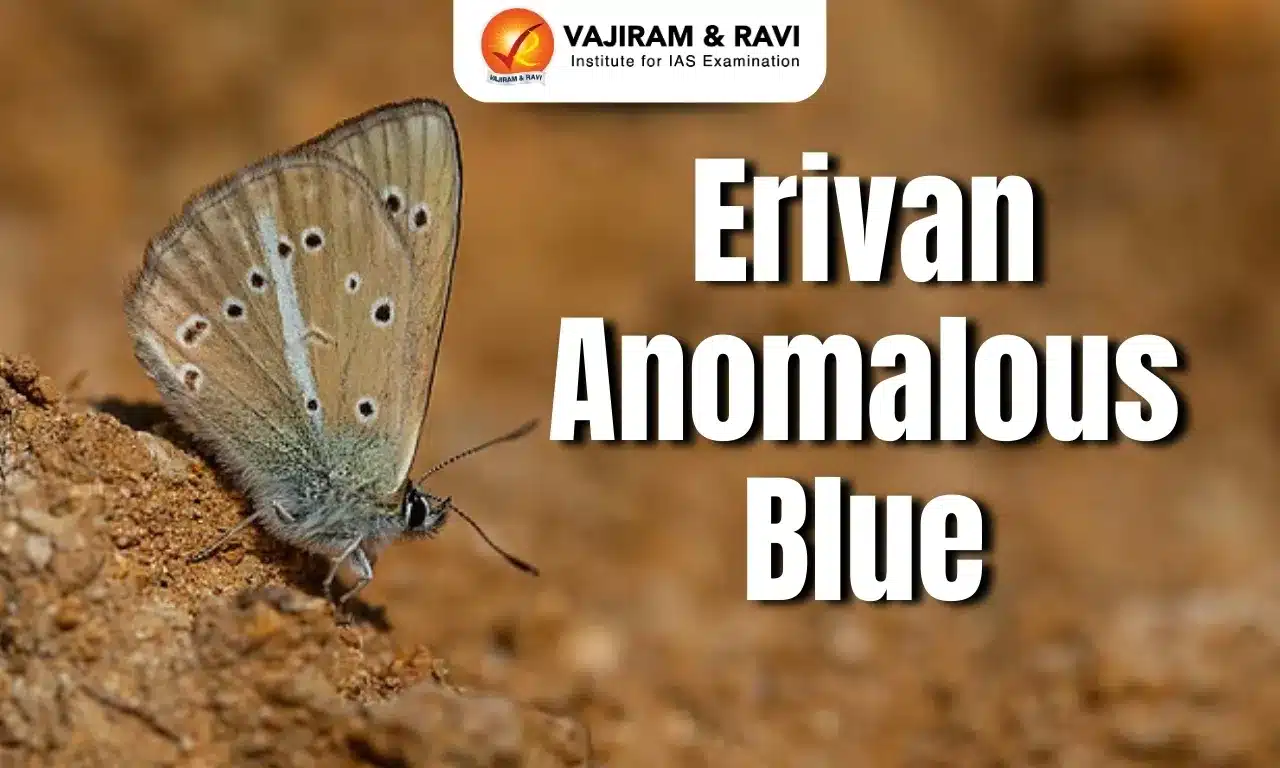
Erivan Anomalous Blue

Erivan Anomalous Blue

Erivan Anomalous Blue Latest News

Recently, Armenia has unveiled the logo for the 17th Conference of the Parties (COP17) to the Convention on Biological Diversity which includes Erivan Anomalous Blue at its centre.

About Erivan Anomalous Blue

  • The Polyommatus eriwanens, also known as Erivan Anomalous Blue, is a blue butterfly.
  •  It is found only in and around Yerevan (Armenia).
  • The Erivan Anomalous Blue gives one generation per year.
  • These butterfly species are active from mid-June till mid-July, depending on elevation.
  • Habitat
    • The species inhabits calcareous grasslands in Armenia but the host plant of the species is still not known. 
    • The species is endemic to Southern Transcaucasia.
    • It is found at the elevation range from 1200 to 2200 m.
    • Conservation Status: The species is not included in the Global and European Red Lists.

What is the Convention on Biological Diversity?

  • It is the most comprehensive binding international agreement in the field of nature conservation and the sustainable use of natural resources.
  • History: It was opened for signing at the UN Conference on Environment and Development in Rio de Janeiro in 1992. 
  • It currently has 196 contracting parties.
  • Governance: The CBD’s governing body is the Conference of the Parties (COP).
  • This ultimate authority of all governments (or Parties) that have ratified the treaty meets every two years to review progress, set priorities, and commit to work plans.
  • Secretariat: Montreal, Canada.

Objectives of Convention on Biological Diversity

  • Conservation of biological diversity
  • Sustainable use of biological diversity
  • Fair and equitable sharing of the benefits arising out of the utilisation of genetic resources

Source: DTE

Erivan Anomalous Blue FAQs

Q1: What is the habitat of Erivan Anomalous Blue?

Ans: Calcareous grasslands in Armenia

Q2: Why is Erivan Anomalous Blue significant?

Ans: It's an indicator species reflecting ecosystem health.

Indian Coast Guard (ICG) Ship Amulya

Indian Coast Guard (ICG) Ship Amulya

Indian Coast Guard (ICG) Ship Amulya Latest News

Recently, the Indian Coast Guard (ICG) Ship ‘Amulya’ was commissioned in Goa.

About Indian Coast Guard (ICG) Ship Amulya

  • It is the third in the series of eight new-generation Adamya-class Fast Patrol Vessels.
  • It has more than 60% indigenous components and designed and built by the Goa Shipyard Limited.
  • It integrates modern design philosophy focused on efficiency, endurance, and rapid response capability.
  • It will be based at Paradip, Odisha, operating under the administrative and operational control of the Commander, Coast Guard Region (North East). 
  • Functions: It will undertake functions like surveillance, interdiction, Search & Rescue, anti-smuggling operations, and pollution response.

Features of Indian Coast Guard (ICG) Ship Amulya

  • Propulsion: It is powered by two 3000 KW advanced diesel engines.
  • Speed: The ship delivers a top speed of 27 knots and an operational endurance of 1,500 nautical miles.
  • Armaments: It is fitted with indigenous state-of-the-art weapons/systems, offering superior manoeuvrability, operational flexibility and enhanced performance at sea.

Source: PIB

Indian Coast Guard (ICG) Ship Amulya FAQs

Q1: What is the class of ICG Ship Amulya?

Ans: Adamya-class

Q2: Where is ICG Ship Amulya based?

Ans: Paradip, Odisha

Bureau of Port Security

Bureau of Port Security

Bureau of Port Security Latest News

Recently, the union Home Minister convened a meeting for the constitution of a dedicated body, the Bureau of Port Security (BoPS), for the security of vessels and port facilities.

About Bureau of Port Security

  • It shall be constituted as a statutory body under the provisions of Section 13 of the Merchant Shipping Act, 2025.
  • It is headed by a Director General, shall function under the aegis of the Ministry of Ports, Shipping and Waterways (MoPSW)
    • He /she shall be responsible for regulatory and oversight functions relating to the security of ships and port facilities.
    • It is being modelled on the lines of the Bureau of Civil Aviation Security (BCAS).
    • The BoPS shall be headed by an IPS officer (Pay Level-15).
    • During the transition period of one year, the Director General of Shipping (DGS/DGMA) shall function as the Director General, BoPS.
  • Functions Bureau of Port Security
    • It ensures timely analysis, collection and exchange of security-related information, with a special focus on cyber security, including a dedicated division to safeguard port IT infrastructure from digital threats.
  • The Central Industrial Security Force (CISF) has been designated as a Recognised Security Organisation (RSO) for port facilities with responsibility for undertaking security assessments and preparation of security plans for ports.

Source: PIB

Bureau of Port Security FAQs

Q1: What is the primary objective of the Bureau of Port Security?

Ans: To ensure port security and safety

Q2: Under which ministry does the Bureau of Port Security function?

Ans: Ministry of Ports, Shipping and Waterways

India’s Quest for 100% Literacy – Bihar’s Reluctance and the ULLAS Challenge

ULLAS

ULLAS Latest News

  • India has set an ambitious target of achieving 100% literacy by 2030, in line with the National Education Policy (NEP) 2020 and UN Sustainable Development Goals (SDG-4: Quality Education). 
  • To realise this, the Union Government launched the ULLAS - Understanding Lifelong Learning for All in Society.
  • However, the non-participation of Bihar—one of India’s least literate states—has emerged as a major obstacle.

Overview of the ULLAS Scheme

  • Launched: It was launched in 2022 by the Union Education Ministry in line with the NEP 2020.
  • Target group: Non-literate persons above 15 years of age.
  • Methodology to identify beneficiaries:
    • Door-to-door identification of non-literates
    • Training in basic literacy and numeracy (Class 3 level)
    • Online/offline learning modes
    • Mandatory assessment and certification
  • Expanded definition of literacy (as per August 2024 guidelines):
    • Reading, writing, and numeracy with comprehension
    • Digital literacy, financial literacy, and life skills
  • Benchmark: 95% literacy treated as equivalent to 100% literacy.

Progress so Far

  • Declared fully literate States/UTs: Himachal Pradesh, Mizoram, Goa, Tripura, Ladakh.
  • Likely to join soon: At least two southern states and one UT.
  • Assessment of impact: Gains likely to reflect in upcoming Census data.

Bihar - A Major Concern

  • Literacy statistics:
    • PLFS 2023–24: 
      • Bihar literacy rate was 74.3% (2nd lowest after Andhra Pradesh – 72.6%), with male literacy of 82.3%, and female literacy of 66.1%.
      • Non-literates (15–59 age group): Nearly 2 crore, including 1.32 crore women.
    • Historical trend: Census 2011 literacy rate was 61.8% (lowest in India).
  • Financial and administrative issues:
    • Funds released under ULLAS (2023–24): A total amount of about Rs 35 crore was approved (Central share: ₹21 cr; State: ₹14 cr). The first instalment of 75% of the approved amount–Rs 16 crore–was released as the central share to Bihar in 2023.
  • Issues flagged by Centre:
    • Funds not transferred to Single Nodal Agency (SNA)
    • No annual plan submitted
    • Non-utilisation of funds
    • 7% interest penalty applicable on delayed transfers (as per Department of Expenditure norms)

Bihar’s Stand - Akshar Anchal Scheme

  • It is a State-run literacy programme in operation for about 15 years.
  • Focus groups:
    • Dalits, Mahadalits, minorities
    • Extremely Backward Classes (EBCs)
    • Women (15–45 age group)
  • Features:
    • Ensuring schooling for children in the 6-14 age group, and basic literacy and numeracy among women in the 15-45 age group. 
    • Women of the targeted groups take a test on basic literacy organised by the state every six months.
  • State’s argument:
    • The scheme attracts larger financial outlay than ULLAS.
    • The existing institutional mechanism makes ULLAS redundant.

Key Challenges and Way Forward

  • Centre–State coordination deficit: Union Education Minister urged Bihar CM to take immediate action, emphasised Bihar’s role in achieving national literacy goals, and directed Bihar to utilise released funds.
  • Duplication vs integration of literacy schemes: Convergence of schemes - Align Akshar Anchal with ULLAS framework.
  • Gender gap in literacy, especially in Bihar: Focus on female literacy as a multiplier for social development.
  • Underutilisation of central funds: Incentivise participation through performance-linked funding.
  • Political and administrative inertia: Strengthen cooperative federalism in education governance.
  • Monitoring and outcome-based evaluation: Digital and community-based learning models to reach adult learners. Robust monitoring mechanism with third-party assessments.

Conclusion

  • The success of India’s mission to achieve 100% literacy by 2030 critically depends on bringing laggard states like Bihar on board. 
  • A cooperative, flexible, and outcome-oriented approach—rooted in NEP 2020’s vision of lifelong learning—is essential to transform literacy from a statistical target into a social reality.

Source: IE

ULLAS

Q1: How does the ULLAS scheme operationalise the goal of 100% literacy envisaged under the NEP 2020?

Ans: ULLAS operationalises NEP 2020 by identifying non-literates above 15 years through surveys, imparting basic literacy, numeracy and life skills, etc.

Q2: Why is Bihar’s non-participation in the ULLAS scheme a major challenge to India’s literacy goals?

Ans: Because it has one of the highest illiteracy loads, with nearly 2 crore non-literates and a female literacy rate far below the national average.

Q3: What is the significance of redefining ‘literacy’ under the ULLAS programme?

Ans: By including digital, financial and life skills, ULLAS shifts literacy from mere alphabet knowledge to functional literacy.

Q4: What are the Centre–State coordination issues highlighted by the implementation of the ULLAS scheme in Bihar?

Ans: Delayed fund transfer, non-submission of annual plans and preference for a parallel state scheme reflect coordination gaps.

Q5: How is the ULLAS scheme linked to global development commitments?

Ans: ULLAS aligns India’s literacy mission with SDG-4 (Quality Education) by targeting universal and lifelong learning outcomes by 2030.

Doppler Weather Radar

Doppler Weather Radar

Doppler Weather Radar Latest News

Recently, the Minister of State for Earth Science informed that there are currently 47 Doppler weather radars (DWRs) across the country to survey weather patterns and forecast.

About Doppler Weather Radar

  • A Doppler radar is a specialized radar that uses the Doppler effect to produce velocity data about objects at a distance.
  • These radar systems can provide information regarding the movement of targets as well as their position.

Working of Doppler weather Radars

  • In radars, a beam of energy, called radio waves, is emitted from an antenna.
  • When this beam strikes an object in the atmosphere, the energy scatters in all directions, with some reflecting directly back to the radar.
  • The larger the object deflecting the beam, the greater is the amount of energy that the radar receives in return.
  • Observing the time required for the beam to be transmitted and returned to the radar allows weather forecasting departments to “see” raindrops in the atmosphere, and measure their distance from the radar.
  • Types of weather Radar Bands: Varying frequencies like S-band, C-band and X-band — are commonly used by the IMD in India.

Applications of  Doppler weather Radars 

  • It is used to track the movement of weather systems and cloud bands, and gauge rainfall over its coverage area of about 500 km.
  • An X-band radar is used to detect thunderstorms and lightning, whereas a C-band radar helps in cyclone tracking.

Source: IE

Doppler Weather Radar FAQs

Q1: What is the primary function of Doppler Weather Radar?

Ans: To detect and track weather systems

Q2: Which band is most commonly used for Doppler Weather Radar?

Ans: S-band

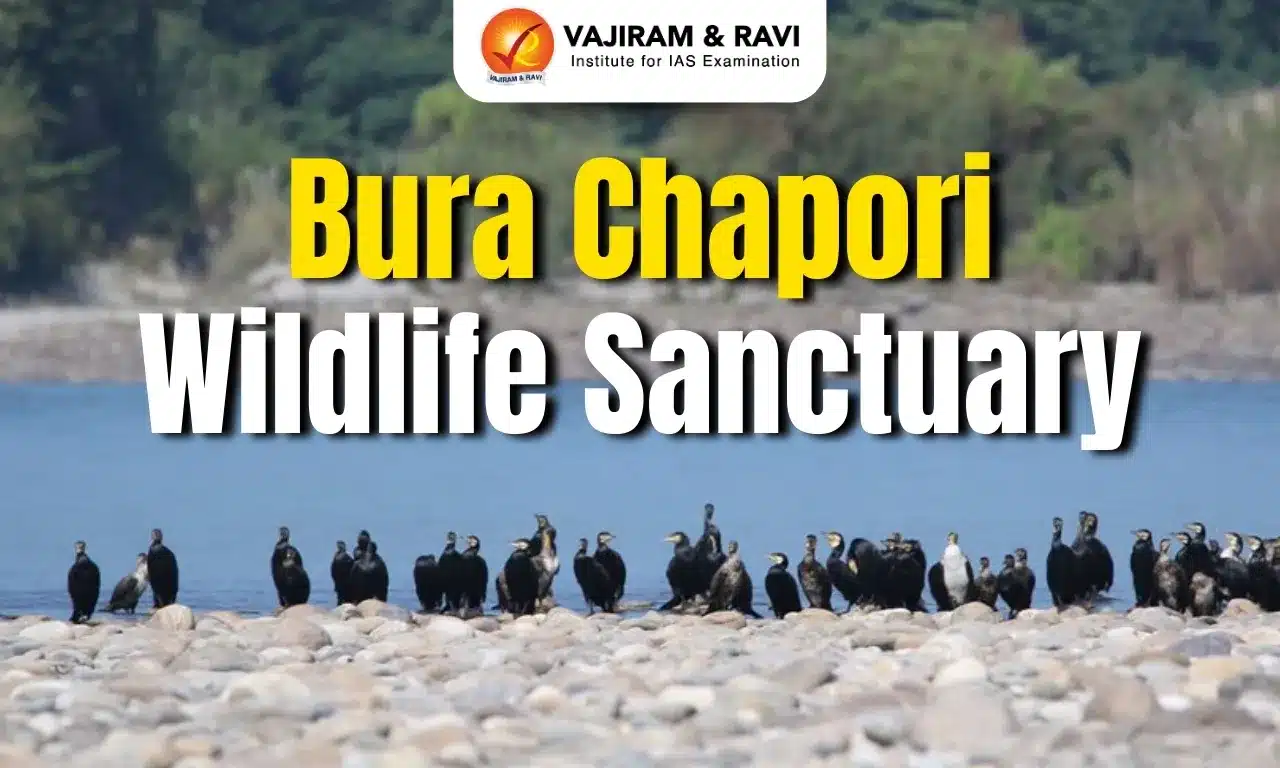
Bura Chapori Wildlife Sanctuary

Bura Chapori Wildlife Sanctuary

Bura Chapori Wildlife Sanctuary Latest News

A team of government officials recently visited the encroached areas of land earmarked for compensatory afforestation at Bura Chapori Wildlife Sanctuary.

About Bura Chapori Wildlife Sanctuary

  • It is located on the southern bank of the river Brahmaputra in the Sonitpur district, Assam
  • It covers an area of 44.06 sq. km.
  • It is located on the north side of Laokhowa Wildlife Sanctuary and shares an integral transboundary landscape of the Laokhowa-Burachapori Wildlife Sanctuary ecosystem. 
  • Both the sanctuary was notified as a buffer zone of the Kaziranga Tiger Reserve in 2007.
  • Most of the low-lying areas of the sanctuary are vulnerable to flooding during summer. 
  • Flora
    • It is enveloped and adorned by wet alluvial grasslands, riparian, and semi-evergreen forests.
    • Most of the plant species found here are of great commercial and medical value.
  • Fauna:
    • It is a habitat of a wide range of wild animals, including tigers, elephants, wild buffalos, one-horned rhinoceros, hog deer, and wild boar.
    • The avian inhabitants feature species like the Bengal florican, black-necked stork, open-billed stork, white-eyed pochard, mallard, spotbill, large whistling teal, and numerous others.

Source: SA

Bura Chapori Wildlife Sanctuary FAQs

Q1: Bura Chapori Wildlife Sanctuary is located in which Indian state?

Ans: Assam

Q2: Bura Chapori Wildlife Sanctuary is situated along which river?

Ans: Brahmaputra

Q3: Bura Chapori Sanctuary shares a landscape with which other wildlife sanctuary?

Ans: Laokhowa Wildlife Sanctuary

Daily Editorial Analysis 20 December 2025

Daily Editorial Analysis

The Changing Patterns of India’s Student Migration

Context

  • India’s expanding student migration marks a decisive shift in global education mobility.
  • Once limited to elite, fully funded pathways, overseas education is now largely self-financed and driven by middle-class aspirations for social mobility and global credentials.
  • With over 13.2 lakh Indian students abroad in 2023 and steady growth projected, this trend is often framed as the democratisation of education.
  • However, behind this narrative lies a complex reality shaped by financial risk, institutional exploitation, and uncertain labour market outcomes.

Scale and Patterns of Student Migration

  • India is among the world’s largest senders of international students. Nearly 40% study in the United States and Canada, followed by the United Kingdom, Australia, and Germany.
  • This growing presence has positioned students as a significant segment of the Indian diaspora.
  • While the scale signals global integration, it also masks deep inequalities in institutional quality and post-study outcomes across destinations.

The Illusion of Democratisation

  • The expansion of overseas education is often interpreted as increased access across social classes.
  • In reality, many students are funnelled into lower-tier universities and vocational colleges with limited academic credibility.
  • Poorly regulated recruitment agencies play a central role, prioritising commissions over student welfare.
  • These agencies often place students in courses misaligned with their academic backgrounds and labour market needs, resulting in deskilling and underemployment.
  • In the United Kingdom, post-1992 universities increasingly rely on international students, sometimes lowering entry standards.
  • Employment outcomes reflect this imbalance, with only about one in four Indian postgraduates securing sponsored skilled visas.

Financial Burden and Reverse Remittances

  • Student migration represents a high-risk investment for Indian middle-class households.
  • Most students rely on education loans or family savings, often mortgaging property to finance degrees costing ₹40–50 lakh.
  • Kerala illustrates this shift clearly: student migration doubled between 2018 and 2023, accounting for over 11% of total emigration.
  • Outward student remittances from the state are estimated at ₹43,378 crore, nearly 20% of inward labour remittances.
  • When expected employment outcomes fail to materialise, families face debt, forced return, or prolonged underemployment, creating reverse remittances, where Indian households subsidise foreign economies.

Contributions to Host Economies and Labour Exploitation

  • While students bear mounting risks, host countries derive substantial economic benefits.
  • International students contributed $30.9 billion to Canada’s GDP in 2022, supporting over 361,000 jobs, with Indian students comprising nearly 45% of enrolments.
  • In the United States, Indian students spend an estimated $7–8 billion annually. Despite this contribution, restrictive visa regimes, limited post-study work options, and rising living costs push many students into low-wage, unskilled employment.
  • Some juggle multiple part-time or undocumented jobs, facing exploitation, insecurity, and mental stress. Recent visa restrictions, particularly in the U.K., have further narrowed survival pathways.

Domestic Push Factors and the Search for Mobility

  • Large-scale student migration is inseparable from domestic conditions in India.
  • Perceived inadequacies in higher education quality and limited access to well-paid employment push students abroad.
  • Notably, Indian students rarely choose offshore campuses of Western universities in Asia despite lower costs.
  • This reveals that migration is not solely about education, but about permanent residency, social mobility, and escape from structural inequality.
  • Overseas education increasingly functions as a migration strategy rather than an academic pursuit.

From Brain Gain to Brain Waste

  • This wave of student migration has produced a new form of cheap labour for OECD economies, resembling Gulf labour migration but financed through private savings and debt.
  • The gap between aspiration and outcome converts potential brain gain into brain waste, where educated migrants remain trapped in low-skilled work.
  • This contradiction highlights the structural inequalities embedded in global education and labour markets.

Conclusion

  • India’s expanding student migration exposes deep contradictions between aspiration and outcome, opportunity and exploitation.
  • While it promises mobility and global exposure, it often results in financial precarity and underemployment.
  • Stronger regulation of education agents, comprehensive pre-departure counselling, and bilateral frameworks ensuring institutional accountability are essential.
  • Without such reforms, student migration risks becoming less a pathway to empowerment and more a mechanism reinforcing global inequality.

The Changing Patterns of India’s Student Migration FAQs

Q1. What defines the current wave of Indian student migration?
Ans. The current wave is defined by self-financed education driven by middle-class aspirations for global mobility.

Q2. Why is overseas education often described as an illusion of democratisation?
Ans. It is an illusion because many students are channelled into lower-tier institutions with weak job prospects.

Q3. What is meant by “reverse remittances” in student migration?
Ans. Reverse remittances refer to Indian households subsidising foreign economies through education loans and savings.

Q4. How do host countries benefit from Indian students?
Ans. Host countries benefit because Indian students contribute significantly to GDP, employment, and local economies.

Q5. Why is this trend described as leading to “brain waste”?
Ans. It leads to brain waste because educated migrants often remain trapped in low-skilled or precarious employment.

Source: The Hindu


The Significance of a Strong Defence Industrial Base

Context

  • India’s ambition to become a developed nation by 2047 hinges not only on socio-economic progress but also on building strong strategic capabilities.
  • A key weakness has been its defence industrial base, long hampered by restrictive policies that excluded domestic private industry while relying heavily on foreign private imports, creating structural economic and security vulnerabilities.
  • This article highlights how building a strong defence industrial base is central to India’s ambition of becoming a developed nation by 2047, linking strategic autonomy, economic resilience, export potential, and global influence through sustained defence-sector reforms.

A Strategic Turn in India’s Defence Manufacturing

  • India’s defence sector has undergone a major transformation with the entry of private industry, liberalised FDI norms, corporatisation of the Ordnance Factory Board, expansion of the ‘Make’ procurement route, and active promotion of innovation.
  • These reforms have boosted defence production and exports, now reaching over 80 countries.
  • The combined impact of reforms signals a maturing ecosystem capable of meeting domestic defence needs while integrating into global supply chains, reducing dependence on imports and strengthening industrial capacity.
  • Geopolitics and the Case for Self-Reliance

    • Ongoing conflicts in Europe, West Asia and Asia have highlighted supply-chain vulnerabilities, underscoring the importance of strong domestic defence industries.
    • For India, facing border and maritime challenges, defence self-reliance is essential for resilience and security.
  • Emerging Global Opportunities
    • Rising defence spending in Europe, saturation of traditional suppliers, and demand for affordable, reliable platforms create new export opportunities.
    • India’s strategic location in the Indian Ocean Region and growing diplomatic influence position it as a credible global defence supplier.

Unlocking India’s Defence Export Potential

  • Need to Simplify Procedures

    • Realising India’s defence export ambitions requires sustained reform.
    • Regulatory complexity continues to impede private-sector participation, particularly for MSMEs and startups.
    • Faster approvals for export licensing, joint ventures and technology transfers are essential.
  • Policy Certainty and Investment Confidence

    • Clear, long-term demand projections are necessary to give industry confidence for large investments.
    • Achieving the target of ₹50,000 crore in defence exports by 2029 depends on simplified procedures and consistent policy continuity.
  • Redefining DRDO’s Role

    • While the DRDO has been central to building strategic capabilities, its future role should prioritise frontier research.
    • Production, scaling and commercialisation should increasingly be led by public and private industry, in line with global best practices.
  • Dedicated Export Facilitation Mechanism

    • Establishing a professionally staffed, single-window defence export facilitation agency would streamline global outreach, reduce inter-ministerial coordination gaps, and enhance India’s competitiveness in international defence markets.

Strengthening India’s Defence Industrial Base: The Way Forward

  • Reforming Finance, Testing and Certification

    • India must overhaul financial, testing and certification frameworks that currently constrain defence manufacturers.
    • Access to competitive credit, faster trials, integrated testing facilities and adoption of international certification standards are crucial to improving export competitiveness.
  • Enhancing Export Support Mechanisms

    • Specialised export financing instruments, proactive use of lines of credit, government-to-government agreements, and long-term service and maintenance commitments can significantly strengthen India’s credibility in global defence markets dominated by established suppliers.
  • Strategic and Economic Significance of Defence Exports

    • Defence exports go beyond commerce; they reflect technological maturity, strategic reliability and international trust.
    • A strong defence industrial base reduces import dependence, creates high-skilled jobs, and enhances India’s geopolitical leverage.
  • Sustaining Momentum for Global Leadership

    • While recent progress is encouraging, sustained and consistent reforms are essential to deepen innovation and attract investment.
    • Building a robust defence ecosystem is a defining step toward India’s emergence as a confident, capable and influential global power.

The Significance of a Strong Defence Industrial Base FAQs

Q1. Why is a strong defence industrial base crucial for India’s development goals?

Ans. A strong defence industrial base enhances national security, reduces import dependence, generates high-skilled employment, boosts exports, and strengthens India’s strategic autonomy and global influence.

Q2. What reforms have transformed India’s defence manufacturing ecosystem?

Ans. Key reforms include private-sector entry, liberalised FDI, corporatisation of ordnance factories, expanded ‘Make’ procurement, and proactive innovation support, boosting production and exports.

Q3. How does the global security environment create opportunities for India?

Ans. Conflicts and supply-chain disruptions have increased global defence demand, while rising costs of traditional suppliers create space for India’s affordable and reliable defence platforms.

Q4. Why are procedural and regulatory reforms still necessary?

Ans. Complex licensing, slow approvals and unclear demand projections deter investment, especially for MSMEs, making simplified procedures and policy certainty essential for export growth.

Q5. What role should DRDO play in the next phase of defence reforms?

Ans. DRDO should focus on frontier research, while industry—public and private—handles production, scaling and commercialisation, aligning India’s defence ecosystem with global best practices.

Source: TH

Daily Editorial Analysis 20 December 2025 FAQs

Q1: What is editorial analysis?

Ans: Editorial analysis is the critical examination and interpretation of newspaper editorials to extract key insights, arguments, and perspectives relevant to UPSC preparation.

Q2: What is an editorial analyst?

Ans: An editorial analyst is someone who studies and breaks down editorials to highlight their relevance, structure, and usefulness for competitive exams like the UPSC.

Q3: What is an editorial for UPSC?

Ans: For UPSC, an editorial refers to opinion-based articles in reputed newspapers that provide analysis on current affairs, governance, policy, and socio-economic issues.

Q4: What are the sources of UPSC Editorial Analysis?

Ans: Key sources include editorials from The Hindu and Indian Express.

Q5: Can Editorial Analysis help in Mains Answer Writing?

Ans: Yes, editorial analysis enhances content quality, analytical depth, and structure in Mains answer writing.

CAG Findings on Pradhan Mantri Kaushal Vikas Yojana

Kaushal Vikas Yojana

Kaushal Vikas Yojana Latest News

  • The Comptroller and Auditor General (CAG) has flagged serious implementation gaps in the Pradhan Mantri Kaushal Vikas Yojana (PMKVY) in an audit report tabled in Parliament.

Pradhan Mantri Kaushal Vikas Yojana: An Overview

  • The Pradhan Mantri Kaushal Vikas Yojana (PMKVY) is the flagship skill development scheme of the Government of India, launched in July 2015 under the Skill India Mission. 
  • The scheme is implemented by the Ministry of Skill Development and Entrepreneurship (MSDE) through the National Skill Development Corporation (NSDC).
  • The core objective of PMKVY is to enable Indian youth to acquire industry-relevant skills, improve employability, and address the problem of educated unemployment. 
  • The scheme focuses on short-term training, Recognition of Prior Learning (RPL), certification, and placement support.
  • PMKVY has been implemented in three phases:
    • PMKVY 1.0 (2015-16)
    • PMKVY 2.0 (2016-20)
    • PMKVY 3.0 (2021-22)
  • Across these phases, the scheme aimed to provide skill training and certification aligned with the National Skills Qualification Framework (NSQF).

Key Features of PMKVY

  • PMKVY provides free skill training to eligible youth across a wide range of sectors such as construction, manufacturing, healthcare, electronics, retail, and services. 
  • Training is conducted through approved Training Centres and Industry Partners.
  • A distinctive feature of the scheme is outcome-based funding, where payments to training partners are linked to certification and placement. 
  • Each certified candidate is eligible for a monetary reward of Rs. 500, transferred through Direct Benefit Transfer (DBT).
  • The scheme also emphasises digital monitoring through the Skill India Portal (SIP), Aadhaar-based authentication, and third-party assessments to ensure transparency.

Achievements of the Scheme

  • Since its launch, PMKVY has emerged as one of the largest skill development programmes in the world. 
  • Between 2015 and 2022, the scheme had a cumulative financial outlay of approximately Rs. 14,450 crore.
  • According to official data, around 1.32 crore candidates were targeted for training and certification, out of which about 1.1 crore candidates were certified across the three phases. 
  • PMKVY has helped expand the skill ecosystem by:
    • Creating a nationwide network of training centres
    • Standardising skill certification through NSQF
    • Promoting Recognition of Prior Learning for informal workers
    • Integrating skill development with Digital India and DBT mechanisms
  • The scheme plays a crucial role in India’s demographic dividend strategy, especially when youth unemployment in the 15-29 age group remains high.

News Summary: CAG Findings on PMKVY

  • A recent CAG audit report, tabled in the Lok Sabha, has highlighted serious deficiencies in the implementation of PMKVY between 2015 and 2022.
  • One of the most glaring findings was the use of invalid bank account numbers, including entries such as “11111111111”, blank fields, or repeated account numbers for multiple beneficiaries. 
  • The audit found that over 94% of candidate records lacked reliable bank account details, raising concerns about beneficiary identification.
  • The CAG also flagged that payouts to more than 34 lakh certified candidates were pending, even years after completion of training. 
  • Despite the ministry’s claim that Aadhaar-linked DBT would resolve payment issues, only 18.44% of candidates received successful DBT payments under PMKVY 2.0 and 3.0.
  • Additionally, the audit revealed shut training centres, instances where training was shown as ongoing even when centres were physically closed, and the reuse of identical photographs for multiple beneficiaries across states such as Bihar, Uttar Pradesh, Maharashtra, and Rajasthan.
  • The CAG also questioned the credibility of “Best-in-Class” employers involved in skill certification and highlighted weak monitoring of training quality and outcomes.

Government Response and Corrective Measures

  • In response to the audit, the Ministry of Skill Development and Entrepreneurship stated that the scheme has since been significantly strengthened. Measures include:
    • Aadhaar-authenticated e-KYC
    • Face authentication and geo-tagged attendance
    • QR-coded digital certificates
    • Enhanced inspections through Kaushal Samiksha Kendras
    • Penalty framework, blacklisting, and recovery from non-compliant entities
  • The government claims that these reforms aim to ensure transparency, accountability, and better beneficiary tracking.

Source: IE

Kaushal Vikas Yojana FAQs

Q1: What is the objective of Pradhan Mantri Kaushal Vikas Yojana?

Ans: It aims to provide industry-relevant skill training and certification to enhance youth employability.

Q2: Which ministry implements PMKVY?

Ans: The Ministry of Skill Development and Entrepreneurship.

Q3: How many phases of PMKVY have been implemented so far?

Ans: Three phases between 2015 and 2022.

Q4: What major issues did the CAG highlight in PMKVY?

Ans: Invalid bank details, pending payments, closed training centres, and weak monitoring.

Q5: Why is PMKVY important for India’s economy?

Ans: It supports skill development, employment generation, and utilisation of the demographic dividend.

SHANTI Bill 2025 Explained: Private Entry, Nuclear Liability Reform and Transparency Concerns

SHANTI Bill

SHANTI Bill Latest News

  • The Sustainable Harnessing and Advancement of Nuclear Energy for Transforming India (SHANTI) Bill, 2025, passed by Parliament, marks a fundamental shift in India’s nuclear power regime by allowing private players to participate in nuclear power plant operations.
  • Once notified, the law will replace the Atomic Energy Act, 1962 and the Civil Liability for Nuclear Damage Act, 2010, redefining rules on who can build and operate nuclear plants, how accident liability is capped, the role of the safety regulator, and mechanisms for dispute resolution and compensation.
  • The Centre argues that the reform is essential to attract investment and achieve India’s target of 100 GW of nuclear capacity by 2047.

Private Sector Entry into India’s Nuclear Power Sector under SHANTI Bill, 2025

  • The SHANTI Bill allows both public and private companies to set up nuclear power plants.
  • They can engage in activities such as the transport, storage, import and export of nuclear fuel, technology, equipment and minerals—areas earlier reserved exclusively for public sector entities.

Strict Safety and Regulatory Oversight

  • Despite opening the sector, the law retains a stringent safety regime.
  • All entities must obtain mandatory safety authorisation from the Atomic Energy Regulatory Board (AERB).
  • Authorisation is required for the manufacture, possession, use, transport, import, export and disposal of radioactive substances, radiation-generating equipment, and for establishing, operating or decommissioning radiation facilities.

Foreign Investment: Conditional and Indirect

  • The Bill does not explicitly permit foreign direct investment in nuclear power.
  • Section 3(e) allows participation by “any other person” expressly permitted by the Central Government through notification.
  • Detailed clarity is expected through subsequent rules, with government sources indicating alignment with DPIIT foreign equity guidelines applicable across sectors.

Activities Reserved for the Central Government

  • Certain critical and sensitive functions remain under exclusive central control, including:
    • Enrichment and isotopic separation of radioactive substances
    • Reprocessing and management of spent fuel and high-level radioactive waste
    • Production and upgradation of heavy water

Question of Accountability under the SHANTI Bill, 2025

  • The Opposition has raised concerns—particularly over the dilution of provisions fixing liability on equipment suppliers in the event of a nuclear accident.

Removal of Supplier Liability (‘Right of Recourse’)

  • A major and contentious change in the SHANTI Bill is the dilution of the operator’s “right of recourse” against equipment suppliers in the event of a nuclear accident.
  • Under Section 17 of the Civil Liability for Nuclear Damage Act (CLNDA), 2010, operators could seek compensation from suppliers if an accident resulted from defective equipment, sub-standard services, or supplier negligence.
  • The new law retains:
    • Contractual recourse if explicitly provided in writing; and
    • Personal criminal liability for acts done with intent to cause nuclear damage.
  • However, it omits the provision covering supplier fault due to patent or latent defects, shielding equipment vendors from long-term and uncertain liability exposure.

Shift to Graded Liability Caps

  • The SHANTI Bill departs from the earlier flat liability cap of ₹1,500 crore for reactors of 10 MW thermal capacity or above.
  • It introduces graded liability caps, linked to the size and capacity of nuclear installations, aiming to better reflect varying risk profiles.

Insurance and Financial Security

  • The obligation to maintain insurance or other financial security to cover nuclear liability applies only to private operators.
  • Central government–owned installations are exempt from this requirement.
  • However, the law authorises the Centre to create a Nuclear Liability Fund to meet its compensation obligations in the event of a nuclear incident.

Strengthened Penalty Framework

  • The SHANTI Bill introduces a two-tier penalty system:
    • Monetary penalties for less serious violations (a provision absent in earlier laws).
    • Imprisonment for grave offences, reinforcing accountability and deterrence.

SHANTI Bill and the Transparency Challenge

  • The SHANTI Bill, 2025 has sparked concern for explicitly overriding the Right to Information (RTI) Act, 2005 through Section 39
  • This provision allows the Central government to declare wide categories of nuclear-related information as “restricted”, including data on nuclear materials, plant design, operations, siting, and regulatory submissions. 
  • Once notified, such information is completely exempt from disclosure under the RTI Act, as Section 39 applies “notwithstanding anything” in the RTI law.

How This Differs from Existing RTI Exemptions

  • The RTI Act already permits withholding sensitive information related to national security, strategic interests, commercial confidence, and personal data. 
  • Crucially, these exemptions are conditional, subject to justification, appeals, and a public interest override under Section 8(2).

Why Section 39 Raises Red Flags

  • Section 39 removes these safeguards entirely. There is no balancing test, appeal mechanism, or scope for public interest review. 
  • Critics warn this could institutionalise secrecy, weaken accountability, deter whistleblowing, and limit independent scrutiny—especially significant as private players enter the nuclear sector.

Source: IE | IE

SHANTI Bill FAQs

Q1: What is the main objective of the SHANTI Bill, 2025?

Ans: The Bill aims to expand nuclear capacity to 100 GW by 2047 by allowing private participation and streamlining India’s nuclear regulatory framework.

Q2: How does the SHANTI Bill change private sector participation?

Ans: It permits private companies to build and operate nuclear plants, though critical functions like fuel reprocessing remain under central government control.

Q3: Why is supplier liability controversial under the new law?

Ans: The Bill removes automatic supplier liability for defective equipment, limiting operators’ right of recourse and raising concerns about accountability after nuclear accidents.

Q4: What changes does the Bill make to nuclear liability caps?

Ans: It replaces the earlier flat ₹1,500 crore cap with graded liability limits based on plant size, while mandating insurance only for private operators.

Q5: Why has Section 39 of the SHANTI Bill drawn criticism?

Ans: Section 39 overrides the RTI Act by permanently exempting “restricted” nuclear information, eliminating appeals and public-interest review, raising transparency concerns.

Why the Indian Rupee Is Weakening Against the Dollar Despite Strong Fundamentals

Declining Rupee

Declining Rupee Latest News

  • Recently, the Reserve Bank of India sold large amounts of US dollars, boosting dollar supply and leading to a nearly 1% appreciation of the rupee. 
  • However, despite this intervention, the rupee has generally been weakening against the dollar over recent months.

A Year of Persistent Rupee Weakness

  • Despite the intervention, the broader trend over recent months has been rupee depreciation. 
  • Over the past year, the rupee has lost nearly 6% of its value against the US dollar, indicating sustained pressure on the Indian currency.

Why the Weakness Is Puzzling

  • Strong Domestic Fundamentals - On paper, the rupee should have strengthened. India remains the fastest-growing major economy, inflation is under control, and external sector indicators such as trade deficit and external debt are relatively stable.
  • Weakening Despite a Soft Dollar - Earlier, the rupee’s fall could be attributed to a globally strong dollar, as other currencies were also depreciating. However, in recent months, the dollar itself has weakened, yet the rupee has continued to slide.
  • Clear Signs of Currency Pressure - The rupee’s depreciation even during phases of dollar weakness removes the argument that global factors alone are responsible. This points to specific pressures on the Indian currency, underlining deeper challenges beyond temporary market interventions.

Why the Rupee Is Weakening Despite Global Currency Strength

  • The rupee’s depreciation stands out at a time when most major and emerging-market currencies are strengthening. 
  • Multiple economic and financial factors explain this divergence.
  • Persistent Trade Deficit Pressures - India continues to import more than it exports in value terms. Higher imports raise demand for US dollars relative to the rupee, pushing down the rupee’s exchange rate.
  • Impact of High US Tariffs on Indian Exports - The US has imposed some of the highest tariffs on Indian goods, making them less competitive abroad. Reduced export demand lowers demand for rupees, further weakening the currency.
  • Uncertainty Over the India–US Trade Deal - The prolonged uncertainty surrounding the India–US trade agreement, despite official optimism of resolution in 3–4 months, discourages investors. Diplomatic tensions that triggered punitive tariffs amplify this risk aversion.
  • Weak Capital Inflows and Investor Apathy - Global investors have largely avoided Indian markets in favour of others. Data show strong gains elsewhere—US indices up 17–23%, China 16–27%, Japan 22–27%, FTSE 18%, Euro area 16%, Hong Kong 27%, Korea 72%—while India’s Sensex rose only about 8%.
    • This suggests investors view Indian equities as either overvalued or less profitable compared to global peers.
  • Role of RBI’s Forex Interventions - The Reserve Bank of India’s buying and selling of dollars significantly influences the rupee’s exchange rate. Such interventions can affect currency movements independent of underlying macroeconomic fundamentals.

Key Determinants of the Rupee’s Movement

  • A recent Bank of Baroda (BoB) study examined the key factors influencing the rupee’s exchange rate using monthly data from October 2020 to November 2025.
  • The study found that three factors explain most of the rupee’s exchange rate fluctuations:
  • RBI’s Spot Market Intervention
    • Direct buying or selling of dollars by the RBI affects short-term currency movements.
    • However, its impact is less significant than forward market operations.
  • RBI’s Position in Forward Contracts
    • Changes in the RBI’s forward dollar positions play a more influential role than spot interventions.
    • Forward market intervention sends a strong signal to markets, making it a more effective tool when the rupee is under pressure.
  • Foreign Portfolio Investment (FPI) Flows
    • In the immediate term, FPI inflows or outflows are a major driver of the rupee’s movement.
    • Investor sentiment and capital flows significantly affect exchange rate dynamics.

Why Trade Deficit Matters Less Than Expected

  • Surprisingly, the trade deficit showed little direct impact on short-term rupee movements.
  • This is because trade data reflect accounting entries rather than actual dollar flows in the same period.
  • Exporters are allowed to retain dollar earnings overseas for a stipulated time before repatriation, weakening the immediate link with exchange rates.

Limits of Economic Variables

  • No single factor explained more than 13–14% of the total variation in the rupee’s exchange rate.
  • This indicates that non-economic factors—such as market psychology, geopolitical developments, and policy signals—also play a significant role.
  • While RBI interventions and forward positions matter, foreign portfolio flows dominate short-term rupee movements, and exchange rates are influenced by factors beyond traditional economic fundamentals.

Source: IE

Declining rupee FAQs

Q1: Why did the RBI intervene in the forex market recently?

Ans: The RBI sold large amounts of US dollars to increase dollar supply, temporarily strengthening the rupee by nearly 1%, amid sustained depreciation pressures.

Q2: Why is the rupee’s weakness considered puzzling?

Ans: India has strong growth, controlled inflation, and stable external metrics, yet the rupee has weakened even when the US dollar itself has softened.

Q3: How do foreign portfolio investors affect the rupee?

Ans: FPI inflows and outflows significantly influence short-term exchange rates, with investor exit from Indian markets putting downward pressure on the rupee.

Q4: Does India’s trade deficit directly drive rupee depreciation?

Ans: Surprisingly, studies show the trade deficit has limited short-term impact because trade data don’t always reflect immediate dollar flows.

Q5: What did the Bank of Baroda study conclude?

Ans: The study found RBI’s forward interventions and FPI flows matter most, but non-economic factors also play a large role in rupee movements.

SHANTI Bill 2025, Objectives, Provisions, Concerns, Way Forward

SHANTI Bill 2025

Why SHANTI Bill 2025 in News?

The Sustainable Harnessing and Advancement of Nuclear Energy for Transforming India, SHANTI Bill 2025, officially called the Atomic Energy Bill 2025, is in the news because the Union Government has approved it to open India’s nuclear energy sector to private and foreign participation.

What is the SHANTI Bill 2025?

The SHANTI Bill 2025 is a proposed law to reform India’s civil nuclear energy sector and make it more open, modern, and investment-friendly. It replaces the Atomic Energy Act, 1962 and the Civil Liability for Nuclear Damage Act, 2010, which earlier kept the sector under strict government control. The Bill allows limited private and foreign participation in nuclear power while retaining state oversight.

SHANTI Bill 2025 Objectives

The SHANTI Bill 2025 aims to reform India’s civil nuclear energy sector to meet future power and climate needs. Its objectives are:

  • Expand nuclear power capacity to provide reliable, round-the-clock (baseload) electricity and reduce dependence on coal.
  • Support India’s climate commitments by promoting low-carbon and clean energy sources alongside renewables.
  • Open the nuclear sector to private and foreign participation in a controlled manner to attract long-term capital and investment.
  • Promote Small Modular Reactors (SMRs) for faster deployment, industrial decarbonisation, and captive power use.
  • Improve grid stability as renewable energy capacity increases across the country.
  • Strengthen India’s energy security by diversifying the power mix and reducing fuel import risks.
  • Leverage international nuclear cooperation, including the Indo-US civil nuclear deal, while maintaining strategic oversight.

Provisions of the SHANTI Bill 2025

  • Expanded role of the private sector in areas such as: Exploration and mining of atomic minerals, Nuclear fuel fabrication, Manufacturing of nuclear equipment and components, and Research and Development (R&D) in civil nuclear technologies
  • Minority equity participation: Private companies are permitted to hold up to 49% equity in nuclear power projects, with the government retaining majority control.
  • Promotion of Small Modular Reactors (SMRs) for industrial use, captive power, and quicker deployment of nuclear capacity.
  • Foreign investment framework through partnerships and sovereign wealth funds, aligned with global nuclear practices.
  • Nuclear Energy Mission support, including a ₹20,000 crore outlay for SMR research and development.
  • Long-term capacity target of achieving 100 GWe nuclear power by 2047.
  • Government oversight and safety control to remain with state agencies such as NPCIL, ensuring nuclear safety and security.
  • Framework for liability and risk-sharing mechanisms to make nuclear projects commercially viable while protecting public interest.

Atomic Energy Regulatory Board

The Atomic Energy Regulatory Board (AERB) is India’s premier authority responsible for ensuring nuclear and radiation safety. It was constituted in November 1983 by the President of India under the Atomic Energy Act, 1962. The AERB derives its regulatory powers from rules and notifications issued under the Atomic Energy Act, 1962 and the Environment (Protection) Act, 1986. Key functions include:

  • Regulates nuclear and radiation safety across civilian nuclear installations
  • Issues safety codes, standards, and licensing conditions
  • Enforces safety provisions under the Atomic Energy Act, 1962 and Environment (Protection) Act, 1986
  • Administers industrial safety provisions of the Factories Act, 1948 for units under the Department of Atomic Energy (DAE) as per Section 23 of the Atomic Energy Act
  • Conducts safety inspections and reviews to prevent radiation hazards
  • Plays a crucial role in strengthening regulatory oversight under the SHANTI Bill 2025 amid increased private sector participation

SHANTI Bill: Comparison with Existing Laws

The SHANTI Bill 2025 marks a significant shift from India’s earlier nuclear laws by reforming ownership, participation, and liability frameworks in the civil nuclear sector. The comparison of this bill and existing laws has been discussed below:

SHANTI Bill: Comparison with Existing Laws
Aspect Atomic Energy Act, 1962 & CLNDA, 2010 SHANTI Bill 2025

Sector Control

Complete government monopoly over nuclear energy

Government control retained, but limited private participation allowed

Private Participation

No role for private companies

Private firms allowed up to 49% minority equity

Foreign Involvement

Effectively restricted due to legal and policy barriers

Foreign participation permitted through partnerships

Liability Framework

Strict supplier liability under CLNDA

Risk-sharing and liability management mechanisms proposed

Technology Focus

Large, indigenous nuclear reactors

Emphasis on Small Modular Reactors (SMRs)

Investment Environment

Closed and risk-heavy for investors

More investment-friendly and aligned with global practices

Concerns and Challenges Related to the Bill

  • Nuclear safety concerns: Expanding private participation raises fears about safety standards, making strong and independent nuclear regulation essential.
  • Public trust and acceptance: Nuclear projects often face local opposition due to health, environmental, and displacement concerns.
  • Liability and compensation issues: Changes in nuclear liability rules may raise worries about whether victims will receive timely and adequate compensation in case of an accident.
  • Commercial viability for private players: High costs, long project timelines, and uncertainty in tariff recovery may discourage private investment.
  • Regulatory capacity: Existing regulatory institutions may face challenges in effectively supervising a larger and more complex nuclear sector.
  • Technology and scalability issues: India’s heavy reliance on indigenous reactor designs may limit rapid scaling and global integration.

Way Forward

  • Strengthen nuclear safety regulation by enhancing the autonomy, capacity, and transparency of the Atomic Energy Regulatory Board (AERB).
  • Ensure clear and fair liability mechanisms that protect victims while providing certainty to investors and suppliers.
  • Promote Small Modular Reactors (SMRs) for industrial decarbonisation, captive power, and improved grid stability.
  • Build public trust through stakeholder consultations, transparency, and awareness about nuclear safety.

  • Encourage phased private participation to test commercial viability before large-scale expansion.
  • Integrate nuclear energy into India’s climate strategy, aligning it with renewable energy growth and net-zero targets.

SHANTI Bill 2025 FAQs

Q1: What is the SHANTI Bill 2025?

Ans: The SHANTI Bill 2025 is a proposed law to reform India’s civil nuclear energy sector by replacing the Atomic Energy Act, 1962 and the Civil Liability for Nuclear Damage Act, 2010.

Q2: Why was the SHANTI Bill introduced?

Ans: It was introduced to expand nuclear power, attract private and foreign investment, ensure energy security, and support India’s climate and net-zero goals.

Q3: Does the SHANTI Bill allow privatisation of nuclear power?

Ans: No. The Bill allows only limited private participation, with private companies permitted up to 49% minority equity while the government retains control.

Q4: What role do Small Modular Reactors (SMRs) play in the Bill?

Ans: SMRs are promoted for faster deployment, industrial decarbonisation, captive power generation, and improved grid stability.

Q5: How does the Bill address nuclear liability issues?

Ans: It proposes risk-sharing and liability management mechanisms to align India’s laws with global practices while ensuring victim compensation.

Viksit Bharat Shiksha Adhikshan Bill 2025, Objectives, Provisions, Councils

Viksit Bharat Shiksha Adhikshan Bill

The Viksit Bharat Shiksha Adhikshan Bill 2025 (Earlier known as Higher Education Commission of India (HECI) Bill) is a major reform step approved by the Union Cabinet to improve India’s higher education system. The Bill proposes a single and unified regulatory body to replace multiple existing regulators like the University Grants Commission, All India Council for Technical Education and National Council for Teacher Education. It follows the National Education Policy 2020 vision to simplify governance, improve quality, and promote autonomy in higher education. The Bill aims to make universities more accountable, transparent and globally competitive while ensuring inclusive growth across regions and social groups.

Viksit Bharat Shiksha Adhikshan Bill Objectives

The Viksit Bharat Shiksha Adhikshan Bill seeks to create a simple, transparent and outcome-focused system to regulate and improve higher education in India.

  • Establish a single national regulator for higher education
  • Reduce regulatory overlap and duplication
  • Improve quality, accreditation and academic standards
  • Promote institutional autonomy and accountability
  • Strengthen global competitiveness of Indian institutions

Viksit Bharat Shiksha Adhikshan Bill Provisions

The Viksit Bharat Shiksha Adhikshan Bill introduces structural, regulatory and academic provisions to transform governance of higher education through a unified framework.

  • Unified Higher Education Regulator
      • Creation of Viksit Bharat Shiksha Adhishthan (HECI) as a statutory body
      • Replacement of UGC, AICTE and NCTE with a single authority
      • Covers universities, colleges and higher educational institutions
      • Excludes medical and law education from its scope
  • Core Regulatory Functions
      • Regulation to ensure compliance and governance norms
      • Accreditation to assess quality of institutions and programmes
      • Standards setting to define learning outcomes and benchmarks
  • Vertical Councils under VBSA
      • Viksit Bharat Shiksha Viniyaman Parishad for regulation
      • Viksit Bharat Shiksha Gunvatta Parishad for accreditation
      • Viksit Bharat Shiksha Manak Parishad for academic standards
  • Autonomy and Accountability Measures
      • Graded autonomy for accredited institutions
      • Mandatory public disclosure of finances, faculty and outcomes
      • Transparent grievance redressal for students
  • Funding and Administrative Control
      • VBSA will not control funding of institutions
      • Funding authority remains with the administrative ministry
  • Scope and Coverage
      • Applies to 1168 universities and university-level institutions
      • Covers 45473 colleges and 12002 standalone institutions
      • Includes open, distance, online and digital education
  • Exempted Professional Programmes
    • Medical, dental, nursing and allied health courses excluded
    • Law, pharmacy and veterinary education remain outside scope
    • Existing councils continue to regulate these fields

Viksit Bharat Shiksha Adhikshan Bill Features

The Viksit Bharat Shiksha Adhikshan Bill introduces key features to strengthen quality, equity and global standing of India’s higher education system.

  • Replaces three major regulators with one unified authority
  • Implements NEP 2020 recommendation for single regulation
  • Ensures separation of regulation, accreditation and standards
  • Covers more than 58000 higher education institutions nationwide
  • Keeps medical and legal education under separate councils
  • Focuses on outcome-based learning and quality assurance
  • Supports autonomy through graded accreditation systems
  • Strengthens transparency through mandatory public disclosures
  • Encourages global ranking improvement, noting 318% growth in global visibility over a decade
  • Promotes inclusion with rising enrolment of OBC, SC and ST students and a Gender Parity Index of 1.01

Viksit Bharat Shiksha Adhikshan Structure

The Viksit Bharat Shiksha Adhikshan Bill establishes a structured institutional framework to ensure clear division of roles and effective governance.

  • Viksit Bharat Shiksha Adhishthan as the apex statutory body
  • Commission headed by a Chairperson appointed by the President of India
  • Up to twelve members including academic experts and officials
  • Three independent councils under the Adhikshan
    • Regulatory Council
    • Accreditation Council
    • Standards Council
  • Each council comprises up to 14 members
  • Members include eminent academicians, experts and government nominees
  • Members selected through a search-cum-selection process with fixed tenure
  • Central Government oversight through policy direction
  • Bodies function as public authorities with statutory accountability

Viksit Bharat Shiksha Adhikshan Bill Specialised Councils

The Viksit Bharat Shiksha Adhikshan Bill introduces three specialised councils under the apex Viksit Bharat Shiksha Adhikshan (VBSA) as given below:

  1. Viksit Bharat Shiksha Viniyaman Parishad (Regulatory Council)
  • Acts as the common regulator for higher education
  • Ensures compliance with governance and disclosure norms
  • Prevents commercialisation of education
  • Facilitates graded autonomy and institutional expansion
  1. Viksit Bharat Shiksha Gunvatta Parishad (Accreditation Council)
  • Oversees outcome-based accreditation frameworks
  • Builds an independent and technology-driven accreditation ecosystem
  • Ensures transparency in quality assessment
  • Promotes continuous quality improvement
  1. Viksit Bharat Shiksha Manak Parishad (Standards Council)
  • Sets national academic and curricular standards
  • Defines learning outcomes and qualification frameworks
  • Facilitates credit transfer and student mobility
  • Encourages innovation while maintaining minimum standards

Viksit Bharat Shiksha Adhikshan Funding

Viksit Bharat Shiksha Adhikshan funding will come from Parliament approved central grants to run the Commission, Councils, staff, secretariats, and regulatory functions nationwide efficiently.

  • The Central Government will provide grants to VBSA after Parliamentary approval under Clause 38, ensuring lawful and accountable public funding.
  • A dedicated Viksit Bharat Shiksha Adhishthan Fund is created to manage salaries, allowances, administration, and operational expenses.
  • Budgetary support will not exceed existing funding levels of UGC, AICTE, and NCTE, ensuring fiscal continuity and stability.
  • All assets and staff of UGC, AICTE, and NCTE transfer to VBSA with unchanged pay, service conditions, and retirement benefits.
  • Funding of centrally funded institutions remains outside VBSA, protecting institutional autonomy and separating regulation from grant disbursal

Viksit Bharat Shiksha Adhikshan Bill Significance

The Viksit Bharat Shiksha Adhikshan Bill marks a structural shift in higher education governance by aligning regulation with quality, autonomy and global standards. 

  • It simplifies regulatory processes, strengthens accountability and supports inclusive growth. 
  • By separating regulation, accreditation and standards, it reduces institutional overlap and conflict. 
  • Its emphasis on transparency, outcome-based education and institutional autonomy positions India’s higher education system to respond effectively to expanding enrolments, rising global competition and evolving knowledge needs, while safeguarding equity and academic integrity.

Viksit Bharat Shiksha Adhikshan Bill FAQs

Q1: What is the Viksit Bharat Shiksha Adhikshan Bill?

Ans: It is a reform law proposing a single regulator to oversee higher education quality, standards and accreditation.

Q2: Which bodies will the Viksit Bharat Shiksha Adhikshan Bill replace?

Ans: It replaces multiple regulators like UGC, AICTE and NCTE with a unified regulatory framework.

Q3: How is the Viksit Bharat Shiksha Adhikshan funded?

Ans: VBSA is funded through Parliament-approved central grants, a dedicated fund, and existing budget support without increasing current higher education expenditure levels.

Q4: Which institutions are covered under the Viksit Bharat Shiksha Adhikshan Bill?

Ans: Most universities and colleges are covered, excluding medical, legal, nursing and veterinary institutions.

Q5: Why is the Viksit Bharat Shiksha Adhikshan Bill considered significant?

Ans: It simplifies regulation, improves transparency, promotes autonomy and aligns higher education with global standards.

Enquire Now