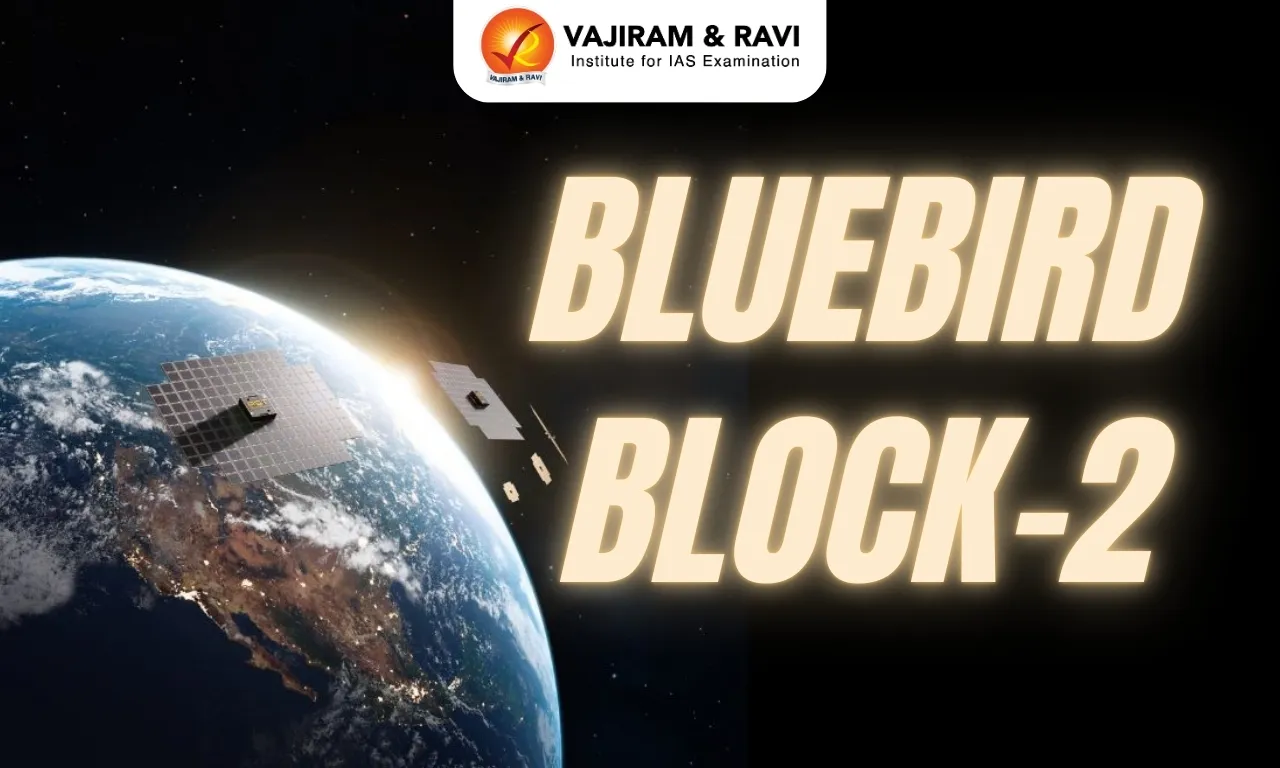
The BlueBird Block-2 Mission marks a significant milestone in India’s space launch capabilities and global commercial space services. The mission involves the launch of a next-generation communication satellite of AST SpaceMobile, USA, using ISRO’s LVM3 (Gaganyaan-class heavy-lift rocket). Officially designated as LVM3-M6 / BlueBird Block-2, this mission represents the 6th operational flight of LVM3 and highlights India’s growing role in deploying advanced commercial satellites into Low Earth Orbit (LEO).
What is BlueBird Block-2?
BlueBird Block-2 is a next-generation space-based cellular broadband satellite developed by AST SpaceMobile. It is designed to deliver direct-to-mobile connectivity, enabling ordinary smartphones to connect to satellites without relying on terrestrial infrastructure.
Capabilities of BlueBird Block-2
- Provides 4G and 5G connectivity directly to standard smartphones
- Supports:
- Voice calls
- Video calls
- Text messaging
- Internet data services
- Operates without ground towers, dish antennas, or special handsets
- Offers global, continuous (24/7) coverage
Features of BlueBird Block-2 Satellite
- Heaviest Commercial Satellite to LEO: BlueBird Block‑2 weighs approximately 6,100 kg, making it the heaviest payload ever placed into Low Earth Orbit (LEO) by India’s LVM3 launch vehicle.
- Massive Phased‑Array Antenna: It carries a 223 m² phased‑array antenna, the largest commercial communications antenna deployed in LEO, enabling strong direct connectivity.
- Direct‑to‑Mobile Connectivity: The satellite is designed to provide 4G and 5G services directly to standard smartphones without special antennas or hardware.
- Global Coverage: It supports voice calls, video calls, messaging, streaming, and high‑speed data worldwide, including remote and underserved regions.
- Part of a LEO Constellation: BlueBird Block‑2 is part of AST SpaceMobile’s global Low Earth Orbit satellite network aimed at universal mobile broadband connectivity.
LVM3-M6 Mission
The LVM3-M6 mission is a dedicated commercial launch undertaken to place the BlueBird Block-2 communication satellite into Low Earth Orbit. The mission is executed through NewSpace India Limited (NSIL), ISRO’s commercial arm, underscoring India’s expanding footprint in the global space launch market.
- Mission Name: LVM3-M6 / BlueBird Block-2
- Launch Vehicle: LVM3 (GSLV Mk-III)
- Launch Site: Second Launch Pad, SDSC SHAR, Sriharikota
- Payload: BlueBird Block-2 Communication Satellite
- Client: AST SpaceMobile, USA
- Orbit: Low Earth Orbit (LEO)
This mission is notable for carrying the largest and heaviest commercial communication satellite ever deployed in LEO.
Why is this mission important?
- Direct-to-Mobile Connectivity: Enables ordinary smartphones to connect directly to the satellite without relying on ground towers or special devices, benefiting remote areas, oceans, and disaster-prone regions.
- Major Commercial Milestone: Executed through NewSpace India Limited, the mission demonstrates India’s capability to launch heavy commercial payloads, strengthening its position in the global space launch market.
- Part of Global LEO Constellation: Contributes to AST SpaceMobile’s worldwide Low Earth Orbit satellite network, enhancing global cellular broadband coverage.
- Technological Demonstration: Showcases India’s advanced launch vehicle technology (LVM3) and precision orbital insertion for extremely heavy payloads, reinforcing confidence in ISRO’s engineering expertise.
- Strategic and Societal Impact: Supports telecommunication expansion, disaster management, and connectivity in underserved regions, aligning with global digital inclusion initiatives.
LVM3 Three-Stage Configuration
The LVM3 (GSLV Mk-III) is a three-stage heavy-lift launch vehicle designed to place large satellites into Low Earth Orbit and Geosynchronous Transfer Orbit. Its configuration combines solid, liquid, and cryogenic propulsion, ensuring high thrust at lift-off and precise orbital insertion.
1. First Stage: S200 Solid Strap-On Boosters
- LVM3 uses two S200 solid rocket boosters attached on either side of the core stage.
- Each booster contains around 200 tonnes of solid propellant, making them among the largest solid boosters in operation globally.
- These boosters provide the maximum thrust during lift-off, accounting for nearly 80–85% of the total thrust at launch.
- Their primary role is to overcome Earth’s gravity and atmospheric drag in the initial phase of flight.
- The S200 boosters are developed by Vikram Sarabhai Space Centre (VSSC).
- After burnout, the boosters are jettisoned to reduce weight and improve flight efficiency.
2. Second Stage: L110 Liquid Core Stage
- The L110 is the central liquid-fuel stage of LVM3.
- It uses liquid propellants (UDMH and N₂O₄) and is powered by two Vikas engines.
- This stage provides controlled and sustained thrust after the solid boosters separate.
- The L110 stage ensures vehicle stability, trajectory correction, and velocity buildup during the mid-phase of the ascent.
- It bridges the transition from high-thrust lift-off to precise orbital insertion.
- After completing its burn, the L110 stage is also separated from the vehicle.
3. Third Stage: C25 Cryogenic Upper Stage
- The C25 stage is the most technologically advanced stage of LVM3.
- It is powered by an indigenously developed cryogenic engine (CE-20).
- The engine uses liquid hydrogen (LH₂) as fuel and liquid oxygen (LOX) as oxidiser.
- Cryogenic propulsion provides very high efficiency and specific impulse, crucial for placing heavy payloads into precise orbits.
- This stage performs the final orbital insertion, whether into LEO or Geosynchronous Transfer Orbit (GTO).
- The C25 stage has been designed and developed by ISRO’s Liquid Propulsion Systems Centre (LPSC).
Track Record of LVM3 Missions
- Proven National Mission Reliability: LVM3 has successfully launched Chandrayaan-2 and Chandrayaan-3, demonstrating its capability for complex scientific and lunar missions.
- Successful Commercial Deployments: It has completed two OneWeb missions, placing 72 satellites into Low Earth Orbit, establishing India as a trusted partner for large commercial satellite launches.
- Recent Operational Success: The LVM3-M5 / CMS-03 mission was successfully executed in November 2025, carrying a 4,400 kg communication satellite, showcasing the vehicle’s consistent reliability.
About Semi-Cryogenic Engine in India
- Indigenous Development: India is developing the SCE-200 semi-cryogenic engine indigenously at ISRO’s Liquid Propulsion Systems Centre (LPSC) to power future heavy-lift rockets.
- Fuel and Oxidizer: Uses kerosene (RP-1) as fuel and liquid oxygen (LOX) as oxidizer, offering higher efficiency than conventional liquid engines.
- High Payload Capability: Designed to enhance payload capacity to GTO and LEO, supporting heavier satellites and ambitious space missions.
- Cost-Effective Launches: The semi-cryogenic engine allows reduced launch costs due to better fuel efficiency and potential for partial reusability.
- Strategic Significance: Strengthens India’s indigenous heavy-lift launch capability, boosting commercial competitiveness and supporting national space exploration goals.
BlueBird Block-2 FAQs
Q1: What is the BlueBird Block‑2 Mission?
Ans: It is a commercial mission by ISRO to launch the AST SpaceMobile BlueBird Block‑2 satellite into Low Earth Orbit using LVM3‑M6.
Q2: Who is the client and purpose of the satellite?
Ans: The client is AST SpaceMobile, and the satellite provides direct-to-mobile 4G/5G broadband to standard smartphones globally.
Q3: Where and when was the mission launched?
Ans: The mission launched from the Second Launch Pad, SDSC SHAR, Sriharikota, on 24 December 2025.
Q4: What is significant about the payload?
Ans: Weighing 6,100 kg, it is the heaviest commercial satellite ever launched into LEO by LVM3.
Q5: What coverage and services will the satellite provide?
Ans: It offers 24/7 global coverage for voice calls, video calls, messaging, and high-speed internet directly to smartphones.

