LVM3-M6 Latest News
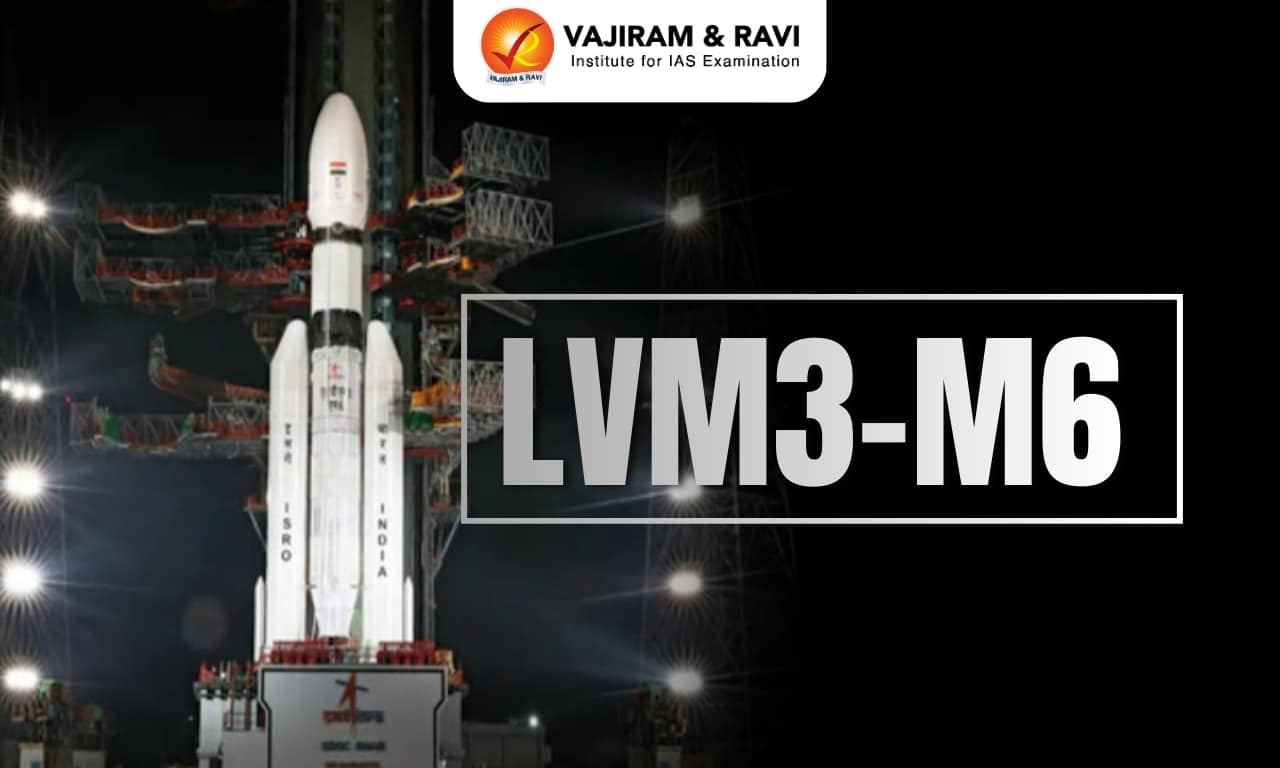
- The Indian Space Research Organisation (ISRO) is set to launch the LVM-3 rocket carrying its heaviest-ever satellite, BlueBird Block-2 (≈6,100 kg).
- The satellite will be placed into a low Earth orbit (LEO) of about 520 km roughly 15 minutes after liftoff.
- BlueBird Block-2 will be the largest commercial communications satellite deployed in LEO to date. Designed by AST SpaceMobile, the satellite is part of a constellation aimed at direct-to-mobile connectivity.
- Unlike traditional satellites that rely on ground stations, this system will communicate directly with standard smartphones, enabling 4G/5G voice and video calls, messaging, streaming, and data access globally.
LVM3: India’s Heavy-Lift Launch Vehicle
- The Launch Vehicle Mark-3 (LMV3) is a three-stage launch vehicle weighing about 640 tonnes and standing 43.5 metres tall.
- Developed over decades, it represents the peak of India’s launch vehicle engineering.
S200 Solid Strap-On Boosters: Power at Lift-Off
- The first stage comprises two S200 solid-propellant boosters, among the most powerful solid rockets in use worldwide.
- They provide the massive thrust needed at lift-off to overcome gravity and pass through Earth’s dense lower atmosphere.
L110 Liquid Core Stage: Controlled Acceleration
- After booster separation, the L110 liquid stage takes over, using hypergolic propellants for smooth, controllable thrust.
- This stage plays a crucial role in shaping the satellite’s trajectory and reflects India’s long-standing expertise in liquid propulsion.
C25 Cryogenic Upper Stage: Precision and Efficiency
- The C25 cryogenic stage burns supercooled liquid oxygen and hydrogen stored below –180°C.
- It is India’s largest and most advanced cryogenic engine, offering high efficiency, longer burn duration, and precise orbit insertion—key to technological self-reliance achieved after decades of effort.
ISRO’s Push to Optimise LVM3 Engines
- ISRO is upgrading the LVM3 to meet human-rating requirements for Gaganyaan and to increase lift capacity for modules of the proposed Bharatiya Antariksh Station.
- This involves adding redundancies for safety and boosting overall performance.
More Thrust from the Cryogenic Upper Stage
- ISRO is enhancing the cryogenic upper stage, which provides nearly 50% of the velocity needed for geosynchronous missions.
- The current C25 stage carries 28,000 kg of propellant and produces 20 tonnes of thrust.
- The planned C32 stage will carry 32,000 kg of fuel, increasing thrust to 22 tonnes, enabling heavier payloads.
Switch to a Semi-Cryogenic Second Stage
- The agency is considering replacing the liquid-propellant second stage with a semi-cryogenic engine using refined kerosene and liquid oxygen.
- This change would lower costs, improve efficiency, and raise LEO payload capacity from ~8,000 kg to ~10,000 kg, a configuration likely for space-station module launches.
Bootstrap Reignition for Multi-Orbit Missions
- To support missions deploying satellites into multiple orbits, ISRO is developing bootstrap reignition for cryogenic engines.
- This allows the upper stage to restart without external gases (like helium), reducing system mass and increasing payload capability—especially valuable for LEO constellation missions.
Significance of LVM3-M6 Mission
- The LVM3-M6 / BlueBird Block-2 mission is a dedicated commercial launch using ISRO’s LVM3 rocket to deploy the BlueBird Block-2 communication satellite of AST SpaceMobile.
- It represents the sixth operational flight of the LVM3 launch vehicle.
- This is ISRO’s third commercial mission with the LVM-3, after launching OneWeb satellites in 2022–23.
- With alternatives like SpaceX’s Falcon-9 and European Space Agency’s Ariane-6 available, the launch is a chance for ISRO to prove it can deliver heavy launches at lower cost.
Expanding the LVM-3’s Role
- Originally designed for geosynchronous missions (~36,000 km), the LVM-3 has now proven versatile in low Earth orbit (LEO) deployments.
- This marks the third LEO mission for the vehicle, reflecting its evolution from the earlier GSLV-Mk3.
Operational Readiness and Turnaround Time
- The launch follows the CMS-03 mission on November 2, making it the shortest gap between two LVM-3 launches.
- It tests ISRO’s ability to assemble and execute heavy missions rapidly, a key metric for commercial reliability.
Record-Breaking Payload
- At 6,100 kg, the BlueBird payload is ISRO’s heaviest satellite ever placed into orbit, surpassing the cumulative OneWeb payloads (~5,700 kg) to LEO and the 4,410 kg CMS-03 sent to geosynchronous transfer orbit last month.
Strategic Momentum
- This is the second year since 2023 that ISRO flies two LVM-3 missions in a single year, underscoring growing cadence, capability, and confidence in India’s heavy-lift launch ecosystem.
LVM3-M6 FAQs
Q1: What is the LVM3-M6 mission?
Ans: The LVM3-M6 mission is a dedicated commercial launch by ISRO to place the BlueBird Block-2 satellite into low Earth orbit using the LVM3 rocket.
Q2: Why is the LVM3-M6 mission significant for ISRO?
Ans: It carries ISRO’s heaviest-ever payload at 6,100 kg and tests India’s ability to conduct heavy commercial launches at a competitive cost.
Q3: What makes the BlueBird Block-2 satellite unique?
Ans: BlueBird Block-2 enables direct-to-mobile connectivity, allowing 4G/5G calls, texts, and data directly on smartphones without ground relay stations.
Q4: How does LVM3 compare with other heavy-lift launch vehicles?
Ans: LVM3 competes with SpaceX’s Falcon-9 and ESA’s Ariane-6, offering a lower-cost alternative for heavy satellite launches to LEO and GTO.
Q5: How does LVM3-M6 support India’s future space plans?
Ans: The mission strengthens ISRO’s readiness for Gaganyaan, Bharatiya Antariksh Station modules, and global commercial satellite launches.

