
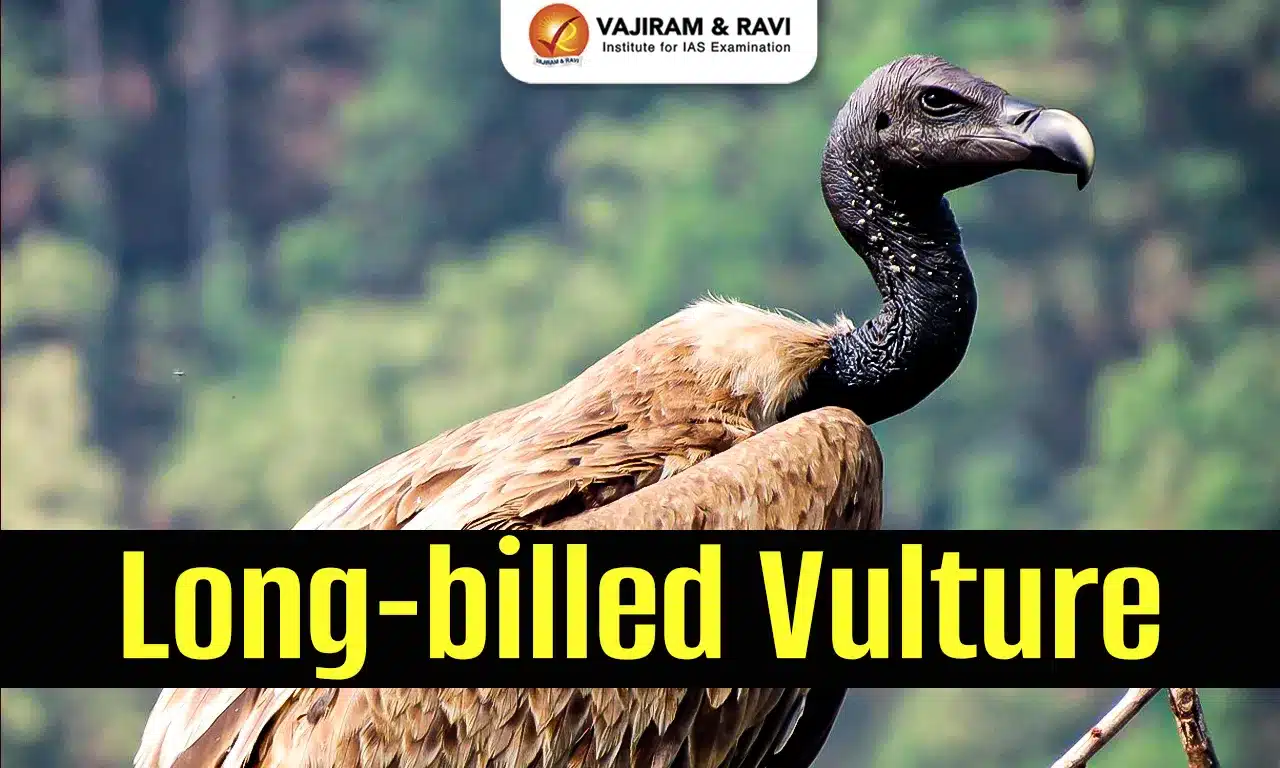
Long-Billed Vulture Latest News
Recently, the Bombay Natural History Society (BNHS), along with the Maharashtra Forest Department, successfully carried out the tagging of 15 long-billed vultures at Melghat Tiger Reserve.
About Long-Billed Vulture
- It is an old World vulture native to the Asian region.
- They are also known as Indian long-billed vultures due to their comparatively longer beak.
- Appearance: It is a medium-sized and bulky scavenger feeding mostly on the carcasses of dead animals.
- Females of this species are smaller than males.
- Habitat: They are usually found in savannas and other open habitats around villages, cities, and near cultivated areas.
- Distribution: These are native to India, Pakistan, and Nepal.
- Conservation status: IUCN Red List: Critically Endangered
Key Facts about Melghat Tiger Reserve
- Location: It is located in the Amaravati district of Maharashtra, specifically on the Gavilgarh Hill, a southern offshoot of the Satpura Hill Range in Central India.
- Vegetation: The forest is tropical dry deciduous in nature, dominated by teak.
- Rivers: The reserve is a catchment area for five major rivers: the Khandu, Khapra, Sipna, Gadga, and Dolar, all of which are tributaries of the river Tapti.
- The Tapti River and the Gawilgadh ridge of the Satpura Range form the boundaries of the reserve.
- Tribes: The Korkus are the largest tribal community in Melghat. Other communities include the Gawli community and the Gond tribe etc.
- Flora: Some of the common species are teak, Lagerstroemia Parviflora, Terminalia Tomentosa, Ougeinia Oojeinensis, Emblica Officinalis, Bamboo, etc.
- Fauna: It includes Sloth Bear, Indian Gaur, Sambar deer, Leopard, Nilgais, dhole, hyena, jungle cat, langur, etc.
Source: DH
Long-billed Vulture FAQs
Q1: What is the scientific name of the Long-billed Vulture?
Ans: Gyps indicus
Q2: What is the main threat to Long-billed Vulture populations?
Ans: Diclofenac poisoning
