
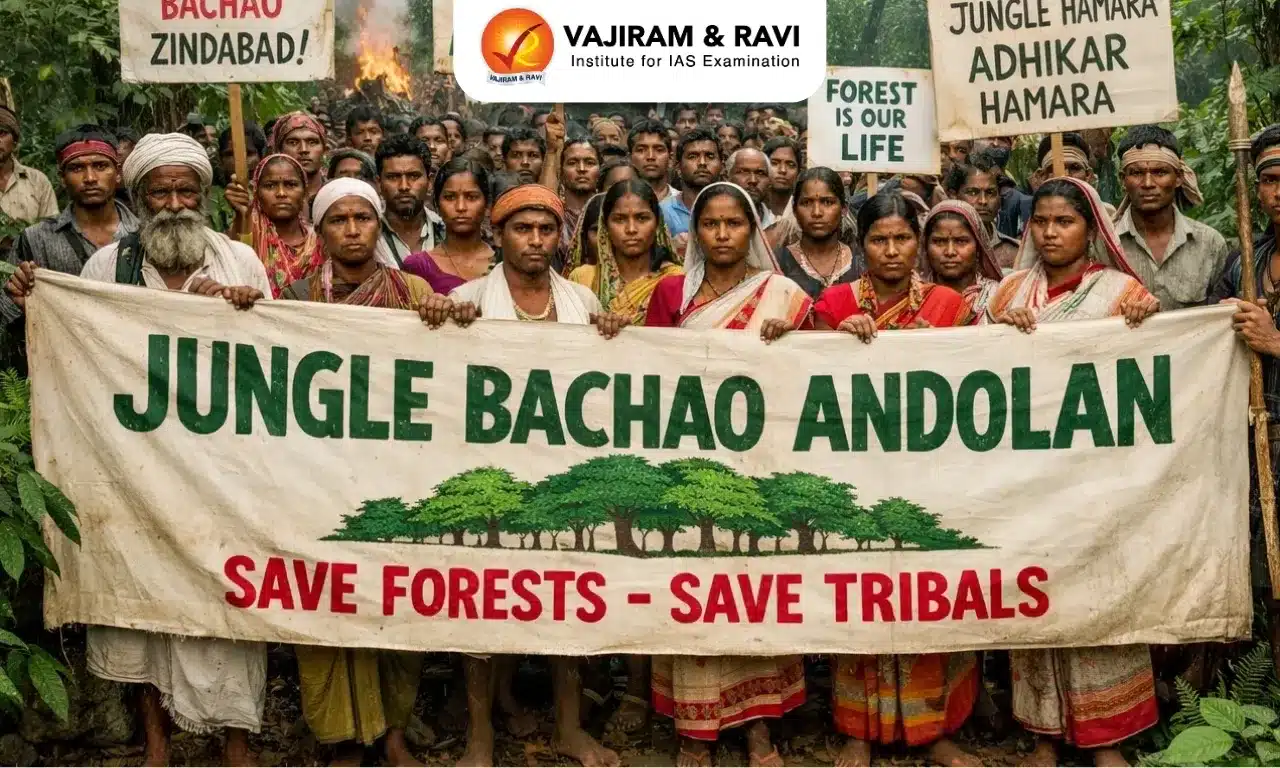
The Jungle Bachao Andolan was a major community led environmental movement that emerged in India during the early 1980s to oppose rapid deforestation and protect indigenous forest rights. Originating in the forest rich Singhbhum region of erstwhile Bihar, now Jharkhand, the movement arose as a direct response to state led commercial forestry policies that threatened natural Sal forests. Jungle Bachao Andolan highlighted the deep link between ecological conservation and tribal livelihoods, transforming forest protection into a people-driven governance issue.
Jungle Bachao Andolan
The Jungle Bachao Andolan, also known as the Jharkhand Jungle Bachao Andolan, focused on safeguarding forests while asserting the customary rights of Adivasi communities. It opposed monoculture commercial plantations, particularly teak, replacing biodiverse Sal forests. The movement expanded from Jharkhand to parts of Odisha, mobilising Gram Sabhas and local institutions. Jungle Bachao Andolan framed forests as living ecosystems rather than revenue-generating assets, shifting environmental discourse toward sustainable, community-controlled conservation.
Jungle Bachao Andolan History
The Jungle Bachao Andolan developed through local resistance against state-controlled forest management models prioritising revenue over ecology and indigenous survival.
- Early 1980s Origin: Initiated in Singhbhum against proposed replacement of Sal forests with teak plantations.
- 1978 Precursor Movements: Jungal Katai Andolan protested forest destruction in Kolhan Singhbhum region.
- Community Resistance: Munda, Ho, and Santhal tribes mobilised to protect ancestral forest lands.
- Government Proposal Trigger: Bihar Forest Department promoted commercial teak plantations for timber revenue.
- Grassroots Mobilisation: Villagers organised rallies, forest guarding, and awareness campaigns.
- Policy Reversal Success: Government dropped teak plantation plans after sustained local opposition.
- 1990s Expansion: Movement spread beyond Jharkhand, influencing forest activism nationally.
- Institutional Consolidation: Jharkhand Jungle Bachao Andolan emerged as organised platform by 2000.
Jungle Bachao Andolan Features
The Jungle Bachao Andolan combined environmental conservation with social justice using decentralised, community based forest governance mechanisms.
- Community Leadership: Forest protection decisions driven by local Adivasi communities.
- Ecological Focus: Emphasis on preserving native Sal forests over monoculture plantations.
- Participatory Governance: Gram Sabhas recognised as primary forest decision making bodies.
- Livelihood Protection: Movement linked forest conservation with survival of tribal economies.
- Decentralised Action: Village level monitoring replaced centralized forest administration.
- Non Violent Protest: Used rallies, public meetings, and awareness campaigns.
- Cultural Integration: Traditional ecological knowledge guided conservation practices.
- Regional Expansion: Spread to Odisha and neighbouring forest regions.
Jungle Bachao Andolan Pillars
The Jungle Bachao Andolan functioned through four institutional pillars that empowered communities to manage forests collectively.
- Gram Sabha: Village councils exercised authority over forest use and protection.
- Forest Protection Committees: Local groups monitored illegal logging and forest degradation.
- Women’s Cooperatives: Women participated in conservation and resource decision making.
- Youth Forums (Bal Akhra): Youth engaged in forest patrolling and awareness activities.
Jungle Bachao Andolan Impact
The Jungle Bachao Andolan produced measurable environmental, social, and policy level outcomes across forest regions.
- Commercial Projects Halted: Prevented conversion of Sal forests into teak plantations.
- Forest Regeneration: Community protection slowed forest degradation in Singhbhum region.
- Adivasi Empowerment: Indigenous communities gained negotiation power over land use.
- Policy Recognition: Government acknowledged people centric forest conservation approaches.
- Institutional Models: Inspired participatory forest management frameworks.
- Movement Replication: Encouraged similar conservation movements across India.
- Awareness Expansion: Linked forests with biodiversity, climate balance, and livelihoods.
Jungle Bachao Andolan Indigenous Communities
The Jungle Bachao Andolan directly addressed the historical marginalisation of Adivasi communities in forest governance.
- Customary Rights Defence: Protected traditional access to forest produce.
- Displacement Resistance: Opposed forced relocation due to dams, mining, and plantations.
- Cultural Preservation: Safeguarded forest based cultural and spiritual practices.
- Economic Security: Prevented loss of minor forest produce livelihoods.
- Political Voice: Enabled tribal participation in development decision making.
Jungle Bachao Andolan Forest Governance
The movement challenged colonial era forest administration models and promoted democratic alternatives.
- Revenue Model Critique: Questioned timber centric forest management.
- Administrative Accountability: Exposed misuse of forest laws against communities.
- Decentralisation Push: Advocated local forest governance systems.
- Ecological Management: Prioritised biodiversity over commercial species.
- Long Term Sustainability: Encouraged regenerative forest use practices.
Jungle Bachao Andolan Significance
The Jungle Bachao Andolan marked a turning point in India’s environmental history by redefining forests as community commons.
- Forest Rights Visibility: Brought Adivasi forest rights into national policy debates.
- Deforestation Awareness: Highlighted ecological damage caused by commercial forestry.
- Policy Influence: Contributed to conservation oriented thinking in National Forest Policy 1988.
- People’s Environmentalism: Demonstrated effectiveness of grassroots ecological movements.
- Sustainable Development: Promoted coexistence of development and conservation.
- Legal Consciousness: Strengthened understanding of customary forest rights.
- Movement Inspiration: Influenced later forest rights and environmental campaigns.
- Movement Blueprint: Provided framework for community based conservation.
- Forest Policy Shift: Influenced conservation first policy thinking.
- Grassroots Strength: Proved local resistance can reshape national agendas.
- Educational Relevance: Became core case study in environmental governance.
- Ongoing Relevance: Continues to inform forest rights activism.
Jungle Bachao Andolan FAQs
Q1: What is Jungle Bachao Andolan?
Ans: Jungle Bachao Andolan was a community led environmental movement to protect natural forests and indigenous rights.
Q2: Where did Jungle Bachao Andolan originate?
Ans: It originated in Singhbhum district of Bihar, now Jharkhand, during the early 1980s.
Q3: Why was Jungle Bachao Andolan started?
Ans: It began to oppose the replacement of Sal forests with commercial teak plantations.
Q4: Who participated in Jungle Bachao Andolan?
Ans: Adivasi communities like Munda, Ho, and Santhal played a central role.
Q5: What was the outcome of Jungle Bachao Andolan?
Ans: The government withdrew commercial plantation plans, strengthening community forest protection.
