
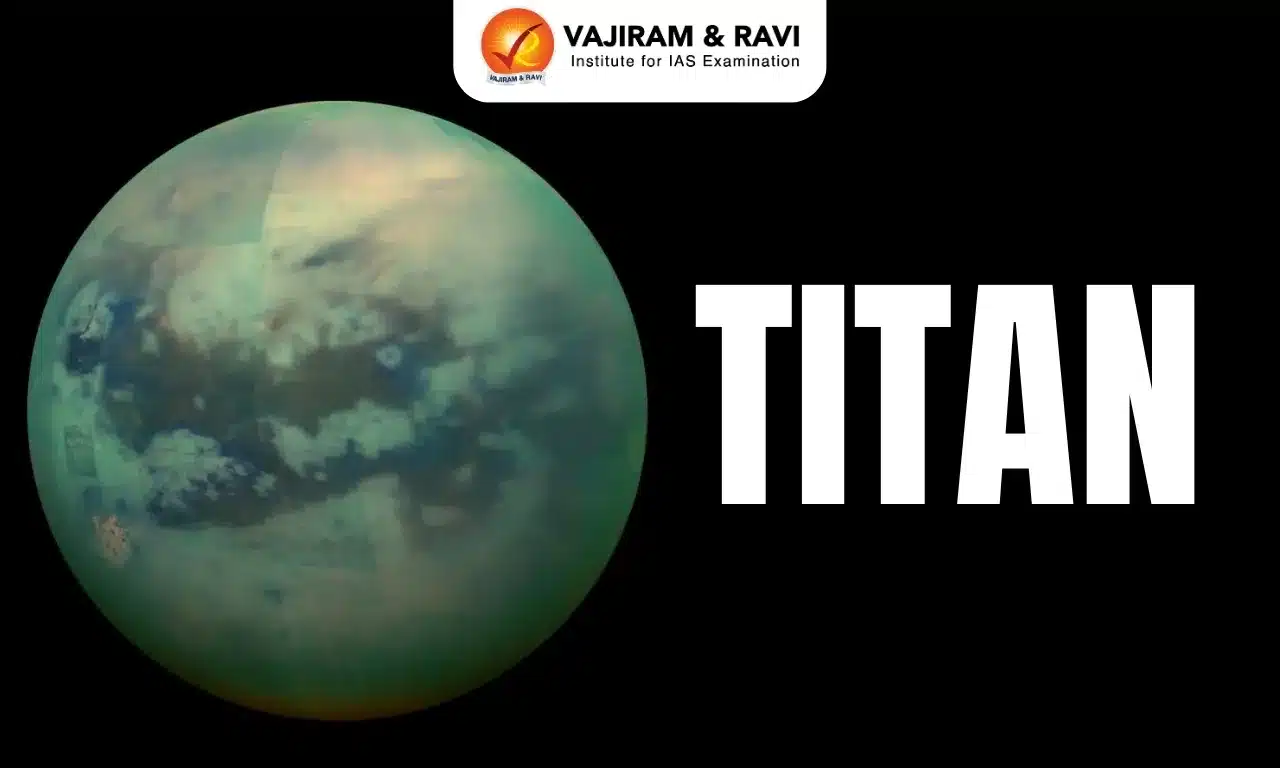
Titan Latest News
Saturn's largest moon, Titan, may not have a subsurface ocean after all, according to a re-examination of data captured by NASA's Cassini spacecraft, which flew by Titan dozens of times starting in 2004.
About Titan
- Titan is Saturn's largest moon.
- Dutch astronomer Christiaan Huygens discovered Titan on March 25, 1655.
- It is the second largest moon in our solar system. Only Jupiter's moon Ganymede is larger, by just 2 percent.
- It has a radius of about 2,575 kilometers, and is nearly 50 percent wider than Earth’s moon.
- It is the only moon in the solar system with a dense atmosphere.
- It's the only world besides Earth that has standing bodies of liquid, including rivers, lakes, and seas, on its surface.
- Like Earth, Titan’s atmosphere is primarily nitrogen, plus a small amount of methane.
- It is the sole other place in the solar system known to have an earth-like cycle of liquids raining from clouds, flowing across its surface, filling lakes and seas, and evaporating back into the sky (akin to Earth’s water cycle).
- Titan takes 15 days and 22 hours to complete a full orbit of Saturn.
- Titan is also tidally locked in synchronous rotation with Saturn, meaning that, like Earth’s Moon, Titan always shows the same face to the planet as it orbits.
Key Facts about Cassini Spacecraft
- It is a joint project of NASA, the European Space Agency, and the Italian Space Agency (ASI).
- Cassini was a sophisticated robotic spacecraft sent to study Saturn and its complex system of rings and moons in unprecedented detail.
- It was launched on October 15, 1997. It was one of the largest interplanetary spacecraft.
- The mission consisted of NASA’s Cassini orbiter, which was the first space probe to orbit Saturn, and the ESA’s Huygens probe, which landed on Titan, Saturn’s largest moon.
Source: SA
Titan FAQs
Q1: Titan is the largest moon of which planet?
Ans: Saturn
Q2: What is the approximate radius of Titan?
Ans: 2,575 km
Q3: Which gas makes up most of Titan’s atmosphere?
Ans: Like Earth, Titan’s atmosphere is primarily nitrogen, plus a small amount of methane.
Q4: What makes Titan unique in terms of surface liquids?
Ans: It's the only world besides Earth that has standing bodies of liquid, including rivers, lakes, and seas, on its surface.
Q5: Is Titan tidally locked with Saturn?
Ans: Yes, Titan is tidally locked, meaning it always shows the same face to Saturn.
