
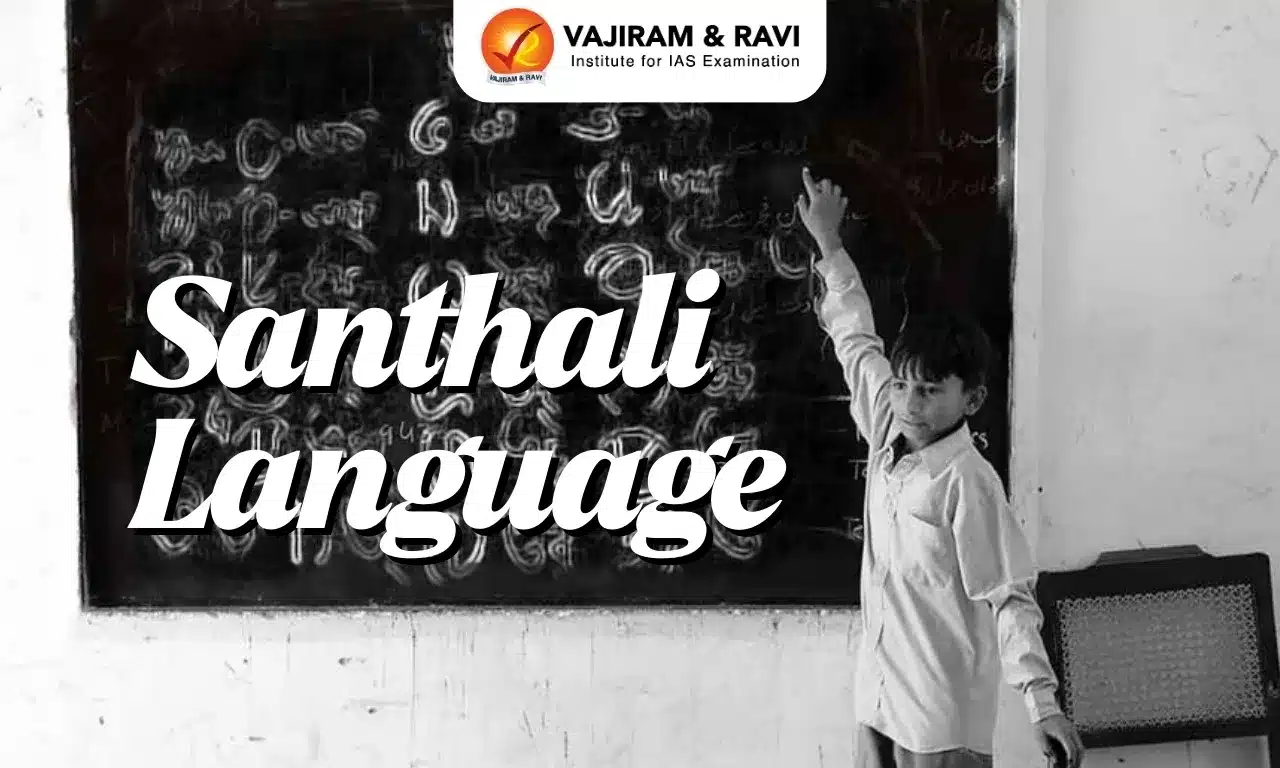
Santhali Language Latest News
President Droupadi Murmu recently released the Constitution of India in the Santhali language at a function held at the Rashtrapati Bhavan here.
About Santhali Language
- The Santhali language, which was included in the Eighth Schedule of the Constitution through the 92nd Amendment Act, 2003, is one of the most ancient living languages of India.
- It is spoken by a significant number of tribal people in Jharkhand, Odisha, West Bengal, and Bihar.
- It is primarily used by the Santhal tribal community.
- It is also spoken in Nepal and Bangladesh.
- In India, it is spoken by an estimated 7 million people, according to recent census data.
- It is a member of the Munda branch of the Austroasiatic language family, which is an ancient family of languages spoken across parts of South and Southeast Asia.
- It is quite distinct from the Indo-European language family of languages spoken in much of India.
- It is closely related to other Munda languages, such as Ho, Mundari, and Korku.
- These languages share common features such as their agglutinative nature (where words are formed by stringing together smaller units of meaning) and their use of tones.
- Santhali has a unique and rich tradition, with its own script and oral literature, reflecting the culture and beliefs of the Santhal tribe.
- Santhali uses the Ol Chiki script, a writing system that was developed in 1925 by Pandit Raghunath Murmu, a Santhal scholar and writer.
Source: TH
Santhali Language FAQs
Q1: The Santhali language was added to the Eighth Schedule of the Constitution through which Amendment Act?
Ans: 92nd Amendment Act, 2003
Q2: Santhali belongs to which language family?
Ans: Austroasiatic (Munda branch)
Q3: Santhali is primarily spoken by which tribal community?
Ans: Santhal tribe
Q4: In addition to India, Santhali is also spoken in which countries?
Ans: Nepal and Bangladesh
