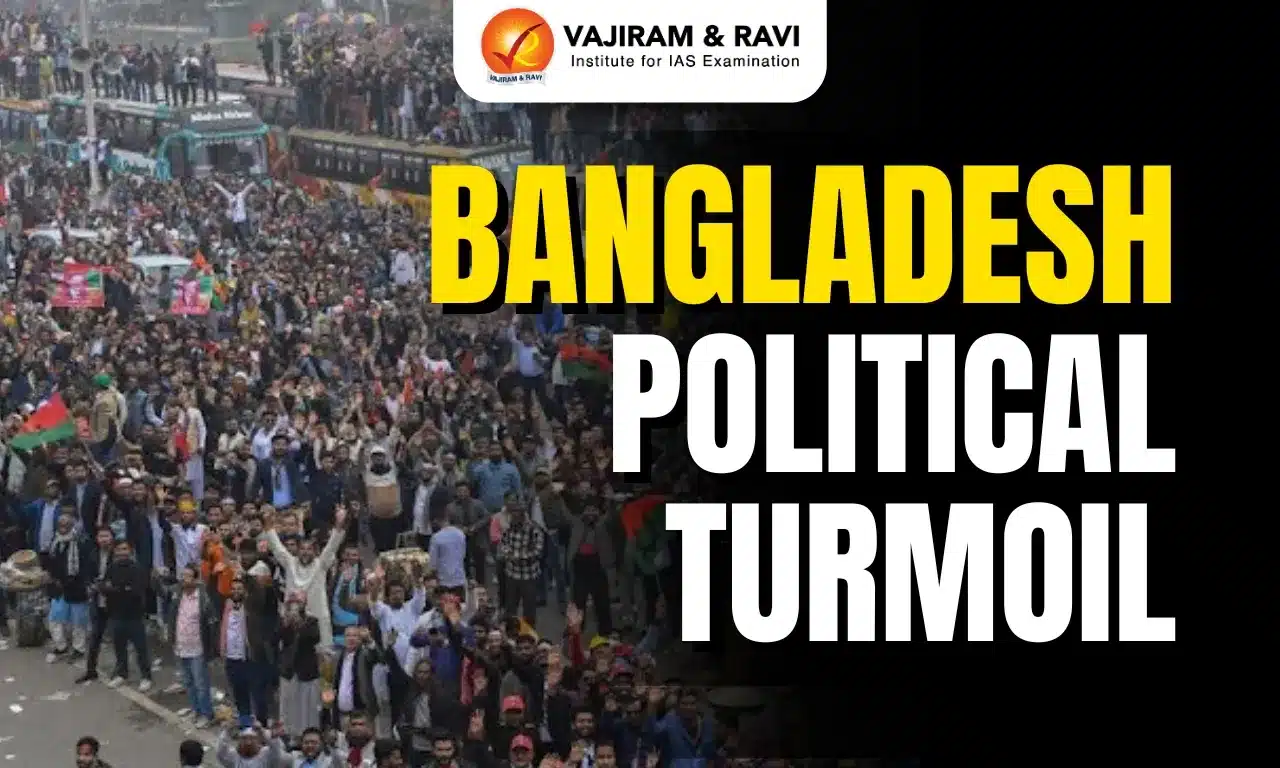
Bangladesh Political Turmoil Latest News
- Amid widespread violence and political unrest in Bangladesh, Bangladesh Nationalist Party (BNP) acting chairman Tarique Rahman returned to the country after 17 years in exile.
- The turmoil has also been marked by intensifying anti-India rhetoric, raising regional and diplomatic concerns.
Forces Driving the Current Turmoil in Bangladesh
- A Planned Regime-Change Operation (July–August 2024)
- The unrest that began in July–August 2024 has often been described as a spontaneous uprising, but evidence points to a planned operation aimed at regime change.
- Bangladesh’s chief adviser Muhammad Yunus publicly acknowledged this in September, identifying a close aide as the strategist behind it.
- The Jamaat-e-Islami, long aligned with Pakistan, emerged as a key driving force—and now exerts significant influence over the administration.
- Dismantling the Post-1971 Political Order
- A central objective has been to erase the post-1971 legacy.
- From August 5, 2024, symbols and institutions linked to the Liberation War and the Awami League have been targeted, signalling an attempt to rewrite national memory and politics.
- Minority Repression and Visible Islamisation
- Another major strand is a crackdown on minorities and a push toward more overt Islamisation.
- Hindus, Buddhists, Christians, and Ahmadiyyas have faced attacks, including allegations of killings, sexual violence, property destruction, and land grabs.
- The lynching of Dipu Chandra Das drew international condemnation, underscoring the severity of abuses.
Mobocracy and Media Control as Tools
- Jamaat-e-Islami’s consolidation of power has been accompanied by violence and unrest as methods of control.
- Mobocracy: Crowds surround offices, officials, and judges until demands are met.
- Institutional Capture: Jamaat-aligned appointees are replacing incumbents across bureaucracy and academia.
- Media Suppression: Attacks on journalists and outlets have surged; offices of Prothom Alo and The Daily Star were recently attacked, and some journalists detained without trial.
Economic Unravelling and India Ties
- The turmoil has disrupted long-standing economic cooperation with India, built over decades under Sheikh Hasina.
- An economy that grew 6.5–7% annually for 15 years has slowed sharply: growth has halved, factories are closing, unemployment is rising, private investment has stalled, and inflation is high.
Tarique Rahman’s Return: Political Impact After 17 Years
- Tarique Rahman, acting chairman of the Bangladesh Nationalist Party (BNP), has returned after 17 years in exile and is widely seen as a frontrunner if elections are held soon.
- However, with the Awami League barred from contesting, any poll in the current climate would likely fall short of being free or fair.
- Rahman’s return is expected to trigger a surge of public support, partly driven by sympathy for his ailing mother.
- Still, an electoral victory is not assured, given shifting alliances and internal party dynamics.
- Rahman’s homecoming does not materially alter the fundamentals: a constrained electoral field, a fragmented BNP, and an emboldened Jamaat.
- Popular enthusiasm may be high, but structural realities limit Rahman’s room to reshape outcomes in the near term.
Rising Anti-India Rhetoric in Bangladesh
- Anti-India sentiment in Bangladesh is not new. Even during 1971, around 20% of the population opposed the Liberation War and India’s role.
- This strand has endured over decades alongside mainstream politics.
- Parallel to this undercurrent, India–Bangladesh relations have been anchored by deep economic cooperation and people-to-people links—including tourism, medical travel, education, and trade—creating mutual stakes beyond politics.
India’s First Priority: Reassure the Bangladeshi People
- India should signal goodwill toward the people of Bangladesh, not regimes alone.
- New Delhi has already demonstrated this by continuing aid and trade, keeping communication channels open, and recently agreeing to export 50,000 metric tonnes of rice.
- Maintaining strategic restraint while engaging all principal actors remains key.
India’s Second Priority: Push for Inclusive Elections
- New Delhi should insist on free, fair, and inclusive elections that allow participation by all parties, including the Awami League.
- Only an inclusive process can restore legitimacy and stability; exclusion risks prolonging violence and volatility.
Why the India–Bangladesh Relationship Matters Deeply
- For Bangladesh, cooperation with India was central to its economic success under Sheikh Hasina.
- India has consistently been the first responder in times of need and a reliable partner due to geographic proximity, competitive pricing, shared history, and strong people-to-people ties.
- While the current regime is engaging Pakistan, China, and Turkey, none can replicate the scale, speed, or depth of support India provides.
Vital for India’s Security Interests
- For India, Bangladesh is pivotal primarily due to security considerations.
- The two share a 4,000+ km porous land border and a maritime boundary, making cooperation essential.
- In the past, Pakistan-backed terror networks and Northeast insurgent groups used Bangladeshi territory as a haven—an issue the Hasina government actively helped address.
Growing Strategic Risks Since August 2024
- Since August 2024, Pakistan’s state and military have reportedly re-established pre-1971 command-and-control linkages with Bangladesh, seeking deeper military embedding, including near the India–Bangladesh border.
- This raises concerns about regional security spillovers.
Source: IE
Bangladesh Political Turmoil FAQs
Q1: Why is Bangladesh political turmoil in the news?
Ans: Bangladesh political turmoil intensified after violence, regime instability, Tarique Rahman’s return from exile, rising Jamaat influence, and growing anti-India rhetoric.
Q2: What role is Jamaat-e-Islami playing in Bangladesh’s crisis?
Ans: Jamaat-e-Islami has emerged as a key force, pushing Islamisation, targeting minorities, weakening democratic institutions, and exerting influence over the interim administration.
Q3: How has the crisis affected Bangladesh’s economy?
Ans: Economic growth has halved, factories are closing, unemployment is rising, private investment has stalled, and inflation is high after disruption of India-centric cooperation.
Q4: Why does Bangladesh matter strategically for India?
Ans: Bangladesh is critical for India’s border security due to a 4,000 km porous boundary and past use of its territory by terror groups and insurgents.
Q5: What should India’s response to Bangladesh’s turmoil be?
Ans: India should maintain engagement, reassure the Bangladeshi people, provide humanitarian support, and push for free, fair, and inclusive elections involving all parties.