Plasser’s Quick Relaying System

Plasser’s Quick Relaying System

Plasser’s Quick Relaying System Latest News

Recently, the Northeast Frontier Railway (NFR) has achieved a major milestone in mechanised track renewal by recording its highest-ever single-day output of 1,033 track metres using Plasser’s Quick Relaying System.

About Plasser’s Quick Relaying System

  • It is a modern semi-mechanized system automatic machine used for quick railway track replacement.
  • It aims to speed up track renewal while minimizing traffic disruption, enhancing safety, reliability, and maintenance efficiency

Features of Plasser’s Quick Relaying System

  • Plasser’s Quick Relaying System consists of self-propelled cranes which move on an auxiliary track of 3400 mm gauge having the same centre line as that of track to be relayed.
  • These portal cranes are capable of self-loading and unloading from BFRs (Bogie Flat Wagons).
  • High Lifting Capacity: Newer models can lift up to 9 tonnes, handling 13m PRC sleeper panels.
  • Uses: The system is widely used for new track construction as well as the modernisation of existing track infrastructure.

Benefits of the Plasser’s Quick Relaying System

  • Renewal time: It helps longer track lengths to be renewed within shorter traffic blocks
  • Cost-Effective: It is cost effective, as it reduces manual labor and lifecycle maintenance costs.

Source: DD News

Plasser’s Quick Relaying System FAQs

Q1: What is Plasser’s Quick Relaying System primarily used for?

Ans: Rapid railway track renewal

Q2: What is a key benefit of Plasser’s Quick Relaying System?

Ans: Reduces manual labor and lifecycle costs

Dulhasti Stage-II Hydropower Project

Dulhasti Stage-II Hydropower Project

Dulhasti Stage-II Hydropower Project Latest News

A panel under the Ministry of Environment, Forest and Climate Change recently approved the 260-megawatt Dulhasti Stage-II hydropower project on the Chenab river in Jammu and Kashmir’s Kishtwar district.

About Dulhasti Stage-II Hydropower Project

  • It is a 260-megawatt hydropower project proposed on the Chenab River in the Kishtwar District of Jammu and Kashmir. 
  • It is an extension of the existing 390 MW Dulhasti Stage-I Hydroelectric Project (Dulhasti Power Station), which has been successfully operating since its commissioning in 2007 by the National Hydroelectric Power Corporation Limited.
  • Under the plan, water will be diverted from the Stage-I power station through a separate tunnel measuring 3,685 metres in length and 8.5 metres in diameter to form a horseshoe-shaped pondage for Stage-II.
  • The project also includes a surge shaft, a pressure shaft, and an underground powerhouse housing two 130 MW units, resulting in a total installed capacity of 260 MW and an annual energy generation.
  • The project is estimated to cost more than Rs 3,200 crore.

Source: TI

Dulhasti Stage-II Hydropower Project FAQs

Q1: On which river is the Dulhasti Stage-II Hydropower Project proposed?

Ans: It is proposed on the Chenab River in the Kishtwar District of Jammu and Kashmir.

Q2: What is the installed capacity of the Dulhasti Stage-II Hydropower Project?

Ans: The installed capacity is 260 MW.

Q3: Dulhasti Stage-II is an extension of which existing hydropower project?

Ans: It is an extension of the 390 MW Dulhasti Stage-I Hydroelectric Project.

Q4: When was the Dulhasti Stage-I Power Station commissioned?

Ans: It was commissioned in 2007.

Dhasan River

Key Facts about Dhasan River

Dhasan River Latest News

The National Green Tribunal (NGT), Principal Bench, New Delhi, recently dismissed an appeal challenging the cancellation of environmental clearance granted for sand mining in the river Dhasan in Jhansi district.

About Dhasan River

  • It is a right bank tributary of the Betwa River, which itself is a tributary of the Yamuna.
  • It flows in the Bundelkhand region of Madhya Pradesh and Uttar Pradesh.
  • Course
    • The river originates in Begumganj tehsil of Raisen district in Madhya Pradesh.
    • The river forms the southeastern boundary of the Lalitpur District of Uttar Pradesh state. 
    • The total length of the river is 365 km, out of which 240 km lies in Madhya Pradesh, 54 km common boundary between Madhya Pradesh and Uttar Pradesh, and 71 km in Uttar Pradesh. 
  • The river was known as the Dasharna in the ancient period.
  • Lehchura Dam is built on this river. It is primarily an irrigation dam providing water for agricultural use via the Dhasan Canal System (DCS).

Source: HT

Dhasan River FAQs

Q1: Dhasan River is a tributary of which river?

Ans: It is a right bank tributary of the Betwa River

Q2: In which regions does the Dhasan River mainly flow?

Ans: It flows in the Bundelkhand region of Madhya Pradesh and Uttar Pradesh.

Q3: Where does the Dhasan River originate?

Ans: It originates in Begumganj tehsil of Raisen district, Madhya Pradesh.

Q4: What is the total length of the Dhasan River?

Ans: The total length is 365 km.

Q5: Which major dam is built on the Dhasan River?

Ans: The Lahchura (Lehchura) Dam.

Revamped Distribution Sector Scheme (RDSS)

What is the Revamped Distribution Sector Scheme (RDSS)

Revamped Distribution Sector Scheme (RDSS) Latest News

Installation of rooftop solar power plants is being expedited in Rajasthan under the revamped distribution sector scheme (RDSS) to reduce transmission and distribution losses and improve power supply quality.

About Revamped Distribution Sector Scheme (RDSS)

  • It was launched by the Ministry of Power, Government of India, in July 2021, aimed at transforming the electricity distribution sector.
  • It is a Reforms-based and Results-linked Scheme with an outlay of Rs.3,03,758 crore over a period of five years from FY 2021-22 to FY 2025-26.
  • It seeks to modernise India’s power distribution sector through smart metering, network strengthening, and financial reforms, with the goal of creating financially sustainable and operationally efficient DISCOMs.
  • The scheme aims to reduce the Aggregate Technical and Commercial (AT&C) losses to pan-India levels of 12-15% and Gap between Average Cost of Supply (ACS) and Average Revenue Realised (ARR) to zero by 2024-25. 
  • The Scheme has two major components: 
    • Part A: Financial support for Prepaid Smart Metering & System Metering and upgradation of the Distribution Infrastructure.
    • Part B: Training & Capacity Building and other Enabling & Supporting Activities.
  • Financial assistance to DISCOMs is provided for upgradation of the Distribution Infrastructure and for Prepaid Smart Consumer Metering & System Metering based on meeting pre-qualifying criteria and achieving basic minimum benchmark in reforms.

Source: TH

Revamped Distribution Sector Scheme (RDSS) FAQs

Q1: Which ministry launched the Revamped Distribution Sector Scheme (RDSS)?

Ans: The Ministry of Power, Government of India.

Q2: What is the primary objective of the Revamped Distribution Sector Scheme (RDSS)?

Ans: To transform India’s electricity distribution sector and make DISCOMs financially sustainable and operationally efficient.

Q3: What kind of scheme is the Revamped Distribution Sector Scheme (RDSS)?

Ans: It is a Reforms-based and Results-linked scheme.

Q4: What is the duration of the Revamped Distribution Sector Scheme (RDSS)?

Ans: Five years, from FY 2021-22 to FY 2025-26.

Ho Tribe

Ho Tribe

Ho Tribe Latest News

The Ho Samaj Yuva Mahasabha (AHSYM) recently called upon tribal people not to celebrate picnics but to observe ‘Black Day’ on January 1 and 2.

About Ho Tribe

  • The Ho, or Kolha, people are an Austroasiatic Munda ethnic group of India.
  • They call themselves the Ho, Hodoko, and Horo, which mean ‘human’ in their own language.
  • Distribution
    • They are mostly concentrated in the Kolhan region of Jharkhand and Odisha, where they constitute around 10.7% and 7.3% of the total Scheduled Tribe population, respectively, as of 2011.
    • Ho also inhabit adjacent areas in the neighboring states of Odisha, West Bengal, and Bihar. 
    • They also live in Bangladesh and Nepal.
  • Language: Ho people speak the Ho language, an Austroasiatic language closely related to Mundari.
  • Occupation: The majority of the Ho tribe is involved in agriculture, either as landowners or labourers, while others are engaged in mining.
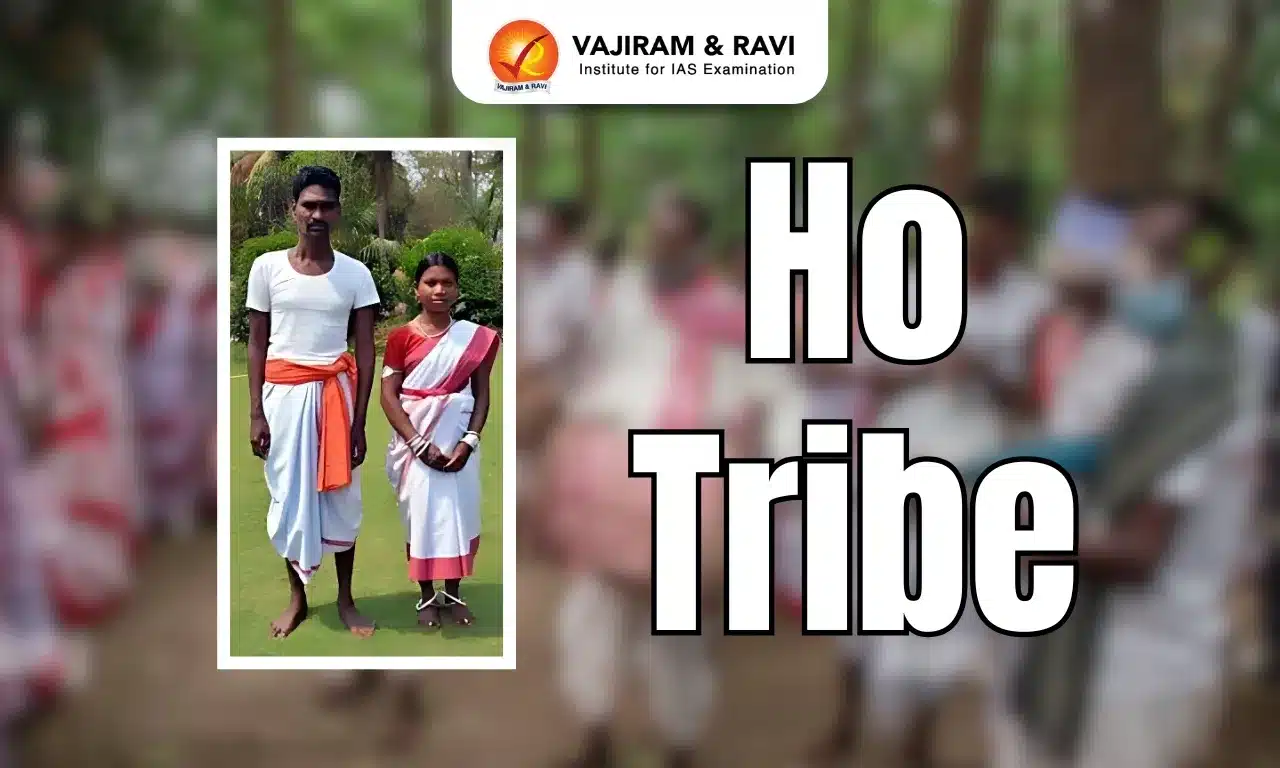
  • The men and women of this community wear very minimal dress. The women prefer to wear tribal jewelleries.
  • Women have higher status among the Ho than they do in most tribes.
  • Dance is very important in Ho culture. Most villages have a dedicated dancing ground, called akhra, usually consisting of a cleared space of hard ground under a spreading tree.
  • Traditional Ho music incorporates native instruments, including a dama (drum), dholak, dumeng (mandar), and the rutu (flute).
  • Religion
    • The majority of the Ho have their own nature-based religion (Sarnaism) that doesn't fit in with Hinduism.
    • They have a village priest called a deuri.

Source: HT

Ho Tribe FAQs

Q1: The Ho people belong to which major ethnic linguistic group?

Ans: They belong to the Austroasiatic Munda ethnic group of India.

Q2: In which Indian region are the Ho people mainly concentrated?

Ans: They are mainly concentrated in the Kolhan region of Jharkhand and Odisha.

Q3: Apart from Jharkhand and Odisha, in which other Indian states are the Ho also found?

Ans: They are also found in West Bengal and Bihar.

Q4: What is the language spoken by the Ho people?

Ans: They speak the Ho language, an Austroasiatic language closely related to Mundari.

Q5: What is the primary occupation of the Ho tribe?

Ans: Their primary occupation is agriculture, as landowners or labourers.

Shipbuilding Financial Assistance Scheme

Shipbuilding Financial Assistance Scheme (1)

Shipbuilding Financial Assistance Scheme Latest News

Recently, the Ministry of Ports, Shipping & Waterways (MoPSW) notified the operational guidelines for two major shipbuilding initiatives—the Shipbuilding Financial Assistance Scheme (SBFAS) and the Shipbuilding Development Scheme (SbDS).

About Shipbuilding Financial Assistance Scheme

  • It is aimed at strengthening India’s domestic shipbuilding capacity and improving global competitiveness. 
  • Time Period: It will remain valid until March 31, 2036.
  • Nodal Ministry: Ministry of Ports, Shipping & Waterways

Features of Shipbuilding Financial Assistance Scheme

  • Financial Assistance: The government will provide financial assistance ranging from 15% to 25% per vessel, depending on the vessel category.
  • Graded Support: The scheme introduces graded support for small normal, large normal and specialised vessels, with stage-wise disbursement linked to defined milestones and backed by security instruments.
  • Shipbreaking Credit Note: Under this, ship owners scrapping vessels at Indian yards will receive a credit equivalent to 40% of the scrap value.
  • It provides for the establishment of a National Shipbuilding Mission to ensure coordinated planning and execution of shipbuilding initiatives.

Key Facts about Shipbuilding Development Scheme

  • It focuses on long-term capacity and capability creation.

Features of Shipbuilding Development Scheme

  • Infrastructure Development: It provides for the development of greenfield shipbuilding clusters, expansion and modernisation of existing brownfield shipyards.
  • India Ship Technology Centre: It is to be established under the Indian Maritime University to support research, design, innovation and skills development.
  • Funding
    • Greenfield shipbuilding clusters will receive 100% capital support for common maritime and internal infrastructure through a 50:50 Centre–State special purpose vehicle.
    • Brownfield expansion will be eligible for 25% capital assistance for brownfield infrastructure such as dry docks, shiplifts etc.
  • Credit Risk Coverage: The scheme also includes a Credit Risk Coverage Framework, offering government-backed insurance for pre-shipment, post-shipment and vendor-default risks.

Source: PIB

Shipbuilding Financial Assistance Scheme FAQs

Q1: Which ministry administers SBFAS?

Ans: Ministry of Ports, Shipping and Waterways

Q2: What is the validity period of SBFAS?

Ans: Until March 2036

Nitrate

Nitrate

Nitrate Latest News

According to a submission by the Central Groundwater Board, over 20% of groundwater samples collected in Delhi in 2023 had nitrate levels exceeding the permissible limit of 45 mg/l.

About Nitrate

  • It is a compound of nitrogen and oxygen.
  • It is naturally found in air, soil, water, and some food.
  • Plants and animals require nitrates for their survival and growth, and the human body also produces this compound.

Applications of Nitrate

  • In industry, nitrate is used as fertilizers for crops and lawns.
  • Nitrates are used in food preservation, certain pharmaceutical medications, as well as the manufacture of munitions and explosives. 

Impact of Nitrate Contamination

  • It gets into water from fertilizer in runoff, manure from animal feeding operations and wastewater treatment plant discharge.
  • Health: Excessive nitrate in groundwater causes methemoglobinemia, reducing the ability of red blood cells to carry oxygen, particularly affecting infants and vulnerable populations.
  • Environment: Elevated nitrate levels in groundwater can lead to algal blooms in lakes and ponds, severely degrading aquatic ecosystems by depleting oxygen and harming biodiversity.

Source: TOI

Nitrate FAQs

Q1: What is the primary health risk associated with high nitrate levels in drinking water?

Ans: Methemoglobinemia (Blue Baby Syndrome)

Q2: Which of the following is a major source of nitrate pollution in groundwater?

Ans: Agricultural runoff (fertilizers)

Buccal Mucosa Cancer (BMC)

Buccal Mucosa Cancer (BMC)

Buccal Mucosa Cancer Latest News

Alcohol consumption, even in small amounts, significantly increases the risk of buccal mucosa cancer (BMC), a common and aggressive form of oral cancer in India, according to a recent study.

About Buccal Mucosa Cancer 

  • It refers to a type of oral cancer that originates in the inner lining of the cheeks, called the buccal mucosa. 
  • It usually occurs in the thin, flat cells called squamous cells that line the buccal mucosa and other parts of the mouth. Hence, most BMC cases are Squamous Cell Carcinoma (SCC).
  • It is the predominant form of oral cancer in the Indian subcontinent.
  • It primarily affects individuals with risk factors such as tobacco use and alcohol use, which causes cellular changes in the cheek lining. 
  • Symptoms commonly include persistent sores, lumps, pain, and difficulty chewing or moving the cheek. 
  • Treatment options include surgery, radiation therapy, and chemotherapy, depending on the cancer stage. 
  • Early detection is essential for improving prognosis and the buccal mucosa cancer survival rate.
  • 5-year survival rates for oral cavity cancers (including buccal mucosa) are roughly in the range of 60–70% overall.

Source: TH

Buccal Mucosa Cancer FAQs

Q1: What is Buccal Mucosa Cancer (BMC)?

Ans: Buccal Mucosa Cancer is a type of oral cancer that starts in the inner lining of the cheeks, known as the buccal mucosa.

Q2: What are the major risk factors for developing Buccal Mucosa Cancer?

Ans: The major risk factors are tobacco use (smoked or smokeless) and alcohol consumption.

Q3: What are common symptoms of Buccal Mucosa Cancer?

Ans: Common symptoms include persistent sores, lumps, pain, and difficulty chewing or moving the cheek.

Q4: What are the treatment options available for Buccal Mucosa Cancer?

Ans: Treatment options include surgery, radiation therapy, and chemotherapy, depending on the cancer stage.

Vallanadu Wildlife Sanctuary

Vallanadu Wildlife Sanctuary

Vallanadu Wildlife Sanctuary Latest News

The blackbuck (Antilope cervicapra) population at the Vallanadu sanctuary has witnessed a surge, recording a total of 300. 

About Vallanadu Wildlife Sanctuary

  • Location: It is located in the state of Tamil Nadu.
  • It was established to protect blackbuck antelopes.
  • Vegetation: Vallanadu Sanctuary is a scrub forest area that is spread over 16.41 sq km.
  • Fauna: Blackbuck, Spotted Deer, Bonnet Macaque, Jungle Cat, Small Indian Civet, Black-naped Hare; Rose-ringed Parakeet; Common Indian Monitor Lizard etc. are found here.
  • Flora: Acacia Albizia amara, Zizyphus sp, Azadirachta indica, Carissa carandus, Euphorbia acalypha etc.

Key Facts about Blackbuck

  • It is a species of antelope native to India and Nepal.
  • Habitat: The blackbuck mostly lives in open grasslands, dry scrub areas, and thinly forested areas.
  • Distribution: It is widespread in the states of Rajasthan, Gujarat, Madhya Pradesh, Tamil Nadu, Odisha, and other areas throughout peninsular India.
  • It has been declared as the state animal by the governments of Punjab, Haryana, and Andhra Pradesh. 
  • Conservation Status: It is classified as ‘Least Concerned’ under the IUCN Red List.

Source: TH

Vallanadu Wildlife Sanctuary FAQs

Q1: Where is Vallanadu Wildlife Sanctuary located?

Ans: Tamil Nadu

Q2: What is the main purpose of establishing Vallanadu Wildlife Sanctuary?

Ans: To protect blackbuck antelop

Somaliland

Key Facts about Somaliland

Somaliland Latest News

Recently, Israel formally recognised the self-declared Republic of Somaliland ‍as an independent and sovereign state.

About Somaliland

  • Location: It is located in the Horn of Africa.
  • Bordered by: It is bordering Djibouti, Ethiopia, Somalia, and the Puntland region, with a strategic coastline along the Gulf of Aden
  • Historical Background of Somaliland
    • Somaliland was a British protectorate from the late 19th century.
    • On 26 June 1960, it gained independence as the State of Somaliland.
    • It united with Italian Somaliland on 1 July 1960 to form the Somali Republic.
    • Northern regions faced political marginalization, economic disparities, and administrative neglect under the Somali government.
    • Siad Barre’s regime (1970s-80s) intensified repression, leading to civil war and mass displacement in the north.
    • In 1991, following state collapse, Somaliland declared independence, establishing its own political institutions.
  • Capital City: Hargeisa
  • Governance: It functions as a de facto independent state with its own constitution, elected government, judiciary, security forces, currency, and national symbols.
    • Governance combines modern democratic institutions with traditional clan-based mechanisms, ensuring stability and conflict resolution.
    • It has a bicameral legislature, including the House of Elders (Guurti), and conducts regular elections contributing to institutional legitimacy.
  • Port: Berbera Port is being developed as a regional trade and logistics corridor, particularly serving landlocked Ethiopia.
  • Economy: The economy is largely livestock-based, with exports to Gulf countries forming a major revenue source.

Source: TH

Somaliland FAQs

Q1: Where is Somaliland located?

Ans: Horn of Africa

Q2: Which country does Somaliland border?

Ans: Djibouti, Ethiopia, Somalia

Enquire Now