MacGregor Memorial Medal

MacGregor Memorial Medal

MacGregor Memorial Medal Latest News

Five military personnel were recently conferred the MacGregor Memorial Medal by Chief of Defence Staff for outstanding contributions in military reconnaissance, exploration and adventure for the years 2023 and 2024.

About MacGregor Memorial Medal

  • It was instituted on 03 July 1888 to commemorate the memory of Maj. Gen. Sir Charles Metcalfe MacGregor, the founder of the United Service Institution of India (USI). 
  • Initially this medal was awarded for military reconnaissance and journeys of exploration such as British Army expeditions in Central Asia, Afghanistan, Tibet, and Burma. 
  • After independence, it was decided to award this medal for adventure activities as well. 
  • The medal is open to all ranks, serving and retired, of the Indian Armed Forces, Territorial Army, and Assam Rifles.
  • Among the notable recipients of this in the past are Capt F E Younghusband (1890), Maj. Gen. Orde Charles Wingate (1943), Maj. ZC Bakshi, VrC (1949), Col. Narinder Kumar for Siachen Glacier exploration (1978-81) and Cdr. Dilip Donde and Lt. Cdr. Abhilash Tomy for their solo global circumnavigations.

What is the United Service Institution of India (USI)?

  • It is a national security and defence services think tank based in New Delhi, India.
  • It was founded in Simla in 1870 by Col. (later Maj Gen) Charles Metcalf MacGregor, to advance military knowledge and professional development among British Indian Army officers. 
  • It is the oldest autonomous think tank in India.
  • Its mission encompassed promoting knowledge in the art, science, and literature of national security, with a particular focus on the Defence Services. 

Source: TH

MacGregor Memorial Medal FAQs

Q1: What is the MacGregor medal in India?

Ans: This medal is awarded to Armed Forces personnel for valuable military reconnaissance.

Q2: When was the MacGregor Memorial Medal instituted?

Ans: 03 July 1888

Q3: Who was Maj. Gen. Sir Charles Metcalfe MacGregor?

Ans: Founder of the United Service Institution of India

Type 5 Diabetes

Type 5 Diabetes

Type 5 Diabetes Latest News

Type 5 diabetes has been officially recognised as a distinct form of diabetes by the International Diabetes Federation (IDF).

What is Type 5 Diabetes?

  • Type 5 diabetes primarily affects lean, undernourished teenagers and young adults in low- and middle-income countries (LMICs).
  • It is caused by malnutrition-induced reduction in insulin production, unlike Type 2 diabetes, which involves insulin resistance with continuing insulin secretion.
  • In Type 5, the pancreatic beta cells function abnormally, resulting in severely reduced insulin secretion.
  • This form of diabetes has long been neglected in medical research and often misdiagnosed.

Historical Background

  • The condition was first reported in Jamaica in 1955 under the term J-type diabetes.
  • In 1985, the World Health Organization (WHO) named it “malnutrition-related diabetes mellitus”, but this was removed in 1999 due to lack of causal evidence linking malnutrition to diabetes.
  • Despite this, similar cases were later reported in India, Sri Lanka, Bangladesh, Uganda, Ethiopia, Rwanda, and Korea, mostly in the Global South.
  • The condition is estimated to affect about 25 million people globally.

Clinical Markers of Type 5 Diabetes

  • No autoimmune or genetic cause is associated with this condition.
  • Patients have very low BMI (<18.5 kg/m²), much lower than typical Type 2 diabetic patients.
  • Insulin levels are extremely low, significantly below Type 2 diabetes and slightly above Type 1 diabetes.
  • Body fat percentage is substantially lower than in Type 2 patients.
  • Dietary intake of protein, fibre, and micronutrients is notably inadequate.

Source: IE

Type 5 Diabetes FAQs

Q1: What is Type 5 Diabetes?

Ans: Type 5 Diabetes is a proposed classification of diabetes linked to genetic mutations affecting insulin secretion and action, distinct from the more common Type 1, Type 2, and gestational diabetes.

Q2: How is Type 5 Diabetes different from Type 2 Diabetes?

Ans: Type 5 Diabetes typically involves specific genetic defects affecting pancreatic β-cells or insulin signalling pathways, while Type 2 Diabetes primarily involves insulin resistance and lifestyle factors.

Supreme Court Flags Key Issues in Waqf Law Amid Rising Legal and Social Debate

Supreme Court on Waqf Law

What’s in Today’s Article?

  • Waqf Law Latest News
  • Supreme Court’s Intervention in Waqf Law:
  • Key Aspects Challenged in the Waqf (Amendment) Act, 2025
  • Judicial Observations and Proposed Interim Relief
  • Petitioners’ Concerns
  • Government’s Stand
  • Waqf Law FAQs

Waqf Law Latest News

  • The Supreme Court has questioned certain provisions of the Waqf (Amendment) Act, 2025.

Supreme Court’s Intervention in Waqf Law

  • In a landmark development, the Supreme Court of India has taken a critical view of the recently enacted Waqf (Amendment) Act, 2025, as it heard over 100 petitions questioning its constitutional validity. 
  • The Chief Justice of India, Sanjiv Khanna, along with Justices P.V. Sanjay Kumar and K.V. Viswanathan, raised concerns over three specific provisions that have potential to disrupt the long-standing waqf structure in India.

Key Aspects Challenged in the Waqf (Amendment) Act, 2025

  • The apex court flagged three significant elements in the amended legislation:
    • Waqf-by-user Denotification:
      • The 2025 Act eliminates the legal recognition of waqf-by-user properties, those in use for religious or charitable purposes for centuries but not formally registered. 
      • Petitioners argued that this change could instantly erase the legal existence of nearly 4 lakh out of 8 lakh waqf properties.
    • Non-Muslims in Waqf Bodies:
      • The Act allows non-Muslims to serve as ex-officio members of the Central Waqf Council and State Waqf Boards
      • The court expressed concerns about this move, questioning whether religious institutions can be governed by individuals from outside the faith.
    • Collector’s Determination of Property Status:
      • The amended law permits District Collectors to determine if a property is waqf or government land. 
      • The court warned that allowing a government officer to act as a judge in such matters could violate due process and raise issues of conflict of interest.

Judicial Observations and Proposed Interim Relief

  • CJI Khanna emphasized that the court normally does not stay legislative enactments unless the situation is exceptional. 
  • However, he observed that this case qualifies as an exception due to the wide-ranging implications of the amendments.
  • In an effort to balance equities, the Chief Justice proposed a three-point interim order:
    • Properties already judicially declared as waqf, including waqf-by-user, should not be denotified for the time being.
    • While the government officer may investigate the nature of land ownership, the status of such properties should not be changed until judicial review is complete.
    • Appointment of non-Muslims to waqf bodies may continue, provided a majority of members remain Muslims.
  • No formal order was passed as Solicitor General Tushar Mehta sought more time for the government to present its arguments. The matter has been posted for further hearing.

Petitioners’ Concerns

  • Petitioners argued that the new provisions violate Article 26 of the Constitution, which guarantees the right of religious denominations to manage their own affairs.
    • On Waqf-by-user:
      • Petitioners noted that the concept has been recognized in the Ayodhya judgment, and its sudden removal would result in mass dispossession of properties traditionally maintained by the Muslim community.
    • On Religious Autonomy:
      • Petitioners highlighted that forcing a Muslim donor to “prove” religious practice before dedicating a waqf is a parliamentary overreach into religious autonomy.
    • On Historical Continuity:
      • Justice Khanna pointed out the historical fact that many mosques and waqf properties predate British rule and land registration systems. 
      • Therefore, requiring registered deeds from centuries ago is unreasonable.

Government’s Stand

  • Solicitor General Tushar Mehta defended the law, stating that:
    • Registration of all waqfs, including waqf-by-user, has been mandatory since the 1923 Act.
    • Non-Muslim inclusion in waqf bodies is limited to two ex-officio positions out of 22.
    • The Collector’s power is procedural and temporary until judicial confirmation.
  • However, the bench remained unconvinced on several points, especially concerning the impact on religious rights and property access.

Waqf Law FAQs

Q1. What is waqf-by-user?

Ans. Waqf-by-user refers to land used for religious or charitable Islamic purposes for a long period without formal registration.

Q2. What change did the 2025 Waqf Act introduce regarding waqf-by-user?

Ans. The Act derecognized waqf-by-user, meaning such properties are no longer legally considered waqf unless registered.

Q3. Why is the Collector’s role controversial in the new Act?

Ans. The Collector can now determine whether land is waqf or government property, raising concerns of executive overreach.

Q4. What is the issue with non-Muslims on waqf boards?

Ans. The inclusion of non-Muslims as members of Waqf Boards has sparked debate on religious autonomy and secularism.

Q5. Has the Supreme Court stayed the new waqf law?

Ans. No stay has been issued yet; the matter is under judicial review, and the next hearing is awaited.

Source: TH | IE

WAVES 2025 – Anti-Piracy Challenge

waves 2025 anti piracy challenge

WAVES 2025 - Anti-Piracy Challenge Latest News

A Key Initiative Under “Create in India” to Promote Indigenous Innovation in Digital Content Security

Why in the News?

  • The Anti-Piracy Challenge is a flagship initiative under the Create in India Challenge, part of WAVES (World Audio Visual and Entertainment Summit) 2025.
  • Organised by the Ministry of Information and Broadcasting, Government of India, WAVES 2025 will be held from May 1–4, 2025, in Mumbai, Maharashtra.
  • The challenge aims to advance technologies like fingerprinting and watermarking to combat the rising threat of digital piracy in India.

About WAVES 2025

  • WAVES (World Audio Visual & Entertainment Summit) is a global event organized by the Government of India.
  • It aims to position India as a hub for media innovation, IP creation, and content development.
  • Sectors covered include:
    • Broadcasting, Films, TV, Radio, Animation, Gaming, Comics, Advertising, and
    • Emerging tech like Generative AI, Augmented/Virtual/Extended Reality (AR/VR/XR) and Digital Media Platforms.
  • Supports the Creative Economy, which is valued at $30 billion and employs nearly 8% of India’s workforce.
  • Contributes to the growth of India’s Media and Entertainment (M&E) sector, projected to reach $44.2 billion by 2028, currently the 5th largest globally.

WAVES 2025 - Anti-Piracy Challenge FAQs

Q1. What is WAVES 2025?
Ans. WAVES 2025 stands for World Audio Visual & Entertainment Summit, an international platform aimed at discussing innovation, regulation, and growth in the global media and entertainment industry.

Q2. Where was WAVES 2025 held?
Ans. WAVES 2025 was hosted in Mumbai, India, showcasing India’s growing influence in the global film, OTT, gaming, and media technology sectors.

Q3. What is the significance of WAVES for India’s soft power?
Ans. WAVES enhances India’s soft power by promoting its cultural exports, creative economy, and international collaborations in film, digital media, and entertainment technologies.

Source: PIB

Navy-Marine Expeditionary Ship Interdiction System (NMESIS)

Navy-Marine Expeditionary Ship Interdiction System (NMESIS)

NMESIS Latest News

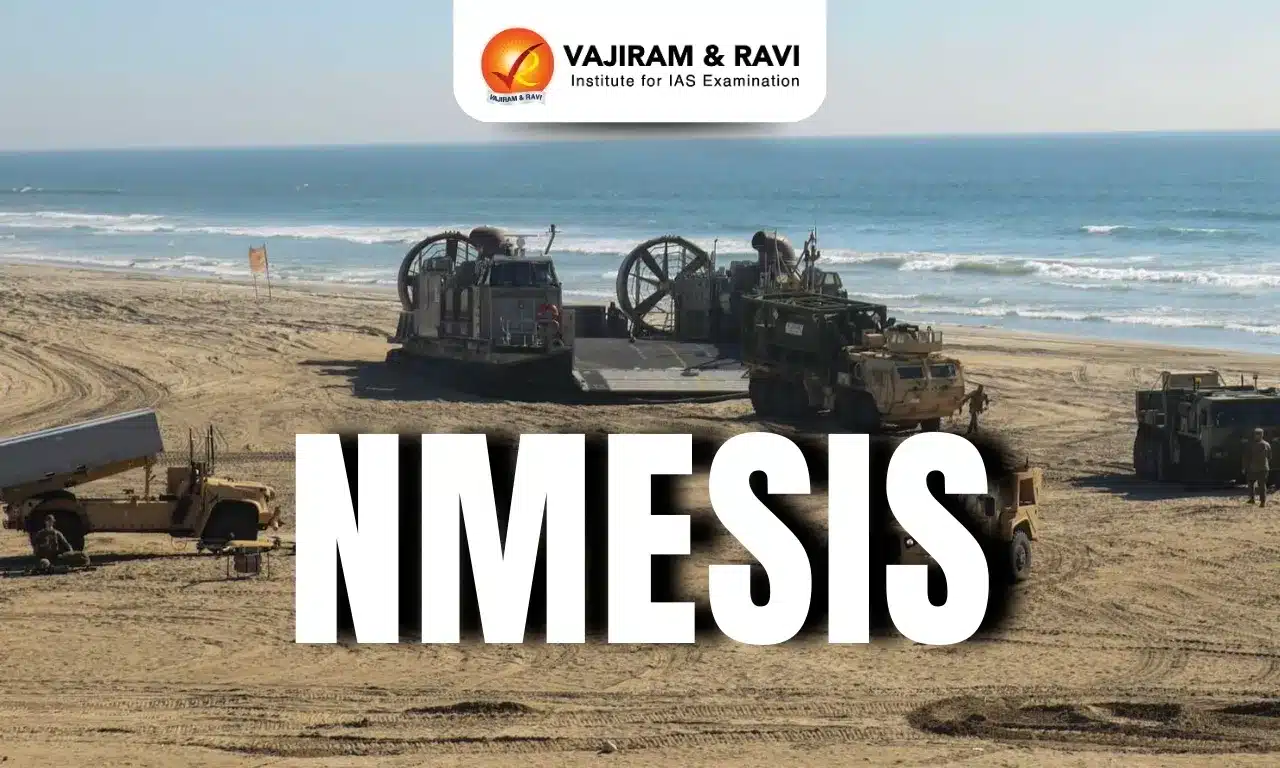
Philippines recently confirmed the deployment of US anti-ship missile system *NMESIS for this year’s Balikatan military exercises.

About NMESIS

  • It is an anti-ship missile system developed for the US Marine Corps (USMC) to support land-to-sea attacks performed by the US Navy.
  • It features the US Navy’s latest anti-ship missile, the Naval Strike Missile (NSM), mounted atop the chassis of an unmanned variant of the Oshkosh Joint Light Tactical Vehicle (JLTV).
  • The ground vehicle platform, known as Remotely Operated Ground Unit for Expeditionary (ROGUE) Fires vehicle, is supplied by Oshkosh Defense, United States, while the NSM is jointly manufactured by Raytheon Missiles & Defense (Raytheon), United States, and Norwegian company Kongsberg Defence & Aerospace.
  • NMESIS is not considered an autonomous launcher, as its fire control system is not controlled by the self-driving system and autonomy technology.
  • The system is operated by a marine who is responsible for mission planning and firing of the missile.

Features of ROGUE Fires

  • It incorporates advanced autonomous vehicle technologies, off-road mobility, and high payload carrying capacity.
  • The vehicle is remotely operated using the teleoperator or leader-follower modes. 
  • The vehicle lacks a crew cab/body. It is integrated with sensors and cameras, with a launcher mounted atop the vehicle.
  • The flexible design of the platform allows it to be configured to meet different mission requirements. 

Features of NSM

  • It is a multi-mission cruise missile that can ably neutralise highly secure maritime and land targets.
  • The missile can destroy enemy ships located more than 100 nm (185 km) away. 
  • Equipped with an advanced seeker, it provides high-precision capabilities.
  • The missile can escape enemy radars by performing manoeuvres and flying close to sea level. 
  • It carries a 226.79 kg-class warhead and programmable fuse.

Source: N18

NMESIS FAQs

Q1: Which missile is used in the NMESIS system?

Ans: Naval Strike Missile (NSM)

Q2: What vehicle platform is used to launch NMESIS missiles?

Ans: ROGUE Fires vehicle

Q3: What is the maximum range of the NSM used in NMESIS?

Ans: Over 100 nautical miles (185 km)

Exercise DUSTLIK-VI

Exercise DUSTLIK-VI

Exercise DUSTLIK-VI Latest News

Recently, the 6th edition of the India-Uzbekistan Joint Military Exercise DUSTLIK-VI officially commenced at the Foreign Training Node, Aundh (Pune).

About Exercise DUSTLIK-VI

  • Exercise DUSTLIK is an annual bilateral military exercise conducted alternatively in India and Uzbekistan, with the previous edition (DUSTLIK-V) held in Termez District, Uzbekistan, in April 2024.
  • The first edition was held in November 2019 in Uzbekistan, marking the beginning of a structured defence partnership.
  • Participants and Representation
    • The Indian contingent consists of 60 personnel, including troops from a battalion of the JAT Regiment and the Indian Air Force (IAF).
    • The Uzbekistan contingent is represented by troops from the Uzbekistan Army, reflecting their ongoing military cooperation with India.

Theme and Focus of DUSTLIK-VI

  • The central theme of DUSTLIK-VI is “Joint Multi-Domain Sub-Conventional Operations in a Semi-Urban Scenario”.
  • The exercise simulates response mechanisms to terrorist activities, specifically territorial capture by hostile forces, with coordinated joint battalion-level operations.
  • Activities will include:
    • Establishment of a Joint Operations Centre
    • Counterterrorism operations, such as population control, raids, and search-and-destroy missions
    • Employment of firepower, including air assets, to neutralise terrorist threats
  • Special Forces from both the Army and Air Force will conduct missions such as:
    • Securing a helipad for further operations
    • Reconnaissance, observation, and Special Heliborne Operations (SHBO)
    • Small Team Insertion and Extraction (STIE)
    • Use of helicopters, drones, and counter-Unmanned Aerial System (UAS) measures
  • The Indian Air Force will also provide logistical support to sustain operations in hostile environments, underlining the air-land integration capabilities.

Source: PIB

Exercise DUSTLIK-VI FAQs

Q1: What is Exercise DUSTLIK-VI (2025)?

Ans: Exercise DUSTLIK-VI (2025) is the sixth edition of the joint military exercise conducted between India and Uzbekistan, aimed at strengthening defence cooperation and counter-terrorism training.

Q2: What is the main focus of Exercise DUSTLIK?

Ans: The focus is on joint training for counter-terrorism operations in semi-urban and mountainous terrains, as well as enhancing interoperability between the Indian Army and the Uzbekistan Army.

Q3: Where was Exercise DUSTLIK-V conducted?

Ans: Exercise DUSTLIK-V was hosted in Termez District, Uzbekistan, in April 2024, following the tradition of alternating venues between the two countries.

Meghayan-25

Meghayan-25

Meghayan-25 Latest News

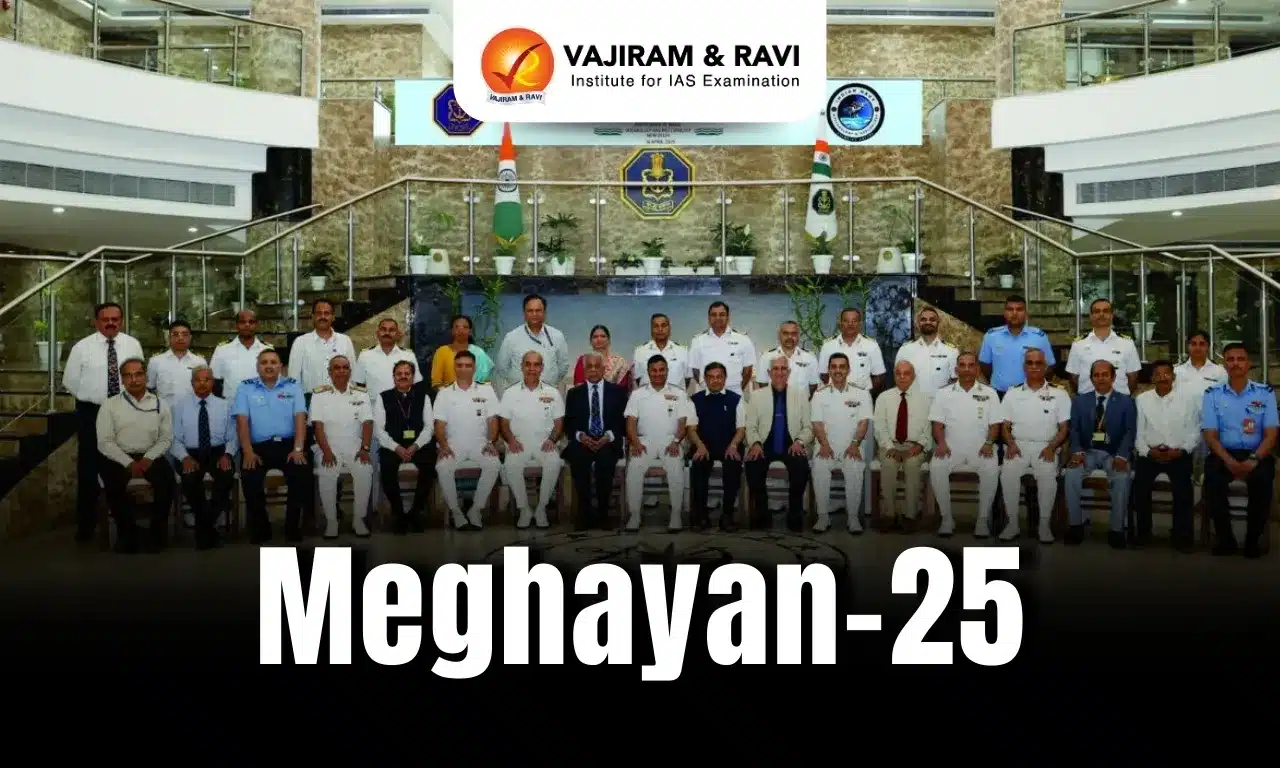
Recently, the Indian Navy hosted the 3rd edition of its Meteorological and Oceanological Symposium, titled Meghayan-25. 

Meghayan-25 Theme and Objective

  • The event commemorated the formation of the World Meteorological Organisation (WMO) and celebrated World Meteorological Day 2025 (23rd March every year).
  • Meghayan-25 was held under the WMO Day 2025 theme, ‘Closing the Early Warning Gap Together’, which highlights the importance of improving early warning systems for climate and disaster preparedness.

Major Launches During Meghayan-25

  • MOSDAC-IN Web Services were launched, a joint initiative of the Directorate of Naval Oceanology and Meteorology (DNOM) and SAC-ISRO.
    • It provides customised satellite-derived weather products with secure, individual log-ins for Naval Meteorological Offices.
  • The Navy also relaunched its professional journal, “Sagarmanthan”, with the 10th edition being published after a decade-long gap.

World Meteorological Organisation (WMO)

  • The WMO is a specialised agency of the United Nations (UN), focused on meteorology, operational hydrology, climate, and related sciences.
  • WMO coordinates global efforts to monitor weather and climate, promotes scientific research, and enables the exchange of data and weather forecasts.
  • The WMO evolved from the International Meteorological Organisation (IMO), which was established in 1873.
  • WMO was officially established in 1950 as a specialised UN agency, building upon the IMO’s foundational work.
  • The headquarters of WMO is located in Geneva, Switzerland.
  • It has 193 member countries and territories, reflecting global participation in meteorological cooperation and research.

Source: PIB

Meghayan-25 FAQs

Q1: What is Meghayan-25?

Ans: Meghayan-25 is a flagship climate monitoring and data-sharing initiative launched under the World Meteorological Organisation (WMO) for the year 2025, aimed at improving global weather forecasting and climate resilience.

Q2: When is World Meteorological Day celebrated?

Ans: World Meteorological Day is celebrated on 23rd March every year, marking the establishment of the World Meteorological Organisation (WMO) in 1950.

Q3: What was the theme of World Meteorological Day 2025?

Ans: The 2025 theme was “Closing the Early Warning Gap Together”, highlighting the importance of climate data and predictive tools for disaster preparedness and policy planning.

Ironwood TPU

Ironwood_TPU

Ironwood TPU Latest News

Google recently introduced Ironwood, their seventh-generation Tensor Processing Unit (TPU), marking a pivotal leap in AI technology. 

About Ironwood TPU

  • It is Google’s seventh-generation Tensor Processing Unit (TPU).
    • TPUs are custom-built chipsets aimed at AI and machine learning (ML) workflows. 
    • These accelerators offer extremely high parallel processing, especially for deep learning-related tasks, as well as significantly high power efficiency.
  • Designed specifically for inference — a process where AI models make predictions based on learned data — Ironwood is the most powerful, scalable, and energy-efficient TPU Google has ever developed.
  • Ironwood signifies a shift from reactive AI models, which respond to queries, to proactive systems that generate insights independently. 
  • This evolution defines what Google calls the “age of inference,” where AI agents autonomously retrieve and synthesise data to offer comprehensive answers, not just raw information.
  • The Ironwood chip comes with a peak compute of 4,614 teraflops (TFLOP), which is a considerably higher throughput compared to its predecessor, Trillium.
  • Google also plans to make these chipsets available as clusters to maximise the processing power for higher-end AI workflows.
  • Ironwood can be scaled up to a cluster of 9,216 liquid-cooled chips linked with an Inter-Chip Interconnect (ICI) network. 
  • At its most expansive cluster, Ironwood chipsets can generate up to 42.5 exaflops of computing power
  • Google claimed that its throughput is more than 24X of the compute generated by the world's largest supercomputer, El Capitan, which offers 1.7 Exaflops per pod. 
  • Ironwood TPUs also come with expanded memory, with each chipset offering 192GB, which is six times more than its predecessor, Trillium.

Source: TH

Ironwood TPU FAQs

Q1: What is ironwood TPU?

Ans: It is Google’s seventh-generation Tensor Processing Unit (TPU).

Q2: What is the peak compute power of a single Ironwood TPU chip?

Ans: 4,614 teraflops (TFLOP)

Q3: What is the total computing power (in exaflops) of Ironwood at full cluster capacity?

Ans: 42.5 exaflops

Silkyara Bend-Barkot Tunnel

Silkyara Bend-Barkot Tunnel

Silkyara Bend-Barkot Tunnel Latest News

Union Road Transport and Highways recently termed the breakthrough in the Silkyara bend-Barkot road tunnel a historic milestone, saying this transformative tunnel will save one hour of travel time.

About Silkyara Bend-Barkot Tunnel

  • It is a 4.531 km long, two-lane bi-directional tunnel with an escape passage, located on the Dharasu-Yamunotri section in Uttarakhand. 
  • Barkot and Silkyara are the two ends of the tunnel. 
  • Part of NH-134 (formerly NH-94), the project is being constructed under the Engineering, Procurement, and Construction (EPC) Mode.
  • Around ninety percent of the tunnel is being excavated in phyllite, which is very weak rock.
  • The New Austrian Tunnelling Method (NATM) is used for the construction of the tunnel. 
  • NATM is a method of modern tunnel design and construction employing sophisticated monitoring to optimize various wall reinforcement techniques based on the type of rock encountered as tunnelling. 
  • Funded under the National Highway Original [NH(O)] Scheme of the Ministry of Road Transport & Highways, it is a key component of the ambitious Chardham Plan.
  • It promises to cut travel time by about an hour and improve accessibility, particularly during adverse weather conditions.
  • Yamunotri is just about 50 km from this tunnel. It will provide easy access to devotees to Badrinath and Kedarnath.

Source: N18

Silkyara Bend-Barkot Tunnel FAQs

Q1: Where is Silkyara tunnel situated?

Ans: Uttarkashi district of Uttarakhand

Q2: Is Silkyara tunnel part of Char Dham Yatra?

Ans: Yes, the Silkyara Tunnel is part of infrastructure developed to support the Char Dham Yatra in Uttarakhand.

Q3: How long is the Silkaya tunnel?

Ans: It is 4.531 km long.

India’s Trade with US and China: Exports Surge, Trade Deficit Widens

India’s Trade with US and China: Exports Surge, Trade Deficit Widens

What’s in Today’s Article?

  • India Trade Deficit Latest News
  • Overall Trade Snapshot (FY25)
  • India–US Trade Registers Strong Growth in FY25
  • China Remains India’s Second-Largest Trading Partner
  • Conclusion
  • India Trade Deficit FAQs

India Trade Deficit Latest News

  • In 2024–25, the US remained India’s largest trading partner for the fourth consecutive year, with bilateral trade reaching $131.84 billion. China retained its position as the second-largest partner, with trade growing to $127.7 billion.
  • However, India’s trade deficit with China widened significantly to $99.2 billion, a 17% increase from the previous year. 
  • Historically, China was India’s top trading partner between 2013–14 and 2017–18, and again in 2020–21. The US has held the top spot since 2021–22.
     

Overall Trade Snapshot (FY25)

  • Goods exports remained flat at $437.42 billion (vs $437.07 billion in FY24).
  • Imports rose by 7% to a record $915.19 billion.
  • Services exports grew 12.45% to $383.51 billion, maintaining a healthy surplus with imports at $195.95 billion.

Sector-Wise Performance

  • Coffee exports surged 40% to a record $1.8 billion, driven by global shortages and high prices.
  • Electronic goods exports jumped 32% to $38 billion, boosted by iPhone manufacturing in India.
  • Drugs, pharmaceuticals, fruits & vegetables, cereal preparations saw 5–10% growth.
  • Exports of gems & jewellery, handicrafts, chemicals declined by 2–10%.
  • Engineering goods exports grew 6.74% overall, but dipped 4% in March.

Challenges Ahead for Engineering Exports

  • US tariffs on iron & steel and auto components may reduce annual engineering exports by $4–5 billion.
  • Increasing competition from Chinese exporters in global markets like Latin America, Africa, and the Middle East may erode profit margins for Indian firms.

India–US Trade Registers Strong Growth in FY25

  • India’s exports to the US rose by 11.6%, reaching $86.51 billion in 2024–25 (up from $77.52 billion in FY24).
  • Imports from the US increased by 7.44% to $45.33 billion (up from $42.2 billion).
  • Resulting trade surplus for India stood at $41.18 billion, an increase from $35.32 billion in the previous year.

Top Indian Exports to the US in 2024–25

  • Drug formulations & biologicals – $8.1 billion
  • Telecom instruments – $6.5 billion
  • Precious & semi-precious stones – $5.3 billion
  • Petroleum products – $4.1 billion
  • Gold & precious metal jewellery – $3.2 billion
  • Readymade garments (mostly cotton) – $2.8 billion
  • Iron & steel products – $2.7 billion

Major US Exports to India in 2024–25

  • Crude oil – $4.5 billion
  • Petroleum products – $3.6 billion
  • Coal & coke – $3.4 billion
  • Cut & polished diamonds – $2.6 billion
  • Electric machinery – $1.4 billion
  • Aircraft, spacecraft & parts – $1.3 billion
  • Gold – $1.3 billion

Future Outlook: Targeting $500 Billion by 2030

  • India and the US are negotiating a trade agreement aimed at boosting bilateral trade.
  • The shared goal: increase total trade to $500 billion by 2030, up from the current $191 billion.

China Remains India’s Second-Largest Trading Partner

  • In 2024–25, India–China bilateral trade rose to $127.7 billion, up from $118.4 billion in 2023–24.
  • China continues as India’s second-largest trading partner, after the US.

Trade Deficit with China Widens Sharply

  • India’s exports to China fell by 14.5%, dropping to $14.25 billion (from $16.66 billion).
  • Imports from China surged by 11.52% to $113.45 billion (from $101.73 billion).
  • This caused India’s trade deficit with China to widen by 17%, reaching $99.2 billion, up from $85.07 billion in the previous year.

Historical Trade Dynamics

  • China was India’s top trading partner from 2013–14 to 2017–18 and again in 2020–21.
  • Prior to China, the UAE held the top spot.

Analysis

  • Experts noted that India’s growing trade deficit with China reflects structural dependency, not just trade imbalance.
  • They termed it a "competitiveness crisis", as exports to China have fallen below FY14 levels despite a weaker rupee.

Conclusion

India’s trade landscape is undergoing a steady transformation, marked by deepening economic ties with the US and persistent trade challenges with China. 

While the US has emerged as India’s largest trading partner, offering significant export growth and a widening trade surplus, China continues to dominate as a key supplier, leading to a growing trade deficit. 

As India seeks to bolster its global economic standing, strategic partnerships with nations like the US and UAE are becoming more crucial. 

India Trade Deficit FAQs

Q1. What is India’s trade deficit with China in FY25?

Ans. India’s trade deficit with China reached $99.2 billion in FY25, a 17% increase from the previous year.

Q2. Which country is India’s largest trading partner?

Ans. The US has been India’s largest trading partner for the fourth consecutive year, with $131.84 billion in trade.

Q3. How did India’s exports to the US perform in FY25?

Ans. India’s exports to the US increased by 11.6%, reaching $86.51 billion in FY25.

Q4. What are India’s top exports to the US?

Ans. Top exports include drug formulations, telecom instruments, precious stones, and petroleum products.

Q5. Why is India’s trade deficit with China increasing?

Ans. The trade deficit with China is widening due to a decrease in exports and an increase in imports.

Source: IE | TH | BS

Type 5 Diabetes Recognized: A New Malnutrition-Induced Form of Diabetes

Type 5 Diabetes Recognized: A New Malnutrition-Induced Form of Diabetes

What’s in Today’s Article?

  • Type 5 Diabetes Latest News
  • About Type 5 Diabetes
  • Global Prevalence
  • Markers of Type 5 Diabetes
  • Treatment Approaches
  • Type 5 Diabetes FAQs

Type 5 Diabetes Latest News

  • Type 5 diabetes, a form of the disease affecting lean and undernourished young adults in low- and middle-income countries, has been officially recognised by the International Diabetes Federation (IDF). 
  • Often misdiagnosed and overlooked in research, this type is caused by malnutrition-induced reduced insulin production and has only recently gained formal acknowledgment after decades of neglect.

About Type 5 Diabetes

  • Type 5 diabetes is a distinct form of diabetes that primarily affects lean and malnourished teenagers and young adults in low- and middle-income countries. 
  • It is caused by malnutrition-induced abnormal functioning of pancreatic beta cells, leading to insufficient insulin production. 
  • Unlike Type 2 diabetes, where the issue is insulin resistance, Type 5 involves impaired insulin secretion due to poor nutritional history.

Recognition and Endorsement

  • The term ‘Type 5 diabetes’ was introduced and endorsed by Prof Peter Schwarz, president of the International Diabetes Federation (IDF), in January 2025. 
  • It received official recognition recently at the 75th World Congress for Diabetes held in Bangkok.

Historical Background

  • Although newly named, Type 5 diabetes is not a new disease. It was first reported in Jamaica in 1955 as "J-type diabetes." 
  • In 1985, the World Health Organization (WHO) classified it as “malnutrition-related diabetes mellitus,” but the category was removed in 1999 due to a lack of conclusive evidence linking it to malnutrition.

Global Prevalence

  • This condition has been observed in several countries including India, Sri Lanka, Bangladesh, Uganda, Ethiopia, Rwanda, and Korea—mostly across the Global South. 
  • It currently affects around 25 million people worldwide.

Recent Research and Renewed Focus

  • Recent studies have shed light on how childhood and early adulthood malnutrition affects pancreatic development and insulin function. 
  • This new evidence has been key in securing the disease's formal recognition as a separate type of diabetes.

Markers of Type 5 Diabetes

  • It is a unique form of diabetes, observed in Asian Indians, has no evidence of autoimmune or genetic causes. 

Key Indicators Include

  • Very low Body Mass Index (BMI): Less than 18.5 kg/m²
  • Severely reduced insulin secretion: Much lower than in Type 2 diabetes, but slightly higher than in Type 1
  • Low body fat: Significantly less than seen in Type 2 diabetes cases
  • Poor nutritional intake: Especially low in proteins, fibre, and essential micronutrients

Underlying Cause: Malnutrition from the Womb

  • The root of Type 5 diabetes lies in malnutrition, beginning as early as the fetal stage.
  • Health experts explain that:
    • Undernourishment during pregnancy can impair fetal development and increase diabetes risk.
    • Historical factors like colonial hardships and food scarcity contributed to generational malnutrition.
    • If a child remains undernourished both before and after birth, without experiencing later weight gain, they are more prone to developing Type 5 diabetes, unlike those who develop Type 2 diabetes after postnatal overnutrition.

Treatment Approaches

  • Since the disease has only recently been officially recognised, standard diagnostic and treatment guidelines are still under development.
  • Preliminary suggestions include:
    • High-protein diet: To combat malnutrition and support insulin function
    • Balanced intake of carbs and fats: Tailored to BMI and physical activity for healthy weight gain
    • Medication: Anti-diabetic drugs or insulin may be prescribed based on individual glucose levels and response to therapy
  • The Type 5 Diabetes Working Group aims to establish concrete protocols over the next two years, focusing on affected populations in low-resource settings.

Type 5 Diabetes FAQs

Q1. What is Type 5 diabetes?

Ans. Type 5 diabetes is a malnutrition-induced form affecting lean, young adults in low-income countries, leading to reduced insulin production.

Q2. What causes Type 5 diabetes?

Ans. Malnutrition, especially during fetal development, causes abnormal pancreatic beta cell function, leading to insufficient insulin production.

Q3. What are the markers of Type 5 diabetes?

Ans. Markers include low BMI, reduced insulin secretion, low body fat, and poor intake of proteins, fiber, and micronutrients.

Q4. How is Type 5 diabetes treated?

Ans. Treatment includes high-protein diets, balanced carbs and fats, and anti-diabetic medications or insulin based on glucose levels.

Q5. Where is Type 5 diabetes most prevalent?

Ans. It is common in countries like India, Sri Lanka, Uganda, and Bangladesh, primarily affecting populations in the Global South.


Source: IE | IE | ET

Enquire Now