Vajiram & Ravi provides Daily articles for 14 May 2025, tailored for aspirants. We cover all relevant news and events crucial for the exam, ensuring you stay updated & well-prepared.
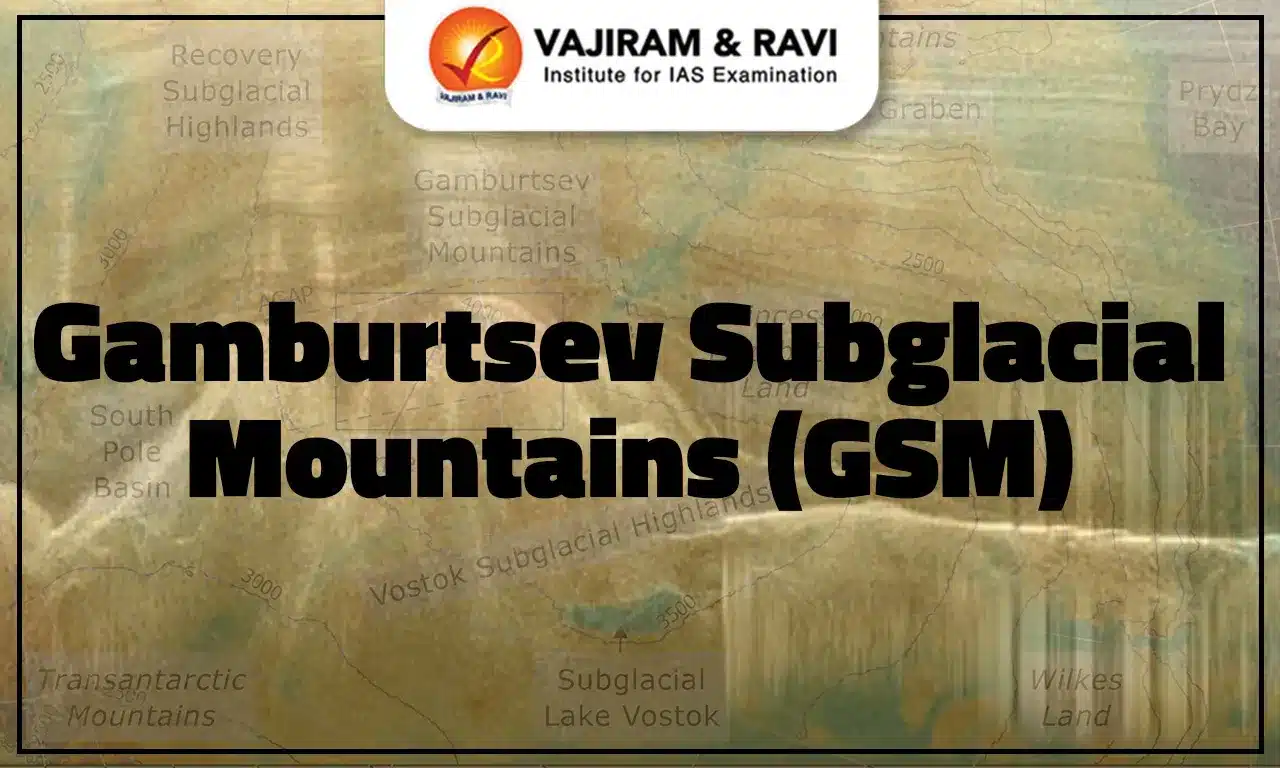
New data published in Earth and Planetary Science Letters reveals the Gamburtsev Subglacial Mountains (GSM) were formed over 500 million years ago, during the assembly of the Gondwana supercontinent.
What are the Gamburtsev Subglacial Mountains (GSM)?
The Gamburtsev Subglacial Mountains are a completely buried mountain range beneath the East Antarctic Ice Sheet, located at its highest point.
These mountains were first discovered in 1958 by a Soviet seismic expedition.
Unlike the Transantarctic Mountains, which are partially visible above the ice, the Gamburtsev Mountains remain entirely buried, concealed under several kilometres of ice.
Typically, mountains form at tectonic plate boundaries due to collision or subduction, but East Antarctica has remained tectonically stable for hundreds of millions of years.
The existence of such a massive mountain range within a stable craton posed a major puzzle for geologists.
Zircon “Time Capsules” and Dating Evidence
Scientists analysed zircon grains from sandstones deposited by ancient rivers flowing from the mountains, collected from the Prince Charles Mountains.
Zircons contain trace uranium, which decays at a known radioactive rate, enabling accurate age determination.
Findings show:
Uplift began ~650 million years ago
Himalayan-scale peaks reached ~580 million years ago
Crustal melting and flow ceased ~500 million years ago.
Gamburtsev Subglacial Mountains FAQs
Q1: Where are the Gamburtsev Subglacial Mountains located? Ans: The Gamburtsev Subglacial Mountains lie beneath the East Antarctic Ice Sheet, completely buried under ice.
Q2: How were these mountains discovered? Ans: They were first discovered in 1958 during the International Geophysical Year by a Soviet expedition using seismic surveys.
Centralised Information Management System Latest News
Regulated entities (REs) will now be required to report details of their digital lending apps (DLAs) through the centralised information management system (CIMS) portal of the Reserve Bank of India (RBI).
About Centralised Information Management System
It was introduced by the Reserve Bank of India (RBI) to handle the massive data flow, aggregation, analysis, public dissemination, and data governance.
CIMS is a warehouse of data. This system uses state-of-the-art technology to manage Big data and will serve as a platform for power users to carry out data mining, text mining, visual analytics, and advanced statistical analysis, connecting data from multiple domains, such as, financial, external, fiscal, corporate, and real sectors, as well as prices.
Advantages:
It enhances the efficacy and efficiency of RBI’s regulatory reporting system.
Banks and other regulated entities can submit their regulatory reports electronically using the cloud-based CIMS technology.
Banks and other regulated firms will have less work to do as a result, and the RBI will benefit from improved timeliness and quality of its regulatory data.
The RBI will be better able to keep an eye on the financial system and respond quickly to any new dangers.
The RBI will benefit from improved communication with banks and other regulated companies due to CIMS.
Centralised Information Management System FAQs
Q1: Who introduced the Centralized Information Management System (CIMS)?
Ans: Reserve Bank of India (RBI)
Q2: What is the primary function of CIMS?
Ans: Data aggregation, analysis, and dissemination.
Q3: What kind of analysis can be performed using CIMS?
Ans: Data mining, text mining, visual analytics, and advanced statistical analysis.
Ayurveda advocates for personalised treatment, customised to the prakriti (constitution) and imbalances (doshas) of each individual.
The Indian Medical Council Act of 1971 provides formal recognition to Ayurveda, Unani, and Siddha systems, ensuring standardisation and regulation.
Core Principles and Holistic Approach
Ayurveda is based on the concept of the tridosha theory: Vata (air & space), Pitta (fire & water), and Kapha (water & earth).
The seven body tissues (dhatus) are: Rasa, Rakta, Mamsa, Meda, Asthi, Majja, and Shukra.
Waste products (malas) include: Mala (feces), Mutra (urine), and Sweda (sweat).
Health is defined as the balanced state of these doshas, dhatus, and malas.
Disease arises from imbalance, and Ayurveda treats the root causes, not just the symptoms.
Ayurveda Day FAQs
Q1: What is Ayurveda Day? Ans: Ayurveda Day is celebrated to promote the ancient Indian system of medicine, Ayurveda, and is observed on Dhanvantari Jayanti, during Dhanteras.
Q2: Which ministry organises Ayurveda Day celebrations? Ans: The Ministry of AYUSH (Ayurveda, Yoga, Unani, Siddha, and Homeopathy) organizes Ayurveda Day in India.
Recently, the U.S. Deputy Secretary of State welcomed the first group of Afrikaner refugees to the United States.
Who Are the Afrikaners?
Afrikaners are a white ethnic group native to South Africa, shaped through ethnogenesis on African soil, and are often referred to as “Africa’s White Tribe” due to their deep-rooted historical presence since the 17th century.
Origin: The Afrikaner community originated in 1652, when Jan van Riebeeck, under the Dutch East India Company (VOC), established a resupply station at the Cape of Good Hope, initially settled by Dutch Protestants.
Over time, the settlers included French Huguenots fleeing persecution after the Edict of Fontainebleau (1685), along with Germans and enslaved people from India, Indonesia, Madagascar, and East Africa, contributing to the ethnic mix.
Formation of Afrikaner Identity
A unique Afrikaner identity developed through interactions among Europeans, slaves, and the indigenous Khoikhoi, marked by paternalistic household systems, strict social hierarchies, and the development of Afrikaans as a distinct language.
Afrikaners were influenced by Calvinist values, frontier living, and a militant, self-reliant culture, especially among the Trekboers who moved inland in the 18th century and often engaged in violent conflicts with indigenous communities.
Afrikaners – Africa’s White Tribe FAQs
Q1: Who are the Afrikaners? Ans: Afrikaners are an ethnic group of Dutch descent in South Africa, descended primarily from 17th-century Dutch settlers.
Q2: Why are Afrikaners called Africa’s “White Tribe”? Ans: Despite being of European origin, their long history in Africa has earned them the identity of a "White Tribe" indigenous to the continent.
Astronomers from the Russian Academy of Sciences, using the Spektr-RG (SRG) space observatory, have detected 11 new Active Galactic Nuclei (AGNs) during their all-sky X-ray surveys.
What are Active Galactic Nuclei (AGNs)?
Active Galactic Nuclei (AGNs) are compact regions at the centers of galaxies that emit exceptionally high levels of electromagnetic radiation, often outshining the rest of the galaxy.
This intense emission arises from either accretion of matter by a supermassive black hole or intense star formation activity.
AGNs are among the most luminous and persistent energy sources in the universe and are critical to understanding galaxy formation and evolution.
The newly detected AGNs were identified during an optical and X-ray inspection of sources listed in the ARTSS1-5 catalog, using SRG’s ART-XC telescope.
The team has also previously identified more than 50 AGNs and several cataclysmic variable stars.
Key Characteristics of the 11 Newly Detected AGNs
All 11 AGNs are located at redshifts ranging from 0.028 to 0.258, indicating they are relatively nearby in cosmic terms.
Their X-ray luminosities fall within the typical range of 2 to 300 × 10³⁹ erg/s, which is consistent with known AGN profiles.
Classification into Seyfert Types
All detected AGNs were classified as Seyfert galaxies, a type of AGN that is common and well-studied:
7 galaxies were classified as Seyfert Type 1 (Sy 1), characterized by broad optical emission lines.
3 galaxies were classified as Seyfert Type 1.9 (Sy 1.9), showing partially broadened lines.
1 galaxy was classified as Seyfert Type 2 (Sy 2), which exhibits narrow emission lines only.
Seyfert galaxies appear like normal galaxies in visible light but show strong infrared and X-ray emissions due to activity at their cores.
Active Galactic Nuclei (AGNs) FAQs
Q1: What are Active Galactic Nuclei (AGNs)? Ans: AGNs are extremely bright central regions of some galaxies, powered by supermassive black holes accreting matter.
Q2: Why are AGNs important in astrophysics? Ans: AGNs help scientists understand galaxy evolution, black hole activity, and cosmic energy sources across the universe.
Q3: What types of AGNs are there? Ans: Common types include quasars, blazars, Seyfert galaxies, and radio galaxies, each emitting energy across various wavelengths.
Recently, a Brazilian surfer, known for surfing the world’s longest tidal waves, uses the Mearim’s pororoca to raise awareness about climate change and ecological degradation.
Mearim River
The Mearim River is a major river located in Maranhão state, in northern Brazil.
It originates in southern Maranhão and drains northward into the Baía de São Marcos (São Marcos Bay), where it forms a common estuary with the Pindaré and Grajaú rivers.
The river is ~800 km long, flowing through the Atlantic Coastal Plain marshlands and passing through dense tropical rainforests and mangrove ecosystems.
The river's upper and middle courses are marked by rapids, making them non-navigable, while only the lower course is suitable for navigation.
The Mearim River forms the southern boundary of the Tocantins–Araguaia–Maranhão moist forests ecoregion, an important biodiversity hotspot.
Tidal Bore (Pororoca) Phenomenon
The Mearim River is famous for its pororoca, a tidal bore that occurs when high tides from the ocean travel upstream into the river.
The term "pororoca" is derived from the Tupi Indigenous language, meaning "great roar", referring to the thunderous sound generated by the collision of river and ocean waters.
A tidal bore is a positive surge of water created when rising ocean tides push against river currents, typically occurring during spring tides and supermoons.
The height of the bore is generally greater near the banks of the river than at the centre and can travel upstream for 30 minutes after the peak high tide.
The Mearim pororoca is one of the last remaining tidal bores of significant strength in Brazil, attracting surfers and researchers.
Mearim River - Tidal Bore FAQs
Q1: Where is the Mearim River located? Ans: The Mearim River is located in the Maranhão state of northeastern Brazil and flows into the Atlantic Ocean.
Q2: What unique tidal phenomenon is observed in the Mearim River? Ans: The Mearim River is known for the tidal bore called the “Pororoca,” where ocean tides push upstream against the river current, creating large waves.
Q3: Which other rivers globally experience tidal bores like the Mearim? Ans: Rivers like the Amazon (Brazil), Qiantang (China), and Seine (France) also exhibit tidal bores.
Two persons, including a chartered accountant, have been arrested for allegedly cheating the Ministry of Electronics and Information Technology (MeitY) of over Rs 3 crore under the pretext of the government-run SAMRIDH scheme for startups.
About SAMRIDH Scheme
The Startup Accelerator of MeitY for Product Innovation, Development, and Growth (SAMRIDH) is a flagship programme of the Ministry of Electronics & IT (MeitY) for startup acceleration under the National Policy on Software Products–2019.
Objective:
It aims to support existing and upcoming Accelerators to select and accelerate potential IT-based startups to scale.
Among others, the program focuses on accelerating the startups by providing customer connect, investors connect and connect to international markets.
An investment of up to Rs 40 lakh to the start-up based on the current valuation and growth stage of the Start-Up will be provided through selected accelerators. It will also facilitate equal matching investment by the accelerator.
Implemented by: The scheme is being implemented by MeitY Start-up Hub (MSH), Digital India Corporation (DIC).
In the first round of the cohort, 22 Accelerators spread across 12 states are supporting 175 startups, selected through a multilevel screening process.
List of accelerators comprises government supported organizations, academic institutions, the private sector, and early-stage start-up funding platforms.
These accelerators then select 5-10 startups each in the focused areas of health-tech, ed-tech, agri-tech, consumer-tech, fin-tech, Software as a Service (SaaS), and sustainability through a multi-level screening process.
The Accelerators have to provide services to the Start-Ups which include the following:
Expert diagnostic for market research and product positioning.
Mentoring startups through experts based on tech vertical
Legal Assistance for all matters: IP, Incorporation, and other matters
Connected learning and networking through shared platform
Co-learning
Weekly meets between founders of all startups
Demo Day: Presentation with venture capitalists (VCs)and angel investors
Assistance to startups in negotiating and closing investment deals with VCs and angel investors
Supreme Court Abolishes Point-Based System for Senior Advocate Designation
Senior Advocate Designation FAQs
Senior Advocate Designation Latest News
The Supreme Court has scrapped the existing points-based system for designating senior advocates in the Supreme Court and High Courts.
Instead, it issued new guidelines stating that the decision to confer the designation will now rest solely with the Full Court of the respective courts.
Senior Advocates in India
Senior advocates are highly experienced and knowledgeable legal professionals recognized for their expertise and contribution to the legal field.
They are typically involved in high-profile cases and play a crucial role in upholding the Rule of Law.
Legal basis
Section 16 of the Advocates Act, 1961 classifies advocates into two categories: Senior Advocates; Other Advocates (Non-designated or Junior Advocates).
Legal Provisions for Designation
Section 16(2) of the Advocates Act, 1961 and Rule 2(a) of Order IV of the Supreme Court Rules, 1966 govern the designation process.
Key Conditions for Designation
The Chief Justice and judges of the court must be satisfied with the advocate’s fitness for the designation.
The advocate must have exceptional legal knowledge and expertise.
Prior consent of the advocate is mandatory.
The selection must be based solely on merit, not influence or seniority.
Restrictions on Senior Advocates
Senior Advocates are bound by specific ethical and procedural restrictions to maintain the dignity of their position:
Cannot appear in court without a junior or an Advocate-on-Record.
Prohibited from drafting pleadings or affidavits themselves.
Cannot accept briefs or instructions directly from clients.
Not allowed to file applications or represent clients independently.
Must adhere to a distinct code of conduct separate from other advocates.
Background: 2017 Framework
India’s first woman Senior Advocate Indira Jaising had filed a petition in SC challenging the existing process of designation.
She termed this process as opaque, arbitrary and fraught with nepotism and sought greater transparency in the process of designating.
The 2017 SC ruling on senior advocate Indira Jaising’s petition led to the formation of:
A Permanent Committee headed by the CJI or HC Chief Justice.
Guidelines including interviews and a points system.
2017 System (Indira Jaising – I)
Under the 2017 system, a Permanent Committee for Designation of Senior Advocates was formed.
It was headed by the Chief Justice (of SC or respective HC), the two senior-most judges, the Attorney General (for SC), or Advocate General (for HCs).
The committee evaluated candidates using a point-based system based on:
Years of legal practice
Reported judgments
Publications
Personal interviews
Amendment in 2023 (Indira Jaising – II)
In response to the Centre’s concerns over the subjectivity and misuse of the 2017 point-based system for designating senior advocates, the Supreme Court issued new guidelines in May 2023.
The new guidelines set a minimum age of 45 for senior advocate designation (with possible relaxation), reduce marks for publications to 5, and increase weightage for reported/unreported judgments to 50 points, aiming for a fairer, merit-based system.
Supreme Court Abolishes Point-Based System for Senior Advocate Designation
The Supreme Court scrapped the points-based assessment system it had introduced in 2017 for designating senior advocates in the Supreme Court and High Courts.
New Guidelines Issued
Full Court Authority: The Full Court of the SC or respective HC will now make final decisions on designation.
Role of Permanent Secretariat: The Permanent Secretariat created under the 2017 rules will continue to scrutinize applications and submit eligible names to the Full Court.
Decision by Consensus or Voting: The Full Court should aim for consensus, but may adopt a voting process—including a secret ballot, if required.
Minimum Eligibility Unchanged: The requirement of a minimum 10 years of legal practice remains valid.
Application Not Mandatory: Designation may be conferred even without a formal application.
No Individual Recommendations: Judges are barred from individually recommending candidates.
Why the Change
The system had not achieved desired results over the past 7.5 years.
Caliber and legal experience cannot be quantified through a numerical score or brief interview.
Current Trigger for Change
The decision came during the hearing of an unrelated case regarding remission, when the apex court expressed concern over the conduct of a senior advocate.
This prompted the court to revisit and revise the senior designation guidelines to make the process more transparent and effective.
Senior Advocate Designation FAQs
Q1. Why did SC scrap the point-based system?
Ans. SC found the system arbitrary and ineffective in reflecting the real merit of senior advocate candidates over 7.5 years.
Q2. Who will now decide senior designations?
Ans. The Full Court of SC or HCs will finalize senior advocate designations by consensus or voting, replacing prior assessment method.
Q3. What were 2017 guidelines for designation?
Ans. A Permanent Committee evaluated candidates on points from interviews, judgments, and publications based on Indira Jaising’s petition.
Q4. What is the legal basis for senior designation?
Ans. Section 16 of the Advocates Act, 1961, and Supreme Court Rules govern senior advocate classification and designation process.
Q5. Are formal applications still required?
Ans. No, courts can confer senior designation even without a formal application, ensuring more discretion and transparency in the process.
The Department of Consumer Affairs (DoCA) recently announced that a report for a “Framework on Repairability Index (RI) in Mobile and Electronic Sector” had been submitted to the government.
Introduction
India has taken a notable step toward empowering consumers and ensuring environmental sustainability through its Right to Repair movement.
The Department of Consumer Affairs (DoCA) recently accepted a report on the proposed Repairability Index (RI)for mobile phones and electronic appliances, which aims to rank products based on how easy they are to repair.
This framework, aligned with the global right to repair movement, is a response to rising concerns about product durability, electronic waste, and consumer dependence on manufacturers for repairs.
Understanding the Repairability Index
The proposed Repairability Index is a score that evaluates how easy it is to repair a product. It considers criteria such as:
Availability and pricing of spare parts
Access to repair documentation
Cost and time of repairs
Software support (e.g., updates)
Consumer electronic products and appliances like smartphones, washing machines, and refrigerators would be rated using this index, allowing consumers to make informed purchase decisions.
The idea is to promote long-lasting products and provide transparency regarding repair options.
The Need for Repairable Electronics
The initiative comes amid increasing complaints that modern appliances break down more often than older ones.
This is partly due to planned obsolescence, where companies deliberately manufacture products with a shorter lifespan to push consumers to buy new ones.
The declining metal content in appliances (due to rising metal prices and competition) has also contributed to poor durability. India’s reliance on imported metals like copper further exacerbates the problem.
Prolonging the lifespan of electronics also ties into India’s broader goals like:
Reducing electronic waste (e-waste)
Supporting a circular economy where old parts re-enter the value chain
Lowering the demand for freshly mined ("virgin") metals
The Right to Repair Movement in India
Globally, the right to repair refers to the consumer’s ability to choose how and where to repair their devices, whether through the manufacturer or independent service providers.
In India, the DoCA launched a Right to Repair Portal, listing:
Manufacturer-authorized service centres
Repair manuals and guides
Unlike the more confrontational stance in countries like the U.S., India's model currently supports manufacturer-authorized channels, with limited support for third-party repairs.
However, the inclusion of consumer rights advocates suggest the framework may not be entirely in favour of manufacturers.
They emphasized that denying repair services for older products violates the consumer's right to choice and advocated for more repair freedom.
Global Context and U.S. Comparison
In the United States, the Right to Repair movement has gained legislative support, especially against practices like:
Restricting access to spare parts
Locking devices with proprietary software
Penalizing third-party repairs
Laws have been introduced requiring companies to publish repair costs and ensure access to spare parts. In contrast, Indian policy is still evolving, with more collaboration between the government and manufacturers.
One notable example is McDonald’s in the U.S., where only Taylor Company technicians are allowed to repair the brand’s ice cream machines, leading to consumer frustration and regulatory scrutiny.
Similar monopolistic repair models in electronics are being questioned globally.
Challenges Ahead
Though India’s Repairability Index is a progressive move, it faces several challenges:
Balancing innovation and industry freedom with consumer rights
Overcoming resistance from electronics manufacturers who profit from repair services
Creating enforcement mechanisms to ensure compliance
Making third-party repairs safe and reliable
Moreover, the committee drafting the RI consisted mostly of industry representatives, which may influence the eventual shape of the policy.
Right to Repair India FAQs
Q1. What is the Repairability Index in India?
Ans. It is a proposed score that rates electronic products based on how easy they are to repair.
Q2. What does the Right to Repair movement advocate?
Ans. It seeks to give consumers greater freedom to repair their products through authorized or third-party services.
Q3. How is India’s Right to Repair approach different from the U.S.?
Ans. India promotes a collaborative approach with manufacturers, while the U.S. has adopted a more regulatory stance.
Q4. Why is the Right to Repair important for consumers?
Ans. It helps consumers save money, extend product lifespans, and reduce e-waste.
Q5. What are the challenges in implementing the Repairability Index?
Ans. Key challenges include resistance from manufacturers, industry lobbying, and the need to balance consumer rights with business innovation.
The IAF’s Integrated Air Command and Control System (IACCS)
The Army’s Akashteer System
Multilayered Air Defence Umbrella
Future of IACCS
India’s Air Defence System FAQs
India’s Air Defence System Latest News
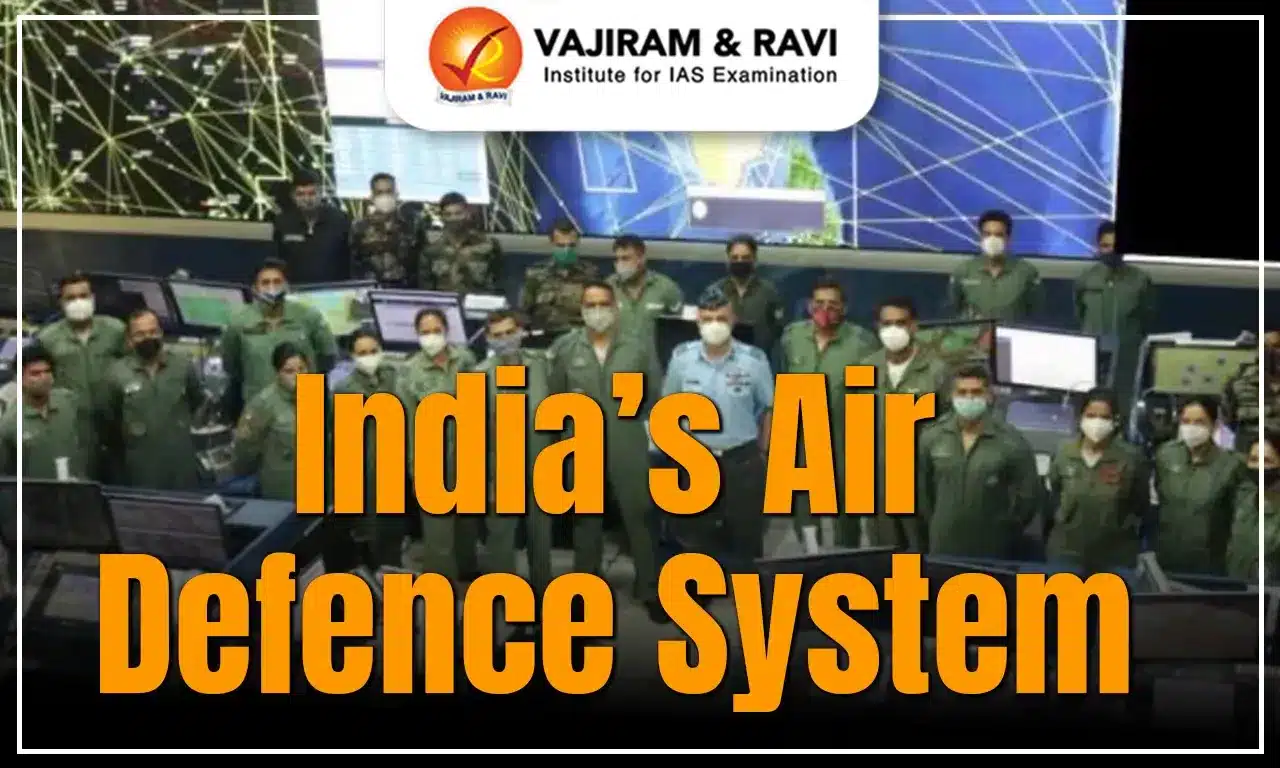
During a media briefing on Operation Sindoor, the IAF showcased its Integrated Air Command and Control System (IACCS), which provides a real-time feed of India's air defence operations.
This system integrates radar, control centres, fighter jets, and ground-based defences to protect against aerial threats like enemy aircraft, drones, and missiles.
The IAF’s Integrated Air Command and Control System (IACCS)
IACCS is an automated command and control system developed by Bharat Electronics Limited (BEL) for the Indian Air Force.
It integrates data from various air defence sources, including ground and airborne radars, civilian radar systems, communication nodes, and command centres.
Real-Time Situational Awareness
The system provides real-time updates and a consolidated dataset to commanders at multiple levels.
This ensures comprehensive situational awareness during air operations and enhances decision-making in response to aerial threats.
Command Structure and Execution
IACCS supports central control with decentralised execution, enabling swift identification and response to threats.
It helps reduce reaction time and allows commanders to deploy air defence assets effectively.
Enhanced Airspace Management
Overlapping radar and radio coverage within IACCS ensures efficient airspace monitoring and reduces system redundancy, leading to better coordination and control of air defence operations.
The Army’s Akashteer System
Akashteer is the Indian Army’s air defence control and reporting system, designed to connect and coordinate its air defence units.
It enables monitoring of low-level airspace over battle zones and controls ground-based air defence weapon systems.
Development
Akashteer has been developed by Bharat Electronics Limited (BEL).
Integration with IAF Systems
Currently operating on a smaller scale, Akashteer is being integrated with the Indian Air Force’s IACCS to ensure seamless coordination between Army and Air Force air defence operations.
Multilayered Air Defence Umbrella
The Indian military employs a multi-layered air defence system, combining various assets to detect and neutralise aerial threats at different ranges and altitudes.
Key Components
Point Defence: Includes low-level air defence guns and shoulder-fired weapons.
Aerial Defence: Comprises fighter aircraft and long-range missiles.
Surveillance Grid: Utilises ground-based radars and airborne systems like (Airborne Warning and Control System) and AEW&C (Airborne Early Warning & Control) Systems, all integrated into the IACCS for real-time tracking and interception.
Four Defence Layers Explained
Layer 1: Counter-drone systems and MANPADS(Man-Portable Air Defence Systems).
Layer 2: Point air defence and short-range surface-to-air missiles (SR-SAM).
The IAF has bolstered its air defence by deploying more radars and Surface to Air Guided Weapon (SAGW) systems, all integrated into the IACCS network at key sensitive bases.
Towards Tri-Service Coordination
With the increasing complexity of modern warfare, IACCS will be pivotal in integrating air defence assets across the Army, Navy, and Air Force for a unified and coordinated response.
Embracing Advanced Technologies
Future upgrades to IACCS will incorporate cutting-edge technologies like artificial intelligence for real-time threat analysis and enhanced situational awareness.
India’s Air Defence System FAQs
Q1. What is IACCS in India’s defence system?
Ans. IACCS is an automated air command and control system integrating radar, aircraft, and defences for real-time situational awareness.
Q2. What does Akashteer system do?
Ans. Akashteer links Army’s air defence units, enabling control and coordination in low-level airspace during battlefield operations.
Q3. How does India manage air threats?
Ans. India uses a multilayered air defence setup, integrating drones, radars, missiles, and fighter jets to detect and neutralize threats.
Q4. What are the four layers of India’s air defence?
Ans. India’s air defence includes counter-drone systems, SR-SAMs, MR-SAMs, and LR-SAMs for full-range aerial threat coverage.
Q5. How will IACCS evolve in the future?
Ans. Future upgrades will integrate AI and expand tri-service coordination for faster, tech-driven responses to complex aerial threats.