GS1’s New Generation QR Codes

GS1’s New Generation QR Codes

GS1’s New Generation QR Codes Latest News

GS1, a global standards organisation, has announced that new generation QR codes will be globally implemented by 2027.

What is GS1?

  • GS1 (Global Standards One) is a non-profit international organisation that develops global data standards for efficient product identificationsupply chain transparency, and consumer safety.
  • GS1 introduced barcodes nearly 50 years ago and now operates in over 100 countries, including GS1 India.

Features of the New QR Code System

  • The next-gen QR codes will offer greater data capacity, supporting enhanced product traceability, real-time inventory management, consumer transparency, and product authentication and safety.
  • Initially, dual codes (traditional 1D barcode + new QR code) will appear on packaging to ensure compatibility with older Point-of-Sale (POS) systems.
  • Eventually, when retail infrastructure is fully upgraded, only the QR code will be used.

What Is a Barcode?

  • barcode is a machine-readable visual representation of data, using a pattern of lines (1D) or dots/squares (2D).
  • It allows quick identification of products, patients, shipments, and records.
  • Originally developed in 1973 by George Laurer and Norman Joseph Woodland.
  • Also known as Universal Product Code (UPC).

What Is a QR Code?

  • QR Code (Quick Response Code) is a 2D barcode that stores more data than traditional barcodes.
  • Developed in 1994 by Masahiro Hara, QR codes store information both horizontally and vertically.
  • Widely used in UPI paymentsticketingsupermarkets, and product authentication.

GS1’s New Generation QR Codes FAQs

Q1: What is GS1 India?
Ans: GS1 India is a not-for-profit organisation under the Ministry of Commerce and Industry that develops and manages global barcoding standards.

Q2: What are New Generation QR Codes?
Ans: These are digital QR codes developed by GS1 to provide authentic product information, enhance supply chain traceability, and prevent counterfeiting.

Source: TH


Nineveh

Nineveh

Nineveh Latest News

During recent excavations in the ancient metropolis of Nineveh, archaeologists came across large parts of a monumental relief, including King Assurbanipal (668 to 627 BC), the last ruler of the Assyrian Empire, accompanied by two important deities and other figures.

About Nineveh

  • It was one of the most important sites in northern Mesopotamia and became the capital of the Assyrian Empire under King Sennacherib in the late 8th century BCE.
  • It is situated on the east bank of the Tigris River within the modern city of Mosul, Iraq. 
  • It was the oldest and most populous city of the ancient Assyrian empire.
  • The area was settled as early as 6000 BCE and, by 3000 BCE, had become an important religious centre for worship of the goddess Ishtar.
  • It came directly under Assyrian rule during the reign of Shamashi Adad I (r. 1813-1791 BCE) but was most fully developed during the Neo-Assyrian Empire (912-612 BCE) by Sennacherib (r. 705-681 BCE).
  • Prior to its fall, however, Nineveh was the largest urban center in the world, ornamented by gardens, statuary, parks, and a zoo, and was regarded as a great cultural center. 
  • The city was destroyed in 612 BCE by a coalition led by Babylonians and Medes, which toppled the Assyrian Empire.

Nineveh FAQs

Q1: What is the significance of Nineveh?

Ans: Nineveh was one of the most important sites in northern Mesopotamia and became the capital of the Assyrian Empire under King Sennacherib in the late 8th century BCE.

Q2: What modern city lies near the ruins of ancient Nineveh?

Ans: Mosul, Iraq

Q3: Who destroyed Nineveh?

Ans: After Nineveh fell to the Medes and Babylonians in 612 BC, the city was destroyed and never regained its earlier significance.

SourceMSN


  •  
  •  
  •  
  •  
  •  
  • Beta
Beta feature

Market Infrastructure Institutions (MIIs)

Market Infrastructure Institutions

Market Infrastructure Institutions Latest News

To further strengthen the governance mechanism at market infrastructure institutions (MIIs), regulator SEBI recently released comprehensive guidelines for internal audit mechanisms at such establishments, along with the prescribed composition of the audit committee.

About Market Infrastructure Institutions

  • A MII is a financial entity that provides essential infrastructure for running the daily operations in the Stock Market/Capital Markets. 
  • The MII primarily consists of the following 3 entities from the Stock Market: 
    • Stock Exchanges (including Commodity Exchanges) 
    • Clearing House/Clearing Corporation 
    • Depository Organization 
  • The MIIs help to efficiently trade the financial securities, which in turn helps in the economic growth of the country. 
  • These entities provide platforms and mechanisms for trading, clearing, settlement, record keeping, storage of securities, etc. 
  • Any disruption in the operations of these institutions can adversely impact the functioning of the entire financial system. 
  • The MIIs are separate corporate entities that are in the business to earn a profitfor their services. 
  • But these are also the first-line regulators in the market and have to follow strong corporate governance standards. 
  • The Securities and Exchange Board of India (SEBI) is the main regulatory body for the capital markets in India. 
    • So, every MII in the stock market has to be registered with SEBI. 
    • The regulatory guidelines primarily include responsibilities for safeguarding the interests of the investors.

Market Infrastructure Institutions FAQs

Q1: What is a market infrastructure institution?

Ans: A MII is a financial entity that provides essential infrastructure for running the daily operations in the Stock Market/Capital Markets. 

Q2: What are the three key entities that make up the Market Infrastructure Institutions?

Ans: Stock Exchanges, Clearing Corporations, and Depository Organizations

Q3: Why is the proper functioning of MIIs crucial to the economy?

Ans: It ensures smooth capital market operations, aiding economic growth.

SourceET


e-Zero FIR System Launched to Combat High-Value Cyber Frauds | Digital FIRs Under New Criminal Laws

e-Zero FIR System

e-Zero FIR System Latest News

  • Union Home Minister Amit Shah announced the launch of the e-Zero FIR system, under which cyber financial crime complaints involving over ₹10 lakh—reported via the 1930 helpline or the National Cybercrime Reporting Portal (NCRP)—will be automatically converted into FIRs. 
  • The initiative, implemented by the Indian Cyber Crime Coordination Centre (I4C), aims to enable faster tracking and action against cybercriminals.

Zero FIR

  • Jurisdiction-Free Filing: A Zero FIR can be lodged at any police station, regardless of where the crime occurred or where the victim resides.
    • Jurisdiction of police stations is now no bar. A victim can provide information to a police station irrespective of its jurisdiction. 
    • He may give such information orally or by electronic communication to the officer in-charge.
  • Procedure: The receiving police station registers the complaint (without assigning a regular FIR number) and forwards it to the concerned police station for investigation.
  • Origins: Recommended by the Justice Verma Committee post the 2012 Nirbhaya case to ensure victims don't face delays due to jurisdictional issues.
  • Purpose: To facilitate immediate registration and ensure timely action, avoiding bureaucratic hurdles for the victim.

FIRs under New Criminal Laws (2024 Onward)

  • New Legal Framework:
    • Bharatiya Nyaya Sanhita (BNS), 2023
    • Bharatiya Nagarik Suraksha Sanhita (BNSS), 2023
    • Bharatiya Sakshya Adhiniyam (BSA), 2023
    • These three laws replaced the IPC, CrPC, and Indian Evidence Act respectively, effective July 1, 2024.
  • Digital Reporting Enabled: Victims can now lodge FIRs electronically, removing the need to visit a police station in person.
  • Mandatory Zero FIR: Under Section 173 of BNSS, police must register Zero FIRs, strengthening victim-centric policing.
  • Victim Empowerment: Victims will receive free copies of FIRs, ensuring transparency and enabling participation in the legal process.

New e-Zero FIR System Launched to Tackle High-Value Cybercrimes

  • Union Home Minister announced the launch of the e-Zero FIR system.
  • Under this, cyber financial crime complaints exceeding ₹10 lakh—filed via the 1930 helpline or the National Cybercrime Reporting Portal (NCRP)—will be automatically converted into FIRs.

Pilot Project Begins in Delhi, National Rollout Planned

  • The initiative, launched as a pilot in Delhi, will soon be extended nationwide. 
  • It allows FIR registration irrespective of territorial jurisdiction, aiming to ensure swift investigation and recovery of lost money.

Integrated Digital Infrastructure

  • The system integrates:
    • I4C’s NCRP system
    • Delhi Police’s e-FIR system
    • NCRB’s Crime and Criminal Tracking Network & Systems (CCTNS)
  • These platforms collectively ensure the immediate registration of Zero FIRs at Delhi’s e-Crime Police Station, which are then routed to the concerned jurisdiction.

Compliance with New Criminal Laws

  • The process follows the provisions of Section 173 (1) and 1(ii) of the Bharatiya Nagrik Suraksha Sanhita (BNSS). 
  • Victims must visit a cybercrime police station within three days to get the Zero FIR converted into a regular FIR.

Towards a Cyber-Secure Bharat

  • This system will empower authorities to act with unprecedented speed and reflects the government's commitment to build a 'Cyber-Secure Bharat'.

e-Zero FIR System FAQs

Q1. What is the e-Zero FIR system?

Ans. It’s a digital initiative to auto-register FIRs for cyber frauds above ₹10 lakh via NCRP or 1930 helpline.

Q2. What makes Zero FIR jurisdiction-free?

Ans. Victims can file FIRs at any police station, irrespective of where the crime happened, ensuring no jurisdictional delays.

Q3. Which section of BNSS mandates Zero FIR registration?

Ans. Section 173 of the Bharatiya Nagrik Suraksha Sanhita (BNSS), 2023 mandates Zero FIR registration and victim-friendly procedures.

Q4. What platforms are integrated under e-Zero FIR?

Ans. It integrates NCRP, Delhi Police’s e-FIR system, and NCRB’s CCTNS for instant Zero FIR generation and routing.

Q5. What is required to convert e-Zero FIR into regular FIR?

Ans. The victim must visit a cybercrime police station within three days to convert Zero FIR into a regular FIR.

.Source: IE | PIB | ToI

Government Orders Nationwide Inspection of Jal Jeevan Mission Projects Amid Cost Overrun Concerns

Jal Jeevan Mission

Jal Jeevan Mission Latest News

  • The Central Government has decided to send 100 teams of Central Nodal Officers for “ground inspection” of the Jal Jeevan Mission schemes across the country. 
  • The move follows a meeting chaired by the Cabinet Secretary recently to review the mission’s schemes.

Introduction

  • Jal Jeevan Mission is a Centrally Sponsored Scheme, launched by the Ministry of Jal Shakti on 15th August, 2019.
  • Objective: To provide to all households in rural India safe and adequate water through individual household tap connections by 2024.
  • The Jal Jeevan Mission is based on a community approach to water. 
  • According to the government, the mission includes Information, Education and Communication as key components. 
  • The mission is meant to create a people's movement for water, making it everyone’s priority.
  • Institutional Mechanism under JJM

Jal Jeevan Mission: Scope and Achievements

  • The original budgetary outlay of the scheme stood at Rs. 3.6 lakh crore
  • However, with new approvals and revised cost estimates, the total projected expenditure has more than doubled to Rs. 8.29 lakh crore as of 2025.
  • Key achievements include:
    • Coverage expanded to over 14 crore rural households, up from 3.2 crore in 2019.
    • Over 6.4 lakh water supply schemes have been sanctioned across the country.
    • Emphasis on source sustainability, village-level water quality monitoring, and convergence with MGNREGA and SBM (Gramin).
  • However, disparities remain among states in execution speed and quality, and some regions have reported challenges in water source availability and community mobilization.

Challenges Facing the Mission

  • Escalating Costs:
    • The cost per tap connection has reportedly increased from Rs. 30,000 to Rs. 1,37,500 in some areas. This sharp rise has prompted scrutiny from the Ministry of Finance and the Expenditure Finance Committee (EFC).
  • Slow Implementation in Certain States:
    • While some states like Gujarat and Telangana have performed well, others are lagging in infrastructure setup, quality checks, and timely utilization of funds.
  • Quality of Work:
    • Reports from rural areas indicate that in some cases, pipeline infrastructure is substandard, or connections are functional only intermittently.
  • Monitoring and Evaluation Gaps:
    • The vast scale of the project has made it difficult to ensure real-time auditing and third-party verifications, leading to lapses.

News Summary

  • In light of the mounting fiscal and operational concerns, the Government of India has decided to send 100 teams of nodal officers to conduct ground-level inspections of JJM schemes across 135 districts in 29 states and Union Territories.
  • Key Details of the Review Initiative:
    • The review decision follows a Cabinet Secretary-led meeting on May 8, 2025.
    • The Department of Personnel and Training (DoPT) has nominated 99 nodal officers to inspect 183 water supply schemes, many of which cost over Rs. 1,000 crore.
    • These schemes collectively account for Rs. 1.5 lakh crore, or 20% of the total JJM outlay.
  • Reason for Cost Overrun:
    • The Jal Shakti Ministry had sought Rs. 2.79 lakh crore in additional central funding to meet the escalated costs for completing the scheme by 2028. 
    • standardized questionnaire has been prepared for these inspection teams, which will evaluate both the cost and quality of execution. 
    • A training session for the officers was scheduled on May 23 to familiarize them with inspection protocols.

Jal Jeevan Mission Inspection FAQs

Q1. Why is the Government sending 100 teams to inspect Jal Jeevan Mission schemes?

Ans. To assess cost escalation, quality of work, and implementation across various states.

Q2. How many schemes are being inspected under this initiative?

Ans. 183 schemes across 135 districts in 29 states and UTs.

Q3. What is the cost implication of the selected schemes?

Ans. These schemes have a cumulative cost of ₹1.5 lakh crore, or 20% of total approved costs.

Q4. What was the original and revised outlay of Jal Jeevan Mission?

Ans. The original outlay was ₹3.6 lakh crore; the revised estimate is ₹8.29 lakh crore.

Q5. Why did the Finance Ministry approve only half the requested additional funding?

Ans. Due to concerns over inflated work orders and lack of justifications for cost hikes.

Source: IE

Supreme Court Declares Post-Facto Environmental Clearances Illegal | Key Judgement Explained

Post-Facto Environmental Clearance

Post-Facto Environmental Clearance Latest News

  • Recently, the Supreme Court declared as illegal the Ministry of Environment’s 2017 notification that allowed ex-post facto environmental clearances — i.e., permissions granted after a project had already started. 
  • The court also struck down a 2021 office memorandum that laid out a procedure for granting such post-facto clearances. 
  • It further barred the Centre from issuing similar notifications or orders that violate the Environment Impact Assessment (EIA) Notification of 2006, reinforcing the principle that environmental approvals must be obtained before project execution.

EIA and the Need for Prior Clearance

  • The Environment Impact Assessment (EIA) Notification, 2006 mandates prior environmental clearance for projects likely to impact the environment, human health, and social infrastructure.
  • The process includes multiple stages: project screening, environmental impact study, public hearing, and expert committee review.
  • Final clearance is granted or denied based on expert recommendations to ensure sustainable development.

2017 Notification and Post-Facto Clearances

  • In March 2017, the Ministry of Environment issued a notification offering a one-time, six-month window for industries to seek clearance after starting operations or making changes without approval.
  • This applied to projects that had begun without prior clearance, expanded beyond approved capacity, or altered their product mix.

Centre’s Justification for Post-Facto Clearances

  • The Centre argued it was better to regulate violations rather than leave them unchecked.
  • Violators would be made to pay for remediation and pollution, nullifying any economic advantage from breaking the law.
  • Simultaneously, state authorities and pollution control boards were expected to take action under the Environment Protection Act, 1986.

Centralised Appraisal and Expert Oversight

  • All post-facto clearance cases, regardless of project size or category, were to be appraised centrally.
  • Appraisal proceeded only if the project was permissible at its site; otherwise, closure was recommended.
  • A committee headed by S R Wate (ex-NEERI Director) appraised violation cases, meeting 47 times between 2017 and 2021.

SOP Introduced in 2021

  • A Standard Operating Procedure (SOP) was issued in July 2021 to standardise the handling of violation cases, following a National Green Tribunal directive.

Supreme Court Criticises Centre for Protecting Environmental Violators

  • The bench of Justice Abhay S Oka and Justice Ujjal Bhuyan criticised the Centre for issuing orders that effectively protected violators of environmental norms.
  • The Court questioned whether development should come at the cost of environmental degradation.

Violation of Fundamental Rights

  • The Court held that the 2017 Notification and 2021 Office Memorandum (OM) violated:
    • Article 21 – Right to life, which includes the right to a healthy, pollution-free environment.
    • Article 14 – Right to equality before law, as the OM extended protection to violators fully aware of the legal consequences.
  • It cited Delhi’s pollution crisis to highlight the devastating effects of unchecked environmental harm.

SC Rejects Centre’s One-Time Justification

  • The Supreme Court reminded the Centre of its earlier undertaking before the Madras High Court, where it claimed the 2017 notification was a one-time exception.
  • The SC ruled that even a one-time exemption was unconstitutional, as it undermines the public's right to a clean environment.

Illegality of Post-Facto Clearances

  • The Court cited Common Cause v. Union of India (2017) and Alembic Pharmaceuticals v. Rohit Prajapati (2020) to reaffirm that ex-post facto clearances are alien to environmental law.
  • Such clearances violate the foundational principles of the Environment Impact Assessment (EIA) notification.

2021 Office Memorandum Violated Judicial Orders

  • The bench criticised the Centre for issuing the 2021 Office Memorandum, which allowed retrospective clearances, despite earlier Supreme Court rulings against it.
  • It held that this regularised illegal actions of starting projects without prior environmental clearance.
  • The Court observed that the Centre intentionally avoided using the term "ex-post facto" in the SOP, but the substance and effect remained the same.
  • It labelled the move as “clever drafting” to circumvent previous judicial restrictions.

Reaffirmation of Environmental Jurisprudence

  • In the Alembic Pharmaceuticals case, the SC had clearly ruled that post-facto approvals were against environmental principles and should not be permitted.
  • The current bench reiterated that such actions are a direct affront to the rule of law and ordered the Centre not to reintroduce such mechanisms in any form.

Post-Facto Environmental Clearance FAQs

Q1. What did the Supreme Court rule on post-facto environmental clearances?

Ans. The SC declared post-facto clearances illegal, citing they violate fundamental rights and environmental law principles under the EIA 2006.

Q2. What was the Centre’s justification for the 2017 notification?

Ans. The Centre claimed it regulated past violations, enforced penalties, and avoided economic disruptions by allowing one-time regularisations.

Q3. How did the Court view the 2021 Office Memorandum?

Ans. The Court criticised it as a disguised attempt to regularise illegal projects, contradicting earlier judicial pronouncements on EIA norms.

Q4. What constitutional rights did the Court say were violated?

Ans. The Court held the clearances violated Article 21 (right to life) and Article 14 (equality before law).

Q5. What precedents did the Supreme Court cite?

Ans. It cited Common Cause (2017) and Alembic Pharmaceuticals (2020) cases, both rejecting ex-post facto approvals in environmental jurisprudence.

Source: IE | CNBC | DTE

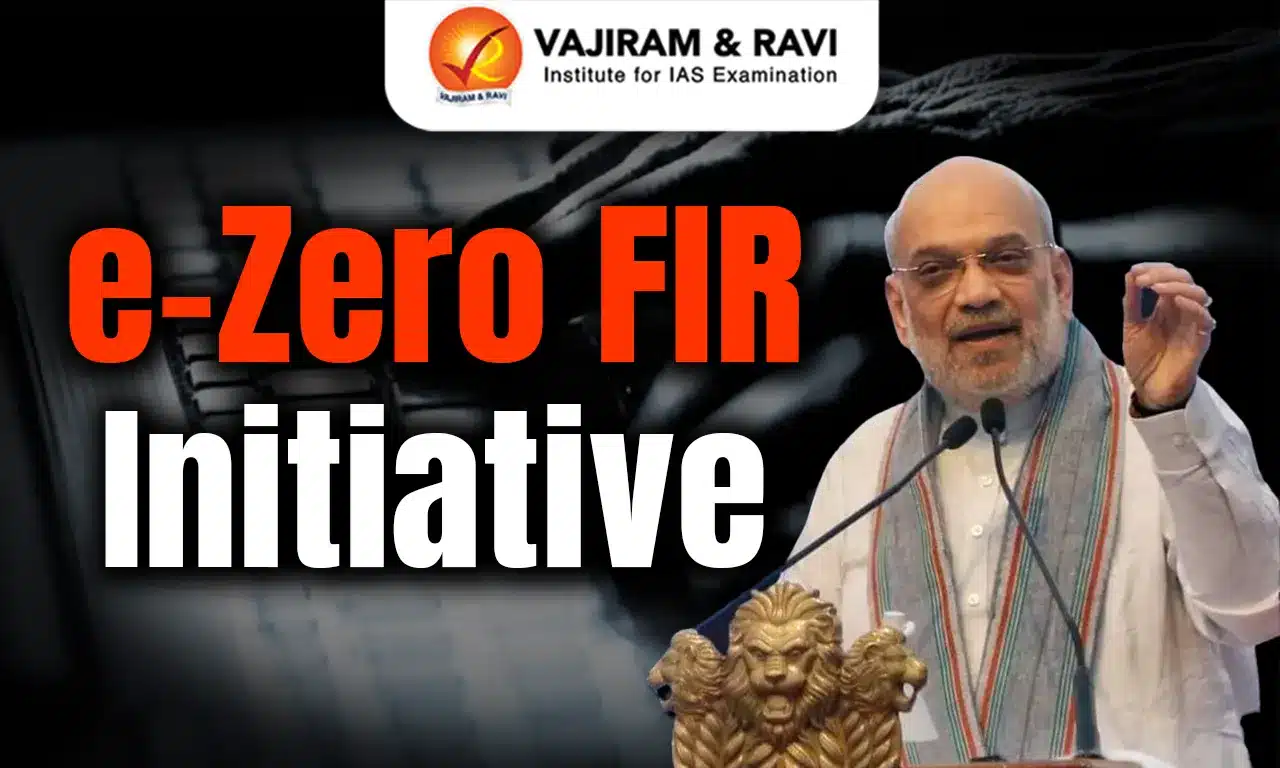
e-Zero FIR Initiative

e-Zero FIR Initiative

e-Zero FIR Initiative Latest News

The Indian Cybercrime Coordination Centre (I4C) has launched the e-Zero FIR initiative, which automatically converts financial cybercrime complaints over ₹10 lakh into First Information Reports (FIRs).

What is the e-Zero FIR Initiative?

  • The e-Zero FIR initiative is a new mechanism where financial cybercrime complaints involving fraud above ₹10 lakh are automatically converted into FIRs if reported via the 1930 helpline or the National Cybercrime Reporting Portal (NCRP).
  • This system has been launched on a pilot basis in Delhi by the Indian Cybercrime Coordination Centre (I4C) under the Ministry of Home Affairs (MHA).
  • Objective: The initiative aims to speed up investigations into large-scale cyber frauds and ensure swift action against cybercriminals.
  • Rationale: It addresses the longstanding grievance of victims who face delays in FIR registration and difficulty recovering stolen money.
  • Legal framework: The system is aligned with the provisions of Sections 173(1) and 1(ii) of the newly enacted Bharatiya Nagarik Suraksha Sanhita (BNSS).
  • The e-Crime Police Station of Delhi has been officially notified for e-FIR registration and case transfer under these legal provisions.

How Does the System Work?

  • Complaints of financial cybercrime losses above ₹10 lakh, once filed through 1930 or NCRP, will automatically trigger a Zero FIR at the e-Crime Police Station, Delhi.
  • This Zero FIR is immediately routed to the relevant territorial cybercrime police station, based on the complainant's location.
  • Victims are required to visit the cybercrime police station within 3 days to get the Zero FIR converted into a regular FIR.

Integration of Key Platforms

  • The process involves integration of: I4C’s National Cybercrime Reporting Portal (NCRP)Delhi Police’s e-FIR System, and National Crime Records Bureau’s (NCRB) Crime and Criminal Tracking Network & Systems (CCTNS).
  • This interlinking of databases facilitates real-time processingauto-routing, and nationwide interoperability for cybercrime cases.

About Zero FIR

  • Zero FIR can be registered at any police station, regardless of the place of the crime.
  • It ensures that jurisdictional issues do not delay investigation and provides legal urgency for prompt action.
  • Introduced following the Justice Verma Committee recommendations post the Nirbhaya case (2012), it reinforces victim-centric policing and quick redressal.

e-Zero FIR Initiative FAQs

Q1: What is the e-Zero FIR Initiative?
Ans: The e-Zero FIR allows victims to file an FIR at any police station, irrespective of jurisdiction, especially in cases of sexual assault, cybercrime, and urgent threats.

Q2: Who launched the e-Zero FIR system?
Ans: It was part of initiatives under the Ministry of Home Affairs and Digital Police Portal, integrated with the Crime and Criminal Tracking Network and Systems (CCTNS).

Q3: Is e-Zero FIR legally valid?
Ans: Yes, it is a legally valid FIR, and once transferred to the correct jurisdiction, it proceeds like a regular FIR.

Source: TH


  •  
  •  
  •  
  •  
  •  
  • Beta
Beta feature

Udanti Sitanadi Tiger Reserve

Udanti Sitanadi Tiger Reserve

Udanti Sitanadi Tiger Reserve Latest News

Recent camera trap images from Chhattisgarh's Udanti Sitanadi Tiger Reserve (USTR) have captured a promising resurgence in wildlife activity, showing extensive use of the forest by carnivores, herbivores, and omnivores alike.

About Udanti Sitanadi Tiger Reserve

  • It is located in the Gariaband and Dhamtari Districts of Chhattisgarh
  • It was established by joining the regions represented by Sitanadi and Udanti wildlife sanctuaries. 
  • The drainage system of the reserve consists of Mahanadi as the main river, along with Udanti, Sitanadi, Indravan, and Pairi Rivers as tributaries.
  • The location of the reserve is strategic since it also connects with the Kanker and North Kondagaon forest divisions, forming a contiguous forest corridor to Indravati Tiger Reserve in the Bastar region.
  • Total Area: 1872 sq.km.
  • There are 19 named mountains in the reserve. Deo Dongri is the highest point. The most prominent mountain is Atānga Dongar.
  • Flora
    • The forest types of USTR are "Tropical Peninsular Sal Forest and Southern Tropical Dry Deciduous Mixed Forest" (Champion & Seth, 1968).
    • The ground is covered with a maze of grass, plants, bushes, and saplings.
  • Fauna
    • Along with the Indravati Tiger Reserve, the Udanti Sitanadi Tiger Reserve is an important refuge for the last few herds of the highly endangered Wild Buffalo.
    • Apart from the tiger, other endangered and rare species are the Indian Wolf, Leopard, Sloth Bear, and Mouse Deer.

Udanti Sitanadi Tiger Reserve FAQs

Q1: In which state is Udanti Sitanadi Tiger Reserve?

Ans: Chhattisgarh

Q2: Which river flows through Udanti-Sitanadi Tiger Reserve?

Ans: The drainage system of the reserve consists of Mahanadi as the main river, along with Udanti, Sitanadi, Indravan, and Pairi Rivers as tributaries.

Q3: What is the total area of the Udanti Sitanadi Tiger Reserve?

Ans: 1872 sq.km.

SourceTOI


  •  
  •  
  •  
  •  
  •  
  • Beta
Beta feature

Overseas Citizen of India (OCI)

Overseas Citizen of India

Overseas Citizen of India Latest News

The Union Home Minister and Minister of Cooperation launched the new Overseas Citizen of India (OCI) Portal in New Delhi recently.

About Overseas Citizen of India

The Overseas Citizenship of India (OCI) Scheme was introduced by amending the Citizenship Act, 1955, in August 2005. 

Who can be an Overseas Citizenship of India? 

  • The Central Government may, subject to such conditions and restrictions as may be prescribed, on an application made in this behalf, register as an OCI a foreign national
    • who was a citizen of India at the time of, or at any time after, 26th January, 1950; 
    • who was eligible to become a citizen of India on 26th January, 1950; 
    • who belonged to a territory that became part of India after 15th August, 1947;
    • who is a child or a grandchild or a great grandchild of such a citizen;
    • who is a minor child of such persons mentioned above; 
    • who is a minor child and whose both parents are citizens of India or one of the parents is a citizen of India- is eligible for registration as an OCI cardholder. 
  • Besides, a spouse of foreign origin of a citizen of India or a spouse of foreign origin of an OCI Cardholder and whose marriage has been registered and subsisted for a continuous period of not less than two years immediately preceding the presentation of the application is also eligible for registration as an OCI cardholder. 
  • However, no person who or either of whose parents or grandparents or great-grandparents is or had been a citizen of Pakistan, Bangladesh, or such other country as the Central Government may, by notification in the Official Gazette, specify, shall be eligible for registration as an OCI Cardholder.
  • The foreigner has to be ordinarily resident of India to be eligible to apply for OCI registration in India.
    • 'Ordinarily resident' will mean a person staying in a particular country or in India for a continuous period of 6 months.

Overseas Citizenship of India Benefits

  • Multi-purpose, multiple entries, and a lifelong visa for visiting India. 
  • Exemption from foreigner registration obligation for any length of stay in India. 
  • Equivalence to NRIs in respect of economic, financial, educational fields. An exception in the matter of acquisition of agricultural and plantation properties. 
  • Equality with NRIs for intercountry adoption. 
  • Offer similar domestic airfare charges to OCI cardholders as of a resident Indian national. 
  • Equality with an Indian national for entry fees to national parks and wildlife sanctuaries. 
  • The OCI cardholder professionals have the opportunity to pursue the profession in pursuance of the provisions contained in the relevant act, such as Doctors, Dentists, Nurses, Pharmacists, Advocates, Architects and Chartered Accountants. 
    • However, these professionals are required to appear for the All India Pre-Medical test or any such other relevant test for eligibility towards admission in fulfilment of the provisions contained in the applicable act. 

What Are All Overseas Citizenship of India Cardholders Not Entitled to?

  • OCI is not to be misconstrued as 'dual citizenship'. OCI does not confer political rights to vote;
  • to be a member of a Legislative Assembly or of a Legislative Council or of the Parliament of India;
  • to hold Indian constitutional posts such as that of the President, Vice President, Judge of the Supreme Court or High Court etc.;
  • He/she cannot normally hold employment in the Government;
  • to undertake any Missionary work, Mountaineering and Journalism work without prior permission of the Govt. of India;
  • OCI card holders shall also require Protected Area Permit (PAP)/Restricted Area Permit (RAP) to visit any place which falls within the Protected/Restricted Area notified by the Government as in the case of any other foreigner.

Renunciation of Overseas Citizenship of India

  • If any overseas citizen of India of full age and capacity makes in the prescribed manner a declaration renouncing his overseas citizenship of India, the declaration shall be registered by the Central Government, and; upon such registration, that person shall cease to be an OCI.
  • Where a person ceases to be an overseas citizen of India under subsection (1), every minor child of that person registered as an OCI, shall thereupon cease to be an OCI.

Cancellation of Registration as Overseas Citizenship of India

  • The Central Government may, by order, cancel the registration granted under sub-section(1) of section 7A if it is satisfied that
    • The registration as an OCI was obtained by means of fraud, false representation, or the concealment of any material fact.
    • The OCI has shown disaffection towards the Constitution of India as by law established.
    • The OCI has, during any war in which India may be engaged, unlawfully traded or communicated with an enemy or been engaged in, or associated with, any business or commercial activity that was to his knowledge carried on in such a manner as to assist an enemy in that war.
    • The OCI has, within five years after registration, been sentenced to imprisonment for a term of not less than two years.
    • It is necessary to do so in the interest of the sovereignty and integrity of India, the security of India, friendly relations of India with any foreign country, or in the interests of the general public.

Overseas Citizen of India FAQs

Q1: Can OCI live in India permanently?

Ans: Yes, OCI cardholders can reside in India permanently.

Q2: Can OCI apply for Aadhaar?

Ans: OCI cardholders who have stayed in India for more than 182 days in twelve months can get an Aadhaar. 

Q3: Does OCI pay tax in India?

Ans: OCI cardholders have to pay income tax in India on the income generated in the country.

SourcePIB


  •  
  •  
  •  
  •  
  •  
  • Beta
Beta feature

National Investigation Agency

National Investigation Agency (NIA)

National Investigation Agency (NIA) Latest News

The National Investigation Agency (NIA) has recently arrested two individuals, including one alleged militant, in connection with violence in Manipur.

About the National Investigation Agency (NIA)

  • The NIA was established under the National Investigation Agency Act, 2008, following the 26/11 Mumbai terror attacks.
  • It is the primary counter-terrorism agency of India with powers to investigate and prosecute offences affecting India's sovereignty, security, and integrity.

Key Features of the NIA

  • Jurisdiction: It applies across India and to Indian citizens abroad. It also extends to offences committed on Indian ships and aircraft, and to crimes outside India that affect Indian citizens or interests.
  • Powers and Mandate:
    • Can investigate Scheduled Offences listed in the Act (e.g., Unlawful Activities Prevention ActArms ActExplosives Act).
    • Can initiate investigations on orders from the Central Government when a Scheduled Offence is suspected.
    • Can prosecute cases in Special NIA Courts.
    • Can coordinate with state police forces.
    • Can conduct extraterritorial operations with international legal cooperation.
  • Headquarters: Located in New Delhi, with zonal offices in Guwahati and Jammu.
  • Leadership: Headed by a Director-General (DG), typically a senior Indian Police Service (IPS) officer.

National Investigation Agency (NIA) FAQs

Q1: What is the National Investigation Agency (NIA)?
Ans: The NIA is India's central counter-terrorism law enforcement agency, established under the NIA Act, 2008, to investigate and prosecute offences affecting the sovereignty, security, and integrity of India.

Q2: Under which ministry does the NIA function?
Ans: The NIA operates under the Ministry of Home Affairs, Government of India.

Q3: Can NIA operate outside India?
Ans: Yes, under a 2019 amendment, the NIA has been empowered to investigate terror-related offences committed outside Indian territory if they affect Indian interests.

Source: TH


  •  
  •  
  •  
  •  
  •  
  • Beta
Beta feature

Alternative Investment Funds (AIFs)

Alternative Investment Funds (AIFs)

Alternative Investment Funds (AIFs) Latest News

Recently, the Reserve Bank of India (RBI) released revised draft directions regarding investments made by Regulated Entities (REs) in Alternative Investment Funds (AIFs).

About Regulated Entities (REs)

  • Regulated Entities (REs) are institutions that operate under the supervision of financial regulators like RBI, SEBI, IRDAI, etc.
  • They are responsible for:
    • Maintaining financial stability,
    • Ensuring compliance with regulations,
    • Preventing financial crimes such as fraud and money laundering.
  • Examples include Scheduled Commercial BanksNBFCsInsurance Repositories, etc.

What are Alternative Investment Funds (AIFs)?

  • AIFs are privately pooled investment vehicles established in India that collect capital from sophisticated Indian and foreign investors.
  • These are regulated by SEBI under the SEBI (Alternative Investment Funds) Regulations, 2012.
  • AIFs can be formed as LLPscompaniestrusts, or other permissible entities.
  • They invest in a wide range of asset classes and are usually preferred by High Net-Worth Individuals (HNIs) and institutional investors.

Categories of AIFs (as per SEBI Regulations)

Category 

Details

Category I AIFs

- Invest in start-upsSMEssocial venturesinfrastructure, and economically desirable sectors.

- Examples: Venture Capital FundsAngel FundsSME FundsSocial Venture Funds, etc.

Category II AIFs

- Do not fall under Category I or III.

- Cannot undertake leverage, except for operational needs.

- Examples: Private Equity FundsDebt FundsReal Estate FundsDistressed Asset Funds.

Category III AIFs

- Employ diverse or complex trading strategies and may use leverage (including derivatives).

- Examples: Hedge FundsPIPE Funds.

- These can be open-ended or close-ended, while Category I and II AIFs are close-ended with a minimum 3-year tenure.

Alternative Investment Funds (AIFs) FAQs

Q1: What are Alternative Investment Funds (AIFs)?
Ans: AIFs are privately pooled investment vehicles that collect funds from investors to invest as per a defined strategy, regulated by SEBI.

Q2: Are AIFs open to all investors?
Ans: No, AIFs are typically for high-net-worth individuals (HNIs), with a minimum investment requirement of ₹1 crore.

Source: TH


  •  
  •  
  •  
  •  
  •  
  • Beta
Beta feature

Mullaperiyar Dam

Mullaperiyar Dam

Mullaperiyar Dam Latest News

The Supreme Court recently directed Tamil Nadu and Kerala to resolve contentious issues related to the Mullaperiyar dam with expert intervention.

About Mullaperiyar Dam

  • It is a masonry gravity dam situated on the Periyar River in Thekkady, Idukki district, in Kerala.
  • It is located 881 m above sea level, in the Western Ghats mountains.
  • The dam is built at the confluence of the Mullayar and Periyar rivers.
  • It is one of the oldest dams in India. Its construction began in 1887 and was completed in 1895. 
  • The construction was carried out by the British Corps of Royal Engineers under the leadership of Pennycuick.
    • The dam was constructed with limestone and “Surkhi" (burnt brick powder and a mixture of sugar and calcium oxide).
  • The dam has a height of 53.6 meters (176 feet), a length of 365.7 meters (1,200 feet), and a storage capacity of 443 million cubic meters (11.5 billion cubic feet). 
  • It created anartificial lake and reservoir that covers an area of 8.5 sq.km
  • The dam is surrounded by the Periyar National Park, a renowned biodiversity hotspot that is home to numerous endangered species of animals and birds. 
  • The dam's primary function is to transfer water from the Periyar River to the Vaigai River basin in Tamil Nadu for irrigation and power generation purposes.
  • Although the dam is located in Kerala, it is operated and maintained by the neighbouring state of Tamil Nadu.
    • It was according to a 999-year lease agreement made during British rule, that the operational rights were handed over to Tamil Nadu.
  • In recent years, there has been a long-standing dispute between Kerala and Tamil Nadu over the safety of the dam. Kerala has been demanding that the dam be strengthened or decommissioned, while Tamil Nadu has opposed any such move.

Mullaperiyar Dam FAQs

Q1: The Mullaperiyar Dam is located in which state?

Ans: It is located in Thekkady, Idukki district, in Kerala.

Q2: In which year was the construction of the Mullaperiyar Dam completed?

Ans: 1895

Q3: Despite being located in Kerala, the Mullaperiyar Dam is operated and maintained by which state?

Ans: Tamil Nadu

SourceTH


  •  
  •  
  •  
  •  
  •  
  • Beta
Beta feature
Enquire Now