Raisina Dialogue 2025, Theme, Venue, Chief Guest

Raisina Dialogue 2025

Raisina Dialogue 2025 being held from 17th March to 19th March, 2025 is a multi-stakeholder discussion on geo-economics and geo-politics. Raisina Dialogue 2025 theme is “Kalachkra- People, Peace and Planet’ and six thematic pillars. The goal is to bring together global leaders, premier conferences, policymakers and discuss critical international issues. 

Raisina Dialogue Overview 

The Raisina Dialogue is a multilateral conference being held in New Delhi annually. Organised by the Observer Research Foundation in collaboration with the Ministry of External Affairs of India. Held for the first time in 2016, this dialogue has become a prominent forum for strategic discussions on issues such as geopolitics, economics, regional and security challenges. 

Raisina Dialogue 2025 - Highlights

Edition

10th Edition

Dates

March 17 to 19, 2025

Location

New Delhi, India

Hosts

Observer Research Foundation (ORF) in partnership with the Ministry of External Affairs, Government of India

Inaugurator

Prime Minister Narendra Modi

Chief Guest

Prime Minister of New Zealand, Christopher Luxon

Theme

"Kālachakra - People, Peace and Planet"

Pillars

6 Thematic Pillars

Participants

Over 3,500 from about 125 countries, including ministers, former heads of state, military commanders, business leaders, academics, journalists, and youth

10th Raisina Dialogue 2025

The Raisina Dialogue 2025 is the 10th edition conference happening between 17 March to 19 March 2025, marking a decade of global conversations. More than 3,500 participants from 125 countries will be participating in this conference, and will be attended by ministers, former heads of state, military leaders, industry experts, journalists and academics, highlighting the commitment of the conference towards inclusivity and diverse discussions. 

Raisina Dialogue 2025 Date

The Raisina Dialogue 2025 is scheduled from March 17 to 19, 2025. Over these three days, participants will engage in various sessions, workshops, and panel discussions addressing critical global issues. The timing of the event allows for comprehensive deliberations on the chosen themes, facilitating in-depth analyses, and exploring opportunities for collaboration across sectors.

Raisina Dialogue 2025 Theme

The Raisina Dialogue 2025 is centered around the theme "Kālachakra – People, Peace, Planet," reflecting a holistic approach to global challenges by emphasizing human interconnectedness, the imperative of peace, and the urgency of environmental protection.

The discussions will be structured around the following six thematic pillars:

  • Politics Interrupted: Shifting Sands and Rising Tides
    • This pillar examines the shifting dynamics of global power, the emergence of new actors, and the challenges posed to traditional international relationships and institutions.
  • Resolving the Green Trilemma: Who, Where, & How
    • Addressing climate change by focusing on key stakeholders, resource distribution, and the balance between economic growth and environmental sustainability.
  • Digital Planet: Agents, Agencies, and Absences
    • Exploring the transformative impact of technology on governance, economies, and societies, while addressing ethical concerns, cybersecurity risks, and the evolving geopolitics of artificial intelligence.
  • Militant Mercantilism: Trade, Supply Chains & Exchange Rate Addiction
    • Analyzing the rise of economic nationalism and protectionism, and discussing strategies to create resilient global trade systems in an increasingly fragmented economic landscape.
  • The Tiger’s Tale: Rewriting Development with a New Plan
    • Highlighting the role of the Global South in shaping development paradigms through innovative governance, sustainable economic growth, and inclusive global partnerships.
  • Investing in Peace: Drivers, Institutions, & Leadership
    • Examining emerging security threats, the role of new technologies and non-state actors in conflict dynamics, and the leadership required to ensure global stability and peace.

The Raisina Dialogue 2025 will bring together policymakers, scholars, and industry leaders to engage in meaningful discussions aimed at shaping a more sustainable and peaceful global order.

Raisina Dialogue 2025 Venue

Raisina Dialogue 2025 is being held at Taj Palace Hotel, diplomatic Enclave, New Delhi. Over 125 nations will be participating in this conference with over 3,500 participants. Also, this conference will be streamed all over the world through digital platforms, wider audience and insights. 

Raisina Dialogue 2025 Chief Guest

The Prime Minister of New Zealand is the Chief Guest of Raisina Dialogue 2025. He will deliver the keynote address and participate in the inaugural session. This session highlights the ties between India and New Zealand. 

Significance of Raisina Dialogue 2025

The 10th edition of the Raisina Dialogue holds significant importance for several reasons:

  • Decadal Milestone: Celebrating a decade since its inception, the 2025 edition reflects on its journey and contributions to global discourse.
  • Premier Global Platform: As India’s leading conference on geopolitics and geo-economics, it brings together global leaders to discuss critical international issues.
  • Extensive Global Participation: With representatives from around 125 countries, the dialogue fosters international collaboration and diverse perspectives.
  • Influence on Policy and Diplomacy: The discussions contribute to shaping policy decisions, enhancing global cooperation and understanding.
  • Strengthening Economic Ties: Coinciding with the India-New Zealand Free Trade Agreement negotiations, the dialogue underscores its diplomatic and economic significance.
  • Multilateral Engagement: Serving as a platform for cross-sector and cross-regional dialogue, it promotes multilateral cooperation among world leaders and experts.

As the Raisina Dialogue 2025 convenes in New Delhi, it is set to be a landmark event, fostering insightful discussions and meaningful collaborations on global challenges and opportunities.

Raisina Dialogue FAQs

Q1: What is the theme of Raisina Dialogue 2025?

Ans: "Kālachakra – People, Peace, Planet."

Q2: Why is it called Raisina?

Ans: It is named after Raisina Hill in New Delhi, where key Indian government buildings, including the Prime Minister’s Office, are located.

Q3: Who conducts Raisina Dialogue?

Ans: It is organized by the Observer Research Foundation (ORF) in collaboration with the Ministry of External Affairs, Government of India.

Q4: What is the 4C in Raisina Dialogue?

Ans: Commerce, Connectivity, Climate, and Cybersecurity.

Q5: What is the full form of ORF?

Ans: Observer Research Foundation.
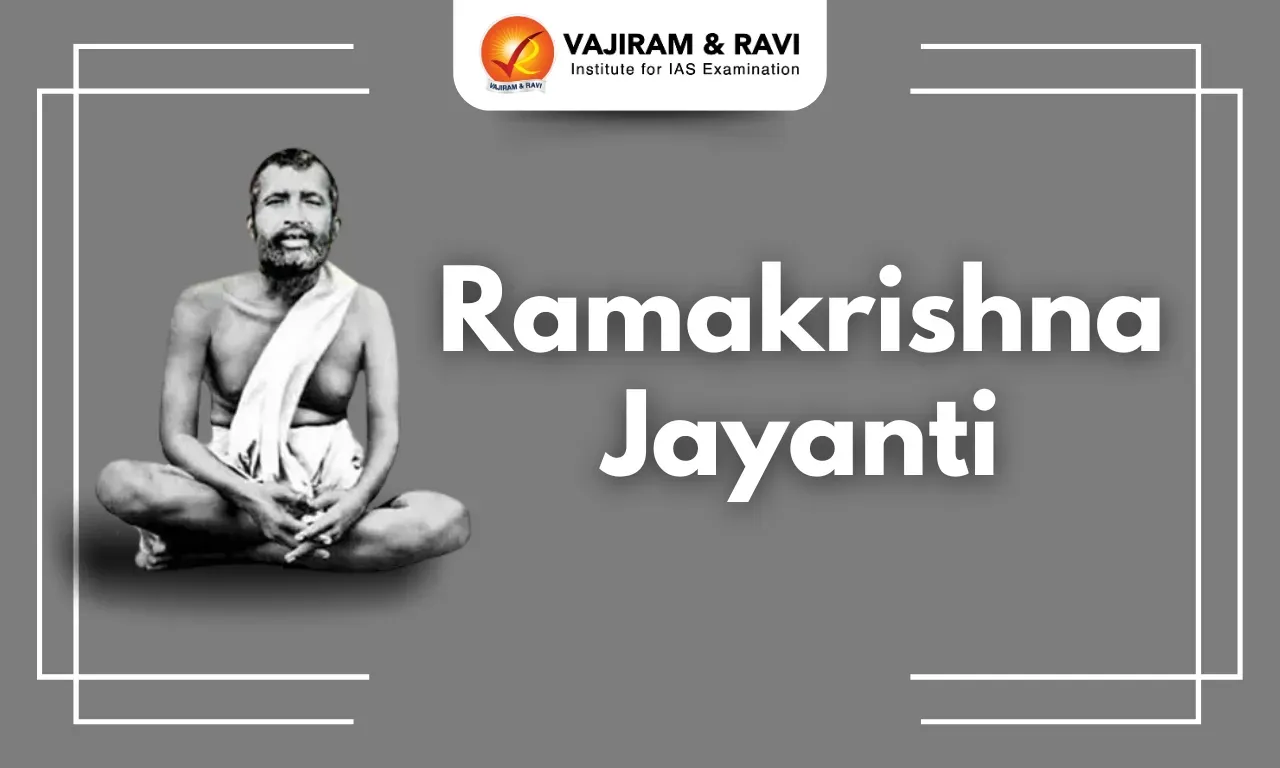
Ramakrishna Paramhansa Jayanti 2025, Date, Teachings

Ramakrishna Paramhansa Jayanti 2025

Sri Ramakrishna Paramhansa, born on 18 February 1836, was named Gadadhar Chattopadhyay who later became the greatest spiritual leader in India. He advocated the importance of self-realisation, love and devotion. According to the Hindu lunar calendar, Sri Ramakrishna Paramhansa’s birth anniversary is celebrated on Dwitiya Tithi in the Shukla Paksha of Phalguna month. 18 February 2025 marks his 189th anniversary. 

Ramakrishna Paramhansa Jayanti 2025

Sri Ramakrishna Paramhansa, was born in Kamarpukur, West Bengal on 18 February 1836. 18th February 2025 marks his 189th birth anniversary and as per the hindu lunar calendar, his birthday falls on Dwitya Tithi of Shukla Paksha in Phalguna Month. 

Sri Ramakrishna Paramhansa Overview

Sri Ramakrishna Paramhansa was one of the greatest spiritual leaders of India. A devotee of Maa Kali, he spent his life seeking spiritual enlightenment. Sri Ramakrishna believed that serving humanity was equal to worshipping God and the goal of human life is to surrender to God. 

Ramakrishna was born into a humble family and had limited formal education. However, from an early age, he displayed deep spirituality, dedicating much of his time to prayer and meditation. Driven by a strong desire for direct divine experience, he explored various spiritual paths, including Hinduism, Islam, and Christianity. Under the guidance of the tantric guru Bhairavi Brahmani, he attained spiritual enlightenment.

He later became a spiritual teacher, inspiring many, including the renowned Indian philosopher Swami Vivekananda. Ramakrishna established the Ramakrishna Mission, which remains active today, and contributed significantly to spiritual literature through his writings and poetry.

Sri Ramakrishna Paramhansa’s Teaching Significance

The teachings of Sri Ramakrishna Paramhansa aimed on love, devotion and self-realisation. For him religion was an instrument that led the way to ultimate truth and taught people to respect and learn about different religious traditions. The Ramakrishna Mission inspired by his name, provided guidance and humanitarian services all over the world. His disciplines included names like Swami Vivekananda. He was also responsible for reviving Hinduism in Bengal. 

Sri Ramakrishna Paramahamsa Teachings

Ramakrishna Paramhansa emphasized spiritual experience over mere bookish knowledge. His core teachings include:

  • All Paths Lead to One Truth: He believed all religions are different routes to the same divine realization.
  • Devotion and Love for God: Sincere love and devotion are essential for spiritual growth.
  • Self-Realization as the Ultimate Goal: Attaining God-consciousness is the highest purpose of life.
  • Inner Purity Over Rituals: True purity lies in being free from greed and lust, not just in external practices.
  • Serving Humanity is Serving God: Since God resides in every being, helping others is a form of worship. 

Sri Ramakrishna Paramhansa Jayanti FAQs

Q1: Why do we celebrate Ramakrishna Jayanti?

Ans: To honor the birth and teachings of Sri Ramakrishna, who emphasized spiritual harmony and devotion.

Q2: When was Sri Ramakrishna born?

Ans: He was born on 18 February 1836.

Q3: What is the age of Ramakrishna in 2024?

Ans: In 2025, Sri Ramakrishna would have been 189 years old.

Q4: What is the date of birth of Ramakrishna Mission?

Ans: The Ramakrishna Mission was founded on 1 May 1897.

Q5: Who launched Ramakrishna Mission?

Ans: Swami Vivekananda established the Ramakrishna Mission in 1897.

Impact of Military Standoffs on Aviation: India-Pakistan Airspace Closures, Losses, and Legal Framework

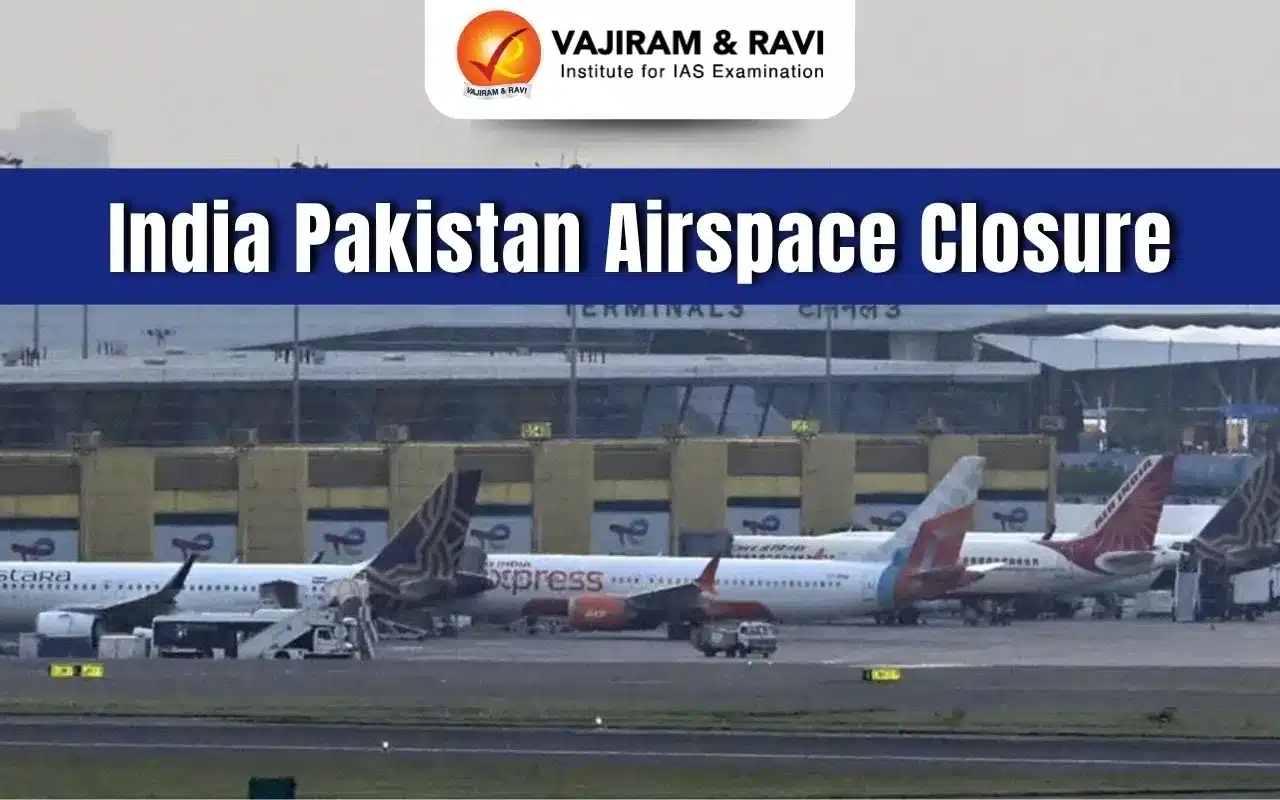
India Pakistan Airspace Closure

India Pakistan Airspace Closure Latest News

  • Following the April 22 Pahalgam terror attack, India suspended the Indus Waters Treaty as part of its measures against Pakistan. 
  • In retaliation, Pakistan issued a NOTAM (notice to airmen) closing its airspace to Indian aircraft from April 24 to May 23, affecting several northern, southern, and Arabian Sea routes. India responded with a similar airspace restriction starting April 30, also lasting till May 23.

NOTAM (Notice to Airmen)

  • NOTAM is an official alert issued to pilots and airlines about temporary changes or hazards in flight operations—such as airspace closures, route changes, or construction—that may affect flight safety or planning.
  • NOTAMs are issued by the civil aviation authority of a country. In India, it is issued by the Airports Authority of India (AAI)
  • These notices are then distributed through international aviation networks to inform pilots and airlines globally.

Timeline of India-Pakistan Airspace Closures

  • 1950s: India opposed Pakistan’s prohibited zone near the border as discriminatory. Resolved diplomatically, setting the precedent that such restrictions need valid security reasons.
  • 1965 War: Post-war, both sides resumed overflights from March 1, 1966. Pakistan sought a direct route to Dhaka, having faced detours via Ceylon.
  • 1971 Hijacking: After an Indian Airlines flight was hijacked to Lahore and destroyed, India banned civil and military overflights. The issue led to legal battles at ICAO and the World Court, and was resolved in 1976.
  • Later Incidents: Airspace closures recurred during major conflicts—Kargil (1999), Parliament attack (2001), and Balakot strikes (2019)—highlighting airspace as a strategic tool.

Estimated Losses from Airspace Closures

  • 2002: Post-Parliament Attack Losses
    • India’s Civil Aviation Ministry estimated annual losses due to airspace closure as follows:
      • Air India: ₹40 crore
      • Indian Airlines: ₹3.4 crore
      • Airports Authority of India: ₹5 crore (from landing, parking, and overflight charges)
    • Pakistan’s losses were estimated to be five times higher, according to India’s Civil Aviation Minister.
  • 2019: After Balakot Strikes
    • Indian carriers suffered a collective loss of ₹548.93 crore (as per a Rajya Sabha reply).
    • Pakistan incurred a loss of around $50 million.
    • According to IATA, at least 220 international flights used Pakistan’s airspace for Asia-Europe connectivity before the ban.
  • 2025: Projected Impact
    • Estimated consolidated loss for the Indian aviation sector (including cargo): ₹7,000 crore (indicative).
    • Based on 2019 data, Pakistan lost approximately: $2,32,000 per day in overflight charges; $3,00,000 per day including landing, parking, and navigation fees.

Airspace Changes in 2025: Key Developments and Impacts

  • Temporary Closures and Route Restrictions
    • 32 airports in northern and western India were temporarily closed.
    • 25 Air Traffic Service (ATS) route segments within the Delhi and Mumbai Flight Information Regions (FIRs) were made unavailable from ground level to unlimited altitude for safety reasons.
      • ATS route segments are like invisible highways in the sky that aircraft follow for safe and efficient travel.
      • FIRs are large blocks of airspace managed by a country's air traffic control—Delhi FIR and Mumbai FIR are two of India's busiest.
      • When these 25 segments were marked “unavailable from ground level to unlimited altitude,” it meant:
        • No aircraft (civilian or military) could use those air routes.
        • This restriction applied to all altitudes, not just low-flying or high-flying aircraft.
    • Air traffic was rerouted and managed by ATC units in Mumbai, Ahmedabad, Nagpur, Kolkata, and Chennai.
  • Waypoint Congestion and Rerouting
    • India and Pakistan normally use about 12 shared points in the sky (called waypoints) to manage air traffic between their airspaces. 
    • But due to restrictions, flights had to be rerouted through only six waypoints, which are shared between India (Mumbai region) and Muscat (Oman’s airspace).
    • To handle the extra traffic safely, air traffic controllers used standard rules to keep planes properly spaced apart—above, beside, and when crossing paths—to avoid any risk of collision.
  • Limited Alternatives and Operational Challenges
    • Rerouting via China was not viable due to the rigid structure of Chinese airspace and mountainous terrain, which pose operational and safety challenges.
    • Suboptimal routes increased flight time and operational costs.

Role of International Aviation Law Depends on Political Will

  • Although international aviation law offers channels for resolving disputes, their success relies heavily on the political will of the countries involved and a clear grasp of the specific details of the India-Pakistan standoff.

India Pakistan Airspace Closure FAQs

Q1. What is a NOTAM?

Ans. A NOTAM is a notice issued to alert pilots about temporary airspace restrictions or hazards affecting flight safety.

Q2. Why did India and Pakistan close airspace in 2025?

Ans. Closures followed rising tensions and Operation Sindoor, with 32 airports and 25 ATS routes restricted for safety.

Q3. How much did India lose during airspace closures?

Ans. In 2025, India’s aviation sector faced an estimated ₹7,000 crore loss, including cargo operations and rerouted flights.

Q4. Can international aviation law resolve airspace conflicts?

Ans. Yes, but its effectiveness depends on political will and understanding of the specific bilateral context and disputes.

Q5. Why were reroutes through China avoided?

Ans. Chinese airspace is highly restricted and mountainous, making rerouting risky and operationally inefficient for international flights.

Source: TH

PM Modi Honours Ahilyabai Holkar: Legacy, Women’s Empowerment & Operation Sindoor Highlights

Ahilyabai Holkar 300th Anniversary

Ahilyabai Holkar 300th Anniversary Latest News

  • On the 300th birth anniversary of Lokmata Devi Ahilyabai Holkar, Prime Minister Narendra Modi addressed the Mahila Sashaktikaran Mahasammelan in Bhopal. 
  • Honoring Ahilyabai’s legacy of public service, he highlighted her relevance in nation-building. On this occasion, PM Modi released a commemorative postage stamp and a special coin dedicated to Lokmata Devi Ahilyabai. The Rs 300 coin will feature a portrait of Ahilyabai Holkar. 
  • He also presented the National Devi Ahilyabai Award to a woman artist for contribution in tribal, folk, and traditional arts.

Ahilyabai Holkar: A Visionary Woman Ruler of Medieval India

  • Early Life and Marriage
    • Born on May 31, 1725, in Chondi village, Ahmednagar, Ahilyabai was the daughter of village head Mankoji Shinde, who ensured she received an education—a rarity for girls at the time. 
    • At the age of eight, she was noticed by Malhar Rao Holkar and later married his son, Khande Rao Holkar.
  • Rise to Power
    • After her husband's death in the Battle of Kumbher in 1754, and later the deaths of her father-in-law and son, Ahilyabai successfully petitioned the Peshwa to become ruler of Malwa in 1765, backed by her army.
  • Administrative Excellence and Peaceful Rule
    • Jawaharlal Nehru and other historians lauded her 30-year reign (1765–1795) for its stability, prosperity, and effective governance. 
    • Malwa, under her rule, remained untouched by the frequent conflicts in Central India.
  • Cultural and Religious Contributions
    • Ahilyabai transformed Maheshwar into a cultural hub, promoting literature, music, arts, and textiles—including the renowned Maheshwari saris
    • She was instrumental in rebuilding major temples, notably the Kashi Vishwanath temple in 1780, and supported infrastructure such as rest houses and public ghats at various pilgrimage sites.
  • Legacy
    • Ahilyabai Holkar is remembered as a just and enlightened ruler who defied societal norms and led with compassion, vision, and strength.

Key Highlights of PM Modi’s Address

  • This speech not only celebrated the historic contributions of Devi Ahilyabai Holkar but positioned her legacy as a foundation for India’s modern-day push toward women-led development, national pride, and inclusive growth. 
  • It tied together cultural reverence, political empowerment, economic opportunity, and national defense into a single vision of empowered womanhood—Nari Shakti—as the driving force of New India.

Ahilyabai’s Legacy and Social Reforms

  • Pioneered widow remarriage, raised the minimum age of marriage, and secured women’s property rights.
  • Formed women's safety groups and a special women’s unit in the Malwa army.
  • Advocated economic self-reliance through agriculture, handicrafts, and water conservation.

Empowerment of Women in Modern India

  • Over 4 crore houses built, largely registered in women’s names.
  • Improved access to electricity, LPG, water, sanitation, and healthcare via schemes like Ayushman Bharat.
  • Mudra Yojana and Self Help Groups (SHGs) have economically empowered crores of women.
  • Aiming to create 3 crore 'Lakhpati Didis'; already 1.5 crore have achieved that goal.

Women in Technology and Innovation

  • Highlighted initiatives like Drone Didi, where women lead agri-tech changes.
  • Recognized women’s increasing roles in STEM, including the Chandrayaan-3 mission.
  • Noted that 45% of Indian startups have at least one-woman director.

Political Representation and Leadership

  • Women now occupy top roles: India has had a full-time woman Defence Minister and Finance Minister.
  • Nari Shakti Vandan Adhiniyam passed, ensuring women’s reservation in Parliament and State Assemblies.
  • 75 women MPs currently serve in the Lok Sabha.

Operation Sindoor & National Security

  • Described Operation Sindoor as the largest and most successful counter-terrorism operation in Indian history.
  • Women from BSF and other forces played vital roles.

Breaking Barriers in Armed Forces

  • Sainik Schools now admit girls.
  • Women’s participation in NCC nearing 50% (up from 25% in 2014).
  • First batch of women cadets passed out from NDA, marking a historic shift.

Ahilyabai Holkar 300th Anniversary FAQs

Q1. Who was Ahilyabai Holkar?

Ans. A visionary 18th-century ruler known for social reform, temple restoration, and empowering the poor through just governance.

Q2. What did PM Modi announce in Bhopal?

Ans. He launched metro services, new air routes, and honored Ahilyabai’s legacy of development and social justice.

Q3. What is Operation Sindoor?

Ans. India’s largest counter-terrorism operation, showcasing the frontline role of women in BSF and defense forces.

Q4. How is women empowerment progressing in India?

Ans. Government schemes like Mudra, Ayushman Bharat, SHGs, and Nari Shakti laws are empowering women economically and politically.

Q5. What role did Ahilyabai play in reforms?

Ans. She promoted widow remarriage, women’s property rights, and tribal welfare 250 years ago—revolutionary for her time..

Source: TH | PIB | IE

Trump Doubles Steel Tariffs to 50% – Implications for Global Trade and India’s Exports

Shift Towards Trade Protectionism

Shift Towards Trade Protectionism Latest News 

  • US President Donald Trump announced a sharp hike in steel import tariffs from 25% to 50% to further secure and rejuvenate the US steel and aluminium industries. The new tariff is to be enforced from June 4th.
  • This move was termed “unfortunate” by India’s exporters, who said this will make trade talks “much more difficult and complicated”.
  • This fresh tariff hike follows a similar increase earlier this year, when Trump raised tariffs on aluminium and steel to 25%.

Key Highlights of the Announcement

  • Legal basis:
    • The US Trade Expansion Act, 1962, allows the President to impose tariffs if imports threaten national security.
    • Trump previously invoked this in 2018, imposing: 25% tariffs on steel and 10% on aluminium
  • Purpose: Announced at a steel plant rally (West Mifflin, Pennsylvania), Trump justified the move to “Make America Great Again”, boosting domestic industries.

Reactions from Indian Exporters

  • Engineering Export Promotion Council (EEPC):
    • The earlier increases already impacted around $5 billion worth of exports to the US in the iron and steel segment.
    • Fears that it will complicate Bilateral Trade Agreement (BTA) negotiations.
    • Requested tariff rate quota (TRQ) exemptions, like those granted to the UK.
  • Federation of Indian Exporters’ Organisation (FIEO):
    • Highlighted negative impact on semi-finished and finished products.
    • Risk to India’s growing engineering exports, especially: stainless steel pipes, structural steel components, automotive steel parts.

Economic Impact Analysis

  • Global price ripple effect:
    • The economic impact of these higher tariffs will be significant. 
    • US steel prices are already high, at around $984 per metric tonne — far above European prices at $690 and Chinese prices at $392.
    • Projected rise: To $1,180/tonne due to the tariff hike, potentially burdening domestic sectors like: automobile, construction, manufacturing.
  • Indian export vulnerability: India’s exports to the US (FY 2025) amounts to total $4.56 billion worth of iron, steel, and aluminium products to the US, including - 
    • Iron and steel: $587.5 million
    • Articles of iron/steel: $3.1 billion
    • Aluminium and related products: $860 million

Strategic and Diplomatic Implications

  • India filed a formal notice at the World Trade Organization (WTO).
  • Signals intention to retaliate with tariffs on US goods.
  • Response may include increased tariffs on select US exports within a month.

Iron and Steel Industry in India

Iron and Steel Industry in India

  • With the industry accounting for about 2% of the nation's GDP, India ranks as the world's second-largest producer of steel, with an output of 125.32 MT of crude steel and finished steel production of 121.29 MT in FY23.
  • India is poised to overtake China as the world's second-largest consumer of steel. The per capita consumption of steel has increased from 57.6 kgs to 74.1 kgs during the last five years.
  • The steel industry has emerged as a major focus area given the dependence of a diverse range of sectors on its output as India works to become a manufacturing powerhouse through policy initiatives like Make in India. 
  • The National Steel Policy2017 envisages 300 million tonnes of production capacity by 2030-31. 
  • Huge scope for growth is offered by -
    • India's comparatively low per capita steel consumption and 
    • The expected rise in consumption due to increased infrastructure construction and the thriving automobile and railways sectors.

Conclusion

  • Trump’s decision to double tariffs on steel imports marks a significant shift towards trade protectionism, with far-reaching consequences for global trade dynamics and India’s export strategy. 
  • As negotiations on trade agreements continue, India must navigate the dual challenge of protecting its exporters while preserving its strategic bilateral ties with the United States.

Shift Towards Trade Protectionism FAQs

Q1. Under which legal provision did the United States impose tariffs on steel and aluminium citing national security concerns?

Ans. The tariffs were imposed under Section 232 of the US Trade Expansion Act, 1962.

Q2. How does the recent US steel tariff hike affect India-US trade relations?

Ans. The unilateral tariff hike complicates ongoing bilateral trade negotiations and threatens India’s export competitiveness in the US market.

Q3. What could be the economic impact of the US steel tariff hike on Indian exporters?

Ans. It may reduce the price competitiveness of Indian steel and aluminium products, adversely affecting exports worth over $4.5 billion.

Q4. How has India responded to the US’s unilateral steel tariffs at the international level?

Ans. India has issued a formal notice at the World Trade Organization (WTO) signaling the possibility of retaliatory tariffs on US goods.

Q5. Which sectors in India are likely to be most affected by the US tariff hike on steel?

Ans. Sectors such as engineering goods, automotive components, and structural steel products are expected to be most impacted.

Source: TH | IE

Republic Day 2025, History, Theme, Significance, Guests

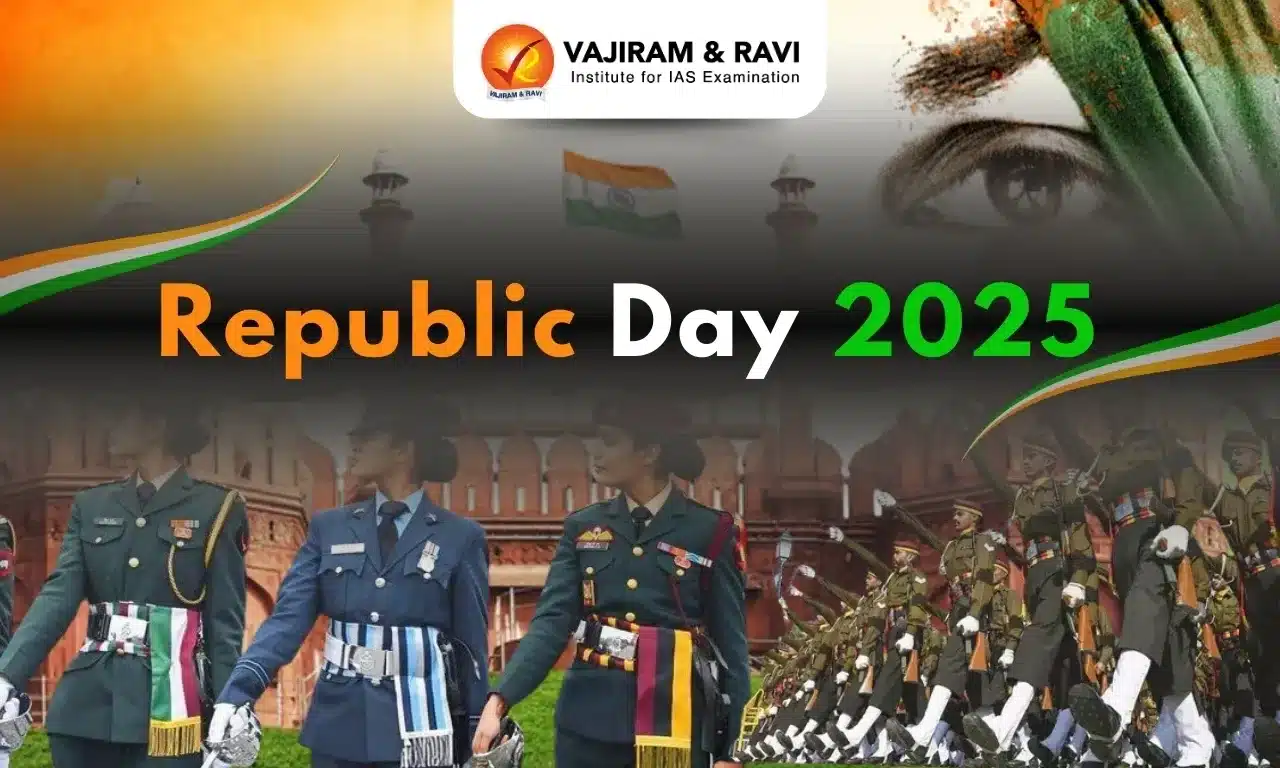
Republic Day 2025

Republic Day 2025 highlights the adoption of India’s constitution and India becoming a republic on 26 January, 1950. The day is celebrated every year by conducting military and cultural pageantry. The grand cultural parade takes place in the national capital, New Delhi along the Raisina Hill near the Rashtrapati Bhavan, along the Kartavya Path, passing the India Gate, into the Red Fort. The ceremonious parade represents the culture and unity of India and the cultural heritage of all states in India by building beautiful tableaus. The theme for tableaux at Republic Day 2025 Parade is Swarnim Bharat: Virasat or Vikas”.

Republic Day 2025 Guest of Honor

Indonesian President Prabowo Subianto will be the chief guest at India’s 2025 Republic Day parade, marking a key moment in India-Indonesia relations. This visit reflects the importance of the Act East Policy in PM Modi’s third term, with both nations aiming to enhance strategic, defense, and economic ties. Historically connected for over 2,000 years, Indonesia and India share deep cultural and commercial bonds, from Ramayana influences to modern trade and investments. Subianto’s visit highlights maritime cooperation in the Indo-Pacific and is expected to bolster bilateral trade, defense collaboration, and mutual investments, further strengthening ASEAN ties.

Republic Day 2025 Theme

The Theme for Republic Day 2025 has been announced by the Ministry of Defence. The theme for the year 2025 is “Swarnim Bharat: Virasat or Vikas”. The parade will represent the development of India in relation to its cultural heritage, and will take place on Kartavya Path. The Parade will include marches by various army troops and creative exhibitions from many states, union territories and ministries. Like every year, the tableaux will represent the cultural roots of India along with its progress. 

Republic Day 2025 Participating States 

15 states are participating in the Republic Day 2025 event. Those are: 

  • Andhra Pradesh
  • Bihar
  • Chandigarh
  • Dadra and Nagar Haveli & Daman and Diu
  • Goa
  • Gujarat
  • Haryana
  • Jharkhand
  • Karnataka
  • Madhya Pradesh
  • Punjab
  • Tripura
  • Uttarakhand
  • Uttar Pradesh
  • West Bengal 

Republic Day 2025 Participation Selection Process

The Ministry of Defence highlighted that the selection of states and ministries for the tableaux was conducted with fairness, transparency, and a focus on merit. The process included:

  • Proposal Invites: States, Union Territories, and Union ministries are invited to submit their tableau concepts.
  • Expert Evaluation: A panel of experts from art, culture, music, architecture, and choreography assess the proposals.
  • Selection Criteria: Key factors included:
    • Originality: Uniqueness of the concept.
    • Creativity: Innovative presentation.
    • Aesthetic Appeal: Balance and visual harmony.
    • Heritage and Development: Representation of India’s culture and progress.
  • Enhanced Process: Incorporating feedback from a senior-level meeting in April 2024, the selection process prioritized quality and diversity.
  • Avoiding Repetition: Proposals with overlapping themes were excluded to maintain variety and uniqueness.

Republic Day 2025 Celebrations

Republic Day is celebrated every year all over India as an honour to the constitution of India. The Parade is hosted every year on Rajpath, New Delhi and is organised by the Ministry of Defence and presided over by the President of India. The Parade represents the military prowess of the country along with the diverse culture. 

  • The day begins by paying homage to the martyrs who sacrificed their lives for the country and they are honoured by the Prime Minister by placing a wreath at the Amar Jawan Jyoti at India Gate. 
  • This is followed by 21 gun salutes, flag hoisting and the national anthem.
  • Courageous soldiers and civilians are presented with the gallantry awards like Paramvir Chakra, Ashok Chakra and the Vir Chakra. 
  • The celebration takes place all over the country, however, Delhi being the capital of India, witnesses the grandest of Republic Day celebrations. 

Republic Day 2025 FAQs

Q1: Which Republic Day is in 2025?

Ans: It is the 76th Republic Day in 2025.

Q2: Is this 76th Republic Day?

Ans: Yes, 2025 marks the 76th Republic Day of India.

Q3: Which was the Republic Day of 2026?

Ans: The 77th Republic Day is in 2026.

Q4: Is it 76th Republic Day 2025?

Ans: Yes, 2025 celebrates the 76th Republic Day.

Q5: How many years of Republic Day 2025?

Ans: It is the 76th year since India's first Republic Day in 1950.

Act East Policy India, Year, Countries, Objectives

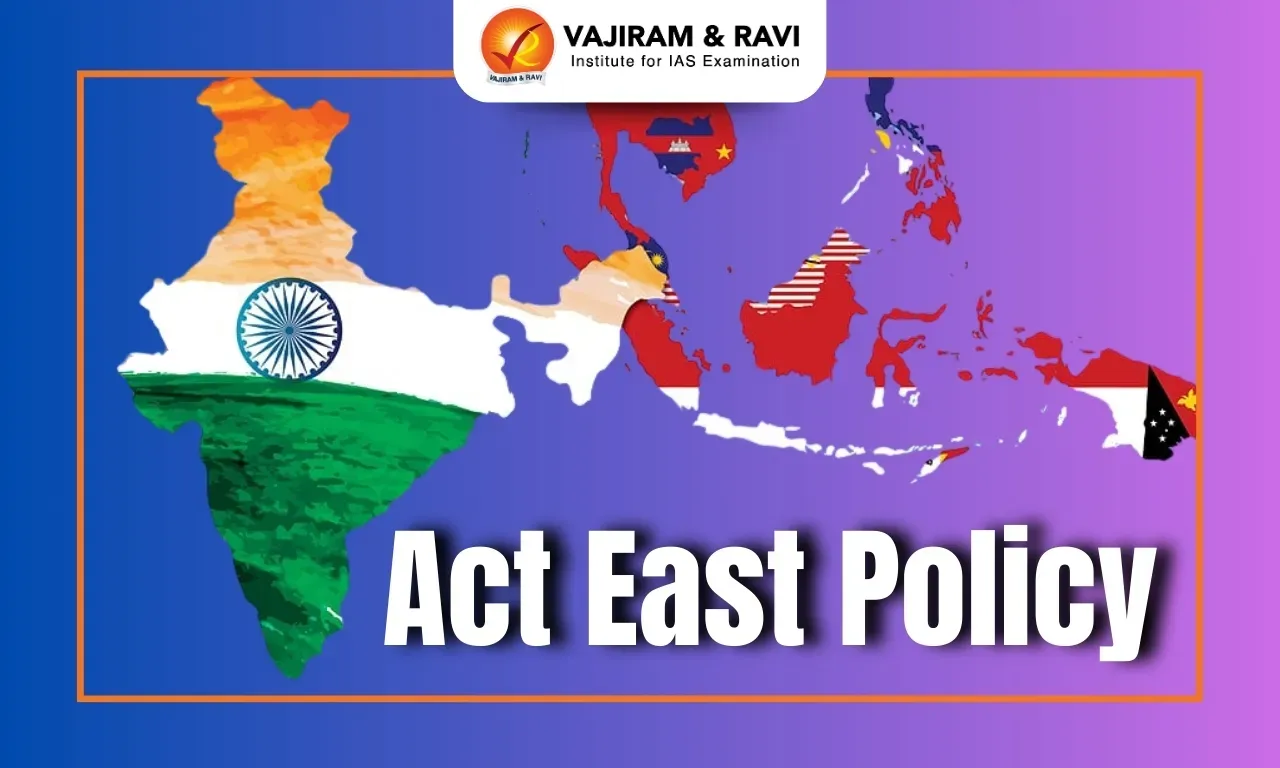
Act East Policy

Act East Policy of India focuses on strengthening economic and strategic relations with Southeast Asian countries. This policy started in 2014, improves the Indian relations in Asia-Pacific region. India’s Act East Policy promotes regional stability and development through cultural ties, economic integration and strategic partnerships. 

Act East Policy 

The Act East Policy aims at creating India’s engagement with southeast Asian Nations. Introduced by the Prime Minister Narendra Modi, the previously existing Look East Policy was upgraded to India’s Act East Policy transforming India’s approach from mere “looking” to active participation in the region’s affairs. The policy strengthens economic, cultural and strategic ties with Indo-Pacific ties with the Indo-Pacific region to promote regional cooperation. 

India’s Act East Policy Objectives

India’s Act East Policy aims to strengthen its engagement with countries in the Indo-Pacific region, with ASEAN at its core. The objectives are: 

  • Improving economic partnerships with the Indo-Pacific region by enhancing investment and trade.
  • Strengthening better people to people relations by deepening cultural understanding and exchanges. 
  • Creating sustained diplomatic engagement by building long-term strategic partnerships through regional, multilateral and bilateral levels. 
  • Boost regional cooperation and integration by improving connectivity in political, cultural, social and political spheres. 
  • Collaborates on issues like counter-terrorism, maritime security and disaster management by contributing to the overall prosperity and stability region. 

Act East Policy Pillars 

The Act East Policy has three pillars: 

  • Economic Pillar: focus on integration with global supply chains in East Asia and Southeast by boosting economic cooperation, investment and boosting trade. 
  • Socio- Cultural Pillar: Deepens social ties and mutual understanding across the region by focusing on cultural exchanges and people to people connections.
  • Political Security Pillar: Focus is on regional stability and counterbalancing external influences by strengthening security ties and defense. 

Key Features of Act East Policy

The Act East Policy fosters multi-dimensional ties across economic, strategic, cultural, and connectivity domains.

  • ASEAN-Centric Approach – Strengthens ties with ASEAN nations and associated frameworks like ARF, EAS, and ADMM+.
  • 4C’s Framework – Emphasizes Culture, Commerce, Connectivity, and Capacity Building for regional engagement.
  • Economic Integration – Boosts trade, investment, and global supply chain integration in Southeast & East Asia.
  • Strategic & Security Ties – Enhances defense partnerships with Japan, Vietnam, and the Philippines.
  • Connectivity & Infrastructure – Develops key projects like the India-Myanmar-Thailand Trilateral Highway.
  • Multilateral Engagement – Strengthens India’s role in ASEAN, BIMSTEC, and the East Asia Summit.

List of Projects Under the Act East Policy

Several key projects have been launched under the Act East Policy to enhance regional connectivity, trade, and cultural ties:

  • India-Myanmar-Thailand Trilateral Highway – Strengthening road connectivity between India and Southeast Asia.
  • Kaladan Multi-Modal Transit Transport Project – Linking India's eastern seaports with Myanmar’s Sittwe port for efficient cargo movement.
  • Agartala-Akhaura Rail Link – Boosting cross-border connectivity between India’s northeast and Bangladesh.
  • Digital Public Infrastructure (DPI) – Advancing digital collaboration through the India-ASEAN Fund for the Digital Future.
  • Mekong-India Economic Corridor – Integrating India’s east coast with Southeast Asia via strategic infrastructure.
  • ITEC Programme – Offering technical and capacity-building support to nations like Cambodia, Laos, and Vietnam.
  • International Buddhist Confederation (IBC) – Strengthening cultural and spiritual ties through shared Buddhist heritage.
  • BIMSTEC Initiatives – Advancing regional cooperation under the Bay of Bengal Initiative.

Look East Policy vs Act East Policy

The Look East Policy was introduced in 1991 with a focus on economic liberalisation and trade relations establishment with Southeast Asian Nations while on the other land Act East Policy was introduced in 2014. The differences between India’s Look East Policy and Act East Policy are: 

Aspect

Look East Policy

Act East Policy

Launch

Initiated in 1991 by PM Narasimha Rao

Launched in 2014 by PM Narendra Modi

Focus

Economic and strategic ties with Southeast Asia

Economic, strategic, and cultural ties with Southeast Asia and Indo-Pacific countries.

Geographical Scope

Mainly focused on Southeast Asia and India's eastern neighbors

Emphasizes Southeast Asia, Indo-Pacific region, and development of India’s North East.

Key Objectives

To establish stronger connections with India’s extended neighborhood.

To boost trade, business, cultural exchanges, and connectivity, particularly benefiting India’s North East.

Security Dimension

Limited focus on security

Strong emphasis on security cooperation

Infrastructure Projects

Limited infrastructure focus

Major infrastructure projects like the Asian Trilateral Highway and the Agartala-Akhaura Rail Link

Outcome and Intent

Economic ties and diplomatic engagement, though the impact was gradual.

More assertive and comprehensive approach to regional influence and development.

Act East Policy FAQs

Q1: What is the Act East Policy in India?

Ans: The Act East Policy is India’s strategic initiative to strengthen economic, cultural, and strategic ties with Southeast and East Asian countries.

Q2: What are the 3 C's of Act East Policy?

Ans: The 3 C's are Commerce, Connectivity, and Culture, which drive India's engagement with the region.

Q3: What are the 4 C's of Act East Policy?

Ans: The 4 C’s are Culture, Commerce, Connectivity, and Capacity Building, forming the core framework of the policy.

Q4: Who launched India's Look East Policy?

Ans: The Look East Policy was launched by Prime Minister P. V. Narasimha Rao in the early 1990s.

Q5: What is the difference between Look East and Act East Policy?

Ans: The Look East Policy focused on establishing diplomatic and economic ties, while the Act East Policy emphasizes deeper engagement through trade, security, and connectivity.

RBI’s New Gold Loan Regulations: Balancing Transparency and Accessibility

RBI’s Gold Loan Norms

RBI’s Gold Loan Norms Latest News

  • Recently, the Reserve Bank of India (RBI) released draft directions on loans against gold collateral.

Strengthening Oversight on Gold Loans

  • The Reserve Bank of India (RBI), on April 9, 2025, released draft guidelines aimed at regulating loans disbursed against gold as collateral. 
  • These measures are intended to harmonise practices across regulated entities such as banks and Non-Banking Financial Companies (NBFCs), in light of substantial growth in gold loan portfolios and growing concerns around irregular lending practices.
  • This regulatory push follows a significant spike in gold loan activity, especially by banks, whose gold loan portfolios more than doubled during FY 2023-24. 
  • While the product remains a vital source of short-term credit for rural and semi-urban borrowers, inconsistencies in its disbursement, valuation, and recovery mechanisms prompted RBI to propose reforms for standardisation and borrower protection.

Background and Rationale for the Reform

  • The proposed changes come amid fears of growing systemic risk and uneven lending practices. In some cases, gold loans were being extended beyond regulatory norms, particularly through top-up and bullet repayment structures. 
  • The Tamil Nadu government, highlighting the socio economic relevance of gold loans, especially in rural South India, raised concerns with the Union Finance Ministry about the potential impact of these changes.
  • In response, the Ministry of Finance clarified that the RBI would ensure small borrowers are not adversely affected and that the implementation of new rules would begin only from January 1, 2026, providing adequate lead time for stakeholders to adjust.

Key Proposals in the Draft Guidelines

  • The draft guidelines encompass several major changes intended to increase transparency and reduce borrower vulnerability:
    • LTV Norms: The maximum Loan-to-Value (LTV) ratio remains capped at 75%. However, for consumption-based bullet loans, the accrued interest is now included in LTV calculations, thereby reducing the net disbursed amount.
    • Collateral Ownership Verification: Borrowers must provide proof of ownership of the gold to prevent fraudulent pledging.
    • Standardisation of Valuation: All gold pledged must be valued at 22-carat purity, with uniform standards for purity and weight assessment.
    • Loan Renewals and Top-ups: These will be allowed only if the original loan is standard and within the LTV cap.
    • Concurrent Loans: Borrowers will not be allowed to take simultaneous loans for consumption and income-generation using the same gold collateral.
    • Timely Return of Collateral: Lenders failing to return gold within seven working days of loan repayment will be liable to compensate the borrower ₹5,000 per day.

Impact on Borrowers and Lending Institutions

  • While the reforms aim to protect consumers, especially from aggressive or opaque lending practices, they also come with trade-offs:
    • Reduced Flexibility for Borrowers: The new requirement for complete repayment (principal + interest) before renewing or topping up a loan will likely affect liquidity-strapped borrowers.
    • Lower Loan Disbursal: With stricter LTV norms (factoring interest), borrowers may need to pledge more gold to get the same loan amount or settle for smaller loans.
    • Increased Compliance Burden: Documentation, ownership verification, and standardised valuation practices will increase operational overheads, especially for small NBFCs.
    • Cost Pass-through: Higher operational costs and risk mitigation measures may result in increased interest rates or charges for borrowers.

Addressing Concerns of Market Disruption

  • The RBI's move has prompted questions about whether a uniform policy is appropriate, given the diversity of India’s financial landscape. 
  • Rural borrowers often depend on gold loans as their only source of formal credit, and a one-size-fits-all approach could disrupt credit access. 
  • Industry experts suggest that RBI could explore differentiated norms, such as micro-loan provisions for small borrowers and stricter norms for high-value loans.

Managing Volatility and Enhancing Sector Stability

  • The RBI's proposal also comes amid a sharp rise in gold prices, which has further fuelled demand for gold-backed credit. 
  • However, volatility in gold prices can also pose risks for lenders, particularly if loans are overvalued or re-pledged. 
  • By ensuring risk-managed valuation practices, preventing re-pledging, and enforcing time-bound recovery protocols, the new norms aim to foster greater discipline in the gold loan ecosystem.
  • Moreover, the regulations aim to level the playing field among lenders by setting common standards across banks and NBFCs, reducing regulatory arbitrage and enhancing consumer confidence.

Conclusion

  • The RBI’s draft norms for gold loans mark a significant step in regulating a fast-growing credit segment that caters predominantly to financially vulnerable groups. 
  • By tightening operational practices and enhancing transparency, the RBI seeks to curb risky lending behaviour without eliminating access to credit. 
  • The proposed January 2026 timeline provides sufficient scope for stakeholder consultations and fine-tuning, ensuring that gold loan reforms are implemented without disrupting the flow of credit to those who need it most.

RBI’s Gold Loan Norms FAQs

Q1. Why is the RBI revising gold loan regulations?

Ans. RBI aims to harmonise lending practices across banks and NBFCs while ensuring borrower protection amid rapid gold loan growth.

Q2. What is the revised Loan-to-Value (LTV) rule for gold loans?

Ans. The LTV ratio remains at 75%, but for bullet loans, accrued interest is now included in the LTV calculation.

Q3. How will the new rules affect borrowers?

Ans. Borrowers may face reduced loan amounts or need to pledge more gold due to stricter LTV and documentation requirements.

Q4. When will the new gold loan norms come into effect?

Ans. The RBI plans to implement the new norms starting January 1, 2026.

Q5. What happens if lenders delay returning gold after loan repayment?

Ans. Lenders will have to pay ₹5,000 per day as compensation for delays beyond seven working days.

Source: TH

14 Feb Black Day in India, Pulwama Attack

14 Feb Black Day in India

February 14, 2025, marks the 6th anniversary of the Pulwama Attack, in which 40 CRPF jawans lost their lives while on duty. The incident took place in 2019 when a suicide bomber targeted a convoy of 78 vehicles transporting over 2,500 soldiers along the Jammu-Srinagar National Highway.

The devastating attack resulted in the loss of 40 jawans and left more than 35 others injured, making it one of the deadliest terror strikes in history. This day serves as a solemn reminder of the ultimate sacrifice made by our brave soldiers.

14 February Black Day Background

  • Kashmir has long been a disputed territory, with both India and Pakistan claiming ownership. 
  • Since the late 1980s, terrorism in the region has intensified, with Pakistan's backing playing a significant role. 
  • Since 1989, around 70,000 people including terrorists, civilians, and security forces have lost their lives due to the conflict.
  • On February 14, 2019, at approximately 3:15 PM, a convoy of CRPF personnel was enroute from Jammu to Srinagar. The convoy comprised 78 vehicles carrying nearly 2,500 soldiers. Due to a two-day highway closure, a larger group of personnel was traveling together. 
  • As the convoy reached the Avantipora area of Pulwama, a suicide bomber rammed a vehicle laden with an improvised explosive device (IED) into one of the CRPF buses. 
  • The massive explosion claimed the lives of 40 soldiers on the spot. The attacker, Adil Ahmad Dar, a local resident of Pulwama, was also killed in the blast.
  • Jaish-e-Mohammed (JeM), a Pakistan-based terrorist organization, took responsibility for the attack and released a video featuring Adil Ahmad Dar, in which he confessed to planning the suicide bombing. 
  • India accused Pakistan of being complicit in the attack, while Pakistan condemned the incident and denied any involvement. 
  • However, JeM's chief, Masood Azhar, was known to operate from Pakistan. This attack led to heightened tensions between the two nations, ultimately triggering the India-Pakistan military confrontation of 2019

14 Feb Black Day Conspiracy

The attack was planned and executed by Pakistan-based terrorist organizations which was was associated with Jaish-e-Mohammed (JeM) and the suicide bomber was Adil Ahmad Dar, who had already been monitored by security agencies. However, he was radicalized and trained by the group before carrying out the attack. Investigations focused on how such a large cache of explosives was acquired and how the attack was executed.

Prior to the incident, Indian intelligence agencies had issued at least 11 alerts about a potential terrorist strike. Just two days before the attack, Jaish-e-Mohammed had released a video showcasing a suicide bombing in Afghanistan, warning of a similar attack in Kashmir.

Black Day 14 February Investigation

Following the attack, the National Investigation Agency (NIA) assembled a 12-member team to conduct a thorough investigation. Initial findings indicated that approximately 300 kilograms of explosives, including 80 kilograms of RDX, were used in the blast. The NIA later confirmed that Adil Ahmad Dar was the suicide bomber responsible for the attack.

In August 2020, the NIA filed a charge sheet against 19 accused terrorists. By August 2021, security forces had neutralized seven key conspirators, while seven others were apprehended.

14 Feb Black Day Consequences

  • In response to the attack, India revoked Pakistan’s Most Favored Nation (MFN) trade status and imposed a 200% import duty on Pakistani goods.
  • The Financial Action Task Force (FATF) continued to keep Pakistan on its "grey list," issuing strict warnings over its links to terrorist organizations.
  • Widespread protests, candlelight marches, and anti-Pakistan demonstrations took place across the country, reflecting the nation's collective outrage.
  • The Indian film and television industry imposed a ban on Pakistani artists, restricting their participation in projects within India.

Pulwama Attack India’s Response

The attack led to nationwide outrage, with the Indian government promising a positive response. On February 26, 2019, the Indian Air Force (IAF) launched the Balakot Airstrike, striking Jaish-e-Mohammed’s training camps in Pakistan’s Khyber Pakhtunkhwa province.

Beyond military action, India also pursued diplomatic measures to isolate Pakistan on the global stage. Efforts were made to ensure Pakistan remained on the FATF "grey list," while India sought international backing for its counter-terrorism initiatives.

Balakot Airstrike

On February 26, 2019, Indian Air Force Mirage-2000 fighter jets crossed the Line of Control (LoC) and targeted a terrorist training camp in Balakot, Pakistan. India asserted that the airstrike neutralized 300–350 terrorists, while Pakistan denied any casualties.

14 Feb Black Day in India FAQs

Q1: Why is February 14 a black day?

Ans: On February 14, 2019, the country suffered one of the most fatal attacks in its events - the Pulwama Terror Attack.

Q2: What happened on 14th Feb in India?

Ans: Pulwama attack of February 14, 2019, remains one of the darkest days in India's history.

Q3: Which day is today black day?

Ans: 14 February is the black day today.

Q4: Which day is known as black?

Ans: February 14, 2025, marks the sixth anniversary of the tragic Pulwama Attack, in which 40 CRPF personnel lost their lives while on duty.

Q5: What does "black day" mean in India?

Ans: KGS10 hours ago. February 14, 2019, is remembered as one of the darkest days in India's history.

Ordnance Factory Day 2025, Theme, History

Ordnance Factory Day

Ordnance Factory Day is celebrated on 18th March every year in India as a mark of establishing the first Ordnance Factory in India in 1801 in Cossipore, Kolkata. The day commemorates the efforts and contributions of the Ordnance Factories in India that strengthens the defense capabilities in India. The factories manufacture a wide range of defense equipment, tanks, small arms and play an important role in success of India’s defense operations. 

Ordnance Factories Day Overview 

The Ordnance Factory Day is celebrated across India by celebrating events and activities. The celebrations include showcasing latest technologies and innovations, part of the defense manufacturing also parade, cultural programs and exhibitions. 

On this day, people honor the brave soldiers who sacrificed their lives to safeguard the nation. The Ordnance Factories in India have been providing the important equipment and ammunition to the armed forces, ensuring the sovereignty and security of the country. The Ordnance Factory Day is considered to be a proud moment of India, celebrating the contribution and legacy of the defense manufacturing industry and the dedication and sacrifice of the armed forces. In the article, we are going to cover about the ordnance factories in India, their history, celebrations and significance.

Ordnance Factories Day History 

Celebrated on 18th March every year, Ordnance Factories Day celebrates the establishment of the first Ordnance Factory in the country. The Ordnance Factory Board established in 1979, manages the defense production in India. In 1775, the Gunpowder Factory was set up in Ishapore near Kolkata by the British East Company that catered to the needs of the British Indian Army. This year marked the beginning of indigenous production of arms and ammunition in India. 

After 1775, many Ordnance Factories were set up in India to support the growth of the defense equipment industry. In 1842, the Field Gun Factory was set up in Kanpur, Uttar Pradesh and in 1904, the Small Arms Factory was established in Ishapore. During World War II, the Ordnance Factories played an important role in meeting the demands of allied forces and after 1947, the Ordnance Factories played an important role in the country's defense production. 

List of Ordnance Factories in India 

This is a list of Ordnance Factories in India: 

Name of the Factory

PSU

Location

State

Ammunition Factory Khadki (AFK)

Munitions India Limited

Pune

Maharashtra

Engine Factory Avadi (EFA)

Armoured Vehicles Nigam Limited

Chennai

Tamil Nadu

Cordite Factory Aruvankadu (CFA)

Munitions India Limited

Aruvankadu

Tamil Nadu

Field Gun Factory, Kanpur (FGK)

Advanced Weapons and Equipment India Limited

Kanpur

Uttar Pradesh

Gun Carriage Factory Jabalpur (GCF)

Advanced Weapons and Equipment India Limited

Jabalpur

Madhya Pradesh

Grey Iron Foundry (GIF)

Yantra India Limited

Jabalpur

Madhya Pradesh

Gun and Shell Factory (GSF)

Advanced Weapons and Equipment India Limited

Kolkata

West Bengal

Heavy Alloy Penetrator Project (HAPP)

Munitions India Limited

Tiruchirappalli

Tamil Nadu

High Explosives Factory (HEF)

Munitions India Limited

Pune

Maharashtra

Heavy Vehicles Factory, Chennai (HVF)

Armoured Vehicles Nigam Limited

Chennai

Tamil Nadu

Machine Tool Prototype Factory Ambernath (MPF)

Armoured Vehicles Nigam Limited

Mumbai

Maharashtra

Metal and Steel Factory (MSF)

Yantra India Limited

Kolkata

West Bengal

Ordnance Clothing Factory Avadi (OCFAV)

Troop Comforts Limited

Chennai

Tamil Nadu

Ordnance Factory Chandigarh (OCFC)

India Optel Limited

Chandigarh

Chandigarh

Ordnance Clothing Factory (OCFS)

Troop Comforts Limited

Shahjahanpur

Uttar Pradesh

Ordnance Equipment Factory Kanpur (OEFC)

Troop Comforts Limited

Kanpur

Uttar Pradesh

Ordnance Equipment Factory Hazratpur (OEFHZ)

Troop Comforts Limited

Hazratpur

Uttar Pradesh

Ordnance Factory Ambernath (OFA)

Yantra India Limited

Mumbai

Maharashtra

Ordnance Factory Ambajhari (OFAJ)

Yantra India Limited

Nagpur

Maharashtra

Ordnance Factory Bhandara (OFBA)

Munitions India Limited

Bhandara

Maharashtra

Ordnance Factory Bhusawal (OFBH)

Yantra India Limited

Bhusawal

Maharashtra

Ordnance Factory Bolangir (OFBOL)

Munitions India Limited

Bolangir

Odisha

Ordnance Factory Kanpur (OFC)

Advanced Weapons and Equipment India Limited

Kanpur

Uttar Pradesh

Ordnance Factory Chandrapur (OFCH)

Munitions India Limited

Chandrapur

Maharashtra

Ordnance Factory Dumdum (OFDC)

Yantra India Limited

Kolkata

West Bengal

Ordnance Factory Dehu Road (OFDR)

Munitions India Limited

Pune

Maharashtra

Ordnance Factory Dehradun (OFDUN)

India Optel Limited

Dehradun

Uttarakhand

Ordnance Factory Itarsi (OFI)

Munitions India Limited

Itarsi

Madhya Pradesh

Ordnance Factory Khamaria (OFK)

Munitions India Limited

Jabalpur

Madhya Pradesh

Ordnance Factory Katni (OFKAT)

Yantra India Limited

Katni

Madhya Pradesh

Ordnance Factory Muradnagar (OFM)

Yantra India Limited

Muradnagar

Uttar Pradesh

Ordnance Factory Project (OFN)

Munitions India Limited

Nalanda

Bihar

Ordnance Factory Project Korwa (OFPKR)

Advanced Weapons and Equipment India Limited

Korwa

Uttar Pradesh

Ordnance Factory Project Medak (OFPM)

Armoured Vehicles Nigam Limited

Hyderabad

Telangana

Ordnance Factory Tiruchirappalli (OFT)

Advanced Weapons and Equipment India Limited

Tiruchirappalli

Tamil Nadu

Ordnance Factory Varangaon (OFV)

Munitions India Limited

Varangaon

Maharashtra

Opto Electronics Factory (OLF)

India Optel Limited

Dehradun

Uttarakhand

Ordnance Parachute Factory (OPF)

Gliders India Limited

Kanpur

Uttar Pradesh

Rifle Factory Ishapore (RFI)

Advanced Weapons and Equipment India Limited

Kolkata

West Bengal

Small Arms Factory (SAF)

Advanced Weapons and Equipment India Limited

Kanpur

Uttar Pradesh

Vehicle Factory Jabalpur (VFJ)

Armoured Vehicles Nigam Limited

Jabalpur

Madhya Pradesh

Ordnance Factories Day Significance

Ordnance Factories Day in India hold the following significance: 

  1. Recognition of Defense Contribution – Ordnance Factories Day honors the crucial role of India’s Ordnance Factories in defense production, ensuring self-reliance in military equipment.
  2. Production of Defense Equipment – These factories manufacture a wide range of defense assets, including small arms, ammunition, tanks, artillery, and missile systems.
  3. Strengthening National Security – Ordnance Factories are vital to India's defense infrastructure, equipping the armed forces with advanced weaponry to safeguard national borders.
  4. Economic Impact – They provide employment opportunities to thousands and contribute significantly to India's economic growth through indigenous defense production.
  5. Tribute to Workforce & Armed Forces – The day recognizes the dedication of factory employees and the sacrifices of soldiers who use this equipment to protect the nation's sovereignty.
  6. Celebration of Innovation & Excellence – It highlights the spirit of technological advancement and commitment that drives India's defense manufacturing sector.
  7. Ensuring a Secure Future – Ordnance Factories play a crucial role in strengthening India's defense capabilities and ensuring the safety of its citizens.

Ordnance Factories Day Celebration

Ordnance Factories Day in India is celebrated with enthusiasm by the Ordnance Factories in India and shows the contributions and achievements of the Ordnance Factories of Indian Defence and Economies. 

  • The Ordnance Factories conduct seminars, exhibitions, workshops and cultural events to commemorate the legacy and achievements of Ordnance Factories. 
  • The Ordnance Factories invite people to witness first-hand the new technologies and innovations of Ordnance Factories and their contributions towards nations defence preparedness. 
  • Experts are invited to share insights, experience and best practices that could help improve the efficiency and quality of the Ordnance Factories. 
  • Cultural events are organised to provide a platform to the employees to showcase their talent and creativity.

Ordnance Factories Day 2025 FAQs

Q1: Why is Ordnance Factories Day celebrated?

Ans: Ordnance Factories Day is celebrated to recognize the contribution of India’s Ordnance Factories in defense production and national security.

Q2: What is the theme of Ordnance Factory Day 2025?

Ans: The theme for Ordnance Factory Day 2025 has not been officially announced yet.

Q3: When was the Ordnance Factory established in India?

Ans: The first Ordnance Factory in India was established in Cossipore, Kolkata, in 1801.

Q4: What is the meaning of Ordnance Day?

Ans: Ordnance Day signifies the celebration of India's defense manufacturing capabilities and the contributions of Ordnance Factories.

Q5: What is an ordnance factory?

Ans: An Ordnance Factory is a government-run facility that manufactures arms, ammunition, and defense equipment for the Indian Armed Forces.

PM VIKAS Scheme, Full Form, Objective, Components, Features

PM VIKAS Scheme

The PM VIKAS Scheme launched under the Ministry of Minority Affairs is a central sector scheme that provides skill development, leadership training and entrepreneurship to minorities and artisan communities all over India. The scheme is divided into four components and is expected to benefit around 9 lakh candidates during the 15th Finance Commission Cycle (2025-26).

PM VIKAS Scheme Overview

The PM VIKAS Scheme stands for Pradhan Mantri Virasaat Ka Samvardhan. The initiative was introduced by the government with an aim to provide skill training, entrepreneurship and leadership training to artisan communities around India. This scheme also highlights the preservation of traditional arts and crafts while supporting the growth and development of minor communities. 

The PM VIKAS Scheme also consolidates five already existing schemes: 

  1. Seekho aur Kamao
  2. USTTAD (Upgrading the Skills and Training in Traditional Arts/Crafts for Development)
  3. Hamari Dharohar
  4. Nai Roshni
  5. Nai Manzil 

The merging of the scheme provides financial support to minorities and artisans while also integrating Skill India Mission and also working with other ministries like Women and Child Development, Panchayati Raj, Tourism and Education for the overall development in minority concentrated areas. 

PM VIKAS Scheme Objectives

The key objectives of the PM VIKAS Scheme are:

  1. Skill Development: Delivering targeted skill training in demand-driven courses to enhance employability and livelihood opportunities for minority and artisan communities.
  2. Educational Support: Providing formal education and certification for school dropouts up to 8th, 10th, and 12th grades through open schooling, thereby improving literacy rates within these communities.
  3. Leadership and Entrepreneurship: Empowering women from minority and artisan backgrounds by training 2 lakh women, including the development of 10,000 business mentors (‘Biz Sakhis’).
  4. Cultural Preservation: Safeguarding and promoting traditional arts, crafts, literature, documents, and manuscripts to ensure their relevance in modern markets.
  5. Infrastructure Development: Establishing sustainable model art and craft villages that blend arts with tourism and commerce, fostering livelihoods, employment, and entrepreneurial opportunities.

PM VIKAS Scheme Components

The PM VIKAS Scheme has four components:

Component 1: Skilling and Training 

  1. Traditional Training sub-component (previously known as USTTAD and Hamari Dharohar).
  2. Non-traditional Skilling sub-component (previously known as Seekho aur Kamao). 

Component 2: Leadership and Entrepreneurship (previously Nai Roshni).

Component 3: Education (previously Nai Manzil).

Component 4: Infrastructure Development (through Hub and Spoke Villages).

PM VIKAS Scheme Features

PM VIKAS Scheme has the following features:

The scheme aims to ensure inclusive growth for not only the minority and artisan communities but also for the youth and women. 

  • Focus is on both traditional and non-traditional skill training based on market demands. 
  • The National Minorities Development & Finance Corporation(NMDFC) has been given the responsibility of providing finance to the communities. 
  • School dropouts are given formal education as well as certification.
  • The Export Promotion Council for Handicrafts provides market linkages in order to provide livelihood opportunities for beneficiaries. 
  • The ‘Hub and Spoke’ model is used to establish Vishwakarma Villages to support the artisans and their crafts. 
  • The PM VIKAS Scheme lays down the foundation of sustainable development and cultural preservation while addressing the socio-economic needs of minority and artisan communities.

PM VIKAS Scheme FAQs

Q1: What is PM Vikas scheme?

Ans: PM Vikas Scheme focuses on skill development, education, and cultural preservation for minority and artisan communities.

Q2: What is PM Vishwakarma Scheme UPSC?

Ans: PM Vishwakarma Scheme supports traditional artisans and craftspeople through financial aid, skill training, and market linkages.

Q3: What is the old name of PM Vikas scheme?

Ans: The old name of PM Vikas Scheme is the USTTAD Scheme.

Q4: What is the PM Virasat scheme?

Ans: PM Virasat Scheme aims to preserve and promote India’s traditional arts, crafts, and cultural heritage.

Q5: What is the full form of Vikas?

Ans: Vikas stands for "Virasat Ka Samvardhan," meaning "Preservation of Heritage."

Kawal Tiger Reserve

Kawal Tiger Reserve

Kawal Tiger Reserve Latest News

Recently,the Telangana State government issued orders declaring the tiger corridor area connecting the Kawal Tiger Reserve with the Tadoba-Andhari Tiger Reserve in Maharashtra as ‘Kumram Bheem Conservation Reserve’.

About Kawal Tiger Reserve

  • Location: It is located in the Telangana State along the banks of river Godavari, forming part of the Deccan peninsula-central highlands.
  • The reserve is nestled in the Sahyadri Mountain Ranges.
  • Geographically the reserve is situated in the southern-most tip of the Central Indian Tiger Landscape, having linkages with the Tadoba-Andhari (Maharashtra) and Indravati (Chhattisgarh) 1 tiger reserves.
  • Vegetation: Southern Tropical Dry Deciduous Forest.

Flora and Fauna of Kawal Tiger Reserve

  • Flora: It consists of teak along with Bamboo and other species like Anogeissus latifolia, Mitragyna parviflora, Terminalia crenulata, Terminalia arjuna, Boswellia serrata, etc.
  • Fauna: The major wild animals include: nilgai, chousinga, chinkara, black buck, sambar, spotted deer, wild dog, wolf, jackal, fox, tiger, leopard, and the jungle cat.

Provision to Declare Conservation Reserve

  • As per the Section 36(A) of the Wildlife Protection Act, 1972 Act, the State government may declare any areas owned by it, particularly in areas adjacent to the national parks and sanctuaries and those areas which link one protected area with another, as conservation reserve for protecting landscapes, seascapes, flora and fauna and their habitat.

Kawal Tiger Reserve FAQs

Q1. What is the difference between core zone and buffer zone in tiger reserve?

Ans: The core zone of a tiger reserve is a strictly protected area, while the buffer zone is an area where human activities are permitted to a limited extent.

Q2. Which state is Kawal Tiger Reserve in?

Ans: Telangana

Source: TH

One Nation One Ration Card Scheme

Default Image

One Nation One Ration Card Scheme was first implemented by the state of Gujarat. An initiative of the Central Government, One Nation One Ration Card Scheme is a technology driven scheme that aims nationwide portability of ration card under the National Food Security Act, 2013. The scheme is extremely beneficial especially for migrants and the people covered under the NFSA. The beneficiaries can opt for buying their ration from any Fair Price Shop at subsidized rate all over India by using their ration cards through biometric authentication. Beneficiaries fingerprints and irises will be used as a record for verification purposes and all the family members living back home can also utilize the scheme for getting subsidized food grains using the same ration card. To support the initiative further, the central government also launched the “MERA RATION” mobile app. 

One Nation One Ration Card Scheme Objectives

One Nation One Ration Card Scheme has the following Objectives: 

  • This scheme is a beneficiary centric interstate ration card portability scheme. 
  • The scheme will empower cardholders with food security all over the country. 
  • Beneficiaries will be eligible to claim full or partial share of food grains at subsidized prices using their ration number or aadhaar card. 

One Nation One Ration Card Scheme Features 

Following are the features of One Nation One Ration Card Scheme are: 

The One Nation, One Ration Card (ONORC) initiative is now active across 35 states and Union Territories, benefiting approximately 77 crore individuals, which accounts for about 96.8% of the total National Food Security Act (NFSA) population.Key Features are:

  • Nationwide Access: Beneficiaries can avail themselves of their entitled food grains under the Targeted Public Distribution System (TPDS) from any Fair Price Shop (FPS) across the country.
  • Technological Backbone: The Integrated Management of Public Distribution System (IM-PDS) portal serves as the digital platform enabling interstate ration card portability.
  • ePoS Devices: An IT-driven system, supported by the installation of electronic Point of Sale (ePoS) devices in FPS outlets, ensures seamless operations.
  • Pre-System Limitation: Previously, ration cardholders could only access subsidized food grains from a specific FPS assigned to their area.

This initiative enhances accessibility and convenience for beneficiaries, particularly for migrant workers. 

One Nation One Ration Card Importance

The One Nation One Ration Card (ONORC) initiative holds immense significance:

  • Interstate Portability: Ensures beneficiaries can access subsidized food grains from any Fair Price Shop (FPS) across the country, enhancing transparency in food grain allocation.
  • Right to Food: Upholds the National Food Security Act, 2013, allowing ration cardholders to claim their entitlements without needing a new ration card when relocating to another state.
  • Seamless Accessibility: Portability enables beneficiaries to partially or fully avail of their entitlements from the FPS of their choice, breaking geographical barriers and ensuring food security for all.
  • Social Inclusion: Reduces discrimination against women and marginalized groups in accessing the Public Distribution System (PDS).
  • Global Hunger Target: Contributes to India’s efforts to eradicate hunger by 2030, despite its 107th rank in the 2022 Global Hunger Index.
  • Leakage Prevention: Linked with Aadhaar and biometric authentication, the scheme eliminates duplicate entries, reducing corruption and leakages in the system.
  • Support for Migrants: Especially beneficial for migrant workers, who form 37% of the population, by allowing uninterrupted access to food grains regardless of location.

Previously, ration cardholders were restricted to designated FPS within their state. ONORC removes these restrictions, ensuring equitable food distribution and enhanced efficiency in the Public Distribution System.

One Nation One Ration Card FAQs

Q1: Who launched the One Nation One Ration Card?

Ans: The One Nation One Ration Card scheme was launched by the Government of India in 2019.

Q2: What is the difference between PR and AAY ration cards?

Ans: PR (Priority) ration cards are issued to low-income families based on state-specific criteria, while AAY (Antyodaya Anna Yojana) ration cards are for the poorest households providing highly subsidized food grains.

Q3: Which Indian state became the first to implement the One Nation One Ration Card scheme to provide ration benefits across state borders?

Ans: Gujarat was the first state to implement the One Nation One Ration Card scheme.

Q4: What is the One Nation One Ration Card scheme?

Ans: It is a scheme that allows beneficiaries to access subsidized food grains from any Fair Price Shop in India, irrespective of their home state.

Q5: What are the three types of ration cards?

Ans: The three types of ration cards are AAY (Antyodaya Anna Yojana), PR (Priority), and BPL (Below Poverty Line) cards.

Thrombectomy

Thrombectomy

Thrombectomy Latest News

The Technology Development Board (TDB), under the Centre’s Department of Science and Technology (DST), recently announced financial support for the development of India’s first indigenous thrombectomy device for stroke care.

About Thrombectomy

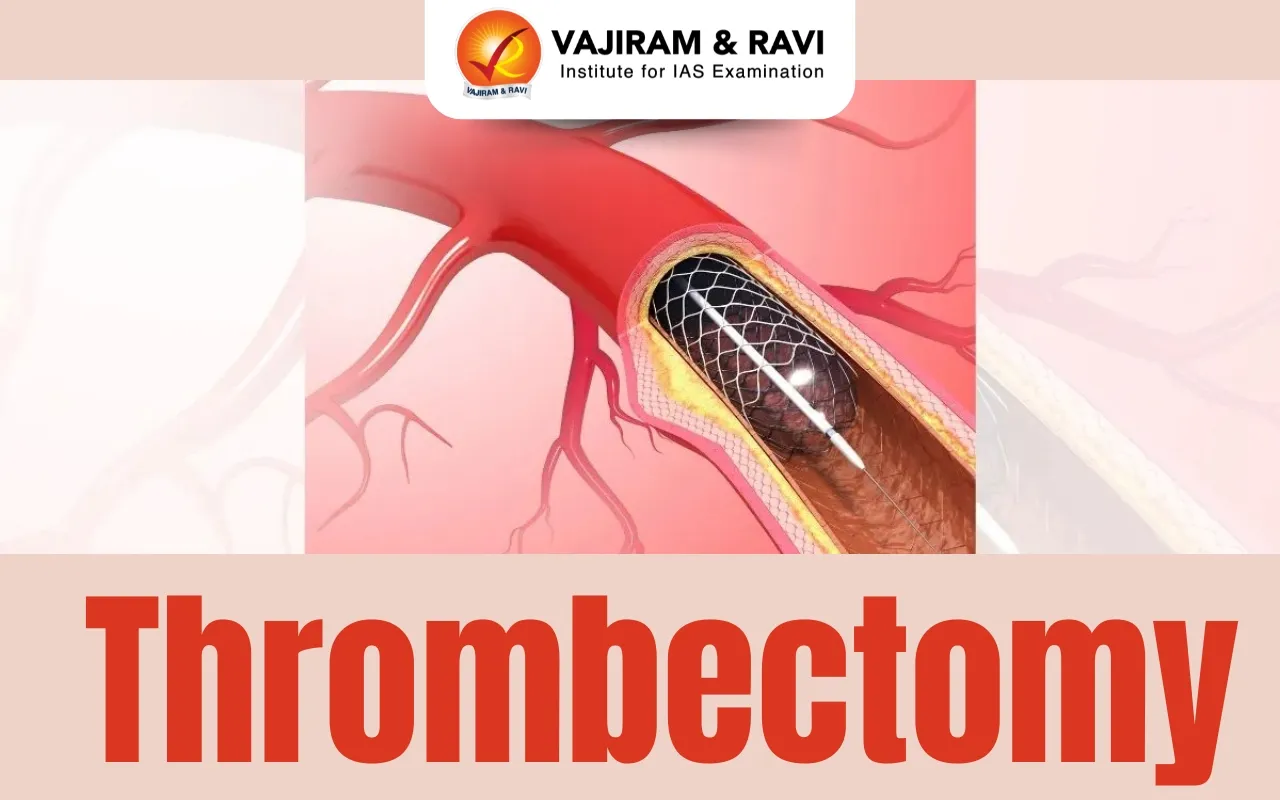
  • A thrombectomy is a surgical or interventional treatment to remove blood clots in an artery or vein to help restore blood flow through your blood vessel.
  • blood clot, also known as a thrombus, can obstruct blood flow, leading to tissue damage or even death. 
  • Some of the most common places for blood clots to occur are your legs, arms, intestines, brain, lungs, and heart.
  • Thrombectomies are performed to restore blood flow and prevent serious consequences.   
  • Sometimes a thrombectomy must be performed within a matter of hours to prevent life- or limb-threatening complications from occurring.
  • There are two large categories of thrombectomies:
    • Surgical (open) Thrombectomy: 
      • During a surgical thrombectomy, your surgeon makes an incision to get to your blocked blood vessel, cuts open your blood vessel, removes the blood clot using a balloon, and then repairs the blood vessel.
    • Percutaneous (minimally invasive) Thrombectomy:
      • During a mechanical thrombectomy, your surgeon introduces special devices through catheters that can either macerate or suction out clots from within your blood vessel. 
      • When there’s a residual clot left, your surgeon will infuse the area with local clot-dissolving medicines.

Thrombectomy FAQs

Q1. What is the main goal of a thrombectomy?

Ans. To remove blood clots and restore blood flow.

Q2. What is the main difference between surgical and percutaneous thrombectomy?

Ans. The use of open surgery vs. catheters.

Q3. During a surgical thrombectomy, how is the clot typically removed?

Ans. By cutting open the vessel and extracting it using a balloon.

SourceBS

New Aadhaar App with Face ID Launched, Features, Benefits

New Aadhaar App

The New Aadhaar App has been launched by Union Minister Ashwini Vaishnaw with an intention of making UPI Payments simpler. The new Aadhaar App provides the users with a platform to share their necessary data and provide complete control on personal information. This app was created in collaboration with Unique Identification Authority of India to allow faster verification using QR Code. In this article, we are going to learn about the New Aadhaar App, its features and benefits. 

New Aadhaar App Overview

The new Aadhaar App allows people to drop the use of physical cards or photocopies and instead store their valuable information in the app in digitized format. Users can now confirm their identification at hotels or other such places without carrying hard copies and instead just scanning the QR Codes. 

New Aadhaar App Features

The newly launched Aadhaar App by the government has the following features: 

  • Users have full control over their data and can choose to share only necessary information.
  • Aadhaar verification is now as simple and quick as making a UPI payment.
  • The app supports Face ID-based authentication for instant and secure verification.
  • A new QR code feature allows users to verify their identity by simply scanning a code at authentication points.
  • Aadhaar details are securely shared directly from the user’s phone, eliminating the need for physical photocopies. 

New Aadhaar App Benefits

The New Aadhaar App has the following benefits for users: 

  • Enhanced Data Privacy: Users can share only selected data, ensuring better control and privacy of personal information.
  • Faster Verification Process: Aadhaar authentication becomes instant and seamless, similar to a UPI transaction.
  • Secure Identity Sharing: Information is shared directly from the user’s phone, reducing risks linked to photocopies or physical documents.
  • Wider Accessibility: With QR codes available at authentication points, Aadhaar verification can be done anywhere, anytime.
  • User-Friendly Experience: Simple face scan verification makes the process easy even for non-tech-savvy users.

New Aadhaar App FAQs

Q1: What is the new Aadhaar app?

Ans: The new Aadhaar app features facial recognition and QR code verification for secure, paperless authentication.

Q2: Can a new Aadhaar be applied for online?

Ans: No, applying for a new Aadhaar requires visiting an Aadhaar Seva Kendra with valid documents.

Q3: How to install the AadhaarFaceRD app?

Ans: Download the Aadhaar app from the official Google Play Store or Apple App Store.

Q4: How to check Aadhaar card update status?

Ans: Visit the UIDAI website and use the 'Check Aadhaar Update Status' feature.

Q5: How to update Aadhaar card details?

Ans: Update address and documents online via the UIDAI portal; for other details, visit an Aadhaar Seva Kendra.

IndiaAI Mission

Default Image

IndiaAI Mission Latest News

Recently, the selection of three new startups for building India's own Foundation Model, the IndiaAI Mission has taken a significant leap toward strengthening indigenous AI capabilities.

About IndiaAI Mission

  • It was initially launched as a joint initiative between the Ministry of Electronics and Information Technology and Nasscom in 2023. 
  • This initiative aims to bolster India’s AI ecosystem by making high-end computing resources accessible to startups and researchers.
  • The mission's key goals are
    • "Making AI in India" – Encouraging domestic AI development.
    • "Making AI Work for India" – Ensuring AI benefits various sectors in the country.
  • Implementing agency: IndiaAI, an independent business division under the Ministry of Electronics and Information Technology (MeitY), serves as the implementing agency for the IndiaAI Mission.
  • It will help to democratize the benefits of AI, strengthen India’s position as a global AI leader, and promote ethical and responsible AI use across sectors.
  • Pillars of the IndiaAI Mission
    • Common Compute Facility
    • AI Kosha (IndiaAI Datasets Platform)
    • AI Safety Institute of India (Upcoming)
    • IndiaAI Innovation Centre
    • AI Application Development Initiative
    • Future Skills Initiative
    • Startup Financing

IndiaAI Mission FAQs

Q1: Who is the father of AI?

Ans: John McCarthy

Q2: What is the full form of FLOPS?

Ans: Floating-point operations per second (FLOPS) is a measure of a computer's performance.

Q3: What is the GPU?

Ans: Graphics processing unit, a specialized processor originally designed to accelerate graphics rendering.

Source: PIB

Vitamin B9 (Folate)

Vitamin B9 (Folate)

Vitamin B9 (Folate) Latest News

According to a recent study by the All-India Institute of Medical Sciences (AIIMS), nearly 41 per cent of urban adolescents in government schools across north India suffer from folate or vitamin B9 deficiency, which might be affecting their growth and development.

About Vitamin B9 (Folate)

  • Folate is the natural form of vitamin B9, water-soluble and naturally found in many foods. 
  • It is needed for red blood cell formation and for healthy cell growth and function, crucial for children in their developmental years.
  • It is needed by cells to carry oxygen throughout the body.
  • Foods containing Vitamin B9: Green leafy vegetables (like spinach and fenugreek), legumes (lentils, chickpeas), citrus fruits, nuts, whole grains and fortified cereals.

Role of Vitamin B9 in Children

  • Vitamin B9 is essential for supporting rapid growth phases in children.
  • Folate is involved in the synthesis and repair of DNA and RNA, which are the building blocks of genetic material. 
  • It aids in the production of red blood cells and development of the central nervous system during early childhood.
  • In growing children, folate ensures proper brain function and emotional health.
  • It is also crucial for tissue growth and cellular repair, processes that are continuous during childhood.
  • If there isn’t enough folate, it can lead to anaemia, when the body lacks enough red blood cells.

Vitamin B9 (Folate) FAQs

Q1: What is folate 9 used for?

Ans: Folate 9 is used for the prevention and treatment of deficiency of vitamin B6, B9, and B12.

Q2: What causes folate deficiency?

Ans: Folate deficiency caused by a lack of dietary folate is more common in people who have a generally unbalanced and unhealthy diet.

Source: IE

New Income Tax Bill 2025, Objectives, Features, Need

New Income Tax Bill 2025

The New Income Tax Bill has been introduced by the Finance Minister Nirmala Sitharaman in her Budget 2025 speech on 1 February, 2025 with the goal of streamlining tax compliance, reduction in disputes and improving clarity in taxation process. The New Income Tax Bill was approved by the Union Cabinet on 7 February 2025 and will be now tabled in front of the Lok Sabha and sent to the standing committee of finance. The new bill follows the approach of “Trust First, Scrutinise Later” with the aim of building taxpayer confidence and ensuring that the tax rules are followed by the citizens of the country.

New Income Tax Bill 2025

The New Income Tax Bill 2025 aims to simplify and modernise the Indian Income tax system through proposed legislation. The bill focuses on important reforms that would enhance tax compliance, reduce litigation and give better clarity in tax laws. At the end of the day, the goal is to optimize and simplify the tax process for authorities as well as tax taxpayers. This would help in creating a better and efficient tax system. 

New Income Tax Bill 2025 Objectives

The New Income Tax Bill 2025 has been designed to make tax compliance simpler and more user-friendly. Here’s how:

  • Simpler Legal Language: The bill replaces complex jargon with clear, straightforward language, making it easier for taxpayers to understand and comply without needing legal expertise.
  • Shorter, More Efficient Laws: The new legislation will be about half the length of the current tax laws, removing redundant sections and reducing legal disputes. This will streamline processing for both taxpayers and officials.
  • No New Taxes: This reform isn’t about adding more taxes—it’s about simplifying existing laws. By cutting down on complexity, taxpayers can navigate the system with ease and minimal bureaucratic hurdles.
  • Budget Announcements Included: Key tax updates from the national budget, like income tax rate changes and TDS revisions, will be seamlessly integrated, ensuring clarity and smoother implementation.

This reform is all about making taxation simpler, more transparent, and easier to follow for everyone.

New Income Tax Bill 2025 Features

The key features of New Income Tax Bill 2025 include: 

Feature

Description

Simplified Tax Law

Reduces word count by almost 50%, making tax laws clearer and more accessible.

Alignment with Global Tax Norms

Enhances India's ease of doing business by meeting international taxation standards.

Trust-Based System

Minimizes manual scrutiny and increases self-assessment reliability.

Tax Base Expansion

Expand the tax net by incorporating the informal sector while increasing exemptions for lower-income groups.

Efficient Litigation Management

Introduces clearer provisions to minimize disputes and ensure statutory certainty.

Rationalized TDS/TCS

Simplifies tax deducted at source (TDS) and tax collected at source (TCS) provisions to reduce compliance burdens.

Higher Exemption Limits

Raises the income tax exemption limit from Rs 7 lakh to Rs 12 lakh, benefiting lower-income taxpayers.

New Income Tax Bill Need

The New Income Tax Bill 2025 was needed to simplify the Income Tax Act 1961, which had more than 298 sections. The new bill removes the old unwanted sections. The requirement of the New Income Tax bill 2025 includes: 

  • 293 sections and 23 chapters was a lot of content and it was difficult to manage and navigate. 
  • The provisions did not have clearly mentioned guidelines making them difficult for taxpayers and authorities to manage. 
  • The current system was reducing the revenue efficiency, leaving the informal sector untapped.
  • A lot of old provisions have lost relevance in present times. 

Comparison Between the Old and New Income Tax Bills 

Aspect

Old Income Tax Bill

New Income Tax Bill

Tax Slabs

Complex structure with multiple slabs and higher tax rates

Simplified structure with fewer tax slabs and lower rates

Exemptions & Deductions

Numerous exemptions (HRA, 80C, etc.) and deductions available

Reduced exemptions and deductions; fewer options for tax saving

Rebate on Income

Limited rebates based on specific conditions (e.g., 87A)

Broader rebate under section 87A for incomes up to ₹7 lakh, making it tax-free for lower-income individuals

Tax Filing Process

Complex filing process, multiple forms required

Simplified filing with fewer forms and a more streamlined process

Corporate Tax Rates

Higher corporate tax rates

Reduced corporate tax rates to make India more competitive globally

Focus on Technology

Relatively less reliance on digital infrastructure

Strong emphasis on digital filing, processing, and technology integration

Taxpayer Benefits

Greater scope for reducing taxable income through exemptions

Lower tax rates but fewer options to reduce taxable income, simplifying the system for general taxpayers

The New Income Tax Bill 2025 showcases a reform in India’s tax system and replaces the Income Tax Act 1961. The new changes create a simpler more efficient taxation regime benefitting all individuals, businesses and the economy eventually driving economic growth. 

New Income Tax Bill FAQs

Q1: When was the Income Tax Act introduced?

Ans: The Income Tax Act was introduced in 1961 and came into effect on 1st April 1962.

Q2: When was the new income tax slab introduced?

Ans: The latest income tax slab revision was introduced in Union Budget 2025.

Q3: Who introduced income tax in 1858?

Ans: James Wilson, the first Finance Member of the British Indian government, introduced income tax in 1860, not 1858.

Q4: Who is the father of income tax?

Ans: James Wilson is considered the father of income tax in India.

Q5: What was the Act of 1858?

Ans: The Government of India Act 1858 transferred rule from the East India Company to the British Crown, marking the beginning of direct British rule in India.

New Income Tax Slab, Rates for FY 2025-26, AY 2026-27

New Income Tax Slab

The finance minister of India, Nirmala Sitharaman has announced the changes in the New Income Tax Slabs under new tax regime in Budget 2025. This budget contained significant initiatives across multiple sectors, aiming to promote economic growth, support agriculture, enhance infrastructure, and introduce various reforms. Keep reading the article to have a clear understanding about the New Income Tax Slab Rates.

New Income Tax Slab

The income tax is a direct tax that follows a progressive slab system, where the tax rate increases as income rises. Under the Income-tax Act, 1961, taxpayers choose between two regimes: the new regime and the old regime. 

In Budget 2025, the Finance Minister announced no income tax will be payable for income up to ₹12 lakh under the new regime, as the rebate has been increased to ₹60,000. The Direct Tax Code will be presented in Parliament next week to introduce tax reforms. The New Income Tax Slab for the new regime for FY 2025-26 (AY 2026-27) has also been announced.

New Income Tax Slab Features

The New Tax Regime 2025 includes various changes to simplify taxation and provide ease to taxpayers. The New Income Tax Slab Features Includes:

  1. The first ₹3 lakh from the annual income is completely tax-free, offering significant benefits to low-income earners. 
  2. New Income Tax Slab ensures a fair distribution of the tax burden. 
  3. The new regime simplifies tax calculations, making it easier for individuals to understand and comply with the tax system.

New Income Tax Slab Rates

The New Income Tax Slab Rates under the New Tax Regime for FY 2025–26 introduce updated brackets aimed at reducing the tax burden on middle-income earners. Below shared is the simplified revised tax slabs:

New Income Tax Slab Rates

Income Range (₹)

Tax Rate (%)

Up to ₹4,00,000

NIL

₹4,00,000 – ₹8,00,000

5

₹8,00,000 – ₹12,00,000

10

₹12,00,000 – ₹16,00,000

15

₹16,00,000 – ₹20,00,000

20

₹20,00,000- ₹24,00,000

25

Above 24,00,000

30

New Tax Regime vs Old Tax Regime

Below we have shared the comparison between tha New Tax Regime vs Old Tax Regime:

New Tax Regime vs Old Tax Regime

New Tax Regime

Old Tax Regime


Introduction

Introduced in April 2023

Traditional tax regime existing prior to the new regime

Basic Income Exemption Limit

Rs 3 lakh for all taxpayers

Varies depending on taxpayer category and deductions

Tax Rates and Slabs

More income tax slabs with lower rates

Fewer slabs with comparatively higher rates

Standard Deduction

Rs 50,000 from salary/pension income

Available, but limited to specific categories

Employer’s NPS Contribution

Up to 10% of salary (14% for government employees)

Deductions available for employer’s NPS contribution

Deductions Available

Limited to standard deduction and employer’s NPS contribution

Wide range of deductions under various sections (80C, 80D, etc.)

Flexibility vs. Simplicity

Simplified structure with fewer deductions

Offers flexibility with multiple deductions

Tax Planning Strategies

Requires careful planning due to limited deductions

Offers more options for tax planning and optimization

Long-term Financial Goals

May be suitable for individuals seeking simplicity

Beneficial for those prioritizing tax savings through deductions

Considerations

Individual income level, eligibility for deductions

Long-term financial goals, tax planning objectives

New Income Tax Slab FAQs

Q1: What is the new income tax slab for 2024-25?

Ans: Check out the new income tax slab for 2024-25 in the article above.

Q2: Is the new tax regime slab 2025-26?

Ans: No income tax will be payable on annual income of up to 12 Lakhs.

Q3: What is the new tax rebate for 2024 25?

Ans: Incomes of up to Rs 7 lakh are eligible for rebate of up to Rs 25,000 under the new tax regime.

Q4: Is 7 lakh income tax free?

Ans: The Finance Minister increased the no-tax limit from ₹7 lakh to ₹12 lakh.

Q5: How upto 12 lakh is tax-free?

Ans: No income tax will be payable on annual income of up to 12 Lakhs.

Perito Moreno Glacier

Perito Moreno Glacier

Perito Moreno Glacier Latest News

The most famous glacier, the Perito Moreno glacier, which has a surface area of 250 sq km is crumbling.

About Perito Moreno Glacier

  • It is also called the ‘White Giant’, is located near the city of El Calafate in the Argentine province of Santa Cruz.
  • It lies in the Andes Mountains in South America.
  • It comes under the Los Glaciares National Park — a UNESCO World Heritage Site.
  • It was formed during the last Ice Age, which occurred approximately 18,000 years ago. Estimates suggest that the glacier is 30 km long, and has a towering height of 60 m above the water level.
  • Due to its enormous size, it is a major source of freshwater for Argentina.
  • The Perito Moreno glacier is now part of the long list of glaciers around the globe which are disappearing faster than ever due to rising temperatures.
  • Since at least 1917, the glacier has witnessed numerous large-scale ice calving events due to its forward movement.
  • The event creates a thunderous sound as colossal blocks of ice break from the glacier and submerge into the water. The stunning visuals of calving have, over the years, attracted tourists from around the world.

Perito Moreno Glacier FAQs

Q1: Where is the Perito Moreno Glacier found?

Ans: Los Glaciares National Park

Q2: How old is the ice in the Perito Moreno Glacier?

Ans: Approximately 18,000 years ago

Q3: What is the biggest glacier in the world?

Ans: Lambert Glacier

Source: IE

Amolops shillong

Amolops shillong

Amolops shillong Latest News

Scientists recently identified a new species of frog named Amolops shillong, or the Shillong Cascade Frog, hiding in plain sight—right within the city limits of Shillong, the capital of Meghalaya.

About Amolops shillong

  • Amolops shillong, or the Shillong Cascade Frog, is a new species of frog.
  • The new species, which loves fast-flowing streams, has been quietly living in Shillong’s urban forest patches.
  • It belongs to a group of visually similar, fast-flowing stream frogs that are notoriously hard to tell apart.
  • Genetic analysis confirmed that A. shillong is part of the Amolops indoburmanensis complex, closely related to Amolops siju—another species described by the Zoological Survey of India (ZSI) in 2023 from Siju Cave in Meghalaya.
  • However, unlike its cave-dwelling cousin, A. shillong was found amidst bustling neighborhoods, just kilometers from the city center. 
  • Their presence in Shillong’s streams signals the existence of vital but overlooked microhabitats.
  • Frogs of the Amolops genus have been known from India since the 1850s, but urban discoveries are almost unheard of.
    • India now has 20 recognized Amolops species, 16 of which were discovered within the country. 
    • Nine of these, including A. shillong, were described in just the last 20 years—most from Northeast India, a known biodiversity hotspot.

Amolops shillong FAQs

Q1. What is Amolops shillong?

Ans. Amolops shillong, or the Shillong Cascade Frog, is a new species of frog.

Q2. Amolops shillong belongs to which species complex?

Ans. Amolops indoburmanensis complex

Q3. What makes the discovery of Amolops shillong particularly unique?

Ans. It was found in an urban forest patch.

SourceHUBN

Zangezur Corridor

Zangezur Corridor

Zangezur Corridor Latest News

The Zangezur Corridor has become a topic of discussion following a recent meeting between Armenia's Security Council Secretary and India's National Security Advisor in New Delhi.

About Zangezur Corridor

  • It is a proposed transport route designed to connect Azerbaijan’s mainland with its exclave, the Nakhchivan Autonomous Republic, bypassing Armenia's Syunik Province.
  • Zangezur, which is currently part of southern Armenia, has been a disputed territory since World War I.
  • On Azerbaijan’s side, the corridor would be integrated into the Horadiz-Agbend transport highway and railway network. On Turkey’s side, it would link into the Nakhchivan-Igdir-Kars railway and highway, providing a direct land route to Anatolia and beyond.
  • It carries significant economic and strategic weight for the South Caucasus and beyond.
  • The project aims to enhance Azerbaijan’s trade with Turkey and Europe by improving logistics infrastructure, reducing transportation costs, and significantly cutting travel time between Azerbaijan and Nakhchivan.
  • The Zangezur Corridor plays a crucial role in increasing regional connectivity — not only throughout Caucasia, but also across greater Eurasia, joining Turkish, Russian, Central Asian, Iranian and Armenian territories and linking Europe to Asia. 

Zangezur Corridor FAQs

Q1: Where is Zangezur located?

Ans: Zangezur is a historical and geographical region in Eastern Armenia.

Q2: What is the land corridor between Armenia and Azerbaijan?

Ans: The Lachin corridor was a mountain road in Azerbaijan that linked Armenia and Nagorno-Karabakh.

Source: DH

Neolithic Age

Neolithic Age

Neolithic Age Latest News

The Archaeological Survey of India recently discovered one of the first rock grooves in Kanniyakumari district, which was created during the neolithic age, where people used to sharpen their weapons.

About Neolithic Age

  • The Neolithic Period, also called the New Stone Age, is the final stage of cultural evolution or technological development among prehistoric humans.
  • It is characterized by the beginning of a settled human lifestyle. People learned to cultivate plants and domesticate animals for food, rather than rely solely on hunting and gathering. 
  • The Neolithic stage of development was attained during the Holocene Epoch (the last 11,700 years of Earth’s history).
  • The starting point of the Neolithic is generally thought to have occurred sometime around 10,000 BCE.
  • The Neolithic followed the Paleolithic Period, or the age of chipped-stone tools, and preceded the Bronze Age, or the early period of metal tools.
  • The Neolithic Revolution started in the Fertile Crescent, a region of the Middle East, where humans first took up farming. It then spread to India, Europe, and beyond. 

Features of the Neolithic Age

  • It was characterized by stone tools shaped by polishing or grinding, dependence on domesticated plants or animals, settlement in permanent villages, and the appearance of such crafts as pottery and weaving. 
  • The houses were built of mud and reed in rectangular or circular shapes. 
  • Alcohol was first produced during this period, and architecture, as well as its interior and exterior decoration, first appeared.
  • Status objects like elaborate pottery and carved jades were placed in tombs during the Neolithic period. This practice suggests two things: Neolithic people’s belief in the afterlife and the emergence of social classes. Only important and wealthy individuals had the privilege of being buried with these precious objects.

Effects of the Neolithic Revolution

  • The Neolithic Revolution led to masses of people establishing permanent settlements supported by farming and agriculture. 
  • It paved the way for the innovations of the ensuing Bronze Age and Iron Age, when advancements in creating tools for farming, wars, and art swept the world and brought civilizations together through trade and conquest.

End of the Neolithic Age

  • Towards the end of the Neolithic era, copper metallurgy is introduced, which marks a transition period to the Bronze Age, sometimes referred to as the Chalcolithic or Eneolithic Era.
  • In time, bronze became the primary material for tools and weapons, and a good part of the stone technology became obsolete, signalling the end of the Neolithic and thus of the Stone Age.

Neolithic Sites in India

Some of the important Neolithic sites in India include Burzahom in Kashmir, Chiron in Bihar and Uttar in Andhra Pradesh, and Edakkal caves in Kerala.

Neolithic Age FAQs

Q1. What is the Neolithic Age period?

Ans. The Neolithic Period, also called the New Stone Age, is the final stage of cultural evolution or technological development among prehistoric humans.

Q2. What is the difference between Paleolithic and Neolithic Age?

Ans. The Paleolithic Age was characterized by a nomadic, hunting-gathering lifestyle while the Neolithic Age marked a shift to settled agriculture.

Q3. The Neolithic Revolution first started in which region?

Ans. The Neolithic Revolution started in the Fertile Crescent, a region of the Middle East, where humans first took up farming. 

SourceTH

Netravati River

Netravati River

Netravati River Latest News

Continuous rainfall in Dakshina Kannada district has led to an increase in the water level of the Nethravathi River, prompting precautionary evacuations of people from low-lying areas.

About Netravati River

  • It is a major west-flowing river in Karnataka.
  • Often referred to as the lifeline of Dakshina Kannada, the river is essential for the region’s sustainability.
  • Course
    • It originates in the Bangrabalige Valley of Yelaneeru Ghat in the Kudremukha range of the Western Ghats in Karnataka. 
    • It begins its journey from an elevation of about 1,300 meters in Chikkamagaluru district, Karnataka. 
    • As it moves forward, the Netravati merges with its major tributary, the Kumaradhara River, at Uppinangadi. 
    • Netravati flows from Uppinangadi and enters the city of Mangalore, where it then joins the Arabian Sea.
  • The total length of the Netravati is 103 km from its source to the outfall. 
  • The river drains an area of 3,657 sq.km.
  • The climate of the basin is characterized by heavy rainfall, high humidity, and oppressive weather in the hot season
  • During the monsoon season, the river experiences heavy flooding.
  • It is a major source of water to the cities of Bantwal and Mangalore. 
  • The town of Bantwal was located on its banks, and thus the Netravati River was called the Bantwal River in the last century.
  • Along its course, the Netravati also flows through the popular pilgrim place called Dharmasthala.
  • Tributaries:
    • Kumaradhara River
    • Mrithyunjaya River (Charmadi Hole)
    • Kapila River (Shishila River)
    • Aniyoor River
    • Somavathi River (Laila River)
    • Kaniyoor River
    • Gundya River (Kempu Hole)

Netravati River FAQs

Q1. Is Netravati a west flowing river?

Ans. It is a major west-flowing river in Karnataka.

Q2. The Netravati River originates from which mountain range?

Ans. Western Ghats (Kudremukha Range)

Q3. Which river is Kumaradhara a tributary of?

Ans. It is a major tributary of the Netravati River.

SourceDH

Enquire Now