Heeng

Heeng

Heeng Latest News

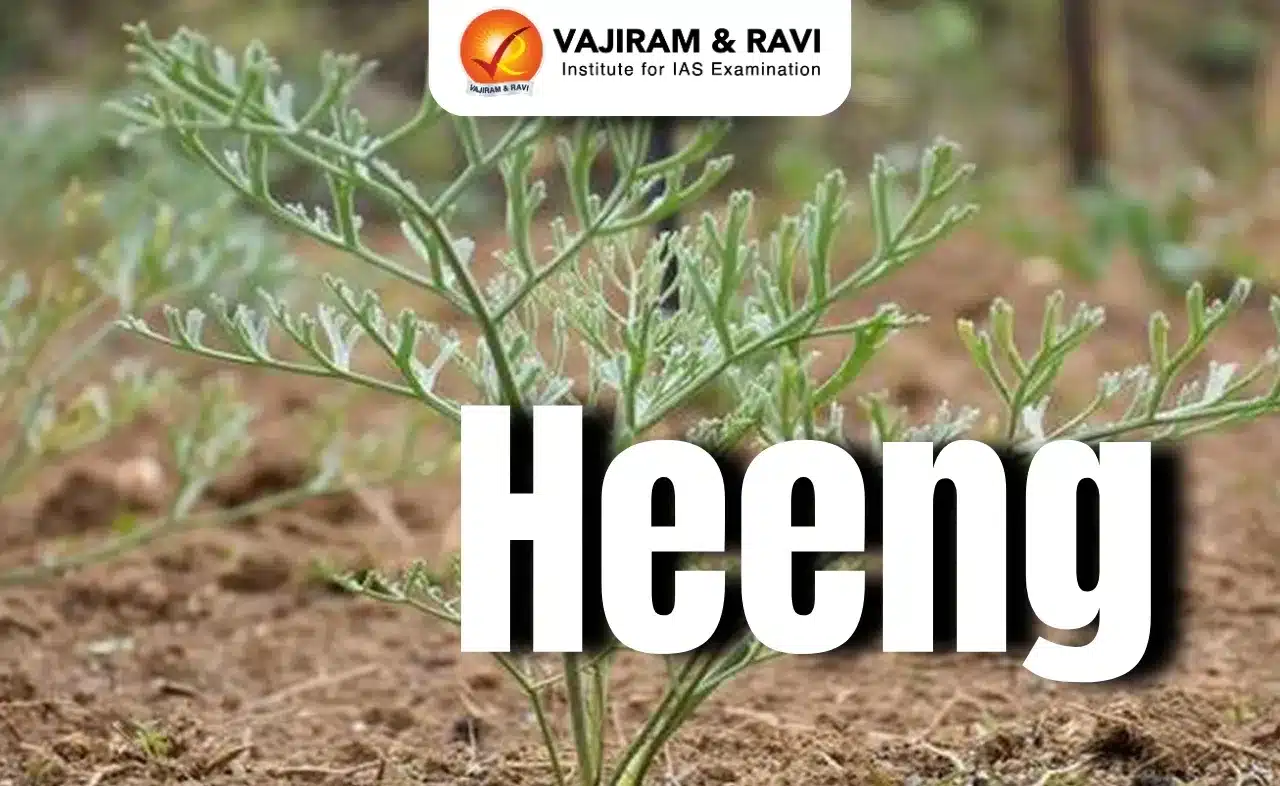
Recently, the first flowering and seed set of Heeng or asafoetida (Ferula assa-foetida) heengat Palampur was reported on by CSIR, showing heeng can indeed be successfully cultivated in India.

About Heeng

  • It is a perennial plant that typically takes five years to mature and start flowering.
  • It thrives in cold, arid environments suited to the native regions in Iran, Afghanistan, and Central Asia.

Required Climatic conditions for Heeng

  • Soil: The plant prefers sandy, well-drained soil with low moisture.
  • Rainfall: Ideally requires annual rainfall of 200 mm or less, though it can tolerate up to 300 mm in cultivated regions like the Indian Himalaya.
  • Temperature: It flourishes in temperatures of 10-20° C, tolerates highs of up to 40° C, and withstands winter lows down to –4° C.
  • In extremely dry and cold weather, heeng plants typically become dormant to survive.

Extraction of Heeng

  • The final product obtained from the plant, asafoetida, is derived from an oleo-gum resin extracted from the plant’s thick, fleshy taproot and rhizome, which makes up 40-64% of the dried gum.
  • Incisions are made in the taproot, allowing the milky latex to exude and harden into a gum-like substance.
  • This resin is dried and processed into powder or crystal form for culinary and medicinal use.

Heeng Cultivation in India

  • India depended on imports from Afghanistan, Iran, and Uzbekistan, among others. 
  • Although there are about 130 species of Ferula found in the world, but only Ferula assa-foetidais the economically important species used for the production of asafoetida.
  • In India, we do not have Ferula assa-foetida, but other species Ferula jaeschkeana is reported from the western Himalaya (Chamba, HP), and Ferula narthex from Kashmir and Ladakh, which are not the species that yield asafoetida.

Heeng FAQs

Q1: What are the benefits of Heeng?

Ans: Being a rich source of carbohydrates, hing promotes metabolism. It is extremely beneficial in maintaining digestive health, promoting heart health and in improving brain function

Q2: Which state is famous for Heeng in India?

Ans: Himachal Pradesh

Source: TH

Coalition for Disaster Resilient Infrastructure

Coalition for Disaster Resilient Infrastructure

Coalition for Disaster Resilient Infrastructure Latest News

Recently, the Prime Minister of India addressed the International Conference on Disaster Resilient Infrastructure (ICDRI), organised by the New Delhi-headquartered Coalition for Disaster Resilient Infrastructure (CDRI), was held on June 6 and 7 in Nice, France.

About Coalition for Disaster Resilient Infrastructure

  • It was established in 2019 under the leadership of the Government of India and with the support of the United Nations Office for Disaster Risk Reduction (UNDRR).
  • It is a multi-stakeholder global partnership of national governments, UN agencies and programmes, multilateral development banks, the private sector, and academic institutions.
  • It aims to promote the resilience of infrastructure systems to climate and disaster risks, thereby ensuring sustainable development.
  • It seeks to rapidly expand the development and retrofit of resilient infrastructure to respond to the Sustainable Development Goals imperatives of expanding universal access to basic services, enabling prosperity and decent work.

Mission of Coalition for Disaster Resilient Infrastructure

  • By 2050, to drive US$10 trillion of new and existing infrastructure investments and services to be resilient to natural hazards and climate change.
  • Improving environmental quality, livelihoods, and overall well-being for more than 3 billion people worldwide.

Governance of Coalition for Disaster Resilient Infrastructure

  • Governing Council: Includes all member countries and organisations, meets yearly.
  • Executive Committee: Oversees programmes and decisions, meets twice a year.
  • Secretariat: Led by the Director General, runs day-to-day operations.
  • Funding: It is funded by voluntary contributions from member countries and organisations.
  • Members: It consists of 46 member countries and 8 partner organizations.
  • Headquarters: New Delhi, India

Coalition for Disaster Resilient Infrastructure FAQs

Q1: What are the four pillars of disaster resilience?

Ans: Mitigation, Preparedness, Response, Recovery.

Q2: What is the primary goal of the Coalition for Disaster Resilient Infrastructure?

Ans: CDRI aims to promote the resilience of infrastructure systems to climate and disaster risks, thereby ensuring sustainable development.

Source: TH

India’s Drone Warfare Doctrine: Strategic Shifts and Emerging Capabilities

India Drone Warfare Strategy

India’s Drone Warfare Strategy Latest News

  • India’s Operation Sindoor, launched after the Pahalgam terror attack, marks a significant shift in the country’s use of drones in combat.

Introduction

  • India’s Operation Sindoor, launched in response to the Pahalgam terror attack, marks a turning point in the country’s adoption of Unmanned Aerial Vehicles (UAVs) in active combat. 
  • This represents a broader strategic shift toward using drones not just for surveillance but also for standoff offensive missions, aligning with global military innovations in modern warfare. 
  • From the battlefields of Nagorno-Karabakh to the ongoing Ukraine conflict, drones have emerged as force multipliers, redefining the nature of aerial combat and offering lessons for India’s evolving military posture.

The Global Evolution of Drone Warfare

  • The Nagorno-Karabakh conflict of 2020 showcased the use of loitering munitions or “kamikaze drones”, such as Israel’s Harop, to systematically destroy enemy air defences. 
  • Ukraine has since become a live testbed for drone warfare innovation, producing a diverse array of UAVs to achieve tactical superiority. 
  • Notably, Ukraine’s Operation Spider Web demonstrated how low-cost drones, paired with innovative strategies, can cause significant damage to high-value targets like Russia’s long-range bomber fleet. 
  • Even in Myanmar, rebel groups are now using 3D-printed drones to challenge a superior conventional force.

India’s Strategic Shift: Learning from Conflict Zones

  • In this global context, India is reforming its military doctrines to integrate drone warfare more fully. 
  • Operation Sindoor’s use of UAVs along with standoff weaponry adds a layer of ambiguity and asymmetry to India's military toolkit, particularly vis-à-vis Pakistan. 
  • However, India’s preparedness must also account for the growing drone capabilities of adversaries. 
  • China’s advanced systems, such as the Soaring Dragon, BZK-005, and Wing Loong II, combined with swarm-capable kamikaze drones like CH-901, present a complex challenge along the Line of Actual Control (LAC).
  • Pakistan, too, is enhancing its drone arsenal with Chinese and Turkish support, complicating India’s threat matrix. These developments call for a more agile and robust defence infrastructure on India's part.

Enhancing Drone Resilience and Survivability

  • Drones, while transformative, remain vulnerable to electronic warfare, radar jamming, and air defence systems. 
  • To address this, India is deploying multi-layered counter-UAV technologies, including both soft-kill (electronic jamming) and hard-kill (physical interception) solutions. 
  • These systems played a pivotal role in countering Pakistani drone incursions during recent border hostilities.
  • However, survivability in contested environments demands further innovation. Techniques such as frequency hopping, low-altitude navigation, AI-based machine vision, and fibre-optic tethering (as used in Ukraine) enhance drone resilience. 
  • Mass deployment of drones, including decoys, can also overwhelm enemy radar systems, as seen in Russia’s use of Shahed drones against Ukraine.

The Blurring Line Between Military and Commercial Drones

  • The distinction between military-grade and commercial drones is rapidly eroding. 
  • Commercial UAVs, equipped with open-source software and modular payloads, offer cost-effective and scalable options for militaries worldwide. 
  • These systems are easier to acquire, modify, and deploy, opening up a new chapter in asymmetric warfare.
  • India, like others, is exploring indigenous manufacturing and 3D-printing technologies to rapidly scale drone production. 
  • The accessibility of commercial drones, however, also increases risks of their misuse by non-state actors and terrorist outfits. Hence, internal security agencies must be equipped with counter-drone capabilities alongside the military.

Operational and Industrial Implications for India

  • India’s Integrated Air Command and Control System (IACCS) has demonstrated effectiveness in coordinating air defence responses. 
  • However, the need for “magazine depth”, a sufficient stockpile of munitions like MR-SAMs, Akash, and loitering munitions, remains critical in the event of prolonged conflict.
  • A significant takeaway from Ukraine is the value of a robust, responsive defence industrial base. 
  • For India to sustain its drone ambitions, the Ministry of Defence (MoD) must streamline procurement processes, address demand uncertainties, and incentivise domestic manufacturers to scale up. 
  • Without structural reform in defence procurement, India risks falling short of operational needs in a fast-paced modern conflict.

India’s Drone Warfare Strategy FAQs

Q1. What marked India’s recent shift toward using drones in combat?

Ans. India’s Operation Sindoor showcased the strategic deployment of drones alongside standoff weapons in active military operations.

Q2. How are India’s adversaries advancing their drone capabilities?

Ans. China and Pakistan are expanding their drone fleets, with China investing in long-range and swarm drones and Pakistan sourcing from China and Türkiye.

Q3. What are India’s key counter-drone strategies?

Ans. India uses a multi-layered defence system with soft- and hard-kill technologies, supported by the Integrated Air Command and Control System (IACCS).

Q4. Why is commercial drone technology significant in modern warfare?

Ans. Commercial drones offer low-cost, easily modifiable platforms, blurring lines between civilian and military use and enabling rapid scalability.

Q5. What structural reforms are needed in India’s drone ecosystem?

Ans. India must resolve defence procurement delays and invest in a scalable industrial base to mass produce drones and related weapon systems.

Source: TH

India to Add 75 GW Renewable Energy by FY27, ₹3.8 Lakh Crore Investment Planned

India Renewable Energy FY27

India Renewable Energy FY27 Latest News

  • India is projected to add 75 GW of renewable energy in FY26 and FY27—a 53% rise from the 49 GW added in FY24–25, according to Crisil Ratings. 
  • Investments are expected to grow by 52%, from ₹2.5 lakh crore to ₹3.8 lakh crore, driven by a rising share of capital-intensive hybrid projects. However, Crisil warns that delays in transmission infrastructure could hinder future capacity expansion.

Renewable Energy in India

  • As of October 10, 2024, India’s total renewable energy capacity has reached 201.45 GW, marking a major milestone in its clean energy journey. 
  • This achievement highlights India's commitment to reducing fossil fuel dependence and building a sustainable energy future.

Non-Fossil Fuel Sources Powering Nearly Half of India

  • Including the 8,180 MW of nuclear capacity, India's total non-fossil fuel-based power now makes up nearly 50% of its installed electricity generation capacity, positioning the country as a global leader in clean energy.

Renewables Dominate India's Energy Mix

  • India’s total electricity generation capacity stands at 452.69 GW, with renewables contributing 46.3% of this. 
  • The renewable segment is supported by a diverse mix of sources:
    • Solar Power: 90.76 GW
    • Wind Power: 47.36 GW
    • Large Hydroelectric Power: 46.92 GW
    • Small Hydro Power: 5.07 GW
    • Biopower (biomass and biogas): 11.32 GW

India’s 2030 Renewable Energy Target

  • The Government of India has set an ambitious goal of achieving 500 GW of installed non-fossil fuel electric capacity by 2030, aiming to bolster energy security and address climate change.

Flagship Renewable Energy Schemes

  • National Green Hydrogen Mission: Promotes production and use of green hydrogen.
  • PM-KUSUM: Supports solar power for agriculture.
  • PM Surya Ghar: Encourages rooftop solar adoption for households.
  • PLI Scheme for Solar PV Modules: Boosts domestic manufacturing of solar equipment.

Investment Facilitation

  • 100% FDI allowed under the automatic route for renewable energy.
  • Project Development Cell established to ease investment processes.

Infrastructure Development

  • Ultra Mega Renewable Energy Parks to provide land and transmission.
  • Transmission plan till 2030 in place for grid readiness.
  • Green Energy Open Access Rules 2022 to ease access for renewable power buyers.

Offshore and Wind Energy Initiatives

  • Offshore Wind Strategy: Targets 37 GW bidding by 2030.
  • Offshore Wind Lease Rules, 2023: Regulates leasing for project development.
  • National Repowering Policy 2023: Modernizes old wind turbines.

Massive Renewable Energy Expansion Planned

  • India is expected to add 75 GW of renewable energy capacity in FY26 and FY27, a 53% increase from 49 GW added in FY24–25, according to Crisil Ratings. 
  • This will raise the country’s total renewable capacity to 233 GW by March 2027.

Investment to Surge by 52%

  • Investments in the renewables sector are projected to grow from ₹2.5 lakh crore in FY24–25 to ₹3.8 lakh crore in FY26–27—a 52% jump. 
  • This surge is driven by the increasing share of capital-intensive hybrid and storage-linked projects.

Rise of Hybrid and Storage-Linked Projects

  • Around 37% of the upcoming 75 GW capacity will come from hybrid and storage-linked projects—up from 17% in FY24–25. 
  • Hybrid projects combine solar and wind to ensure more consistent power generation, while storage-linked projects use batteries or pumped hydro to store excess energy. 
  • As renewable power is intermittent—solar during the day and wind being seasonal—increasing its share can disrupt grid stability. 
  • Hybrid and storage solutions help maintain round-the-clock power supply and grid balance.

Transmission Infrastructure a Key Bottleneck

  • Transmission remains a major challenge. 
  • Though capex in this sector rose to ₹36,000 crore in FY25 (up from ₹15,000 crore in FY24), the Crisil report warns of delays due to equipment supply constraints and execution bottlenecks. 
    • FY26–27 transmission capex is projected to reach ₹0.9–1 lakh crore.

Slow Progress in Power Purchase Agreements (PPA)

  • Only 50% of PPAs for projects awarded in the last 1–2 years have been finalized, due to limited interest from state discoms. 
  • However, this is expected to improve as power demand and renewable purchase obligations grow.

Capacity Addition Planned in FY26

  • As per a recent Grid-India resource adequacy report, the country will add 45 GW in the ongoing FY26, led by: 
    • Solar: 26.5 GW
    • Wind: 6.3 GW
    • Coal: 4.4 GW
    • Battery Storage: 3.3 GW
    • Hydro: 1.6 GW
    • Pumped Storage: 1.5 GW
    • Nuclear: 1.4 GW

India Renewable Energy FY27 FAQs

Q1. How much renewable energy will India add by FY27?

Ans. India will add 75 GW of renewable capacity during FY26 and FY27, a 53% rise from previous two years.

Q2. What is driving investment growth in renewables?

Ans. The rising share of hybrid and storage-linked projects, which are more capital intensive, is pushing up investments.

Q3. What is India’s total renewable capacity as of 2024?

Ans. As of October 2024, India’s renewable energy capacity reached 201.45 GW, or 46.3% of total generation capacity.

Q4. What challenges could affect capacity addition?

Ans. Delays in expanding transmission infrastructure and limited progress in finalizing Power Purchase Agreements (PPAs) are major hurdles.

Q5. What are key renewable energy sources in India?

Ans. India's mix includes solar (90.76 GW), wind (47.36 GW), hydro (51.99 GW), and biopower (11.32 GW).

Source: IE | PIB

Sree Padmanabhaswamy Temple

Sree Padmanabhaswamy Temple

Sree Padmanabhaswamy Temple Latest News

A 'Maha Kumbhabhishekam' was recently performed at the famed Sree Padmanabhaswamy temple in Thiruvananthapuram after 270 years.

About Sree Padmanabhaswamy Temple

  • It is a Hindu temple dedicated to Lord Vishnu located in Thiruvananthapuram (Trivandrum), Kerala.
  • The name of the city of Thiruvananthapuram in Malayalam translates to “The City of Lord Ananta, ”referring to the deity of Padmanabhaswamy Temple.
  • The earliest recorded mention of the temple is from the 8th or 9th century CE, although the temple is likely older. 
  • The temple was built and rebuilt over the centuries, most recently by Martanda Varma, king of Travancore, who in 1750 donated the kingdom to the deity.
  • Architecture:
    • It is a blend of Kerala and Dravidian styles of architecture.
    • The idol of Vishnu is in the Anantha shayanam posture, the eternal yogic rest posture on his serpent Adisheshan. 
    • It has a seven-tier-high gopuram, which is decorated with delicate designs and carvings. 
    • Along with exquisite and intricate works on stone and bronze, the interior of the temple is adorned by exquisite paintings and murals, most of which are life-sized depictions of Lord Vishnu in the reclining posture, Lord Ganapati, Gaja Lakshmi, and Narasimha Swamy (half-lion, half-man incarnation of Lord Vishnu). 
    • The flag post of the temple (dhwaja stamba) is covered with gold-plated copper sheets and is about 80 ft high.
  • The temple has around 3 million palm leaf manuscripts dating back to the 14th century CE.
    • Known as Mathilakam records, they contain the administrative and financial details of the temple town and Travancore kingdom spread over six centuries.
  • In 2011 the temple was the subject of international news when an exploration of its vaults revealed a wealthof jewels, precious metals, and other treasures.
  • It is also widely believed to be the world’s richest temple.

Sree Padmanabhaswamy Temple FAQs

Q1. Sree Padmanabhaswamy Temple is located in which Indian city?

Ans. Thiruvananthapuram

Q2. The architectural style of the Padmanabhaswamy Temple is a blend of which two traditions?

Ans. Kerala and Dravidian

Q3. Which ruler is credited with renovating and donating the Travancore kingdom to Lord Padmanabha?

Ans. Marthanda Varma

SourceNDTV 

Spathaspina Noohi

Spathaspina Noohi

Spathaspina noohi Latest News

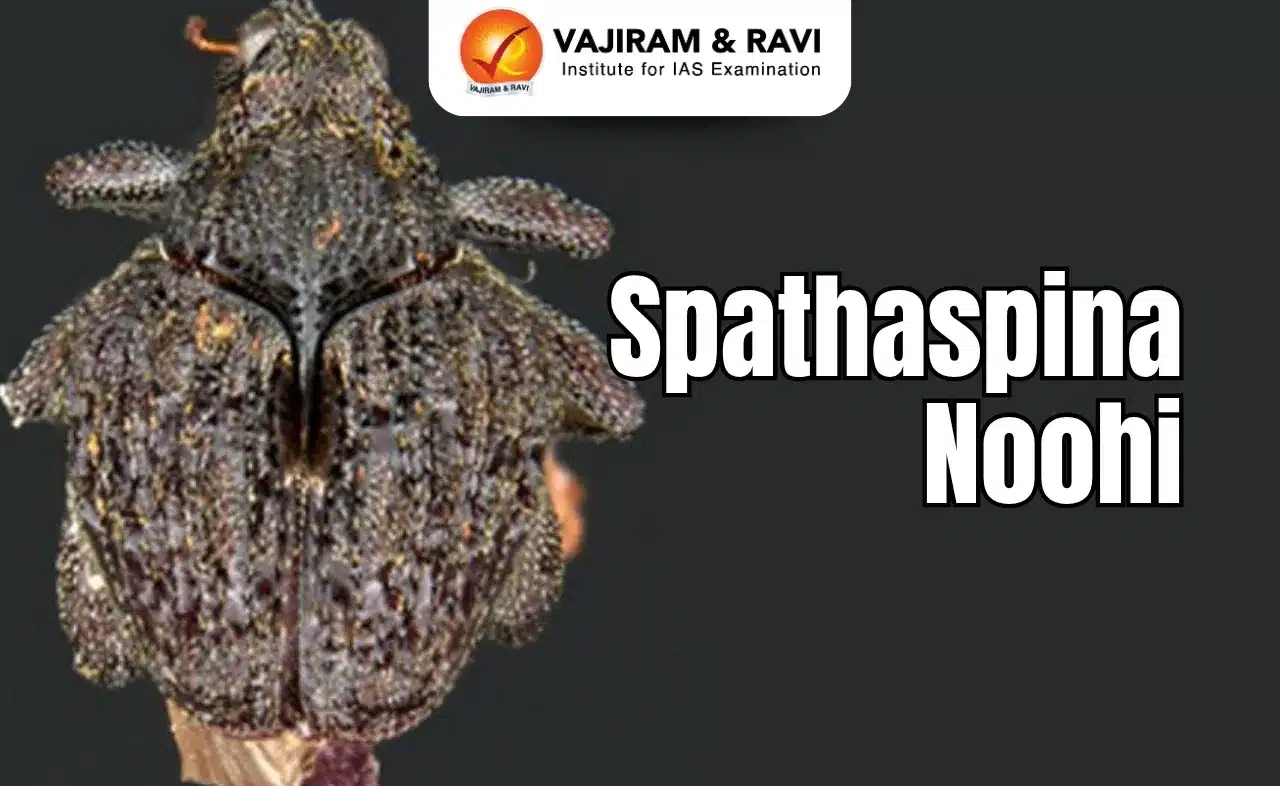
A new species of beetle, named Spathaspina noohi, was recently discovered from the biodiverse forests of Meghalaya.

About Spathaspina Noohi

  • It is a new species of beetle.
  • The beetle was found in the Umran area of Ri Bhoi district in Meghalaya at an elevation of 781 metres.
  • It belongs to the weevil family.
    • Weevils are part of the large beetle family Curculionidae, which includes over 60,000 known species globally. 
    • While many are known as agricultural pests, some, like the Spathaspina noohi, play important roles in ecosystems by helping control invasive plant species and maintaining ecological balance.
  • Spathaspina noohi features a striking sword-like spine on its back. This highly unusual anatomical feature led researchers to assign it to an entirely new genus within the subfamily Ceutorhynchinae.
  • This new genus name combines the Latin words spatha (meaning sword) and spina (meaning spine), inspired by the beetle’s prominent spine.
    • The subfamily Ceutorhynchinae includes just over 1,300 species. 
    • These beetles are found around the world, but not in New Zealand, Oceania, Antarctica and nearby islands, or southern South America (below central Argentina and Chile). 
    • The greatest variety of these beetles is seen in the Palaearctic Region (Europe, North Africa, parts of Asia), followed by the Oriental Region (South and Southeast Asia).
    • Ceutorhynchinae beetles can be identified by their sturdy body, their ability to tuck their snout (rostrum) between their front legs when at rest, and the visibility of a part of their body (mesanepimera) from the back — except in a few genera like Cyphosenus and Ceutorhynchoides.

Spathaspina Noohi FAQs

Q1. What is Spathaspina noohi, recently discovered in India?

Ans. It is a new species of beetle.

Q2. In which Indian state was Spathaspina noohi discovered?

Ans. Meghalaya

Q3. What is the ecological significance of some weevil species like Spathaspina noohi?

Ans. Help control invasive plant species.

SourceNEN

Magnetic Isolation and Concentration Cryo-Electron Microscopy

Magnetic Isolation and Concentration cryo-electron microscopy

Magnetic Isolation and Concentration Cryo-Electron Microscopy  Latest News

Researchers in the U.S. have created Magnetic Isolation and Concentration cryo-electron microscopy (MagIC) which can study samples 100x more dilute than before.

About Magnetic Isolation and Concentration Cryo-Electron Microscopy

  • It helps researchers to study samples 100 times more dilute than before.
  • It is a technique enabling direct structural analysis of targets captured on magnetic beads, thereby reducing the targets’ concentration requirement to <0.0005 mg/mL.

Working of Magnetic Isolation and Concentration Cryo-Electron Microscopy 

  • It uses magnetic beads (50-nm size beads) to hold molecules in place.
  • This greatly reduces the amount of protein needed in the initial sample.
  • A refined analysis method called Duplicated Selection To Exclude Rubbish (DuSTER) was designed in parallel to help capture the structure of smaller molecules.
  • MagIC-cryo-EM and DuSTER will allow scientists to use cryo-EM to examine the structure of proteins which are smaller, challenging to isolate or present in minute quantities inside cells.
  • Application: The knowledge gained from these findings could help us better understand a wide range of biological processes.

Key Facts about Cryo-Electron Microscopy  (Cryo-EM)

  • It is a technique that allows researchers to directly visualize proteins.
  • The approach first requires flash-freezing a sample at extremely low temperatures, and then sending a beam of electrons through the specimen from several angles.
  • The resulting series of two-dimensional images are analysed using advanced algorithms to construct a final three-dimensional protein model.
  • Limitations: Despite its power, cryo-EM also has limitations, including requiring very large quantities of protein in the initial sample. The algorithms currently available for Cryo-EM analyses also struggle to determine the structure of smaller molecules.

Source: TH

Magnetic Isolation and Concentration Cryo-Electron Microscopy FAQs

Q1: What is the principle of cryo-electron microscopy?

Ans: The basic principle of cryo‐EM is to image biological macromolecules frozen and fixed in glassy ice, thereby obtaining the projection of protein molecules in all directions.

Q2: What are the different types of cryo-EM?

Ans: Cryo-electron tomography, single-particle cryo-electron microscopy, and electron crystallography

Battle of Sinhagad, History, Events, Challenges, Aftermath

Battle of Sinhagad

The Battle of Sinhagad took place on the night of February 4, 1670, within the walls of the Sinhagad Fort, located near Pune, Maharashtra. This battle was fought between Tanaji Malusare, a commander of the Maratha ruler Chhatrapati Shivaji Maharaj, and Udaybhan Rathod, the Sinhagad Fort keeper serving under Jai Singh I. Tanaji Malusare and his troops claimed their victory and reclaiming the fortress for the Marathas. The battle resulted in approximately 300 casualties on the Mughal side and 50 on the Maratha side, while nearly 4,000 Mughal troops were captured by just 500 Maratha warriors.

Battle of Sinhagad

In 1670, the Battle of Sinhagad occurred in the fort of Sinhagad near Pune. The Maratha War took place between Tanaji Malusare, a Koli commander of Maratha ruler Shivaji Maharaj and Udaybhan Rathod. In this Battle of Sinhagad, Tanaji Malusare died and Shivaji renamed the fort of Kondhana as Sinhagad Fort (Lion’s Fort) in his remembrance.

Battle of Sinhagad History

Sinhagad Fort was previously known as Kondhana, the fort was under the control of Mirza Raja Jai Singh and held strategic significance due to its location among other forts like Rajgad, Purandar, and Torna. The Mughals had stationed weapons to nearly 5,000 soldiers, led by Udaybhan Rathod, a subordinate of Jai Singh. Tanaji Malusare managed to invade the fort and conduct a reconnaissance mission. During his observation, he discovered that a celebration was scheduled for the night of the attack, meaning the Mughal soldiers would be less focused. Seizing this opportunity, Tanaji, along with his brother Suryaji and 300 Mavalas began warriors from the Maval region, prepared for the daring assault.

Battle of Sinhagad Overview

Below in the table we have discussed the Battle of Sinhagad Overview:

Battle of Sinhagad Overview

Event

Battle of Sinhagad

Date

4 February 1670

Location

Sinhagad Fort, Pune

Forces Involved

Forces of Maratha Empire and Mughal Empire 

Result

Victory of Maratha Empire

Battle of Sinhagad Series of Events

Shivaji gave instruction to begin the battle and achieved significant success, reclaiming several forts that had been ceded under the Treaty of Purandar.

  • The first victory was on 4th February 1670, when Fort Kondana was seized from Udai Bhan, a Rajput commander. 
  • Leading this daring assault, Tanaji Malusare, along with 300 Mavle warriors, scaled the hillside near the Kalyan Gate using rope ladders. 
  • With the guidance of local Koli (fishermen) who were well-known with the terrain, they swiftly eliminated the guards and advanced into the fort.

Attack on the Garrison

Tanaji Malusare and his warriors got involved in the night assault on Sinhagad Fort, scaling its steep cliffs with the aid of rope ladders and a monitor lizard named Yashwanti.

Seizing the element of surprise, the Marathas launched their attack when the Mughal forces were least prepared. They successfully breached the fort’s defenses, catching the enemy off guard. In the battle that followed, Udaybhan Singh Rathore was murdered, and the Mughal garrison had no choice but to surrender.

Who was Tanaji Malusare?

Tanaji Malusare was a well known general in Chhatrapati Shivaji’s army and one of his most trusted companions. He is best known for his heroic role in the Battle of Sinhagad 1670, where he led the Marathas against Udaybhan Singh Rathore, a fierce Rajput warrior and Mughal fort keeper. His bravery and sacrifice played a crucial role in securing a Maratha victory.

Battle of Sinhagad Challenges

  • The Marathas recognized that direct assault was impossible, and the only way to capture Sinhagad was by scaling its steep, nearly walls.
  • To maintain the element of surprise, the assault was launched at night. The warriors used rope ladders to climb the sheer cliffs, making their way up under extreme difficulty.
  • Once inside, the Marathas engaged in fierce close battle with the Mughal defenders, leading to intense and brutal fighting within the fort’s premises.
  • The Marathas moved strategically, sneaking in and eliminating looks before reaching and unlocking the fort’s main gate.
  • Once the gate was opened, more Maratha troops entered, overwhelming the remaining Mughal forces and securing control of the fort.
  • The fort’s steep cliffs and rugged terrain made it nearly unaffected by cannon fire, as there were no suitable positions for artillery to be placed.
  • Sinhagad Fort had only a few narrow pathways leading to the main gate, making it difficult for large enemy forces to approach or lay siege effectively.

Battle of Sinhagad Aftermath

Purandar Fort served as a crucial refuge for the Peshwas whenever they could not remain safely in their capital, especially after they had taken control from Shivaji’s successors in Poona.

In 1818, a British force under General Pritzker captured Purandhar. The attack began with a mortar battery assault on March 14, followed by the British takeover of Wazirgarh on March 15. Although Purandhar was under Wazirgarh’s jurisdiction, its commandant was compelled to accept the surrender terms, leading to the British flag being raised over the fort on March 16, 1818.

Strategically positioned, the fort oversees the Purandhar Ghat, an important passage through the Western Ghats. In 1776, the British government and the Maratha states signed a treaty regarding the fort. However, the agreement was invalidated by the Treaty of Salbai, signed in 1782 at the end of the First Anglo-Maratha War between the Bombay government and Raghunath Rao.

Battle of Sinhagad FAQs

Q1: Who won the Battle of Sinhagad?

Ans: The Battle of Sinhagad (1670) was won by the Marathas under the leadership of Tanaji Malusare, a trusted commander of Chhatrapati Shivaji Maharaj.

Q2: Who killed Udaybhan in real?

Ans: In reality, there is no definitive historical record confirming exactly who killed Udaybhan Rathod during the Battle of Sinhagad (1670). However, according to folklore and popular accounts, he was slain by Shelar Mama, a senior Maratha warrior who fought alongside Tanaji Malusare.

Q3: Did Tanaji survive the battle?

Ans: No, Tanaji Malusare did not survive the Battle of Sinhagad (1670).

Q4: Did Udaybhan cut Tanhaji's hand?

Ans: There is no concrete historical evidence confirming that Udaybhan Rathod cut off Tanaji Malusare's hand during the Battle of Sinhagad (1670).

Q5: Who defeated Shivaji?

Ans: Chhatrapati Shivaji Maharaj was a brilliant strategist and warrior who successfully resisted the Mughals, Adilshahi, and other rivals for most of his life.

National Food Security Mission, Significance, Objectives, Initiatives

National Food Security Mission

The National Food Security Mission (NFSM) was launched in 2007-08 aiming to increase the production of rice, wheat, and pulses by expanding the cultivation area, enhancing productivity, restoring soil fertility, creating employment opportunities, and improving the farm-level economy. This initiative was renamed as National Food Security and Nutrition Mission (NFSNM) in 2024. Keep reading the article to know how the National Food Security Mission continues to play a major role in ensuring food security and strengthening India’s agricultural sector.

National Food Security Mission Overview

The National Food Security Mission (NFSM) is a significant initiative by the central government to increase food production and ensure food security for the growing population. The mission focuses on increasing the production of essential crops like pulses, nutri cereals, rice, wheat, and cereals. Check out the table below to get the National Food Security Mission Overview:

National Food Security Mission Overview

Launch Year

2007

Renamed

National Food Security & Nutrition Mission (NFSNM)

Ministry

Ministry Of Agriculture and Farmers Welfare

Objective

To increase the production of rice, wheat, and pulses, ensuring food security in India.

Target 

Production Increase: Rice (10 million tonnes), Wheat (8 million tonnes), Pulses (2 million tonnes by the end of the Eleventh Plan), Additional target of 25 million tonnes during the Twelfth Plan.

Funding

Centrally Sponsored Scheme 

Thrust Areas of Scheme

  • Increase in the production of targeted crops (through area expansion and productivity enhancement).
  • Restoration of soil fertility and productivity 
  • Rise in farm level net income.

Implementation 

Currently implemented across 638 districts in India.

National Food Security Mission Objectives

The NFSM is introduced to promote the sustainable agricultural practices and enhance the productivity through the below mentioned National Food Security Mission Objectives:

  1. Increase the production of rice, wheat, pulses, and coarse cereals to meet the growing food demand of the country.
  2. Reduce reliance on imports and support farmers in improving their yields. 
  3. Provide farmers with high-quality seeds, fertilizers, and irrigation support to improve crop yields.
  4. Implement measures to restore soil health and maintain productivity at the farm level for sustainable agriculture.
  5. Encourage the adoption of eco-friendly farming practices to conserve natural resources and ensure environmental balance.
  6. Contribute to the nation’s food security by making more food grains available.
  7. Create rural employment opportunities by promoting agricultural activities and interventions.

National Food Security Mission Scheme Details

The National Food Security Mission (NFSM) is implemented by the Ministry of Agriculture and Farmers' Welfare through the Department of Agriculture and Farmers Welfare (DA&FW). It offers both financial and technical support to farmers to increase the production of crops and new cultivation measures:

The mission primarily focuses on key food crops and operates in close partnership with state governments to ensure effective implementation and maximize its impact at the ground level. Target Crops includes Rice, wheat, pulses, coarse cereals, nutri cereals, and commercial crops.

NFSM Beneficiary

Under the National Food Security Mission (NFSM), farmers of all categories are eligible to receive the scheme's benefits. This approach ensures that small, marginal, and large-scale farmers can access financial assistance, technical support, and other resources to improve their crop production and agricultural productivity.

NFSM Components

  • NFSM-Rice
  • NFSM-Wheat
  • NFSM-Pulses
  • NFSM-Coarse Cereals
  • NFSM-NFSM-Nutri-Cereals
  • NFSM-Commercial Crops

Initiatives under NFSM

Under the National Food Security Mission (NFSM), farmers receive incentives through their respective States/UTs to enhance agricultural productivity. The support includes:

  1. Promoting advanced techniques for better crop management and protection.
  2. Conducting on-field demonstrations to showcase effective farming practices.
  3. Encouraging the use of newly released varieties and hybrids by providing access to certified seeds.
  4. Supporting sustainable farming through balanced fertilization and pest control methods.
  5. Offering training programs during the cropping season to equip farmers with the latest agricultural knowledge and skills.

National Food Security Mission Application Process

Farmers can easily apply for support under the National Food Security Mission (NFSM) by approaching their local Rural Agricultural Extension Officers and submitting the required documents. Other than this, they can register on the e-Krishi Yantra Grant Portal to access assistance and avail various benefits under the scheme.

National Food Security Act

The National Food Security Act (NFSA), 2013 is a legal framework designed to provide subsidised food grains to eligible households, aiming to eliminate hunger and malnutrition in India. Key highlights of the NFSA include:

  1. It covers around 75% of the rural population and 50% of the urban population under the Antyodaya Anna Yojana (AAY) and priority households categories.
  2. Each eligible person is entitled to 5 kg of wheat, rice, or grains per month at subsidised prices.
  3. Food grains are distributed through an extensive network of ration shops.
  4. Pregnant women are provided with nutritional support and financial assistance to ensure maternal and child health.
  5. The oldest woman in the household is recognized as the head for ration card issuance, promoting gender equality.

National Food Security Mission FAQs

Q1: What is the National Food Security Mission?

Ans: The National Food Security Mission (NFSM) is a government initiative launched in 2007 to increase the production of rice, wheat, pulses, and coarse cereals.

Q2: Who launched the NFSM scheme?

Ans: The National Food Security Mission (NFSM) was launched by the Government of India under the Ministry of Agriculture and Farmers' Welfare in 2007.

Q3: During which five year plan was NFSM launched?

Ans: The National Food Security Mission (NFSM) was launched during the 11th Five Year Plan (2007-2012) to increase the production of rice, wheat, and pulses.

Q4: Who is eligible for NFSM scheme?

Ans: Under the National Food Security Mission (NFSM), eligibility includes farmers, Self-Help Groups (SHGs), Farmer Producer Organizations (FPOs), and State Agriculture Departments for financial and technical support.

Q5: Who is eligible for National Food Security Act?

Ans: Under the National Food Security Act (NFSA), eligible beneficiaries include priority households and Antyodaya Anna Yojana (AAY) families, covering about 67% of India's population.

Major Dhyan Chand Khel Ratna Awards 2024, Winners List, Names

Major Dhyan Chand Khel Ratna Awards

The Major Dhyan Chand Khel Ratna Awards 2024 are named after the hockey wizard Major Dhyan Chand (1905–79), an Indian legendary field hockey player, the "Major Dhyan Chand Khel Ratna Award" (erstwhile Rajiv Gandhi Khel Ratan Award) is the highest sporting honour in India. Announced by the Ministry of Youth Affairs and Sports on 2nd January 2025, the winners of this award will be facilitated by the President of India on 17 January 2025. 

Major Dhyan Chand Khel Ratna Awards 2024

The Major Dhyan Chand Khel Ratna Awards were instituted in 1991-92, conferred annually by the Ministry of Youth Affairs and Sports, Government of India. Announced on 2 January 2025, Ace Indian Shooter Manu Bhaker, Men’s Hockey Team Skipper Harmanpreet Singh, Chess GrandMaster D Gukesh and Para Athlete Praveen Kumar will be felicitated with this Indian Sports Honour. The awardees will be facilitated by the President of India at the Rashtrapati Bhawan on 17 January 2025. Here is a list of awarded winners: 

List Of Major Dhyan Chand Khel Ratna Award Winners 

S. No.

Name of the Sportsperson

Discipline

1

Shri Gukesh D

Chess

2

Shri Harmanpreet Singh

Hockey

3

Shri Praveen Kumar

Para-Athletics

4

Ms Manu Bhaker

Shooting

Major Dhyan Chand Khel Ratna Awards Eligibility Criteria

To apply for the Major Dhyan Chand Khel Ratna Awards, the following eligibility criteria has to be met: 

  • The spectacular and most outstanding performance in the field of sports and games at the international level, i.e. Olympic/Asian/Commonwealth/World Games/Championships/World Cup and equivalently recognized international tournaments, by a sportsperson over a period of four years immediately preceding the year during which the award is to be given.
  • During the years when Olympic Games, Commonwealth Games and Asian Games are held, the achievements of the sportspersons in these Games and other abovementioned tournaments up to the conclusion of the Olympic Games/Commonwealth/Asian Games, as the case may be, will also be considered.
  • Sportspersons who have been penalized or against whom an enquiry is pending or ongoing for the use of drugs/substances banned by the World Anti-Doping Agency (WADA) will not be eligible for the award.

Major Dhyan Chand Khel Ratna Awards General Conditions

To win the Major Dhyan Chand Khel Ratna Award, the following conditions have to be met: 

  • No award will be made for a second time to the same person.
  • There will be only one award every year to be given to an individual sportsperson. This condition will be relaxed only in exceptional circumstances.
  • The award may be given posthumously if such an occasion arises.
  • The Government of India may cancel or annul the award for any recipient for specific reasons, including doping. 

Major Dhyan Chand Khel Ratna Awards Benefits

The participants who win the Major Dhyan Chand Khel Ratna Award will enjoy the following benefits: 

  • A cash amount of ₹25,00,000, which is exempt from income tax and wealth tax.
  • A Certificate of honor to each sportsperson.
  • One medal to each sportsperson.

Major Dhyan Chand Khel Ratna Awards 2024 FAQs

Q1: Who are the recent winners of the Major Dhyan Chand Khel Ratna Award?

Ans: In 2024, the awardees included D Gukesh (Chess), Harmanpreet Singh (Hockey), Manu Bhaker (Shooting), and Praveen Kumar (Para-Athletics).

Q2: What is the criteria for the Major Dhyan Chand Khel Ratna Award?

Ans: The award recognizes athletes with outstanding performance in international events such as the Olympics, Asian Games, Commonwealth Games, and equivalent tournaments, over the four years preceding the award year.

Q3: Which cricketer got the Major Dhyan Chand Khel Ratna Award?

Ans: Cricketers who have received the award include Virat Kohli in 2018 and Rohit Sharma in 2020.

Q4: When was the Dhyan Chand Award instituted?

Ans: The Dhyan Chand Award for Lifetime Achievement in Sports and Games was instituted in 2002.

Q5: Who announces the Dhyan Chand Khel Ratna Awards?

Ans: The Ministry of Youth Affairs and Sports, Government of India, announces the recipients of the Major Dhyan Chand Khel Ratna Award.

Daily Editorial Analysis 10 June 2025

Daily Newspaper Editorial Analysis

Empowering Women in Agriculture for Food Security

Context

  • In a landmark resolution supported by over 100 countries, the United Nations General Assembly has declared 2026 as the International Year of the Woman Farmer, placing global focus on the indispensable role of women in agriculture.
  • While this recognition is a step forward, it also draws attention to the deeply entrenched challenges women face in the agricultural sector.
  • Therefore, it is important to explore those challenges and the innovative responses being developed, particularly in India, through the lens of recent collaborative projects and policy initiatives. 

The Centrality of Women in Agriculture

  • Women are the backbone of food production globally.
  • They contribute to 60% to 80% of food production in developing countries and constitute 39% of the agricultural workforce in South Asia.
  • In India, a staggering 80% of economically active women are employed in agriculture. Yet, their contributions remain under-recognised and under-rewarded.
  • One stark indicator of this disparity is land ownership. Despite their large presence in agricultural work, only 14% of landowners in India are women, and the National Family Health Survey reports an even lower rate of 8.3%.
  • This lack of land ownership not only restricts their access to institutional credit but also hampers investments in modern tools and technology, limiting their productivity and economic independence.

Institutional Support and Policy Initiatives

  • Recognising these barriers, the Government of India has initiated several programs aimed at supporting women in agriculture.
  • The Mahila Kisan Sashaktikaran Pariyojana focuses on skill development and enhancing access to resources, while the Sub-Mission on Agricultural Mechanisation provides significant subsidies on farm machinery.
  • Additionally, 30% of the National Food Security Mission’s budget is earmarked for women farmers across various States and Union Territories.
  • These initiatives aim to narrow the gender gap in agriculture by promoting sustainable farming practices and facilitating women’s access to credit, inputs, and technologies.
  • However, the impact of such programs depends on their reach, quality of implementation, and the creation of enabling ecosystems.

Climate Change and the Gendered Vulnerability

  • Climate change is compounding existing gender disparities.
  • Women, already burdened with domestic responsibilities, face heightened risks due to erratic weather patterns and agricultural uncertainties.
  • Projects like ENACT (Enhancing Climate Adaptation of Vulnerable Communities), implemented by the World Food Programme (WFP) and supported by the Government of Assam and the Norwegian government, are addressing these concerns.
  • In the flood-prone regions of Assam, ENACT introduces climate-resilient crop varieties and promotes livelihood diversification.
  • By equipping over 300 women farmers with weekly advisories on weather and agriculture through mobile phones, the project exemplifies the use of technology and information dissemination to strengthen resilience.
  • The Climate Adaptation Information Centres further this mission by enabling video conferencing and community meetings for knowledge exchange. 

The Way Forward

  • Partnerships and Scalable Solutions
    • ENACT demonstrates the power of multi-stakeholder collaboration.
    • By engaging state departments, meteorological institutions, agricultural universities, and rural livelihood missionsit creates an integrated approach to address the vulnerabilities of women farmers.
    • This project also promotes smart seed production systems, market linkages, and the cultivation of nutrient-rich local varieties, enhancing both food security and sustainability.
    • Such interventions show that when women are empowered with knowledge, tools, and networks, they can lead climate adaptation at the grassroots level.
  • Need for Gender Equality in Agriculture
    • While initiatives like ENACT are promising, much more is needed to realise gender equity in agriculture.
    • Policy frameworks must be gender-sensitive, informed by granular, sex-disaggregated data, and responsive to the diverse needs of women. This includes:
    • Designing tools and technologies suited to women’s use and scale of operation
    • Expanding access to credit, savings, and insurance mechanisms
    • Supporting women-led agri-value chains and self-help groups
    • Building collective agency and leadership among women farmers

Conclusion

  • The declaration of 2026 as the International Year of the Woman Farmer presents a historic opportunity to mainstream gender equality in agriculture.
  • Women farmers are not just food producers; they are agents of change, resilience, and sustainability.
  • By recognising their contributions and addressing systemic inequalities, we can promote a more inclusive, secure, and prosperous future for all.

The Census and the Remaking of a People

Context

  • The transition from a population to a people is not merely a demographic process, but a deeply political transformation.
  • In India, this transformation is mediated by tools such as the decadal census, which, while appearing to be a technical exercise in enumeration, in reality plays a profound role in shaping political identities, resource allocation, and representational structures.
  • The upcoming 2027 Census promises to be a watershed moment in this regard, comparable in its long-term consequences to the COVID-19 pandemic that delayed the 2021 census, as it is poised to redraw the contours of Indian democracy through delimitation, caste enumeration, and political redistribution.

The Census: More Than a Count

  • census is conventionally understood as a comprehensive enumeration of the population, accounting for various demographic markers, including urban/rural residence, caste and tribe status, literacy, fertility, economic activity, and migration.
  • However, the census does more than passively record reality; it actively shapes it.
  • By categorising individuals into fixed groups, the census institutionalises identities and priorities, and in doing so, it helps constitute the political community, the people.
  • Thus, the census is not a neutral exercise. As population trends shift, so too does the political landscape.
  • For instance, increasing Hindi speakers in metropolitan cities or migration flows to southern India indicate changing demographic dynamics with potent political implications.

Political Demography and Parliamentary Representation

  • At the heart of the 2027 Census lies the question of parliamentary representation.
  • Article 81 of the Constitution mandates that parliamentary seats be redistributed after the first census following 2026.
  • Due to the delay of the 2021 census, this redistribution, or delimitation, could take place earlier than expected, potentially in time for the 2029 general elections.
  • With all data being captured digitally, the pace of this exercise is likely to be unprecedented.
  • This raises a crucial question: What happens when population size becomes the sole criterion for representation?
  • States with higher birth rates but slower economic growth, predominantly in northern and central India, stand to gain seats, while southern and western States, which have invested in population control and economic development, could lose influence.
  • This paradox threatens to penalise states that have pursued responsible demographic policies and rewarded those that have not, thereby igniting regional tensions. The Centre has acknowledged the need for discussions, but clarity remains elusive.

Caste Enumeration, Social Politics and The Federal Compact and Revenue Sharing

  • Caste Enumeration and Social Politics
    • One of the most transformative elements of Census 2027 is the proposed comprehensive caste census, the first since 1931.
    • The counting of all castes, beyond Scheduled Castes (SCs) and Scheduled Tribes (STs), is expected to dramatically alter the political discourse.
    • Caste identities, long embedded in India's social fabric, are poised to become even more central to resource claims and political mobilisation.
    • This development is likely to rekindle debates over the 50% reservation ceiling, a landmark constraint that many political groups seek to overturn.
    • Moreover, this census aligns with the constitutional push for one-third reservation for women in legislative bodies, further adding complexity to the social reorganisation of political power.
    • Combined with the possibility of simultaneous elections to Parliament and State Assemblies, these changes suggest a far-reaching restructuring of democratic representation.
  • The Federal Compact and Revenue Sharing
    • Alongside these demographic and electoral transformations, the Sixteenth Finance Commission, due to submit its recommendations by October 2025, is expected to revisit the formula for revenue sharing between the Centre and the States.
    • Many States have expressed dissatisfaction with the criteria used by previous Commissions, especially when these have appeared to favour population size over developmental performance.
    • As with parliamentary representation, the question is whether population-heavy but economically weaker states should receive a disproportionately higher share of national revenues.
    • The overlapping timelines of the census, delimitation, and the Finance Commission’s recommendations underscore a moment of pivotal renegotiation in India’s federal compact.

Political Strategies and National Identity

  • These demographic transitions are not occurring in a political vacuum.
  • The ruling Bhartiya Janata Party (BJP), with its centralising and majoritarian vision, sees in these changes both a challenge and an opportunity.
  • population-based delimitation could consolidate its power in regions where it is strongest, primarily in the north and central belt.
  • At the same time, by bringing gender and caste into the delimitation debate, the BJP may seek to transcend narrow regional rivalries and construct a broader national coalition based on identity categories that cut across states.
  • The Congress and Left parties, traditionally national in outlook but now weakened in the heartland, are also seeking to reclaim space by aligning with demands for caste-based justice.
  • Yet, whether they can compete with the BJP’s organisational strength and ideological clarity in navigating this demographic moment remains uncertain.
  • The political use of census categories, from caste to language to migration status, is now central to all parties’ electoral strategies.

Conclusion

  • Census 2027 is more than a decadal statistical exercise; it is a political event of generational importance. It will reconfigure how Indians are counted, represented, governed, and resourced.
  • From delimitation to caste enumeration, from revenue sharing to identity formation, this census sits at the intersection of administration and politics, demography and democracy.
  • It will shape not only the size and shape of constituencies but also the meaning of citizenship and the nature of national identity in 21st-century India.
  • As the nation prepares for this defining moment, it must confront the tensions inherent in balancing demographic realities, federal equity, and democratic fairness.

Maratha Wars List, Timeline, Battles, Combatants

Maratha Wars

The list of Maratha Wars includes some of the most prominent demonstrations of power that shaped the expansion, rise and finally the decline of the kingdom. The study of these wars helps us in understanding about the political culture of that era and the power struggle between different forces and the Maratha Legacy. The Marathas faced many challenges both within and outside the empire. In this article, we are going to learn about the important maratha wars that were fought during the period.

List of Maratha Wars

The Maratha Empire witnessed a number of wars that also became a part of defining their power, economic, cultural and political. These wars are what eventually led to the downfall of the Maratha Kingdom. 

Maratha - Mughal Conflict

The war between the Maratha and the Mughal started in the 17th century and continued till early 18th century. These conflicts became a major reason for reducing mughal control in India and strengthening the hold of Maratha Empire. Some of the key battles fought include: 

Battle

Year

Combatants

Result

Battle of Pratapgarh

1659

Marathas vs. Bijapur Sultanate

Victory

Battle of Pavan Khind

1660

Marathas vs. Bijapur Sultanate

Inconclusive

Battle of Panhala

1660

Marathas vs. Bijapur Sultanate

Defeat

Battle of Chakan

1660

Marathas vs. Mughal Empire

Defeat

Battle of Umberkhind

1661

Marathas vs. Mughal Empire

Victory

Battle of Surat

1664

Marathas vs. Mughal Empire

Victory

Battle of Purandar

1665

Marathas vs. Mughal Empire

Defeat

Battle of Sinhagad

1670

Marathas vs. Mughal Empire

Victory

Battle of Salher

1672

Marathas vs. Mughal Empire

Victory

Battle of Bhupalgarh

1679

Maratha Kingdom vs. Mughal Empire

Defeat

Battle of Kalyan

1682-1684

Maratha Kingdom vs. Mughal Empire

Victory

Battle of Ramsej

1682-1688

Maratha Kingdom vs. Mughal Empire

Defeat

Battle of Wai

1687

Maratha Kingdom vs. Mughal Empire

Victory

Maratha-Nizam Wars

The war between the Maratha and the Nizam’s began in the 18th century. The first war took place between the Marathas and the Nizam of Hyderabad. The main reasons for these wars were territorial disputes and the ambition of the Marathas to establish their dominance over the Deccan Region.

Battle

Year

Combatants

Outcome

Battle of Palkhed

1728

Maratha Confederacy vs. Hyderabad Deccan

Victory

Battle of Uruli

1762

Maratha Confederacy vs. Hyderabad Deccan

Victory

Battle of Rakshasbhuvan

1763

Maratha Confederacy vs. Hyderabad Deccan

Victory

Battle of Kharda

1795

Maratha Confederacy vs. Hyderabad Deccan

Victory

Maratha-Rajput Wars

The Maratha-Rajput wars took place in the 18th century in between the Maratha Empire and many Rajput kingdoms. These wars showcased the attempts of maratha’s to expand their power and influence in the Rajputana region, eventually leading to alliances and military confrontations.

Battle

Year

Combatants

Outcome

Battle of Pilsud

1715

Maratha Confederacy vs. Kingdom of Amber

Defeat

Battle of Mandsaur

1732

Maratha Confederacy vs. Kingdom of Amber

Victory

Battle of Kakkor

1759

Maratha Confederacy vs. Kingdom of Amber

Defeat

Maratha-Mysore Wars

The Maratha-Mysore wars took place in the 18th century in between the Kingdom of Mysore and the Marathas. These wars included tiff over problems like territorial disputes in the southern region of India and witnessed many shifting alliances and battles. 

War

Battle

Year

Outcome

First Maratha-Mysore War

Battle of Rattihalli

1764

Victory

Battle of Jadi Hanwati

1764

Victory

Battle of Sira

1767

Victory

Battle of Moti Talab

1771

Victory

Second Maratha-Mysore War

Battle of Saunshi

1777

Defeat

First Battle of Nargund

1778

Defeat

Second Battle of Nargund

1785

Defeat

Battle of Adoni

1786

Defeat

Battle of Savanur

1786

Defeat

Anglo-Maratha Wars

The Anglo-Maratha Wars were a series of three conflicts between the British East India Company and the Maratha Empire, ultimately leading to the decline of the Marathas and the rise of British rule in India.

War

Duration

Key Events & Outcome

First Anglo-Maratha War

1775-1782

Triggered by the Treaty of Surat; ended with the Treaty of Salbai, maintaining the status quo.

Second Anglo-Maratha War

1803-1805

British gained control over Delhi and several Maratha territories.

Third Anglo-Maratha War

1817-1819

Final defeat of the Maratha Confederacy; British supremacy established in India.

Battles Fought by Chhatrapati Shivaji Maharaj List

Chhatrapati Shivaji Maharaj is remembered as the founder of the Maratha Empire, who fought many battles during his period of ruling and defended his kingdom. The battles fought by him include: 

Battle

Year

Outcome

Battle of Torna

1646

Shivaji captured Torna Fort from the Bijapur Sultanate

Battle of Raigad

1656

Shivaji defeated the Adil Shahi forces and captured Raigad Fort, which later became his capital.

Battle of Pratapgad

November 10, 1659

Shivaji defeated Afzal Khan, a commander of the Bijapur Sultanate.

Battle of Kolhapur

December 28, 1659

Shivaji defeated the Adilshahi forces, expanding his control.

Battle of Chakan

1660

Shivaji faced defeat against the Mughal Empire.

Battle of Umberkhind

February 2, 1661

Shivaji defeated the Mughal general Kartalab Khan.

Sacking of Surat

January 5, 1664

Shivaji raided Surat, defeating the Mughal captain Inayat Khan.

Battle of Purandar

1665

Shivaji strategically defended his territories against the Mughal Empire.

Battle of Sinhagad

February 4, 1670

Tanaji Malusare led the Marathas to victory against the Mughal forces.

Battle of Wadgaon

1670

Shivaji's forces defeated the Adil Shahi Sultanate, strengthening control over the western Deccan.

Battle of Toppur

1678

Shivaji defeated the Bijapur Sultanate, gaining control over Toppur Fort.

Battle of Sangamner

1679

This was Shivaji's last battle against the Mughal Empire, resulting in defeat.

Battle of Vani-Dindori

1679

Shivaji's forces defeated the Mughals, capturing important territories.

List of Maratha Wars FAQs

Q1: How many Maratha Wars were there?

Ans: There were three Anglo-Maratha Wars.

Q2: Who defeated the Marathas?

Ans: The British East India Company defeated the Marathas.

Q3: Who won the 3rd Anglo-Maratha War?

Ans: The British East India Company won the 3rd Anglo-Maratha War.

Q4: Who won the 4th Anglo-Maratha War?

Ans: There was no 4th Anglo-Maratha War.

Q5: Who fought the 2nd Anglo-Maratha War?

Ans: The British East India Company and the Maratha Empire fought the 2nd Anglo-Maratha War.

Minorities Rights Day in India 2024, Theme, History

Minorities Rights Day in India 2024

Minorities Rights Day 2024 is observed on 18 December every year in India to spread awareness about the need of protecting the rights of the minority communities. The day encourages people to learn more about the issues faced by minorities in India and ways and methods to ensure their safety. 

Minorities Rights Day in India 2024

India is a secular nation and the constitution of India provides equal rights to all its citizens. In the same spirit of equality, our constitution also provided measures that safeguard the rights of minorities through ensuring specific laws for them are made. These laws take care of people who are economically and socially disadvantaged irrespective of their caste, culture, and community including the people of scheduled tribes and scheduled castes. 

Minorities Rights Day 2024 Theme

The theme for Minorities Rights Day 2024 is "Promoting Diversity and Protecting Rights". This theme emphasizes the importance of recognizing and celebrating cultural, linguistic, religious, and social diversity while ensuring that the rights of minority communities are safeguarded.

Minorities Rights Day 2024 History 

Minorities Rights Day in India is observed by the National Commission for Minorities, emphasizing the importance of religious harmony, mutual respect, and fostering a deeper understanding of all minority communities.

The United Nations, on 18th December 1992, adopted and proclaimed the Declaration on the Rights of Persons Belonging to National or Ethnic, Religious, and Linguistic Minorities. This declaration underscores the need to respect, preserve, and protect the cultural, religious, linguistic, and national identities of minority groups, both at the state and individual levels.

It also places a responsibility on state governments to enhance the living conditions of minorities and actively promote awareness about their unique identities, ensuring their rights are safeguarded and valued.

Ministry of Minority Affairs in India

On 29th January 2006, the Ministry of Minority Affairs was established, separating it from the Ministry of Social Justice and Environment to adopt a more focused approach to addressing issues concerning notified minority communities, namely Muslims, Christians, Buddhists, Sikhs, Parsis, and Jains.

The ministry is tasked with formulating comprehensive policies, planning, coordination, evaluation, and reviewing developmental programs and regulatory frameworks to promote the welfare and empowerment of these communities.

National Commission of Minorities

The Union Government established the National Commission for Minorities under the National Commission for Minorities Act, 1992 to protect the interests of minority communities. Initially, five religious communities—Muslims, Christians, Sikhs, Buddhists, and Zoroastrians (Parsis)—were notified as minorities. Later, on 27th January 2014, the Jains were also recognized as a minority community.

Several states, including Andhra Pradesh, Assam, Bihar, Chhattisgarh, Delhi, Jharkhand, Karnataka, Maharashtra, Madhya Pradesh, Manipur, Rajasthan, Tamil Nadu, Uttarakhand, Uttar Pradesh, and West Bengal, have established State Minorities Commissions, with offices located in their respective state capitals.

These State Commissions are responsible for safeguarding and protecting the constitutional and legal rights of minority communities. Members of minority communities can approach their State Minorities Commissions for redressal of grievances. 

Minorities Rights Day in India 2024 FAQs

Q1: What is the theme of Minority Rights Day?

Ans: The theme for Minority Rights Day 2024 is "Promoting Diversity and Protecting Rights."

Q2: Which is the first minority group in India?

Ans: Muslims were the first officially recognized minority group in India.

Q3: What are minority rights in India?

Ans: Minority rights in India include protection of cultural, educational, religious, and linguistic identities under Articles 29 and 30 of the Constitution.

Q4: On which of the following day is World Minority Day celebrated?

Ans: World Minority Rights Day is celebrated on 18th December.

Q5: Who are minorities in India in UPSC?

Ans: In India, minorities are notified religious communities, including Muslims, Christians, Sikhs, Buddhists, Zoroastrians (Parsis), and Jains.

Fuego Volcano

Fuego Volcano

Fuego Volcano Latest News

Guatemalan authorities recently said they were evacuating more than 500 people after Central America's most active volcano, Fuego Volcano, spewed gas and ash.

About Fuego Volcano

  • Volcan de Fuego, which translates to "Volcano of Fire" in Spanish, is located in Guatemala.
  • It is one of three large stratovolcanoes overlooking Guatemala's former capital, Antigua.
  • Guatemala lies on the Pacific “Ring of Fire” and experiences frequent seismic and volcanic activity.
  • Fuego has erupted more than 60 times since 1524, making it Central America's historically most active volcano.
  • A deadly eruption in 2018 claimed 194 lives and left 234 people missing.
  • Since then Volcan Fuego has continued to be active, but to a lesser extent, with small eruptions several times a day.
  • Activity has consisted of ashfall, pyroclastic flows, lava flows, and lahars. 

What is a Stratovolcano?

  • Stratovolcanoes have relatively steep sides and are more cone-shaped than shield volcanoes. 
  • Unlike flat shield volcanoes, they have higher peaks.At the peak, stratovolcanoes usually have a small crater.
  • They are formed from viscous, sticky lava that does not flow easily. The lava therefore builds up around the vent forming a volcano with steep sides. 
  • Stratovolcanoes are more likely to produce explosive eruptions due to gas building up in the viscous magma.
  • Andesite (named after the Andes Mountains), is perhaps the most common rock type of stratovolcanoes, but stratovolcanoes also erupt a wide range of different rocks in different tectonic settings.
  • Stratovolcanoes comprise the largest percentage (~60%) of the Earth's individual volcanoes.

Fuego Volcano FAQs

Q1. Which country is the Fuego volcano in?

Ans. Guatemala

Q2. Is Fuego Volcano still active?

Ans. Yes, Fuego Volcano is still active.

Q3. What type of volcano is Fuego?

Ans. Stratovolcano

SourcePHYS

Mizoram Foundation Day 2025, Date, History, Significance

Mizoram Foundation Day 2025

Mizoram Foundation Day is celebrated annually on February 20 to celebrate the formation of the state as a separate state as the 23rd state of India in 1987. This day holds historical and cultural significance. Before recognition as a separate state, Mizoram was a Union Territory (UT) from 1972, after being separated from Assam. On February 20, 1987, it officially became a full-fledged state of India, marking a significant milestone in its political and administrative history. Check out the article below delves into various aspects of Mizoram, including its history, cultural heritage, and the significance of its Foundation Day, reflecting on the state’s growth and contributions to the nation.

Mizoram Foundation Day 2025

Mizoram Foundation Day holds historical and cultural significance for the people of Mizoram, marking a crucial achievement in their political and administrative journey. Mizoram officially became the 23rd state of India on February 20, 1987. Since then, the Mizoram Foundation Day 2025 is celebrated with great enthusiasm and pride, honoring the state's progress and achievements.

Mizoram Foundation Day 2025 is a moment of immense pride for the Mizo people, showcasing cultural programs, official events, and community gatherings that to portrait the state's rich heritage, traditions, and unity.

Mizoram Foundation Day 2025 Overview

Mizoram Foundation Day 2025 is a historic event that took place in Mizoram history in 1986 and was formalized by the 53rd Amendment of the Indian Constitution. Various cultural events, official ceremonies, and community programs are held across the state to celebrate this day with joy.

Mizoram Foundation Day 2025 Overview

Occasion

Mizoram Statehood Day

Date

20th February 2025

Significance

Marks Mizoram’s journey to statehood

Established as a state

1987

Capital

Aizawl

Area

21,087 Sq Kms

Population

10,91,014 (Census 2011)

District

11

Celebrations

Cultural programs, parades, and official ceremonies

Mizoram Foundation Day 2025 History

Mizoram Foundation Day marks the state's journey from a Union Territory to a full-fledged state, reflecting its cultural identity, political evolution, and aspirations for progress. Below mentioned is the Mizoram Foundation Day 2025 History:

  • 1946: Formation of the Mizo Common People's Union (later renamed Mizo Union), marking the beginning of political awareness in the region.
  • 1959-1960: The devastating Mautam Famine led to the rise of the Mizo National Famine Front (MNFF), which later evolved into the Mizo National Front (MNF).
  • 1961: The MNF was formally established, demanding sovereignty for Mizoram. This resulted in armed conflict and disturbances in 1966.
  • 1972: Mizoram was granted Union Territory status under the North-Eastern Areas (Reorganisation) Act, 1971, providing limited self-rule.
  • 1986: The Mizoram Accord was signed between the Government of India and the MNF, leading to peace and paving the way for statehood.
  • 1987: On February 20, Mizoram officially became the 23rd state of India after the MNF surrendered arms and committed to peaceful governance.

Mizoram Foundation Day 2025 Significance

Mizoram Foundation Day 2025 holds deep political and cultural significance, serving as a day of reflection, unity, and celebration for the people of Mizoram. This occasion highlights the state's journey towards peace, self-governance, and development.

  • Symbol of Peace: The 1986 Mizo Accord remains one of India's most successful peace agreements, bringing stability to the region.
  • Recognition of Identity: Statehood in 1987 provided the Mizo people with political and administrative recognition, strengthening their unique identity.
  • Development Growth: Since achieving statehood, Mizoram has witnessed significant growth in education, infrastructure, and tourism, contributing to overall progress.
  • Cultural Pride: The day is an occasion to celebrate and showcase Mizoram’s rich traditions, heritage, and customs, reinforcing a sense of unity among its people.

Mizoram Foundation Day 2025 Interesting Facts

Mizoram is a state known for its landscapes and vibrant culture, is home to diverse tribes and traditions. Below the table is shared including the Mizoram Foundation Day 2025 Interesting Facts:

Mizoram Foundation Day 2025 Interesting Facts

Nickname

‘Land of the Highlanders’ due to its hilly terrain

Official Language

Mizo (Lushai) and English

Bordering States

Assam, Manipur, and Tripura

International Borders

Myanmar (404 Kms) and Bangladesh (318 Kms)

Literacy Rate

91.85 %, one of the highest in India

Major Festivals

Chapchar Kut, Mim Kut, and Pawl Kut

Traditional Dance

Cheraw (Bamboo Dance)

Economy

Agriculture, handicrafts, and handloom industries

Highest Point

Phawngpui (Blue Mountain) 2,210/2065 M

State Animal

Serow (Saza)

State Bird

Hume's Bartailed Pheaasant (Vavu)

State Flower

Dancing Girl (Aiting)

State Tree

Mesual Ferrea/Nahar (Herhse)

Longest River

Tlawng (185.15 Kms)

Wildlife

Rich flora and fauna, with Dampa Tiger Reserve as a sanctuary

Mizoram Foundation Day 2025 FAQs

Q1: What is the formation date of Mizoram?

Ans: Mizoram Foundation Day is celebrated annually on February 20 to celebrate the formation of the state as a separate state as the 23rd state of India in 1987.

Q2: When did Mizoram and Arunachal Pradesh become states?

Ans: On 21st February (1987) two new States of Mizoram, Arunachal Pradesh came into being as the 23rd and 24th states of the Indian Union respectively.

Q3: What is the foundation day of Arunachal Pradesh?

Ans: Arunachal Pradesh became a full-fledged state on February 20, 1987.

Q4: When did Mizoram become UT?

Ans: Mizoram become UT on 21 January 1972.

Q5: What is the state tree of Mizoram?

Ans: The state tree, the Ironwood tree, is known as Herhse in the Mizo Language.

Ken-Betwa Link Project

Ken-Betwa Link Project

Ken-Betwa Link Project Latest News

Experts recently flagged concerns over the construction work for the Ken-Betwa river linking project going on in the Panna Tiger Reserve in Madhya Pradesh, citing a severe impact on the wildlife population inside the reserve.

About Ken-Betwa Link Project

  • It is a river interlinking project designed to transfer surplus water from the Ken River (Madhya Pradesh) to the water-scarce Betwa basin (Uttar Pradesh)both tributaries of the Yamuna.
  • It is expected to bring prosperity to the drought-prone Bundelkhand region.
  • Phase I of the project involves the construction of the Daudhan Dam in Madhya Pradesh, a 77-meter-high structure, and a 221 km long canal, including a 2 km tunnel, to move water efficiently. 
  • The project will also generate 103 MW of hydropower and 27 MW of solar power.
  • The project will utilize 4,543.52 MCM of water, benefiting Madhya Pradesh (2,350 MCM) and Uttar Pradesh (1,700 MCM) for irrigation, drinking water, and industrial use.
  • Phase II of the project includes the Lower Orr Dam, Kotha Barrage, and Bina Complex Projects to enhance water availability.
  • A significant concern is the impact on Panna Tiger Reserve, as nearly 6,000 hectares of its core area will be submerged due to the dam construction, affecting wildlife habitats.

Ken-Betwa Link Project FAQs

Q1. What is the primary objective of the Ken-Betwa Link Project?

Ans. Transfer of surplus water from Ken to Betwa basin.

Q2. The Ken and Betwa rivers are tributaries of which major river?

Ans. Yamuna

Q3. Which region is expected to benefit the most from the Ken-Betwa Link Project?

Ans. Bundelkhand region

SourceHT

International Day of Forests 2025, Theme, History

International Day of Forests 2025

World Forestry Day, also known as International Day of Forests, is observed on 21st March every year to spread awareness about the importance of forests and their role in sustaining life on Earth. The theme for the year 2025 is “Forests and Foods.” Forests are very important for human survival and environmental balance as they provide oxygen, store carbon and support biodiversity. In this article, we are going to cover the importance of world forestry day, the importance of forests and their conservation, afforestation and sustainable management of forest resources. 

International Day of Forests 2025

The International Day of Forests 2025 is celebrated every year to increase global understanding of the critical role of forests in providing food security and biodiversity. In 2012, the United Nations General Assembly established this day to bring the focus and spread awareness about the importance of Forestry. 

International Day of Forests 2025 Highlights

Also Known As

World Forestry Day 2025

Date

March 21, 2025

Theme

“Forests and Food”

Purpose

Raise awareness about the role of forests in food security, nutrition, livelihoods, and climate action.

History

Established by the United Nations General Assembly in 2012

Key Activities

Tree planting, educational workshops, discussions on sustainable food systems and forest conservation, Policy recommendations for COP30 in Belém, Brazil.

Organizers

Food and Agriculture Organization (FAO), United Nations, Collaborative Partnership on Forests (CPF), Governments, NGOs, and regional organizations

World Forestry Day 2025 Theme 

The theme of World Forestry Day 2025 is “Forests and Food” that brings to attention the important role of forests in food systems. The aim is to highlight the important role of forests in food security, nutrition and livelihoods. Apart from providing food, forests also provide fuel, income and jobs while maintaining healthy soil and protecting water sources. This year’s theme urges policymakers to formulate policies with forests at the heart of climate change. 

History of World Forestry Day

The concept of World Forestry Day originated in 1971 during the 16th session of the Conference of the Food and Agriculture Organization (FAO). The idea was to dedicate a day to raising awareness about the importance of forests worldwide.

Since its official recognition by the United Nations in 2012, the International Day of Forests has gained global participation. Various countries organize tree-planting drives, educational programs, and awareness campaigns to promote forest conservation.

Importance of Forests 

Forests are essential for human survival and environmental balance, offering numerous benefits:

  • Food and Medicine: They provide fruits, nuts, seeds, mushrooms, and honey, meeting the food and medicinal needs of over 5 billion people worldwide.
  • Cooking Fuel: Wood and traditional fuels remain the primary cooking source for over 2 billion people, especially in rural areas.
  • Agricultural Support: Forests enrich soil, retain water, and provide habitats for pollinators, boosting crop production.
  • Rural Livelihoods: They contribute nearly 20% of rural household income, ensuring a diverse and nutritious diet.
  • Water and Food Security: Forests supply freshwater, enhance water quality, and play a vital role in global food security.

Forestry in India

India has a rich and diverse forest ecosystem, covering 21.71% of its total land area (India State of Forest Report 2023). These forests are classified into tropical rainforests, deciduous forests, mangroves, alpine forests, and thorn forests.

  • Forest and Tree Cover: India’s total forest and tree cover stands at 8,27,357 sq km (25.17%), including 1,12,014 sq km of tree cover.
  • Increase in Forest Cover: The forest cover increased by 156 sq km compared to 2021.
  • Major Forested States: Madhya Pradesh, Arunachal Pradesh, Chhattisgarh, Odisha, and Maharashtra have the highest forest cover, while Chhattisgarh, Uttar Pradesh, Odisha, and Rajasthan have shown an increase since 2021.
  • Carbon Stock and Sequestration: India’s forests store 7,285.5 million tonnes of carbon, contributing to an additional 2.29 billion tonnes of carbon sink.
  • Economic Contribution: Forests support India’s economy through timber, non-timber forest products (NTFPs), medicinal plants, and ecotourism.
  • Conservation Efforts: Government initiatives like the National Afforestation Programme (NAP), Green India Mission, and Joint Forest Management (JFM) play a crucial role in forest.

World Forestry Day 2025 Significance

World Forestry Day 2025 emphasizes the crucial link between forests and food security. It aims to:

  • Raise awareness about the role of forests in sustaining agriculture and human health.
  • Encourage sustainable farming that integrates forests and biodiversity.
  • Promote conservation efforts to combat deforestation and habitat loss.
  • Highlight government initiatives for afforestation and forest protection.
  • Inspire individual action in environmental conservation.

This day serves as a reminder of how forests support food security, climate stability, and biodiversity. Understanding their importance helps us work toward a more sustainable future.

World Forestry Day 2025 FAQs

Q1: Why is World Forestry Day celebrated?

Ans: To raise awareness about the importance of forests and promote their sustainable management.

Q2: What is National Forest Day?

Ans: It is another term for the International Day of Forests, observed on March 21 to highlight the significance of forests.

Q3: What is the theme of Forest Day on 21 March?

Ans: The 2025 theme is "Forests and Food," emphasizing forests' role in food security and nutrition.

Q4: What is the World Day on March 21?

Ans: March 21 hosts multiple observances, including the International Day of Forests, World Poetry Day, and the International Day for the Elimination of Racial Discrimination.

Q5: Why is March 21 special?

Ans: It marks the vernal equinox in the Northern Hemisphere and is recognized globally for various international observances.

International Mother Language Day 2025, Theme, History

International Mother Language Day 2025

International Mother Language Day 2025 observed on 21 February every year aims to promote cultural and linguistic diversity all over the world. The day recognised by UNESCO, highlights the significance of preserving mother language and ensuring multilingual education. This year marks the silver jubilee celebration of International Mother Language Day 2025.. 

International Mother Language Day 2025 Overview

The International Mother Language Day 2025 aims to spread awareness about the importance of protecting endangered languages and respecting the linguistic rights of people. Celebrating this day includes educational programs, cultural activities and discussions etc. 

International Mother Language Day 2025 Overview

Date

February 21, 2025

Purpose

Promote awareness of linguistic and cultural diversity and multilingualism

Background

First announced by UNESCO on November 17, 1999. Formally recognized by the United Nations General Assembly in 2002.

Theme

"Silver Jubilee Celebration of International Mother Language Day".

Key Issues

Many languages are disappearing at an accelerated pace. 

40% of the global population does not have access to education in a language they speak or understand.

Observances

  • Celebrated through poetry recitations, multilingual storytelling, and traditional music. 
  • Two-day event at UNESCO Headquarters, Paris, France.
  • Observed as a national holiday in Bangladesh.

2025 Focus

The year 2025 marks the 25th anniversary, highlighting efforts to preserve linguistic diversity and promote mother tongues

Event Features

Technical dialogues, high-level sessions, cultural performances, and an exhibition celebrating global linguistic diversity.

International Mother Language Day 2025 Theme 

International Mother Language Day 2025 theme is “Language Matter: Silver Jubilee Celebration of International Mother Language Day.” This year's theme is emphasising on showcasing the efforts of promoting linguistic diversity, protecting endangered languages and encouraging multilinguistic education. 

International Mother Language Day History 

International Mother Language Day was proclaimed by UNESCO in 1999 and has been observed annually since 2000. In 2002, the UN General Assembly officially recognized its significance.

The idea for this observance originated in Bangladesh, inspired by the 1952 Language Movement, where students in Dhaka protested against Urdu being imposed as the only state language of Pakistan. On February 21, 1952, several students lost their lives in the movement. To honor their sacrifice, UNESCO declared February 21 as International Mother Language Day, promoting linguistic diversity and multilingual education worldwide.

Since its inception, this day has been vital in advocating language rights and protecting endangered languages, ensuring that cultural and linguistic heritage is preserved for future generations.

What is Mother Language?

Mother Language is the native language of a person which they learn in early childhood. The mother language of a person helps in shaping one's personality and identity and helps make a deep connection with the traditions and heritage. Important facts about Mother Language include: 

  • Studies have shown that individuals with multilingual and bilingual activities have better cognitive abilities and problem solving skills. 
  • The most languages spoken globally are Arabic, English, Hindi, Mandarin Chinese. 
  • There are 22 official languages in India. 

International Mother Language Day 2025 Significance

International Mother Language Day 2025 highlights the significance of safeguarding languages and promoting multilingual learning. The International Mother Language Day 2025 is important because: 

  • It promotes the use of mother tongue in schools to promote better learning and comprehension. 
  • Advocates the revival of endangered languages and their revival. 
  • Helps the communities to cherish and pass down their linguistic traditions. 
  • Helps protect the linguistic rights of indigenous populations. 

International Mother Language Day 2025 FAQs

Q1: Why is International Mother Language Day celebrated?

Ans: To promote linguistic and cultural diversity, as well as multilingualism.

Q2: When did UNESCO declare 21st February as International Mother Language Day?

Ans: In 1999 UNESCO declared 21st February as International Mother Language Day.

Q3: What is the theme for International Mother Language Day 2024?

Ans: "Multilingual education is a pillar of learning and intergenerational learning."

Q4: What is special about 21 February?

Ans: It is observed as International Mother Language Day to promote linguistic and cultural diversity.

Q5: Why is February 21 so important?

Ans: It commemorates the 1952 Bengali Language Movement in Bangladesh, where students protested for the recognition of their mother language.

International Volunteer Day 2024, Theme, History, Importance

International Volunteer Day 2024

International Volunteer Day 2024 also known as IVD, celebrated on 5th December marks the 38th Anniversary. This day was introduced by the United Nations to recognise the invaluable contributions for Economic and Social Development globally. International Volunteer Day 2024 is the day to appreciate the transformative effects of volunteerism in resolving the global challenges and establish sustainability at local, national, and international levels.

International Volunteer Day 2024

Volunteers are the backbone of a developing nation, International Volunteer Day 2024 is celebrated globally on 5th December each year, a global celebration of contribution and dedication of the volunteers worldwide. For this year, International Volunteer Day 2024 Theme is “Recognize volunteers’ contributions to achieving the Sustainable Development Goals”. This day was established by the United Nations General Assembly in 1985.

International Volunteer Day 2024 Theme

The International Volunteer Day 2024 Theme is "Recognise Volunteers' Contributions to Achieving the Sustainable Development Goals". This theme highlights the important role that volunteers play in helping to achieve the United Nations' Sustainable Development Goals (SDGs). Below we have mentioned the International Volunteer Day Theme for previous 10 years:

International Volunteer Day 2024 Theme

S.no

Year

Theme

1

2024

Recognize volunteers’ contributions to achieving the Sustainable Development Goals

2

2023

The power of collective action: if everyone did.

3

2022

Solidarity through volunteering.

4

2021

Volunteer now for our common future.

5

2020

Together we can through volunteering.

6

2019

Volunteer for an inclusive future.

7

2018

Volunteers build resilient communities.

8

2017

Volunteers act first. Here. Everywhere.

9

2016

Global applause – give volunteers a hand.

10

2015

Your world is changing. Are you? Volunteer!

11

2014

Make change happen, volunteer!

International Volunteer Day 2024 History

International Volunteer Day 2024 has its roots in the United Nations, which has a long history of promoting volunteerism:

  1. 1985: The UN General Assembly adopts resolution 40/212, which is established as International Volunteer Day 2024 on December 5 for Economic and Social Development.
  2. 1990s: The United Nations Volunteers (UNV) programme is established to support and promote volunteerism globally.
  3. 2001: The International Year of Volunteers was launched by the UN to raise awareness about the importance of Volunteerism.
  4. 2002: The UN General Assembly adopts resolution 57/106, which designates December 5th as International Volunteer Day (IVD) and encourages governments, organizations, and individuals to observe the day.
  5. 2010s: IVD becomes an annual event, celebrated on December 5th, to recognize the contributions of volunteers worldwide.

International Volunteer Day 2024 Impact

International Volunteer Day (IVD) is celebrated on December 5th each year to recognize the contributions of volunteers worldwide. The day is an opportunity to raise awareness about the importance of volunteerism. Below mentioned are the International Volunteer Day 2024 Impacts:

  1. Raises awareness about the importance of volunteerism
  2. Promotes social inclusion and diversity
  3. Contributes to economic growth and development
  4. Supports environmental sustainability and conservation
  5. Provide networking opportunities and build connections

Check more about: World Soil Day 2024

International Volunteer Day 2024 Secretary-General Message

The International Volunteer Day 2024 Secretary-General Message for Economic and Social of Development 5 December 2024:

"The task of building a better world belongs to all people. On International Volunteer Day for Economic and Social Development, we honour the women and men who devote their time, energy and skills to make our world a healthier, more peaceful and humane place for all.

Whether responding to natural disasters, supporting communities in conflict or working to eradicate poverty, the selflessness and courage of volunteers shine through. And we are reminded that even the smallest acts have the power to change lives.

Our own United Nations Volunteers work to advance peace, justice and equality in 169 countries across the globe. Volunteers embody the best of humanity. On this important day, let’s draw inspiration from their example, and resolve to do our part to help shape a better world for all."

Ways to Celebrate International Volunteer Day 2024

  1. Go for volunteering: Look for opportunities to volunteer in your local community. You can look up for organizations or events that need volunteers.
  2. Share your story: If you're a volunteer, share your experiences and the impact you've made on social media using hashtags trending today.
  3. Thank a volunteer: Express gratitude to volunteers who have made a difference in your life or community.
  4. Donate to a cause: Consider donating to organizations that rely on volunteers to deliver their services.

International Volunteer Day 2024 FAQs

Q1: What is the theme of International Volunteer Day 2024?

Ans: The theme of International Volunteer Day 2024 is "Recognize volunteers’ contributions to achieving the Sustainable Development Goals”.

Q2: How can I get involved in International Volunteer Day 2024?

Ans: You can get involved by volunteering your time, sharing your story, thanking a volunteer, or donating to a cause.

Q3: What is the significance of International Volunteer Day?

Ans: International Volunteer Day recognizes the contributions and dedication of volunteers worldwide, promoting the value of volunteering in building resilient communities.

Q4: What is the theme for volunteer Week 2024?

Ans: The theme for National Volunteer Week is Celebrate Service

Indravati National Park

Indravati National Park

Indravati National Park Latest News

Recently, security forces have encountered moist anti-Naxal operations in the Indravati National Park area of Chhattisgarh. 

About Indravati National Park

  • Location: It is located in the Bijapur district of Chhattisgarh.
  • It was declared as a tiger reserve in 1983 under the Project Tiger of India.
  • The park derives its name from the Indravati River, which flows from east to west and forms the northern boundary of the reserve with the Indian state of Maharashtra.
  • Topography: It mainly comprises undulating hilly terrain with altitudes ranging between 177 to 599 m above sea level.
  • It has connectivity with several tiger reserves, viz. Kawal (Telangana), Tadoba (Maharashtra) and Kanha (Madhya Pradesh).
  • Vegetation: It consists of three major forest types: Moist Mixed Deciduous Forest with Teak, Moist Mixed Deciduous Forest without Teak, and Southern Dry Mixed Deciduous Forest.
  • Flora: Some common species include teak, achar, karra, kullu, shisham, semal, haldu, arjun, bel, and Jamun.
  • Fauna: It is home to one of the last populations of rare wild buffalo. Other animals include Nilgai, Black Buck, Sambar, Gaur, Tiger, Leopard, Chital, Sloth bears, etc.

Indravati National Park FAQs

Q1: What is Indravati National Park famous for?

Ans: Rare wild buffalo

Q2: Which river passes through Indravati National Park?

Ans: Indravati River

Source: IE

Algorithmic Trading

Algorithmic Trading

Algorithmic Trading Latest News

The Securities and Exchange Board of India (SEBI) recently announced a settlement scheme for stockbrokers currently under regulatory scrutiny for collaborating with unregulated algorithmic (algo) trading platforms.

About Algorithmic Trading

  • Algorithmic trading (also called automated trading, black-box trading, or algo-tradinguses a computer program that follows a defined set of instructions (an algorithm) to place a trade. 
  • It combines computer programming and financial markets to execute trades at precise moments.
  • The trade, in theory, can generate profits at a speed and frequency that is impossible for a human trader.
  • The defined sets of instructions are based on timing, price, quantity, or any mathematical model. 
  • Algo trading is already prevalent in India among both institutional and retail investors.
  • Apart from profit opportunities for the trader, algo-trading renders markets more liquid and trading more systematic by ruling out the impact of human emotions on trading activities.
  • Black Swan Events:
    • Algorithmic trading relies on historical data and mathematical models to predict future market movements. 
    • However, unforeseen market disruptions, known as black swan events, can occur, which can result inlosses for algorithmic traders.

Algorithmic Trading FAQs

Q1. What is algorithmic trading primarily based on?

Ans. A set of defined instructions or algorithms.

Q2. What is another term commonly used for algorithmic trading?

Ans. Black-box trading

Q3. In the context of algorithmic trading, what are "black swan events"?

Ans. Sudden and unpredictable market disruptions.

SourceHB

Enquire Now