Litchis

Litchis

Litchis Latest News

Recently, India has dispatched its first-ever consignment of rose-scented litchis to Qatar.

About Litchis

  • It is a delicious juicy fruit of excellent quality. Botanically it belongs to Sapindaceae family.
  • The translucent, flavoured aril or edible flesh of the litchi is popular as a table fruit in India.
  • Litchis are believed to have arrived in India from China over 300 years ago.

Required climatic condition for Litchis

  • Litchi is a sub-tropical fruit and thrives best under moist sub-tropical climate.
  • It usually prefers low elevation and can be grown up to an altitude of 800 m.
  • Soil: Deep, well drained loamy soil, rich in organic matter and having pH in the range of 5.0 to 7.0 is ideal for the crop.
  • Temperature: The temperature should not go beyond 40.5 0C in summer and below freezing point in winter.
  • Rain: Prolonged rain may be harmful especially at the time of flowering, when it interferes with pollination.
  • The young trees require protection against frost and hot winds for several years till they are firmly established, even though some variation in temperature is necessary for proper fruiting of trees.
  • Frost during winter and dry heat in summer are limiting factors for its successful cultivation.

Distribution of Litchis Cultivation

  • In India, commercial cultivation was traditionally restricted to the north in the foothills of Himalayas from Tripura to Jammu & Kashmir and plains of Uttar Pradesh and Madhya Pradesh.
  • India is the second largest producer of litchi in the World after China. Other major producing countries are Thailand, Australia, South Africa, Madagascar and Florida in US.

Source: LM

Litchis FAQs

Q1: What is Loamy soil?

Ans: It is a type of soil that is considered to be ideal for plant growth. It is a balanced soil composition that combines three main soil particles: sand, silt, and clay, in roughly equal proportions.

Q2: What is the climate of tropical India?

Ans: These regions in the country have high to moderate temperatures throughout the year and heavy rainfall occurs between May to November.

Mobile Biosafety level-3 Laboratory

Mobile Biosafety level-3 Laboratory

Mobile Biosafety level-3 Laboratory Latest News

The Indian Council of Medical Research (ICMR) is in the process of adding to its Mobile Biosafety level-3 (MBSL-3) laboratory capacity to enhance India’s outbreak response capabilities, and strengthen public health delivery.

About Mobile Biosafety level-3 Laboratory

  • It is also known as Rapid Action Mobile BSL-3 Advanced Augmented Network (RAMBAAN).
  • Mobile Biosafety level-3 (MBSL-3) laboratory is a fully indigenous and sophisticated Mobile BSL-3 ‘laboratory on wheels’, first deployed in response to the Nipah virus outbreak in Kerala in 2023.
  • It is developed under the Pradhan Mantri Ayushman Bharat Health Infrastructure Mission in collaboration with Klenzaids Contamination Controls Pvt. Ltd., Mumbai.
  • It’s classified as a Type-IV Rapid Response Mobile Laboratory in the WHO’s Global Outbreak Alert and Response Network classification.

Features of Mobile Biosafety level-3 Laboratory

  • It is designed to maintain a negative air pressure environment, and is equipped with an advanced heating, ventilation, and air-conditioning (HVAC) system with HEPA filters.
  • It also features a double door autoclave and a biological liquid effluent decontamination (BLED) and hydrogen peroxide (H2O2) fogger system for biological waste management.
  • The MBSL-3 was validated by ICMR-National Institute of Virology, Pune in 2022-2023, including onsite and on-field validation.
  • Significance: It enhances India’s outbreak response capabilities, and strengthen public health delivery, especially in remote and inaccessible areas. 

Source: TH

Mobile Biosafety level-3 Laboratory FAQs

Q1: What is a biosafety level 3 laboratory?

Ans: BSL-3 laboratories are used to study infectious agents or toxins that may be transmitted through the air and cause potentially lethal infections.

Q2: What is the Indian Council of Medical Research (ICMR)?

Ans: The Indian Council of Medical Research (ICMR), New Delhi is the apex body in India for the formulation, coordination, and promotion of biomedical research. It is one of the oldest medical research bodies in the world.

Asiatic Wild Dog

Asiatic Wild Dog

Asiatic Wild Dog Latest News

According to a new study by scientists from the Wildlife Institute of India (WII), the dhole, or Asiatic wild dog (Cuon alpinus), believed to have been locally exterminated, has made a confirmed return to Assam’s Kaziranga-Karbi Anglong Landscape (KKAL).

About Asiatic Wild Dog

  • It is a wild canid carnivorous species.
  • Other Names: Indian wild dog, whistling dog, red wolf, red dog and mountain wolf.
  • Habitat:  Dholes are animals that inhabit dense jungles, steppes, mountains, scrub forests, and pine forests. 

Distribution of Asiatic Wild Dog

  • They are found throughout Central, Eastern Asia and Southeastern Asia. 
  • In India, they are found in three clusters across India, namely the Western and Eastern Ghats, the central Indian landscape and North East India. The Western and Eastern Ghats is a stronghold region for dholes.
  • Threats: Habitat degradation, prey depletion, and retaliatory killings.

Conservation status of Asiatic Wild Dog

  • IUCN Red List: Endangered
  • CITES: Appendix II
  • Wildlife Protection Act 1972: Schedule II

Key facts about Kaziranga-Karbi Anglong Landscape

  • It is a critical part of the Indo-Burma Biodiversity Hotspot.
  • This area has been known as the North Bank Landscape which covers the south of the Brahmaputra river in Assam.
  • It is home toabout half of Assam’s elephant population, more than 70 per cent of Assam’s tigers and close to 90 per cent of the rhino population of India.

Source: TH

Asiatic Wild Dog FAQs

Q1: What are canids?

Ans: Canids are a family of mammals belonging to the order Carnivora. They are commonly known as the dog family and encompass a wide range of species, including domestic dogs, wolves, foxes, jackals, and several other wild canines.

Q2: In which state is Kaziranga National Park located?

Ans: Assam

Kolhapuri Chappals

Kolhapuri Chappals

Kolhapuri Chappals Latest News

Italian luxury fashion brand Prada recently acknowledged being inspired by ‘traditional Indian handcrafted footwear, with a centuries-old heritage’, for its sandals featured in the recent Men’s Spring/Summer 2026 collection, after being slammed for failing to acknowledge the resemblance to India’s GI-tagged Kolhapuri chappals.

About Kolhapuri Chappals

  • Kolhapuri Chappals are named after the city of Kolhapur in Maharashtra, where they originated.
  • They are handmade leather sandals with a Geographical Indication (GI) tag. 
  • They are renowned for their intricate, handcrafted designs.
  • They have been produced in the Kolhapur region of India since the 13th century.
  • Handcrafted with leather, Kolhapuri usually have open-toed, T-strap designs.
  • The original Kolhapuri is made from 100% leather. This leather can be from cow, buffalo, or even goat. 
  • These handmade leather footwear are then tanned using vegetable dyes, giving them a soft feel free of any allergens.
  • The traditional Kolhapuris do not have many different color options and can be seen only in shades of tan and deep brown. Similarly, they had three finishes: oil, natural, or polish.
  • Traditional artisans can take up to six weeks to make a pair of chappals. 
  • Their robust construction makes them suitable for various terrains and weather conditions.
  • The leather used in Kolhapuri chappals molds to the shape of your feet over time, providing a custom fit that enhances comfort.
  • With proper care, they can serve you for many years, making them a sustainable and cost-effective choice in the long run.

Source: TH

Kolhapuri Chappals FAQs

Q1: The production of Kolhapuri Chappals dates back to which century?

Ans: 13th century

Q2: What is the traditional design style of Kolhapuri Chappals?

Ans: Open-toed with T-strap.

Q3: How long can traditional artisans take to make one pair of Kolhapuri Chappals?

Ans: 6 weeks

THAAD Missile System

THAAD Missile System

THAAD Missile System Latest News

The United States used up a total of 15 to 20 percent of the country's THAAD missile system to bolster the defence against Iran's aerial strikes during the 12-day conflict in which Israel and the US struck nuclear facilities.

About THAAD Missile System

  • The THAAD (Terminal High Altitude Area Defense) is an advanced missile defence system developed by the United States to intercept and destroy short-, medium-, and intermediate-range ballistic missiles during their terminal phase (the last phase of their flight).
  • It was developed by the U.S. after their experience of Iraq’s Scud missile attacks during the Persian Gulf War in 1991.
  • It is a key element of U.S. ballistic missile defense (BMD).
  • It is the only US system capable of intercepting targets within (endoatmospheric) and outside (exoatmospheric) the atmosphere.
  • Features:
    • Each THAAD battery is made up of five parts: 48 interceptor missiles, six truck-mounted launchers, a radar, a command-and-control platform, and 95 soldiers.
    • The THAAD missile is 6.17 m in length and is equipped with a single-stage solid-fuel rocket motor with thrust vectoring.
    • There is no warhead on the missile, which destroys its targets by the force of its impact.
    • The launch weight is 900 kg. 
    • The THAAD Radar is an X-band radar,  the world's largest ground/air-transportable X-band radar. The radar has the capability to acquire missile threats at ranges up to 1,000 km.
    • The target object data and the predicted intercept point are downloaded to the missile prior to launch. The updated target and intercept data are also transmitted to the missile in flight. 
    • The THAAD missile can destroy aerial targets at ranges from 150 to 200 km and can reach a maximum altitude of 150 km. 
    • It is interoperable with other Ballistic Missile Defense (BMD) systems.

Source: NDTV

THAAD Missile System FAQs

Q1: The THAAD missile system is primarily designed to intercept which types of missiles?

Ans: Short-, medium-, and intermediate-range ballistic missiles.

Q2: THAAD was developed by the United States after which conflict?

Ans: Persian Gulf War (1991)

Q3: What makes THAAD unique among U.S. missile defense systems?

Ans: It can intercept targets both within and outside the atmosphere

Q4: What is the approximate range at which the THAAD radar can detect missile threats?

Ans: Up to 1,000 km

Q5: What is the maximum altitude at which THAAD can intercept targets?

Ans: 150 km

Bacillus ayatagriensis

Bacillus ayatagriensis

Bacillus ayatagriensis Latest News

Researchers at Bengal's Raiganj University recently discovered a new species of soil bacteria named Bacillus ayatagriensis.

About Bacillus ayatagriensis

  • It is a new species of soil bacteria.
  • It was isolated from the rhizosphere (the region surrounding plant roots, populated with microorganisms) of mulberry plants, a key component of the region's sericulture and farming systems.
  • It exhibits strong antimicrobial properties and significantly enhances seed germination, indicating its immense potential in promoting plant health and productivity. 
  • Early tests suggest it can serve as a powerful agent in organic farming systems, reducing the need for chemical inputs.
  • The bacterium’s ability to promote seed germination and bolster plant health comes as a boost for local farming communities struggling with soil degradation and crop vulnerability.
  • The name of the bacteria has been drawn from Sanskrit, with ‘ayata’ linked to growth and ‘agriensis’ symbolising its agricultural relevance.

Source: TOI

Bacillus ayatagriensis FAQs

Q1: Bacillus ayatagriensis is a newly discovered species of:

Ans: Bacteria

Q2: What role does Bacillus ayatagriensis play in agriculture?

Ans: Enhances seed germination and promotes plant health.

Q3: How does Bacillus ayatagriensis benefit local farming communities?

Ans: By improving soil health and reducing dependency on chemicals.

SPREE Scheme

SPREE Scheme

SPREE Scheme Latest News

Recently, the Employees’ State Insurance Corporation (ESIC) approved the re-launch of SPREE Scheme from July 1 to December 31, 2025.      

About SPREE Scheme

  • The Scheme to Promote Registration of Employers/Employees (SPREE) was originally introduced in 2016,  
  • Objective: The objective of expanding ESI coverage across the country.
  • The scheme successfully facilitated the registration of over 88,000 employers and 1.02 crore employees.
  • The renewed SPREE will be open from 1st July to 31st December 2025, offering a one-time opportunity for unregistered employers and left-out workers—including contractual and temporary staff—to enroll under the ESI Act.
  • Under the scheme, employers registering during this period will be treated as covered from the date of registration or as declared by them, while newly registered employees will be covered from their respective dates of registration.
  • By focusing on voluntary compliance rather than penalization, the scheme will seek to ease the litigation burden, encourage formal registration, and foster improved engagement and goodwill among stakeholders.

Source: TH

SPREE Scheme FAQs

Q1: Who is eligible for ESIC scheme?

Ans: All the establishments covered under the ESI Act and all factories that employ more than 10 employees and pay wages below or upto Rs. 21,000 per month (Rs. 25,000 for employees with disability) must register with the ESIC and contribute towards the ESI scheme.

Q2: What is the employment-linked incentive scheme?

Ans: The Employment Linked Incentive (ELI) Scheme is a government initiative announced in Budget 2024–25 to generate formal employment by offering financial support to both employers and first-time employees.

Black-headed Caterpillar Disease

Black-headed Caterpillar Disease

Black-headed Caterpillar Disease Latest News

Recently, the Chief Minister of Karnataka has sought a report from the Horticulture Department on the reported threat posed by the black-headed caterpillar (Opisina arenosella) disease to the coconut plantation across the state.  

About Black-headed Caterpillar Disease

  • It causes serious damage to coconut trees in both coastal and inland regions.
  • The caterpillars reside in silken galleries built on the undersides of leaves and consume the green portions, reducing the plant’s photosynthetic ability.
  • The pest spreads rapidly through wind dispersal.
  • It occurs round the year with the spike in population during summer.
  • Control Strategy: It can be controlled by using neem-based pesticides, root nourishment and release of Goniozus parasitoids along with integrated nutrient management.
  • Goniozus nephantidis is the most widely used parasitoid of Opisina arenosella. The parasitoid is being mass multiplied and released in Karnataka, Kerala and several other states.

Symptoms of Black-headed Caterpillar Disease

  • It infests coconut of all age groups and is a prolific feeder of coconut leaves.
  • Dried up patches on leaflets of the lower leaves, only three or four youngest leaves at the center of the growth remain green.
  • In case of severe infestation the whole plantations present a scorched appearance.
  • The attacked leaves droop, bunches buckle and the immature nuts are shed heavily, in extreme cases feeding by the caterpillar on the green nut surface is also observed.

Source: TH

Black-headed Caterpillar Disease FAQs

Q1: How do you control the coconut black headed caterpillar?

Ans: Control of the coconut black-headed caterpillar has been accomplished with the use of both garlic and neem based biopesticides.

Q2: What is the life cycle of the black caterpillar?

Ans: Its life cycle includes four life stages — egg, larva, pupa and adult.

Aralam Butterfly Sanctuary

Aralam Butterfly Sanctuary

Aralam Butterfly Sanctuary Latest News

The Kerala State Wildlife Board recently renamed the Aralam Wildlife Sanctuary in Kannur as the Aralam Butterfly Sanctuary, thereby becoming India's first protected forest dedicated entirely to butterflies.

About Aralam Butterfly Sanctuary

  • It is located in the Kannur District of Kerala.
  • It is spread over 55 sq. km. area of forests on the Western Ghats.
  • The Cheenkannipuzha River forms the main drainage system of Aralam.
  • Vegetation: Tropical and semi-evergreen forests.
  • It is home to over 266 species of butterflies, accounting for more than 80 percent of all butterflies in Kerala. Some of these are unique to this region, while others are endangered. 
  • Between October and February, the sanctuary transforms into a living rainbow when butterflies migrate here from the lower slopes of the Western Ghats. 
  • An amazing scene is created during this season, also known as the time for the Common albatross butterfly, when hundreds of butterflies fill the air and fly amid tall trees, orchids, and wildflowers.
  • Every January or February, the sanctuary holds a Butterfly Migration Study, which celebrates this seasonal movement and deepens our understanding of these pollinators. 
  • In addition to butterflies, Aralam is home to several animals, including elephants, giant squirrels, leopards, and a variety of birds. 

Source: NDTV

Aralam Butterfly Sanctuary FAQs

Q1: Where is the Aralam Wildlife Sanctuary situated?

Ans: Kannur District of Kerala.

Q2: Which river flows through Aralam Wildlife Sanctuary?

Ans: The Cheenkannipuzha River forms the main drainage system of Aralam.

Q3: The Aralam Butterfly Sanctuary is located on the slopes of which mountain range?

Ans: Western Ghats

Q4: Which type of forest vegetation is found in Aralam Butterfly Sanctuary?

Ans: Tropical and semi-evergreen forests

Secondary Pollutants

Secondary Pollutants

Secondary Pollutants Latest News

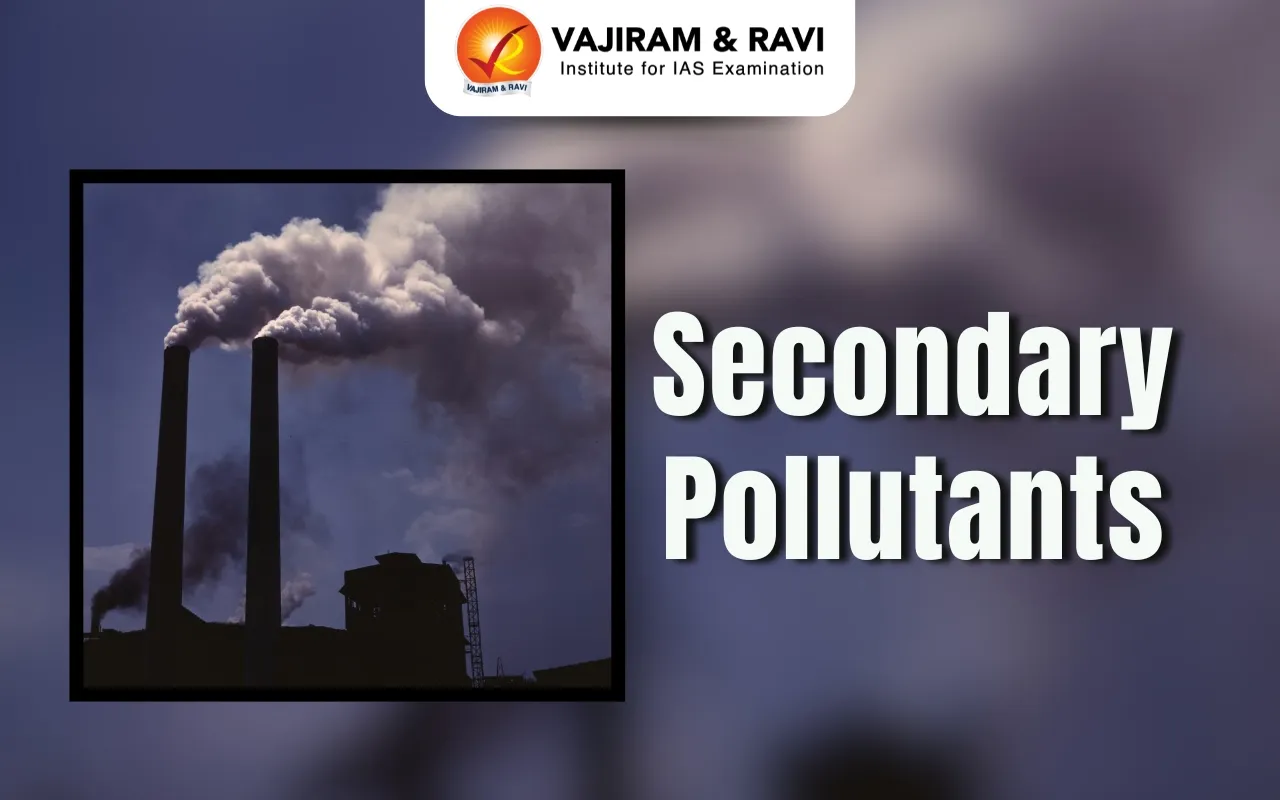
Secondary pollutants, particularly ammonium sulphate, are responsible for nearly one-third of India’s fine particulate matter (PM2.5) pollution, said a study from the Centre for Research on Energy and Clean Air (CREA).

About Secondary Pollutants

  • Secondary pollutants are pollutants which form in the atmosphere. 
  • These pollutants are not emitted directly from a source (like vehicles or power plants).
    • Pollutants that are emitted into the environment from a source are called primary pollutants.
  • Secondary pollutants form as a result of the pollutants emitted from these sources reacting with molecules in the atmosphere to form a new pollutant. 
  • Examples of secondary pollutants are ozone and secondary organic aerosol (haze).
  • Secondary pollutants are harder to control because they have different ways of synthesizing, and the formation is not well understood. 
  • They form naturally in the environment and cause problems like photochemical smog.
    • The phenomenon of photochemical smog is a result of the interactions of primary pollutants with other molecules in the air, such as molecular oxygen, water, and hydrocarbons.
    • These combine to form yellow clouds that are harmful to humans.

Source: TH

Secondary Pollutants FAQs

Q1: What distinguishes secondary pollutants from primary pollutants?

Ans: Secondary pollutants are formed by reactions of primary pollutants in the atmosphere.

Q2: Why are secondary pollutants harder to control compared to primary pollutants?

Ans: They have complex formation mechanisms in the atmosphere.

Q3: What is an example of a secondary pollutant?

Ans: Secondary pollutants include ozone, which is formed when hydrocarbons (HC) and nitrogen oxides (NOx) combine in the presence of sunlight.

India’s China Challenge in the Indian Ocean: Strategic Contest for Primacy

India coastline expansion

India’s China challenge in the Indian Ocean Latest News

  • The Parliamentary Standing Committee on External Affairs has flagged the growing presence of extra-regional powers in the Indian Ocean Region (IOR) as a major strategic challenge, especially China’s expanding footprint.

Significance of the Indian Ocean

  • Since the early 2000s, the Indian Ocean's significance has resurged, becoming a critical zone in global security and economic dynamics.

Rise of Regional Economies and Trade Networks

  • The emergence of new economies, especially India and China, has increased the Indian Ocean’s role in global trade and connectivity, turning it into a central hub of commerce.

Maritime Security and Piracy Threats

  • The rise of piracy off the Somali coast highlighted vulnerabilities in Sea Lines of Communication (SLOCs), prompting enhanced maritime security efforts across the region.

Indo-Pacific as the New Geostrategic Construct

  • The Indo-Pacific framework, which links the Indian and Pacific Oceans, has elevated the Indian Ocean’s strategic value, positioning it as a central axis in the evolving global order.

Chinese Advances in the Indian Ocean

  • Unlike its overt assertiveness in the South China Sea, China has adopted a long-term, calculated approach in the Indian Ocean, gradually enhancing its footprint through economic, political, and maritime initiatives.

Strategic Port Infrastructure and Political Engagement

  • China is expanding its influence in the IOR by:
    • Strengthening political and economic ties with littoral states like Sri Lanka, Maldives, and Bangladesh.
    • Investing in dual-use port infrastructure across the region.

Surveillance via Research Vessels

  • China has been deploying research and survey vessels in the Indian Ocean, docking them in countries like Sri Lanka and Maldives.
  • These vessels are believed to support underwater surveillance and data gathering, posing a potential security threat to India’s maritime interests.

Launch of the China-Indian Ocean Forum

  • In 2022, China initiated the China-Indian Ocean Forum, aiming to take the lead in regional governance and multilateral cooperation.
  • India’s notable absence from the forum highlights a growing geopolitical divergence in the region.

Key Highlights of the Report

  • The Parliamentary Standing Committee on External Affairs identifies the increasing involvement of extra-regional players, especially China, as a major strategic challenge for India in the Indian Ocean Region (IOR).

Dual-Use Infrastructure and Surveillance Expansion

  • China is developing ports, airports, and logistics hubs for dual-use purposes.
  • It is also deploying survey and research vessels to gather sensitive maritime and oceanographic data, boosting its maritime domain awareness.

Naval Power Projection and Military Base in Djibouti

  • Since establishing a military base in Djibouti (2017), China has expanded its naval presence, increasing both the number of vessels and the duration of deployments across the IOR.

Strategic Assets Near India’s Maritime Boundary

  • China is actively building dual-use infrastructure in IOR littoral states, including areas near India’s maritime boundary, aiming to support logistical functions and assert maritime dominance.

India’s Response: Regional Partnerships and Sensitisation

  • India is working with partner nations in the IOR to raise awareness about China's long-term strategic intentions and the security implications of its expanding footprint.

Assurance from Sri Lanka

  • In December 2024, Sri Lankan President Anura Kumara Dissanayake reiterated that Sri Lanka would not allow its territory to be used against India’s security or regional stability.

India’s Stand on BRI and the CPEC

  • India maintains a principled opposition to China’s Belt and Road Initiative (BRI).

Projecting Leadership in Maritime Security

  • India is emerging as a first responder and preferred security partner in the IOR, particularly in:
    • Humanitarian Assistance and Disaster Relief (HADR)
    • Maritime Domain Awareness (MDA)
    • Developmental aid
  • PM Modi’s launch of the MAHASAGAR doctrine (Mutual and Holistic Advancement for Security and Growth for All in the Region) redefines India’s regional vision.

Strengthening Regional Security Institutions

  • India is actively reinforcing institutional maritime cooperation, aiming to exclude China from Indian Ocean affairs:
    • Indian Ocean Rim Association (IORA)
    • Indian Ocean Naval Symposium (IONS)
    • Information Fusion Centre – IOR (IFC-IOR)
    • Quad and Colombo Security Conclave

Naval Modernisation and Indigenous Capability Building

  • India is investing heavily in the indigenous development and modernisation of naval assets, with a focus on force build-up and operational readiness in the Indian Ocean.

Source: TH | ORF

India coastline expansion FAQs

Q1: What is India’s China challenge in the Indian Ocean about?

Ans: It concerns China’s strategic expansion through port infrastructure, naval bases, and surveillance across the Indian Ocean Region.

Q2: How is China expanding its presence in the IOR?

Ans: Through dual-use port projects, survey vessels, and forums like the China-Indian Ocean Forum launched in 2022.

Q3: What is India’s strategy to counter China in the IOR?

Ans: India strengthens regional partnerships, promotes the IORA, and invests in indigenous naval capability and maritime diplomacy.

Q4: Why is the Indian Ocean strategically important now?

Ans: Due to global trade, piracy threats, and Indo-Pacific dynamics making it central to 21st-century geopolitics.

Q5: What role does MAHASAGAR play in India’s strategy?

Ans: It’s India’s vision for inclusive maritime security and development, projecting leadership without patron-client dynamics.


India’s Gaps in Gender Equality Metrics Reflected in Global Rankings

India’s gaps in gender equality metrics

India’s gaps in gender equality metrics Latest News

  • India has slipped to 131st out of 148 countries in the 2025 Global Gender Gap Index by the World Economic Forum. 
  • While gaps in economic participation, education, and health have improved or remained stable, political empowerment has worsened. Despite more women voting, their representation in top political positions remains low. 
  • The upcoming 33% reservation for women in legislatures from 2029 may improve this, but sustained efforts are needed to ensure long-term impact.

Reasons Behind the Fall in the Index

  • India's drop in the 2025 Global Gender Gap Index is primarily due to a decline in political empowerment indicators
  • The percentage of women in Parliament fell from 14.4% (78 MPs) in 2024 to 13.6% (74 MPs) in 2025. 
  • Additionally, the share of women in ministerial roles declined from 6.45% to 5.56%, further impacting India’s overall ranking.

Impact of Women’s Reservation on Political Representation

  • The 33% reservation for women in Lok Sabha and State Assemblies, passed in 2023, will be implemented only after the next Census and delimitation, making 2029 the earliest possible rollout.
  • If implemented in 2029, the law would raise women’s representation to at least 33%, significantly improving India’s political empowerment metrics on global indices.

Current Representation Levels Remain Low

  • Women in Lok Sabha have ranged from 3.4% (1977) to 14.4% (2019).
  • The 18th Lok Sabha (2024) has 74 women members, constituting approximately 13.6% of the total members.
  • In 2023, women made up only 9% of MLAs across States.
  • Chhattisgarh had the highest share (18%), while Himachal Pradesh had just one woman MLA and Mizoram had none.

Limited Timeframe, Uncertain Long-Term Gains

  • The reservation law is valid for only 15 years, meaning it will likely apply to just two general elections (2029 and 2034). 
  • Concerns remain about the sustainability of progress beyond that period.

Gaps in Ministerial and Leadership Pipelines

  • Even with more women MPs, ministerial appointments may not rise proportionately. Despite decades of 33–50% reservation at local levels, there's no structured pathway to elevate women from panchayats to higher politics.

From Exclusion to Participation: A Historic Shift

  • In 1952, 28 lakh women were excluded from voting rolls due to being listed only as someone’s wife or mother. Since then, women’s inclusion has drastically improved.

Gender Gap in Voting Narrows

  • The voter gender gap has shrunk from 17 percentage points in 1962 to less than 2 points in 2014.
  • In the last two general elections, women voters outnumbered men, partly due to male migration for work.

Women as a Key Votebank

  • With growing turnout, political parties now actively court women voters, launching targeted welfare schemes like free bicycles for girls and monthly cash allowances for poor women.
  • The rise in women voters is reshaping electoral strategies and policy priorities, making women a central force in India’s democratic process.

Rising Voters, Stagnant Representation

  • Despite the surge in women voters, this has not led to a rise in women candidates fielded by political parties.

Parties Avoid Giving Women Winnable Seats

  • Parties often cite “lack of winnability” to deny women tickets in stronghold constituencies. 
  • Instead, they field women in reserved SC/ST seats to meet multiple quotas.
  • Experts note that women voters don’t vote solely for women. Unlike caste-based voting, women prefer performance and policies over identity.

The Need for Systemic Change

  • Since 1952, women candidates have had a higher average winning percentage than men
  • The issue lies in low nomination rates, with women making up only 8–9% of candidates from major parties.
  • Structural barriers, internal party dynamics, and outdated assumptions continue to block capable women from entering the political arena in larger numbers.

Source: TH | TW | PRS

India’s gaps in gender equality metrics FAQs

Q1: Why did India fall in the 2025 Global Gender Gap Index?

Ans: Due to a decline in political empowerment indicators like women’s representation in Parliament and ministerial positions.

Q2: What is India’s rank in the 2025 Gender Gap Index?

Ans: India ranks 131st out of 148 countries, highlighting persistent gaps in gender equality metrics.

Q3: How will women’s reservation affect India’s gender equality?

Ans: It will raise women’s representation to 33% in legislatures, improving India’s gender equality metrics significantly from 2029.

Q4: Do women voters guarantee better representation of women?

Ans: No, despite rising turnout, women remain underrepresented as candidates due to party biases and structural barriers.

Q5: What limits long-term gains of women’s reservation?

Ans: The law’s 15-year validity, limited ministerial inclusion, and absence of a local-to-national leadership pipeline hinder sustained change.

RBI’s Financial Conditions Index – Tracking Market Health in Real Time

Financial Conditions Index

Financial Conditions Index Latest News

  • In a bid to enhance real-time monitoring of the country’s financial health, a recent study by the Reserve Bank of India (RBI) has proposed the construction of a Financial Conditions Index (FCI) for India with a daily frequency.

Introduction

  • To enhance real-time assessment of India’s financial ecosystem, the Reserve Bank of India (RBI) has proposed a Financial Conditions Index (FCI) with a daily frequency. 
  • The FCI is a composite indicator that aggregates data across major financial segments to evaluate how tight or relaxed financial conditions are, relative to their historical average since 2012. 
  • This move aligns with global central banking practices, where FCIs help gauge monetary transmission, inform policy decisions, and signal systemic stress.

Purpose and Structure of the Financial Conditions Index

  • The proposed FCI aims to serve as a dynamic and high-frequency barometer of India’s financial stability by integrating data from:
    • Money Markets
    • Government Securities (G-Sec)
    • Corporate Bonds
    • Equity Markets
    • Foreign Exchange Markets
  • According to the RBI study published in its June 2025 Bulletin, the FCI is designed to:
    • Measure the ease or tightness of financial conditions daily.
    • Capture trends across calm and volatile phases.
    • Serve as a macro-financial surveillance tool for policymakers.
  • The FCI is built using 20 market-based indicators, and values are standardised to reflect changes in financial tightness or looseness in standard deviation units. A positive value indicates tighter conditions, while a negative value suggests easier financial conditions.

Evolution of Financial Conditions in Recent Years

  • Post-Pandemic Recovery and Easy Financial Conditions
    • The COVID-19 pandemic led to a dramatic tightening of financial conditions due to a sharp sell-off in equity and corporate bond markets. 
    • However, this was followed by an exceptionally loose financial environment in 2021-2022, driven by the RBI’s proactive interventions, including:
      • Large-scale liquidity infusion
      • Policy rate cuts
      • Regulatory forbearance measures
    • During this period, the FCI reached a low of -2.197 in mid-June 2021, indicating extremely easy financial conditions.
  • Periods of Tightening
    • Significant peaks in the FCI were observed during historical stress episodes, such as:
    • July 2013 Taper Tantrum: A peak of +2.826, primarily driven by tightening in bond and forex markets due to fears of US Federal Reserve tapering.
    • September 2018 IL&FS Crisis: Equity and bond markets contributed to financial tightening, reflecting stress in the NBFC sector.
    • Early 2020 COVID-19 Onset: Market panic due to the global economic shutdown led to a sharp tightening again.

Recent Trends and Current Financial Landscape

  • Since mid-2023, India’s financial conditions have largely remained easy, aided by:
    • Robust equity market performance
    • Ample liquidity in the money market
    • Supportive government bond yields
  • From November 2024, conditions started to tighten slightly, attributed to:
    • Rising global financial uncertainty following the US presidential election
    • Changing risk perception in bond and equity markets
    • Policy normalisation by global central banks
  • However, by March 2025, the FCI moderated and returned to near-neutral levels, signalling stabilisation.

Significance and Policy Implications

  • The introduction of a daily FCI is expected to strengthen India’s macro-financial analysis toolkit. Key implications include:
    • Real-time Monitoring: Enables early identification of stress build-up or excess exuberance.
    • Policy Calibration: Supports timely and data-backed monetary and fiscal policy decisions.
    • Market Guidance: Offers insights to financial market participants regarding liquidity and systemic risk.
  • Globally, FCIs are used by institutions like the US Federal Reserve and European Central Bank. For India, a customised FCI tailored to its unique market dynamics will aid in improving monetary transmission and crisis management.

Future Outlook

  • As India’s financial architecture becomes increasingly complex, the RBI’s daily FCI will play a pivotal role in ensuring financial stability. 
  • By offering a unified, real-time view of multiple market segments, it empowers both policymakers and investors with actionable intelligence.
  • Continued refinement of the index, such as inclusion of newer market indicators, algorithmic adjustments, and integration with other macroeconomic dashboards, can further enhance its utility.

Source : IE | BS

Financial Conditions Index FAQs

Q1: What is the Financial Conditions Index (FCI) proposed by RBI?

Ans: The FCI is a daily composite index that measures the tightness or looseness of India’s financial market conditions across multiple segments.

Q2: Which market indicators are included in the FCI?

Ans: The FCI includes indicators from the money, G-sec, corporate bond, equity, and forex markets.

Q3: When was the financial condition in India at its tightest?

Ans: The tightest condition occurred during the July 2013 taper tantrum, with an FCI value of +2.826.

Q4: Why is the FCI important for policymakers?

Ans: It helps in real-time assessment of financial health, enabling timely policy decisions and early stress detection.

Q5: How has India’s financial condition evolved in 2025?

Ans: After tightening in late 2024, financial conditions have moderated and returned to neutral levels by March 2025.

Secondary Pollutants Now a Major Contributor to India’s PM2.5 Burden

Secondary Pollutants

Secondary Pollutants Latest News

  • A recent study has revealed that Secondary Pollutants are responsible for nearly one-third of India’s fine particulate matter (PM2.5) pollution.

Understanding Secondary PM2.5 Pollution in India

  • Particulate matter smaller than 2.5 microns (PM2.5) is one of the most hazardous components of air pollution, responsible for serious respiratory and cardiovascular diseases. 
  • Traditionally, primary pollutants such as soot and dust from burning fossil fuels have been considered the chief contributors to PM2.5 levels. 
  • However, new research highlights the rising significance of secondary pollutants, especially ammonium sulphate, as key components of India’s air pollution challenge.

Primary and Secondary Pollutants: A Distinction

  • Primary pollutants originate directly from emission sources such as vehicle exhaust, coal-fired power plants, and biomass burning. 
  • In contrast, secondary pollutants are formed when primary pollutants react with each other or with atmospheric elements like water vapour and sunlight. 
  • These reactions lead to the formation of complex particles like ammonium sulphate and ammonium nitrate, which can be equally or more harmful.

Key Findings of the CREA Study

  • According to a study by the Centre for Research on Energy and Clean Air (CREA), secondary pollutants, especially ammonium sulphate, constitute up to 34% of India’s PM2.5 mass. 
  • This widespread presence was identified using satellite-based imagery and atmospheric modelling.
  • Nationwide Impact:
    • The average ammonium sulphate concentration across India was found to be 11.9 μg/m³.
    • These concentrations are not limited to cities near pollution hotspots, but extend nationwide due to the transboundary nature of air pollution.
  • Coal Plants as a Major Source:
    • Over 60% of India’s sulphur dioxide (SO₂) emissions, the precursor to ammonium sulphate, are linked to coal-fired thermal power plants. These facilities become the primary driver of secondary PM2.5 formation.
  • Higher Concentration near Coal Plants:
    • Within 10 km of coal power plants, ammonium sulphate concentrations were 2.5 times higher (15 μg/m³) compared to areas beyond that range (6 μg/m³). 
    • Near these plants, it accounts for 36% of PM2.5 pollution, whereas even distant areas reported a significant 23% contribution.

Status of Emission Control Measures

  • Although it is mandatory for Indian coal thermal plants to install Flue Gas Desulphurisation (FGD) systems to reduce SO₂ emissions, compliance has been poor; only about 8% of such plants have installed the required units. 
  • Further, reports suggest that the government is contemplating rolling back this requirement, which could severely undermine efforts to reduce secondary PM2.5.

Impact Across NCAP Cities

  • The findings are particularly significant for the 130 cities identified under the National Clean Air Programme (NCAP). 
  • These cities are mandated to reduce pollution by 20-30% by 2025-26, but face an uphill task given the high concentration of secondary pollutants.
  • Concentration Levels:
    • PM2.5 levels due to ammonium sulphate in these cities ranged from 3.9 to 22.5 μg/m³.
  • Widespread Presence:
    • In 114 out of the 130 NCAP cities, ammonium sulphate made up more than 30% of the total PM2.5 burden.
  • Combined Effect:
    • Including ammonium nitrate, secondary pollutants could constitute up to 50% of PM2.5 pollution in urban areas.

Strategies for Mitigation

  • To address the growing burden of secondary pollutants, a multipronged strategy is required:
  • Strict Implementation of Emission Norms:
    • Enforcement of FGD installation in coal power plants must be non-negotiable. Regulatory rollback would be counterproductive to public health goals.
  • Agricultural and Industrial Reforms:
    • Efficient fertiliser management can reduce ammonia emissions, which are a key reactant in forming secondary particles.
  • Source-Specific Action:
    • Pollution mitigation efforts must target both direct emission sources and precursor gases like SO₂ and NH₃.
  • Transboundary Cooperation:
    • Given the dispersal nature of secondary pollutants, regional coordination between states is essential for effective air quality management.
  • Real-Time Monitoring and Research:
    • Investments in air quality monitoring infrastructure and continuous data-driven research are needed to identify evolving patterns in pollution dynamics.

Source : TH

Secondary Pollutants FAQs

Q1: What are secondary pollutants in the context of PM2.5 pollution?

Ans: Secondary pollutants are formed in the atmosphere when primary emissions react with gases, forming particles like ammonium sulphate and nitrate.

Q2: What is the role of coal-fired power plants in India’s PM2.5 problem?

Ans: Coal plants emit sulphur dioxide, which reacts with ammonia to form ammonium sulphate, a major secondary PM2.5 pollutant.

Q3: How much of India’s PM2.5 burden is from ammonium sulphate?

Ans: According to CREA, ammonium sulphate contributes about 34% to India’s total PM2.5 mass.

Q4: What is the compliance rate for flue gas desulphurisation systems in Indian coal plants?

Ans: Only around 8% of coal-fired power plants in India have installed mandatory FGD systems.

Q5: Why is ammonium sulphate pollution concerning in urban areas?

Ans: In 114 of 130 NCAP cities, ammonium sulphate contributes over 30% of PM2.5 levels, worsening urban air quality.

Enquire Now