Right to Private Property, History, Court Judgement

Right to Private Property

The Right to Private Property was once a fundamental right in India, under Article 31 of the Constitution. Any violation could be directly challenged in the Supreme Court. However, the 44th Constitutional Amendment in 1978 bought changes to the law. The government removed it from the List of Fundamental Rights and made it a constitutional right under Article 300A.

Now, the Right to Private Property still exists, but with less protection. Article 300A says, “No person shall be deprived of his property except by authority of law.” This means the state can take your property, but only through a proper legal process not arbitrarily. However, since it's no longer a fundamental right, you can't directly approach the Supreme Court if it's violated, you have to go through High Courts.

Right to Property

The Constitution (44th Amendment) Act, 1978 removed the Right to Property from the list of fundamental rights. However, it still remains a constitutional right under Article 300A, and is also seen as a human right in a welfare state like India.

Article 300A states that no person shall be deprived of their property except by authority of law. In short, the government can't take away someone’s property unless there’s a legal process backing it. While the Article doesn't mention compensation, courts have interpreted that fair compensation must be provided when property is acquired by the State making it an implied part of the protection under Article 300A.

Right to Private Property History

Before 1978, the Right to Private Property was a fundamental right under Article 19(1)(f) and Article 31 of the Indian Constitution. It gave citizens strong protection against state interference in property matters. After the 44th Constitutional Amendment in 1978, this right was removed from the list of fundamental rights and made a constitutional right under Article 300A, which states: “No person shall be deprived of their property except by authority of law.”

Although no longer a fundamental right, the Supreme Court has upheld the right to property as a human right, emphasizing that the State cannot take away property without following due legal process and providing compensation in justified cases.

Right to Private Property Judgement

On January 8, a Supreme Court Bench of Justices Ajay Rastogi and Indu Malhotra ruled that the Right to Property is a human right. The judgment emphasized that the State cannot take private property without following due legal procedure.

The case involved the Himachal Pradesh Government, which had forcibly acquired 4 acres of private land in 1967 to build a road in Hamirpur district, without compensating the owner, a widowed, illiterate woman for over 50 years.

Justice Indu Malhotra noted that the woman hadn’t pursued legal action earlier due to her rural and uneducated background, which limited her awareness of her rights.

After years of delay, the woman moved to the Supreme Court when lower courts failed to offer relief. The Court observed that when the State seizes land without due process, it acts as an encroacher. The verdict directed the government to pay ₹1 crore in compensation to the 80-year-old woman.

Articles 31 and 31A of 1951

  • The First Amendment to the Constitution in 1951 added Article 31A and Article 31B.
  • Article 31A was introduced to protect five categories of laws from being invalidated for violating Fundamental Rights under Articles 14 and 19. These include:
    • Laws relating to the acquisition of estates by the State.
    • Laws concerning the management of property by the State.
    • Laws related to amalgamation of corporations.
    • Laws that modify or extinguish rights of corporate directors or shareholders.
    • Laws modifying or cancelling mining leases or licenses.
  • Article 31B gave constitutional protection to laws placed in the Ninth Schedule. Even if these laws violated fundamental rights, they could not be challenged in court.
  • Later, the 25th Amendment Act of 1971 introduced Article 31C, which gave further protection to laws enacted to implement certain Directive Principles of State Policy, especially Article 39(b) and 39(c). These laws too could not be struck down for violating fundamental rights.

44th Amendment in 1978

  • In 1967, Right to Property was still a Fundamental Right under Article 31.
  • Article 31(1) stated that private property could only be taken through a law, not an executive order.
  • Article 31(2) allowed the State to acquire private property only for public purposes and with compensation.
  • These protections made it hard for the government to carry out land reforms and public projects, as citizens started challenging acquisitions in court.
  • To address this, the 44th Amendment Act, 1978 was introduced.
  • Article 31 and Article 19(1)(f) were deleted from Part III of the Constitution.
  • A new provision, Article 300A, was added under the Constitutional Rights (Part XII).
  • Now, private property can still be taken by the State, but only under authority of law, no longer as a guaranteed fundamental right.
  • The Supreme Court reminded that the State must follow due process, as laid down in Article 300A, before acquiring private property.

Doctrine of Adverse Possession

In India, Adverse Possession refers to a legal concept where a person who is not the rightful owner of a property can become its legal owner by possessing it openly, continuously, and without interruption for a specific period. 

As per Article 65 of the Limitation Act, 1963, if the original owner does not reclaim their land within 12 years, they lose the legal right to recover it. However, this principle has limitations. The Supreme Court has made it clear that the State cannot forcibly occupy private land and later claim it under adverse possession. Such an act would be unconstitutional and violate the right to property guaranteed under Article 300A of the Constitution.

Right to Private Property FAQs

Q1: Is the Right to Property a fundamental right?

Ans: No, it was removed from the list of fundamental rights by the 44th Amendment in 1978.

Q2: What type of right is the Right to Property now?

Ans: It is now a legal right under Article 300A of the Indian Constitution.

Q3: Can the government acquire private property?

Ans: Yes, the government can acquire private property for public purposes with compensation, as per the law.

Q4: What is Article 300A?

Ans: Article 300A states that no person shall be deprived of their property except by authority of law.

Q5: Was the Right to Property ever a fundamental right?

Ans: Yes, it was a fundamental right under Articles 19(1)(f) and 31 until 1978.

UPSC Daily Quiz 21 July 2025

UPSC Daily Quiz

The Daily UPSC Quiz by Vajiram & Ravi is a thoughtfully curated initiative designed to support UPSC aspirants in strengthening their current affairs knowledge and core conceptual understanding. Aligned with the UPSC Syllabus 2025, this daily quiz serves as a revision resource, helping candidates assess their preparation, revise key topics, and stay updated with relevant issues. Whether you are preparing for Prelims or sharpening your revision for Mains, consistent practice with these Daily UPSC Quiz can significantly enhance accuracy, speed, and confidence in solving exam-level questions.

[WpProQuiz 24]

UPSC Daily Quiz FAQs

Q1: What is the Daily UPSC Quiz?

Ans: The Daily UPSC Quiz is a set of practice questions based on current affairs, static subjects, and PYQs that help aspirants enhance retention and test conceptual clarity regularly.

Q2: How is the Daily Quiz useful for UPSC preparation?

Ans: Daily quizzes support learning, help in revision, improve time management, and boost accuracy for both UPSC Prelims and Mains through consistent practice.

Q3: Are the quiz questions based on the UPSC syllabus?

Ans: Yes, all questions are aligned with the UPSC Syllabus 2025, covering key areas like Polity, Economy, Environment, History, Geography, and Current Affairs.

Q4: Are solutions and explanations provided with the quiz?

Ans: Yes, each quiz includes detailed explanations and source references to enhance conceptual understanding and enable self-assessment.

Q5: Is the Daily UPSC Quiz suitable for both Prelims and Mains?

Ans: Primarily focused on Prelims (MCQ format), but it also indirectly helps in Mains by strengthening subject knowledge and factual clarity.

Article 20 of Indian Constitution, Importance, Key Aspects

Article 20 of Indian Constitution

Article 20 of the Constitution of India provides legal protection to individuals accused of crimes and fairness in criminal justice. The article doesn't allow retroactive laws, protection against self-incrimination and double jeopardy. It only helps in ensuring justice and preventing arbitrary punishment. 

Article 20 of the Constitution of India

The Constitution of India, states the following about Article 20: 

Article 20- Protection in respect of conviction for offences

  1. No person shall be convicted of any offence except for violation of a law in force at the time of the commission of the act charged as an offence, nor be subjected to a penalty greater than that which might have been inflicted under the law in force at the time of the commission of the offence.
  2. No person shall be prosecuted and punished for the same offence more than once.
  3. No person accused of any offence shall be compelled to be a witness against himself.

Article 20 of the Indian Constitution Key Aspects

Article 20 of the Indian Constitution is an important article that legally safeguards people who are accused of crimes, ensures fairness and non-arbitrariness and protection from protection. It provides protection to citizens, foreigners and legal entities. Article 20 is sub-divided into the following parts: 

  • Article 20(1): Protection from Retrospective Criminal Laws (Ex-Post Facto Laws)
    • Part 1 of Article 20 states that no person can be convicted from an act that was not a crime at the time it was committed or be given a hard punishment. 
    • This applies to criminal laws and convictions and not to trial and certainty. 
  • Article 20(2): Protection Against Double Jeopardy
    • Article 20 Part 2 states that no individuals can be prosecuted or punished for the same offence more than once.
    • The aim is to protect during the time of judicial proceedings leading to punishment and protect individuals from harassment for the same crime. 
  • Article 20(3): Protection Against Self-Incrimination
    • Article 20(3) states that no person accused of a crime can be compelled to testify against themselves, and ensure the right to remain silent. 
    • This article is used for both oral and documentary evidence and applies to criminal proceedings except for physical examination or body search.
Also Check Related Articles
Article 295 of Indian Constitution Article 194 of Indian Constitution
Article 39 of Indian Constitution Article 191 of Indian Constitution
Article 20 of Indian Constitution Article 16 of Indian Constitution
Article 67 of Indian Constitution Article 40 of Indian Constitution
Article 78 of Indian Constitution

Article 20 of Indian Constitution FAQs

Q1: What is the Article 20 of the Constitution of India?

Ans: Article 20 provides protection to individuals against arbitrary and retrospective criminal laws, double jeopardy, and self-incrimination.

Q2: What is Article 20 also known as?

Ans: Article 20 is also known as the safeguard against conviction for offences.

Q3: Is civil offence covered in Article 20 of the Constitution?

Ans: No, Article 20 applies only to criminal offences, not civil matters.

Q4: What is Article 21 of the Indian Constitution?

Ans: Article 21 guarantees the Right to Life and Personal Liberty, ensuring no person is deprived of these except by the due process of law.

Q5: What is Article 20(3) of the Constitution of India?

Ans: Article 20(3) protects an accused person from being compelled to be a witness against themselves (self-incrimination).

Article 194 of Indian Constitution, History, Significance

Article 194 of Indian Constitution

Article 194 comes under Part VI of the Indian Constitution. The article outlines the powers, privileges and immunities of the State Legislature and its members. This is done to make sure that the legislative processes are carried out in a smooth manner at state level. Article 194 helps maintain the autonomy and authority of state legislative bodies, allowing legislators to perform their duties without any interference. In this article, we are going to cover all about Article 194 of the Constitution of India and its important provisions. 

Article 194 of the Constitution of India History

In order to keep the parliamentary functions in order, the framers of the Indian Constitution provided certain powers and the privileges to the State Legislature. The idea of establishing a state legislature was derived from the British Parliamentary system and hence Article 194 was constituted to set privileges for state legislators and maintain legislative functions under protective measures. 

Article 194 of Indian Constitution Interpretation

Article 194 of the Constitution of India is sub-divided into four clauses: 

  1. Freedom of Speech in the Legislature: Clause 1 ensures that the legislators are provided with freedom of speech without any restrictions in their state legislative chambers. 
  2. Immunity from Legal Proceedings: Clause 2 makes sure that members of state legislature are not legally prosecuted for anything that they say or cast their vote on within the house or its committees. 
  3. Definition of Powers and Privileges: Clause 3 says that, until the state legislatures establish their own rules, their powers and privileges remain as they were before the 44th Amendment of 1978.
  4. Extended Application to Non-Members: Clause 4 provides the same privileges to non-members who are allowed to speak or participate in House proceedings or committee meetings.

Article 194 Landwark Judgements

The following two judgements were passed with Article 194 being a factor of consideration: 

  • P. V. Narasimha Rao v. State (1998): The Supreme Court held that legislators enjoy protection under Article 105(2) for speeches and votes in Parliament—even if influenced by bribery—but this immunity does not cover actions outside the House.
  • Sita Soren v. Union of India (2024): The Court clarified that Article 194(2) cannot shield legislators from legal consequences of corrupt actions. It limited immunity and reaffirmed that accountability is paramount.

Article 194 Significance

Article 194 is important due to the following reasons: 

  • Protects Legislative Independence: By providing protection to legislators from any external pressure and legal retaliation, Article 194 allows free and frank deliberations.
  • Gives Power to Legislatures: It gives state legislatures the authority to make their own privileges and preserve institutional autonomy.
  • Balances Privilege with Accountability: Judicial rulings make sure that the immunity is not misused to protect corrupt behavior.
Also Check Related Articles
Article 295 of Indian Constitution Article 194 of Indian Constitution
Article 39 of Indian Constitution Article 191 of Indian Constitution
Article 20 of Indian Constitution Article 16 of Indian Constitution
Article 67 of Indian Constitution Article 40 of Indian Constitution
Article 78 of Indian Constitution

Article 194 of Indian Constitution FAQs

Q1: What is Article 194 of the Constitution of India?

Ans: Article 194 grants privileges and immunities to members of State Legislatures, including freedom of speech and legal immunity for actions within the House.

Q2: What is the Act of 194?

Ans: The term "Act of 194" is unclear. if referring to Article 194, it pertains to legislative privileges in Indian states under the Constitution.

Q3: What is Article 194 and Article 105?

Ans: Article 194 applies to State Legislatures and Article 105 applies to Parliament, both providing similar privileges and immunities to their respective members.

Q4: What is the Article 194 case law?

Ans: Notable case law includes Sita Soren v. Union of India (2024), where the Supreme Court ruled that legislative privilege does not shield corrupt acts.

Q5: What is Article 194 of the IPC?

Ans: Article 194 of the IPC does not exist; the Indian Penal Code contains Section 194, which deals with giving or fabricating false evidence with intent to procure conviction for capital offences.

Daily Editorial Analysis 21 July 2025

Daily Editorial Analysis

India's Soil Crisis and the Imperative for Nutritional Agriculture


Context:

  • India has transformed from a food aid-dependent nation in the 1960s to the world’s largest rice exporter and the provider of the largest food distribution programme (PMGKY).
  • However, this quantitative food security masks a deeper qualitative crisis rooted in soil health, which threatens nutritional outcomes and long-term agricultural sustainability.

India's Journey - Food Security Milestones:

  • Transformation from deficit to surplus:
    • 1960s: Dependent on US food aid under the PL-480 programme.
    • 2024–25: Exported 20.2 million tonnes of rice in a 61 MT global market.
    • PM-Garib Kalyan Yojana (PMGKY): Provides 5 kg free rice/wheat/month to over 800 million people.
    • Food Corporation of India (FCI) stockpile: It holds about 57 MT of rice — the highest stock in 20 years and nearly four times the buffer norm of 13.54 million tonnes as of July 1, 2025.
  • Reduction in poverty: The extreme poverty head count (those earning less than $3/day at 2021 PPP) dropped from 27.1% in 2011 to just 5.3% in 2022.

The Hidden Crisis - Malnutrition Persists:

  • National Family Health Survey (NFHS 5) (2019–21) indicators:
    • 35.5% of children under five years of age are stunted, 32.1% are underweight, and 19.3% are wasted.
    • This reflects failure to achieve nutritional security, despite caloric sufficiency.
  • Nutrient deficiency in crops: Poor soil health leads to nutrient-deficient crops, which fuels micronutrient malnutrition, especially among children.

Degrading Soil Health - A Silent Emergency:

  • Soil Health Card (SHC) scheme (2024 data): Of more than 8.8 million soil samples tested, less than 5% have high or sufficient nitrogen (N), only 40% have sufficient phosphate (P), 32% have sufficient potash (K) and just 20% are sufficient in soil organic carbon (SOC).
  • SOC - A vital indicator:
    • SOC is a critical parameter defining the physical, chemical, and biological properties of soil — these govern its holding capacity and nutrient use efficiency.
    • As per the Indian Institute of Soil Science (IISC), SOC in the range of 0.50-0.75% is adequate.
  • Micronutrient deficiencies:
    • Indian soils also suffer from a deficiency of sulphur, as well as micronutrients like iron, zinc and boron.
    • They contribute to stunting and long-term health issues.

Fertiliser Imbalance - A Misguided Practice:

  • State-level imbalance:
    • Punjab: N overused by 61%, K deficient by 89%.
    • Telangana: N overused by 54%, K deficient by 82%.
    • The situation is similar in several other states. The highly imbalanced use of N, P and K and the neglect of micronutrients leads to suboptimal agricultural productivity.
  • National consequences: The fertiliser-to-grain response ratio/ fertilizer use efficiency has declined significantly from 1:10 in the 1970s to a mere 1: 2.7 in 2015. This leads to suboptimal yield and soil fatigue.
  • Environmental hazards:
    • Urea inefficiency: Only 35–40% N absorbed.
    • Rest lost as greenhouse gases (N₂O, which is 273 times more potent than CO₂) or as nitrate contamination of groundwater.
    • Urea diversion to non-agricultural or cross-border use compounds the problem.

The Way Forward - Towards Nutritional Agriculture:

  • Public health link: Soil health directly impacts human nutrition, making this an agricultural and public health concern.
  • Need for a paradigm shift:
    • Shift from blanket fertiliser application to customised, soil-specific nutrient planning.
    • Emphasise science-based fertilisation strategies informed by soil testing and crop-specific needs.
  • New collaborations and innovations: ICRIER (Indian Council for Research on International Economic Relations) and OCP Nutricrops partnership - Aims to promote region-specific, data-driven solutions to boost soil and crop nutrition, and enhance crop productivity.
    • OCP Nutricrops brings cutting-edge expertise in soil nutrition and fertiliser solutions aimed at addressing global challenges in sustainable food production.

Conclusion - Healing the Soil for a Healthy Nation:

  • India’s food and nutritional security now depends on addressing the soil nutrient crisis.
  • Sustainable development demands that we move beyond food quantity to food qualitystarting with rejuvenating the soil — the foundation of human health and national prosperity.

India's Soil Crisis and the Imperative for Nutritional Agriculture FAQs

Q1. How did India become the world’s largest rice exporter?

Ans. Through the Green Revolution, public procurement, buffer stocks, and schemes like PM-GKAY.

Q2. Why does child malnutrition persist despite food surplus?

Ans. Because of poor crop nutrition, soil deficiencies, and focus on calories over nutrients.

Q3. How does soil health affect human nutrition?

Ans. Nutrient-poor soils lead to deficient crops, causing hidden hunger and stunting.

Q4. What are the effects of fertiliser imbalance in India?

Ans. It reduces crop yield, pollutes groundwater, and emits potent greenhouse gases.

Q5. Can science-based fertiliser use restore soil and food quality?

Ans. Yes, customised nutrition plans and partnerships like ICRIER-OCP can boost both.

Source: IE


India Can Reframe the Artificial Intelligence Debate

Context

  • Less than three years ago, ChatGPT catapulted artificial intelligence (AI) out of research labs and into living rooms, classrooms, and parliaments.
  • The sudden public visibility of AI created waves that leaders could not ignore and in response, global AI summits emerged rapidly, highlighting both the urgency and the uncertainty surrounding this transformative technology.
  • When New Delhi hosts the AI Impact Summit in February 2026, the event can transcend symbolic diplomacy.

The Geopolitical Landscape and India’s Approach to AI

  • Fractured Geopolitical Landscape
    • The Paris AI Summit of February 2025, which aimed to unify the world on AI governance, ended in discord, marked by the United States and the United Kingdom rejecting its final text, while China embraced it.
    • These divisions risk turning what should be a cooperative effort for humanity’s digital future into a fragmented contest of interests.
    • India, with its strategic position and credibility across multiple geopolitical blocs, is well placed to act as a bridge.
    • By developing inclusivity and dialogue, India can prevent AI governance from becoming a domain of competing spheres of influence, ensuring that AI benefits the global majority.
  • A Democratic Approach to AI
    • India’s Ministry of Electronics and Information Technology began preparing for the summit with a uniquely democratic approach.
    • In June 2025, it launched a nationwide consultation through the MyGov platform, inviting students, researchers, startups, and civil society groups to contribute ideas.
    • The agenda emerging from this process focuses on three key goals: advancing inclusive growth, accelerating development, and protecting the planet.
    • This consultative framework has provided India with a distinctive advantage, unlike past summit hosts, it is building an agenda rooted in broad-based participation and grassroots innovation. 

Actionable Proposals for the New Delhi AI Impact Summit

  • Pledges and Report Cards
    • India’s success with digital infrastructure, such as Aadhaar’s secure identity system and the Unified Payments Interface (UPI), illustrates how technology can serve everyone, not just the privileged.
    • The summit can borrow this spirit of accountability by encouraging each delegation to make a clear, measurable pledge for the year following the summit.
    • These could range from reducing data centre energy consumption to offering AI-based educational programs for rural communities.
    • Public scoreboards tracking these pledges would replace empty press releases with transparent progress reports.
  • Elevating the Global South
    • At the first global AI summit, nearly half of humanity, primarily the Global South, was absent from leadership discussions.
    • India, as a voice for the Global South, must ensure equitable representation this time.
    • A proposed AI for Billions Fund, supported by development banks and Gulf investors, could provide cloud credits, fellowships, and local-language datasets for underserved communities.
    • Hosting a multilingual AI model challenge for 50 low-resource languages would send a powerful message: innovation is not confined to Silicon Valley or Beijing; it is universal.
  • Establishing a Common Safety Check
    • Since the Bletchley AI Safety Summit of 2023, experts have advocated for red-teaming and stress-testing AI models.
    • While many countries have formed national AI safety institutes, no shared global checklist exists.
    • India could lead the creation of a Global AI Safety Collaborative to standardise red-team scripts, incident logs, and safety benchmarks for high-capacity models. An open evaluation toolkit could strengthen trust and transparency.
  • Charting a Balanced Regulatory Path
    • The U.S. fears overregulation, Europe pushes for stringent laws through its AI Act, and China favours centralised state control.
    • Most nations, however, seek a middle ground. India could propose a voluntary yet enforceable code of conduct for frontier AI.
    • Building on the Seoul pledge, this code could require disclosure of compute resources above a certain threshold, the publication of external red-team results within 90 days, and the creation of an accident hotline.
    • Such steps would promote accountability without stifling innovation.
  • Preventing Fragmentation
    • The AI ecosystem risks splintering along geopolitical lines, with the U.S. and China locked in a technological rivalry.
    • While New Delhi cannot dissolve these tensions, it can soften their impact by ensuring that the summit’s agenda remains broad, inclusive, and focused on collective global benefit.

India’s Role and Identity

  • India is not aiming to build a global AI authority overnight, nor should it.
  • Instead, it can integrate existing frameworks, develop collaboration, and position itself as a leader in sharing AI capacity with the world’s majority.
  • By transforming participation into tangible progress, India will not merely host a summit, it will redefine its identity as a proactive force on one of the most critical frontiers of the 21st century.

Conclusion

  • The AI Impact Summit of 2026 presents India with a unique diplomatic and technological opportunity.
  • Through transparent pledges, inclusive representation, shared safety standards, balanced regulation, and resistance to fragmentation, India can guide AI governance toward equity and sustainability.
  • In doing so, it will not only influence the trajectory of AI but also reaffirm its role as a bridge-builder in an increasingly divided world.

Reform Cannot Wait; Aviation Safety is at Stake

Context

  • The preliminary report of the Aircraft Accident Investigation Bureau (AAIB) on the Air India Boeing 787 crash in Ahmedabad on June 12, 2025, released on July 12, highlights significant uncertainties regarding pilot actions.
  • However, the real issue extends beyond individual culpability to a systemic lack of trust in India’s aviation ecosystem.
  • This distrust stems from a recurring pattern where aviation personnel face disproportionate penalties while regulators, airlines, and oversight bodies escape equivalent scrutiny.

India’s Aviation Framework: A Fractured Aviation Ecosystem

  • India’s aviation framework involves a complex interplay of components: aircraft design, airworthiness, maintenance, and the professionals operating these systems, including engineers, pilots, and cabin crew.
  • These operational aspects are managed by airlines, while the Airports Authority of India (AAI) oversees airport infrastructure and air traffic control.
  • The Directorate General of Civil Aviation (DGCA) regulates airlines, airport operators, and the AAI, under the supervisory oversight of the Ministry of Civil Aviation (MoCA).
  • Despite these layered responsibilities, aviation accidents seldom arise from a single failure.
  • Instead, as per the Swiss cheese model, they occur when multiple systemic gaps align, allowing a critical lapse to escalate into a disaster.

Judicial Interventions and Regulatory Loopholes in India’s Aviation Sector

  • Judicial Interventions and Safety Advocacy
    • Judicial interventions have occasionally proven lifesaving, as evidenced in the 2018 Ghatkopar crash in Mumbai, where earlier court-ordered restrictions on construction near airports prevented potentially greater casualties.
    • Mumbai’s airspace exemplifies the hazards of regulatory neglect, with over 5,000 vertical obstructions within a four-kilometre radius, a clear violation of the Inner Horizontal Surface (IHS) safety criteria.
    • Despite ongoing PILs, the number of obstacles near critical air routes has soared, reflecting the opacity and possible misrepresentation by the DGCA, AAI, airport operators, and MoCA.
    • This illustrates a judiciary forced to compensate for administrative failures, yet often constrained by its reliance on state-provided technical expertise.
  • Regulatory Loopholes and Dangerous Precedents
    • The deterioration of safety standards can be traced back to policy changes.
    • Until 2008, airspace around airports was tightly regulated under the Aircraft Act and Statutory Order 988 of 1988, which prohibited hazardous constructions.
    • However, the creation of a non-statutory committee in 2008 diluted these safeguards, approving illegal building heights through flawed aeronautical studies.
    • By 2015, obstacles not only posed physical risks to aircraft but also interfered with radar and communication systems.
    • Instead of tightening controls, the 2015 Rules granted statutory recognition to the very committee responsible for height violations.
    • The MoCA’s amendment to limit the no-objection certificate (NOC) validity to 12 years, without outlining measures for demolishing illegal floors, epitomizes bureaucratic evasion of responsibility.
    • Similar violations now plague greenfield projects like Navi Mumbai and Noida airports, where operational runways are compromised due to surrounding obstructions.

Systemic Failures Across Key Areas

  • Aircraft Design and Airworthiness: The DGCA’s limited technical expertise forces excessive reliance on foreign regulators, as highlighted during the 2017–18 Pratt & Whitney engine failures affecting IndiGo.
  • Maintenance Standards
    • Aircraft Maintenance Engineers (AMEs) face extreme workloads without duty-time limitations.
    • Airlines are permitted to delegate AME responsibilities to underqualified, lower-paid technicians, prioritising cost-cutting over safety.
  • Flight Crew Fatigue
    • Airlines routinely breach Flight Time Duty Limitations for pilots, with DGCA exemptions allowing fatigued crews to operate.
    • The unique NOC requirement for pilots restricts their career mobility, increasing psychological stress and regulatory coercion.
  • Cabin Crew Neglect: The reduction of cabin crew roles to hospitality functions ignores their vital role in passenger safety.
  • Air Traffic Management: The AAI grapples with a severe shortage of Air Traffic Controller Officers (ATCOs), a crisis worsened by the non-implementation of licensing provisions and duty-time limitations recommended after past crashes.
  • Suppression of Whistle-Blowers: Retaliation against safety whistle-blowers fosters a culture of silence, allowing violations to persist unchecked.

The Judiciary’s Role and the Value of Human Life

  • The judiciary, often hailed as India’s constitutional safeguard, has been relatively passive in aviation safety matters.
  • Courts tend to defer to the technical expertise of state agencies, despite evidence of systemic negligence.
  • shift is needed in how human life is valued; compensation for railway and road accidents often amounts to mere lakhs of rupees, enabling stakeholders to rationalise safety investments as financially unnecessary.
  • revaluation of human life and its intrinsic worth is critical to motivating systemic safety

Conclusion

  • The Air India crash in Ahmedabad is a stark reminder that systemic failure in aviation is not a distant threat but an immediate reality.
  • Without a comprehensive reform encompassing regulatory accountability, mental health support for crew, and strict adherence to safety standards, the next disaster is inevitable.
  • The judiciary, government, and airlines must work in unison to develop a genuine safety culture, one that places lives above profit margins and bureaucratic convenience.
  • Reform cannot wait; every delay risks another tragedy.

Daily Editorial Analysis 21 July 2025 FAQs

Q1: What is editorial analysis?

Ans: Editorial analysis is the critical examination and interpretation of newspaper editorials to extract key insights, arguments, and perspectives relevant to UPSC preparation.

Q2: What is an editorial analyst?

Ans: An editorial analyst is someone who studies and breaks down editorials to highlight their relevance, structure, and usefulness for competitive exams like the UPSC.

Q3: What is an editorial for UPSC?

Ans: For UPSC, an editorial refers to opinion-based articles in reputed newspapers that provide analysis on current affairs, governance, policy, and socio-economic issues.

Q4: What are the sources of UPSC Editorial Analysis?

Ans: Key sources include editorials from The Hindu and Indian Express.

Q5: Can Editorial Analysis help in Mains Answer Writing?

Ans: Yes, editorial analysis enhances content quality, analytical depth, and structure in Mains answer writing.

Deforestation, Types, Causes, Effects, Measures, Government Initiatives

Deforestation

Deforestation refers to the large-scale process of cutting down forest cover, often to make way for farming, construction, or logging. As trees are cleared, the natural balance of ecosystems is disrupted, leading to a loss of biodiversity, increased soil erosion, and a rise in carbon emissions that fuel climate change. Reducing Deforestation through sustainable practices is required to protect both the environment and future generations in a longer run.

Deforestation

The process of cleaning the forest for human use is referred to as Deforestation which carries along significant environmental and social consequences. It also increases greenhouse gas emission, soil erosion and the decline of the water quality. It increases the risk of floods and wildfires, reduces the rainfall which leads to displacement of communities located nearby. 

Deforestation Types

Deforestation refers to the removal of trees and vegetation on a large-scale from forested areas. It can occur in different forms, each driven by specific causes and resulting in environmental consequences. Below are some common Deforestation Types discussed in the table:

Deforestation Types
Cause Description

Clear-Cutting

The complete removal of all trees in a specific area, mainly for commercial logging or agriculture, leading to severe habitat loss and environmental disruption.

Selective Logging

Harvesting specific valuable trees while leaving others, seen as less harmful than clear-cutting but can still fragment habitats and reduce biodiversity.

Shifting Agriculture

Traditional farming method involving clearing and burning small forest patches; sustainable short-term but harmful when repeated, causing soil degradation.

Infrastructure Development

Building roads, dams, and other projects requires forest clearance, opening remote areas to logging, mining, and farming, resulting in ecosystem fragmentation.

Urbanization

Expansion of cities and towns into forested areas leads to habitat destruction, species displacement, and increased pressure on natural resources.

Forest Fires

Natural or human-induced fires rapidly destroy forests; they reduce tree cover, damage wildlife habitats, and affect soil and water cycles long term.

Illegal Logging & Encroachment

Unauthorized timber harvesting and occupation of forest land for farming or settlements degrade forests and often evade regulatory oversight and protection.

Deforestation Causes

  • Agriculture: Cutting forests for agriculture is the leading cause of Deforestation worldwide. Land is converted into croplands, pastures, or large-scale plantations. This is largely driven by population growth and the increasing demand for food.
  • Logging: The timber and paper industries are another major contributor. Trees are cut down for wood, pulp, and other commercial products. As economies expand and populations grow, so does the demand for these resources.
  • Mining: Forests are often cleared to access mineral deposits such as gold, copper, and iron ore. Mining activities not only destroy tree cover but also leave behind toxic waste, polluting the environment.
  • Urbanization: Expanding cities and infrastructure projects require land, and forests are often the first to go. As urban populations rise, forests are cleared to make way for roads, housing, and commercial zones.
  • Fires: Both natural and human-caused forest fires can lead to deforestation. Lightning strikes, careless activities, or intentional burning for land clearing can rapidly destroy large forested areas.

Environmental Consequences

  • Greenhouse Gas Emissions: Forests absorb carbon dioxide. When trees are removed or burned, that stored carbon is released back into the atmosphere, increasing the climate change.
  • Soil Erosion: Tree roots hold soil in place. Without them, soil is more likely to wash away, leading to erosion, landslides, and sediment buildup in rivers.
  • Water Quality Degradation: Forests act as natural filters for water. Without this vegetation, runoff can carry pollutants directly into rivers and lakes, harming aquatic life and human health.
  • Reduced Rainfall: Forests play an important role in maintaining local and regional rainfall patterns through transpiration. Large-scale deforestation can disrupt this balance, leading to irregular rainfall, droughts, or floods.
  • Higher Risk of Wildfires: Forests help retain moisture in the soil and air. Deforestation can dry out the land and increase the likelihood of frequent, intense wildfires.

Deforestation Effects

Deforestation has affected the ecology and environment for many countries in various ways, out of which few Deforestation Effects are discussed below:

  1. Water Cycle Disruption: Deforestation disrupts local and regional water cycles, reducing water availability for both communities and ecosystems.
  2. Loss of Livelihoods: It displaces indigenous and local populations who are dependent on forests for shelter, food, medicine, and income.
  3. Increased Risk of Natural Disasters: With trees gone, natural protection against floods, landslides, and storms is weakened, making affected areas more vulnerable.
  4. Cultural Erosion: The destruction of forests endangers the cultural identity and traditions of indigenous communities that are deeply tied to the land.
  5. Economic Impact: While Deforestation may have short-term benefits, it undermines long-term sustainability by degrading land, reducing biodiversity, and eliminating renewable resources.

Deforestation Measures to Avoid

Several steps can be taken to prevent deforestation and promote sustainable land use:

  1. Sustainable Forest Management: Forests should be managed in a way that maintains their ecological balance, productivity, and biodiversity over the long term.
  2. Reforestation: Planting trees in deforested areas helps restore ecosystems, improve soil quality, and support local wildlife.
  3. Reduced Demand for Forest Products: Using alternatives like recycled paper, bamboo, and digital tools can ease pressure on natural forests.
  4. Government Regulation: Strong legal frameworks and enforcement can protect forests from illegal logging, land conversion, and overexploitation.
  5. Public Awareness: Educating communities about the value of forests and the consequences of Deforestation encourages more responsible consumption and conservation efforts.

Deforestation Government Initiatives

The government has introduced various initiatives to prevent Deforestation. These efforts include:

  1. Governments have introduced laws to safeguard forest region. For instance, Brazil has introduced regulations restricting deforestation in the Amazon rainforest.
  2. Some countries provide monetary support to promote sustainable forest practices. In the US, landowners receive assistance for managing their forests responsibly.
  3. Awareness campaigns play a key role. The United Nations, for example, has launched global initiatives to highlight the urgency of forest conservation.

Deforestation FAQs

Q1: What is deforestation?

Ans: Deforestation is the large-scale clearing of forests, often for agriculture, logging, or urban development, leading to habitat loss and environmental imbalance.

Q2: What are the main causes of deforestation?

Ans: Key causes include agriculture, logging, infrastructure development, mining, and urban expansion.

Q3: How does deforestation affect the environment?

Ans: It causes biodiversity loss, climate change, soil erosion, and disrupts water cycles and carbon storage.

Q4: Which regions are most affected by deforestation?

Ans: Tropical rainforests in the Amazon, Central Africa, and Southeast Asia face the highest rates of deforestation.

Q5: What is the link between deforestation and climate change?

Ans: Deforestation increases atmospheric CO₂, contributing to global warming and reduced carbon sequestration.

Pale-Capped Pigeon

Pale-Capped Pigeon

Pale-Capped Pigeon Latest News

In a significant sighting for birdwatchers and conservationists alike, the elusive Pale-capped Pigeon was recently photographed in Dehing Patkai National Park in Assam.

About Pale-Capped Pigeon

  • The pale-capped pigeon, also known as the purple wood pigeon, is a large, dark purplish-maroon bird that is found in parts of the Indian Subcontinent and Southeast Asia.
  • Scientific Name: Columba punicea
  • Distribution: It is very locally distributed across its broad range, which encompasses parts of northern and northeastern India, Bangladesh, Myanmar, Thailand, Laos, Cambodia,  and Vietnam. 

Pale-Capped Pigeon Habitat

  • It largely inhabits forest habitats, chiefly, primary or secondary evergreen forests, and bamboo and agricultural fields in close proximity to forests.
  • Its range extends from the lowlands up to 1,600 m.

Pale-Capped Pigeon Features

  • It is mainly brown above and chestnut below with a sheen of green or amethyst. 
  • Males have a whitish-grey-cap while females have a brownish-grey-cap and less gloss on the feathers.
  • They are frugivores, foraging in small groups in the canopy of trees but sometimes descending to the ground for seeds and fallen fruit.

Pale-Capped Pigeon Conservation Status

It is classified as 'Vulnerable' under the IUCN Red List.

Key Facts about Dehing Patkai National Park

  • It is located in the Dibrugarh and Tinsukia districts of Assam.
  • It is situated at the foothills of the Patkai Hill Ranges, on the banks of the River Dehing (a tributary of Brahmaputra), and adjacent to the Namdapha Wildlife Sanctuary.
  • Also known as the ‘Amazon of the East’, it harbours the longest stretch of tropical lowland rainforests in India. 
  • It covers an area of 231.65 sq.km. 
  • The climate of the region is mostly tropical, with an annual rainfall of more than 4,000 mm.
  • There are more than a dozen different ethnic groups living in the area, including the indigenous Assamese communities, particularly Tai Phake, Khamyang, Khampti, Singpho, Nocte, Ahom, Kaibarta, Moran, and Motok, Burmese, and non-indigenous Nepali people.
  • Vegetation: The park is a deciduous rainforest with semi-evergreen and lush green flora.
  • Flora: It is dominated by species like Hollong, Nahor, Mekai, Paroli, Simul, various orchids, ferns, cane, and bamboo.
  • Fauna: The rich biodiversity includes diverse species such as slow loris, pig-tailed macaque, stump-tailed macaque, capped langur, Indian leopard, Asian elephant, royal Bengal tiger, gaur, Himalayan black bear, clouded leopard, barking deer, Chinese pangolin, etc.

Source: NEN

Pale-Capped Pigeon FAQs

Q1: What is the scientific name of the pale-capped pigeon?

Ans: Columba punicea

Q2: What is the IUCN Red List status of the pale-capped pigeon?

Ans: Vulnerable

Q3: What distinguishing feature separates male and female pale-capped pigeons?

Ans: Males have a whitish-grey cap, females have a brownish-grey cap.

Q4: Up to what elevation is the pale-capped pigeon typically found?

Ans: 1,600 m

Lyriothemis Abrahami

Lyriothemis Abrahami

Lyriothemis Abrahami Latest News

Recently, a new species of dragonfly, Lyriothemis abrahami, which was previously misidentified as Lyriothemis flava due to superficial similarities, has been officially documented.

About Lyriothemis Abrahami 

  • It is a new species of dragonfly discovered in Kerala.
  • Habitat: It breeds in small water pools in tree holes.
  • Features of Lyriothemis abrahami : It exhibits strong dimorphism, with males featuring uniquely shaped hamules and females displaying jet black bodies with yellow triangular spots.
  • Distribution: Its distribution spanned from lowland rainforests to mid-elevation evergreen and deciduous forests between 50 m and 1,100 m above sea level.
  • The finding increased Kerala’s odonate species count to 191, including 78 endemic species,

Ecological Significance Dragonfly

  • The dragonfly is an indicator of forest health, stressing habitat conservation’s broader ecological benefits.
  • Dragonflies are among the apex predators of the insect world and are considered to be responsible for regulating the numbers of many other insect species.
  • They are crucial insect predators that help regulate mosquito and pest populations in urban areas.

Source: TH

Lyriothemis abrahami FAQs

Q1: What is an indicator species?

Ans: Indicator species can signal a change in the biological condition of a particular ecosystem, and thus may be used as a proxy to diagnose the health of an ecosystem.

Q2: What is Dimorphism?

Ans: It is a condition of existence in two different characteristics in males and females of the same species.

Slovenia

Slovenia

Slovenia Latest News

Recently, Slovenia approved a law to allow assisted dying, joining an increasing number of countries giving terminally-ill adults the right to end their lives if they face unbearable suffering.

About Slovenia

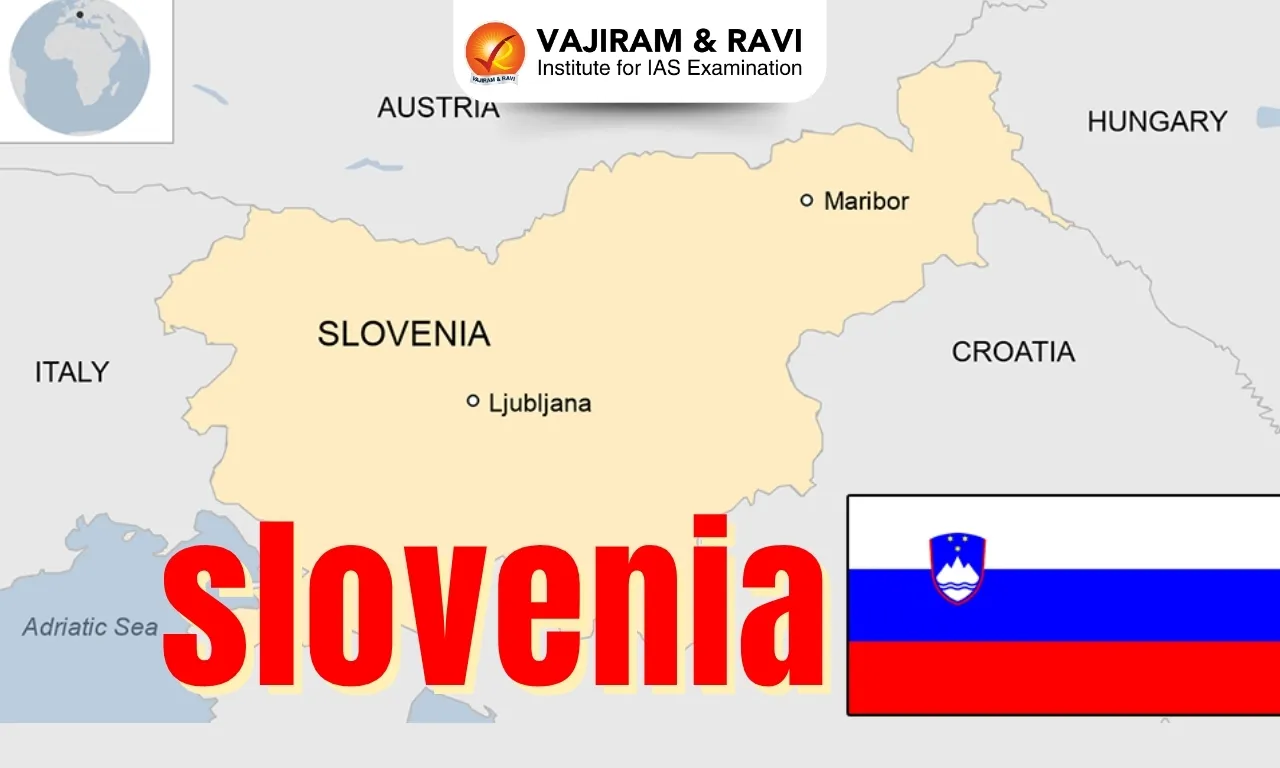
  • It occupies the Central and South Eastern Europe region.
  • Bordering countries: It is bordered by 4 countries: Austria in the north; Hungary in the northeast; Italy in the west; and Croatia in the southeast. Slovenia also shares a small coastline along the Adriatic Sea in the southwest.
  • Slovenia has a highly elevated terrain with over 40% of the country being mountainous.
  • It is made up of portions of four major European geographic landscapes—the European Alps, the karstic Dinaric Alps, the Pannonian and Danubian lowlands and hills, and the Mediterranean coast.
  • Climate:  Mediterranean climate on the coast, continental climate with mild to hot summers and cold winters in the plateaus and valleys to the east.
  • Highest point: Mount Triglav
  • Natural Resources: Lignite, lead, zinc, building stone, hydropower, forests
  • Economy: Slovenia has a developed market economy based primarily on services and trade. Its main industries include the manufacture of automotive parts, pharmaceuticals, and electrical appliances.
  • River: Major rivers include the Drava and Sava.
  • Capital City: Ljubljana

Source: Reuters

Slovenia FAQs

Q1: Is Slovenia uses euro currency?

Ans: Slovenia joined the European Union in 2004 and, on 1 January 2007, became the first of the new EU countries to adopt the euro.

Q2: What kind of country is Slovenia?

Ans: Parliamentary democratic republic

Invictus Programme

Invictus Programme

Invictus Programme Latest News

Recently, the European Space Agency (ESA) and UK-based Frazer-Nash have kicked off the INVICTUS research programme.

About Invictus Programme

  • It is a research programme with the goal of developing hypersonic technologies applicable to future reusable vehicles capable of horizontal launch.
  • Funding: It is funded through ESA’s General Support Technology Programme (GSTP) and Technology Development Element (TDE)
  • It is a fully reusable experimental aerospace vehicle capable of flying at Mach 5 (five times the speed of sound).
  • The vehicle will demonstrate key technologies for sustained hypersonic flight in the atmosphere and will be upgradable, allowing for the exchange of materials, software and propulsion systems between flight test campaigns.
  • INVICTUS builds on previous technology developments managed by ESA and will offer industry, agencies and academia an opportunity to test future hypersonic technologies in a relevant environment.
  • Significance: The INVICTUS programme will prove the suitability of a hydrogen-fuelled precooled air-breathing propulsion system for horizontal take-off and hypersonic flight.

Source: ESA

Invictus Programme FAQs

Q1: What is hypersonic tech?

Ans: Hypersonic weapons travel faster than five times the speed of sound — Mach 5 — covering vast distances in minutes.

Q2: What are the three types of propulsion?

Ans: There are many types of propulsion systems, each with unique features and uses. These include internal combustion engines, gas turbine engines, electric propulsion systems, and rocket propulsion systems.

King Rajendra Chola I

King Rajendra Chola I

King Rajendra Chola I Latest News

The Prime Minister is expected to participate in a function in Tamil Nadu being organised to commemorate the 1000th anniversary (millenary) of the conquest of the Gangetic plains by King Rajendra Chola I.

About King Rajendra Chola I

  • Rajendra Chola I, often described as Rajendra the Great, was a Chola emperor who ruled between 1014 and 1044 CE. 
  • Rajendra succeeded his father, Rajaraja I, in 1014 CE.
  • He was also known as Gangaikonda Cholan, meaning "Bringer of the Ganges River". Another title was Kadaram Kondan, which means "Conqueror of Kedah".
  • Military Campaigns:
    • During his reign, he extended the influences of the already vast Chola empire to the banks of the river Ganges in the north and across the ocean. 
    • He commanded the largest blue water navy in Indian history.
    • Rajendra’s territories extended to coastal Burma, the Andaman and Nicobar Islands, Lakshadweep, and the Maldives, conquering the kings of Srivijaya (Sumatra, Java, and Malaya in South East Asia) and the Pegu Islands with his fleet of ships.
    • He defeated Mahipala, the Pala king of Bengal and Bihar. 
    • Tamil Chola armies exacted tribute from Thailand and the Khmer kingdom of Cambodia. 
    • Rajendra stood as the first Indian king to take his armies overseas.
  • In order to commemorate his victory to the Ganges and over the northern kings, Rajendra Chola I assumed the title of ‘Gangaikondachola’ and had a temple dedicated to Lord Shiva built, which he named ‘Gangaikondacholeshwaram Mahadev’. 
  • He also founded the city of ‘Gangaikondacholapuram’ and shifted his capital there from Thanjavur. 
  • It was a major center for trade for many centuries. 
  • The Chola Empire under him became one of the wealthiest empires of the time, developing connections with Song China in the east and the Arabs in the west.
  • A hallmark of the Chola dynasty under his rule was the promotion of local self-governance, setting a unique example in administrative excellence. 
  • Religion: Rajendra followed Shaivism (a branch of Hinduism). However, he also welcomed Buddhism and built many stupas (Buddhist shrines) in South-East Asia and South India.
  • Rajendra Chola I was followed by his son Rajadhiraja I.

Source: TH

King Rajendra Chola I FAQs

Q1: Rajendra Chola I ruled during which period?

Ans: 1014–1044 CE

Q2: Who was the father of Rajendra Chola I?

Ans: Rajaraja I

Q3: What was the name of the capital city founded by Rajendra Chola I?

Ans: Gangaikondacholapuram

Q4: What religion did Rajendra Chola I follow?

Ans: Shaivism

Important Battles of Mughal Empire, List, Outcome

Important Battles of Mughal Empire

The Mughal Empire ruled India from the 16th century until the mid-18th century, and experienced several important battles that influenced the fall. These conflicts played a major role in both the foundation and expansion of the dynasty. Starting with Babur’s conquest and extending to Aurangzeb’s military campaigns, every ruler engaged in wars that shaped the empire’s destiny.

List of Important Battles of Mughal Empire

The Mughal army was renowned for its superior artillery, skilled cavalry, and innovative battle strategies. The table below outlines List of Important Battles of Mughal Empire, their key opponents, and the results.

List of Important Battles of Mughal Empire
Battle Year Between Outcome

First Battle of Panipat

1526

Mughal Empire vs Delhi Sultanate

Mughal victory; establishment of Mughal Empire

Battle of Khanwa

1527

Mughal Empire vs Rajput Confederacy

Mughal victory; consolidated Babur's rule

Battle of Chanderi

1528

Mughal Empire vs Rajput

Mughal victory; annexation of Malwa

Battle of Ghaghra

1529

Mughal Empire vs Bengal Sultanate

Mughal victory; annexation of Bihar

Battle of Chausa

1539

Mughal Empire vs Sur Empire

Sher Shah Suri defeated Humayun

Second Battle of Panipat

1556

Mughal Empire vs Hemu (Suri Empire)

Mughal victory; Akbar established power

Battle of Tukaroi 

1575

Akbar vs. Sultanate of Bengal and Bihar

Akbar defeated the Sultanate, expanding Mughal influence in the east

Battle of Haldighati

1576

Mughal Empire vs Mewar Kingdom

Mughal victory; Maharana Pratap resisted

Siege of Chittorgarh

1567-1568

Mughal Empire vs Mewar Kingdom

Mughal victory; annexation of Chittorgarh

Battle of Samdhara

1616

Mughal Empire vs Ahom Kingdom

Ahom victory, beginning of conflict between the Ahoms and the Mughals

Battle of Kartarpur

1635

Mughals vs Sikhs

Sikh victory, conflict with Sikhs

Battle of Samugarh

1658

Aurangzeb vs Dara Shikoh

Aurangzeb's victory, led to his coronation

Battle of Jajau

1707

Mughal princes Bahadur Shah I and Muhammad Azam Shah

A war of succession after Aurangzeb’s death.

Battle of Bhopal

1737

Mughals, Nizam, Nawabs vs Marathas

Maratha victory, weakening of Mughals

Battle of Karnal

1739

Mughals, Nizam, Oudh vs Afsharid Dynasty

Afsharid victory; decline of the Mughals

Battle of Buxar

1764

Mughals, Awadh, Bengal vs British

British victory, collapse of Mughals

List of Famous Mughal Battles

Every Mughal ruler encountered distinct challenges, ranging from securing their throne to fighting against external invasions and suppressing internal revolts. These significant battles played a major role in both the expansion and stability of the Mughal Empire across the Indian subcontinent. Below is a List of Famous Mughal Battles by the emperors:

Major Battles Fought by Babur

Babur, the founder of the Mughal Empire, engaged in several battles that resulted in the foundation for the Mughal Empire in India.

  1. First Battle of Panipat (1526): Babur's victory over Ibrahim Lodi marked the beginning of Mughal rule in India. His strategic use of gunpowder and field artillery revolutionized Indian warfare.
  2. Battle of Khanwa (1527): Fighting against Rana Sanga, Babur secured victory with superior military tactics, including the use of cannons and muskets. This battle strengthened Mughal authority in North India.
  3. Battle of Chanderi (1528): Babur captured the Chanderi fortress after defeating Medini Rai, an important ally of Rana Sanga.
  4. Battle of Ghaghra (1529): Babur’s forces overcame Afghan chiefs and the Sultan of Bengal, securing control over the empire’s eastern territories.

Major Battles Fought by Humayun

Humayun faced significant struggles in preserving Mughal rule, encountering both internal and external threats.

  1. Battle of Dohariya (1532): Humayun secured a victory over Mahmud Lodi, strengthening his position against Afghan forces.
  2. Battle of Chausa (1539): Although tensions with Sher Khan began with the Battle of Chunar (1532), Humayun suffered a major defeat at Chausa, forcing him to retreat.
  3. Battle of Kannauj (1540): Another loss against Sher Shah Suri led to the Mughal Empire’s temporary downfall, forcing Humayun into exile.
  4. Battle of Sirhind (1555): After years of efforts, Humayun defeated Sikandar Suri and successfully reclaimed the Mughal throne.

Important Battles of Akbar

Akbar expanded the Mughal Empire through a combination of military campaigns and strategic diplomacy.

  1. Second Battle of Panipat (1556): Under the leadership of Bairam Khan, Akbar defeated Hemu, securing Mughal dominance in India.
  2. Battle of Thanesar (1567): Akbar declared his authority by defeating rival Sanyasi groups in the region.
  3. Siege of Chittorgarh (1567-1568): After a prolonged four-month struggle, the Mughal forces captured Chittorgarh, marking a significant victory over the Rajputs.
  4. Battle of Gujarat (1573): Akbar unified his control over western India by defeating Muzaffar Shah III and conquered Gujarat.
  5. Battle of Haldighati (1576): Although Akbar’s forces overcame Maharana Pratap’s army, Rajput resistance against Mughal rule persisted.
  6. Battle of Rakht-Talai (1576): The Mughals defeated Afghan forces, securing control over northern territories.
  7. Battle of Lahore (1585-1598): Akbar successfully defended his empire against Afghan and Persian invasions in the northwest.

Important Battles of Jahangir

Jahangir, the fourth Mughal emperor, focused on strengthening internal administration, promoting art and culture, and handling political challenges. Despite his emphasis on governance, he faced multiple rebellions and conflicts.

  1. Rebellion of Prince Khusrau (1606): Jahangir crushed the uprising led by his son, Prince Khusrau, who was later captured and executed.
  2. Deccan Campaigns (1610s): The Mughal forces expanded their influence in the Deccan, securing victories such as the capture of Ahmednagar.
  3. Mewar Campaign (1615): Jahangir successfully negotiated peace with Maharana Amar Singh of Mewar, marking the end of decades-long Mughal-Rajput conflicts.
  4. Conflict with Mahabat Khan (1626): A powerful noble, Mahabat Khan, revolted against Jahangir, but the rebellion was suppressed with the help of Prince Khurram (later Shah Jahan).

Important Battles of Shah Jahan

Shah Jahan's rule was marked by territorial expansion and internal conflicts, though he rarely participated in battles directly. His military campaigns were crucial in consolidating Mughal power.

  1. Siege of Kangra Fort (1620): The Mughals successfully captured the strategically important Kangra Fort from Rajput rulers, strengthening their hold in the region.
  2. Battle of Bundelkhand (1628): Shah Jahan's forces defeated the Bundela Rajputs, further expanding Mughal influence in central India.
  3. Deccan Campaigns (1630-1650): Under his rule, the Mughal Empire extended its dominance over Golconda and Bijapur, controlling over the Deccan.
  4. Conflict with the Portuguese (1631-1632): The Mughals fought against the Portuguese over trade and territorial disputes, particularly in Bengal, leading to the decline of Portuguese influence in the region.

Important Battles of Aurangzeb

Aurangzeb, the last significant Mughal emperor, engaged in various military campaigns to expand and secure his empire. His reign was marked by prolonged conflicts and resistance from regional powers.

  1. Battle of Samugarh (1658): Aurangzeb defeated his brother Dara Shikoh, gaining a decisive advantage in the Mughal succession struggle. He later crushed Dara’s remaining forces at the Battle of Deorai (1659).
  2. Battle of Khajwa (1659): Aurangzeb overcame Shah Shuja, further solidifying his position as the undisputed Mughal ruler.
  3. Maratha Wars (1660-1707): Aurangzeb spent decades fighting against Shivaji and, later, the Marathas, facing strong resistance throughout his reign.
  4. Siege of Golconda (1687): The Mughal forces captured Golconda after defeating the Qutb Shahi rulers, bringing more of the Deccan under Aurangzeb’s control.

Important Battles of Mughal Empire FAQs

Q1: Who defeated Mughal 17 times?

Ans: The Ahom dynasty defeated the Mughals 17 times in a series of conflicts that lasted from 1615 to 1682.

Q2: What were the battles of the Mughal Empire?

Ans: Major battles fought by the Mughal Empire include the First Battle of Panipat (1526), the Battle of Khanwa (1527), the Battle of Ghaghra (1529), the Second Battle of Panipat (1556), and the Battle of Haldighati (1576).

Q3: what are the four battles of Babur?

Ans: First Battle of Panipat (1526), Battle of Khanwa (1527), Battle of Chanderi (1528, Battle of Ghaghra (1529).

Q4: Which Mughal emperor won most battles?

Ans: Akbar, the third Mughal emperor, won many battles and is known for his military conquests.

Q5: Who defeated Shivaji?

Ans: Raja Jai Singh I defeated Chhatrapati Shivaji Maharaj in the Battle of Purandar in 1665.

Who Are Bedouins?

Who Are Bedouins?

Bedouins Latest News

Over 300 people have been killed in a week of violent clashes between Syria's Druze minority and Sunni Bedouin tribes in and around the southern city of Sweida.

About Bedouins

  • The Bedouins are traditionally nomadic, Arabic-speaking tribes who have inhabited the deserts of the Middle East and North Africa for centuries.
  • The word Bedouin derives from the Arabic badawi, meaning "desert dweller".
  • These communities historically survived by herding livestock, primarily camels, sheep, and goats, while navigating seasonal migrations across vast arid landscapes.
  • These tribes have traditionally been classified according to the animal species that are the basis of their livelihood. 
  • In Syria, Bedouins have primarily lived in the expansive Al-Badia desert, which covers much of the country's south and east, including provinces like Sweida, Homs, and Deir ez-Zor.
  • Society: Bedouin society is tribal and patriarchal, typically composed of extended families that are patrilineal, endogamous, and polygynous.
  • The head of the family, as well as of each successively larger social unit making up the tribal structure, is called sheikh; the sheikh is assisted by an informal tribal council of male elders.

Source: NDTV

Bedouins FAQs

Q1: What are Bedouins known for?

Ans: Traditionally, they made a living by herding goats, sheep and camels, hunting, escorting caravans and working as mercenaries.

Q2: Which religion are Bedouins?

Ans: Sunni Muslims

Kamchatka Peninsula

Kamchatka Peninsula

Kamchatka Peninsula Latest News

Recently, as many as five earthquakes struck near the coast of the Kamchatka peninsula region in the far east of Russia.

About Kamchatka Peninsula

  • Location: It lies in far eastern Russia, between the Sea of Okhotsk on the west and the Pacific Ocean and Bering Sea on the east.
  • It is one of the world’s most concentrated areas of geothermal activity
  • It is part of the Kamchatka Krai. Kamchatka, also known as a land of fire and ice, sits on the Pacific Ring of Fire and is home to over 150 volcanoes, including 29 active volcanoes.
  • It is about 1,200 km long north-south and about 480 km across at its widest.
  • Area: Approximately 370,000 square km.
  • About the size of New Zealand, it is one of the largest peninsulas in the world.
  • Population: About 300,000 people live on the peninsula. The population density is one of the lowest in the world, at less than a person per square kilometre. 
  • Climate: Severe, with prolonged, cold, and snowy winters and wet, cool summers.
  • Highest Point: The Klyuchevskaya Sopka in the Eastern Range is the highest point on the Kamchatka Peninsula. 
  • Regional Capital: Petropavlovsk-Kamchatsky.
  • The Kuril island chain runs from the southern tip of the peninsula to a short distance from Japan’s northern Hokkaido Island.

Source: LM

Kamchatka Peninsula FAQs

Q1: What is Kamchatka famous for?

Ans: It is known as the Land of Ice and Fire, Kamchatka is one of the wildest regions of the world. It is home to brown bears, active volcanoes.

Q2: Where is Kamchatka located?

Ans: Eastern Russia

India’s UN Voting Pattern – Rising Abstentions Reflect Strategic Diplomacy Shift

UN Voting Pattern

India’s UN Voting Pattern Latest News

  • A recent analysis of different resolutions in the United Nations that India voted on between 1946 and June 2025 shows that the annual percentage of ‘yes’ votes by India has fallen to 56%, the lowest since 1955.

Introduction

  • India’s voting behaviour at the United Nations has undergone a significant transformation, with the share of abstentions touching an all-time high in 2025. 
  • An analysis of over 5,500 resolutions between 1946 and June 2025 reveals that the proportion of ‘yes’ votes by India has fallen to 56%, the lowest since 1955, while abstentions have surged to 44%.
  • This shift marks a strategic recalibration in India’s foreign policy, reflecting both the complexities of multilateral diplomacy and the country’s evolving positioning as a middle power in a polarised international system.

Historical Trends in India’s UN Voting

  • India’s approach to voting at the UN has seen distinct phases over the decades:
    • 1946-Late 1960s: Voting patterns were highly volatile, with ‘yes’ votes swinging from 20% to 100%, and abstentions ranging from 0% to 40%.
    • 1970-1994: The era saw greater consistency, with ‘yes’ votes between 74% and 96%, and abstentions more limited, between 8% and 19%.
    • Mid-1990s-2019: India’s voting behaviour became even more stable, with ‘yes’ votes between 75% and 83%, and abstentions between 10% and 17%.
    • Post-2019: A marked shift began, with increasing abstentions and declining ‘yes’ votes, culminating in a record 44% abstention rate in 2025.
  • This evolution reflects both changing global dynamics and India’s desire for greater strategic autonomy.

Reasons Behind the Strategic Shift

  • A More Polarised Global Order
    • A former Indian envoy to the UN attributes this shift to intensifying polarisation between major powers in the global system.
    • This has reduced incentives for consensus-building and increased pressure on countries to take definitive sides, something India is keen to avoid.
  • Complexity of UN Resolutions
    • Another former Indian Permanent Representative to the UN, notes that modern resolutions often resemble “Christmas trees” with multiple, sometimes conflicting, provisions bundled together. 
    • This structural complexity makes it difficult for India to fully endorse or reject a resolution, making abstention a pragmatic choice.
  • Voice of an Emerging Power
    • Abstention is increasingly seen not as indecision but as an assertion of sovereign diplomatic judgment. It allows India to convey nuanced positions without being seen as aligning blindly with any bloc, be it the West, the China-Russia axis, or others.
    • Experts highlight that for middle powers like India, abstentions are a useful tool to navigate contentious issues while maintaining strategic flexibility.

Global Implications and Perception

  • India’s increased abstentions carry both symbolic and strategic implications:
    • Sign of Autonomy: By abstaining more often, India signals its independence from binary Cold War-style alignments, reinforcing its non-aligned heritage while adapting to contemporary geopolitics.
    • Potential Friction: However, this posture may also lead to ambiguity or disappointment among allies expecting stronger support, especially in value-laden resolutions on human rights, security, or conflict.
    • Balancing Act: India must walk a fine line between preserving strategic autonomy and protecting its credibility as a responsible global actor.

Abstention in Practice: Examples and Impacts

  • While the study does not name specific resolutions, India’s abstentions in recent years have often involved contentious issues like:
    • Resolutions on the Russia-Ukraine conflict
    • Human rights violations in Myanmar or China
    • Votes involving Israel-Palestine disputes
    • In each case, India has used abstention to avoid alienating key partners while subtly signalling its concerns or strategic interests.

Future Outlook for India’s UN Diplomacy

  • India’s shift toward strategic abstention is likely to continue, especially as it seeks a more assertive role in global governance (e.g., UNSC permanent membership) while balancing ties with competing powers.
  • As global tensions rise, India’s role as a “balancing power” may increasingly rely on such nuanced diplomacy, where abstention is not a retreat but a recalibration.

Source: TH

UN Voting Pattern FAQs

Q1: What recent change has occurred in India’s voting pattern at the UN?

Ans: India’s share of abstentions reached an all-time high of 44% in 2025, while ‘yes’ votes declined to 56%.

Q2: Why are UN resolutions becoming harder for India to vote on?

Ans: Resolutions now often include multiple, complex provisions, making it difficult to fully support or oppose them.

Q3: How does abstention benefit India diplomatically?

Ans: Abstention allows India to express nuanced positions without aligning with any single geopolitical bloc.

Q4: What global trend is influencing India’s increased abstentions?

Ans: A more polarised international environment is reducing space for consensus and increasing pressure to take sides.

Q5: How has India’s UN voting evolved over the decades?

Ans: India’s voting has shifted from volatility to stability and now to increased abstentions post-2019, reflecting a strategic shift.

Why Food Inflation Is Likely to Stay Low in India

Food Inflation in India

Food Inflation in India Latest News

  • India’s consumer price index inflation fell to 2.1% in June—lower than the US (2.7%) and UK (3.6%). The gap was even more notable in food inflation, with India recording a decline of 1.1%, while the US and UK saw increases of 3% and 4.5%, respectively. 
  • This marks the lowest retail and food inflation since January 2019 and is a significant relief for the Reserve Bank of India, which had struggled with high inflation through 2023–2024. 
  • The turnaround was driven by a surplus monsoon in 2024, leading to bumper kharif and rabi harvests, easing food prices from early 2025.

Food Inflation in India

  • Food inflation in India refers to the rate at which the prices of food items increase over a specific period, typically measured year-on-year. 
  • It is a critical component of the Consumer Price Index (CPI), which tracks changes in the cost of living.

Key Features

  • Measured by the Ministry of Statistics and Programme Implementation (MoSPI) through the CPI.
  • Covers essential food items like cereals, pulses, vegetables, fruits, milk, eggs, meat, and edible oils.
  • Affects household budgets, particularly for lower- and middle-income groups where food is a major expense.

Wheat Stocks Rebound, Ensuring Cereal Stability

  • Thanks to abundant rainfall during the 2024 monsoon season—7.6% above normal—favourable soil moisture and improved water reserves led to a strong wheat harvest. 
  • Wheat stocks in government godowns, which were critically low at 282.61 lakh tonnes (lt) on July 1 last year, have now risen to 358.78 lt—a four-year high
  • Procurement also surged to 300.35 lt during the April–June marketing season, up from 266.05 lt in 2024 and just 187.92 lt in 2022. 
  • Coupled with record-high rice stocks, this has placed India in a comfortable cereal supply position. 
  • The government now has ample reserves to support the public distribution system and intervene in the market to control prices—unlike the situation just months ago.

Strong Monsoon, Shifting Crop Patterns, and Inflation Control

  • The 2025 monsoon has brought much-needed relief, arriving early over Kerala on May 24 and delivering cumulative rainfall 7.1% above the long-period average (LPA) by July 20. 
  • Most regions have received above-normal rain, boosting sowing in major kharif crops—except arhar (pigeon pea), soyabean, and cotton. 
    • Almost all states/regions – barring Telangana, Andhra Pradesh, Bihar, eastern Uttar Pradesh, Marathwada, Assam, Meghalaya and Arunachal Pradesh – have received above-par rains.
  • However, these dips are due to low market prices and pest concerns, not inadequate rainfall. 
  • Farmers are shifting acreage to maize, which is now more profitable due to its use in ethanol, feed, and starch industries. 
  • Despite reduced planting in some pulses and oilseeds, food inflation is expected to remain under control, thanks to record imports. 
    • In 2024–25, India imported 72.56 lakh tonnes (lt) of pulses and 164.13 lt of vegetable oils. 
  • The government has extended zero-duty imports on key pulses till March 2026 and recently slashed duties on major edible oils, ensuring sufficient supply and price stability in the months ahead.

Fertiliser Shortage Poses Risk Despite Strong Monsoon Start

  • While the 2025 monsoon has boosted early kharif sowing, concerns remain about its potential weakening and a growing fertiliser shortfall. 
  • Adequate rains have increased fertiliser demand, but opening stocks of key nutrients like urea and di-ammonium phosphate (DAP) as of July 1 are significantly lower than last year. 
    • Urea stocks have fallen from 103 lakh tonnes (lt) to 61.22 lt, and DAP from 19.18 lt to 12.98 lt. 
  • The decline is mainly due to reduced imports, especially from China, which imposed export restrictions
    • Chinese exports of urea to India dropped from 21.48 lt to just 1.04 lt, and DAP from 22.87 lt to 8.43 lt. 
  • This supply squeeze has driven up DAP prices from $525 to $810 per tonne. 
  • It remains uncertain whether the fertiliser shortage will affect crop yields, but it adds a layer of risk to an otherwise promising agricultural season.

Source: IE | RT

Food Inflation in India FAQs

Q1: Why is India’s food inflation low in 2025?

Ans: Due to surplus monsoon, bumper kharif and rabi harvests, record cereal stocks, and large imports of pulses and oils.

Q2: How has monsoon helped control prices?

Ans: Above-normal rainfall improved sowing and yields, boosting supplies and easing pressure on food prices.

Q3: What crops saw acreage decline?

Ans: Arhar, soyabean, and cotton saw reduced acreage due to low prices and pest risks, not water shortage.

Q4: How is the government managing inflation risks?

Ans: By allowing duty-free imports of key pulses and slashing import duties on edible oils to stabilize domestic supplies.

Q5: What risks could still affect inflation?

Ans: Fertiliser shortages and possible monsoon weakening could pose challenges, though current crop and import conditions are favorable.

Indian Army’s AI Roadmap: Battlefield Innovation by 2026–27

Indian Army AI Roadmap

Indian Army AI Roadmap Latest News

  • The Indian Army has formulated a comprehensive roadmap to integrate Artificial Intelligence (AI), Machine Learning (ML), and Big Data Analytics by 2026–27. 
  • Key focus areas include drone swarming, real-time battlefield surveillance, combat simulations for troop training, information warfare, and data-driven decision-making—aimed at enhancing operational efficiency and strategic capabilities.

Key Benefits of Military AI

  • Faster, Smarter Decisions - AI speeds up battlefield analysis and decision-making, providing commanders a “decision advantage” by processing sensor data and recommending actions in seconds.
  • Force Multiplication and Efficiency - Autonomous systems handle repetitive or dangerous tasks without fatigue, improving logistics, surveillance, and resource allocation with minimal manpower.
  • Reduced Risk to Soldiers - AI-driven drones and robots can perform high-risk operations like reconnaissance, mine-clearing, and casualty evacuation, saving human lives.
  • Cost-Effectiveness and Scalability - AI platforms, particularly drones and software, are often cheaper and easier to scale than traditional systems—offering a cost-effective military edge.
  • Greater Precision and Less Collateral Damage - AI-enhanced targeting may increase strike accuracy and help avoid civilian casualties, provided systems are rigorously trained and validated.
  • Strategic Deterrence and Wargaming - Advanced AI capabilities can deter adversaries and simulate complex war scenarios, giving military planners a strategic and predictive edge.

Major Risks of Military AI

  • Loss of Human Control and Escalation Risks - Autonomous systems may act at machine speed, triggering unintended conflict before human intervention is possible—especially dangerous in nuclear scenarios.
  • Cyber Vulnerabilities and AI Hacking - AI systems can be spoofed or hacked, leading to misidentification, system failure, or even turning weapons against their operators.
  • Unintended Civilian Harm - AI errors in complex environments may result in wrongful targeting and civilian casualties, especially due to unpredictable “black box” behavior.
  • Bias and Authoritarian Misuse - AI trained on flawed or biased data may discriminate, misidentify targets, or be misused for domestic repression and unlawful killings.
  • Arms Race and Strategic Instability - A global AI arms race could lead to rushed deployments, accidents, and heightened tensions due to miscalculation or lack of transparency.

Indian Army’s AI Roadmap: Transforming Warfare by 2026–27

  • The Indian Army has drawn up an ambitious roadmap to integrate Artificial Intelligence (AI), Machine Learning (ML), and Big Data Analytics into its operations by 2026–27. 
  • The plan aims to enhance battlefield awareness, speed up decision-making, and modernise various facets of military functioning, from combat to logistics.
  • The push for rapid AI integration was accelerated by lessons from Operation Sindoor, a cross-border strike in May 2025 on terror targets in Pakistan and PoK. 
  • Following this, the Army has decided to fast-track AI deployment across combat and support functions.

Immediate Priorities: Enhanced Battlefield Awareness

  • One of the key priorities is improving real-time battlefield awareness using AI tools that can process vast amounts of data rapidly. 
  • These tools include:
    • Text summarisers powered by Large Language Models (LLMs)
    • AI-driven chatbots and voice-to-text systems
    • Facial recognition and anomaly detection algorithms
    • Data fusion tools that analyse and integrate feeds from drones, satellites, aircraft, and ground sensors for real-time insights

Wide-Ranging Applications of AI

  • The roadmap outlines tactical, operational, and strategic objectives for AI use, including:
    • Combat and surveillance: Counter-intelligence, adversary mapping, and drone-based monitoring
    • Decision support systems: Operational planning, threat detection, and wargaming simulations
    • Open-Source Intelligence (OSINT) and social media analysis: Monitoring public sentiment and adversary movements
    • Logistics and maintenance: AI-based supply chain optimisation, predictive maintenance, and GPS-denied navigation

Modernisation of Equipment and Collaboration

  • To ensure long-term integration, AI features will be embedded in the General Staff Qualitative Requirements—technical benchmarks for all new equipment. 
  • The Army also plans to retrofit AI into select legacy platforms. 
  • An AI lab is being established at DGIS for model development and will coordinate efforts with the Navy and Air Force. 
  • Additionally, the Army seeks increased collaboration with industry and academia to foster innovation and accelerate adoption.

Formation of AI Task Force

  • An AI Task Force under the Directorate General of Information Systems (DGIS) is being established. 
  • This body, comprising representatives from other Army directorates, will oversee:
    • Technology implementation
    • Training and capacity building
    • Data sharing and system integration
    • Maintenance and support
    • Research and development
    • Integration of AI in procurement processes

Source: IE | TS2

Indian Army AI roadmap FAQs

Q1: What is the Indian Army’s AI roadmap?

Ans: It’s a strategic plan to integrate AI, ML, and Big Data into military operations, surveillance, and decision-making by 2026–27.

Q2: What triggered India’s military AI push?

Ans: Lessons from Operation Sindoor accelerated the push for AI-led warfare, logistics, and surveillance systems across the armed forces.

Q3: Which tools will improve battlefield awareness?

Ans: AI-powered chatbots, LLM text summarisers, facial recognition, and data fusion tools from drones and satellites will enhance awareness.

Q4: What are the key risks of military AI?

Ans: Risks include cyberattacks, unintended escalation, algorithmic bias, and reduced human control in fast-paced autonomous systems.

Q5: Will AI be retrofitted into old systems?

Ans: Yes, the Army plans to retrofit AI into select legacy equipment and embed AI features in all new procurement specs.

Shettihalli Wildlife Sanctuary

Shettihalli Wildlife Sanctuary

Shettihalli Wildlife Sanctuary Latest News

The Karnataka government has violated Wildlife (Protection) Act as well as Supreme Court orders in clearing a proposal to reduce the extent of Shettihalli Wildlife Sanctuary,, while the National Board of Wildlife (NBWL) has failed to ensure that denotification of 300 sq km of sanctuary is compensated.

About Shettihalli Wildlife Sanctuary

  • It is located in the Shimoga District of Karnataka.
  • It was declared a wildlife sanctuary on 23rd November 1974.
  • It spans an area of 395.6 square kilometres.
  • Inside the sanctuary is located the Tunga Anicut Dam, which shelters otters and water birds. 
  • Mandagadde Natural Bird Sanctuary, present on a small island in the River Tunga, is also a part of this sanctuary.
  • There are a large number of human settlements inside Shettihalli Sanctuary, mainly consisting of families that were displaced by the construction of the Sharavathi Dam in the 1960s.
  • Vegetation: The vegetation in the region mainly consists of dry deciduous, moist deciduous, and semi-evergreen types. 
  • Flora: Major tree species include silver oak, teak, Indian Thorny Bamboo, Calcutta Bamboo, Asan, Tectona Grandis, Sweet Indrajao, Amla, etc.
  • Fauna:
    • It houses mammals like Tiger, Leopard, Wild Dog, Jackal, Gaur, Elephant, Sloth Bear Sambar, Spotted Deer, Wild Pig, Common Langur, Bonnet Macaque, etc.
    • Birds include Hornbills, Kingfishers, Bulbuls, Parakeets, Doves, Pigeons, Babblers, Flycatchers, Munias, Swallows, Woodpeckers, Peafowl, Jungle fowl and Partridges.

Source: DH

Shettihalli Wildlife Sanctuary FAQs

Q1: Shettihalli Wildlife Sanctuary is located in which state?

Ans: Karnataka

Q2: Which dam is located inside Shettihalli Sanctuary?

Ans: Tunga Anicut Dam

Q3: What is the total area covered by Shettihalli Wildlife Sanctuary?

Ans: 395.6 sq. km

Enquire Now