Indian Banks Association, Chairman, Members, Objectives

Indian Banks Association

The Indian Banks Association (IBA) is a voluntary group of Indian banks and financial institutions formed in 1946 having headquarters in Mumbai, the IBA was established to improve coordination among banks, support the development of the Indian banking sector, and promote the adoption of common standards and best practices across member institutions. It plays an important role in representing the banking industry's interests and acts as a bridge between banks and regulatory bodies to ensure smooth functioning and growth of the financial system in India.

Indian Banks Association

  • The Indian Bank’s Association (IBA) is the representative body of banks and financial institutions in India. It plays a key role in shaping policies and promoting sound banking practices.
  • IBA was established on September 26, 1946, in Mumbai with just 22 member banks. Today, it represents 241 banking entities across the country.
  • IBA is governed by a managing committee that includes:
    • 1 Chairman
    • 3 Deputy Chairmen
    • 1 Honorary Secretary
    • 26 Members
  • Current Leadership includes:
    • Chairman: Shri Rajkiran Rai G
    • Chief Executive: Shri Sunil Mehta
  • IBA works through a consultative model, offering guidance and views on matters affecting the banking sector. It acts as a coordination and discussion platform for its members.
  • IBA’s members include:
    • Public Sector Banks
    • Private Sector Banks
    • Foreign Banks with offices in India
    • Co-operative Banks
    • Regional Rural Banks
    • All-India Financial Institutions

IBA News

  • The Indian Banks Association (IBA) has applied to the Ministry of Corporate Affairs for setting up the National Asset Reconstruction Company (NARCL), or the ‘bad bank’.
  • All public sector banks (except Punjab & Sind Bank) have shown interest in taking equity stakes in NARCL.
  • The move is aimed at speeding up the resolution of bad loans and operationalising the NARCL swiftly.
  • Indian Banks Association conducted its 73rd annual general meeting virtually.
  • During the meeting, the Finance Minister advised banks to introduce new reforms and implement existing ones without delay.

Indian Banks Association Mission

The Indian Banks Association Mission is to actively support the development of a responsible and forward-thinking banking and financial sector in India. It aims to ensure that this growth benefits not just the industry but also aligns with the broader interests of the public. By promoting collaboration, ethical practices, and innovation among its members, the Indian Banks Association works to strengthen trust in the banking system while contributing to the country’s economic growth.

Indian Banks Association Objectives

  1. Encourage creativity in banking by supporting fresh ideas and modern approaches.
  2. Promote strong, ethical, and progressive banking practices across the industry.
  3. Drive innovation in banking operations, customer service, and internal procedures.
  4. Facilitate cooperation among banks to address legal, technical, and administrative challenges together.
  5. Collect, organize, and share data on how banks function, helping members make informed decisions.
  6. Act as a central hub for distributing financial statistics and banking insights.
  7. Conduct in-depth studies on banking trends, business models, workforce, and leadership development.
  8. Support banking education by promoting awareness of legal frameworks and best practices.
  9. Help banks share credit-related information, market intelligence, and expert opinions.
  10. Strengthen the public image of banking as a reliable, service-driven industry.
  11. Promoting healthy employer-employee relationships and involving banking staff in the growth journey.
  12. Build strong ties with the RBI, financial institutions, business chambers, and academic bodies to support the industry’s overall goals.

Indian Banks Association Issues

  • The Indian Banks Association (IBA) claims it's a voluntary association, not a statutory body or regulator. It defines itself as neither part of the government nor subject to direct regulatory control.
  • IBA maintains that it's not accountable under writ jurisdiction of courts, which means it's not bound by judicial review mechanisms applicable to public bodies.
  • Despite its key role in shaping banking practices, the IBA asserts it's not covered under the Right to Information (RTI) Act, 2005. It has not appointed a Central Public Information Officer (CPIO), a basic requirement for institutions covered under RTI.
  • Even though all public sector banks and several private banks fund the IBA, its financial records remain outside public scrutiny. There is no official disclosure on its revenue, expenditure, or budget allocations.
  • Public Sector Banks (PSBs) contribute to the IBA using taxpayer-backed resources, yet the general public has no visibility into how these funds are used. That raises serious questions about transparency and accountability.

Indian Banks Association Case and R K Jain

While the Indian Banks Association mentions it’s a private, voluntary body, several legal questions have been raised:

  • The IBA performs key roles that align with public functions, policy coordination, wage negotiations, and industry representation. Many of its actions directly impact how public banking services operate in India.
  • Recognizing this, the Central Information Commission (CIC) ruled that the IBA qualifies as a “public authority” under the RTI Act, 2005. The CIC pointed out that the association functions in the nature of a state agency, especially since it is primarily run by the Managing Directors of Public Sector Banks, who are appointed by the Government of India.
  • The CIC directed the IBA to appoint a Central Public Information Officer (CPIO) and adhere to proactive disclosure norms under Section 4 of the RTI Act, which include publishing its structure, functioning, and finances.
  • In response, the IBA filed a writ petition in the Delhi High Court. The High Court stayed the CIC's order, noting that IBA has 241 members and only 9 of them are Public Sector Banks.
  • As of now, the matter remains legally unresolved. The IBA continues to operate outside the scope of RTI, even though it’s largely funded by banks that manage public money.

Key Takeaways

  • While IBA may have over 200 members, the real influence lies with its Managing Committee. A majority of this committee over 50% comprises representatives from Public Sector Banks (PSBs) which are government-owned, and their top management is appointed by the Government of India.
  • The financial contributions made by PSBs to IBA haven’t been disclosed in the public domain. Given that these banks handle public money, this lack of transparency is troubling. Without knowing how much public money flows into the IBA, it’s impossible to assess whether it functions independently or not.
  • The Delhi High Court noted that only 9 out of 241 IBA members are PSBs. But that number was factually incorrect. Prior to the April 2020 mergers, there were 16 PSBs. More importantly, comparing PSBs with private and foreign banks just by count is flawed. PSBs dominate the sector in terms of deposits, outreach, and policy influence making their role in IBA far more consequential than the number suggests.

Indian Banks Association FAQs

Q1: What is the Indian Banks' Association (IBA)?

Ans: IBA is a representative body of Indian banks that promotes sound banking practices and coordinates industry-wide policies and standards.

Q2: When was IBA established?

Ans: The Indian Banks' Association was established on September 26, 1946, in Mumbai.

Q3: Who are the members of IBA?

Ans: IBA’s members include public sector banks, private banks, foreign banks with Indian operations, cooperative banks, and financial institutions.

Q4: Is IBA a government body?

Ans: No, IBA is not a government body. It is an industry body functioning as a voluntary association of Indian banks.

Q5: What are the functions of IBA?

Ans: IBA facilitates coordination among banks, formulates industry standards, represents banks in policy discussions, and promotes training and best practices.
UPSC Daily Quiz 22 July 2025

UPSC Daily Quiz

The Daily UPSC Quiz by Vajiram & Ravi is a thoughtfully curated initiative designed to support UPSC aspirants in strengthening their current affairs knowledge and core conceptual understanding. Aligned with the UPSC Syllabus 2025, this daily quiz serves as a revision resource, helping candidates assess their preparation, revise key topics, and stay updated with relevant issues. Whether you are preparing for Prelims or sharpening your revision for Mains, consistent practice with these Daily UPSC Quiz can significantly enhance accuracy, speed, and confidence in solving exam-level questions.

[WpProQuiz 25]  

UPSC Daily Quiz FAQs

Q1: What is the Daily UPSC Quiz?

Ans: The Daily UPSC Quiz is a set of practice questions based on current affairs, static subjects, and PYQs that help aspirants enhance retention and test conceptual clarity regularly.

Q2: How is the Daily Quiz useful for UPSC preparation?

Ans: Daily quizzes support learning, help in revision, improve time management, and boost accuracy for both UPSC Prelims and Mains through consistent practice.

Q3: Are the quiz questions based on the UPSC syllabus?

Ans: Yes, all questions are aligned with the UPSC Syllabus 2025, covering key areas like Polity, Economy, Environment, History, Geography, and Current Affairs.

Q4: Are solutions and explanations provided with the quiz?

Ans: Yes, each quiz includes detailed explanations and source references to enhance conceptual understanding and enable self-assessment.

Q5: Is the Daily UPSC Quiz suitable for both Prelims and Mains?

Ans: Primarily focused on Prelims (MCQ format), but it also indirectly helps in Mains by strengthening subject knowledge and factual clarity.

Article 67 of Indian Constitution, Vice President’s Tenure, Removal

Article 67 of Indian Constitution

Article 67 of the Constitution of India covers the term of office of the Vice-President. The Constitution of India is the Supreme law that provides the outlines of governance and defines the rights, powers and the duties of the government and the citizens of India. Article 67 covers the following provisions about the Vice President of India

  • Tenure of the Vice-President 
  • Election of the Vice-President
  • Removal of the Vice-President 

Vice President Jagdeep Dhankar  Resigns 

On 21st July 2025, Vice President Jagdeep Dhankar shared his resignation letter addressed to President Droupadi Murmu. This resignation letter was submitted in accordance with Article 67(a) of the Constitution. The resignation was accepted on 22nd July 2025.  

Article 67 of the Constitution of India

Article 67 of the Constitution of India states that, “ The Vice President shall hold office for a term of five years from the date of which he enters upon his office. Provided that- 

  • a Vice-President may, by writing under his hand addressed to the President, resign his office
  • a Vice-President may be removed from his office by a resolution of the Council of States passed by a majority of all the then members of the Council and agreed to by the House of the People; but no resolution for the purpose of this clause shall be moved unless at least fourteen days' notice has been given of the intention to move the resolution
  • a Vice-President shall, notwithstanding the expiration of his term, continue to hold office until his successor enters upon his office.” 

Tenure of the Vice-President of India

The Vice-President of India holds office for a term of five years from the date of entering office. However, they can continue to hold office beyond the term until a successor assumes charge. There is no limit to the number of times a person can be re-elected to the office of the Vice-President.

Appointment of the Vice-President of India

The Vice-President is elected by an electoral college consisting of members of both Houses of Parliament (Lok Sabha and Rajya Sabha), using the proportional representation system with single transferable vote through secret ballot.
To be eligible, a candidate must:

  • Be a citizen of India.
  • Be at least 35 years of age.
  • Be qualified for election as a member of the Rajya Sabha.
  • Not hold any office of profit under the Government of India or any state government.

Resignation of the Vice-President of India

The Vice-President may resign from office at any time by submitting a written resignation to the President of India.
The resignation becomes effective once it is accepted by the President. In case of a vacancy due to resignation, fresh elections must be held as soon as possible.

Removal of the Vice-President of India

The Vice-President can be removed through impeachment from office by a resolution of the Rajya Sabha, passed by an absolute majority and agreed to by the Lok Sabha.

  • However, no formal impeachment process (as in the case of the President) is required.
  • A 14-day notice must be given before the resolution is taken up.
  • The grounds for removal are not specified in the Constitution.
Also Check Related Articles
Article 295 of Indian Constitution Article 194 of Indian Constitution
Article 39 of Indian Constitution Article 191 of Indian Constitution
Article 20 of Indian Constitution Article 16 of Indian Constitution
Article 67 of Indian Constitution Article 40 of Indian Constitution
Article 78 of Indian Constitution

Article 67 of Indian Constitution FAQs

Q1: What is Article 67 of the Constitution of India?

Ans: Article 67 deals with the term, resignation, and removal of the Vice President of India.

Q2: What is Article 67B of the Constitution?

Ans: There is no Article 67B in the Constitution of India; the Constitution contains only Article 67 (no suffix).

Q3: What is the 67th Amendment of the Constitution?

Ans: The 67th Amendment Act, 1990 extended President’s rule in Punjab beyond one year due to ongoing internal disturbances.

Q4: How is the Vice President of India removed?

Ans: The Vice President is removed by a resolution passed by the Rajya Sabha with an absolute majority, and agreed to by the Lok Sabha.

Q5: What are the responsibilities of a Vice President of India?

Ans: The Vice President serves as the ex-officio Chairman of the Rajya Sabha and acts as the President in their absence or vacancy.

Article 40 of Indian Constitution, Importance, Panchayati Raj System

Article 40 of Indian Constitution

Article 40 of the Indian Constitution directs the state to establish and empower village panchayats to function as self-governing institutions. Being a part of the Directive Principles of State Policy, this article focuses on decentralisation of power and encourages the citizens of India to become a part of governance and foster rural development. To put into action, the 73rd Constitutional Amendment Act 1992 was implemented and the Panchayati Raj System was institutionalised. In this article, we are going to look into Article 40 and its constitutional importance. 

Article 40 of the Constitution of India

The Article 40 of the Constitution of India states that “The State shall take steps to organise village panchayats and endow them with such powers and authority as may be necessary to enable them to function as units of self government.” 

Added in the Directive Principle of State Policy, Article 40 aims to build a system of self-governance in villages, where decision-making is localised and people are involved in managing their community affairs.  The article is based on Gandhian principles and emphasises on self-sufficiency and local self-governance while ensuring self-sustaining units within decentralised units. 

Panchayati Raj System of India

The Panchayati Raj System of India has been framed on the lines of local self-governance. The goal has been to promote autonomy in rural areas and make sure people get an equal right to participate in the governance process. Rajasthan was the first state to opt for panchayati raj form of government in India. 

Panchayati Raj System Structure 

The Panchayati Raj System in India was introduced following the recommendations of the Balwant Rai Mehta Committee (1957), which advocated a decentralized governance structure. As a result, a three-tier system was established—

  • Village Panchayat- local administration in rural areas
  • Panchayat Samiti – Acts as the intermediate tier that coordinates and links multiple Gram Panchayats
  • Zila Parishad- district level body. Supervises the work of panchayat Samitis within its jurisdiction

Article 40 of Indian Constitution Importance

Article 40, enshrined in Part IV of the Indian Constitution (Directive Principles of State Policy), holds significant importance in shaping India’s democratic and developmental ethos. Though not enforceable by law, it provides a vital constitutional directive for establishing village panchayats, promoting decentralized governance, and strengthening grassroots democracy.

Key Aspects of Article 40 are:

  • Decentralization of Power:
    Article 40 advocates the devolution of authority from the central and state governments to village-level institutions, ensuring that governance is more accessible, accountable, and people-centric.
  • Strengthening Grassroots Democracy:
    By empowering local self-governments, it fosters participatory democracy where citizens are directly involved in planning, implementation, and monitoring of development initiatives.
  • Rural Development and Self-Reliance:
    Panchayats, as envisioned by Article 40, play a critical role in delivering welfare schemes, managing local resources, and resolving community issues—thereby promoting self-sufficiency and sustainable rural development.
  • Realisation of Gandhian Ideals:
    Article 40 reflects Mahatma Gandhi’s vision of self-reliant and self-governing village republics, where governance is transparent, participatory, and rooted in local needs.
  • Constitutional Empowerment through the 73rd Amendment:
    The 73rd Constitutional Amendment Act, 1992, gave constitutional status to panchayats, operationalizing Article 40 by providing a clear framework of powers, functions, and safeguards for local governance.
  • Inclusive Representation:
    By mandating reservations for Scheduled Castes, Scheduled Tribes, and women, the panchayati raj system under Article 40 ensures inclusive and representative governance at the village level.

Article 40 Important Cases 

Article 40, as part of the Directive Principles of State Policy, is not legally enforceable in a court of law. However, it plays an important role in shaping India's vision of decentralized governance through village panchayats. Recognizing this, both the judiciary and various expert committees have emphasized the importance of empowering Panchayati Raj institutions to ensure effective self-governance and inclusive rural development.

Judicial Endorsement of Article 40

  • Balwant Raj vs Union of India (2000):
    In this landmark case, the Supreme Court reinforced the constitutional vision of decentralized governance, underscoring the essential role of strong village panchayats in achieving self-reliant and sustainable rural development. The judgment upheld Article 40 as a guiding force for empowering rural India.

  • State of Karnataka vs Ranganatha Reddy (1978):
    This case emphasized the necessity of granting real authority, powers, and financial resources to village panchayats. The Court advocated for meaningful devolution of power, asserting that local bodies must be equipped to fulfill their constitutional responsibilities effectively.

Key Reports Supporting Article 40

  • Balwant Rai Mehta Committee Report (1957):
    Regarded as a cornerstone in the history of decentralized governance in India, this report recommended the establishment of the three-tier Panchayati Raj system, laying the foundation for structured grassroots democracy.

National Commission to Review the Working of the Constitution (2002):
The Commission reviewed the performance of local self-government institutions and proposed significant reforms aimed at empowering Panchayati Raj bodies. Its recommendations sought to enhance their effectiveness, accountability, and autonomy in local governance.

Also Check Related Articles
Article 295 of Indian Constitution Article 194 of Indian Constitution
Article 39 of Indian Constitution Article 191 of Indian Constitution
Article 20 of Indian Constitution Article 16 of Indian Constitution
Article 67 of Indian Constitution Article 40 of Indian Constitution
Article 78 of Indian Constitution

Article 40 of Indian Constitution FAQs

Q1: What is the Article 40 of the Constitution?

Ans: Article 40 directs the State to organize village panchayats and empower them as units of self-government.

Q2: What is the importance of Article 40?

Ans: It lays the foundation for grassroots democracy and decentralized governance in rural India.

Q3: What is the 73rd constitutional amendment act?

Ans: The 73rd Amendment (1992) gave constitutional status to Panchayati Raj Institutions and added Part IX to the Constitution.

Q4: Why was the Balwant Rai Mehta Committee created?

Ans: It was formed in 1957 to examine and recommend measures for democratic decentralization in rural governance.

Q5: What are the articles under the Panchayati Raj System in India?

Ans: Articles 243 to 243-O under Part IX of the Constitution pertain to the Panchayati Raj System.

Daily Editorial Analysis 22 July 2025

Daily Editorial Analysis

National Sports Policy 2025 - A Paradigm Shift towards Science, Support, and Sustained Excellence

Context

  • The article critically examines the National Sports Policy 2025, highlighting how it marks a transformational shift in India’s approach to athlete development by integrating sports science, medicine, and technology.
  • This development is crucial for sustained elite performance on the global stage.

 From Passion to Precision - India’s Sporting Evolution:

  • India’s rise in global sports:
    • India has made commendable progress in international sports, with growing medal counts and participation.
    • However, success remains inconsistent due to gaps in support systems, athlete care, and scientific integration.
  • The 2025 policy:
    • Core message: “Performance must be supported, not just expected.”
    • Objective: The 2025 policy integrates science, technology, and medicine as foundational to sports development.

Key Pillars of the National Sports Policy 2025

  • Sports science and medicine integration:
    • Injury surveillance and early intervention: Focus on athlete longevity.
    • Biomechanics and performance analytics: Scientific refinement of training and techniques.
    • Nutrition and recovery science: Targeting marginal gains that decide podium finishes.
    • Mental health and cognitive conditioning: Addressing psychological pressure in high-stakes competition.
  • Infrastructure and institutional development:
    • The Sports Authority of India (SAI) regional centres and National Centres of Excellence are being upgraded, in partnership with the National Centre for Sports Science & Research.
    • Examples include:
      • Bengaluru Centre: Advanced sports science hub under Target Olympic Podium Scheme (TOPS).
      • Indira Gandhi Stadium, Delhi: Home to new Return to Sports division.
  • Medical team support at global events: For the first time, the Ministry of Youth Affairs and Sports had constituted a 10-member Indian medical team in association with the Indian Olympic Association last year, to be stationed in Paris during the Olympic Games.

Technology - Backbone of the New Sports Ecosystem

  • Governance and monitoring: Use of AI-driven platforms, real-time dashboards, and digital tools for:
    • Tracking performance and recovery.
    • Predicting injury risks and facilitating early intervention.
    • Enhancing transparency and efficiency in sports schemes.
  • Innovation and research ecosystem:
    • Formation of a Sports Innovation Task Force.
    • Research grants for academic institutions to develop India-specific, interdisciplinary technologies.
    • These will help in creating a self-reliant pipeline of ideas and tools for athlete development.

Strategic Vision for the Future

  • The policy emphasizes systemic support over sporadic talent success.
  • It marks a shift from reactive care to proactive performance support.
  • Embeds a data-driven, medically sound, and technologically equipped sporting ecosystem.

Conclusion

  • The National Sports Policy 2025 is a visionary shift in India's sporting philosophy — from mere passion to performance driven by precision, planning, and preventive care.
  • It is a vital case study in policy innovation, evidence-based governance, and the intersection of sports, science, and technology.

National Sports Policy 2025 FAQs

Q1. How does the National Sports Policy 2025 aim to integrate sports science and medicine into athlete development in India?

Ans. The policy places sports science, biomechanics, nutrition, recovery, and mental health at the core of athlete training, promoting a holistic and preventive approach to performance management.

Q2. What is the role of technology and data in the implementation and governance of the National Sports Policy 2025.

Ans. Technology is leveraged for AI-driven performance monitoring, real-time dashboards, and predictive analytics to ensure transparency, efficiency, and early interventions in athlete care.

Q3. What institutional efforts are being made to develop sports science infrastructure under the National Sports Policy 2025?

Ans. Facilities like SAI regional centres and the Indira Gandhi Stadium’s Return to Sports division are being equipped with world-class sports science and recovery technologies.

Q4. What significance does the deployment of a dedicated Indian medical team at the Paris Olympics hold in the context of the new policy?

Ans. It marks India’s first-ever real-time, on-ground medical support at the Olympics, reflecting the policy’s commitment to athlete health and evidence-based decision-making.

Q5. In what ways does the National Sports Policy 2025 promote innovation and research in the field of sports in India?

Ans. The policy envisions a Sports Innovation Task Force and research grants to foster interdisciplinary, India-specific solutions through institutional collaboration.

Source: IE


Temples of Social Justice

Context

  • The recent controversy in Tamil Nadu over the diversion of temple funds for the construction of colleges has sparked intense political debates.
  • Beyond the immediate political implications, the issue highlights a unique social justice model surrounding the regulation of secular practices linked to religion.
  • This model, with roots in the erstwhile Madras Presidency, is grounded in a 200-year-old legislative tradition that continues to shape governance in South India.

Historical Background of Religious Endowments

  • Regulation of Religious Endowments in India
    • The Religious Endowment and Escheats Regulation of 1817, enacted by the East India Company, laid the foundation for legislative oversight of temple affairs.
    • By the mid-19th century, when the British Crown assumed control over India, Queen Victoria’s proclamation of 1858 emphasised the need to avoid interference in religious practices.
    • This move was prompted by concerns over the religiously charged 1857 Sepoy Mutiny.
    • Despite this stated non-interference, the colonial state continued to regulate temple endowments for revenue and administrative control.
  • History of South Indian Temples’ Endowments
    • Temples in South India have a long history of being more than mere places of worship.
    • Dating back to the Chola empire (970 AD), rulers lavished donations, both land and wealth, upon temples.
    • Historian Anirudh Kanisetti notes how queens like Sembiyan Mahadevi strategically endowed temples with resources, turning them into socio-cultural hubs.
    • During the Vijayanagara period, temples served as centers for education, culture, and welfare.
    • Architectural features such as spacious mandapams (pillared halls) bear testimony to their role in hosting educational and cultural events.
    • This historical precedent strengthens the argument that the use of temple funds for modern educational purposes aligns with the original intent of temple endowments.

The Legal Framework

  • The legislative structure governing temple funds in Tamil Nadu and other parts of South India evolved through various statutes, culminating in the Tamil Nadu Hindu Religious and Charitable Endowments (HR&CE) Act of 1959.
  • Section 36 of this Act explicitly permits trustees of religious institutions to utilise surplus funds, those remaining after temple maintenance and the training of its staff, for purposes sanctioned by law, with prior approval from the Commissioner.
  • Furthermore, Section 66 allows surplus funds to be used for the establishment and maintenance of universities or colleges, provided that these institutions include studies on Hindu religion or temple architecture.
  • The legality of this arrangement has been repeatedly upheld by constitutional courts, reinforcing the state’s right to manage temple resources in a manner that promotes public welfare.
  • Within this legal framework, the diversion of temple funds for building colleges is not only lawful but also a continuation of the traditional practice of using temple resources for education and societal development.

The Debate Over Government Control of Temples, Social Justice and Reform

  • The Debate Over Government Control of Temples
    • The debate over government control of temples cannot be reduced to mere legalities; it is deeply intertwined with the legacy of social justice in South India.
    • In the pre-colonial era, temple endowments were a means for rulers to fund welfare initiatives.
    • During colonial rule, state involvement in temple administration ensured the maintenance of these institutions and the allocation of resources for public good.
  • Social Justice and Reform
    • The Self-Respect Movement of the early 20th century viewed temple regulation as essential to dismantling caste hierarchies and ensuring social equity.
    • Landmark reforms, such as the Temple Entry legislations of 1936 and 1947, were enabled by the government’s oversight of temple resources.
    • In modern times, Tamil Nadu and Kerala have become pioneers in appointing priests from backward classes, a milestone achieved after years of legal battles and social struggle.
    • Opposition to state management of temple affairs, therefore, risks undermining the hard-won gains of social reform.
    • Government oversight ensures not only lawful allocation of surplus funds but also the continuation of a broader egalitarian legacy.
    • rollback of such measures would amount to undoing decades of progress toward caste equality and social justice.

Conclusion

  • The controversy surrounding the diversion of temple funds for educational purposes is not merely a question of legality but also of historical continuity and social justice.
  • The temples of South India have historically functioned as cultural, educational, and welfare institutions, a tradition preserved under the HR&CE Act of 1959.
  • The use of surplus temple funds to build colleges is both legally sanctioned and aligned with the temples’ original role in community development.
  • More importantly, it is part of a larger social justice model that has defined South Indian politics and society for over a century.

Temples of Social Justice FAQs

Q1. What triggered the recent controversy in Tamil Nadu?
Ans. The recent controversy in Tamil Nadu was triggered by the decision to divert temple funds for building colleges.

Q2. Which colonial law first regulated religious endowments?
Ans. The Religious Endowment and Escheats Regulation of 1817 was the first colonial law to regulate religious endowments.

Q3. What does Section 36 of the HR&CE Act allow?
Ans. Section 36 of the HR&CE Act allows surplus temple funds to be used for approved public purposes with the Commissioner’s sanction.

Q4. How were temples used during the Chola period?
Ans. During the Chola period, temples were used as centers for education, cultural activities, and welfare initiatives.

Q5. Why is opposing state control of temples controversial?
Ans. Opposing state control of temples is controversial because it challenges the legacy of social justice, caste reforms, and equitable use of temple resources.

Source: The Hindu


At FTA’s Heart, The Promise of Global Capacity Centres

Context

  • The Free Trade Agreement (FTA) between the United Kingdom and India is poised to be a landmark development in international trade, not only for its economic significance but also for its transformative potential in the services sector.
  • Among the various areas of collaboration, the rise of Global Capability Centres (GCCs) stands out as a strategic frontier where India’s proven leadership meets the U.K.’s post-Brexit ambition to reinforce its global footprint.
  • Therefore, it is important to understand how the FTA can serve as a catalyst for advancing the GCC ecosystem by harmonising trade policies, developing innovation, and driving cross-border collaboration.

India’s GCC Leadership and the U.K.’s Strategic Opportunity

  • India’s GCC Leadership
    • India has firmly established itself as the global hub for GCCs, housing over 1,500 centres that employ nearly two million professionals.
    • These centres have evolved from serving as cost-effective back offices to becoming innovation engines for multinational corporations, offering services in research and development, analytics, cybersecurity, and emerging technologies.
    • British firms, recognising India’s expertise, are increasingly leveraging these capabilities to enhance their competitiveness in global markets.
  • U.K.’s Strategic Opportunity
    • For the U.K., the FTA represents a timely opportunity to secure access to India’s fast-growing digital economy and tap into its world-class talent pool.
    • Post-Brexit, the U.K. seeks to strengthen its global services and innovation footprint, and India’s GCC landscape offers an ideal platform for this expansion.
    • By easing market entry and enabling smoother professional mobility, the FTA can pave the way for British companies to not only outsource operations but also collaborate on high-value services and cutting-edge technological solutions.

The Role of Policy and Regulation

  • The FTA could address existing challenges such as double taxation, data localisation mandates, and misaligned digital governance standards barriers that often hinder the scaling of GCC operations.
  • A well-crafted agreement can create a more seamless environment for intellectual property protection, data sharing, and cross-border digital trade, which are essential for high-tech service delivery.
  • India, despite lacking a formal national GCC policy, has cultivated a highly conducive ecosystem through proactive initiatives from both central and state governments.
  • The Ministry of Electronics and Information Technology (MeitY) has collaborated with industry players like NASSCOM and KPMG to outline a national GCC framework in Budget 2025.
  • Additionally, states like Uttar Pradesh are making concerted efforts to attract GCC investments, as evidenced by the GCC Conclave under Invest UP.
  • This multi-layered approach aligns well with U.K. interests, as the FTA could further incentivise British investment by aligning policy frameworks and enhancing investor confidence.

Economic Diplomacy and the Knowledge Corridor

  • The broader diplomatic context adds weight to this economic engagement.
  • The high-level visits of U.K. leaders, including Foreign Secretary David Lammy and Business and Trade Secretary Jonathan Reynolds, signal a renewed commitment to deepening bilateral trade ties.
  • The meeting between Prime Ministers Keir Starmer and Narendra Modi at the 2024 G20 Summit further reinforces this vision.
  • Both nations share a strategic interest in building a knowledge corridor, wherein services, digital trade, and talent mobility take centre stage.
  • The UK India Business Council (UKIBC) emphasises that future trade will increasingly revolve around services, skills, and technology, precisely the domains where GCCs excel.
  • By facilitating the cross-border movement of professionals and fostering collaboration in emerging technologies, the FTA can transform the U.K.-India partnership from one of traditional trade to a dynamic and future-ready alliance.

Challenges and the Way Forward

  • While the outlook is promising, certain challenges remain.
  • The debate over the necessity of a dedicated national GCC policy highlights the complexities of balancing organic growth with structured regulation.
  • Additionally, competition between state-level policies, if not coordinated, may dilute national-level progress.
  • Talent diversity and professional mobility also require careful management to ensure that the GCC ecosystem remains globally competitive and inclusive.
  • Industry leaders have a vital role in shaping the trajectory of this partnership.
  • Closed-door consultations by the UKIBC have already begun exploring best practices, legal hurdles, and market outlooks.
  • These industry-driven insights, combined with governmental efforts, could ensure that the FTA delivers tangible benefits for both nations.

Conclusion

  • The forthcoming U.K.-India Free Trade Agreement offers a historic opportunity to reimagine bilateral trade by prioritising services, innovation, and human capital, areas where Global Capability Centres play a central role.
  • For India, the FTA can drive foreign investment, talent development, and digital transformation. For the U.K., it provides a strategic gateway to one of the world’s most dynamic digital economies.
  • Together, these nations have the potential to create a resilient, knowledge-driven corridor that sets new benchmarks for international cooperation in the 21st-century services economy.
  1. What is the main focus of the U.K.-India FTA discussed in the analysis?
    Ans. The U.K.-India FTA focuses on strengthening collaboration in services, technology, and the expansion of Global Capability Centres (GCCs).

At FTA’s Heart, The Promise of Global Capacity Centres FAQs

Q1. What is the main focus of the U.K.-India FTA discussed in the analysis?
Ans. The U.K.-India FTA focuses on strengthening collaboration in services, technology, and the expansion of Global Capability Centres (GCCs).

Q2. How many GCCs are currently operating in India?
Ans. There are currently over 1,500 GCCs operating in India, employing around 1.9 million people.

Q3.  Why is the FTA important for the U.K.?
Ans. The FTA is important for the U.K. because it provides access to India’s fast-growing digital economy and skilled workforce, which is crucial for the U.K.’s post-Brexit global strategy.

Q4. What key challenges could the FTA address for GCCs?
Ans. The FTA could address key challenges such as double taxation, data localization mandates, and misaligned digital governance standards.

Q5. What role do state governments play in GCC growth?
Ans. State governments, such as those in Uttar Pradesh, are introducing policies and organizing initiatives like GCC conclaves to attract investments and promote the growth of GCCs.

Source: The Hindu

Daily Editorial Analysis 22 July 2025 FAQs

Q1: What is editorial analysis?

Ans: Editorial analysis is the critical examination and interpretation of newspaper editorials to extract key insights, arguments, and perspectives relevant to UPSC preparation.

Q2: What is an editorial analyst?

Ans: An editorial analyst is someone who studies and breaks down editorials to highlight their relevance, structure, and usefulness for competitive exams like the UPSC.

Q3: What is an editorial for UPSC?

Ans: For UPSC, an editorial refers to opinion-based articles in reputed newspapers that provide analysis on current affairs, governance, policy, and socio-economic issues.

Q4: What are the sources of UPSC Editorial Analysis?

Ans: Key sources include editorials from The Hindu and Indian Express.

Q5: Can Editorial Analysis help in Mains Answer Writing?

Ans: Yes, editorial analysis enhances content quality, analytical depth, and structure in Mains answer writing.

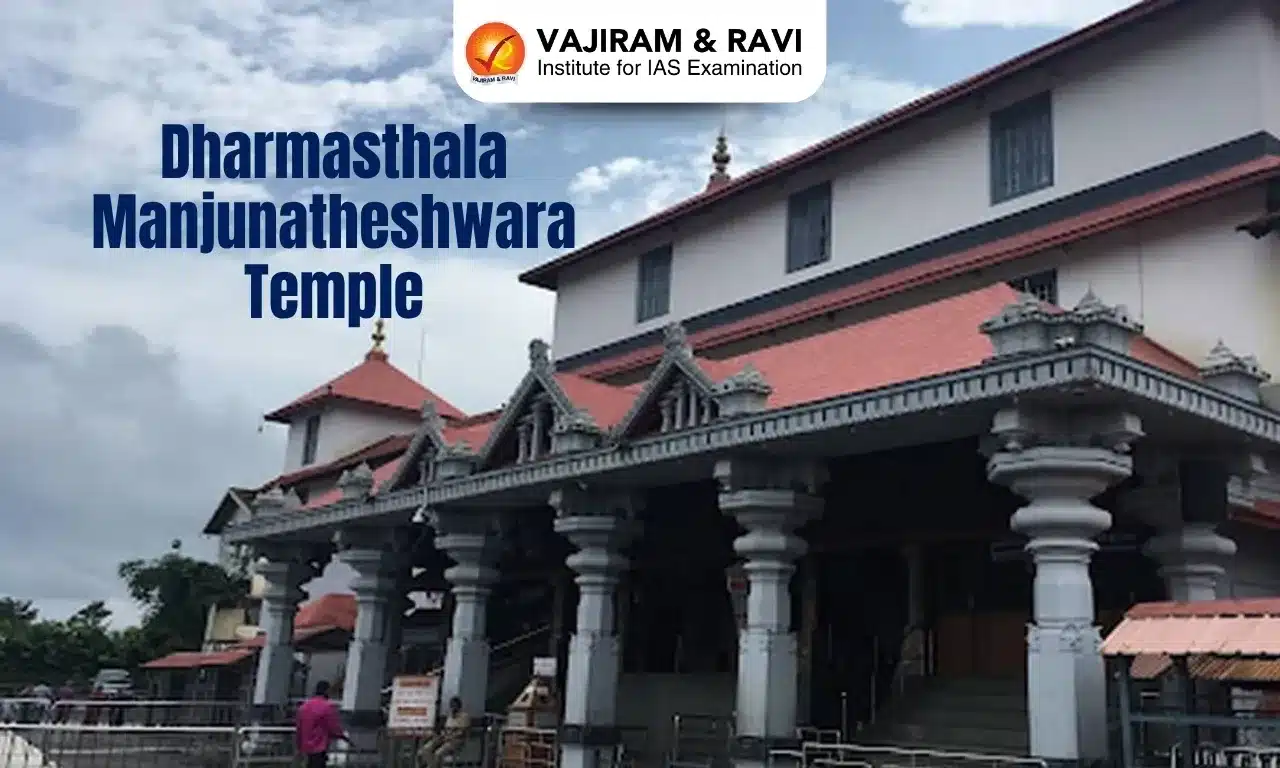
Dharmasthala Manjunatheshwara Temple

Dharmasthala Manjunatheshwara Temple

Dharmasthala Manjunatheshwara Temple Latest News

The Sri Dharmasthala Manjunatheshwara Temple at Dharmasthala recently welcomed the formation of a Special Investigation Team (SIT) by the Karnataka government to probe the allegation of mass secret burial of unidentified bodies in the pilgrimage centre.

About Dharmasthala Manjunatheshwara Temple

  • It is a Hindu temple located in the town of Dharmasthala in Karnataka.
  • It is dedicated to Lord Shiva, who here is worshipped as Lord Manjunatha.
  • The temple dates back 800 years.
  • It has Madhwa Vaishnava priests and is administered by a hereditary Jain family, the Heggades.

Dharmasthala Manjunatheshwara Temple Architecture

  • The temple has been built following the Kerala temple architecture
  • Kerala-style temples are different from temples in other South Indian temple architecture, and the Manjunatha Dharmasthala temple reflects this differentiation.
  • Materials used in building the temple are wood, clay, stone, metals, and laterite. The base structure is made up of granite and laterite.  
  • The temple has a square plan, and therefore a pyramidal sloping roof. 
  • The wooden roof is covered in gold-plated copper plates to protect the inner skeletal framework. 
  • Wooden pillars support the front pavilion of the temple.

Source: IE

Dharmasthala Manjunatheshwara Temple FAQs

Q1: The Dharmasthala Manjunatheshwara Temple is located in which Indian state?

Ans: Karnataka

Q2: To which deity is the Dharmasthala Temple primarily dedicated?

Ans: Lord Shiva (as Lord Manjunatha)

Q3: Approximately how old is the Dharmasthala Manjunatheshwara Temple?

Ans: 800 years

Q4: The architecture of the Dharmasthala Manjunatheshwara Temple is influenced by which regional style?

Ans: Kerala temple architecture

Kashi Declaration

Kashi Declaration

Kashi Declaration Latest News

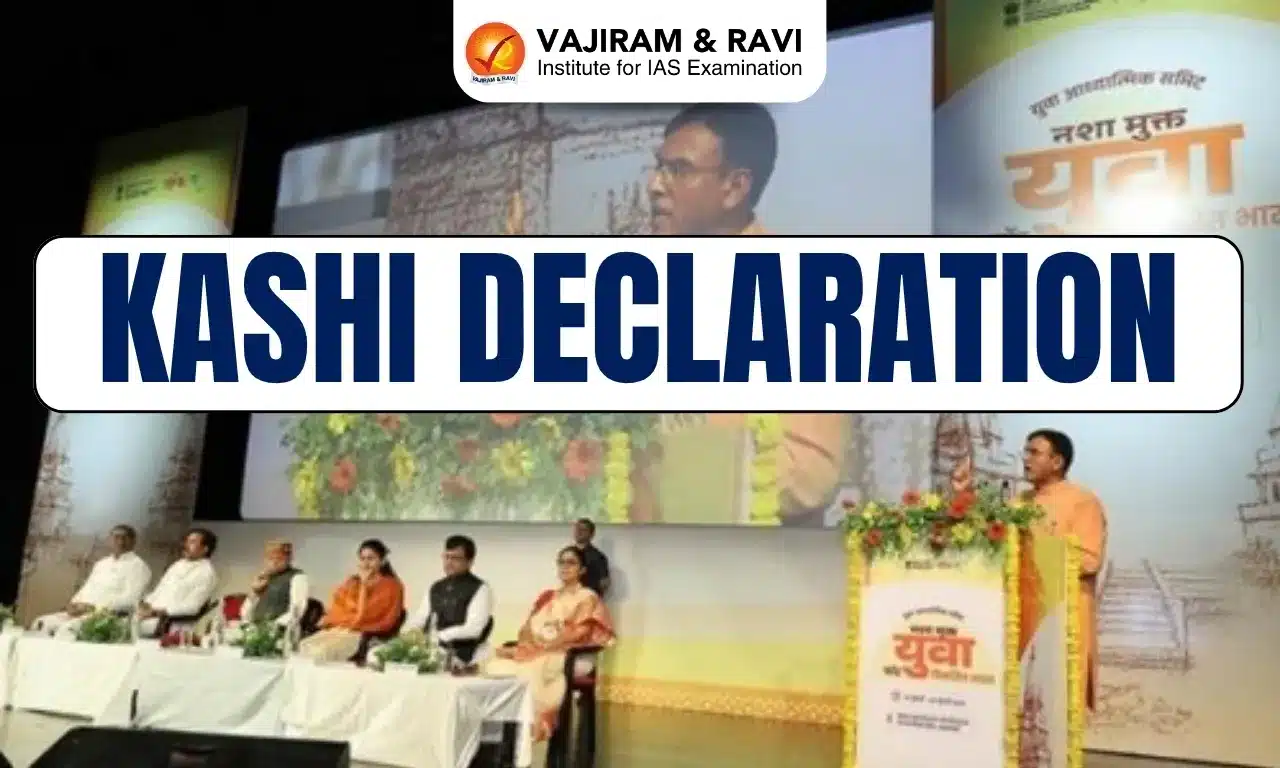
The Youth Spiritual Summit concluded recently at the Rudraksh International Convention Centre in Varanasi with the formal adoption of the Kashi Declaration.

About Kashi Declaration

  • It was adopted at the Youth Spiritual Summit, held under the theme ‘ Drug-free Youth for Developed India ’ at the Rudraksh International Convention Centre in Varanasi.
  • The summit was organised by the Ministry of Youth Affairs and Sports.
  • The summit brought together over 600 youth leaders from more than 120 spiritual and socio-cultural organisations, along with academicians, experts, and government representatives. 
  • The event was a moment in India’s pursuit of a drug-free society by 2047, uniting spiritual strength with youthful resolve.
  • The Kashi Declaration calls for treating substance abuse as a complex public health and societal challenge.
    • It recommends a whole-of-government and whole-of-society approach, integrating efforts from spiritual, educational, technological, and cultural domains.
    • It proposed institutional mechanisms for multi-ministerial coordination, including the formation of a Joint National Committee, annual progress reporting, and a national platform for linking affected individuals to support services.

Source: DD

Kashi Declaration FAQs

Q1: The Kashi Declaration was adopted at which event?

Ans: Youth Spiritual Summit

Q2: What was the theme of the Youth Spiritual Summit where the Kashi Declaration was adopted?

Ans: Drug-free Youth for Developed India

Q3: Which Ministry organized the Youth Spiritual Summit?

Ans: Ministry of Youth Affairs and Sports

Guryul Ravine Fossil Site

Guryul Ravine Fossil Site

Guryul Ravine Fossil Site Latest news

The Geological Survey of India (GSI) has issued a stark warning to the Jammu and Kashmir administration over a “serious threat” to the important Guryul Ravine fossil site in Khonmoh, on the outskirts of Srinagar.

About Guryul Ravine Fossil Site

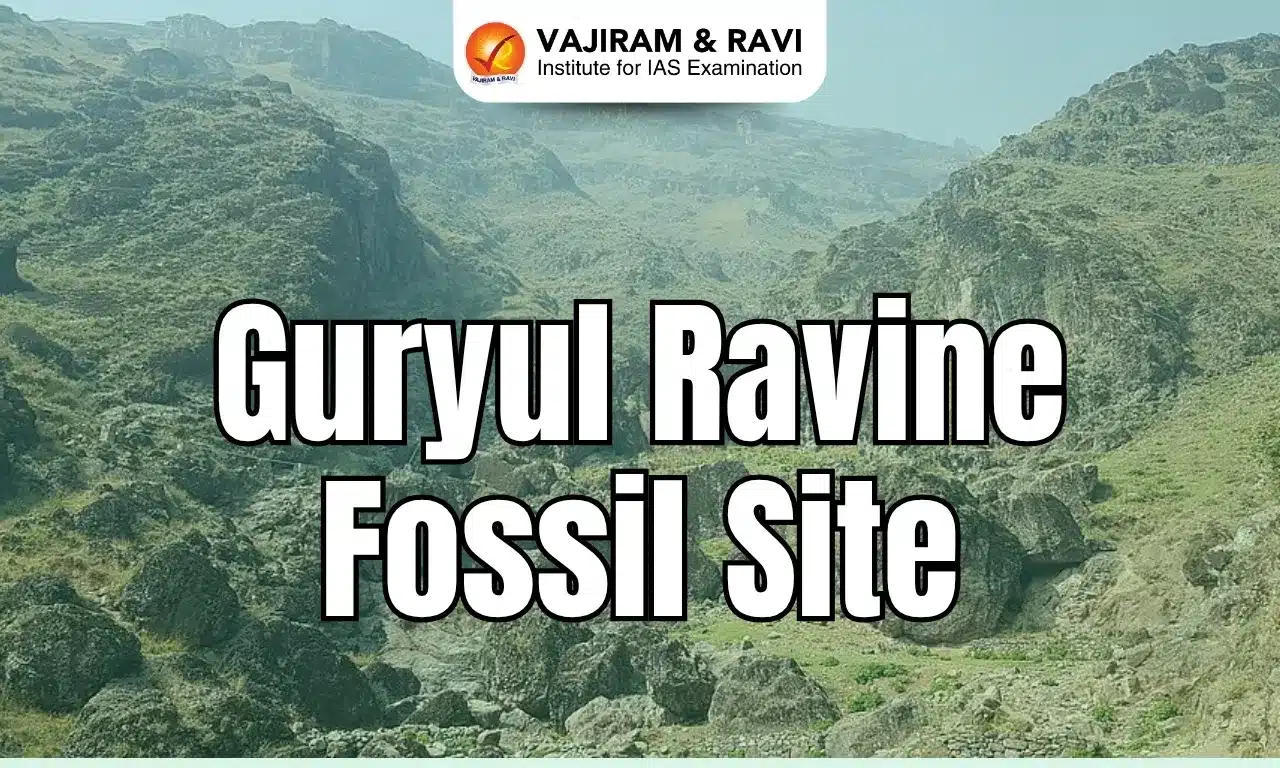
  • Location: The Guryul Ravines is located in Kashmir, geologically known as the Vihi district.
  • It consists of a repository of fossils that hold evidence of the Permian–Triassic extinction event, dating as far as back 260 million years.
  • These preserve clear evidence of the catastrophic Permian–Triassic mass extinction, which wiped nearly all life on Earth.
  • It also hosts what geologists believe is the world’s first-ever recorded tsunami event, its imprint still visible in the exposed rock layers.
  • The site lies near Dachigam National Park and falls within the sensitive Khonmoh Conservation Reserve area.

What is the Permian–Triassic Extinction Event?

  • It is also known as the End-Permian Extinction or, colloquially, the ‘Great Dying’.
  • The Permian-Triassic extinction event marked the boundaries between the Permian and Triassic geological periods, as well as between the Paleozoic and Mesozoic eras approximately 251.9 million years ago.
  • It was one of the major extinction events that the planet ever saw, when biodiversity decreased rapidly and across wide stretches. 

Source: DH

Guryul Ravine Fossil Site FAQs

Q1: What was the cause of the Permian triassic mass extinction?

Ans: Warming of the Earth's climate and associated changes to oceans were the most likely causes of the extinctions.

Q2: What animals went extinct in the Permian Triassic extinction?

Ans: Many families of brachiopods, gastropods, bivalves, and marine reptiles also became extinct.

Meri Panchayat App

Meri Panchayat App

Meri Panchayat App Latest News

The mobile application “Meri Panchayat” has been internationally recognized with the prestigious World Summit on the Information Society (WSIS) Prizes 2025 Champion Award.

About Meri Panchayat App

  • It is designed to provide a unified digital governance platform for rural areas, catering to residents, functionaries, and stakeholders of the Panchayati Raj Institution system.
  • This platform integrates and consolidates diverse functions and information currently dispersed across multiple government portals into a single, seamless web-based interface. It fosters a more accountable and participatory governance ecosystem for rural communities.
  • It is an initiative of the Ministry of Panchayati Raj and National Informatics Centre (NIC) under the Ministry of Electronics and Information Technology.  
  • Through Meri Panchayat App, citizens can effortlessly access, on their mobile devices:
    • Real-time Panchayat budgets, receipts, payments and development plans 
    • Details of elected representatives and functionaries 
    • Information on public infrastructure and civic services in their Panchayat
    • Gram Panchayat Development Plans (GPDPs) and track project proposals
    • Weather forecasting at Gram Panchayat level
    • Social audit tools, fund utilization data, and grievance redressal with geo-tagged and geo-fenced features
    • Multilingual interface supporting 12+ Indian languages to ensure inclusiveness
    • The app also enables citizens to propose new projects, review and rate implemented works, and access Gram Sabha agendas and decisions, thereby strengthening participatory democracy and civic engagement.

World Summit on the Information Society (WSIS) Prizes

  • It was developed in response to requests from the WSIS stakeholders to create an effective mechanism to evaluate projects and activities that leverage the power of information and communication technologies (ICTs) to advance sustainable development.

Source: PIB

Meri Panchayat App FAQs

Q1: What is the use of Meri Panchayat app?

Ans: "Meri Panchayat" app plays a significant role in the Panchayati Raj system by providing a digital platform for citizens to access comprehensive information about their local Gram Panchayats and Village Committees.

Q2: What does the National Informatics Centre do?

Ans: NIC was established in the year 1976 with the objective to provide technology-driven solutions to Central and State Governments, NIC mandate is: Technology partner of the Government. Design and Develop IT Systems for the Government. Provide ICT Infrastructure to the Government.

Cy-TB Test

Cy-TB Test

Cy-TB Test Latest News

Recently, the Kerala health authorities have introduced a test called Cy-TB for detecting and treating tuberculosis (TB) infection following the prioritisation of latent TB infection treatment under the National TB Elimination Programme (NTEP). 

About Cy-TB Test

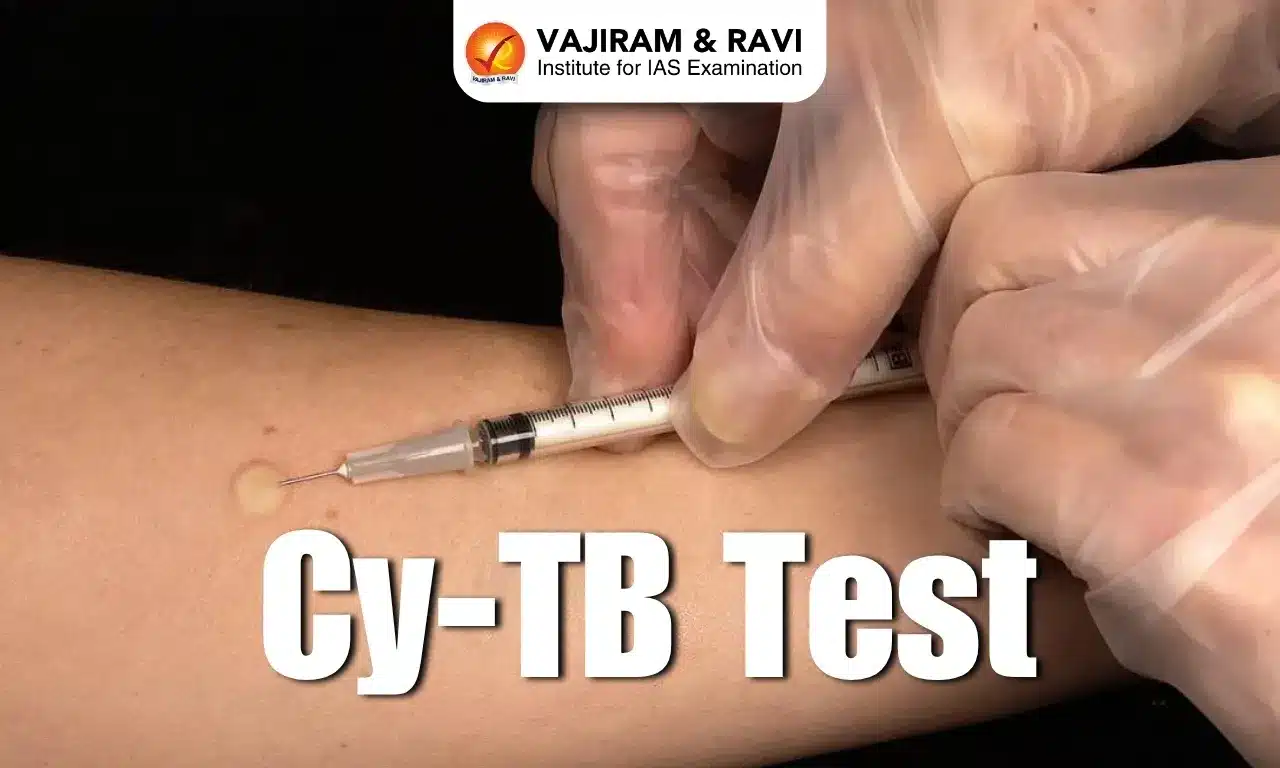
  • It is a new intradermal test for detecting and treating tuberculosis (TB) infection.
  • It is a third-generation test approved by the Central TB Division, Government of India.
  • It is the current recommendation for use of the Cy-tb skin test under the NTEP program for age 18 years and above.

How does the Cy-TB Test Work?

  • Cy-TB is a highly specific, accurate and user-friendly skin test, wherein 0.1 ml doses of M. tuberculosis-specific antigens (ESAT-6 and CFP-10) are injected into the skin in the inner forearm.
  • An induration (a raised area) of 5 mm or more which develops on the skin within 48-72 hours indicates TB infection.

What is TB?

  • TB is caused by bacteria (Mycobacterium tuberculosis) and it most often affects the lungs. TB is spread through the air when people with lung TB cough, sneeze or spit. A person needs to inhale only a few germs to become infected.
  • According to the World Health Organization’s Global Tuberculosis Report 2024, India continues to lead in the global TB burden (26% of cases) and is also the hub for drug-resistant TB (DR-TB) and TB deaths.
  • TB is the leading cause of death of people with HIV and also a major contributor to antimicrobial resistance.

Source: TH

Cy-TB Test FAQs

Q1: What is the cy-tb test?

Ans: Cy-Tb is the next generation skin test for the detection of TB infection (TBI).

Q2: What are the disadvantages of Cy-TB test?

Ans: The most common side effects of Cy-Tb are mild reactions at the injection site, for instance, itching and pain (23.7%–53.1%).

Hatti Tribe

Hatti Tribe

Hatti Tribe Latest News

Recently, two brothers of the Hatti tribe tied the knot to a woman in Himachal Pradesh, with hundreds of people witnessing the marriage solemnised under the anachronistic tradition of polyandry.

About Hatti Tribe

  • The Hattis are a close-knit community who take their name from their traditional occupation of selling home-grown crops, vegetables, meat, and wool at small-town markets known as ‘haats’.
  • Hatti men traditionally don a distinctive white headgear on ceremonial occasions.
  • These tribal people reside in the Himachal-Uttarakhand border in the basin of the Giri and Tons rivers, both tributaries of the Yamuna.
  • There are two main Hatti clans: one in the Trans-Giri area of the Sirmaur district in Himachal Pradesh and the other in Jaunsar Bawar of Uttarakhand.
  • The two Hatti clans have similar traditions, and intermarriages are common.
  • They are governed by a traditional council called ‘khumbli’ which decides community matters.
  • Economy: The Hatti population relies on agriculture for livelihood and bare subsistence since their climate is ideal for growing “Cash Crops.”
  • Population: According to the 2011 census, members of the community numbered 2.5 lakh, but at present population of the Hattis are estimated at around 3 lakhs.
  • In 2023, the Indian government granted Scheduled Tribe (ST) status to the Hatti community in Himachal Pradesh.
  • The Jaunsar- Bawar region of Uttarakhand was granted tribal status in 1967.

Source: IE

Hatti Tribe FAQs

Q1: What are the criterias for inclusion in the Scheduled Tribes List in India?

Ans: The criteria presently followed for specification of a community as a Scheduled Tribe are : (i) indications of primitive traits, (ii) distinctive culture, (iii) geographical isolation, (iv) shyness of contact with the community at large, and (v) backwardness.

Q2: In which state is the Hatti tribe?

Ans: They inhabit in the Trans-Giri region along the Himachal Pradesh–Uttarakhand border.

Codex Alimentarius Commission (CAC)

Codex Alimentarius Commission

Codex Alimentarius Commission Latest News

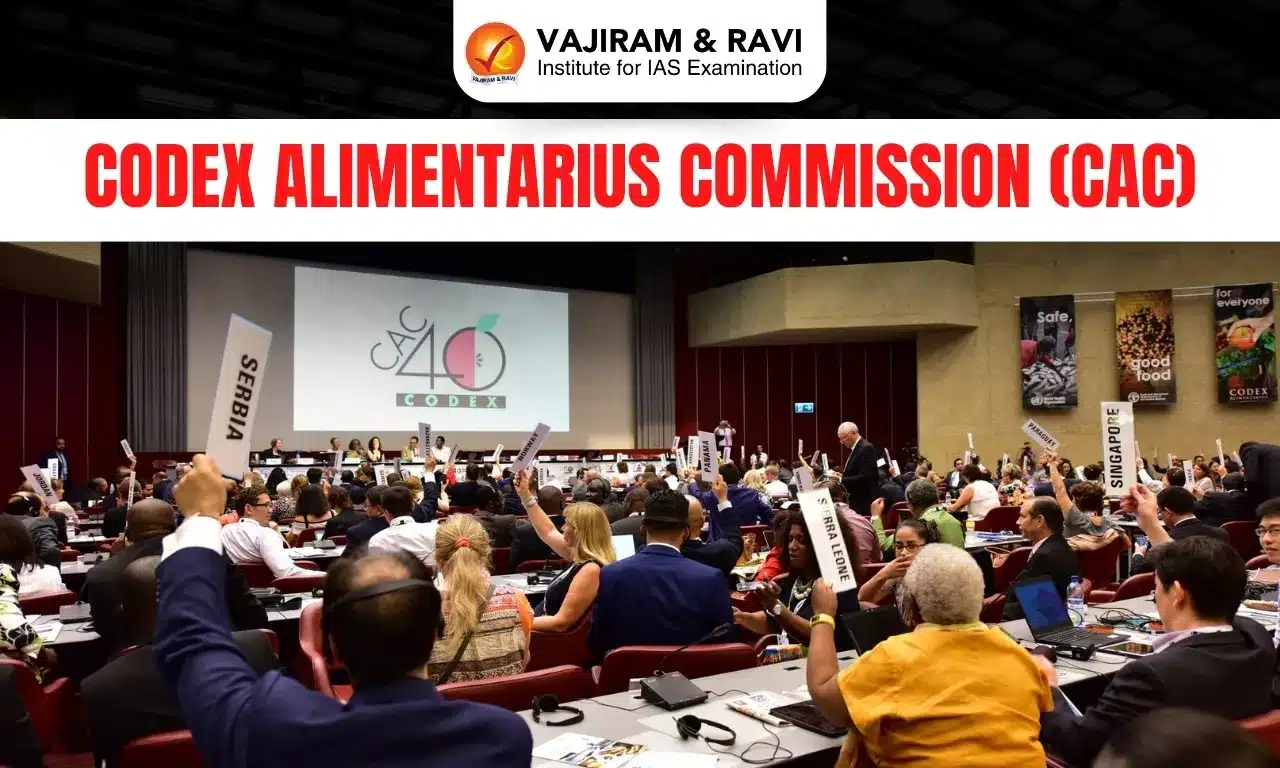
India’s role in global food standard development was appreciated in the 88th session of the Executive Committee of the Codex Alimentarius Commission (CCEXEC 88), held at the FAO Headquarters in Rome recently.

About Codex Alimentarius Commission

  • It is the international food standards-setting body.
  • It was established jointly by the Food and Agriculture Organization (FAO) and the World Health Organization (WHO) in May 1963.
  • Objective: Protecting consumer’s health and ensuring fair practices in the food trade.
  • It has its headquarters in Rome.
  • Membership:
    • Membership of the Commission is open to all Member Nations and Associate Members of FAO and WHO which are interested in international food standards.
    • Currently the CAC has 189 Codex Members made up of 188 Member Countries and 1 Member Organization (The European Union). 
    • India became a member of CAC in 1964.
  • The CAC consists of the following main organizational elements:
    • Commission;
    • Executive Committee;
    • Codex Secretariat;
    • Codex subsidiary bodies.
  • The Commission meets in regular session once a year, alternating between Geneva and Rome.
  • Funding: The programme of work of the Commission is funded through the regular budgets of WHO and FAO, with all work subject to approval of the two governing bodies of the parent organisations.


What is Codex Alimentarius?

  • The Codex Alimentarius, or “Food Code”, is a collection of international standards, guidelines, and codes of practice to protect the health of consumers and ensure fair practices in the food trade. 
  • Codex standards are used worldwide to harmonize national food safety regulations and are recognized in the WTO Agreement on the Application of Sanitary and Phytosanitary (SPS) Measures as the international reference point for food safety. 
  • When food producers and traders comply with Codex standards, consumers can trust the safety and quality of the products they buy, and importers can have confidence that the food they ordered will meet the specifications.
  • The standards are adopted by the Codex Alimentarius Commission.

Codex Alimentarius and India

  • The National Codex Contact Point (NCCP) of India has been constituted by the Food Safety and Standards Authority of India (FSSAI) for keeping liaison with the Codex Alimentarius and to coordinate Codex activities in India. 
  • NCCP for India coordinates and promotes Codex activities in India in association with the National Codex Committee and facilitates India’s input to the work of Codex through an established consultation process.

Source: NOA

Codex Alimentarius Commission FAQ's

Q1: What is the primary function of the Codex Alimentarius Commission (CAC)?

Ans: To set international food standards.

Q2: The Codex Alimentarius Commission (CAC) was established jointly by which two organizations?

Ans: FAO and WHO

Q3: Where is the headquarters of the Codex Alimentarius Commission located?

Ans: Rome

Q4: India became a member of the Codex Alimentarius Commission in which year?

Ans: 1964

Bima Sakhi Yojana

Bima Sakhi Yojana

Bima Sakhi Yojana Latest News

Life Insurance Corporation of India (LIC) recently entered into an MoU with the Department of Rural Development, Union Ministry of Rural Development, to promote its Bima Sakhi Yojana in rural areas.

About Bima Sakhi Yojana

  • It is an initiative of the Life Insurance Corporation of India (LIC).
  • It is a performance-oriented stipendiary scheme exclusively for women.
  • It is designed to empower women aged 18-70 years, who are Class X pass. 
  • They will receive specialized training and a stipend for the first three years to promote financial literacy and insurance awareness. 
  • Female agents will get a stipend of Rs. 7,000 per month for the first year, Rs. 6,000 per month in the second year, and Rs. 5,000 per month in the third year.
  • Bima Sakhis will also get commissions. They will receive a commission of Rs 48,000 (excluding bonus) for the first year.
  • After training, they can serve as LIC agents, and the graduate Bima Sakhis would have the opportunity to qualify for being considered for Development Officer roles in LIC.
  • The plan is to appoint two lakh Bima Sakhi over a period of three years.

Bima Sakhi Yojana Eligibility

  • Women must be aged between 18 and 70.
  • The minimum qualification of a woman must be 10th grade passed.
  • Preference will be given to women residing in rural areas.
  • The following women are ineligible to apply for this scheme:
    • Women related to existing agents and employees of LIC. Relatives include spouses, children, adopted and stepchildren, parents, sisters, brothers, and immediate in-laws.
    • Women should not be retired employees and ex-agents of LIC.
    • Women should not be existing agents of LIC.

Source: TH

Bima Sakhi Yojana FAQs

Q1: Which organization launched the Bima Sakhi Yojana?

Ans: Life Insurance Corporation of India (LIC)

Q2: What is the minimum educational qualification required to apply for Bima Sakhi Yojana?

Ans: 10th pass

Q3: What is the monthly stipend for Bima Sakhis during the first year?

Ans: Rs. 7,000

International Seabed Authority (ISA)

International Seabed Authority

International Seabed Authority Latest News

After two weeks of negotiations, the International Seabed Authority (ISA) is still far from finalising rules for the extraction of coveted metals on the high seas despite heightened pressure triggered by US efforts to fast-track the controversial practice.

About International Seabed Authority

  • It is an autonomous international organization established under the 1982 United Nations Convention on the Law of the Sea (UNCLOS) and the 1994 Agreement relating to the Implementation of Part XI of the United Nations Convention on the Law of the Sea (1994 Agreement).
  • ISA, which has its headquarters in Kingston, Jamaica, came into existence on 16 November 1994, upon the entry into force of UNCLOS.
  • Mandate: To regulate mining and related activities in the international seabed beyond national jurisdiction.
    • The international seabed area — the part which is under ISA jurisdiction — is the seabed and ocean floor and the subsoil thereof, beyond the limits of national jurisdiction. 
    • The international seabed area covers around 54 percent of the total area of the world’s oceans.
  • ISA is the organization through which states parties to UNCLOS organize and control all mineral-resources-related activities in the international seabed area for the benefit of humankind as a whole.
  • In so doing, ISA has the mandate to ensure the effective protection of the marine environment from harmful effects that may arise from deep-seabed-related activities.

International Seabed Authority Membership

  • In accordance with UNCLOS, Article 156(2), all States Parties to UNCLOS are members of ISA. 
  • ISA has 169 members, including 168 member States and the European Union.

International Seabed Authority Structure

  • The supreme authority of the ISA is the assembly, in which all ISA members are represented. 
  • The assembly sets general policies, establishes budgets, and elects a 36-member council, which serves as the ISA’s executive authority.
  • The council approves contracts with private corporations and government entities for exploration and mining in specified areas of the international seabed.
  • The council oversees implementation of the seabed provisions of the UNCLOS and establishes provisional rules and procedures (subject to approval by the assembly) by which the ISA exercises its regulatory authority. 
  • The secretary-general of the ISA is nominated by the council and is elected by the assembly to a four-year term.

Key Facts about United Nations Convention on the Law of the Sea

  • UNCLOS, also called the Law of the Sea Convention or the Law of the Sea Treaty, is an international agreement that establishes a legal framework for all marine and maritime activities.
  • It lays down a comprehensive regime of law and order in the world’s oceans and seas, establishing rules governing all uses of the oceans and their resources. 
  • UNCLOS became effective on 16th November 1982.
  • UNCLOS covers a wide range of issues, including:
    • The definition of maritime zones, such as the territorial sea, the contiguous zone, the exclusive economic zone, and the continental shelf.
    • The rights and responsibilities of coastal states and flag states.
    • The conservation and management of marine resources.
    • The protection of the marine environment.
    • The peaceful settlement of disputes

Source: TH

International Seabed Authority FAQs

Q1: Under which international legal framework was the International Seabed Authority (ISA) established?

Ans: United Nations Convention on the Law of the Sea (UNCLOS)

Q2: Where is the headquarters of the International Seabed Authority (ISA) loca

Ans: Kingston, Jamaica

Q3: What is the main mandate of the International Seabed Authority?

Ans: To regulate mining and related activities in the international seabed area.

Vice President Jagdeep Dhankhar Resigns Citing Health Reasons

Vice President Resignation

Vice President Resignation Latest News

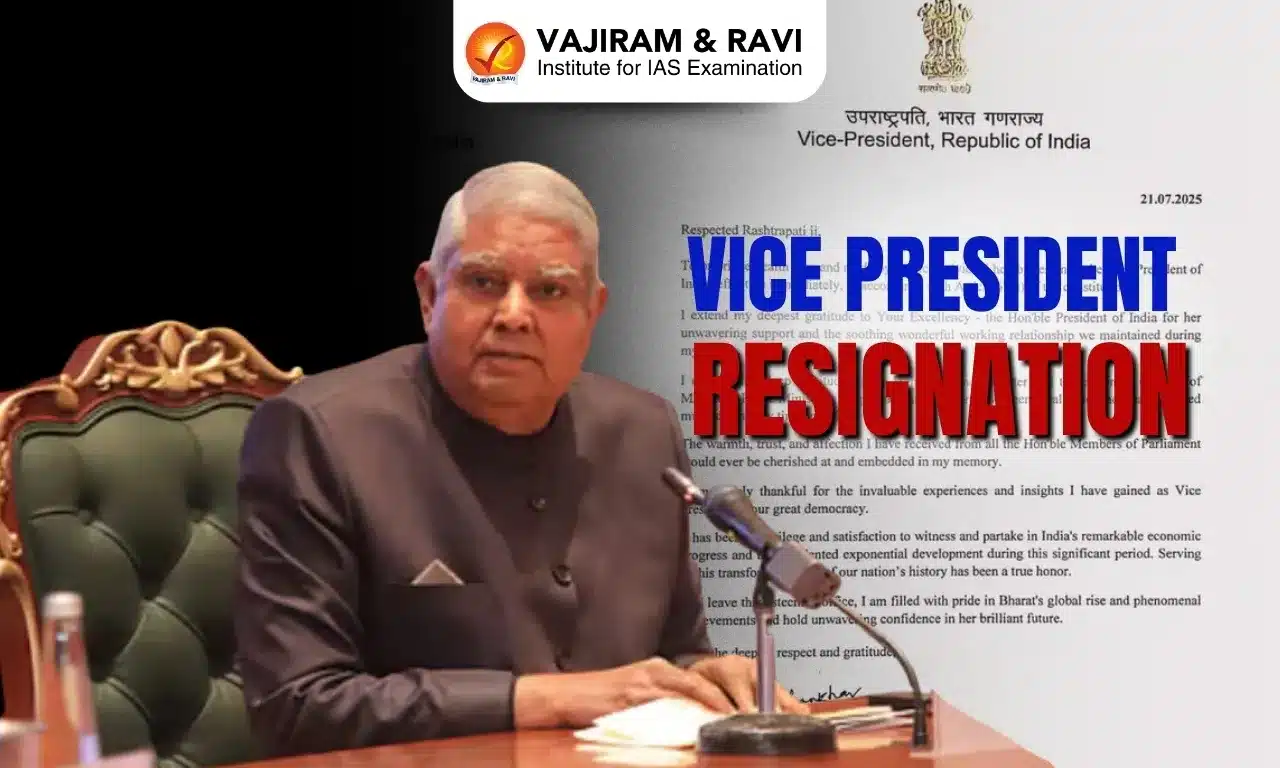
  • In an unexpected development, Vice President Jagdeep Dhankhar resigned from his post on July 21, the opening day of the Monsoon session of Parliament. 
  • Citing health concerns and following medical advice, Dhankhar submitted his resignation to President Droupadi Murmu, invoking Article 67(a) of the Constitution
  • Jagdeep Dhankhar is the third Vice President in India’s history to resign mid-term, after V. V. Giri and R. Venkataraman, who resigned to contest presidential elections.

Vice President’s Resignation Procedure

  • As per Article 67 of the Constitution, the Vice President can resign anytime by submitting a written resignation to the President. 
  • Once accepted, the resignation takes immediate effect, requiring only formal communication and acknowledgment—no approval process is needed.

Article 67(a) 

  • Article 67(a) of the Indian Constitution allows the Vice President to resign before completing the five-year term by submitting a written resignation to the President. 
  • Jagdeep Dhankhar, who became Vice President in August 2022, invoked this article to step down two years early, well before his term was due to end in 2027.

Succession After Vice President’s Resignation

  • When the Vice President of India resigns, an election must be held to fill the vacancy, as per constitutional provisions. 
  • The Constitution does not provide for an acting Vice-President
  • However, since the Vice-President is also the ex-officio Chairman of the Rajya Sabha, the Deputy Chairman, currently Harivansh Narayan Singh, will preside over the House in his absence.
  • This seamless succession mechanism ensures that the functioning of the Rajya Sabha continues without disruption.

Timeline for Vice-Presidential Election

  • Unlike the President’s post, the Constitution does not set a fixed deadline for filling a Vice-Presidential vacancy
  • The only stipulation is that the election be conducted “as soon as possible” after the office falls vacant
  • The Election Commission is responsible for announcing the schedule. 
  • The election is held under the Presidential and Vice-Presidential Elections Act, 1952. 
  • Traditionally, the Secretary General of either House of Parliament is appointed as the Returning Officer on a rotational basis.

Tenure of the New Vice President

  • A newly elected Vice President, in the event of a mid-term vacancy, will serve a full five-year term from the date of assuming office, not merely the remaining period of the predecessor's term. 
  • This is a crucial distinction from some other constitutional offices where successors may serve only the unexpired term.

Eligibility Criteria for Vice-President of India

  • As per Article 66 of the Indian Constitution, a person is eligible to contest for the office of Vice-President if: 
    • He is an Indian citizen, 
    • at least 35 years old, and 
    • qualified to be elected as a member of the Rajya Sabha. 
  • Additionally, the candidate must not hold any office of profit under the Central or State Government or any local or public authority.

Election Process for the Vice-President of India

  • The Vice-President is elected by an electoral college consisting of members from both the Lok Sabha and Rajya Sabha, including nominated members. 
  • State legislatures do not participate in this process. 
  • Voting takes place in the Parliament House through a secret ballot, using the proportional representation system with a single transferable vote. 
  • Each Member of Parliament ranks candidates in order of preference, with all votes carrying equal weight. 
  • A candidate must secure a quota of votes — calculated by dividing the total valid votes by two and adding one — to win. 
  • If no candidate reaches the quota initially, the one with the fewest first-preference votes is eliminated, and their votes are redistributed according to second preferences. 
  • This elimination and transfer process continues until a candidate meets the required quota.

Role and Importance of the Vice President of India

  • The Vice President is the second-highest constitutional authority in India and acts as the ex-officio Chairperson of the Rajya Sabha
  • Though not a member of any House or state legislature, the Vice President ensures smooth conduct of proceedings in the Upper House. 
  • In the event of the President’s death, resignation, removal, or inability to perform duties, the Vice President temporarily assumes presidential responsibilities until a new President is elected.

Source: TH | LM | ABP

Vice President resignation FAQs

Q1: Why did Vice President Jagdeep Dhankhar resign?

Ans: He resigned citing health issues and medical advice, invoking Article 67(a) of the Constitution for voluntary resignation.

Q2: What happens after a Vice President resigns?

Ans: The Deputy Chairman of Rajya Sabha presides temporarily, and an election must be held to fill the vacancy.

Q3: How is a new Vice President elected?

Ans: MPs vote in a secret ballot using proportional representation and transferable votes until one candidate meets the quota.

Q4: What are the eligibility criteria for Vice President?

Ans: Must be an Indian citizen, at least 35, eligible for Rajya Sabha, and not hold an office of profit.

Q5: What is the Vice President’s role in India?

Ans: He is the second-highest constitutional authority and ex-officio Chairman of Rajya Sabha, ensuring smooth functioning of the House.

AI vs Copyright: What Courts Are Saying About Fair Use

AI vs Copyright

AI and Copyright Latest News

  • Recent U.S. court rulings — Thomson Reuters vs Ross Intelligence, Bartz vs Anthropic, and Kadrey vs Meta — have clarified that using legitimately acquired texts for training AI models may qualify as "fair use" under copyright law, especially when the output is transformative. 
  • However, the legality of using pirated data or the full impact on creative markets remains unresolved, leaving significant legal uncertainty around AI-generated content.

Copyright Challenges in AI-Generated Content

  • Generative AI models sometimes replicate or closely resemble original copyrighted works, leading to legal and ethical concerns. 
  • The key legal question is whether training AI on such data and producing new content harms the original creator’s market or qualifies as “transformative use.” 
  • While some jurisdictions like the U.S. may consider it fair use, others like the EU and U.K. allow it under text and data mining exceptions. 
  • However, with AI often trained on large datasets scraped from the internet—including both copyrighted and public domain materials—the global legal consensus on copyright infringement remains unsettled.

Legal Uncertainty Around Databases and Generative AI

  • The use of databases and published works for training generative AI models raises complex questions rooted in intellectual property law, contracts, and privacy norms. 
  • There is widespread legal ambiguity about whether training AI on IP-protected data and generating outputs from it constitutes infringement. 
  • Some countries allow exceptions for fair use, text and data mining, or temporary copying, but these exceptions vary and haven’t been universally tested in court. 
  • A major concern is the lack of harmonised global rules, which deepens the uncertainty around who owns IP rights in AI-generated content. 
  • This is particularly challenging in copyright law, which traditionally demands human authorship—a standard generative AI does not meet.

US Courts Back Fair Use in AI Training but Warn Against Piracy

  • Two significant U.S. court rulings—one favoring Anthropic and the other Meta—affirmed that using copyrighted material to train AI models may qualify as fair use. 
  • In Anthropic’s case, Judge ruled that training AI using copyrighted texts is transformative, likening it to how writers learn from existing literature
  • However, he allowed the trial to proceed on the issue of using pirated data. 
  • In Meta’s case, Judge held that the plaintiffs failed to prove that AI outputs diluted the market for original works, thus ruling in Meta’s favor under the fair use doctrine
  • Both rulings offer legal protection to tech firms for AI training but underscore that piracy remains a legal risk and that mechanisms for compensating copyright holders are necessary.

Implications of AI Copyright Disputes for India

  • The ANI vs OpenAI lawsuit is shaping how India’s intellectual property laws apply to generative AI. 
  • Under the Copyright Act, 1957, copyright holders have exclusive rights—such as reproduction and adaptation—which require permission unless exempt under Section 52’s fair dealing clause
  • Although India’s IP laws don’t explicitly mention AI, the prevailing view is that the existing legal framework is adequate to handle AI-related challenges. 
  • As a signatory to major global IP treaties, India recognises works by legal entities and provides civil and criminal enforcement, including safeguards against digital rights violations.

Source: TH

AI and copyright FAQs

Q1: What is the main legal issue around AI and copyright?

Ans: Whether AI training on copyrighted material qualifies as fair use or infringes rights is the central legal challenge.

Q2: What did U.S. courts say about training AI models?

Ans: Courts upheld fair use for legally acquired data but warned against piracy and potential market harm from AI outputs.

Q3: Does India have laws for AI and copyright?

Ans: India’s Copyright Act 1957 applies, but lacks AI-specific clauses. Fair dealing under Section 52 may offer exceptions.

Q4: What is the status of database use in AI training?

Ans: Database use raises IP and privacy issues. No global clarity yet on fair use or ownership of AI-generated outputs.

Q5: What’s the global legal outlook for AI and copyright?

Ans: No harmonised global rule exists yet. Fair use and text mining exceptions vary across jurisdictions, leading to uncertainty.

Article 295 of Indian Constitution, Landmark Cases, Importance

Article 295 of Indian Constitution

Article 295 of the Constitution of India covers the succession of property, rights, liabilities and obligations in cases. The article is extremely important as it helps in a transition of responsibilities from princely states to the Union and state government. In this article, we are going to cover Article 295, its importance, developments and amendments. 

Article 295 of Constitution of India

Article 295 of the Constitution of India talks about the integration of princely states into the Indian Union after independence that needed guidelines for the transfer of assets and liabilities. The article covers all the guidelines that a princely state had to qualify in order to be succeeded by Union or state governments . These guidelines and rights and obligations help in setting legal clarity and governance. 

Article 295 as Stated in the Indian Constitution 

Succession to property, assets, rights, liabilities and obligations in other cases

(1) As from the commencement of this Constitution —

(a) all property and assets which immediately before such commencement were vested in any Indian State corresponding to a State specified in Part B of the First Schedule shall vest in the Union, if the purposes for which such property and assets were held immediately before such commencement will thereafter be purposes of the Union relating to any of the matters enumerated in the Union List; and

(b) all rights, liabilities, and obligations of the Government of any Indian State corresponding to a State specified in Part B of the First Schedule, whether arising out of any contract or otherwise, shall be the rights, liabilities, and obligations of the Government of India, if the purposes for which such rights were acquired or liabilities or obligations were incurred before such commencement will thereafter be purposes of the Government of India relating to any of the matters enumerated in the Union List, subject to any agreement entered into in that behalf by the Government of India with the Government of that State.

(2) Subject as aforesaid, the Government of each State specified in Part B of the First Schedule shall, as from the commencement of this Constitution, be the successor of the Government of the corresponding Indian State as regards all property and assets and all rights, liabilities, and obligations, whether arising out of any contract or otherwise, other than those referred to in clause (1).

Article 295 of Indian Constitution Landmark Cases 

Although Article 295 has not been the centerpiece of numerous landmark Supreme Court judgments, its principles concerning the succession of assets and liabilities have been recognized and upheld in several important cases, especially in the context of the integration of princely states and the distribution of property between the Union and states. Key judgments include:

  • State of Rajasthan v. Union of India (1977):
    This case examined the scope of the Union’s powers over states and referred to the distribution of assets and liabilities during the integration process. The Supreme Court acknowledged the significance of constitutional provisions like Article 295 in maintaining the federal structure.
  • Madhav Rao Scindia v. Union of India (1971):
    The abolition of privy purses and derecognition of princely rulers raised questions about property rights. The Court analyzed how such changes impacted asset succession, underlining the role of Article 295 in resolving disputes arising from constitutional transitions.

  • State of Seraikella & Others v. Union of India (1951):
    This case involved merger agreements of princely states and the transfer of assets and liabilities to the Union. The judgment highlighted the practical relevance of Article 295 in legitimizing such transfers.

  • Bholanath J. Thakar v. State of Saurashtra (1954):
    The Court addressed disputes stemming from pre-accession agreements of princely states. Article 295 was cited to determine the rights and obligations carried forward after integration.

These judgments reflect how Article 295 has been a constitutional anchor in settling legal issues linked to the succession of assets and liabilities post-independence, particularly in cases involving the merger of princely states into the Indian Union.

Article 295 of Constitution of India Importance

Article 295 in India’s Constitutional Framework has the following importance: 

  • Enabling Integration: Article 295 established the legal basis for transferring the assets and liabilities of princely states to the Indian Union, thereby smoothing their incorporation into the Republic.
  • Guaranteeing Continuity: By prescribing how property and obligations would pass to the Union or the states, the provision ensured administrative stability throughout the post-independence transition.
  • Defining Jurisdiction: It clearly allocated responsibility between the Union and the states for the estates of former princely rulers, averting jurisdictional disputes and ambiguity.

Collectively, Article 295 provided the legal architecture that underpinned the orderly consolidation of a newly independent India.

Also Check Related Articles
Article 295 of Indian Constitution Article 194 of Indian Constitution
Article 39 of Indian Constitution Article 191 of Indian Constitution
Article 20 of Indian Constitution Article 16 of Indian Constitution
Article 67 of Indian Constitution Article 40 of Indian Constitution
Article 78 of Indian Constitution

Article 295 of Indian Constitution FAQs

Q1: What is Article 295 of the Indian Constitution?

Ans: Article 295 deals with the succession of property, assets, rights, and liabilities of the Government of India and the states after the integration of princely states.

Q2: What is Article 296 of the Indian Constitution?

Ans: Article 296 states that properties without an owner (bona vacantia) shall belong to the Union or the State, depending on the territorial jurisdiction.

Q3: What is Article 299 of the Indian Constitution?

Ans: Article 299 lays down the procedure for contracts made in the name of the President or the Governor, making such contracts legally binding only if properly executed.

Q4: What are the Princely states that joined the Indian Union?

Ans: Major princely states that joined India include Hyderabad, Junagadh, Kashmir, Travancore, Mysore, Bhopal, and Baroda, among others.

Q5: What are the guidelines to join the Indian Union?

Ans: Princely states were required to sign the Instrument of Accession, accepting Indian sovereignty in matters of defense, foreign affairs, and communications.

Chhatrapati Sambhaji Maharaj, Biography, Role in Maratha Empire

Chhatrapati Sambhaji Maharaj Biography

Chhatrapati Sambhaji Maharaj was the son of Shivaji Maharaj who was the founder of Maratha Empire. He was a warrior known for his bravery and focused on Maratha heritage and swarajya. He was the descendant of the 96 Maratha Clans well known as 'Kshatriyas' or brave fighters. Sambhaji Maharaj, took the responsibility of safeguarding the Maratha Empire against the Mughal Empire in Delhi as well as carrying and promoting the ideologies of Shivaji Maharaj ahead to the future generation.

Chhatrapati Sambhaji Maharaj Early Life

Chhatrapati Sambhaji Maharaj was the son of Chhatrapati Shivaji Maharaj. His mother's name was Saibai who passed away in 1659 after that he was raised by his grandmother Jijabai. He was well-educated with several languages such as Sanskrit, marathi and hindi.

When Sambhaji was nine years old, he was sent to Raja Jai Singh I of Amber as a political hostage under the Treaty of Purandar (1665) between the Marathas and the Mughals. During his time with the Mughals, he was given the rank of Mansabdar. In 1666 with his father, Shivaji, managed to escape from Mughal captivity. 

Sambhaji Maharaj Role in Maratha Empire

After their escape from the Mughal Captivity, Sambhaji actively supported Shivaji Maharaj in military campaigns. Between 1666 and 1670, he assisted the Mughals against the Sultan of Bijapur before joining his father in expanding the Maratha Empire.

When Chhatrapati Shivaji passed away in April 1680, some court ministers attempted to crown his half-brother, Rajaram, as king. However, Sambhaji quickly took control of key forts like Raigad and Panhala, preventing the capture of these important forts. On 20 July 1680, he was crowned as the Chhatrapati of the Maratha Empire.

Chhatrapati Sambhaji Maharaj Important Events

  • Capture of Torna Fort (1645)

At the age of 16, Shivaji captured Torna Fort, marking his first major conquest and showcasing his courage and strategic skills. Encouraged by this success, he went on to capture forts like Raigad and Pratapgad. These victories caused panic in the Sultan of Bijapur mind, who imprisoned Shivaji’s father, Shahaji. In 1659, when Shivaji attempted another attack on Bijapur, the Sultan sent Afzal Khan to stop him. In 1662, the Sultan of Bijapur signed a peace treaty, recognizing Shivaji as an independent ruler.

  • Battle for Kondana Fort

Kondana Fort was controlled by Nilkanth Rao and later defended by Udaybhan Rathod under Mughal commander Jai Singh I. In a battle, Tanaji Malusare, one of Shivaji’s trusted commanders, led the Maratha forces to capture the fort. Though Tanaji lost his life in battle, the Marathas ultimately secured victory. In his honor, the fort was renamed Sinhagad (Lion’s Fort).

  • Shivaji’s Coronation (1674)

In 1674, Shivaji established himself as an independent ruler and was crowned as Chhatrapati at Raigad. His coronation ceremony symbolized the rise of regional powers challenging Mughal dominance. He was given the title "Haidava Dharmodharka" (Protector of Hindu Dharma) and gained the authority to collect land revenue and taxes, strengthening the newly formed Hindavi Swarajya.

  • Alliance with the Qutb Shahi Dynasty of Golconda

Shivaji allied with the rulers of Golconda, which helped him launch a successful military campaign in Bijapur Karnataka (1676–1679). Through this alliance, he expanded Maratha influence by capturing important forts like Gingee (Jingi), Vellore, and several strongholds in Karnataka.

The Battle of Wai

The Battle of Wai was a significant Maratha War with the Mughals during the late 17th century. It took place near the town of Wai in Maharashtra, a region strategically important for both sides. The Marathas successfully defeated the Mughal forces in the dense forests of Wai and Mahabaleshwar. The victory came at a great cost, as their commander-in-chief, Hambirrao Mohite, was killed. His loss was a major setback for the Marathas, impacting their military leadership.

The Battle of Wai Aftermath

After the Battle of Wai, Sambhaji faced the loss of his court member against the victory in Maratha War. In February 1689, he was captured at Sangameshwar along with 25 close advisors, including his trusted companion, Kavi Kalash.

He was taken to Bahadurgad in Ahmednagar, where Aurangzeb’s forces subjected him to severe humiliation and torture. Despite this, he refused to surrender or convert to Islam. On 11 March 1689, he was executed by beheading at Tulapur. His courage and sacrifice earned him the title “Dharmaveer”, meaning the Protector of Religion in Maratha history.

Chhatrapati Sambhaji Maharaj as a Scholar

Sambhaji Maharaj was not only a brave warrior but also a learned scholar. He was fluent in Marathi, Sanskrit, and Hindi. He authored the Sanskrit book Budhbhushanam, which covers politics and military strategies. He wrote Hindi publications such as Saatsatak, Nayikabhed, and Nakhshikha, depicting his deep knowledge of literature and leadership.

Chhatrapati Sambhaji Maharaj FAQs

Q1: What is Sambhaji Maharaj famous for?

Ans: Chhatrapati Sambhaji Maharaj is renowned for his bravery, military prowess, and unwavering defense of the Maratha Empire against the Mughal Empire, particularly under Aurangzeb, earning him the title of a "dharmaveer" (protector of dharma).

Q2: How did Shivaji's brother Sambhaji die?

Ans: Sambhaji Maharaj was captured by the Mughals in 1689, tortured, and executed by beheading at Tulapur on Aurangzeb’s orders for refusing to convert to Islam.

Q3: How was Sambhaji caught?

Ans: Sambhaji was captured in February 1689 at Sangameshwar after being betrayed by his own court members. Mughal forces, led by Muqarrab Khan, seized him and his advisors.

Q4: Who died first, Shivaji or Sambhaji?

Ans: Shivaji passed away first, on 3 April 1680, at Raigad Fort. His son, Sambhaji, was later captured and executed by the Mughals on 11 March 1689.

Q5: What was the biggest war of Sambhaji?

Ans: Sambhaji’s biggest war was the Maratha-Mughal War (1681–1689), where he fiercely resisted Aurangzeb’s massive invasion of the Deccan, defending Maratha territory until his capture in 1689.

Difference Between Interim Budget and Union Budget

Difference Between Interim Budget and Union Budget

An Interim Budget and a Full Budget play different roles in a country's financial management. While both contribute to fiscal planning, they vary in scope and duration. An Interim Budget acts as a temporary financial arrangement, allowing the government to manage expenses until a new administration takes over. On the other hand, a Full Budget is an extensive financial budget that details revenue sources, expenditures, and policy directions for the entire fiscal year, aligning with the government's broader economic goals and vision.

What is an Interim Budget?

An interim budget is a temporary financial document introduced by the Union government during an election year. Its main objective is to secure parliamentary approval for necessary government expenditures until the newly elected administration takes charge.  

This budget ensures the smooth functioning of the government without interruptions. It avoids major policy announcements or long-term economic reforms, as such decisions are typically left to the incoming government.  

Unlike a full budget, an interim budget undergoes minimal parliamentary debate and scrutiny. Its primary focus is to obtain a vote-on-account, allowing the government to meet essential expenses during the transition period.

Features of an Interim Budget

  1. The Interim Budget is usually introduced at the start of the financial year, ensuring that essential government expenditures are met until a newly elected government presents a full-fledged budget.
  2. Unlike the detailed and policy-driven Union Budget, the Interim Budget avoids major policy declarations or new schemes. Its primary aim is to maintain financial stability and ensure continuity in governance without implementing significant fiscal changes.
  3. The Interim Budget is approved by Parliament for a short duration, typically a few months, allowing the government to function smoothly until the newly formed administration introduces its financial roadmap.

What is a Full Budget?

The Full Budget is also known as the annual budget, is a financial blueprint presented by the Finance Minister of India. It includes the details of the fiscal year's revenue sources, expenditure allocations, and policy priorities, serving as a roadmap for economic planning and governance of a fiscal year.

Unlike an Interim Budget, the Full Budget undergoes extensive discussion and scrutiny in both Lok Sabha and Rajya Sabha. This parliamentary process allows members to analyze its provisions, propose modifications, and ensure a well-balanced financial plan before approval.

As an annual financial statement, the Union Budget reflects the government's economic vision, focusing on reforms, infrastructure development, and welfare measures. While the Interim Budget serves as a temporary fiscal arrangement during an election period, the Full Budget lays out a structured financial strategy for the entire year.

Features of a Full Budget

  1. The full Union Budget is presented every year by the government which is in power, including its financial priorities and objectives for the upcoming fiscal year. It covers key aspects such as government expenditures, developmental initiatives, and ongoing welfare schemes.
  2. Unlike the interim budget, which secures approval for a limited period, the full Union Budget requires parliamentary support for the entire fiscal year. This underscores its role as the government's primary financial document, shaping economic policies and fiscal management.
  3. The full Union Budget provides an in-depth financial overview, covering various economic sectors and policy areas. It serves as a strategic tool for the government to define its economic vision, drive growth, and implement developmental reforms.

Difference Between Interim Budget and Full Budget

Below in the table we have shared the details about the Difference Between Interim Budget and Full Budget:

Aspect Interim Budget Union Budget

Timing

Presented before the general elections or during a transition period when a full-term government is not in place.

Presented by the government with a clear mandate and a full-term tenure.

Duration

Covers only the immediate financial needs for a few months until the new government is formed and can present a full-fledged budget.

Encompasses the entire fiscal year, typically from April 1 to March 31 of the following year.

Policy Direction

Focuses on maintaining continuity of government policies and programs.

Sets new policies and financial allocations for the upcoming fiscal year in line with the government’s vision and priorities.

New Schemes and Projects

Usually avoids announcing significant new schemes or projects that could commit the upcoming government.

Introduces new schemes, projects, and allocations for various sectors to drive economic growth and development.

Tax Changes

Generally, no significant changes in tax structure are introduced.

Often includes proposals for changes in tax rates, exemptions, and other fiscal measures to boost revenue collection.

Vote on Account

A provision is made for a Vote on Account to grant the government permission to spend during the transition period until a full budget is passed.

A full budget is presented, including detailed estimates of revenue and expenditures, along with proposals for new taxes and spending.

Parliament’s Role

Parliament’s approval is sought only for the Vote on Account.

Parliament debates and approves the Union Budget, and its proposals become law once passed.

Economic Survey

The Full Economic Survey is not usually presented along with the Interim Budget.

The Economic Survey is typically released a day before the Union Budget, providing an analysis of the economy’s performance and outlook.

Purpose

Serves as a temporary budget to meet essential expenses until a new government takes office and presents a comprehensive budget.

Forms the comprehensive financial plan for the fiscal year, outlining government’s revenue and expenditure, and policy direction.

Government’s Status

The government presenting an Interim Budget is usually a caretaker government.

Presented by a stable government that has a full mandate to govern.

Importance

The Interim Budget is considered essential for maintaining financial stability during transitional periods.

The Union Budget is of paramount importance as it outlines the government’s fiscal priorities and economic policies.

Long-term Planning

Usually lacks long-term planning as it is a stop-gap arrangement.

Includes provisions for long-term planning and the execution of government policies throughout the fiscal year.

Pre-election Populism

Often avoids announcing major populist measures to avoid influencing the election outcome.

May include populist measures and schemes to appeal to the electorate, especially if presented close to elections.

Difference Between Interim Budget and Full Budget FAQs

Q1: What is the difference between budget and budgetary?

Ans: A budget is a financial plan, while budgetary is an adjective that means relating to a budget. Budgetary control is the process of managing a budget by comparing actual performance to the budget.

Q2: What is the difference between interim budget and vote on account budget?

Ans: The provision of a "vote-on-account" is used by a regular Government, while an "interim budget" is a provision used by a caretaker Government.

Q3: What are the three types of budgets?

Ans: The three main types of budgets are operating, capital, and cash flow budgets.

Q4: Why are there two budgets?

Ans: In election years, however, the incumbent government refrains from presenting a Full Budget due to potential changes in executive leadership following the polls. An Interim Budget fills this gap, serving as a temporary measure until a new government assumes office and presents a full Budget.

Q5: What is the difference between types of budgets?

Ans: Companies may also have long-term or short-term budgets. Long term budgets are for a year or more and are not for immediate use. Short-term budgets, on the other hand, are meant for a year or less and are created with guidance from the long-term budget.

National Highways Authority of India, NHAI Chairman, Functions

National Highways Authority of India (NHAI)

The National Highways Authority of India (NHAI) serves as the primary agency under the Ministry of Road Transport and Highways, which is responsible for the development and maintenance of National Highways. These highways are the backbone of India's road network, ensuring seamless connectivity between cities, towns, and villages. They play a source of transportation of people and goods, which is essential for economic growth. National Highways contribute to national security by supporting military logistics and strategic mobility across the country.

National Highway

National highways are approximately 2.7% of India's total road network and play an important role in facilitating the movement of people and goods across the country. The establishment of the National Highways Authority of India (NHAI) Act laid the foundation for the development and management of these highways. India has one of the most extensive road networks globally, ranking as the second-largest in the world. Some of the major National Highways in India include NH 65, NH 147, NH 41, and NH 138.

National Highways Authority of India Functions

The National Highways Authority of India Act (NHAI Act) was formed by the Indian Parliament in 1988 after passing the law to establish the NHAI as an autonomous body responsible for the development, maintenance, and management of the country’s National Highways. This legislation grants NHAI the authority to administer the construction, operation, and upkeep of highways, while also regulating traffic on these roads. Key provisions of the NHAI Act include:

  1. Establishing NHAI as an independent body to manage the National Highways network.
  2. Granting powers to construct, operate, and maintain National Highways.
  3. Enabling funding for highway projects through loans, grants, and bonds.
  4. Creating the National Highways Fund to finance infrastructure development.
  5. Authorizing NHAI to acquire, manage, and dispose of property, along with entering contracts and agreements.
  6. Regulating and managing traffic on National Highways.
  7. Empowering NHAI to impose and collect tolls and fees.
  8. Setting up a National Highways Tribunal to address disputes related to National Highways.

National Highway Authority of India Achievements

Sanctioned Projects

In August 2024, the Cabinet Committee on Economic Affairs approved multiple highway projects to enhance connectivity across the country. These include:

  1. Agra-Gwalior Highway (6-lane expansion)
  2. Kharagpur-Moregram Highway (4-lane expansion)
  3. Tharad-Deesa-Mehsana-Ahmedabad Highway (6-lane expansion)

Foundation Stone Laying

In February 2024, key infrastructure projects saw their foundation stones laid, including:

  1. Dudhdhari Elevated Flyover on NH-34
  2. Kotdwar Bypass on NH-534
  3. Bhaniawala (Dehradun) to Rishikesh section of NH-07 (4-lane expansion)

Budget Allocation

For the financial year 2024-25, the Union Budget allocated ₹1.68 lakh crore to the National Highways Authority of India (NHAI) to accelerate highway development.

Highway Upgradation Focus

The government has directed NHAI to prioritize upgrading existing highways to improve road quality and efficiency. NHAI and the National Highways and Infrastructure Development Corporation Ltd (NHIDCL) are leading highway and expressway construction efforts in India.

Major Achievements of NHAI

The National Highways Authority of India has accomplished several milestones, including:

  1. Constructing over 40,000 km of National Highways across India.
  2. Implementing electronic toll collection (ETC) systems to reduce congestion.
  3. Rolling out the FASTag program for cashless toll payments.
  4. Launching the Bharatmala Pariyojana to enhance connectivity and infrastructure.
  5. Promoting green highways by integrating eco-friendly construction practices.
  6. Adopting advanced technologies like drones, GPS, and 3D mapping for efficient project execution.
  7. Strengthening road safety measures through crash barriers, traffic signals, and speed limit enforcement.

National Highway Authority of India Chairman

Santosh Kumar Yadav, a senior Indian Administrative Service (IAS) officer from the 1995 batch of the Uttar Pradesh cadre, took charge as the Chairperson of the National Highways Authority of India (NHAI) in December 2022.

Current Status of total length of Highways

As of 2024, India has an extensive national highway network spanning approximately 150,000 km. The National Highways Authority of India (NHAI) is responsible for the development, maintenance, and management of these highways, which play a crucial role in the country's road transport system.

List of National Highways in India

The table below provides a List of National Highways in India, including their old and new numbering along with the Indian states and union territories.

List of National Highways in India
Highway Number New National Highway Number Serial No. in NH Act, 1956 States/UTs Through which it Passes

NH 1 A and NH 1 D

NH 1

1

Jammu & Kashmir

NH 1 B

NH 244

144

Jammu & Kashmir

NH 2

NH 19 (Golden Quadrilateral)

63

Bihar, Delhi, Haryana, Jharkhand, Uttar Pradesh, West Bengal

NH 2A

NH 519

66

Uttar Pradesh

NH 2B

NH 114

40

West Bengal

NH 3NH 50

NH 60

188

Maharashtra

NH 223

NH 4

12

Andaman & Nicobar Islands

NH 4 A

NH 748

165

Goa, Karnataka

NH 4 B

NH 348

161

Maharashtra

NH 5NH 6

NH 60

NH 217

NH 16 (Golden Quadrilateral)

49

Andhra Pradesh, Odisha, Tamil Nadu, West Bengal

NH 7

NH 135

123

Madhya Pradesh, Uttar Pradesh

NH 7 A

NH 138

131

Tamil Nadu

NH 8

NH 48 (Golden Quadrilateral)

157

Delhi, Gujarat, Haryana, Karnataka, Maharashtra, Rajasthan, Tamil Nadu

NH 8 A

NH 41

139

Gujarat

NH 8 C

NH 147

154

Gujarat

NH 8 D

NH 151

171

Gujarat

NH 9

NH 65

196

Andhra Pradesh, Maharashtra, Karnataka, Telangana

NH 11

NH 21

73

Rajasthan, Uttar Pradesh

NH 11 A

NH 148

158

Rajasthan

NH 12

NH 45

336

Madhya Pradesh, Chattisgarh

NH 18

NH 4

NH 40

136

Andhra Pradesh, Tamil Nadu

NH 21NH 22

NH 95

NH 5

13

Haryana, Chandigarh, Himachal Pradesh, Punjab

NH 23

NH 320

71

Jharkhand

NH 24

NH 530

102

Uttar Pradesh

NH 30

NH 319

65

Bihar

NH 35

NH 112

37

West Bengal

NH 39

NH 129

98

Assam, Nagaland

NH 47

NH 544

147

Kerala, Tamil Nadu

NH 47 A

NH 966 B

205

Kerala

NH 47 C

NH 966 A

204

Kerala

NH 55

NH 110

34

West Bengal

NH 56

NH 731

110

Uttar Pradesh

NH 79

NH 156

184

Rajasthan

NH 152

NH 127 A

87

Assam

NH 38 & NH 153

NH 315

45

Assam, Arunachal Pradesh


National Highways in India FAQs

Q1: Is NHAI a Government company?

Ans: NHAI has been set up as a Central Authority to develop, maintain and manage the National Highways entrusted to it by the Government of India.

Q2: Who is the Minister of NHAI in India?

Ans: The current minister is Nitin Gadkari who has been serving in office since 27 May 2014 and is currently assisted by V. K. Singh as the Minister of State for Road Transport and Highways

Q3: What is the salary of NHAI?

Ans: The average Nhai salary ranges from approximately ₹1,99,764 per year (estimate) for a Supervisor to ₹18,00,765 per year (estimate) for a Resident Engineer.

Q4: What is the function of NHAI?

Ans: It oversees the development, maintenance, and management of assigned National Highways, along with related responsibilities and matters essential to their operation and connectivity.

Q5: who is the CEO of NHAI?

Ans: Akhilesh Srivastava is the CEO of NHAI.

Enquire Now