The India-U.K. FTA Spells a Poor Deal for Public Health
Context
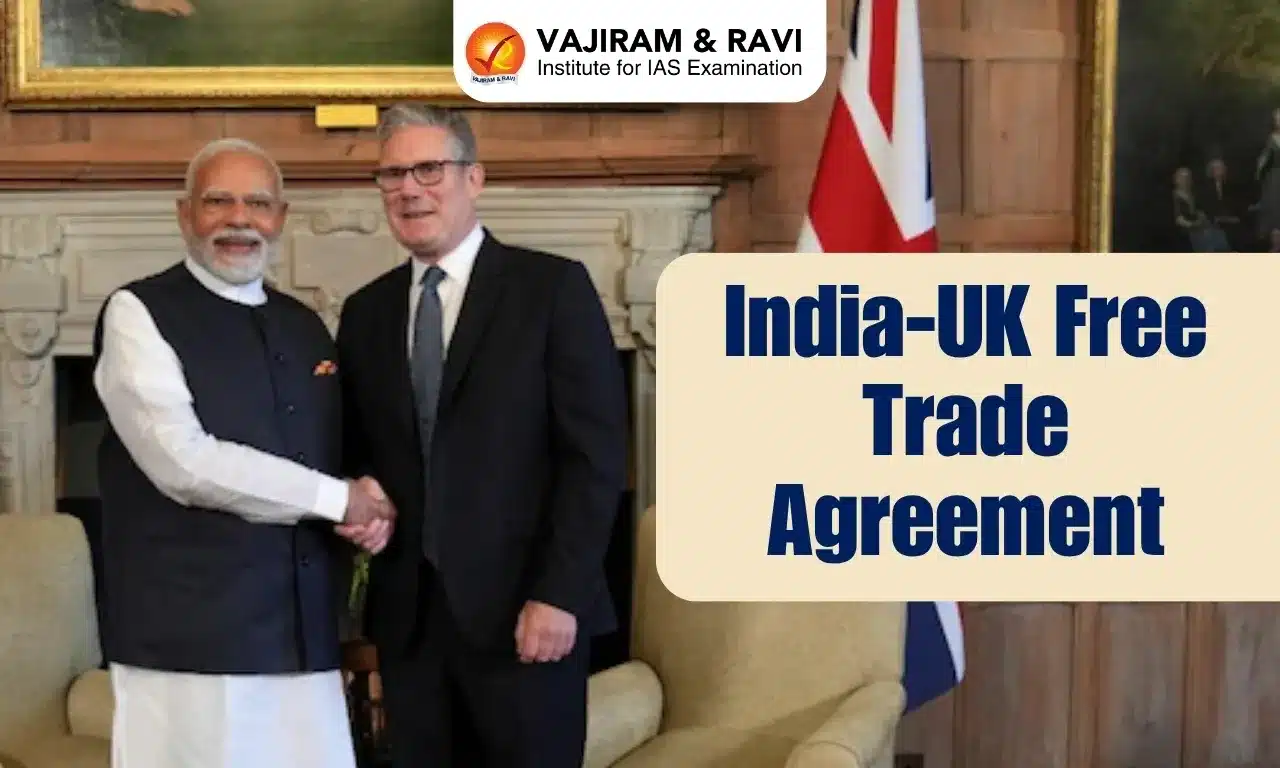
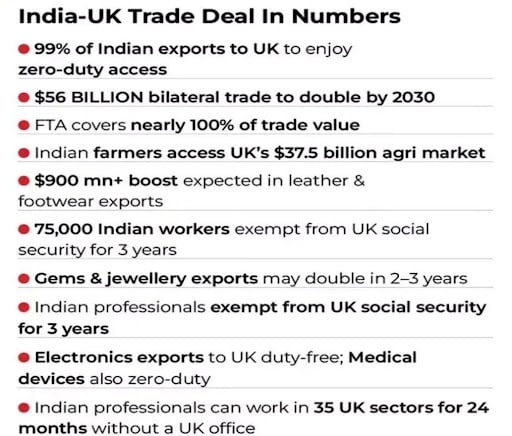
- The signing of the Comprehensive Economic and Trade Agreement, commonly known as the India-UK Free Trade Agreement (FTA), on July 24, 2025, marks a significant milestone in the bilateral relationship between India and the United Kingdom.
- While the deal is lauded for its economic potential, it has prompted serious public health concerns in India, particularly regarding the surge of High Fat, Sugar and Salt (HFSS) food
- Therefore, it is important to analyse the multifaceted impacts of the FTA, drawing comparisons from international experiences and highlighting the urgent policy interventions needed to safeguard public health.
Economic Prospects of the India-UK FTA
- Trade agreements such as the India-UK FTA stimulate economic growth by:
- Eliminating tariffs, thereby lowering consumer prices.
- Encouraging cross-border investment and generating employment.
- Deepening trade ties and diversifying import-export portfolios.
- For India, cheaper imports of U.K.-made products, expanded market access for goods and services, and closer strategic cooperation are anticipated benefits.
Public Health Challenges: Lessons from Mexico
- The optimism surrounding FTAs is not without caveat.
- The case of Mexico post-NAFTA (1992) serves as a cautionary tale.
- The North American Free Trade Agreement (NAFTA) was signed between Mexico, the United States and Canada, Mexico made the mistake of not implementing robust public health safeguards.
- Lax regulation and lack of public health safeguards resulted in:
- A dramatic rise in the import and consumption of sugary drinks and processed foods.
- Escalating rates of obesity, diabetes, and related chronic illnesses.
- The need for reactive policies, such as the imposition of a Soda Tax and the adoption of mandatory warning labels in 2014, well after the negative health impact had materialized.
- This experience underscores the risks for India, where regulatory frameworks are even less robust.
Regulatory Gaps in India vs. the UK
- The UK Approach
- HFSS Advertising Ban:
- The UK enforces strict bans on advertising HFSS foods to children on television before 9 p.m. and will introduce a total ban on online paid advertisements for such products from October 1, 2025.
- Front-of-Pack Nutrition Labelling (FOPNL):
- A color-coded traffic light system helps consumers identify levels of fat, sugar, and salt immediately, empowering healthier choices.
- The Indian Scenario
- Weak Advertisement Controls
- India lacks binding restrictions on junk food advertising, particularly towards children.
- Self-regulation by industry bodies like the Advertising Standards Council of India is unreliable and often ineffective.
- Misleading Marketing: Celebrity endorsements and cartoon mascots influence children and normalise unhealthy behaviours, with minimal accountability.
- FOPNL Issues
- India’s move toward mandatory nutrition labelling remains stalled.
- While warning labels are globally recognised as effective, Indian authorities have delayed implementation, focusing instead on a potentially ambiguous star rating system influenced by industry lobbying.
Rising Tide of Lifestyle Diseases and Commercial Determinants of Health
-
Rising Tide of Lifestyle Diseases
- From 2011-21, the Compound Annual Growth Rate (CAGR) of Ultra Processed Food (UPF) and HFSS food sales in India was 13.3%.
- As a result, non-communicable diseases such as obesity and diabetes are on the rise, especially among children and adolescents.
- The lack of robust food labelling and advertising controls exacerbates these trends.
-
Commercial Determinants of Health
- Trade deals, while crucial to economic ambitions, also serve as commercial determinants of health, that is, practices and policies by commercial actors that influence public health at a large scale.
- Without sufficient restrictions and awareness, FTAs risk becoming Trojan horses for the spread of diet-related diseases.
Path Forward: Opportunities for Policy Action
- Implement Strong Advertising Regulations: Enforce comprehensive, binding controls on the marketing of HFSS foods, especially toward children, as recommended by recent government surveys and dietary guidelines.
- Adopt Mandatory Warning Labels: Prioritise clear, effective warning labels on HFSS and UPF products, in line with international best practices, rather than the less effective “star rating” system.
- Promote Healthy School Environments: Institutionalise bans on the sale of unhealthy food and beverages in school and college canteens, and introduce holistic HFSS Boards in schools as part of a health-promoting educational framework.
- Engage Health Policymakers: Encourage active involvement of public health practitioners in trade negotiations to ensure health considerations are not subsumed by economic interests.
Conclusion
- Striking a balance between economic gains and public health imperatives is vital as India forges ahead with present and future FTAs.
- Immediate implementation of effective labelling, marketing restrictions, and public health safeguards can avert a health crisis like that experienced in Mexico.
- This is a pivotal moment for India to take decisive action, ensuring that the promise of economic prosperity does not come at the cost of its citizens' health.
The India-U.K. FTA Spells a Poor Deal for Public Health FAQs
Q1. When was the India-UK Free Trade Agreement signed?
Ans. The India-UK Free Trade Agreement was signed on July 24, 2025.
Q2. What public health risk does the India-UK FTA pose to India?
Ans. It may increase the availability and consumption of unhealthy High Fat, Sugar, and Salt (HFSS) food products.
Q3. Which country’s experience serves as a cautionary example for India regarding FTAs?
Ans. Mexico’s experience after signing NAFTA in 1992 is a cautionary example.
Q4. What kind of food advertising regulation does the UK implement that India currently lacks?
Ans. The UK bans HFSS food advertising on TV before 9 p.m. and online paid ads for such products.
Q5. What labelling system is considered most effective for informing consumers about unhealthy foods?
Ans. Mandatory warning labels are considered the most effective for food packaging.
Source: The Hindu
The Fault Lines in India’s Electoral Architecture Are Visible
Context
- As the Election Commission of India (ECI) closes the first phase of its Special Intensive Revision (SIR) of electoral rolls in Bihar by August 1, 2025, the state finds itself embroiled in familiar controversy.
- Allegations of disenfranchisement, especially of the poor, minorities, and migrants, have taken centre stage in political debate.
- Critics claim the ECI’s methods are partisan and exclusionary, while supporters argue for the necessity of maintaining the integrity of election rolls.
- Both arguments, however, fall short by failing to address the deeper, structural misfit between India’s election laws and its increasingly mobile society.
Flawed Foundations: Historical and Legal Context
- The Representation of the People Act, 1950, was drafted for a post-colonial India characterised by predominantly rural and sedentary populations.
- Over 82% of Indians lived in villages, and less than 8% were migrants at the time.
- The electoral laws, therefore, presumed that citizens would vote where they were born.
- Unfortunately, this assumption has persisted, surviving profound demographic and economic shifts.
- Today, India is among the world’s most migrant-heavy societies, over 450 million internal migrants constitute 37% of its population.
- Bihar exemplifies this: 36% of its households have at least one migrant, and more than 20% of the working-age population lives outside the state at any given moment.
- The 2011 census indicated nearly 13.9 million Biharis resided outside Bihar; current estimates suggest that number is now between 17 and 18 million.
- The legal fixation on geographic ordinary residence thus inevitably produces material exclusions.
- In 2025 alone, over 1.2 million names, primarily those absent during verification, were deleted in Bihar.
- Some districts with high migration rates saw roll deletions between 5%-7%, systematically disenfranchising citizens compelled by economic need to move.
Citizenship vs Residency and ECI’s Dilemma
-
Citizenship vs. Residency: The Conceptual Collapse
- The current public debate often conflates citizenship, a juridical status guaranteed by the Constitution and Citizenship Act, with residency, which is a contingent and administrative basis for enrolling a voter in a specific constituency.
- The Representation of the People Act, by prioritising residency, locks out millions of internal migrants.
- For such voters, disenfranchisement is not merely a bureaucratic hurdle, but an existential erasure: they are left in a liminal space, neither fully here nor there, with little prospect for political inclusion.
-
The ECI’s Dilemma: Administrative Minimalism
- The ECI’s approach, administrative minimalism, centres on procedural compliance rather than substantive justice.
- By strictly enforcing procedural rules without questioning the underlying legal assumptions, the ECI often preserves the appearance of neutrality at the cost of perpetuating systemic exclusion.
- Cleansing the rolls of non-residents may meet formal requirements, but it cannot be regarded as just when the rules themselves are unfit for a mobile society.
Perspectives from Abroad
- Democracies facing similar challenges have innovated to balance roll integrity and inclusiveness:
- United States:Absentee and mail-in ballots permit tens of millions of voters to remain registered in their home states while voting from wherever they reside.
- Philippines:Facilitates absentee voting for its 1.8 million overseas workers, regularly achieving turnout rates above 60%.
- Australia:Mobile polling stations in remote and transient communities have driven voter participation above 90%.
- These solutions demonstrate that designing for inclusiveness is possible when supported by institutional will and creative reform.
Political Instrumentalization and Public Awareness
- Political parties often exploit voter disenfranchisement as a means for electoral mobilisation, rather than educate or assist affected citizens.
- Practical safeguards, such as the ability to scrutinise draft rolls and submit claims or objections, remain largely inaccessible due to illiteracy, poor communication, and the hardships of migratory labour.
- Surveys indicate that more than 60% of Bihar’s voters, and less than one-quarter of migrants, were aware they could challenge roll changes, leaving the majority voiceless and vulnerable.
Conclusion
- Defending the ECI against scapegoating is important, but insufficient. True electoral justice requires demanding more from both the institution and ourselves.
- The integrity-inclusiveness trade-off is not inevitable; it is a matter of legislative and institutional design.
- The ECI must not only conscientiously enforce the law but actively advocate for reforms that align India’s electoral practices with the realities of a migratory society.
- Meanwhile, political actors and civil society must work to educate, empower, and include the marginalised, ensuring that no citizen is left voiceless by administrative oversight or legislative inertia.
The Fault Lines in India’s Electoral Architecture Are Visible FAQs
Q1. What is the main issue highlighted in the Bihar electoral roll revision?
Ans. The main issue highlighted in the Bihar electoral roll revision is the systemic disenfranchisement of migrants, the poor, and minorities due to outdated electoral laws.
Q2. Why are many Bihari voters being removed from electoral rolls?
Ans. Many Bihari voters are being removed from electoral rolls because the current law excludes those who are not residing in their constituency at the time of verification.
Q3. What key concepts are being conflated in the public debate?
Ans. The public debate often conflates the two key concepts of citizenship and residency.
Q4. How have other countries addressed voter mobility?
Ans. Other countries have addressed voter mobility by implementing absentee voting, mail-in ballots, and mobile polling stations.
Q5. What is recommended for improving voter inclusion in India?
Ans. Improving voter inclusion in India requires legislative reform and greater public education about voting rights and procedures.
Source: The Hindu
Daily Editorial Analysis 25 July 2025 FAQs
Q1: What is editorial analysis?
Ans: Editorial analysis is the critical examination and interpretation of newspaper editorials to extract key insights, arguments, and perspectives relevant to UPSC preparation.
Q2: What is an editorial analyst?
Ans: An editorial analyst is someone who studies and breaks down editorials to highlight their relevance, structure, and usefulness for competitive exams like the UPSC.
Q3: What is an editorial for UPSC?
Ans: For UPSC, an editorial refers to opinion-based articles in reputed newspapers that provide analysis on current affairs, governance, policy, and socio-economic issues.
Q4: What are the sources of UPSC Editorial Analysis?
Ans: Key sources include editorials from The Hindu and Indian Express.
Q5: Can Editorial Analysis help in Mains Answer Writing?
Ans: Yes, editorial analysis enhances content quality, analytical depth, and structure in Mains answer writing.