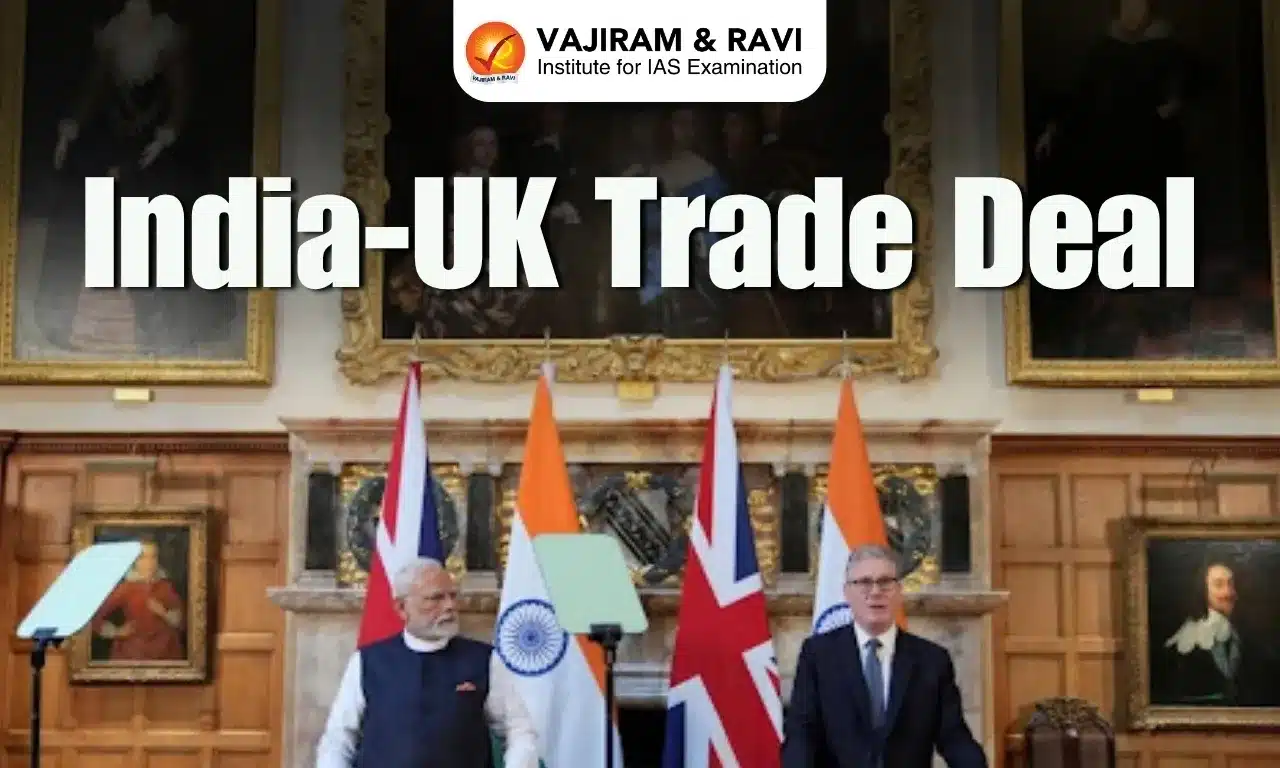
India-UK Trade Deal Latest News
- Recently, India and the U.K. formally signed a Comprehensive Economic and Trade Agreement (CETA), concluding negotiations that began in January 2022.
- The pact, finalized after more than three years of intense discussions, aims to significantly boost bilateral trade and deepen economic ties between the two countries.
Key Takeaways from the India-U.K. Trade Deal
- The India-U.K. trade agreement offers substantial tariff reductions on both sides.
- The U.K. has agreed to remove tariffs on 99% of its product lines, benefiting around 45% of India’s current exports such as textiles, footwear, automobiles, seafood, and fresh fruits like mangoes and grapes — all of which will now enter the U.K. duty-free.
- Meanwhile, India will cut or reduce duties on 90% of its tariff lines, covering 92% of U.K. exports to India.
- This means British whisky, cars, and engineering goods will become more affordable for Indian consumers.
- Notably, India’s high-value exports like petroleum products, pharmaceuticals, and diamonds already enjoy duty-free access in the U.K.
- Although the U.K. is not among India’s top trading partners — accounting for just 3.3% of exports and 1.2% of imports in 2024–25 — the deal marks a significant step in enhancing bilateral trade and economic cooperation.
India-U.K. Trade Deal Goes Beyond Goods — Services and Workers Benefit Too
- The India-U.K. Comprehensive Economic and Trade Agreement (CETA) is not limited to trade in goods; it also includes a strong focus on services — a key area for India’s economy.
- Under the agreement, India will open sectors like accounting, auditing, financial services, telecom, and environmental services to U.K. companies, allowing them to offer services in India without setting up a local office, while enjoying the same treatment as Indian firms.
- India has also agreed to recognise U.K. professional qualifications in fields such as law and accounting (excluding legal practice).
- On the flip side, Indian companies will now be allowed to establish offices in the U.K. in sectors like IT, consulting, and environmental services.
- A major win for Indian workers comes through the Double Contribution Convention (DCC), a separate agreement signed alongside CETA.
- It ensures that 75,000 Indian workers on short-term assignments in the U.K. can continue contributing only to India’s social security system, avoiding double payments in both countries.
- This is a significant relief for those who typically don’t stay long enough in the U.K. to benefit from its system.
India-U.K. FTA Features Unusual Provisions on Cars and Government Procurement
- While most aspects of the India-U.K. trade deal follow a typical pattern of tariff and service liberalisation, it includes a few notable exceptions.
- For the first time, India has agreed to reduce import duties on cars through a trade pact.
- Import duties on large-engine luxury petrol cars from the U.K. will drop from 110% to 10% over 15 years, though within a quota system starting at 10,000 cars and rising to 19,000 in year five.
- Mid-sized and small cars will also see gradual tariff cuts to 10% by the fifth year, again within quotas. These phased cuts are designed to give Indian carmakers time to adjust.
- However, electric, hybrid, and hydrogen vehicles are excluded from duty cuts for the first five years to protect India’s emerging green vehicle sector.
- Another unusual feature is that the U.K. will now be allowed access to Indian government procurement.
- India will open up around 40,000 high-value central government contracts in areas like transport, renewable energy, and infrastructure, allowing U.K. companies to bid for them.
Conclusion
- The India-U.K. trade deal is not yet in force. It must first be ratified by the Cabinets of both countries, a process expected to take six months to a year.
- For India, the agreement is not just significant in its own right — it could also act as a template for future trade negotiations with major economies like the U.S. and the European Union.
Source: TH
India-UK Trade Deal FAQs
Q1: What is the India-UK Trade Deal about?
Ans: It aims to reduce tariffs, boost bilateral trade, and open services and government procurement between India and the UK.
Q2: Which Indian exports benefit from the deal?
Ans: Textiles, footwear, cars, seafood, and fruits like mangoes now enter the UK duty-free under the FTA.
Q3: How does the deal help Indian workers in the UK?
Ans: It prevents double social security contributions for 75,000 Indian workers on short-term UK assignments.
Q4: What’s unique in the FTA regarding car imports?
Ans: It includes India’s first car tariff cuts, phased with quotas, excluding electric vehicles for initial five years.
Q5: Is the trade deal active now?
Ans: Not yet. It awaits ratification by both countries’ Cabinets, which may take up to one year.