UPSC Daily Quiz 31 July 2025

UPSC Daily Quiz

The Daily UPSC Quiz by Vajiram & Ravi is a thoughtfully curated initiative designed to support UPSC aspirants in strengthening their current affairs knowledge and core conceptual understanding. Aligned with the UPSC Syllabus 2025, this daily quiz serves as a revision resource, helping candidates assess their preparation, revise key topics, and stay updated with relevant issues. Whether you are preparing for Prelims or sharpening your revision for Mains, consistent practice with these Daily UPSC Quiz can significantly enhance accuracy, speed, and confidence in solving exam-level questions.

[WpProQuiz 33]  


UPSC Daily Quiz FAQs

Q1: What is the Daily UPSC Quiz?

Ans: The Daily UPSC Quiz is a set of practice questions based on current affairs, static subjects, and PYQs that help aspirants enhance retention and test conceptual clarity regularly.

Q2: How is the Daily Quiz useful for UPSC preparation?

Ans: Daily quizzes support learning, help in revision, improve time management, and boost accuracy for both UPSC Prelims and Mains through consistent practice.

Q3: Are the quiz questions based on the UPSC syllabus?

Ans: Yes, all questions are aligned with the UPSC Syllabus 2025, covering key areas like Polity, Economy, Environment, History, Geography, and Current Affairs.

Q4: Are solutions and explanations provided with the quiz?

Ans: Yes, each quiz includes detailed explanations and source references to enhance conceptual understanding and enable self-assessment.

Q5: Is the Daily UPSC Quiz suitable for both Prelims and Mains?

Ans: Primarily focused on Prelims (MCQ format), but it also indirectly helps in Mains by strengthening subject knowledge and factual clarity.

Article 36 of the Constitution of India, Interpretation, State Policy 

Article 36 of the Constitution

Article 36 comes under Part IV of the Constitution of India and talks about the Directive Principles of State Policy. The Directive Principle of State Policy promotes the idea of a “Welfare State" and establishes a social and economic democracy in the country. In this article, we are going to cover Article 36, its interpretation and its significance as well.  

Article 36 of the Indian Constitution Interpretation

Article 36 states - “In this Part, unless the context otherwise requires, "the State" has the same meaning as in Part III.” 

Article 36 of the Constitution of India gives the definition of ‘State’ for the purpose of DPSPs. This definition includes: 

  • The Government and Parliament of India
  • The Government and Legislature of each state
  • All local or other authorities within the territory of India or
  •  Under the control of the Indian government 

Directive Principles of State Policy 

Directive Principles of State Policy act as the main principles for the Central and State Governments to work towards maintaining a fair and just society. It is important to note that DPSP are not enforceable by Courts unlike the Fundamental Rights. The main objective of DPSP is to promote welfare of the public and secure -

  • Social justice
  • Economic justice
  • Political justice

The DPSP are further divided into -

  • Socialistic Principles: Articles 38, 39, 39A, 41, 42, 43, 43A and 47
  • Liberal-Intellectual Principles: Articles 44, 45, 48, 48A, 49, 50, and 51
  • Gandhian Principles: Articles 40, 43, 43B, 46, 47, and 48
Also Check Related Articles
Article 295 of Indian Constitution Article 194 of Indian Constitution
Article 39 of Indian Constitution Article 191 of Indian Constitution
Article 20 of Indian Constitution Article 16 of Indian Constitution
Article 67 of Indian Constitution Article 40 of Indian Constitution
Article 78 of Indian Constitution

Article 36 of the Constitution of India FAQs

Q1: What is Article 36 of the Indian Constitution?

Ans: Article 36 defines the term "State" for the purpose of applying the Directive Principles of State Policy.

Q2: What is the meaning of Article 36?

Ans: It means that the word "State" in Part IV includes all authorities as defined in Article 12.

Q3: What is Article 36 and 37 of the Constitution?

Ans: Article 36 defines "State" for DPSPs, while Article 37 declares DPSPs as non-justiciable but fundamental to governance.

Q4: What are Directive Principles of State Policy?

Ans: They are guidelines in Part IV of the Constitution meant to guide the State in making laws and policies for social justice and welfare.

Q5: What is the importance of Directive Principles of State Policy?

Ans: They aim to establish a just, equitable, and welfare-oriented society by directing State action toward the common good.

12th Schedule of Indian Constitution, Provisions & Subjects

12th Schedule of Indian Constitution

The 12th Schedule of Indian Constitution discusses the powers, authority, and responsibilities of Municipalities. It was added through the 74th Constitutional Amendment Act of 1992, which marked a major step toward decentralising governance in urban areas. The amendment aimed to strengthen Urban Local Bodies (ULBs) by empowering them with the 3Fs, Functions, Funds, and Functionaries.

Schedule of Indian Constitution

The Constitution of India was adopted on January 26, 1950 which consists of 8 Schedules initially which expanded to 12 Schedule of Indian Constitution through amendment.

table

12th Schedule of the Indian Constitution Provisions

Article 243W of the Indian Constitution empowers municipalities to function as effective institutions of self-government. It allows the State Legislature to assign powers, authority, and responsibilities to municipalities through legislation. These powers include:

  • Preparing plans for economic development and social justice

  • Implementing schemes related to subjects entrusted to them, such as those listed in the 12th Schedule

This provision is the constitutional foundation for decentralised urban governance in India.

Types of Municipal Bodies under Article 243W:

  1. Nagar Panchayat - for transitional areas (moving from rural to urban)
  2. Municipal Council - for smaller urban areas
  3. Municipal Corporation - for larger urban areas

12th Schedule of Indian Constitution Subjects

The 12th Schedule of the Indian Constitution includes 18 functional items under the domain of municipalities:

  • Urban planning including town planning;
  • Regulation of land use and construction of buildings;
  • Planning for economic and social development;
  • Roads and bridges;
  • Water supply for domestic, industrial, and commercial purposes;
  • Public health, sanitation, conservancy, and solid waste management;
  • Fire services;
  • Urban forestry, protection of the environment, and promotion of ecological aspects;
  • Safeguarding the interests of weaker sections of society, including the handicapped and mentally retarded;
  • Slum improvement and up-gradation;
  • Urban poverty alleviation;
  • Provision of urban amenities and facilities such as parks, gardens, and playgrounds;
  • Promotion of cultural, educational, and aesthetic aspects;
  • Burials and burial grounds, cremations and cremation grounds, and electric crematoriums;
  • Cattle ponds, prevention of cruelty to animals;
  • Vital statistics including registration of births and deaths;
  • Public amenities including street lighting, parking lots, bus stops, and public conveniences; and
  • Regulation of slaughterhouses and tanneries.
Also Check
2nd Schedule of Indian Constitution 3rd Schedule of Indian Constitution
4th Schedule of Indian Constitution 10th Schedule of Indian Constitution
11th Schedule of Indian Constitution

12th Schedule of Indian Constitution FAQs

Q1: What is the 12th Schedule of the Indian Constitution?

Ans: It lists the functions of municipalities under Article 243W, added by the 74th Constitutional Amendment Act of 1992.

Q2: How many subjects are included in the 12th Schedule?

Ans: The 12th Schedule contains 18 functional items that municipalities are responsible for managing.

Q3: Which amendment introduced the 12th Schedule?

Ans: The 74th Constitutional Amendment Act, 1992 introduced the 12th Schedule to strengthen urban local governance.

Q4: What is the main purpose of the 12th Schedule?

Ans: It defines the scope of work for municipalities, ensuring effective urban planning and administration.

Q5: Which article relates to the 12th Schedule?

Ans: Article 243W relates to the 12th Schedule, empowering municipalities to perform functions listed in it.

Article 103 of Indian Constitution, Interpretation & Importance

Article 103 of Indian Constitution

Article 103 of the Constitution of India talks about the questions such as the disqualification of members. The Constitution of India provides the outline of governance of India as well as the structure, power and responsibilities of government bodies. In this article, we are going to cover all about Article 103 of the Indian Constitution. 

Article 103 of the Indian Constitution Interpretation

Article 103 of the Constitution states -“1) If any question arises as to whether a member of either House of Parliament has become subject to any of the disqualifications mentioned in clause (1) of Article 102, the question shall be referred for the decision of the President and his decision shall be final. 2) Before giving any decision on any such question, the President shall obtain the opinion of the Election Commission and shall act according to such opinion.” 

Article 103 of the Constitution of India talks about the disqualification of a member of Parliament and its reference to the President of India. The article makes it compulsory for the President to ask the opinion of the Election Commission of India and work accordingly before announcing the decision. The decision given by the President is always final. The Election Commission is consulted in order to make the decision impartial and ensures a system of checks and balances.  

Article 103 of Indian Constitution Importance

Article 103 deals with the decision on disqualification of Members of Parliament. The article is important due to the following reasons: 

  1. Independent Decision-Making: It gives the President of India the power to decide on disqualification cases only after receiving the opinion of the Election Commission.
  2. Checks Political Misuse: By involving the Election Commission, Article 103 protects the MPs from politically motivated disqualifications, upholding democratic values.
  3. Upholds Constitutional Morality: It makes sure that decisions related to disqualification (under Article 102) are managed judiciously and constitutionally, not arbitrarily.
  4. Protects Legislative Sanctity: By setting up a clear and consultative process, it provides the credibility and stability of legislative institutions.
Also Check Related Articles
Article 295 of Indian Constitution Article 194 of Indian Constitution
Article 39 of Indian Constitution Article 191 of Indian Constitution
Article 20 of Indian Constitution Article 16 of Indian Constitution
Article 67 of Indian Constitution Article 40 of Indian Constitution
Article 78 of Indian Constitution

Article 103 of Indian Constitution FAQs

Q1: What is the Article 103 of the Constitution?

Ans: Article 103 empowers the President to decide on disqualification of Members of Parliament, based on the Election Commission’s opinion.

Q2: What is the 103rd Amendment of the Indian Constitution?

Ans: The 103rd Amendment provides 10% reservation in education and jobs for Economically Weaker Sections (EWS) of the general category.

Q3: What is Article 104 of the Constitution of India?

Ans: Article 104 imposes a penalty on Members of Parliament for sitting or voting while disqualified,

Q4: What is the importance of Article 103?

Ans: It ensures impartial and constitutionally guided decisions on MP disqualifications through consultation with the Election Commission.

Q5: When can a member of parliament be disqualified?

Ans: An MP can be disqualified for reasons like defection, holding an office of profit, unsound mind, insolvency, or under anti-defection laws.

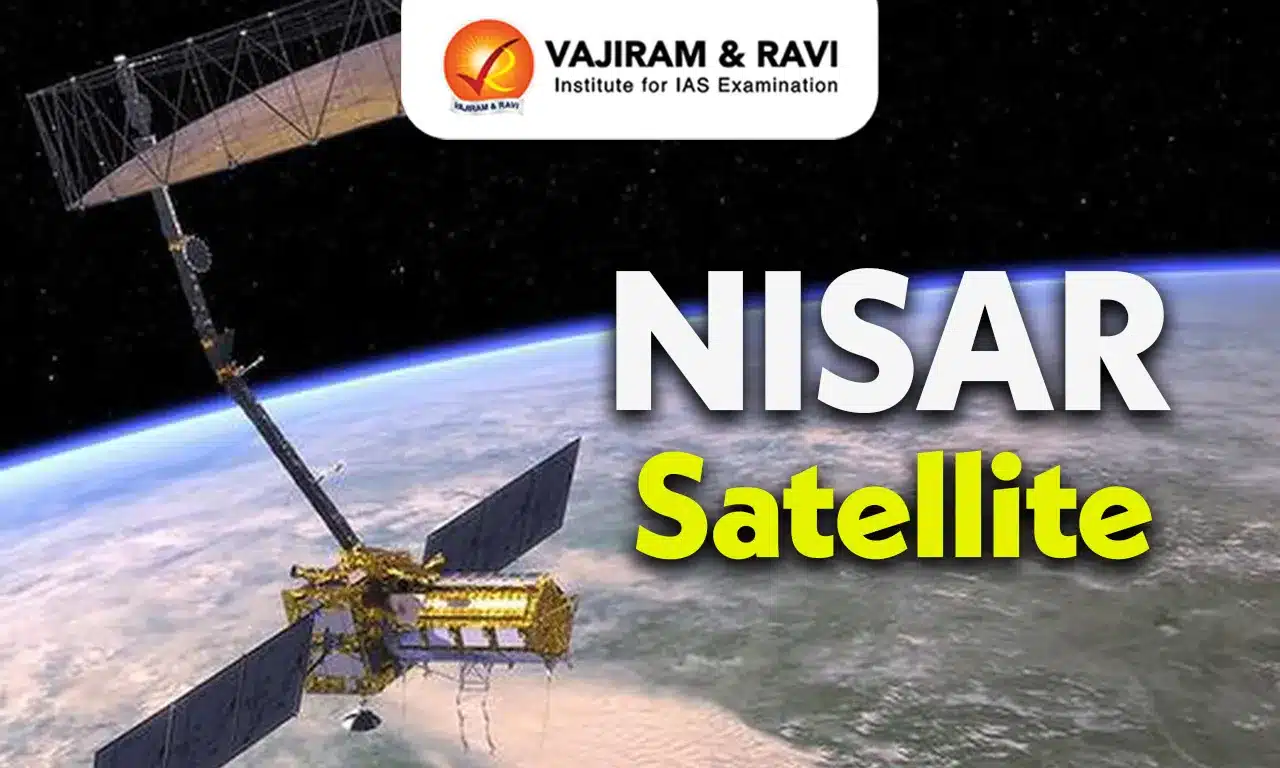
Nisar Satellite, Objectives, Spacecraft Configuration, Mission Phase

Nisar Satellite

Nisar Satellite is an Earth observation satellite jointly developed by ISRO and NASA, built on ISRO’s I-3K satellite platform, it uses both L-band and S-band Synthetic Aperture Radar (SAR) systems, which allow it to see through clouds, smoke, and even vegetation, day or night, regardless of weather.

The L-band radar works like an X-ray, it can peer beneath forest canopies, track glacier movement, and detect subtle shifts in the Earth’s crust, which helps with things like earthquake forecasting. On the other hand, the S-band radar focuses on surface-level details. It’s great for monitoring crops, spotting snow cover changes, and measuring soil moisture.

Nisar Satellite Objectives

The Nisar Satellite not only clicks pictures from orbit, it’s about decoding Earth’s ongoing transformations. With its dual-band radar system, NISAR will give scientists the tools to monitor key environmental and geological changes over time. Key Objectives of the Nisar Satellite:

  • Track land surface deformation caused by earthquakes, volcanic activity, and landslides.
  • Monitor glaciers and polar ice sheets to study melting patterns and sea-level rise.
  • Map subsidence and uplift due to groundwater depletion, mining, and hydrocarbon extraction.
  • Measure forest biomass and detect changes in forest cover to support carbon accounting.
  • Detect crop extent and changes to aid agricultural planning and food security.
  • Observe the dynamics of wetlands to understand their ecological health and seasonal shifts.
  • Study sea ice and selected ocean areas to monitor shifts in polar climates.
  • Enable regular, high-resolution mapping of Earth's land and ice-covered surfaces every 12 days.

Nisar Satellite Spacecraft Configuration

The Nisar Satellite is built on ISRO’s I-3K satellite bus and carries two core payloads: the L-band and S-band Synthetic Aperture Radars (SAR). These two radar systems work together to collect rich, high-resolution data on Earth’s surface and subsurface changes.

The mission is a true collaboration between ISRO and NASA, where both agencies bring their strengths, ISRO handles much of the spacecraft design and support, while NASA contributes key payload elements and mission planning.

Nisar Satellite Spacecraft Configuration

Mainframe Bus

I3K Structure with ~2400Kg Lift Off Mass

70V Bus

3-axis stabilized spacecraft

Imaging Payload

  • Dual Frequency (L & S-Band) Synthetic Aperture Radar (SAR).
  • L-band SAR (NASA); S-band SAR (SAC-ISRO)
  • Large size 12m diameter common unfurlable reflector antenna mounted on deployable 9m Boom.
  • ~240 km observable swath with 5-100 m resolution

Free and open data policy

Orbit

Sun synchronous, Polar (6PM)

Orbit altitude

747 km – Circular

Inclination

98.405 deg

Launcher

GSLV Mk-II with 4m PLF

Mission Life

5 Years

ISRO Responsibilities in Nisar Satellite

  • Designed and built the spacecraft platform (I-3K structure).
  • Developed the S-band radar system, used for imaging surface-level changes.
  • Built the data handling system and high-speed downlink system for transmitting radar data to ground stations.
  • Responsible for the launch vehicle and launch operations from Indian soil.
  • Manages satellite commanding and control once NISAR is in orbit.
  • Provides ground station support for receiving radar data and image downloads.

Also Check: Geosynchronous Satellite

NASA Responsibilities in Nisar Satellite

  • Developed the L-band radar system, which can penetrate vegetation and soil for subsurface imaging.
  • Supplied the 9-meter deployable boom that supports the large 12-meter radar reflector.
  • Delivered the Solid-State Recorder, GPS receiver, and part of the high-speed downlink system.
  • Provides the orbital maneuver plan and oversees the radar operations strategy.
  • Supports the mission with its ground stations, working in sync with ISRO’s network.

Nisar Satellite Mission Phase

The Nisar Satellite Mission Phase is structured into four key phases, each critical for the satellite’s success in gathering and transmitting Earth observation data:

Launch Phase

Nisar Satellite is scheduled to launch on July 30, 2025, aboard the GSLV-F16 from ISRO’s Satish Dhawan Space Centre (SHAR) in Sriharikota. This marks the beginning of its journey into low-Earth orbit.

Deployment Phase

Once in orbit, a 12-meter diameter radar reflector will be deployed using a 9-meter boom developed by NASA’s Jet Propulsion Laboratory. This stage involves complex mechanical operations to ensure the radar system is correctly extended and aligned.

Commissioning Phase

The first 90 days post-launch focus on in-orbit testing and calibration. This includes verifying satellite subsystems, checking radar payloads, and ensuring that instruments are functioning as expected. Initial operations are led jointly by ISRO and JPL.

Science Operations Phase

This long-duration phase starts once commissioning ends. The satellite begins systematic Earth observations, including radar imaging, data collection, calibration, and orbit maintenance. Regular coordination between ISRO and NASA ensures smooth operations and data delivery throughout its mission life.

Nisar Satellite FAQs

Q1: What is the NISAR mission?

Ans: A joint NASA–ISRO Earth observation mission using dual-frequency SAR to monitor terrain shifts, ice, ecosystems, and disasters.

Q2: When and where was NISAR launched?

Ans: Launched on July 30, 2025, aboard ISRO's GSLV-F16 from Satish Dhawan Space Centre, Sriharikota.

Q3: What is NISAR’s orbital configuration?

Ans: It operates in a 743 km Sun-synchronous orbit inclined at ~98.4°, mapping Earth every 12 days.

Q4: What payload does NISAR carry?

Ans: Dual SAR: NASA’s L-band (24 cm) and ISRO’s S‑band (9 cm) radars on a deployable 12 m reflector using SweepSAR tech.

Q5: How precise is NISAR?

Ans: It can detect ground deformation with centimetre‑level accuracy, even under vegetation, clouds, or darkness.

Article 28 of Indian Constitution, Interpretation, Importance & Landmark Cases

article 28 of indian constitution

Article 28 comes under Part III of the Constitution of India. It is part of a fundamental right that provides protection related to religion in educational institutions. Article 28 makes sure that secularism is always a guiding principle in state-funded education. It addresses the freedom of individuals in context with religious instruction in educational institutes. It makes sure that no religion is promoted in state-funded educational organisations and individual rights are protected in state-recognised or state-aided institutions. In this article, we are going to cover Article 28, its interpretation and significance. 

Article 28 of the Constitution of India

Freedom as to attendance at religious instruction or religious worship in certain educational institutions

(1)No religious instruction shall be provided in any educational institution wholly maintained out of State funds.

(2)Nothing in clause (1) shall apply to an educational institution which is administered by the State but has been established under any endowment or trust which requires that religious instruction shall be imparted in such institution.

(3)No person attending any educational institution recognised by the State or receiving aid out of State funds shall be required to take part in any religious instruction that may be imparted in such institution or to attend any religious worship that may be conducted in such institution or in any premises attached thereto unless such person or, if such person is a minor, his guardian has given his consent thereto.

Article 28 of Indian Constitution Interpretation 

Article 28 of the Constitution of India can be interpreted in the following manner: 

  • No Religious Instruction in State-Funded Institutions :
    • Article 28(1) does not allow religious instructions in any school or college completely funded by the government. This keeps in check that taxpayers money remains secular and inclusive for everybody. 
  • Exception for Endowment-Based Institutions : 
    • Article 28(2) allows certain religious instructions in exceptional cases that are administered by the state and established under a specific trust or endowment that allows religious education. 
  • Freedom from Compelled Participation:
    • Article 28(3) makes sure that no student is pushed to attend any religious instruction or worship in a state-recognised or state-aided institution. 

Also Check: Article 88 of Indian Constitution

Article 28 of the Indian Constitution Landmark Cases 

Article 28 of the Constitution of India has been a part of many landmark cases and judgements: 

  • D.A.V. College v. State of Punjab (1971):
    The Supreme Court said that religious instruction cannot be forced in institutions wholly maintained by the State, firmly upholding the spirit of Article 28(1).

  • Aruna Roy v. Union of India (2002):
    The Court said that  the teaching of moral values without religious bias does not violate Article 28, thus differentiating secular moral education from religious instruction.

  • Bijoe Emmanuel v. State of Kerala (1986):
    This case protected the rights of students who refused to sing the national anthem on religious grounds, reminding the idea that participation in religious activity cannot be forced—an extension of the freedom protected under Article 28(3).

  • S.R. Bommai v. Union of India (1994):
    Though primarily addressing the idea of secularism, the Court said that Articles 25 to 28 form part of the Constitution’s basic structure and underscore the foundational importance of religious freedom and secular governance.

Article 28 of the Constitution Importance

Article 28 of the Constitution of the India is important due to the following reasons: 

  • Protect Secular Education Spaces:
    It prohibits religious instruction in State-funded institutions, and makes sure that education remains inclusive and neutral.

  • Prevents Misuse of Public Resources:
    It restricts the use of government funds for propagating any particular religion, thereby promoting equal treatment of all faiths within public institutions.

  • Allowing Flexibility for Religious Trusts:
    Article 28(2) allows educational institutions established under specific religious endowments to continue providing religious education—striking a balance between institutional autonomy and constitutional secularism.

Protecting Individual Choice:
Through Article 28(3), individuals, especially students, are protected from being compelled to participate in religious instruction or worship, ensuring the freedom of conscience.

Also Check Related Articles
Article 295 of Indian Constitution Article 194 of Indian Constitution
Article 39 of Indian Constitution Article 191 of Indian Constitution
Article 20 of Indian Constitution Article 16 of Indian Constitution
Article 67 of Indian Constitution Article 40 of Indian Constitution
Article 78 of Indian Constitution

Article 28 of Indian Constitution FAQs

Q1: What is Article 28 in the Indian Constitution?

Ans: Article 28 prohibits religious instruction in educational institutions wholly funded by the State.

Q2: What is the importance of Article 28?

Ans: It safeguards the secular character of State-run educational institutions by ensuring freedom from compulsory religious instruction.

Q3: What is the name of Article 28?

Ans: Article 28 – Freedom as to attendance at religious instruction or religious worship in certain educational institutions.

Q4: What is Article 29 of the Indian Constitution?

Ans: Article 29 protects the cultural and educational rights of minorities to conserve their distinct language, script, or culture.

Q5: What is Part III of the Constitution of India?

Ans: Part III deals with Fundamental Rights, guaranteeing civil liberties to all citizens of India.

Trump Hits India With 25% Tariffs, Announcement & Affected Products

Trump Hits India With 25% Tariffs

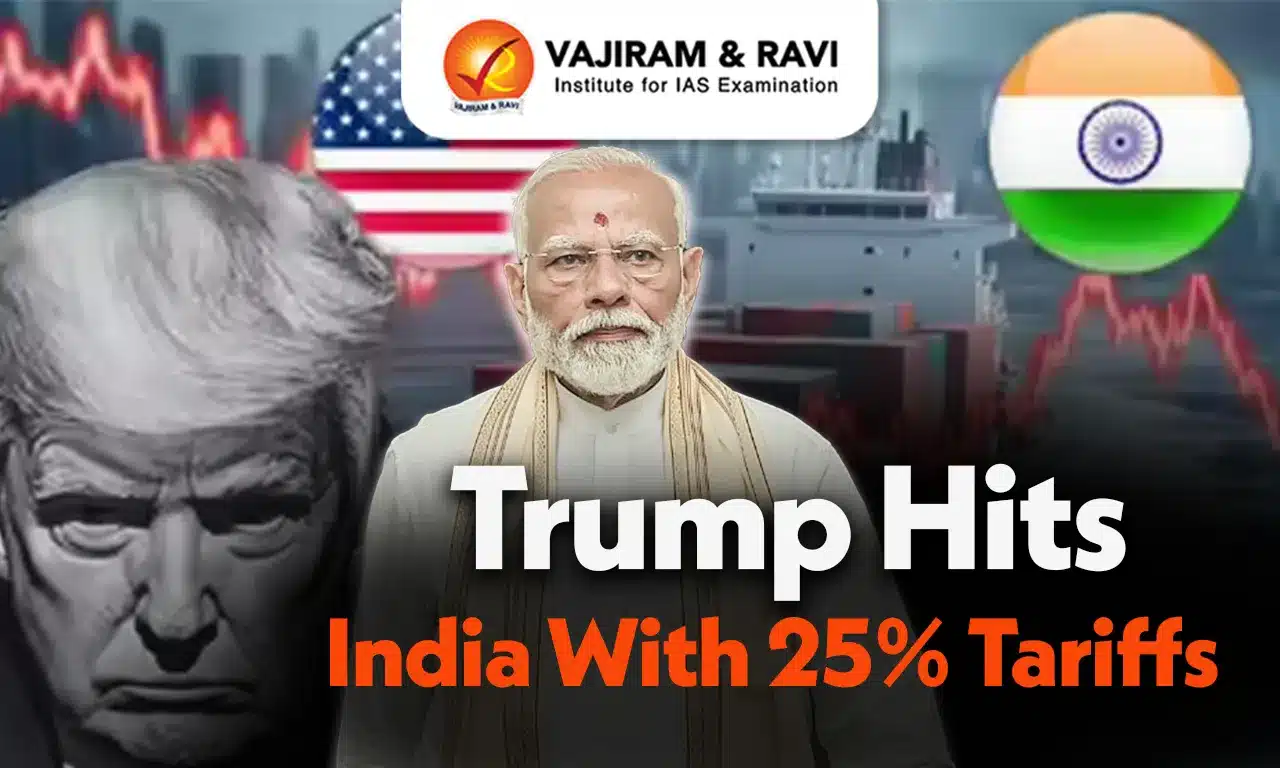
Donald Trump, US President has declared a 25% tariff on imports to India on 30th July 2025 which will be effective from 1st August 2025. This decision will increase the trade tension between India and the United States of America. The key sectors which will be affected include pharmaceuticals and textiles. Negotiations may begin soon to manage the situation.

Recent Tariff Announcement

The 25% Tariff Rates by the United States of America will be imposed on imports on India from August 1, 2025. That’s slightly lower than the 26% tariff Donald Trump announced back in April but later paused, hoping for trade talks.

Trump mentioned India has extremely high tariffs on goods from America which is highest globally. He also mentioned “strenuous and obnoxious non-monetary trade barriers,” referring to regulatory hurdles that make it tough for US exporters to do business there.

Another reason for this high tariff rate is ongoing import of defense gear and petroleum products from Russia despite global sanctions and pressure after Russia’s invasion of Ukraine. Trump sees this as undermining US and allied interests and says it justifies not only the 25% tariff but also an additional “penalty” tied to India’s Russia trade.

At the time of the announcement, the U.S. Commerce Department and the White House hadn’t released a full list of affected items. But past tariffs on India have included each item from steel and aluminum to agricultural goods, textiles, and more.

Trump made his stance clear on Truth Social:

“INDIA WILL THEREFORE BE PAYING A TARIFF OF 25%, PLUS A PENALTY FOR THE ABOVE, STARTING ON AUGUST FIRST.”

Also Check: Shift Towards Trade Protectionism

Recent Tariff Announcement Background

India-US trade ties have expanded over the years, but they remain complicated. One of the main sticking points is India’s high tariff rates and non-tariff barriers. Despite being a key trading partner, India’s policies continue to frustrate US exporters. According to US Commerce Department data, the bilateral trade volume runs into billions, with India exporting pharmaceuticals, electronics, garments, and a range of manufactured goods to the U.S.

Trump, while calling India a friend, described the trade relationship as “very tough” because of what he sees as excessive tariffs. He repeated a term he’s used before calling India the “tariff king” and claimed the country imposes some of the highest duties in the world on American products.

The US Trade Representative’s office has confirmed that talks are ongoing. But as of late July 2025, no deal has been finalized. Trump has warned that if a trade agreement isn’t reached by August 1, the 25% tariffs will be enforced. The goal, he says, is to pressure India into opening its markets more fairly to US exporters.

Also Check: Trump’s Reciprocal Tariffs on India

List of Key Product Categories Potentially Affected

Though there no official list disclosed announcing the tariff rates but from the previous tariff rates and area of focus in trade disputes and areas likely to be affected are mentioned below: 

  1. Pharmaceuticals: India's biggest export sector to the U.S.
  2. Textiles and Apparel: Cotton and synthetic clothing included.
  3. Communication Equipment: Such as smartphones and associated electronics.
  4. Agricultural Products: Like spices, rice, and tea.
  5. Steel and Aluminum Products: Which were subject to prior duties.
  6. Machinery and Auto Parts: Potentially hit by wider trade barriers.
  7. Information Technology Services: Although services are generally excluded, any digital products or computer software imported physically could be affected.

Recent Tariff Announcement Impact

The Commerce Ministry of India hasn’t issued an official statement yet. However, officials have indicated that they’re open to resuming negotiations, with hopes of working toward a new trade agreement by October 2025. 

If the tariff goes into effect, it won’t just affect Indian exporters, it’s likely to raise prices for American consumers and businesses that rely on Indian goods. That ripple effect could add economic friction to what is already a sensitive trade relationship.

Beyond economics, there’s a bigger strategic concern. The tariff move adds stress to India-US ties at a time when both countries are trying to align more closely, especially in the face of growing challenges from China and Russia.

Recent Tariff Announcement Overview

Under the Donald Trump administration, 25% tariff on Indian imports signals more than just a trade dispute, it’s a mix of economic pressure and geopolitical posturing. With added friction over India’s ties to Russia. The table below includes the Recent Tariff Announcement Overview:

Recent Tariff Announcement Overview

Aspect

Details

Announcement Date

July 30, 2025

Tariff Rate

25% on Indian imports

Effective Date

August 1, 2025

Additional Penalty

Unspecified penalty related to India's Russia trade

Justification

High Indian tariffs & trade barriers; Russia energy and military imports

Impacted Sectors (Likely)

Pharmaceuticals, textiles, electronics, agriculture, steel, machinery

Current Status of Trade Deal

Not finalized; negotiations ongoing

Indian Government Response

No official public comment yet; talks expected to resume mid-August

Trump’s Quote

“India will therefore be paying a tariff of 25%, plus a penalty, starting August first.”

Recent Tariff Announcement FAQs

Q1: What are the current India–US tariff rates?

Ans: The U.S. has announced a 25% tariff on Indian goods from August 1, 2025, as part of its “reciprocal tariff” policy.

Q2: What are India–Russia relations?

Ans: India maintains close strategic ties with Russia, including major energy imports and defence equipment procurement, despite Western sanctions on Moscow.

Q3: Why did Trump increase tariffs on India?

Ans: Trump cited India’s high import tariffs, strict non‑tariff barriers, and its ongoing purchases of Russian oil and military equipment as reasons for imposing the 25% tariff rate.

Q4: What do you mean by the Russian penalty?

Ans: The “Russia penalty” refers to an additional unspecified tariff imposed by the U.S. on Indian imports in response to India’s continued trade—especially energy and defence ties—with Russia.

Q5: On what products has the U.S. increased tariffs on India?

Ans: The 25% tariff is broadly applied to Indian imports including textiles, pharmaceuticals, autos, agro‑products, gems & jewellery, and engineering goods, among others
Mount Cilo

Mount Cilo

Mount Cilo Latest News

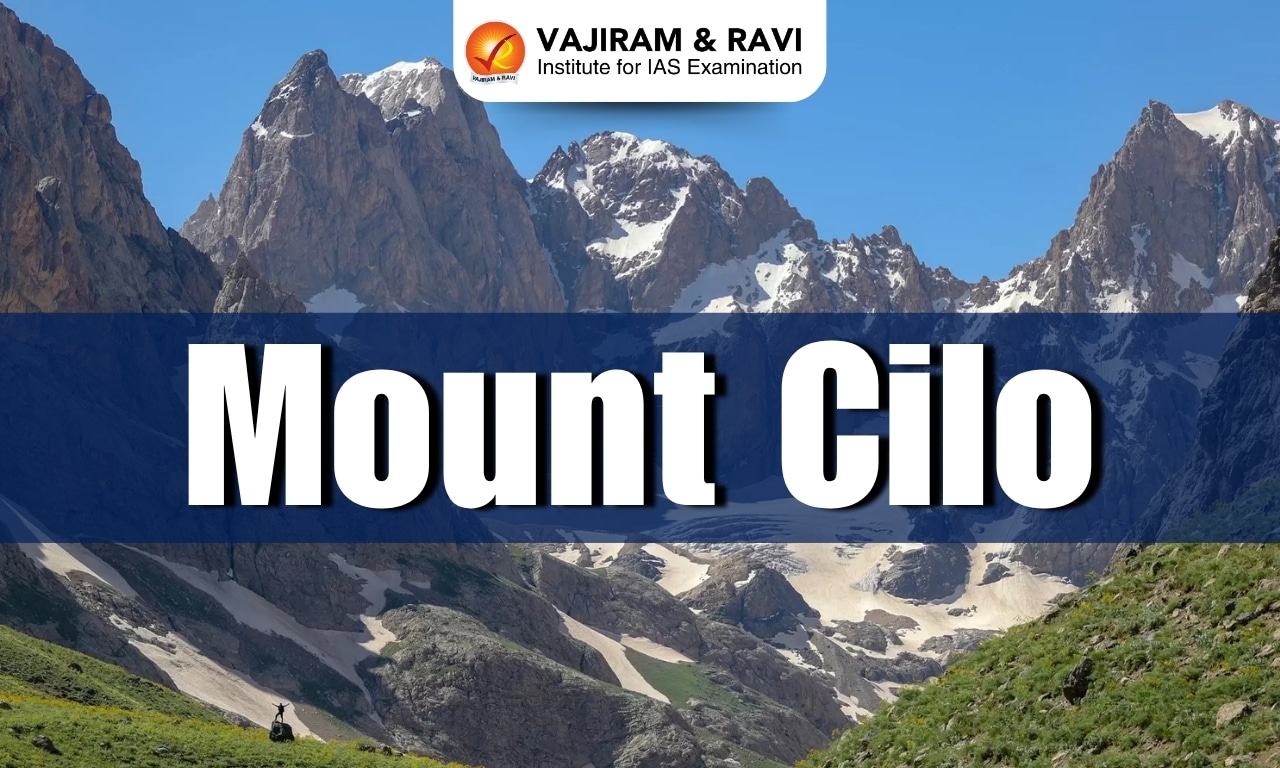
According to our researchers, the glaciers of Mount Cilo have had almost 50% of their ice cover in 40 years.

About Mount Cilo

  • Location: It is located southeast of Lake Van and the southeast end of the Taurus mountain range in the Anatolia region of Turkey.
  • The glaciers of Mount Cilo, which rises to 4,135 meters in the province of Hakkari on the Iraqi border, are the second largest in the country behind those of Mount Ararat (5,137 meters ) 
  • It is the peak of the easternmost extension of the Taurus mountain range.
  • It is situated in the Alpine-Himalayan Fold System and emerged as a result of the movement of the Arabian, Anatolian and Eurasian plates.
  • Physical features of Mount Cilo
    • It has five important high peaks. These; Uludoruk Peak,  Suppa Durek Peak, Kosedireği Mountain, Kisara Mountain and Maunseli Sivrisi.
    • The present shape of Cilo Mountain has been formed by tectonic movements and erosions. 
    • It has rugged topography with ridges, steep limestone cliffs, deep gorges, and glacial valleys.
  • Impact of Climate Change: Turkey, which is experiencing heatwaves and drought, even registered a record temperature of 50.5C recently and has been affecting glaciers.

Source: TOI

Mount Cilo FAQs

Q1: What is the second highest peak in Turkey?

Ans: Mount Cilo

Q2: What is a glacier?

Ans: A glacier is a large, perennial accumulation of crystalline ice, snow, rock, sediment, and often liquid water that originates on land and moves down slope under the influence of its own weight and gravity.

Barbados Threadsnake

Barbados threadsnake

Barbados Threadsnake Latest News

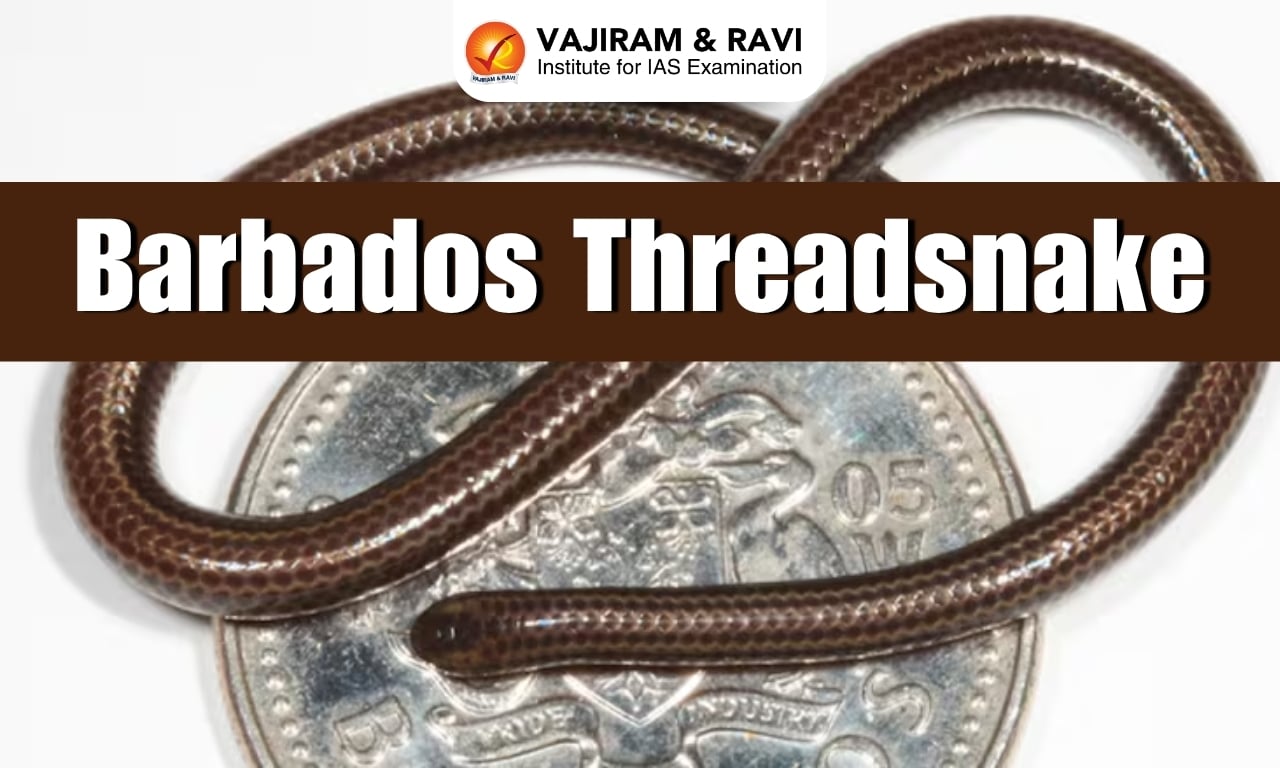
Recently, the world's smallest known snake Barbados threadsnake was rediscovered after vanishing for decades.

About Barbados Threadsnake

  • It is a tiny snake belonging to the family Leptotyphlopidae.
  • The snake is blind, burrows in the ground, eats termites and ants and lays one single, slender egg. 

Features of Barbados Threadsnake

  • It reaches a maximum adult length of only 10.4 cm (4.1 inches) and an average weight of 0.6 g (0.02 ounce), it is thought to be the world’s smallest known snake.
  • They are solitary fossorial creatures adapted to burrowing.
  • They are nocturnal and during the day usually hide under rocks.
  • Due to their diet preferences, they are often found near ant and termite nests.
  • The pheromones these snakes produce protect them from attack by termites.
  • Habitat: Its habitat is most likely limited to the forests of eastern Barbados. They inhabit tropical dry forests.
  • Distribution: Barbados threadsnakes are found on the Caribbean island of Barbados.
  • Diet: Barbados threadsnakes are carnivores and their diets consist mostly of termite or ant larvae.
  • Reproduction: They are oviparous meaning they lay eggs to reproduce.
  • Conservation Status: Critically Endangered (IUCN Red List)
  • Threats: Habitat loss is the main threat to the Barbados threadsnake.

Source: TH

Barbados Threadsnake FAQs

Q1: Is thread snake venomous?

Ans: They are generally harmless and considered non-venomous.

Q2: What does a threadsnake eat?

Ans: This species eats small insects and their larvae and eggs, spiders, centipedes, and millipedes, but their favorites are ants and termites.

Skill Impact Bond

Skill Impact Bond

Skill Impact Bond Latest News

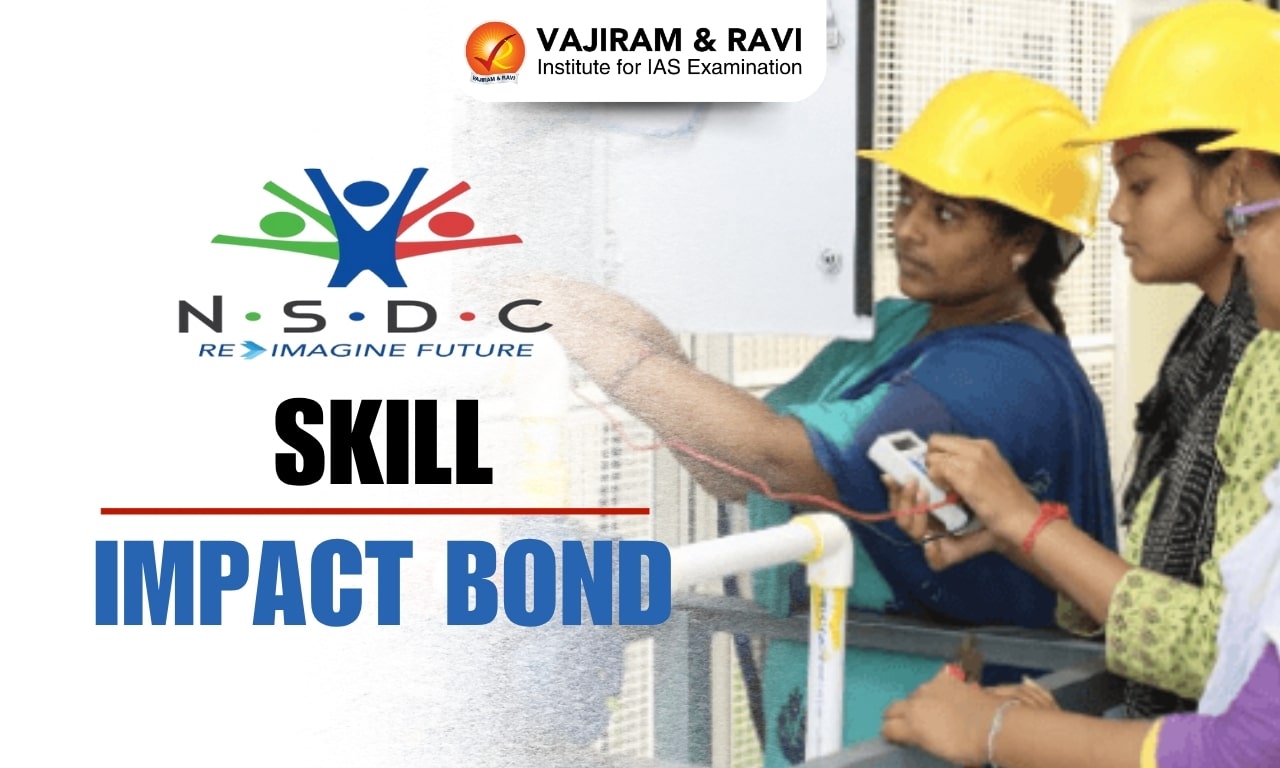
Recently, the Minister of State for skill development and entrepreneurship cited that Skill Impact Bond (SIB) as delivering measurable social impact.

About Skill Impact Bond

  • It is an innovative financing tool aimed at improving employment outcomes for young people.
  • Under this initiative, first skilling is provided to young people, and then provide them jobs or making them perform better within their current jobs.
  • India’s Skill Impact Bond (SIB) was launched in November 2021.
  • It is the country’s first development impact bond focused on employment.
  • It is backed by the Ministry of Skill Development and Entrepreneurship through the National Skill Development Corporation,
  • Its objective is to benefit 50,000 young Indians over four years, with 60% of the beneficiaries being women.
  • This innovative outcomes-based financing tool uses private sector capital and expertise, focusing on job placement and retention rather than merely on training and certification.

How does it Work?

  • There are ‘risk investors’ usually from the private sector who provide funding to service providers (organisations that deliver skills training and support job placement).
  • Then there are outcome funders who repay the ‘risk investors’ if the programme has met its employment targets. There is also a third-party evaluator who verifies employment outcomes.

Source: TOI

Skill Impact Bond FAQs

Q1: What is the first skill impact bond in India?

Ans: It is the first development impact bond in India dedicated to skills training and job placement.

Q2: What is National skills Development Corporation?

Ans: NSDC was set up by Ministry of Finance as Public Private Partnership (PPP) model. The Government of India through Ministry of Skill Development & Entrepreneurship (MSDE) holds 49% of the share capital of NSDC, while the private sector has the balance 51% of the share capital.

CRIB Blood Group

CRIB Blood Group

CRIB Blood Group Latest News

A new blood group CRIB, previously unidentified anywhere in the world, has been discovered in a South Indian woman from Kolar district in Karnataka. 

About CRIB Blood Group

  • It is part of the Cromer (CR) blood group system and, in recognition of its origin, has been officially named CRIB, with ‘CR’ representing ‘Cromer’ and ‘IB’ standing for ‘India’, ‘Bangalore’.
  • This historic announcement was made at the 35th Regional Congress of the International Society of Blood Transfusion (ISBT) held in Milan, Italy.
  • It is a new blood group, previously unidentified anywhere in the world.
  • After ten months of research and molecular testing, international experts identified a new antigen in the Cromer (CR) blood group system.
  • The blood group nomenclature is decided by the International Society of Blood Transfusion.
  • Identifying new antigens like CRIB enhances global transfusion safety, improves compatibility testing, and lays the foundation for better donor matching in future medical emergencies.
  • Cromer blood group system involves 12 high-prevalence and 3 low-prevalence antigens on decay-accelerating factor (DAF).

What are Rare Blood Types?

  • Rare blood type is when a person’s blood type is present in only 0.1% of the population.
  • If a Rare type patient develops an antibody, they can only receive blood from another Rare Type donor.
  • It poses serious challenges in emergency transfusions, organ transplants, and complex surgeries.

Source: TH

CRIB Blood Group FAQs

Q1: Which blood group is known as golden blood?

Ans: Rh-null

Q2: Which one is called Bombay blood group?

Ans: H antigen deficiency is known as the "Bombay phenotype" (h/h, also known as Oh) and is found in 1 of 10,000 individuals in India and 1 in a million people in Europe.

11th Schedule of Indian Constitution, Defines and Provisions

11th Schedule of Indian Constitution

The 11th Schedule of Indian Constitution was included in 1992 by the 73rd Constitution Amendment Act which includes the powers, authority, and responsibilities of the Panchayat System. It has 29 subjects such as Agriculture, Animal Husbandry, Fishery, etc.

11th Schedule of Indian Constitution Provisions

  • The state legislature is established to implement the laws which provide power and authority to the Panchayat to function effectively as units of local self government.
  • The 11th Schedule of Indian Constitution includes the scope of the responsibilities which lists 29 subjects that Panchayats may be entrusted with, ranging from agriculture and rural housing to education and social welfare which includes: 
    • Agriculture, including agricultural extension.
    • Land improvement, implementation of land reforms, land consolidation, and soil conservation.
    • Minor irrigation, water management, and watershed development.
    • Animal husbandry, dairying, and poultry.
    • Fisheries.
    • Social forestry and farm forestry.
    • The minor forest produces.
    • Small-scale industries, including food processing industries.
    • Khadi, village, and cottage industries.
    • Rural Housing.
    • Drinking water.
    • Fuel and fodder.
    • Roads, culverts, bridges, ferries, waterways, and other means of communication.
    • Rural electrification, including the distribution of electricity.
    • Non-conventional energy sources.
    • Poverty alleviation program.
    • Education, including primary and secondary schools.
    • Technical training and vocational education.
    • Adult and non-formal education.
    • Libraries.
    • Cultural activities.
    • Markets and fairs.
    • Health and sanitation including hospitals, primary health centers, and dispensaries.
    • Family welfare.
    • Women and child development.
    • Social welfare, including the welfare of the handicapped and mentally retarded.
    • The welfare of the weaker sections, in particular, of the scheduled castes and the scheduled tribes.
    • Public Distribution System.
    • Maintenance of community assets.
Also Check
2nd Schedule of Indian Constitution 3rd Schedule of Indian Constitution
4th Schedule of Indian Constitution 10th Schedule of Indian Constitution
11th Schedule of Indian Constitution

11th Schedule of Indian Constitution FAQs

Q1: What is the 11th Schedule of the Indian Constitution?

Ans: It lists the functions of Panchayats (rural local bodies) under Article 243G, empowering them with responsibilities in 29 subjects.

Q2: When was the 11th Schedule added to the Constitution?

Ans: It was added by the 73rd Constitutional Amendment Act, 1992.

Q3: Why was the 11th Schedule introduced?

Ans: To strengthen the Panchayati Raj system by formally assigning duties and subjects to local rural bodies.

Q4: How many subjects are included in the 11th Schedule?

Ans: It contains 29 subjects ranging from agriculture to social welfare, education, and health.

Q5: Does the 11th Schedule apply to urban areas?

Ans: No, it applies only to Panchayats in rural areas. Urban local bodies are covered under the 12th Schedule.

Digital Payments Index

RBI's Digital Payments Index

Digital Payments Index Latest News

Recently, the Reserve Bank of India (RBI) announced that its Digital Payments Index (RBI-DPI) surged to 493.22 in March 2025, up from 465.33 in September 2024.

About Digital Payments Index

  • It has been constructed by the Reserve Bank of India to measure the extent of digitisation of payments across the country.
  • It was first launched in January 2021.
  • It is based on multiple parameters and reflects the expansion of various digital payment modes accurately.
  • It is a first-of-its kind index to measure the spread of digital payments across the country.
  • Base Year: It has been constructed with March 2018 as the base period, i.e., the DPI score for March 2018 is set at 100.
  • The DPI index comprises five broad parameters that enable the measurement of deepening and penetration of digital payments in the country over different time periods. 
  • The parameters include:
    • Payment enablers (25 per cent weightage in the index)
    • Demand-side and supply-side payment infrastructure factors (10 per cent each) 
    • Payment performance (45 per cent) 
    • Consumer centricity (5 per cent) 
    • Each of the parameters has sub-parameters, which, in turn, consist of various measurable indicators.

Source: DD News.

Digital Payments Index FAQs

Q1: Which institution releases the Digital Payments Index in India?

Ans: Reserve Bank of India

Q2: What is the DPI index?

Ans: The RBI constructed a composite Digital Payments Index (DPI) to capture the extent of digitisation of payments across the country.

Tsunami

Tsunami

Tsunami Latest News

A powerful 8.8-magnitude earthquake struck Russia’s Kamchatka Peninsula recently, triggering tsunami warnings across the northern Pacific, including Alaska, Hawaii, and down to New Zealand.

About Tsunami

  • A tsunami is a series of waves generated by a large and sudden displacement of the ocean. 
  • Tsunamis can have devastating and wide-ranging effects, especially in coastal regions.
  • The word tsunami is composed of the Japanese words "tsu" (which means harbor) and "nami" (which means "wave"). 
  • Large earthquakes below or near the ocean floor are the most common cause (about 80% of all known tsunamis are triggered by earthquakes), but landslides, volcanic activity, certain types of weather, and meteorites can also cause tsunamis. 
    • Not all earthquakes cause tsunamis; they must be strong and shallow (at least 6.5 magnitude and less than 70 km from the Earth’s surface), and move the seafloor vertically.
  • Tsunamis radiate outward in all directions from their source and can move across entire ocean basins, around islands,  and into bays, sounds, and up rivers. 
  • Out in the depths of the ocean, tsunami waves do not dramatically increase in height. 
  • But as the waves travel inland, they build up to higher and higher heights as the depth of the ocean decreases.
  • The speed of tsunami waves depends on ocean depth rather than the distance from the source of the wave. 
  • Tsunami waves may travel as fast as jet planes over deep waters, only slowing down when reaching shallow waters. 
    • Tsunamis can have heights of up to 30 m (98 ft) and reach speeds of 950 km per hour.
  • It is hard to see that a tsunami is approaching. The most obvious sign is when coastal water retreats just before the waves reach the shore. This is actually the trough of the wave following behind.

Source: TOI

Tsunami FAQs

Q1: What is the most common cause of tsunamis?

Ans: Earthquakes

Q2: In which direction do tsunami waves radiate from their source?

Ans: In all directions

Q3: What happens to tsunami waves as they approach the coastline?

Ans: Their speed decreases and height increases.

Q4: What is often the first visible sign of an approaching tsunami?

Ans: Coastal water retreats abnormally.

10th Schedule of Indian Constitution, Provisions, Anti-Defection Law Case

10th Schedule of Indian Constitution

The 10th Schedule of Indian Constitution, added through the 52nd Amendment in 1985, introduced as the Anti-Defection Law. It was the first time the term "political party" officially appeared in the Constitution. This law was brought in to curb political defections, a growing problem at the time and to ensure elected representatives remained loyal to the party on whose ticket they won.

What is Defection?

Defection happens when a member of a political party abandons their loyalty to the party either by resigning or switching sides. For example, a politician might quit their party in one state and join another in a different state, often for personal or political gain. This kind of party-hopping disrupts governance, weakens public trust, and raises serious concerns about the leader’s commitment to voters and party ideology.

10th Schedule of Indian Constitution Provisions

  • Definition: Defection happens when a legislator voluntarily gives up their party membership or votes against the party’s official line. It doesn’t have to be a formal resignation even actions or statements can signal defection.
  • Grounds for Disqualification: A member caught defying the party whip or switching sides without proper approval can be disqualified from their seat. This applies to both elected and nominated members.
  • What Doesn’t Count as Defection: There are exceptions. For example, if a legislator is elected as the Speaker of the House and then resigns from their party to maintain neutrality, they won’t be disqualified.
  • Role of Courts: While the Tenth Schedule tried to keep courts out of defection cases, the Supreme Court in Kihoto Hollohon vs Zachillhu (1992) made it clear: the Speaker’s decisions can be reviewed by the courts under Articles 32 and 226.
  • Framing the Rules: Each House, the Lok Sabha or a State Assembly can set its own rules for handling defection cases. The Speaker or Chairman gets the authority to do this, which gives some flexibility based on the House’s needs.

Also Check: 1st Schedule of Indian Constitution

Anti-Defection Law Process

When a legislator is suspected of defection, a petition can be filed before the Speaker or Chairman of the House. Contrary to popular belief, there's no requirement for one-third of party members to sign it, anyone, including another legislator, can raise the complaint.

The Speaker (or Chairman in the Rajya Sabha or State Councils) reviews the petition, examines the facts, and may seek explanations from the accused member. If satisfied that defection has taken place, the member is disqualified under the Tenth Schedule.

Here’s the thing: the Speaker’s decision is considered final within the House, but it isn’t above judicial review. The disqualified member can challenge the ruling in the High Court or Supreme Court and not appeal to the President. The part about the President and Election Commission only applies in cases involving disqualification under Articles 102 or 191, not defection.

Also Check: 4th Schedule of Indian Constitution

10th Schedule of Indian Constitution Merits

  • Stability in Governance: The 10th Schedule of Indian Constitution has helped prevent the chaos of frequent party-switching. By keeping legislators from jumping ship for personal gain or political bargains, it adds a layer of stability to both state and central governments. Fewer defections mean fewer mid-term collapses and smoother continuity in governance.
  • Preserving the Voter’s Mandate: The anti-defection law protects the spirit of the vote. When a candidate wins on a party ticket, they’re expected to stick with that party’s platform. Switching sides mid-term is seen as a betrayal not just of the party, but of the voters who backed that candidate. This law helps keep that trust intact.

10th Schedule of Indian Constitution Demerits

  • Weakening Independent Voices: One major criticism of the Anti-Defection Law is that it clips the wings of independent thinking within parties. Legislators who disagree with their party’s stance on key issues often stay silent not because they’re convinced, but because speaking out could cost them their seat. This stifles healthy debate and turns representatives into rubber stamps.
  • Tool for Political Control: The law, meant to curb opportunism, has sometimes been turned into a political weapon. Party leaders have used the threat of disqualification to silence dissent or force compliance. Instead of addressing genuine concerns from within, parties have used the law to enforce loyalty through fear.

Also Check: 7th schedule of indian constitution

Anti-Defection Law Case

The phrase “Aaya Ram Gaya Ram” became a political shorthand for party-hopping in India. It goes back to 1967, when Haryana MLA Gaya Lal famously switched parties three times in a single day. That moment exposed just how easily politicians could jump ship for personal or political gain. It was this kind of instability that pushed Parliament to introduce the Anti-Defection Law in 1985. Keep elected officials loyal to their party, reduce political chaos, and protect the spirit of democracy. So when someone says “Aaya Ram Gaya Ram,” they’re pointing to the deeper issue of political flip-flopping.

10th Schedule of Indian Constitution Recent Development

  • 91st Amendment Act, 2003: This amendment tightened the rules by disallowing splits in a party as a ground to avoid disqualification. Only mergers were recognized as valid, if at least two-thirds of members agree, the merger is legal and those members won’t face disqualification.
  • 97th Constitutional Amendment (Clarification): This doesn’t actually relate to the anti-defection law, it dealt with cooperative societies. The confusion might come from proposals or private members’ bills, but there’s no official 97th Amendment affecting the Tenth Schedule.

Time Limit on Defection Cases: While various court judgments and recommendations have pushed for a clear deadline (often suggesting three months), no constitutional amendment has officially fixed this time frame. It’s been a subject of debate but isn’t yet part of the law.

10th Schedule of Indian Constitution FAQs

Q1: What is the 10th Schedule of the Indian Constitution?

Ans: It deals with provisions relating to the disqualification of Members of Parliament and State Legislatures on grounds of defection.

Q2: When was the 10th Schedule added?

Ans: It was added by the 52nd Amendment Act in 1985 to curb political defections.

Q3: What is the purpose of the 10th Schedule?

Ans: To ensure political stability by preventing elected legislators from switching parties for personal gain.

Q4: Who decides disqualification under the 10th Schedule?

Ans: The Speaker or Chairman of the respective House decides disqualification under this schedule.

Q5: What is considered defection under the 10th Schedule?

Ans: Voluntarily giving up party membership or voting against party directives (whip) can lead to disqualification.

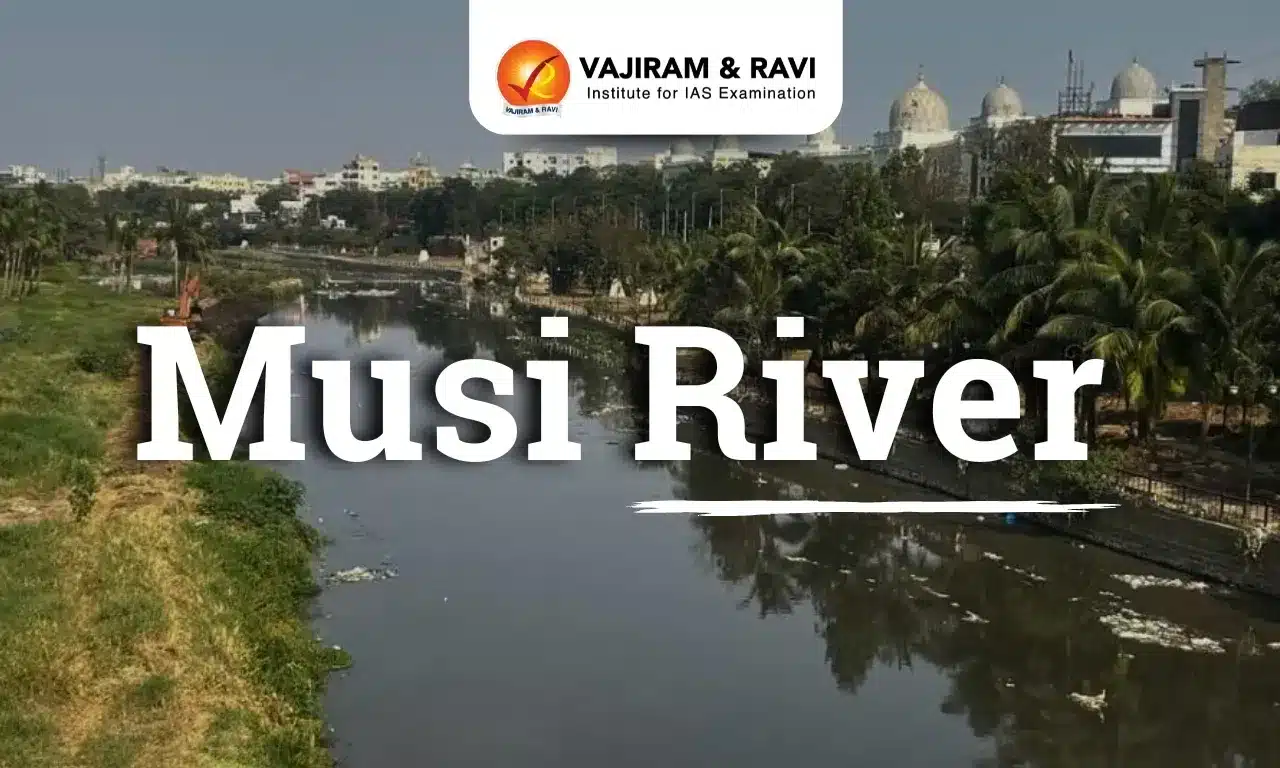
Musi River

Key Facts about Musi River

Musi River Latest News

The Hyderabad Disaster Response and Asset Protection Agency (HYDRAA) has cracked its whip against the illegal encroachments into the Musi river bed.

About Musi River

  • The Musi River, also known as the Muchukunda or Musunuru River, is a major tributary of the Krishna River in the Deccan Plateau, flowing through Telangana.
  • Course:
    • Source: Anantagiri Hills, Vikarabad, Telangana
    • The river is formed by the merging of two small rivulets: Esi (8 km) and Musa (13 km).
    • After originating, the Musi River flows in an eastward direction, cutting through the heart of Hyderabad city, where it historically divided the Old City from the New City.
    • The river then continues its journey through the southern Telangana plains, passing through parts of Rangareddy and Nalgonda districts.
    • Confluence: The Musi ultimately joins the Krishna River near Wazirabad in Nalgonda district.
  • The river’s total length is approximately 240 kilometers.
  • Dams: Himayat Sagar and Osman Sagar are the two dams that are constructed over the river.
  • The Musi River has 24 diversion weirs for irrigation, locally known as kathwas.
  • Irrigation and drinking water for villages downstream is heavily polluted with waste from the city.

Source: TH

Musi River FAQs

Q1: The Musi River is a major tributary of which river?

Ans: Krishna

Q2: What is the origin of the Musi River?

Ans: Anantagiri Hills, Vikarabad, Telangana

Q3: Which city does the Musi River flow through?

Ans: Hyderabad

Q4: What is the approximate length of the Musi River?

Ans: 240 km

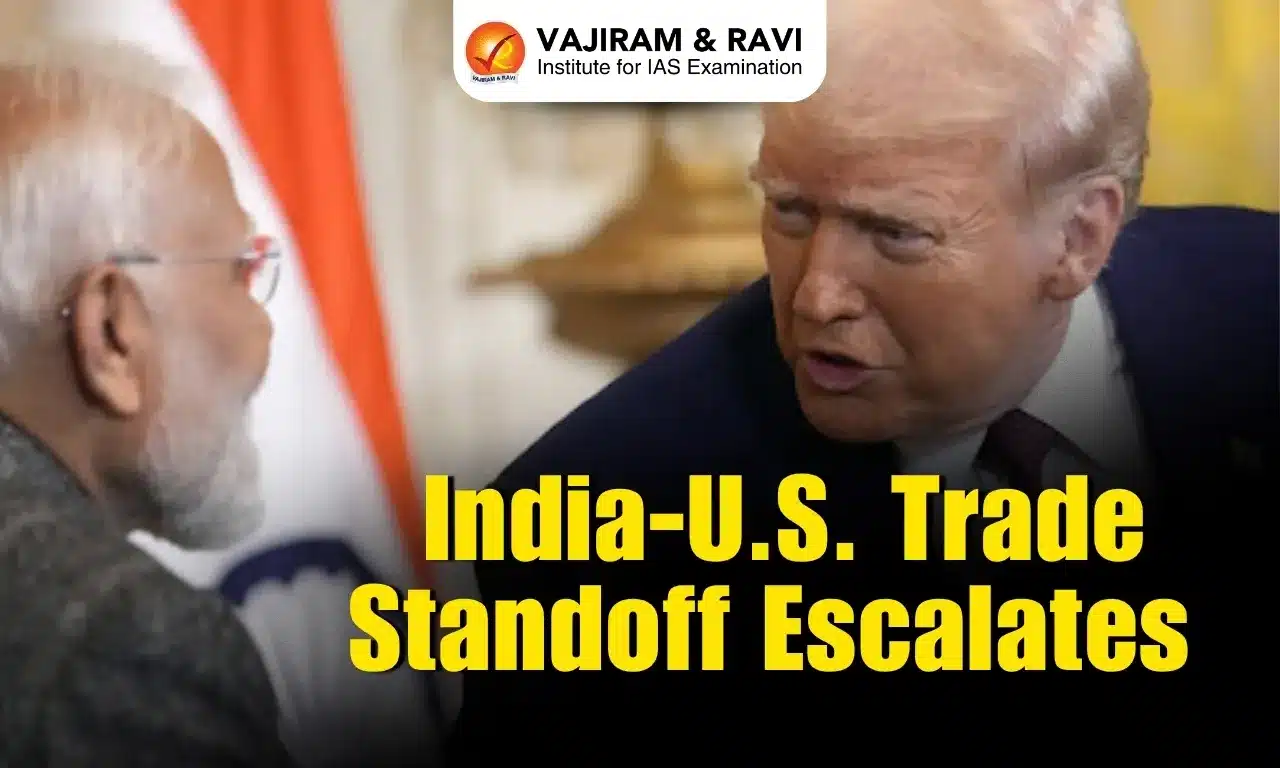
India-U.S. Trade Standoff Escalates – Tariffs, Penalties, and Strategic Dilemmas

India-U.S. Trade Standoff Escalates

India-U.S. Trade Standoff Escalates Latest News

  • U.S. President Donald Trump’s imposition of a 25% tariff on Indian imports, along with a potential 100% penalty for India’s continued purchase of Russian oil and defense equipment, comes just ahead of the August 1 deadline to finalize a bilateral trade deal. 
  • As a result, India-U.S. trade standoff escalates, putting ongoing trade negotiations at risk, and complicating India’s trade positioning vis-à-vis its global competitors, especially China.

Background - U.S.-India Trade Relations

  • Ongoing negotiations: India and the U.S. have been in talks since February 2025 to finalize a Bilateral Trade Agreement (BTA) aimed at establishing a mutually beneficial trade framework.
  • Mini-deal attempts:
    • Alongside the broader BTA, efforts were underway to create a “mini-deal” to roll back retaliatory tariffs. 
    • However, this deal has not materialized before the U.S.-imposed deadline of August 1.

New Tariff Measures

  • Announcement by U.S. President: Trump declared a 25% tariff and an unspecified “penalty” on Indian imports, effective August 1, 2025.
  • Reasons cited:
    • High Indian tariffs and non-tariff barriers.
    • India’s continued defense and energy purchases from Russia (India is the second-largest buyer of Russian oil after China).
    • Geopolitical concerns over India’s ties with Russia during the Ukraine conflict.
    • Penalty tied to Trump’s pressure campaign to force countries to reduce dependence on sanctioned Russian oil and arms.
  • Public statement: Trump criticized India’s trade practices on Truth Social, labeling them “strenuous and obnoxious.”

India’s Response

  • Commerce Ministry reaction: The Indian government is “studying the implications” and reiterated its commitment to a fair and balanced trade agreement.
  • Protection of domestic interests: The ministry emphasized safeguarding the interests of farmers, MSMEs, and entrepreneurs, drawing parallels with its stance during the India-UK Comprehensive Economic and Trade Agreement (CETA) negotiations.

Global Context - Trump’s Retaliatory Trade Policy

  • Liberation day tariffs: In April 2025, Trump imposed blanket tariffs on countries he accused of levying disproportionately high tariffs on U.S. goods.
  • 90-day pause and bilateral deals: A pause was provided to negotiate individual deals. Agreements were reached with -
    • UK: Reduced car tariffs to 10% and removed aerospace tariffs
    • Indonesia & Philippines: 19% tariff
    • Japan & EU: 15% tariff
  • India left out: India’s inability to secure a deal has now subjected it to higher tariffs and potential trade isolation.

Key Concerns for India

  • Strategic autonomy vs. trade realpolitik: The case underscores challenges India faces in balancing strategic autonomy (especially defense and energy ties with Russia) and economic pragmatism in dealing with major powers.
  • China’s first-mover advantage:
    • China has already concluded advanced-stage negotiations and could secure better terms, including waivers on secondary tariffs.
    • China cut tariffs on U.S. goods from 125% to 10%; the U.S. reciprocated by cutting tariffs from 145% to 30%.
  • Impact on MSMEs and agriculture: Heightened tariffs may affect exports from India's MSME sector and agricultural goods, which are highly price-sensitive.
  • Growing trend of bilateralism: This episode highlights the growing trend of bilateralism in global trade and the declining relevance of multilateral platforms like the WTO.

Conclusion

  • India stands at a crossroads where principled trade diplomacy is tested against economic imperatives. 
  • While New Delhi’s refusal to accept a one-sided deal has protected key domestic sectors, the pressure to conclude a deal has intensified due to mounting external tariffs and strategic maneuvering by China. 
  • The final shape of the India-U.S. deal may now hinge on top-level intervention, especially a conversation between PM Modi and President Trump, with the goal of minimizing economic damage while preserving strategic interests.

Source: TH | IE

India-U.S. Trade Standoff Escalates FAQs

Q1: How do U.S. tariffs affect India's strategic autonomy and trade stance?

Ans: They pressure India to alter ties with Russia and trade policies, challenging its strategic autonomy.

Q2: Are India's tariffs and trade practices WTO-compliant?

Ans: Yes, India asserts its tariffs comply with WTO norms and NTBs are globally common.

Q3: What is the likely economic impact of U.S. tariffs on India?

Ans: They may hurt exports and slow GDP growth to around 6.2% in FY2026.

Q4: How do China’s trade talks with the U.S. affect India?

Ans: China's progress weakens India’s position and increases pressure to conclude a deal.

Q5: What may India offer in an interim trade deal with the U.S.?

Ans: Likely concessions include big-ticket purchases like defense and LNG, while protecting key sectors.

Russia’s Kamchatka Hit by 8.8 Earthquake: Causes, Ring of Fire Role, and Global Impact

Kamchatka Earthquake 2025

Kamchatka Earthquake 2025 Latest News

  • A powerful 8.8 magnitude earthquake struck off the coast of Russia’s Kamchatka Peninsula, leading to widespread tsunami warnings across the Pacific. 
  • The quake, centered 119 km southeast of Petropavlovsk-Kamchatsky at a shallow depth of 19.3 km, was initially reported as 8.0 but later upgraded. It was followed by a strong 6.9 aftershock. 
  • This marks the strongest global quake since Japan’s devastating 9.0 magnitude earthquake in March 2011 that triggered the Fukushima nuclear disaster.

Understanding Earthquake Magnitude and Measurement

  • The 8.8 magnitude earthquake off Kamchatka is classified as a great earthquake, a rare event globally. 
  • According to the US Geological Survey (USGS), earthquakes of this scale release immense energy — with each whole-number increase in magnitude corresponding to roughly 31.6 times more seismic energy
  • For instance, the Kamchatka quake released over 30 times more energy than Myanmar’s 7.7 magnitude quake in March 2024. 
  • While “magnitude” refers to the measured energy released by an earthquake, “intensity” describes the perceived shaking at specific locations. 
  • Earthquake movements are recorded using a seismograph, which tracks the relative motion between the Earth’s surface and a suspended mass to determine seismic activity.

Kamchatka: A High-Risk Seismic Zone

  • The Kamchatka Peninsula in Russia’s Far East is one of the world’s most earthquake-prone regions. 
  • This 1,250-km landmass has witnessed several powerful quakes in recent history — including those in 2020, 2006, 1959, 1952, and 1923 — many of which triggered tsunamis. 
  • Historical accounts also mention similar events in 1841 and 1737.

Frequent Earthquakes Fuelled by Tectonic Plate Movements

  • The region’s high seismic activity is due to the subduction of the Pacific Plate beneath the Okhotsk microplate
    • Subduction is a geological process where a denser tectonic plate slides beneath a lighter one, causing stress at plate boundaries. 
    • This stress, when released, results in earthquakes. 
    • The Himalayas were formed by the Indian plate pushing under the Eurasian plate through subduction, making the region highly earthquake-prone.
  • This tectonic interaction forms the Kuril-Kamchatka Trench, which reaches depths of nearly 10 km. 
  • As the Pacific Plate descends at a rate of around 86 mm per year, stress builds up along the megathrust fault line, periodically releasing as massive earthquakes and resulting tsunamis in the North Pacific.

Kamchatka and the Pacific Ring of Fire

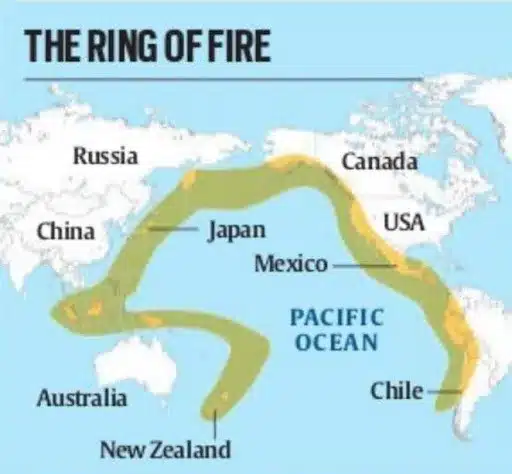
  • The Kamchatka Peninsula is part of the Pacific Ocean’s Ring of Fire, a horseshoe-shaped belt of intense seismic and volcanic activity encircling the Pacific Plate. 
  • Stretching over 40,000 km, this zone marks the boundaries of multiple tectonic plates — including the Eurasian, North American, Indian, Australian, and others — making it one of the most geologically active regions on Earth. 
  • The Ring of Fire spans more than 15 countries, including Russia, Japan, Indonesia, the US, Chile, and the Philippines, all of which frequently experience earthquakes, volcanic eruptions, and tsunamis due to constant tectonic movements.

Tectonic Forces Behind the Ring of Fire

  • The intense seismic and volcanic activity in the Ring of Fire is driven by constant tectonic plate movement. 
  • Plates frequently slide past, collide, or subduct beneath one another. 
  • When rough plate edges get stuck while the rest of the plate continues moving, stress builds up until it suddenly releases, causing an earthquake — as seen in the recent Kamchatka quake and tsunami. 
  • Volcanoes in this zone also form due to subduction, where a denser plate sinks beneath a lighter one, creating deep ocean trenches and magma build-up that fuels eruptions.

Global Earthquake Zones and Their Impact

  • The Circum-Pacific Belt (Ring of Fire) is Earth’s most active seismic zone, generating around 80% of major earthquakes. 
  • The second-most active is the Alpide Belt, stretching from Indonesia through the Himalayas to Turkey, contributing 15–17% of quakes. 
    • Though less active, it runs through densely populated regions, making its quakes more deadly. 
    • E.g., the sparsely populated Kamchatka Peninsula, despite facing a powerful 8.8 quake, saw no casualties, unlike Nepal’s 7.6 magnitude quake in 2015 that killed over 15,000. 
  • The third major zone, the mid-Atlantic ridge, lies deep underwater and causes moderate, less impactful quakes. 
  • Earthquake strength is also influenced by faultline length; a magnitude 9.5 quake is likely the upper limit, as no faultline spans the Earth to enable a stronger quake.

Source: IE | IE | NDTV

Kamchatka Earthquake 2025 FAQs

Q1: What caused the Kamchatka earthquake?

Ans: Subduction of the Pacific Plate under the Okhotsk Plate triggered the massive seismic activity off Kamchatka.

Q2: What is the Ring of Fire?

Ans: A 40,000 km seismically active zone encircling the Pacific, responsible for most of Earth’s major earthquakes.

Q3: Why is Kamchatka vulnerable?

Ans: Its location near a tectonic plate boundary and deep trench makes it prone to frequent quakes and tsunamis.

Q4: What is earthquake magnitude vs. intensity?

Ans: Magnitude measures energy released; intensity describes shaking felt at locations. Both are crucial in assessing earthquakes.

Q5: How are earthquakes measured?

Ans: Using seismographs that track Earth’s movements. A one-point increase in magnitude releases 31.6 times more energy.

Judicial Discretion in POCSO Bail: Legal Grey Zones and Recent Trends

POCSO bail discretion

POCSO Bail Discretion Latest News

  • A special POCSO court in Mumbai recently granted bail to a 40-year-old teacher accused of sexually assaulting a minor, citing consensual relations. 
  • The order has renewed focus on the complexities of bail under the POCSO Act, which is stricter than standard criminal law. 
  • Unlike regular cases where the prosecution must prove guilt, in POCSO cases the burden shifts to the accused to prove innocence. 
  • This reversal makes securing bail—especially in the early stages of investigation—particularly difficult. 

POCSO Act

  • The Protection of Children from Sexual Offences (POCSO) Act, 2012 is a special law enacted to safeguard children (individuals below 18 years of age) from sexual offences. 
  • It provides a comprehensive legal framework to address sexual abuse, harassment, and exploitation of minors.

Key features of the Act

  • Gender-neutral protection: Applies to both boys and girls.
  • Wide range of offences: Covers penetrative and non-penetrative assault, sexual harassment, and pornography involving children.
  • Special courts: Mandates the establishment of child-friendly Special Courts for speedy trial.
  • Mandatory reporting: Any person who has knowledge of child sexual abuse is legally required to report it.
  • Presumption of guilt: The accused must prove innocence, reversing the general legal principle of “innocent until proven guilty.”
  • Confidentiality: Protects the identity of the child during investigation and trial to avoid further trauma.
  • Support for Victims: It provides a framework for supporting and rehabilitating victims of sexual offenses. 
  • Child-Friendly Procedures: The act emphasizes child-friendly procedures for recording statements, medical examinations, and court appearances. 

Judicial Discretion and Bail in POCSO Cases

  • Offences under the POCSO Act are cognizable and non-bailable, meaning arrests can occur without a warrant and bail is not guaranteed
  • However, the Act does not lay down specific bail criteria. 
  • Courts rely on Section 483 of the Bharatiya Nagarik Suraksha Sanhita, 2023 (formerly Section 439 CrPC), which considers factors like the gravity of the offence, potential punishment, flight risk, and risk of evidence tampering. 
  • Over time, courts have introduced additional considerations. 
    • In Dharmander Singh (2020), the Delhi High Court listed factors like the ages of the victim and accused, their age gap, relationship dynamics, coercion, and post-offence conduct—though not binding, they serve as a guide. 
    • In Deshraj @ Musa vs State of Rajasthan (2024), the Supreme Court granted bail to an 18-year-old in a consensual relationship with a 16-year-old, given the minor age gap, time spent in custody, and slow trial progress. 
  • These cases underscore that bail in POCSO matters ultimately depends on judicial discretion balancing individual liberty with victim protection.

Consent and Legal Grey Zones Under POCSO

  • The POCSO Act does not recognise consent from individuals below the age of 18, treating all sexual activity with minors as an offence, regardless of whether it was voluntary. 
  • This creates a legal grey area, particularly in cases involving consensual adolescent relationships that are later criminalised. 
  • While courts have started considering such nuances during bail hearings—especially when the alleged victim confirms the consensual nature of the relationship in a magistrate’s statement—bail remains difficult in the early investigation phase. 
  • Courts often wait for critical evidence and victim testimony before granting relief, leading to prolonged custody for the accused.
  • Due to this, Senior Advocate Indira Jaising has urged the Supreme Court to lower the age of consent to 16, citing infringement of adolescent rights. 
  • However, the Centre opposed this, warning that reducing the age could weaken protections for minors and potentially increase vulnerability to abuse.

Source: IE | NHRC

POCSO Bail Discretion FAQs

Q1: What is the POCSO Act?

Ans: It’s a law to protect children under 18 from sexual abuse with strict procedures and special child-friendly courts.

Q2: Why is bail difficult under POCSO?

Ans: The accused must prove innocence, reversing the usual presumption, making early-stage bail challenging.

Q3: What guides bail decisions under POCSO?

Ans: Courts consider age, coercion, relationship nature, and conduct but use judicial discretion on a case-by-case basis.

Q4: How does POCSO treat adolescent relationships?

Ans: All sexual activity under 18 is illegal, but courts now consider consensual adolescent relations in bail decisions.

Q5: What debate exists on age of consent?

Ans: Advocates want it reduced to 16; the government opposes this, citing risk to child protection norms.

New GDP Series to Enhance Accuracy Using GST, UPI, and E-Commerce Data

New GDP Series

New GDP Series Latest News

  • India will release a new GDP series with 2022-23 as the base year in February 2026, followed by revised IIP and CPI series, to enhance the accuracy and relevance of key economic indicators.

Introduction

  • The Ministry of Statistics and Programme Implementation (MoSPI) is set to overhaul India’s key macroeconomic indicators, beginning with the release of a new GDP series based on the 2022-23 base year on February 27, 2026
  • This will be followed by updated series for the Index of Industrial Production (IIP) and the Consumer Price Index (CPI), which currently use outdated base years from 2011-12 and 2012, respectively.
  • This revision is part of a broader push by the government to ensure more real-time, granular, and representative measurement of India’s dynamic economy, using newer data sources and methodologies.

Updates to National Indicators

  • New GDP Series (Base Year 2022-23)
    • The revised GDP series will offer a more accurate reflection of economic activity by updating the reference period from 2011-12 to 2022-23, incorporating the following improvements:
      • Use of Goods and Services Tax (GST) data for indirect tax estimates
      • Incorporation of UPI transaction data from NPCI
      • Data from the E-Vahan portal for vehicle registrations
      • Administrative records from MCA-21, RBI, and CGA
    • This marks a significant advancement in capturing the informal and formal sectors more comprehensively.
  • Revised IIP Series (Base Year 2022-23)
    • Scheduled for release from April 2026, the new IIP series will reflect current industrial structures and consumption patterns. 
    • The existing 2011-12 base is now considered outdated due to rapid shifts in manufacturing priorities and technologies.
  • Updated CPI Series (Base Year 2024)
    • Expected in early FY2026-27, the new CPI base year will be updated to 2024, capturing recent shifts in household consumption, especially post-pandemic behavioural changes. 
    • The new series will also explore alternative data sources for better accuracy, including:
      • Online airfare and rail fare data
      • OTT subscription prices
      • Fuel prices from administrative records
      • Scanner data and web scraping for real-time e-commerce pricing

Enhancing Measurement Accuracy

  • The upcoming revisions go beyond base year updates and reflect a shift in India’s statistical infrastructure. 
  • MoSPI is adopting technology-driven and data-diverse approaches to capture economic changes more accurately.
  • Key initiatives include:
    • Leveraging e-commerce and digital transactions for consumption tracking
    • Web scraping and online price surveillance for real-time CPI inputs
    • Collaborating with platforms like NPCI for digital payment trends
    • Aligning survey frames with GSTN databases for improved service sector measurement
  • These changes are part of MoSPI’s effort to adapt to a digitally driven, consumption-diverse economy.

Launch of New Statistical Surveys

  • National Household Travel Survey (NHTS)
    • Launched in July 2025, the NHTS will assess travel patterns, choice of transport modes, and price elasticity of demand. The data will support transportation planning and be shared with ministries such as the Railways.
  • Domestic Tourism Expenditure Survey (DTES)
    • Also launched in July 2025, DTES will measure household expenditure on domestic tourism, purpose of travel, choice of transport, and use of tourism-specific services.
  • Annual Survey of Service Sector Enterprises (ASSSE)
    • Beginning January 2026, the ASSSE will systematically track India’s formal services sector, akin to the Annual Survey of Industries for the manufacturing sector. This is expected to bridge long-standing data gaps on:
      • Incorporated service enterprises
      • Revenue and employment metrics
      • Sectoral composition and regional variations
      • MoSPI has already completed a successful pilot study for ASSSE and will use the GSTN database to construct the survey frame.

Implications for Policymaking and Research

  • These statistical upgrades are crucial for:
    • Policy formulation based on real-time and reliable data
    • Private sector and investor decision-making
    • International comparability and credibility of Indian economic data
    • Better understanding of informal and digital economy shifts
  • By diversifying data sources and increasing survey frequency (e.g., Household Consumption Expenditure Survey every three years instead of five), MoSPI is aligning with global best practices in statistical governance.

Source: TH

New GDP Series FAQs

Q1: When will the new GDP series be released?

Ans: The new GDP series with a 2022–23 base year will be released on February 27, 2026.

Q2: What is the base year for the updated CPI series?

Ans: The new Consumer Price Index will use 2024 as its base year.

Q3: What innovative data sources will be used for the new GDP and CPI series?

Ans: GST, UPI, E-Vahan, e-commerce platforms, and web scraping will be used for improved data accuracy.

Q4: What is the Annual Survey of Service Sector Enterprises (ASSSE)?

Ans: It is a new MoSPI survey launching in January 2026 to measure activity in India’s formal services sector.

Q5: What are the goals of the National Household Travel Survey (NHTS)?

Ans: NHTS aims to study travel patterns, transport preferences, and the price sensitivity of Indian households.

Daily Editorial Analysis 31 July 2025

Daily Editorial Analysis

India’s Police Must Get Out of Dirty Harry’s Shadow

Context

  • In the dim light of a crime scene, two archetypes of policing emerge, Sherlock Holmes and Dirty Harry and Holmes is the emblem of reason: calm, methodical, and devoted to logic.
  • He sifts through chaos with precision, guided by evidence and a belief that truth must be discovered, not forced.
  • Dirty Harry, on the other hand, represents the opposite: brash, violent, and dismissive of rules; Justice, for him, is delivered swiftly, regardless of procedure or accuracy.
  • These fictional figures reflect two very real and divergent models of policing in India. In a nation governed by law, the pressing question is not just how we catch criminals, but what kind of justice we are willing to accept, one driven by truth or one fuelled by vengeance.

The Cost of Impunity: A National Crisis

  • The death of 27-year-old Ajith Kumar in police custody in Tamil Nadu is not an aberration but a symptom of a deeper malaise.
  • Despite previous reform recommendations, including those from the Tamil Nadu Police Commission, torture and custodial violence remain rampant.
  • Between 2018 and 2023, 687 people died in police custody across Indian, average of two to three deaths per week. States like Gujarat, Maharashtra, and Tamil Nadu top this grim list.
  • These figures are likely understatements. Many deaths are cloaked under vague labels like suicide or natural causes.
  • Torture often occurs away from formal detention spaces, in police vans, remote buildings, or even cow sheds, as in Ajith’s case.
  • Most victims come from India's most marginalised communities: daily-wage labourers, Dalits, tribals, migrants, and slum dwellers.
  • Thus, custodial torture is not merely an issue of poor policing, it is an expression of structural violence rooted in caste, class, and power disparities.

The Legal and Moral Vacuum

  • Despite multiple legal safeguards, from the Supreme Court’s D.K. Basu (1996) guidelines to the reaffirmation of bodily autonomy in K.S. Puttaswamy (2017), custodial violence remains entrenched.
  • The 273rd Report of the Law Commission (2017) strongly recommended a dedicated anti-torture law, but Parliament has failed to act.
  • India still has not ratified the United Nations Convention Against Torture.
  • In 2025, the Global Torture Index ranked India as a high-risk country, an indictment that must not be ignored.

The Scientific and Strategic Case Against Torture

  • The argument against custodial torture extends beyond ethics and legality, it is grounded in science.
  • Torture, popularised in media as a tool for urgent truth extraction, is in fact counterproductive.
  • In his book Why Torture Doesn’t Work, neuroscientist Shane O’Mara explains how torture disrupts brain regions essential for memory and reasoning.
  • Victims, impaired and desperate, often provide false information just to stop the pain.
  • Historical examples reinforce this. During the Algerian War, torture by French forces led to false intelligence.
  • The CIA’s infamous enhanced interrogation techniques failed to produce actionable insights, as concluded by the U.S.
  • Senate Intelligence Committee’s 2014 report. Worse still, these methods misdirected investigations and wasted precious time.
  • The case of Ajith Kumar, where a coerced confession led to a cow shed instead of evidence, tragically echoes this pattern.

What Actually Works: The Case for Reform

  • The United Kingdom’s response to the wrongful conviction of six men in the Birmingham pub bombings was to move away from confession-based policing.
  • It adopted the PEACE model, Preparation and Planning, Engage and Explain, Account, Closure, and Evaluation.
  • This method prioritises rapport, open-ended questioning, and transparency, reducing false confessions and increasing both conviction accuracy and public trust.
  • This model has been successfully adopted by other nations, including Norway, Canada, and New Zealand.
  • The European Committee for the Prevention of Torture endorses it, and peer-reviewed studies by the U.S. High-Value Detainee Interrogation Group confirm its effectiveness over coercive methods.
  • Real-world examples further affirm this.
  • Norwegian police obtained a full confession from mass murderer Anders Breivik through calm, professional questioning.
  • In the U.S., Najibullah Zazi, involved in a terror plot, cooperated fully with investigators who treated him respectfully, leading to the dismantling of a broader network.

Conclusion

  • Every custodial death is not just a tragedy; it is a declaration of the state’s failure to protect its citizens.
  • India must act decisively. Ratifying the UN Convention Against Torture, enacting a standalone anti-torture law, embedding the PEACE model into police training, and enforcing zero tolerance for custodial abuse are immediate, achievable reforms.
  • When truth can be found without violence, when the facts can emerge through patience and intellect, as Sherlock Holmes shows us, why should we endorse Dirty Harry’s path of destruction?

India’s Police Must Get Out of Dirty Harry’s Shadow FAQs

Q1. Who are the two contrasting models of policing described in the text?
Ans. The two contrasting models are Sherlock Holmes, who represents logical and evidence-based policing, and Dirty Harry, who represents violent, rule-breaking policing.

Q2. What does the case of Ajith Kumar highlight about Indian policing?
Ans. The case of Ajith Kumar highlights the prevalence of custodial torture and the failure of the system to protect citizens from police brutality.

Q3. Why is torture considered ineffective according to scientific research?
Ans. Scientific research shows that torture impairs memory and cognitive function, causing victims to give false or unreliable information.

Q4. What is the PEACE model of interrogation?
Ans. The PEACE model is a non-coercive interrogation technique that focuses on preparation, open-ended questioning, and rapport-building.

Q5. What reforms does the essay suggest for Indian policing?
Ans. India should ratify the UN Convention Against Torture, enact an anti-torture law, and adopt the PEACE model in police training.

Source: The Hindu


Boost the Capacity of Legal Aid Systems

Context

  • Access to justice is a constitutional promise in India, yet the gap between principle and practice remains stark.
  • The Legal Services Authorities Act, 1987, mandates free legal aid for approximately 80% of India's population.
  • Despite this expansive objective, the actual outreach of legal aid services remains significantly limited.
  • The analysis of recent trends, particularly between April 2023 and March 2024, exposes both structural strengths and glaring systemic weaknesses that continue to hinder equitable access to justice.

Concerns Surrounding Free Legal Aid

  • Modest Reach Amidst Expansive Mandate

    • In 2023–24, only 15.5 lakh people availed legal aid services, an increase of 28% from the previous year’s 12.14 lakh.
    • Although this rise appears promising, it pales in comparison to the sheer scale of India's eligible population.
    • Legal aid services are typically offered through front offices in local courts, prisons, and juvenile justice boards, supported by empanelled lawyers.
    • In rural areas, legal aid clinics serve as important access points.
    • Yet, the India Justice Report 2025 highlights that there is merely one legal service clinic for every 163 villages, underscoring the skewed distribution and limited penetration of services, especially in remote regions.
    • The situation is aggravated by inconsistent financial and human resource support.
  • Budgetary Constraints and Skewed Prioritisation

    • Legal aid services receive less than 1% of the total justice budget, which includes police, prisons, judiciary, and legal aid combined.
    • Funding is provided both by State governments and the Centre through the National Legal Services Authority (NALSA).
    • While the cumulative allocation rose from ₹601 crore in 2017–18 to ₹1,086 crore in 2022–23, primarily due to an increase in State contributions, NALSA’s share declined from ₹207 crore to ₹169 crore.
    • Even more concerning is the declining utilisation rate of NALSA funds, which dropped from 75% to 59% over the same period.
  • Inadequate Per Capita Spending

    • Per capita expenditure on legal aid has increased from ₹3 to ₹7 since 2019, but remains far from adequate.
    • States like Haryana lead with ₹16 per capita spending, while populous and vulnerable states like Bihar (₹3), West Bengal (₹2), and Uttar Pradesh (₹4) fall below the national average of ₹6.
    • This unevenness not only highlights disparities in fiscal commitment but also signals an inequitable access to quality legal services across regions.
  • Decline of the Frontline: Para-Legal Volunteers

    • One of the most alarming trends is the reduction in para-legal volunteers (PLVs), trained individuals who act as community-level intermediaries and educators.
    • Between 2019 and 2024, their numbers dropped by 38%, with deployment plummeting from 22,000 in 2019–20 to just 14,000 in 2023–24.
    • Despite their pivotal role, PLVs are poorly compensated; in most states, their daily honorarium remains below minimum wage levels.
    • Kerala is an exception, offering ₹750 per day, while states like Gujarat and Mizoram pay only ₹250—barely enough to cover daily sustenance.
    • This fiscal neglect severely undermines the sustainability and motivation of this critical workforce.

Innovations and Missed Opportunities: The LADC Scheme

  • Since 2022, NALSA has attempted to address quality concerns in legal representation through the Legal Aid Defence Counsel (LADC) scheme, modelled after public defender systems.
  • With ₹200 crore fully utilised in 2023–24 and the scheme operational in 610 out of 670 districts, early indications suggest promise.
  • However, its budget has already been slashed to ₹147.9 crore for 2024–25.
  • While still in its infancy, the LADC could alleviate the burden on empanelled lawyers and improve legal aid delivery, but only if sustained through robust policy and financial support.

Structural Deficiencies and the Way Forward

  • Despite incremental financial improvements and administrative innovations, legal aid in India suffers from enduring deficiencies, uneven quality, low public trust, and insufficient accountability.
  • These challenges are compounded by chronic underfunding and misallocation of existing resources.
  • The over-regulation of fund utilisation hampers local initiative, while poor compensation and declining deployment of key personnel like PLVs compromise outreach and impact.
  • If legal aid services are to fulfil their constitutional mandate, a radical recalibration is necessary. Ans this includes:
  • Increasing budgetary allocation and ensuring it is commensurate with the scale of need.
  • Flexible and needs-based fund utilisation, allowing local units to address contextual challenges.
  • Fair compensation and wider deployment of para-legal volunteers.
  • Sustained investment in promising schemes like the LADC with mechanisms for quality assurance and impact evaluation.
  • Greater integration with community justice mechanisms to develop trust and awareness.

Conclusion

  • The legal aid framework in India stands at a crossroads and while legislative intent and institutional infrastructure exist, the system remains underpowered.
  • Enhancing financial support, human resources, and decentralised governance can turn legal aid from a symbolic gesture into a tangible reality.
  • Only then can India ensure that justice is not just a lofty ideal, but a lived experience for all its citizens, regardless of economic status or geographic location.

Boost the Capacity of Legal Aid Systems FAQs

Q1. What is the main goal of legal services institutions in India?
Ans. The main goal of legal services institutions in India is to provide free legal aid to around 80% of the population, especially the economically and socially vulnerable.

Q2. Why is the reach of legal aid services still limited?
Ans. The reach remains limited due to low funding, poor resource utilisation, and an uneven distribution of legal aid clinics and personnel.

Q3. What role do para-legal volunteers play in the legal aid system?
Ans. Para-legal volunteers create awareness, help resolve disputes, and act as a bridge between communities and legal services.

Q4. What is the LADC scheme introduced by NALSA?
Ans. The Legal Aid Defence Counsel (LADC) scheme is a central program to provide dedicated legal aid to accused persons, modeled on the public defender system.

Q5. What are some key issues facing legal aid in India today?
Ans. Key issues include inadequate budgets, poor compensation for frontline workers, restricted fund usage, and lack of accountability.

Source: The Hindu

Daily Editorial Analysis 31 July 2025 FAQs

Q1: What is editorial analysis?

Ans: Editorial analysis is the critical examination and interpretation of newspaper editorials to extract key insights, arguments, and perspectives relevant to UPSC preparation.

Q2: What is an editorial analyst?

Ans: An editorial analyst is someone who studies and breaks down editorials to highlight their relevance, structure, and usefulness for competitive exams like the UPSC.

Q3: What is an editorial for UPSC?

Ans: For UPSC, an editorial refers to opinion-based articles in reputed newspapers that provide analysis on current affairs, governance, policy, and socio-economic issues.

Q4: What are the sources of UPSC Editorial Analysis?

Ans: Key sources include editorials from The Hindu and Indian Express.

Q5: Can Editorial Analysis help in Mains Answer Writing?

Ans: Yes, editorial analysis enhances content quality, analytical depth, and structure in Mains answer writing.

Schengen Visa Scheme

schengen visa

Schengen Visa Latest News

Indian travellers with a clean visa history now have access to a fast-tracked, long-term Schengen visa under a new “cascade” system rolled out by the European Commission.

About Schengen Visa

  • A Schengen visa is an entry permit that allows non-EU nationals to temporarily visit or transit through the Schengen Area, which comprises 29 European countries. 
  • Within this area, there are no internal borders, allowing for unrestricted movement between the countries.
  • The visa is valid for up to 90 days within a 180-day period, which begins the day you enter a Schengen country. 
  • You can enter and leave the area multiple times, but the total stay must not exceed 90 days within the 180-day period.
  • Schengen visas are issued for various purposes, such as tourism, business, visiting family, medical treatment, and participation in cultural or sporting events.
  • The visas do not give the right to work.

Which Countries Issue Schengen Visas?

  • There are currently 29 European countries in the Schengen.
  • Members of this area include 25 of the 27 EU member states (except for Cyprus and Ireland) and all members of the European Free Trade Association (Iceland, Liechtenstein, Norway and Switzerland).
  • Being part of this area means that countries:
    • Do not carry out checks at their internal borders, except in cases of specific threats;
    • Carry out harmonized controls at their external borders, based on clearly defined criteria.

The Cascade Visa Scheme

  • The cascade visa scheme rewards “trusted travellers” with a documented travel record. 
  • Indian citizens who have obtained two Schengen visas within the past three years are now eligible for a two-year multi-entry visa. 
  • This can later be upgraded to a five-year visa, provided their passport is valid for the full term.
  • During its validity, the visa allows holders to travel freely across the Schengen area, mirroring the travel rights of visa-free nationals. 
  • However, the visa does not grant the right to work and still limits stays to 90 days within any 180-day period.
  • It applies a tiered structure for visa validity based on prior usage:
    • 1-year visa if the traveller used three Schengen visas in the previous two years.
    • 2-year visa if they used a 1-year multiple-entry visa in the previous two years.
    • 5-year visa if they used a 2-year multiple-entry visa in the previous three years.

Source: BT

Schengen Visa FAQs

Q1: What is the maximum duration of stay allowed under a Schengen visa within a 180-day period?

Ans: 90 days

Q2: What is the primary purpose of the Schengen visa?

Ans: What is the Schengen Area?

Q3: How many countries are currently in the Schengen Area?

Ans: 2929

Enquire Now