UPSC Daily Quiz 11 August 2025

UPSC Daily Quiz

The Daily UPSC Quiz by Vajiram & Ravi is a thoughtfully curated initiative designed to support UPSC aspirants in strengthening their current affairs knowledge and core conceptual understanding. Aligned with the UPSC Syllabus 2025, this daily quiz serves as a revision resource, helping candidates assess their preparation, revise key topics, and stay updated with relevant issues. Whether you are preparing for Prelims or sharpening your revision for Mains, consistent practice with these Daily UPSC Quiz can significantly enhance accuracy, speed, and confidence in solving exam-level questions.

[WpProQuiz 42]  


UPSC Daily Quiz FAQs

Q1: What is the Daily UPSC Quiz?

Ans: The Daily UPSC Quiz is a set of practice questions based on current affairs, static subjects, and PYQs that help aspirants enhance retention and test conceptual clarity regularly.

Q2: How is the Daily Quiz useful for UPSC preparation?

Ans: Daily quizzes support learning, help in revision, improve time management, and boost accuracy for both UPSC Prelims and Mains through consistent practice.

Q3: Are the quiz questions based on the UPSC syllabus?

Ans: Yes, all questions are aligned with the UPSC Syllabus 2025, covering key areas like Polity, Economy, Environment, History, Geography, and Current Affairs.

Q4: Are solutions and explanations provided with the quiz?

Ans: Yes, each quiz includes detailed explanations and source references to enhance conceptual understanding and enable self-assessment.

Q5: Is the Daily UPSC Quiz suitable for both Prelims and Mains?

Ans: Primarily focused on Prelims (MCQ format), but it also indirectly helps in Mains by strengthening subject knowledge and factual clarity.

Article 137 of Indian Constitution, Interpretation, Purpose

Article 137 of Indian Constitution

Article 137 of Indian Constitution is discussed in Part V which grants the Supreme Court the authority to review its own judgments or orders. This power acts as a safeguard to ensure justice is served and to correct errors that may have occurred in earlier decisions. It reinforces judicial accountability and provides litigants with a limited avenue to seek reconsideration without approaching another forum. The review power is exercised under Article 137 of the Constitution, Order XLVII of the Supreme Court Rules, 2013 and Provisions of the Civil Procedure Code (CPC), 1908, where applicable.

Article 137 of Indian Constitution Interpretation

Article 137 of Indian Constitution provides that, subject to any law made by Parliament or rules framed under Article 145, the Supreme Court has the power to review any judgment pronounced or order made by it. This review jurisdiction ensures that the Court can correct its own errors in the interest of justice, but it is exercised only in rare and exceptional circumstances. The review power is guided by the principles laid out in Order 47 Rule 1 of the Civil Procedure Code, which allows review in three situations:

  • Discovery of new and important evidence not available earlier despite due diligence
  • An apparent error on the face of the record
  • Any other sufficient reason of comparable gravity

In R. D. Sagar vs V. Nagary (1976), the Supreme Court emphasized that while its judgments are final, they are open to review only on well-established grounds such as a grave or glaring error. The petitioner in this case contended that certain observations in the judgment portrayed him as guilty of abetting forgery and perjury. While the Court refused to entirely delete the remarks, it mitigated their impact by making specific modifications, illustrating its cautious and limited approach to the review power.

Also Check Related Post
Article 295 of Indian Constitution Article 194 of Indian Constitution
Article 39 of Indian Constitution Article 191 of Indian Constitution
Article 20 of Indian Constitution Article 16 of Indian Constitution
Article 67 of Indian Constitution Article 40 of Indian Constitution
Article 78 of Indian Constitution

Article 137 of Indian Constitution FAQs

Q1: What does Article 137 deal with?

Ans: Article 137 grants the Supreme Court of India the power to review its own judgments or orders.

Q2: What is the main purpose of Article 137?

Ans: It ensures that the Supreme Court can correct any mistakes or errors in its own decisions, thereby upholding justice.

Q3: Is the power of review under Article 137 unlimited?

Ans: No. The power is subject to laws made by Parliament and rules made under Article 145 of the Constitution.

Q4: Can any judgment of the Supreme Court be reviewed under Article 137?

Ans: Yes, but only if a valid ground for review exists, such as an apparent error on the face of the record, violation of natural justice, or discovery of new evidence.

Q5: Who can file a review petition under Article 137?

Ans: Any party to the case who is aggrieved by the judgment can file a review petition.

Article 312 of Indian Constitution, Interpretation, Significance

Article 312 of Indian Constitution

Article 312 of Indian Constitution is discussed in part of Part XIV which strengthens administrative unity and efficiency through the establishment of All-India Services (AIS). Officers serve both the Union and State governments, ensuring a uniform system of recruitment, training, and service conditions. The article empowers Parliament to create new AIS, such as the proposed All India Judicial Service (AIJS). Rajya Sabha requires a two-thirds majority resolution in the Council of States, declaring it necessary in the national interest.

Article 312 of Indian Constitution

  • Notwithstanding anything in Chapter VI of Part VI or Part XI, if the Council of States has declared by resolution supported by not less than two-thirds of the members present and voting that it is necessary or expedient in the national interest so to do, Parliament may by law provide for the creation of one or more all-India services (including an all-India judicial service) common to the Union and the States, and, subject to the other provisions of this Chapter, regulate the recruitment, and the conditions of service of persons appointed, to any such service.
  • The services known at the commencement of this Constitution as the Indian Administrative Service and the Indian Police Service shall be deemed to be services created by Parliament under this article.
  • The all-India judicial service referred to in clause (1) shall not include any post inferior to that of a district judge as defined in article 236.
  • The law providing for the creation of the all-India judicial service aforesaid may contain such provisions for the amendment of Chapter VI of Part VI as may be necessary for giving effect to the provisions of that law and no such law shall be deemed to be an amendment of this Constitution for the purposes of article 368.

Article 312 of Indian Constitution Interpretation

Article 312 of Indian Constitution found in Part XIV of the Constitution, which deals with Services under the Union and the States.

  • Clause (1) - Parliament can create new All-India Services (AIS), including a judicial service, if the Rajya Sabha passes a resolution by a two-thirds majority declaring it necessary in the national interest.
  • Clause (2) - The existing Indian Administrative Service (IAS) and Indian Police Service (IPS) are deemed to have been created under this Article.
  • Clause (3) - An All-India Judicial Service (AIJS) would include only posts not below the rank of District Judge, as defined in Article 236.
  • Clause (4) - Any law to create AIJS can amend Chapter VI of Part VI (subordinate courts), but it will not be treated as a constitutional amendment under Article 368.

Article 312 of Indian Constitution and AIJS Background

  • 1958 - The 14th Law Commission Report first recommended creating AIJS to improve efficiency and uniformity in judicial appointments.
  • 1976 - The 42nd Constitutional Amendment added Clauses (3) and (4) to Article 312, paving the way for AIJS.
  • 1978 & 2006 - The Law Commission and Parliamentary Standing Committee revisited the proposal, stressing its relevance.
  • 2008 - The 213th Law Commission Report reiterated the urgent need for AIJS to address judicial vacancies and delays.
  • Recent Years - Support from both judiciary and executive has revived the debate, framing AIJS as a national interest measure to tackle pendency and strengthen judicial capacity.

All India Judicial Service Overview

  • Objective-Create a centralised cadre of judicial officers selected through a common national examination.
  • Level of Appointment-Primarily for District Judges, with possible extension to other subordinate judiciary roles.
  • Recruitment Model-Modeled on UPSC-style recruitment for IAS/IPS, ensuring transparency and merit.
  • Scope-Promote judicial diversity, speed up vacancy filling, and allow career mobility for judges.

Judicial and Executive Views

  • Justice D.Y. Chandrachud (2024)-Called AIJS necessary to address 21% vacancies in the district judiciary.
  • President Droupadi Murmu (2023)-Supported a system to recruit young, capable legal professionals to IAS/IPS selection.

Need for AIJS

  • Vacancy Crisis-Over 5,400 vacancies and 2.78 crore pending cases require faster, streamlined recruitment.
  • Standardization-A single merit-based exam ensures uniform national criteria.
  • Diversity-Broad-based selection can improve representation in the judiciary.
  • Judicial Independence-Helps limit political or local interference in appointments.
  • Career Path-Provides structured promotion avenues.

Challenges in Implementation

  • Lack of Consensus-Divergent opinions among states and High Courts on feasibility.
  • Legislative Inaction-No concrete progress since 2022.
  • Dual Accountability-Balancing administrative control between Centre and States is complex.
  • Transition Issues-Integrating AIJS with existing judicial structures requires major logistical adjustments.

Article 312 of Indian Constitution Significance

  • Sets consistent national standards for recruitment, training, and promotions.
  • Enables judges from different regions to serve across states, promoting a pan-Indian judicial identity.
  • Recruitment is centralised, but appointments are fulfilled to each state’s requirements, maintaining the federal balance.
  • A national-level exam ensures selection of highly capable candidates for judicial posts.

Article 312 of Indian Constitution Important Case

Article 312 of Indian Constitution Important Case includes various landmark judgements out of which one of a notable case is All India Judge Association vs Union of India. During this case, the Supreme Court has set up the requirement for uniformity in appointment of the judicial system.

Also Check Related Post
Article 295 of Indian Constitution Article 194 of Indian Constitution
Article 39 of Indian Constitution Article 191 of Indian Constitution
Article 20 of Indian Constitution Article 16 of Indian Constitution
Article 67 of Indian Constitution Article 40 of Indian Constitution
Article 78 of Indian Constitution

Article 312 of Indian Constitution FAQs

Q1: What does Article 312 deal with?

Ans: Article 312 provides for the creation of one or more All-India Services (in addition to the existing ones) if the Rajya Sabha passes a resolution by a two-thirds majority of members present and voting.

Q2: What are All-India Services?

Ans: These are services common to both the Union and the States, where officers are recruited by the Union but serve under both Central and State Governments. Examples include the Indian Administrative Service (IAS), Indian Police Service (IPS), and Indian Forest Service (IFS).

Q3: Who can create a new All-India Service under Article 312?

Ans: The Parliament can create a new All-India Service by passing a law after the Rajya Sabha passes the required resolution.

Q4: Why is the Rajya Sabha’s role crucial in Article 312?

Ans: Since All-India Services affect the states directly, the Rajya Sabha (the Council of States) must first approve the proposal with a special majority before Parliament can act.

Q5: Has Article 312 been used to create services after the Constitution came into force?

Ans: Yes. The Indian Forest Service (IFS) was created in 1966 under the provisions of Article 312.

Article 238 of Indian Constitution, Interpretation, Significance

Article 238 of Indian Constitution

Article 238 of Indian Constitution discusses the application of provisions of Part VI to States in Part B of the First Schedule. It was amended by the Seventh Amendment Act in 1956 by which it was removed from the Constitution of India following the recommendations of the States Reorganisation Commission. The amendment reorganized states largely on linguistic basis, abolished the old classification of states into Categories A, B, C, and D, and introduced the concept of Union Territories.

Article 238 of Indian Constitution

The provisions of Part VI shall apply in relation to the States specified in Part B of the First Schedule as they apply in relation to the States specified in Part A of that Schedule subject to the following modifications and omissions, namely:-

  1. For the word “Governor” wherever it occurs in the said Part VI, except where it occurs for the second time in clause (b) of article 232, the word “Rajpramukh” shall be substituted.
  2. In article 152, for the word and letter “Part A” the word and letter “Part B” shall be substituted.
  3. Articles 155, 156 and 157 shall be omitted.
  4. In article 158,
    1. (i) in clause (1), for the words “be appointed” the word “becomes” shall be substituted;
    2. (ii) for clause (3), the following clause shall be substituted, namely:—
      1. “(3) The Rajpramukh shall, unless he has his own residence in the principal seat of Government of the State, be entitled without payment of rent to the use of an official residence and shall be also entitled to such allowances and privileges as the President may, by general or special order, determine.”;
    3. (iii) in clause (4), the words “emoluments and” shall be omitted.
  5. In article 159, after the words “seniormost Judge of that Court available” the words “or in such other manner as may be prescribed in that behalf by the President” shall be inserted.
  6. In article 164, for the proviso to clause (1) the following proviso shall be substituted, namely:-
    1. “Provided that in the State of Madhya Bharat there shall be a Minister in charge of tribal welfare who may in addition be in charge of the welfare of the Scheduled Castes and backward classes or any other work.”
  7. In article 168, for clause (1) the following clause shall be substituted, namely:—
    1. “(1) For every State there shall be a Legislature which shall consist of the Rajpramukh and—
    2. in the State of Mysore, two Houses;
    3. in other States, one House.”
  8. in article 186, for the words “as are specified in the Second Schedule” the words “as the Rajpramukh may determine” shall be substituted.
  9. In article 195, for the words “as were immediately before the commencement of this Constitution applicable in the case of members of the Legislative Assembly of the corresponding Province” the words “as the Rajpramukh may determine” shall be substituted.
  10. In clause (3) of article 202—
    1. (i) for sub-clause (a), the following sub-clause shall be substituted, namely:—
      1. “(a) the allowances of the Rajpramukh and other expenditure relating to his office as determined by the President by general or special order;”
    2. (ii) for sub-clause (f) the following sub-clauses shall be substituted, namely:—
      1. “(f) in the case of the State of Travancore-Cochin, a sum of fifty-one lakhs of rupees required to be paid annually to the Devaswom fund under the covenant entered into before the commencement of this Constitution by the Rulers of the Indian States of Travancore and Cochin for the formation of the United State of Travancore and Cochin;
      2. (g) any other expenditure declared by this Constitution, or by the Legislature of the State by law, to be so charged.”
  11. In article 208, for clause (2), the following clause shall be substituted, namely:—
    1. Until rules are made under clause (1), the rules of procedure and standing orders in force immediately before the commencement of this Constitution with respect to the Legislature for the State or, where no House of the Legislature for the State existed, the rules of procedure and standing orders in force immediately before such commencement with respect to the Legislative Assembly of such Province as may be specified in that behalf by the Rajpramukh of the State, shall have effect in relation to the Legislature of the State subject to such modifications and adaptations as may be made therein by the Speaker of the Legislative Assembly or the Chairman of the Legislative Council, as the case may be.”
  12. In clause (2) of article 214, for the word “Province” the words “Indian State” shall be substituted.
  13. For article 221, the following article shall be substituted, namely:—
    1. (1) There shall be paid to the Judges of each High Court such salaries as may be determined by the President after consultation with the Rajpramukh.
      ⁠(2) Every Judge shall be entitled to such allowances and to such rights in respect of leave of absence and pension as may from time to time be determined by or under law made by Parliament and, until so determined, to such allowances and rights as may be determined by the President after consultation with the Rajpramukh:
  14. ⁠Provided that neither the allowances of a Judge nor his rights in respect of leave of absence or pension shall be varied to his disadvantage after his appointment.”

Article 238 of Indian Constitution Interpretation

  • Article 238 applied the provisions of Part VI (dealing with states) to Part B states listed in the First Schedule, with specific modifications.
  • The term Governor was replaced with Rajpramukh in most references.
  • Adjustments were made in articles related to appointments, salaries, allowances, privileges, and powers of the Rajpramukh.
  • Special provisions were included for legislative structures in Part B states, including bicameral and unicameral legislatures depending on the state.
  • Financial provisions were modified to allow the Rajpramukh or the President to determine salaries, allowances, and certain charged expenditures.
  • Procedural rules for legislatures and judicial provisions for High Courts were adapted to the context of Part B states.
  • Part B states were mostly former princely states or unions of princely states, which had integrated into the Indian Union after independence.
  • The article became redundant after the States Reorganisation Act, 1956 and the Constitution (Seventh Amendment) Act, 1956, which abolished the classification of states into Part A, B, C, and D, placed all states on the same footing, and introduced Union Territories.
  • Article 238 was omitted by the Constitution (Seventh Amendment) Act, 1956.

Article 238 of Indian Constitution Landmark Cases

  • No major landmark judgments directly addressed Article 238 due to its early repeal in 1956.
  • Its impact was felt mainly through the integration of princely states and the establishment of a common governance system across newly formed Indian states.
  • State of Rajasthan v. Union of India (1977) - While unrelated to Article 238 specifically, this case clarified the extent of the President’s powers in dismissing state governments and shaped the understanding of state-Union relations.
  • Berubari Union Case (1960) - Although not about Article 238, it established important guidelines on altering Indian territory and reinforced the constitutional process for integrating regions into the Indian Union.

Article 238 of Indian Constitution Significance

  • Article 238 of Indian Constitution ensured the smooth transition of princely states to be a part of the democratic nation of India. Applied Part VI provisions (with modifications) to Part B states, giving them a stable legal and administrative framework during integration into India’s democratic system.
  • Placed Part B states under a governance model similar to Part A states, reducing administrative inconsistencies and reinforcing the federal structure.
  • Allowed former rulers to serve as ceremonial heads of state, ensuring a politically smooth transition before full integration into the Union.
  • As the difference between Part A and B states lost relevance, it covered the way for linguistic and administrative reorganisation of states.

Article 238 of Indian Constitution Amendment

  • Basis for Repeal - Recommended by the States Reorganisation Commission (1953-1955), which found the Part A, B, and C classification outdated and inadequate.
  • Abolition of Rajpramukh System - The hereditary or appointed heads of former princely states (Rajpramukhs) were removed, and all states adopted a uniform governance model.
  • Merger of Part A, B, and C States - The three-tier classification was replaced with a single category of states and Union Territories.
  • Linguistic Reorganisation - States were reorganised based on linguistic and cultural identity, creating new states such as Andhra Pradesh, Kerala, Madhya Pradesh, and Maharashtra.
Also Check Related Post
Article 295 of Indian Constitution Article 194 of Indian Constitution
Article 39 of Indian Constitution Article 191 of Indian Constitution
Article 20 of Indian Constitution Article 16 of Indian Constitution
Article 67 of Indian Constitution Article 40 of Indian Constitution
Article 78 of Indian Constitution

Article 238 of Indian Constitution FAQs

Q1: What did Article 238 originally deal with?

Ans: Article 238 laid down the provisions for the administration of Part B States in India after the Constitution came into effect in 1950.

Q2: What were Part B States?

Ans: Part B States were former princely states or groups of princely states that had merged with India after independence but were not classified as Part A or Part C States. Examples include Hyderabad, Mysore, Travancore-Cochin, Jammu & Kashmir, etc.

Q3: How were Part B States governed under Article 238?

Ans: They were administered according to the provisions of the Constitution, with certain adaptations and modifications, often under a Rajpramukh as head of the state.

Q4: Does Article 238 still exist in the Constitution?

Ans: No. Article 238 was omitted by the 7th Constitutional Amendment Act, 1956.

Q5: Why was Article 238 removed?

Ans: It was deleted because the States Reorganisation Act, 1956 abolished the classification of states into Part A, B, C, and D, creating a uniform system of states and union territories.

Daily Editorial Analysis 11 August 2025

Daily Editorial Analysis

The Difficult Path for Trump's 'One Big Budget Bet'

Context

  • The Department of Government Efficiency (DOGE) initiative, launched in Donald Trump’s second term, seeks to cut U.S. federal spending, deficit, debt, and interest burden while streamlining operations.
  • Elon Musk was appointed as an advisor, aiming to create a leaner government by reducing the number of federal agencies from over 400 to 99.
  • This article highlights the U.S. DOGE initiative under Donald Trump’s second term, its cost-cutting measures, revenue challenges, and the fiscal risks threatening its long-term success, especially with the proposed One Big Beautiful Bill (OBBB).

Low Revenue Collection as the Core of U.S. Deficit and Debt

  • The Trump administration’s push for a smaller government stemmed from persistent high spending and deficits.
  • Although U.S. public expenditure averaged 36.49% of GDP between 2001 and 2024 — the smallest among major advanced economies (MAE) — its fiscal deficit (6.0% of GDP) and debt burden (119.5% of GDP) in 2024 exceeded MAE averages.
  • The key reason is chronically low revenue collection.
  • From 2001 to 2022, U.S. government revenue averaged 30.55% of GDP, the lowest among peers, and its tax-to-GDP ratio of 19.27% lagged far behind countries like Italy, France, and the OECD average.

DOGE Reforms Deliver Major Cost Savings and Workforce Reduction

  • The Department of Government Efficiency (DOGE) has implemented extensive expenditure reforms, including:
    • cancelling unused office leases and wasteful contracts,
    • recovering misallocated funds,
    • reducing the federal workforce through hiring restrictions,
    • voluntary buyouts,
    • performance-based layoffs, and
    • cutting overseas humanitarian spending.
  • AI tools now monitor employee productivity, detect inefficiencies, and identify overlapping departmental functions.
  • DOGE also repealed or modified several regulations, saving $30.1 billion and removing 1.8 million words from federal rules.
  • Its transparency measures include publishing savings updates, revealing grant recipients via a payments portal, and sharing workforce size data.
  • Layoffs have been streamlined with the “Workforce Reshaping Tool,” leading to about 2,60,000 staff exits.
  • Overall, DOGE has achieved an estimated $190 billion in savings — $1,180 per taxpayer.
  • As per the unconstitutionality index (UI), for every law passed by Congress in 2024, there were about 19 rules created by the bureaucracy.
    • DOGE publishes a unique UI measuring the extent of bureaucracy’s role in shaping federal policy.

Conclusion: Fiscal Risks Threaten DOGE’s Long-Term Goals

  • DOGE’s future faces uncertainty after Elon Musk opposed the One Big Beautiful Bill (OBBB), a legislative extension of DOGE reforms, over its removal of electric vehicle tax credits.
  • More critically, the OBBB’s tax cuts far outweigh its spending cuts, projected to add $3.2 trillion to U.S. debt in the next decade.
  • With the U.S. already having the lowest corporate tax rates among major economies, below-OECD-average effective tax rates for the wealthy, and secrecy laws aiding tax evasion, deficit reduction is unlikely without boosting revenues.
  • Without addressing this, President Trump’s plan to cut debt through DOGE-style spending reforms may fall short.

The Difficult Path for Trump's 'One Big Budget Bet' FAQs

Q1. What is the primary aim of the DOGE initiative under Donald Trump’s administration?

Ans. DOGE seeks to reduce federal spending, deficit, debt, and interest burden while streamlining operations and cutting the number of federal agencies from over 400 to 99.

Q2. Why does the U.S. have high deficits despite the smallest government size among major economies?

Ans. The main reason is chronically low revenue collection, with a tax-to-GDP ratio of just 19.27%, far below peers and the OECD average.

Q3. What cost-saving measures has DOGE implemented?

Ans. DOGE cancelled wasteful contracts, recovered misallocated funds, cut workforce, used AI to monitor efficiency, repealed regulations, and reduced overseas humanitarian spending, saving $190 billion.

Q4. What is the Unconstitutionality Index (UI) published by DOGE?

Ans. The UI measures bureaucracy’s influence, revealing that in 2024, for every law passed by Congress, 19 rules were created by bureaucrats.

Q5. Why is the One Big Beautiful Bill (OBBB) seen as a fiscal risk?

Ans. Its tax cuts far exceed spending cuts, projected to add $3.2 trillion to U.S. debt over a decade, undermining deficit reduction efforts.

Source: TH


Signing Off on an Entrenched Symbol of Stigma 

Context

  • In April 2025, Tamil Nadu Chief Minister M.K. Stalin announced in the Legislative Assembly that all village names ending with colony or containing explicit caste references, such as Pallappatti, Paraiyappatti, Naavidhan Kulam, Paraiyan Kulam, and Sakkilippatti, would be removed from official state records.
  • These localities would be renamed, with the goal of eliminating public markers of caste identity and social stigma.
  • While the move is symbolic, its implications are rooted in a long and complex history of caste-based segregation in rural Tamil Nadu, as well as in the linguistic evolution of place names.

Historical Origins of Caste-Based Segregation

  • The practice of spatial segregation based on caste in Tamil Nadu likely began around the 12th century CE, drawing on the varnashrama system.
  • By this time, literature began recording the isolation of toiling, marginalised communities in settlements away from dominant caste quarters.
  • These divisions became entrenched over centuries, reinforced by religious movements such as the Bhakti period under the Cholas, which restructured village layouts in alignment with temple-centric social hierarchies.
  • By the Vijayanagar period (14th–17th centuries) and under the Nayakkas, caste segregation was brutally enforced.
  • The arrival of European colonisers deepened pre-existing social schisms while also introducing new administrative classifications that formalised derogatory locality names in official records.

The Evolution of ‘Colony’ and ‘Chery’

  • Historically, the Tamil word chery (or cherry) simply referred to a settlement.
  • Ancient works like Tolkappiyam (7th century BCE) and the Kurunthokai poetry collection (5th century BCE) used the term without any caste implication.
  • However, by the medieval period, especially in texts like Periya Puranam (12th century CE), terms like theendachery (untouchable settlement) emerged, marking a clear social boundary.
  • The English word colony underwent a similarly dramatic shift in meaning.
  • Initially used by Europeans to describe elite, exclusive white settlements in colonised territories, the word lost its colonial grandeur in rural Tamil Nadu, where it came to refer almost exclusively to Dalit habitations.
  • By the 20th century, chery and colony were interchangeable in rural caste geography.

The Social Stigma of Place Names

  • In rural Tamil Nadu, a village name containing colony is rarely neutral.
  • Unlike in urban, areas where Railway Colony or Jayendrar Colony may be socially mixed rural colonies are understood as lower caste enclaves.
  • The stigma operates as a form of linguistic dog-whistling, instantly signalling a resident’s caste to outsiders.
  • This has far-reaching consequences because residential addresses appear on essential identity documents such as Aadhaar cards, ration cards, passports, voter IDs, and driving licences.
  • For members of historically marginalised castes, the mere mention of their locality can trigger prejudiced attitudes, discriminatory treatment, and social exclusion, perpetuating a cycle of psychological harm and economic disadvantage.

Attempts at Reform and New Terminology and the 2025 Renaming Initiative

  • Attempts at Reform and New Terminology

    • The 20th century saw various reformist attempts to replace derogatory caste labels.
    • Mahatma Gandhi coined Harijan to symbolically uplift Dalits, but the term soon became another instrument of condescension.
    • Leaders like Iyothee Thass Pandithar and M.C. Rajah promoted the use of Adi-Dravidar instead of Parayar or Panchamar, and the Madras Presidency formally adopted this classification in 1922.
    • Yet even this designation eventually became associated with marginalisation.
  • The 2025 Renaming Initiative

    • The Tamil Nadu government’s 2025 renaming plan is not a direct welfare scheme but a social reform measure.
    • The initiative aims to replace derogatory names with those inspired by flowers, poets, or scientists, deliberately avoiding political leader names.
    • While urban localities like Saibaba Colony or Velachery will remain untouched, since they are not caste-coded, rural habitations with colony or chery used in a discriminatory sense will be renamed.
    • This renaming is intended to promote dignity, reduce the everyday visibility of caste divisions, and create social cohesion.
    • While it cannot by itself dismantle caste prejudice, it signals an official recognition of the problem and sets a precedent for symbolic action in the service of equality.

Conclusion

  • The stigma embedded in place names is not a relic of the past; it is an active mechanism of caste discrimination in rural Tamil Nadu.
  • The journey of words like chery and colony from neutral descriptors to markers of exclusion reveals the power of language to both reflect and perpetuate social hierarchies.
  • By removing derogatory locality names from state records, the Tamil Nadu government is making a historic, symbolic gesture towards a more inclusive society.
  • Though symbolic reforms cannot substitute for structural change, they can reshape public consciousness and lay groundwork for genuine social integration.

Signing Off on an Entrenched Symbol of Stigma FAQs

Q1. Why is the word “colony” considered stigmatizing in rural Tamil Nadu?
Ans. In rural Tamil Nadu, “colony” is almost always used to denote lower caste settlements, making it a marker of social stigma and discrimination.

Q2. What was the original meaning of the Tamil word chery?
Ans. The word chery originally meant any settlement or village and had no caste-related connotation in ancient Tamil literature.

Q3. How does a caste-linked locality name affect residents today?
Ans. Such names reveal a person’s caste through their address, often leading to prejudice, discrimination, and social exclusion.

Q4. What change did the Tamil Nadu government announce in April 2025?
Ans. The government announced that village names ending with “colony” or containing caste references would be removed and replaced with neutral names.

Q5. Why is the renaming considered a symbolic but important step?
Ans. It removes visible markers of caste segregation from public records, encouraging dignity and social cohesion even if it does not eliminate prejudice entirely.

Source: The Hindu

Daily Editorial Analysis 11 August 2025 FAQs

Q1: What is editorial analysis?

Ans: Editorial analysis is the critical examination and interpretation of newspaper editorials to extract key insights, arguments, and perspectives relevant to UPSC preparation.

Q2: What is an editorial analyst?

Ans: An editorial analyst is someone who studies and breaks down editorials to highlight their relevance, structure, and usefulness for competitive exams like the UPSC.

Q3: What is an editorial for UPSC?

Ans: For UPSC, an editorial refers to opinion-based articles in reputed newspapers that provide analysis on current affairs, governance, policy, and socio-economic issues.

Q4: What are the sources of UPSC Editorial Analysis?

Ans: Key sources include editorials from The Hindu and Indian Express.

Q5: Can Editorial Analysis help in Mains Answer Writing?

Ans: Yes, editorial analysis enhances content quality, analytical depth, and structure in Mains answer writing.

National Medical Register

National Medical Register

National Medical Register Latest News

Recently, the Minister of State for Health and Family Welfare informed the Lok Sabha that application for issuance of an National Medical Register (NMR) Identification (ID) is voluntary.

About National Medical Register

  • It is a centralised database of registered medical practitioners in modern medicine, maintained by the National Medical Commission (NMC).
  • It was launched in August 2024 under Section 31 of the NMC Act, 2019, the register was introduced as a mandatory exercise for all registered medical practitioners.
  • It aims to eliminate duplication and enable the public to access information on any doctor working in India.
  • It contains information on each practitioner, including qualification, area of specialisation (in process), registration status, and date of registration, and assigns a unique identification number called the NMR ID.
  • Each doctor’s record is linked to their Aadhaar ID for verification, with some data made public while sensitive information is restricted to specified individuals and institutions.
  • State Medical Councils (SMCs) are responsible for verifying degrees and facilitating the process, with the portal dynamically updated for transparency and governance.
  • Upon successful verification by the State Medical Council, the application is sent to the National Medical Commission. After the NMC verification, a unique NMR ID would be issued.

Source: TH

National Medical Register FAQs

Q1: What is the national medical register?

Ans: The National Medical Register (NMR) is a centralized database of registered medical practitioners in modern medicine in the country, maintained by the National Medical Commission

Q2: What is the National Medical Commission ?

Ans: It has been constituted by the National Medical Commission Act, 2019, which came into force on September 25, 2020.

Blue Pinkgill Mushroom

Blue Pinkgill Mushroom

Blue Pinkgill Mushroom Latest News

Recently, a burst of rare and colourful Blue Pinkgill fungi has been documented in the Kagaznagar forest division of the Komaram Bheem Asifabad district, of Telangana.

About Blue Pinkgill Mushroom

  • It is referred as “sky-blue mushroom,” (scientific name: Entoloma hochstetteri) this genus of mushrooms has pink to purplish hues in their gills.
  • It a species native to New Zealand and famously featured on the country’s $50 note.
  • Appearance of Blue Pinkgill Mushroom
    • It is vivid blue mushroom, its colour derived from rare azulene pigments,
    • Some are small, with a distinctive all-blue colour and slightly reddish-tinted gills from spores, thanks to azulene pigments.
    • They have caps that can be flat or funnel-shaped, pink or white gills and stems that may be centrally or laterally attached.
    • The spore print is typically pink to salmon-coloured, which helps in identification.
  • Habitat: It is common in forests across New Zealand, where it grows in the ground between litter in the broadleaf forest.
  • The Blue Pinkgill mushroom appears during the monsoon when the forest cover reaches saturation due to abundant rainfall, which creates perfect soil conditions for mushrooms to grow and thrive.

Source: NIE

Blue Pinkgill Mushroom FAQs

Q1: Is blue mushroom rare?

Ans: Blue colors are relatively rare in nature, but there are a significant number of mushrooms that are blue or stain blue.

Q2: What is the scientific name for blue pinkgill?

Ans: Entoloma hochstetteri

Colorado River

Colorado River

Colorado River Latest News

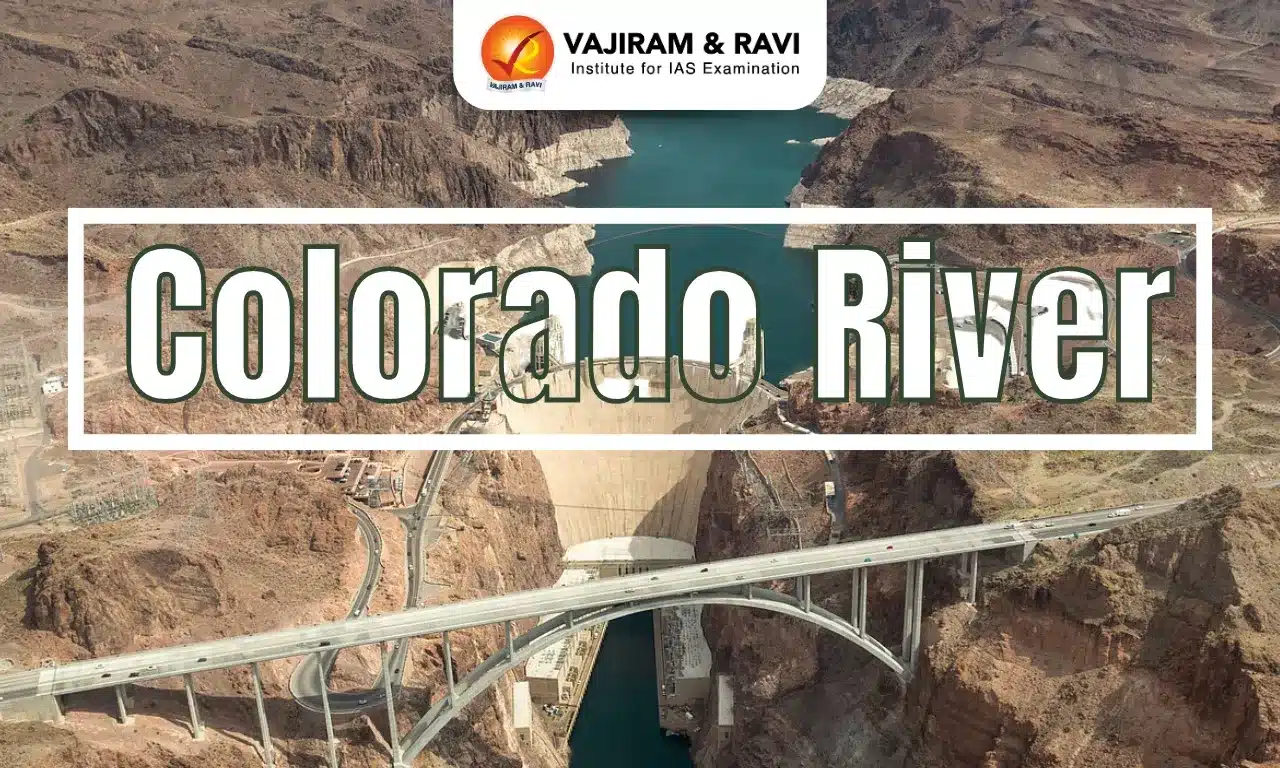
The Colorado River, a vital water source for millions, faces a crisis as its flow diminishes, prompting states to vie for future water rights.

About Colorado River

  • It is a major river of North America.
  • Origin: It rises in the Rocky Mountains of Colorado, U.S.
  • It flows generally west and south for 1,450 miles (2,330 kilometres) into the Gulf of California in northwestern Mexico.
  • It flows through seven U.S. states and two Mexican states, providing water to over 40 million people.
  •  The river drains a vast arid and semiarid sector of the North American continent, and because of its intensive development it is often referred to as the “Lifeline of the Southwest.”
  • Lakes: It forms several major reservoirs, including Lake Mead and Lake Powell.
  • Colorado forms an international boundary between Arizona (US) and Mexico for about 29 kilometers.
  • Tributaries: The Colorado River has several tributaries, including Green, Gunnison, San Juan, Dolores, Little Colorado, Gila, and Virgin Rivers.
  • One of the Colorado River’s most famous features is the Grand Canyon, which it carved over millions of years. This breathtaking landscape is a UNESCO World Heritage Site and a major tourist attraction.
  • The river also flows through Canyonlands National Park and Horseshoe Bend in Arizona.

Source: DTE

Colorado River FAQs

Q1: Why is the Colorado River so famous?

Ans: It is known for its dramatic canyons, whitewater rapids, and eleven U.S. National Parks, the Colorado River and its tributaries are a vital source of water for 40 million people.

Q2: What is the longest river in the world?

Ans: The River Nile

Biosafety Levels (BSL)

Biosafety Levels

Biosafety Levels Latest News

Nehru Zoological Park, Hyderabad, will soon establish a Biosafety Level-3 (BSL-3) laboratory, the first of its kind in southern India, enabling rapid diagnosis, post-mortem analysis, and research on zoonotic diseases.

About Biosafety levels

  • Biosafety levels (BSL), also known as biological safety levels or biohazard levels, define the necessary containment precautions for handling infectious agents in laboratory settings. 
  • They’re a mandatory requirement in any biological research facility. 
  • Biosafety levels contribute to the isolation of dangerous organisms and lethal agents.
  • The levels of containment range from the lowest biosafety level 1 (BSL-1), to the highest at level 4 (BSL-4). 
  • Each BSL lab level builds upon the previous level—thereby creating layer upon layer of constraints and barriers. 
  • These lab levels are determined by the following:
    • Risks related to containment
    • Severity of infection
    • Transmissibility
    • Nature of the work conducted
    • Origin of the microbe
    • Agent in question
    • Route of exposure
  • BSL-1: It applies to laboratory settings in which personnel work with low-risk microbes that pose little to no threat of infection in healthy adults. Because of this, BSL-1 labs typically do not need to be isolated from surrounding facilities.
  • BSL-2: It covers all laboratories that work with agents associated with human diseases — that is, pathogenic or infectious organisms — that pose a moderate health hazard if inhaled, ingested, or exposed to the skin.
  • BSL-3: BSL-3 laboratory typically conducts research into or work on microbes that are either indigenous or exotic and can cause serious or potentially lethal disease through inhalation.
  • BSL-4: BSL-4 labs are rare. As the highest level of biological safety, BSL-4 labs work with highly dangerous and exotic microbes. Infections caused by these types of microbes are often fatal and come without treatment or vaccines.
  • At the lowest level of biosafety, precautions may consist of regular hand-washing and minimal protective equipment. 
  • At higher biosafety levels, precautions may include airflow systems, multiple containment rooms, sealed containers, positive pressure personnel suits, established protocols for all procedures, extensive personnel training, and high levels of security to control access to the facility.

Source: TT

Biosafety Levels FAQs

Q1: What are Biosafety levels (BSL)?

Ans: Biosafety levels (BSL) define the necessary containment precautions for handling infectious agents in laboratory settings.

Q2: Which biosafety level deals with low-risk microbes that pose little to no threat to healthy adults?

Ans: BSL-1

Q3: Which of the following is the highest level of biological safety used for handling the most dangerous pathogens?

Ans: BSL-4

Kasargodia Sheebae and Pilarta Vaman

Kasargodia Sheebae and Pilarta Vaman

Kasargodia Sheebae and Pilarta Vaman Latest News

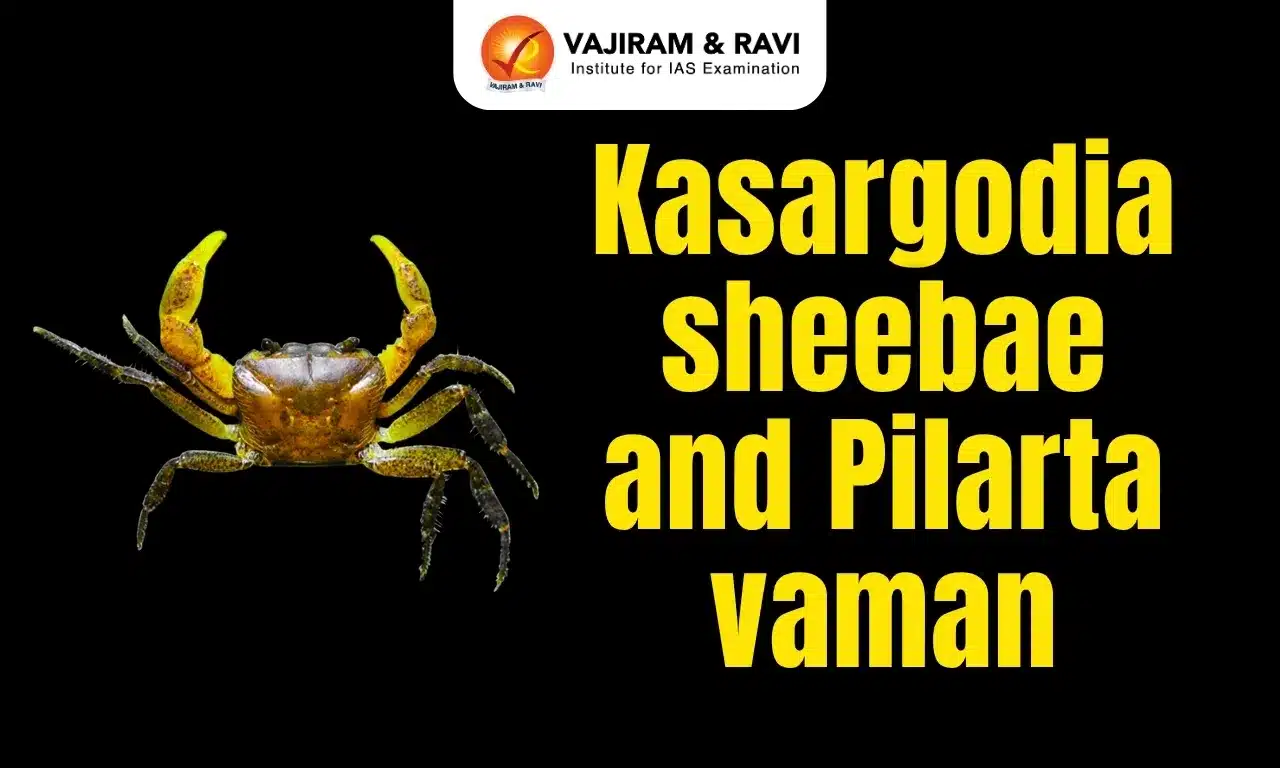
Recent studies launched by researchers have led to the discovery of a new genus and two new species of freshwater crabs named Kasargodia sheebae and Pilarta vaman from Western Ghats regions in Kerala.

About Kasargodia Sheebae and Pilarta Vaman

  • They are two new species of freshwater crabs.
  • They are discovered in the Western Ghats regions in Kerala.
  • They belong to the freshwater crab family Gecarcinucidae.
  • In the case of Kasargodia sheebae, the name of the new genus, Kasargodia, is derived from the northernmost Kerala district.
    • Kasargodia sheebae is distinguished by a brownish-orange carapace with numerous black spots. 
    • The limbs bearing the claws are orange with black spots. 
  • The other new species, Pilarta vaman, is named after Vaman, one of the avatars of Vishnu in Hindu mythology. 
    • The name alludes to the small size of this crab. 
    • The carapace of this species is more quadrate.

Source: TH

Kasargodia Sheebae and Pilarta Vaman FAQs

Q1: In which region were Kasargodia sheebae and Pilarta vaman discovered?

Ans: Western Ghats regions in Kerala.

Q2: Kasargodia sheebae and Pilarta vaman belong to which family of freshwater crabs?

Ans: Gecarcinucidae

Q3: Which feature distinguishes Kasargodia sheebae from other freshwater crabs?

Ans: Brownish-orange carapace with black spots.

Article 27 of Indian Constitution, Interpretation, Pronouncements

Article 27 of Indian Constitution

Article 27 of Indian Constitution is a Fundamental Right discussed in Chapter III of the constitution listed under “Freedom of Religion”. Under this Article, any citizen who promotes their religion or religious dominance must not pay any tax. Through this right, the constitution has protected the “Freedom of Conscience” under Article 25 which consists of four elements which are important including person, tax, promotion or maintenance of the religion or religious dominance.

Article 27 of Indian Constitution Interpretation

Article 27 of Indian Constitution discusses that there is no tax implied on the citizens promoting or maintaining any religion, it is a part of Fundamental Rights under the Freedom of Religion including the principle of secularism. This article ensures that the funds collected must not support any particular religion. Essential elements from the Article 27 of Indian Constitution includes:

  • The term “person” has a broader definition and may refer to-
    • Individuals
    • Companies
    • associations or 
    • entities

Article 27 mentions that the state cannot compel anyone to pay a tax if that tax is used to promote or maintain a particular religion or religious denomination. For it to be violated, four conditions must all be met:

  • There is a tax.
  • The proceeds are used to promote or maintain a religion or religious denomination.
  • A person is compelled to pay it.
  • The dominant purpose of the tax is religious promotion or maintenance.

The key factor is the state’s intention behind levying the tax. If it’s for general public expenditure, Article 27 doesn’t apply. If it’s aimed at supporting a religion, it does.

Article 27 of Indian Constitution Judicial Pronouncements

In Commissioner, Hindu Religious Endowments, Madras vs Sri Lakshmindra Thirtha Swamiar of Sri Shirur Mutt (1954), the Supreme Court had to decide whether contributions collected from religious institutions under the Madras Hindu Religious and Charitable Endowment Act, 1951, were taxes under Article 27.

The petitioner argued they were taxes and therefore unconstitutional. The Court held that while the contributions resembled a tax, they were meant for the secular purpose of managing religious institutions, not for promoting or maintaining any religion.

This case drew an important line, a levy for administrative regulation is valid, but a levy for religious promotion violates Article 27.

Also Check Related Post
Article 295 of Indian Constitution Article 194 of Indian Constitution
Article 39 of Indian Constitution Article 191 of Indian Constitution
Article 20 of Indian Constitution Article 16 of Indian Constitution
Article 67 of Indian Constitution Article 40 of Indian Constitution
Article 78 of Indian Constitution

Article 27 of Indian Constitution FAQs

Q1: What does Article 27 of the Indian Constitution deal with?

Ans: Article 27 prohibits the use of tax proceeds collected from the public for the promotion or maintenance of any particular religion or religious denomination.

Q2: What is the main objective of Article 27?

Ans: Its primary aim is to uphold the principle of secularism by ensuring that taxpayers are not compelled to support a religion they do not follow.

Q3: What does ‘freedom as to payment of taxes for promotion of any particular religion’ mean?

Ans: It means the State cannot levy, collect, or use taxes specifically to fund the propagation or upkeep of any religion.

Q4: Is Article 27 a Fundamental Right?

Ans: Yes, Article 27 is part of the Fundamental Rights under Part III of the Constitution.

Q5: Does Article 27 prohibit all use of public money for religious purposes?

Ans: No, it only prohibits specific taxation for religion. If public money is spent on religious institutions as part of promoting culture or heritage generally, it may be permissible.

Article 85 of Indian Constitution, Interpretation, Objective

Article 85 of Indian Constitution

The Constitution of India lays down the framework that determines the structure and functioning of the government of the country. Article 85 of Indian Constitution discusses the sessions of the Parliament, Prorogation and Dissolution, it sets out the procedure for convening parliamentary sessions, the conditions under which they can be prorogued, and the circumstances in which they may be dissolved. This provision ensures Parliament works efficiently while keeping a balance of power between the legislature and the executive.

Article 85 of Indian Constitution Interpretation

Article 85 of Indian Constitution says that the President can summon each House of Parliament at times and places he thinks fit, but there can’t be more than six months between the last sitting of one session and the first sitting of the next. It also allows the President to:

  • Prorogue either House or both Houses.
  • Dissolve the Lok Sabha.

Parliament is required to meet at least twice a year, the Budget Session (February to May) and the Monsoon Session (July to September). A Winter Session is often held in November and December.

The President decides the timing of these sessions in consultation with the Lok Sabha Speaker and the Rajya Sabha Chairman.

  • Article 85(2)(a) covers prorogation, ending a session without dissolving Parliament. It’s done by the President after consulting the presiding officers and is different from adjournment, which is just a temporary pause during a session.
  • Article 85(2)(b) covers dissolution, ending the Lok Sabha entirely, either at the end of its five-year term or earlier on the Prime Minister’s advice. Dissolution leads to general elections. The Rajya Sabha is permanent and not subject to dissolution.
Also Check Related Post
Article 295 of Indian Constitution Article 194 of Indian Constitution
Article 39 of Indian Constitution Article 191 of Indian Constitution
Article 20 of Indian Constitution Article 16 of Indian Constitution
Article 67 of Indian Constitution Article 40 of Indian Constitution
Article 78 of Indian Constitution

Article 85 of Indian Constitution FAQs

Q1: What does Article 85 of the Indian Constitution deal with?

Ans: Article 85 empowers the President of India to summon each House of Parliament, prorogue them, and dissolve the Lok Sabha.

Q2: What is the main provision regarding Parliamentary sessions in Article 85?

Ans: It states that there should not be a gap of more than six months between the last sitting of one session and the first sitting of the next session of Parliament.

Q3: Who has the authority to summon Parliament under Article 85?

Ans: The President of India has the authority, but acts on the advice of the Council of Ministers headed by the Prime Minister.

Q4: What does ‘prorogue’ mean in the context of Article 85?

Ans: Proroguing means ending a session of Parliament without dissolving the Lok Sabha. It stops all parliamentary work until the next session is summoned.

Q5: What is the difference between proroguing and dissolving the House?

Ans: Proroguing ends a session but the House continues to exist and dissolving ends the term of the Lok Sabha, requiring a new general election.

UN Conference on Landlocked Developing Countries

UN Conference on Landlocked Developing Countries

UN Conference on Landlocked Developing Countries Latest News

Recently, the third United Nations Conference on Landlocked Developing Countries (LLDC3) opened in Awaza, Turkmenistan.

About UN Conference on Landlocked Developing Countries

  • The LLDC3 conference, held once every ten years, brings global attention to the 32 landlocked developing countries, which collectively house over 600 million people.
  • The primary objective of LLDC3 is to facilitate coordinated international efforts to bridge these development gaps.
  • The conference will explore actionable solutions through partnerships, smarter investment frameworks, and the development of efficient, flexible transport corridors that enhance the movement of goods and services across regions.
  • Due to lack of direct access to seaports, landlocked countries face disproportionate barriers to trade, economic diversification, and infrastructure development. 
  • This year’s conference, themed “Driving Progress through Partnerships,” serves as a crucial platform to address structural challenges, mobilize investment, and implement the newly adopted Awaza Programme of Action (2024–2034).

Key Facts about The Awaza Programme of Action (2024–2034)

  • A central focus of LLDC3 is the implementation of the Awaza Programme of Action (APoA) for the Decade 2024–2034.
  • The APoA was adopted by consensus at the UN General Assembly on 24 December 2024 and offers a comprehensive framework to tackle persistent development challenges faced by LLDCs. 
  • Built on five interconnected priority areas, the programme aims to support:
    • Structural Transformation, and Science, Technology, and Innovation
    • Trade, Trade Facilitation, and Regional Integration
    • Transit, Transport, and Connectivity
    • Enhancing Adaptive Capacity, Strengthening Resilience, and Reducing Vulnerability
    • Implementation, Follow-up, and Monitoring

Source: TOI

UN Conference on Landlocked Developing Countries FAQs

Q1: What is the UN Convention on landlocked countries?

Ans: The Convention on Transit Trade of Land-locked States is a multilateral treaty that addresses international rules allowing for land-locked countries to transport goods to and from seaports (transit trade).

Q2: What is a landlocked country?

Ans: Landlocked countries are nations that do not have any coastline.

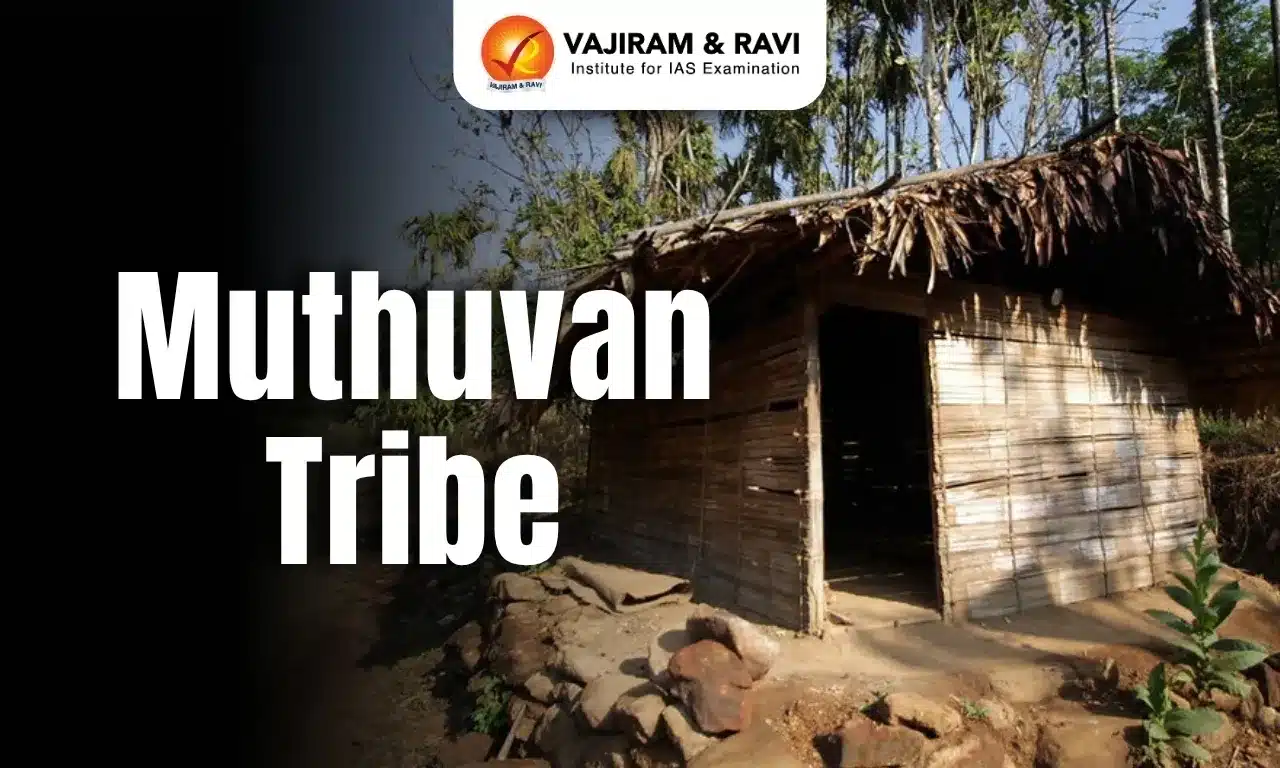
Muthuvan Tribe

Muthuvan tribe

Muthuvan Tribe Latest News

A rare convention of the Muthuvan community has taken on a novel mission to protect their language and culture, organising a three-day special conference as part of the International Day of the World’s Indigenous Peoples.

About Muthuvan Tribe

  • The Muthuvans, or Mudugars, live on the border hill forests of Kerala and Tamil Nadu.
  • There are two different groups among the Muthuvan, and they speak slightly two different dialects. Hence, they call each other Malayalam Muthuvan and Pandi Muthuvan.
  • They are known for coexisting with the wildlife with their traditional knowledge and understanding of hills.
  • They have expertise in traditional medicines which are very effective and these medicines and the medicine men are confidentially preserved and passed on to the generations.
  • Social Organization
    • The Muthuvan have six clans known as Koottams. Each koottam is again divided into sub clans. 
    • The functions of these divisions are mainly for marriage alliance, to keep up the social status, and to indicate descent and ancestry. 
    • The Muthuvan adhere to community endogamy and clan exogamy. 
  • These tribal people follow a unique system of governance called the ‘Kani System’.
    • Under this system, each village is headed by a ‘Kani’, who is responsible for the administration of the village.
    • They have various punishment methods for breaking their traditions and moral standards.
  • Religion and Beliefs: 
    • They are animists and spirit worshippers and also worship the forest gods.
    • They believe that the spirits of their ancestors are to be the first migrants to the hill forests.
  • Occupation
    • Virippukrishi (a form of shifting cultivation) is their traditional means of livelihood, and they cultivate a wide variety of food grains that are used only for consumption. 
    • Ragi (Little Millet), Maize (Sorghum), Thina (Italian Millet), Varagu, Chama Rice, Tomato, Carrot, Sweet Potato, Potato, Cheeni Vala, Toppi, Mocha, etc., are principal food crops cultivated by the Muthuvan community.

Source: TH

Muthuvan Tribe FAQs

Q1: The Muthuvan tribe is primarily found in which Indian states?

Ans: Muthuvan tribe live on the border hill forests of Kerala and Tamil Nadu.

Q2: What is the traditional governance system followed by the Muthuvan tribe?

Ans: Kani System

Q3: What is the primary form of cultivation traditionally practiced by the Muthuvan tribe?

Ans: Virippukrishi (a form of shifting cultivation)

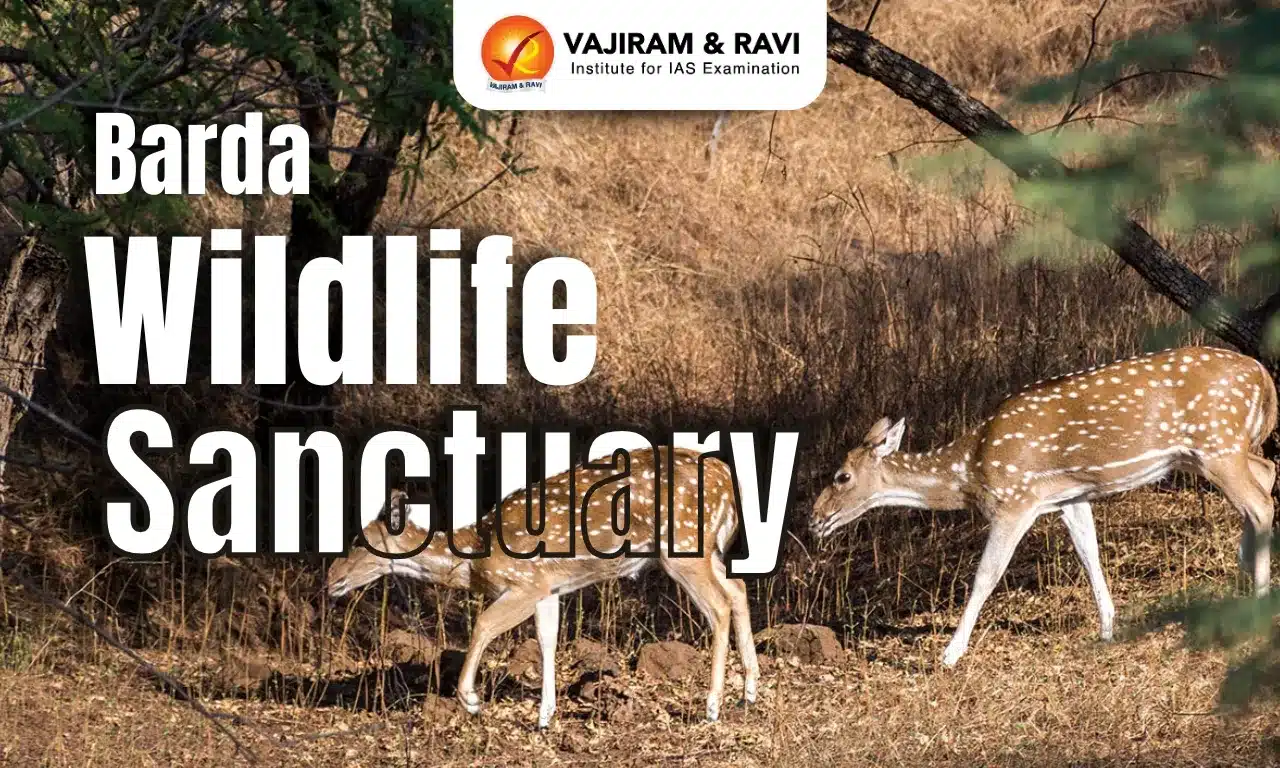
Barda Wildlife Sanctuary

Barda Wildlife Sanctuary

Barda Wildlife Sanctuary Latest News

Recently, the Ministry of Environment, Forest and Climate Change in collaboration with the Forest and Environment Department, Government of Gujarat celebrated World Lion Day – 2025 at Barda Wildlife Sanctuary, Devbhumi Dwarka district, Gujarat.

About Barda Wildlife Sanctuary

  • Location: It is located in the state of Gujarat.
  • Rivers: There are two waterways, the Bileshvary River and the Joghri River, and two dams, Khambala and Fodara.
  • Tribes: Ethnic races such as Maldharis, Bharvads, Rabaris, and Gadhvis live in this region.
  • To develop Barda as the second home for the Asiatic lion, the state government implemented the ‘Gir-Barda Project’ in 1979.
  • The sanctuary is a significant biodiversity hotspot and a key area for the conservation of Asiatic Lions.
  • Flora: It is characteristically abundant in floral diversity, which consists of a good number of medicinal plants.
  • The sanctuary boasts about 650 plant species, which comprise Rayan, Babul, Ber, Jamun, Amli, Gorad, Bamboo, Dhav, Dhudhlo, etc
  • Fauna: Leopard, Hyena, Wild boar, wolf, Jackal, blue bull, rare and endangered spotted eagle, crested hawk eagle, etc.

Key Facts about Asiatic Lion

  • It is also known as the Persian Lion or Indian Lion, belongs to the subspecies Panthera leo persica.
  • It is found exclusively in India, specifically in the Gir National Park and Wildlife Sanctuary in Gujarat.
  • Conservation Status
    • IUCN: Vulnerable
    • CITES: Appendix I
    • Wild Life Protection Act 1972: Schedule I

Source: PIB

Barda Wildlife Sanctuary FAQ's

Q1: In which state is Barda Wildlife Sanctuary?

Ans: Gujarat, India

Q2: Which country is home to both lions and tigers?

Ans: India

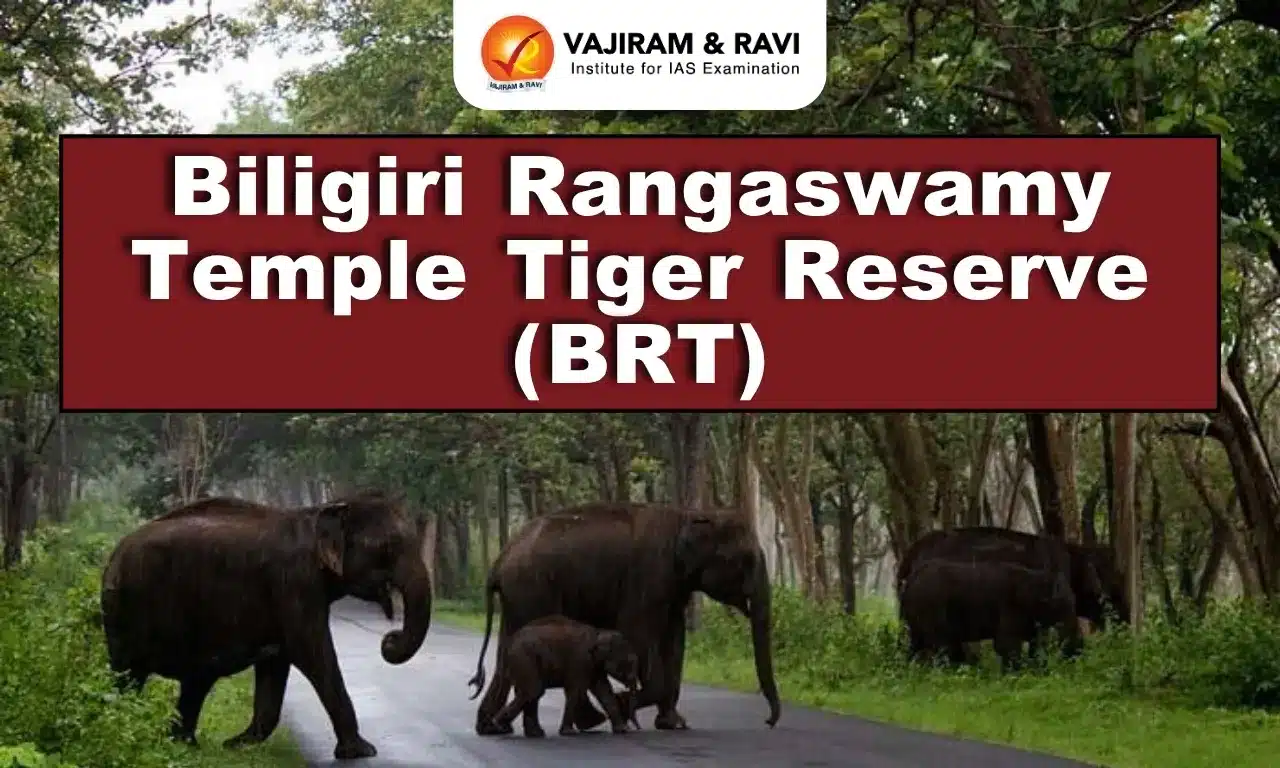
Biligiri Rangaswamy Temple Tiger Reserve (BRT)

Biligiri Rangaswamy Temple Tiger Reserve

Biligiri Rangaswamy Temple Tiger Reserve Latest News

Two prominent religious institutions and two businessmen are among those served eviction notices in the Biligiri Ranganatha Temple (BRT) Tiger Reserve recently.

About Biligiri Rangaswamy Temple Tiger Reserve 

  • It is located in the  BR Hills (Biligirirangana Hills) in Chamarajanagar District of Karnataka.
  • This unique Bio-geographical habitat is in the middle of the bridge between Western and Eastern ghats
  • It was declared a Tiger Reserve in 2011.
  • It is spread over an area of 574.82 sq.km. and lies at an elevation of 5,091 feet above sea level.
  • The reserve gets its name from Biligiri, meaning “white rocky cliff,” which is home to the ancient Rangaswamy Temple dedicated to Lord Vishnu.
  • It is also believed that the hill range gets its name due to white mist and silvery clouds which cover these lofty hills for a greater part of the year. 
  • There is a tribal community living within the tiger reserve known as the Soliga tribe. 
    • Soligas was the first tribal community living inside a tiger reserve and getting their forest rights recognised by a court in a judgment in 2011.
  • Vegetation:  It is covered with a variety of species of plant life, including scrub, dry deciduous, moist deciduous, shola forests, and montane grasslands. 
  • Flora: The major species include Anogeissus latifolia, Dalbergia paniculata, Grewia teliaefolia, Terminalia alata, Terminalia bellirica, Terminalia paniculata, etc.
  • Fauna: Animals including tiger, elephant, leopard, wild dog, bison, sambar, spotted deer, barking deer, four-horned antelope, sloth bear, wild boar, common langur, bonnet macaque, varieties of reptiles, birds, etc., are found in the Tiger Reserve.

Source: DH

Biligiri Rangaswamy Temple Tiger Reserve FAQs

Q1: Biligiri Rangaswamy Temple Tiger Reserve is located in which state?

Ans: Karnataka

Q2: What is the total area of the Biligiri Rangaswamy Temple Tiger Reserve?

Ans: It is spread over an area of 574.82 sq.km.

Q3: Which tribal community resides within Biligiri Rangaswamy Temple Tiger Reserve?

Ans: Soliga tribe

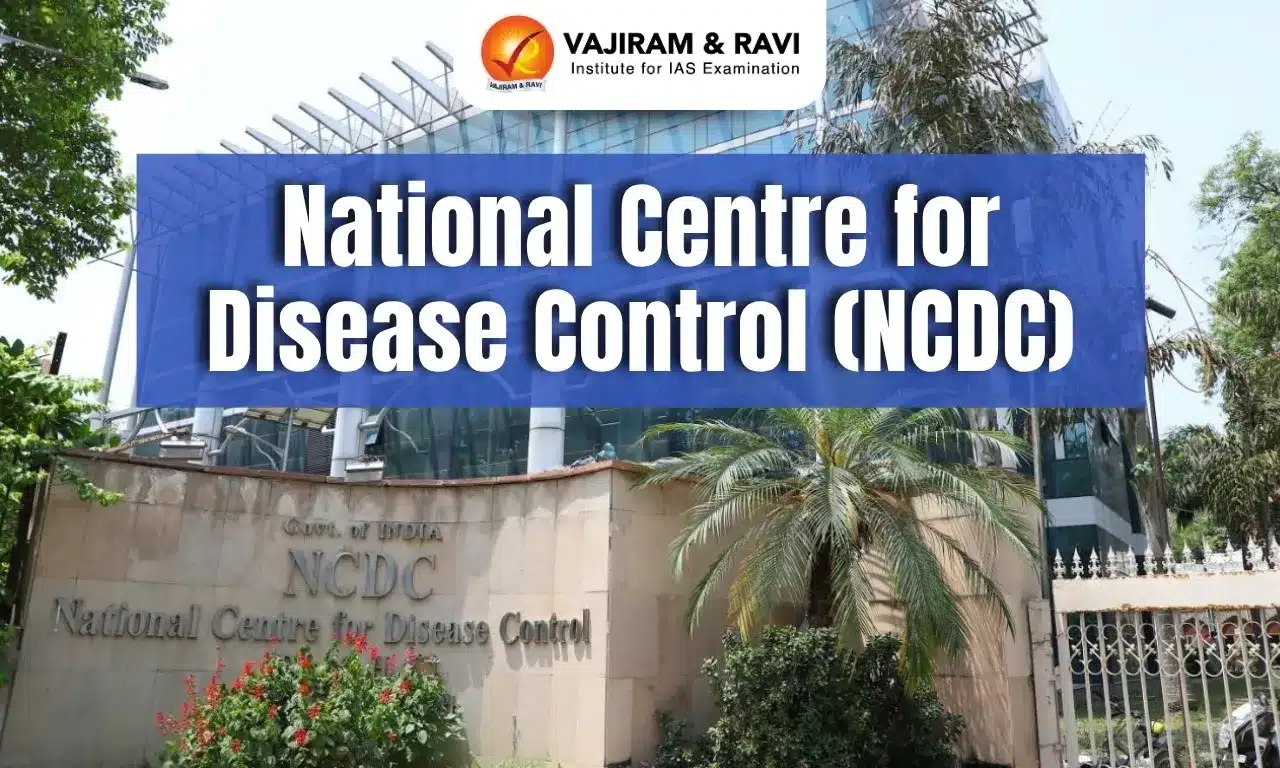
National Centre for Disease Control (NCDC)

National Centre for Disease Control

National Centre for Disease Control Latest News

The National Centre for Disease Control (NCDC) recently issued several guidelines to combat illnesses arising out of water contamination.

About National Centre for Disease Control 

  • It is an institute under the Indian Directorate General of Health Services, Ministry of Health and Family Welfare.
  • The institute was established to function as a national centre of excellence for control of communicable diseases.
  • The Director, an officer of the Public Health sub-cadre of Central Health Service, is the administrative and technical head of the Institute.
  • Headquarters: New Delhi.
  • Besides the headquarters in Delhi, NCDC has 8 branches located at Alwar (Rajasthan), Bengaluru (Karnataka), Kozhikode (Kerala), Coonoor (Tamil Nadu), Jagdalpur (Chhattisgarh), Patna (Bihar), Rajahmundry (Andhra Pradesh), and Varanasi (Uttar Pradesh). 

National Centre for Disease Control History

  • NCDC, formerly the National Institute of Communicable Diseases (NICD), had its origin as the Central Malaria Bureau, established at Kasauli (Himachal Pradesh) in 1909, and following expansion, was renamed in 1927 as the Malaria Survey of India. 
  • The organization was shifted to Delhi in 1938 and called as the Malaria Institute of India (MII).
  • In view of the drastic reduction achieved in the incidence of malaria under National Malaria Eradication Programme (NMEP), the Government of India decided to reorganize and expand the activities of the institute to cover other communicable diseases.
  • Thus, in 1963, the erstwhile MII was renamed as the National Institute of Communicable Diseases (NICD) to shoulder these additional responsibilities.
  • In the year 2009, NICD transforms into National Centre for Disease Control (NCDC) with a larger mandate of controlling emerging and re-emerging diseases.

National Centre for Disease Control Functions

  • It functions as the nodal agency in the country for disease surveillance facilitating prevention and control of communicable diseases.
  • In coordination with the State Governments, NCDC has the capacity and capability for disease surveillance, outbreak investigation, and rapid response to contain and combat outbreaks. 
  • It also deals with Anti-Microbial Resistance (AMR), an emerging area of concern with far-reaching consequences.
  • It also provides referral diagnostic support, capacity building, and technical support to States/UTs in the country.
  • The mandate of the Institute broadly covers three areas viz. services, trained health manpower development, and research.

Source: ET

National Centre for Disease Control FAQs

Q1: The National Centre for Disease Control (NCDC) functions under which Ministry of the Government of India?

Ans: It is an institute under the Indian Directorate General of Health Services, Ministry of Health and Family Welfare.

Q2: Where is the headquarters of the National Centre for Disease Control (NCDC) located?

Ans: New Delhi

Gaza War Stalls IMEC: Challenges and Future Prospects

India-Middle East-Europe Economic Corridor

India-Middle East-Europe Economic Corridor Latest News

  • India’s National Security Council Secretariat recently hosted officials from the U.S., UAE, Saudi Arabia, France, Italy, Germany, Israel, Jordan, and the EU to review progress on the India-Middle East-Europe Economic Corridor (IMEC). 
  • This article deals with the corridor’s ambitions, challenges, and future prospects.

About India-Middle East-Europe Economic Corridor (IMEC)

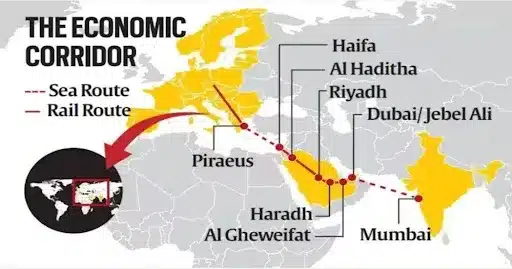
  • Announced at the 2023 G20 Summit in New Delhi, the IMEC aims to boost economic development through enhanced connectivity between Asia, the Arabian Gulf, and Europe. 
  • It consists of two segments:
    • the India-Gulf corridor, linking India’s western ports to the UAE and then via high-speed freight rail through Saudi Arabia and Jordan to Haifa, Israel; and 
    • the Gulf-Europe corridor, connecting Haifa to Greece and Italy by sea, followed by onward transport through Europe’s rail networks. 
  • Expected to reduce India-Europe shipping times by about 40% compared to the Red Sea route, the project has seen limited progress since its launch.

IMEC’s Promise and the Geopolitical Opening That Enabled It

  • The IMEC was conceived during India’s G20 Presidency in September 2023, at a rare moment of Middle East stability following years of regional rivalries. 
  • Arab normalisation with Israel, which Saudi Arabia was poised to join, created conditions for India, Middle Eastern states, the U.S., and Europe to envision a corridor connecting India to Europe. 
  • The economic case was strong — the EU is India’s largest trading partner, with FY 2023-24 bilateral trade at $137.41 billion, and non-oil trade with the UAE and Saudi Arabia rising significantly
  • Planned as more than a trade route, IMEC aimed to integrate electricity and digital connectivity cables, clean hydrogen pipelines, and measures to boost efficiency, reduce costs, create jobs, and cut emissions. 
  • It sought to address persistent trade challenges, including lack of tariff standardisation, low financial integration, limited corridor-wide insurance, and varying port capacities, while building a cross-Saudi/UAE railway to link its sea legs. 
  • Although these were considered manageable through investment and cooperation, the project stalled when, less than a month later, the region was plunged into ongoing conflict, preventing the first stakeholder meeting from taking place.

Gaza War Turns IMEC’s Challenges into Fundamental Obstacles

  • While the IMEC’s economic rationale remains strong, its hurdles have shifted from manageable to fundamental due to Israel’s ongoing war on Gaza, which has strained regional ties. 
  • The corridor’s key Middle East-Europe link depends on Jordan-Israel cooperation, now at a low point amid tensions over Palestinian displacement. 
  • Prospects for Saudi-Israel normalisation have also diminished, with Riyadh demanding Palestinian concessions that Israel is unwilling to make. 
  • The war’s expansion into Lebanon, Yemen, Syria, Iraq, and tensions with Iran heightens insurance costs for regional trade, further complicating implementation. 
  • Ironically, despite hindering progress, Israel sees the IMEC as crucial to deepening its economic integration with the Arab world, excluding Palestine.
    •  Prime Minister Netanyahu has termed framed of the project as a geopolitical blessing for participating states.

IMEC’s Future Hinges on Middle East Stability and Conflict Resolution

  • While the IMEC’s western leg faces uncertainty, India’s strong strategic and economic ties with the UAE and Saudi Arabia keep prospects for its eastern leg alive. 
  • Initiatives like UPI integration enhance digital connectivity potential, but intra-Gulf economic rivalries, such as Saudi measures to counter Emirati dominance, hinder unified corridor planning. 
  • For the IMEC to match its 2023 vision, the regional stability that enabled its conception must be restored — a goal tied to resolving the Palestinian statehood issue. 
  • Growing global recognition of the need to end Israel’s Gaza war, reflected in actions like Germany halting certain arms shipments to Israel, underscores this reality. 
  • Until lasting peace is achieved, IMEC remains a “day-after” project, with current efforts limited to planning and trade facilitation.

Source: IE

India-Middle East-Europe Economic Corridor FAQs

Q1: What is the IMEC?

Ans: A trade and connectivity corridor linking India, the Gulf, and Europe through sea and rail routes.

Q2: When was IMEC announced?

Ans: During the G20 Summit in New Delhi in September 2023.

Q3: How much can IMEC reduce shipping time?

Ans: By about 40% compared to the Red Sea route.

Q4: What halted IMEC’s progress?

Ans: The outbreak of the Gaza war less than a month after its launch.

Q5: Which countries are key IMEC partners?

Ans: India, UAE, Saudi Arabia, Jordan, Israel, Greece, and Italy.

India’s Agricultural Exports Surge Amid Global Trade Challenges

India Farm Exports

India Farm Exports Latest News

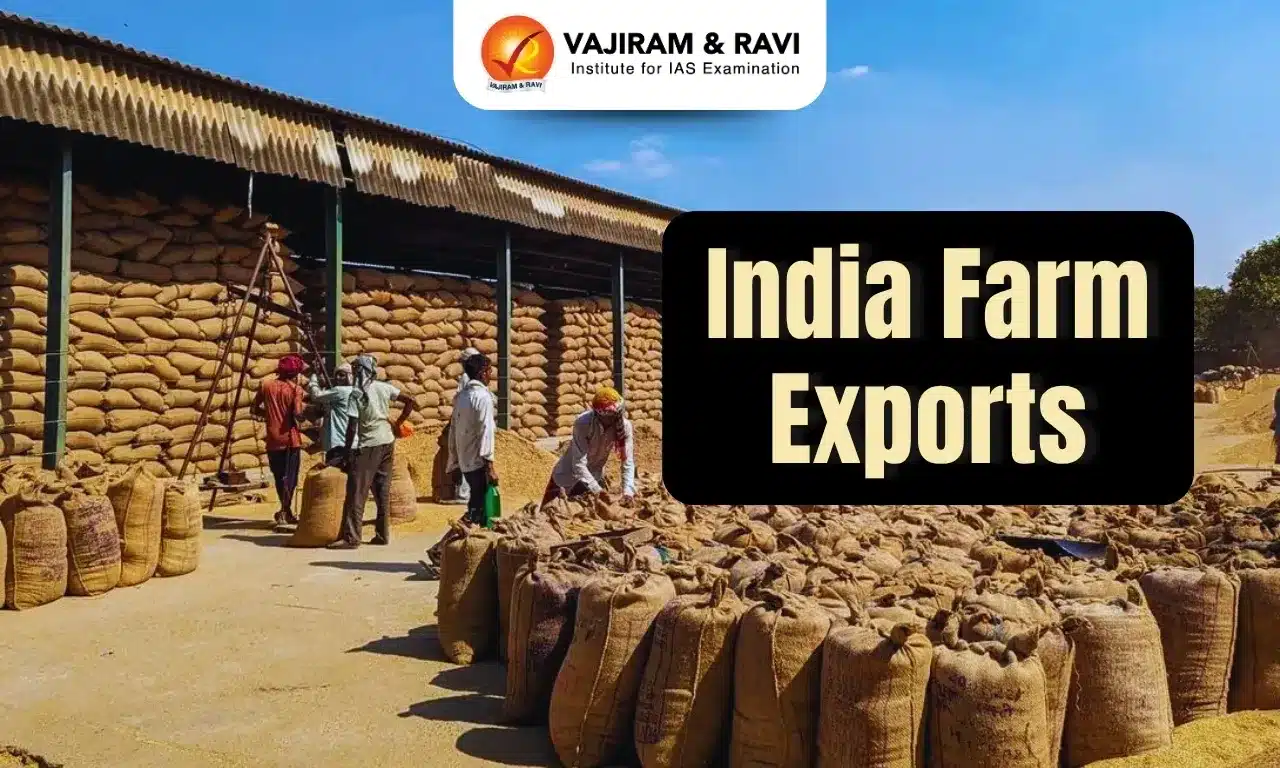
  • While overall merchandise export growth remains flat and unlikely to exceed the 2022-23 peak of $451.1 billion, agricultural exports are driving India’s export momentum, showing resilience and record-breaking potential.

India’s Export Performance in 2024-25

  • In 2024-25, India’s merchandise exports stood at $437.4 billion, just 0.1% higher than the $437.1 billion in 2023-24. 
  • During April-June 2025, exports rose to $112 billion, a 1.7% increase from $110.1 billion in the same period last year. 
  • Union govt expressed confidence that exports this fiscal would surpass last year’s levels, despite potential disruptions from U.S. President Donald Trump’s tariff measures, including a 50% duty on Indian goods.

Agricultural Exports: Strong Upward Trend

  • Agricultural exports recorded robust growth of 6.4%, increasing from $48.8 billion in 2023-24 to $51.9 billion in 2024-25. 
  • The first quarter of 2025-26 posted a further 5.8% year-on-year rise.
  • If current trends continue, farm exports could reach $55 billion in 2025-26, surpassing the previous record of $53.2 billion in 2022-23.
  • India’s agricultural exports to the U.S. have been particularly strong, growing by 24.1% during January-June 2025 compared to the same period in 2024.

Drivers and Risks for India’s Farm Exports

  • India’s farm exports surged from $7.5 billion in 2003-04 to $43.3 billion in 2013-14, later peaking at $53.2 billion in 2022-23 due to a global agri-commodity price boom
  • The FAO food price index rose from 96.4 (2019-20) to 140.6 (2022-23).
  • The 2023-24 decline was driven by drought and government curbs on wheat, rice, sugar, and onion exports to control food inflation
  • These restrictions eased in 2024-25 as monsoon-aided farm output improved, with a second consecutive above-normal monsoon likely allowing sugar export resumption. 
    • Sugar net exports fell sharply from $5.5 billion (2022-23) to $771.3 million (2024-25).
  • In Q1 2025-26, major items like marine products, non-basmati rice, buffalo meat, coffee, tobacco, and fruits & vegetables posted strong growth. 
  • Coffee exports benefited from low global stocks due to poor harvests in Brazil and Vietnam, while tobacco shipments rose following output shortfalls in Brazil and Zimbabwe.
    • Brazil and Vietnam are the world’s biggest producers of arabica and robusta varieties respectively. 
    • India mostly exports robusta beans and powder used in instant coffee and espresso blends.

Tariff Risks and Competitive Pressures

  • From August 27, 2025, U.S. tariffs of 50% on Indian goods could hit marine products hardest, with the U.S. taking 35% of India’s exports in this category. 
  • Frozen shrimps and prawns alone sent $1.9 billion of the $4.5 billion total to the U.S
  • Similar tariffs on Brazilian goods may divert their coffee surplus to other markets, potentially lowering prices and hurting Indian exports.

India’s Agricultural Import Trends and Growing Dependence

  • India maintained a $13.4 billion agricultural trade surplus in 2024-25, with farm exports ($51.9 billion) exceeding imports ($38.5 billion), even as the surplus has fallen sharply from $27.7 billion in 2013-14 due to faster import growth. 
  • Agricultural imports remain concentrated in a few commodities, with over two-thirds coming from vegetable oils, pulses, and fresh fruits
  • Fresh fruit imports — worth $1.7 billion, largely from the U.S. — include almonds, pistachios, walnuts, apples, grapes, kiwis, figs, pears, and dates. 
  • Pulses imports hit a record 7.3 million tonnes ($5.5 billion) in 2024-25 after duty cuts following the 2023-24 El Niño drought, though they have reduced this year with a bumper harvest. 
  • Vegetable oil imports (palm, soyabean, sunflower) continue rising as domestic production lags demand.
  • Cotton and natural rubber imports have also grown due to declining domestic output since their peaks in 2013-14 and 2012-13, respectively.

Agriculture Emerges as a Sticking Point in India–US Trade Talks

  • PM Modi’s recent statement that India will never compromise the interests of its farmers, livestock rearers, and fisherfolk underscores the government’s firm stance in stalled trade negotiations with the US. 
  • The key point of contention is opening India’s market to US farm produce — including GM maize, soyabean, fuel ethanol, and dairy products — which New Delhi now wants excluded from any deal. 
  • This hardened position is shaped by domestic political sensitivities and US President Donald Trump’s tariff measures, including a 50% duty on Indian imports, part of which penalises oil purchases from Russia. 

Source: IE | IE

India Farm Exports FAQs

Q1: What was India’s agricultural export value in 2024-25?

Ans: $51.9 billion, up 6.4% from the previous year.

Q2: Which products saw strong export growth in Q1 2025-26?

Ans: Marine products, non-basmati rice, buffalo meat, coffee, tobacco, fruits, and vegetables.

Q3: What factors boosted coffee exports?

Ans: Poor harvests in Brazil and Vietnam reducing global stock levels.

Q4: What is India’s agricultural trade surplus in 2024-25?

Ans: $13.4 billion, with exports exceeding imports.

Q5: Why is agriculture a sticking point in India–US trade talks?

Ans: India refuses to open its market to US farm products like GM maize and soyabean.

Tamil Nadu’s State Education Policy 2025

State Education Policy

State Education Policy Latest News

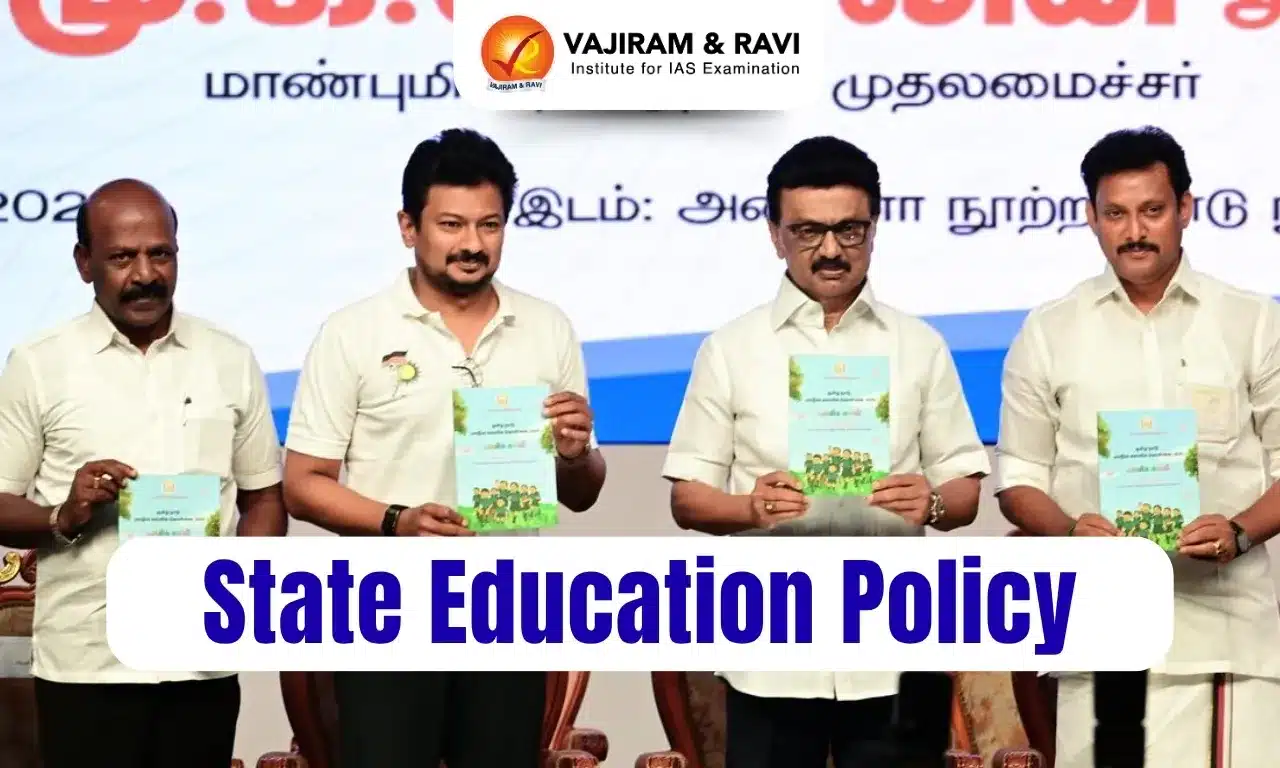
  • Tamil Nadu has launched its State Education Policy 2025 as an alternative to the NEP, emphasising state-specific priorities in school and higher education.

Introduction

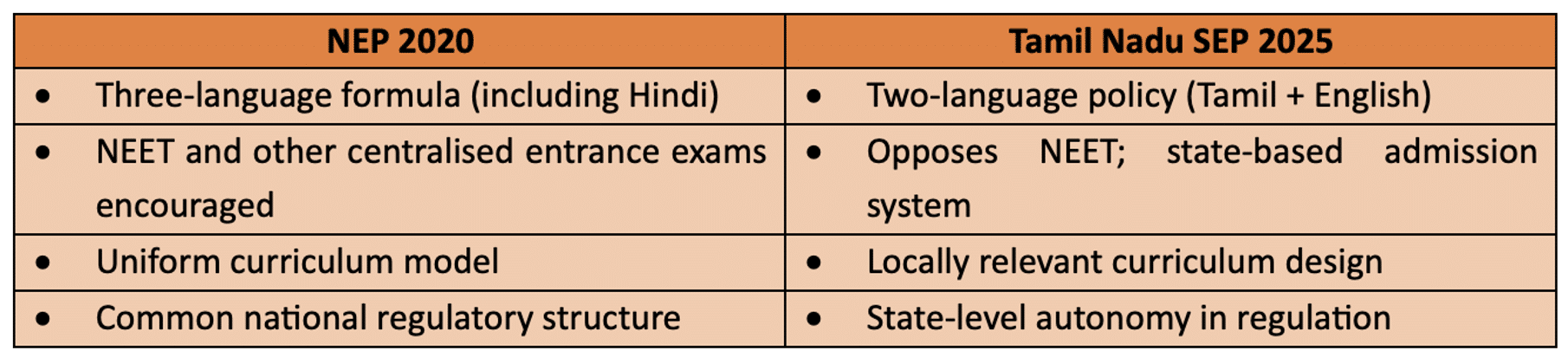
  • Tamil Nadu has introduced its long-awaited State Education Policy (SEP) 2025, offering a distinct alternative to the Centre’s National Education Policy 2020
  • The policy aims to uphold the state’s historical emphasis on equitable education, social justice, and linguistic diversity while addressing future challenges in skill development, higher education, and technology integration.
  • The decision comes amid ongoing differences between the Tamil Nadu government and the Union government over language policy, entrance examinations, and federal autonomy in education.

Historical Context of Education Policy in Tamil Nadu

  • Tamil Nadu has historically pursued progressive education policies that prioritise accessibility and social equity. 
  • Since the introduction of free noon meals in schools in the mid-20th century and the expansion of state-run institutions, the state has consistently worked to reduce dropouts and bridge socio-economic divides.
  • In recent decades, Tamil Nadu has:
    • Resisted the three-language formula, opting instead for a two-language policy prioritising Tamil and English.
    • Opposed NEET (National Eligibility-cum-Entrance Test) for medical admissions, arguing it disadvantages rural and socially backward students.
    • Maintained higher-than-national-average Gross Enrolment Ratios (GER) in both school and higher education.

About the State Education Policy 2025

  • The SEP 2025 was drafted by a high-level expert committee chaired by retired Chief Justice of the Delhi High Court, Justice D. Murugesan, after extensive consultations with educators, students, civil society, and subject experts.
  • Key Principles:
    • Equity and Inclusivity: Ensuring access to quality education regardless of caste, gender, language, or socio-economic status.
    • State Autonomy: Crafting education strategies that align with Tamil Nadu’s socio-cultural and economic needs rather than following a uniform national template.
    • Employment-Readiness: Integrating skill development and vocational training from the school level.

School Education Reforms

  • Two-Language Policy: Tamil and English will remain the medium of instruction, rejecting the NEP’s three-language recommendation.
  • Foundational Literacy and Numeracy: Strengthened focus on early learning in Classes 1-3, with continuous assessment instead of high-stakes exams.
  • Digital Infrastructure: Expansion of smart classrooms, ICT tools, and teacher training in digital pedagogy.
  • Social Justice Measures: Continuation and strengthening of welfare schemes such as free textbooks, uniforms, and the noon-meal programme.

Higher Education Framework

  • Autonomous Curriculum Design: State universities will have greater flexibility in designing syllabi suited to local industries and employment needs.
  • Multiple Entry-Exit System: Students will have the option to pause and resume studies without losing academic credits, similar to NEP’s flexibility but tailored for Tamil Nadu’s academic calendar.
  • Research and Innovation Hubs: Investment in domain-specific research centres, especially in agriculture, renewable energy, and healthcare.
  • Opposition to Common Entrance Tests: Admissions to professional courses will continue to follow the state’s reservation policies and entrance examination exemptions where applicable.

Vocational and Skill Development Focus

  • Collaboration with industries to update vocational curricula in polytechnic and ITI institutions.
  • Introduction of skill-based courses in secondary schools covering AI, robotics, agritech, and entrepreneurship.
  • Partnerships with MSMEs to offer internships and apprenticeships for final-year students.

Teacher Training and Capacity Building

  • Revised Teacher Education Modules integrating technology and inclusive pedagogy.
  • Continuous Professional Development (CPD) programmes for educators in both school and higher education.
  • Creation of an online teacher resource portal in Tamil and English.

Differences with the NEP 2020

The following table list downs the key differences between NEP 2020 and Tamil Nadu's SEP 2025:

Differences-between-SEP-NEP

Significance of the SEP 2025

  • The SEP 2025 underscores Tamil Nadu’s federal stance that education should remain a Concurrent List subject with adequate space for states to address their unique contexts. 
  • By resisting uniformity, the policy strengthens the state’s identity and commitment to social justice while aligning with global education trends in flexibility and skills-based learning.

Future Outlook

  • The success of the SEP 2025 will depend on its implementation, funding allocation, and coordination between the state education department, universities, and private institutions. 
  • As Tamil Nadu seeks to position itself as an education hub, the policy could also serve as a model for other states asserting autonomy over education governance.

Source: IE | TH

State Education Policy FAQs

Q1: What is the Tamil Nadu State Education Policy 2025?

Ans: It is the state’s comprehensive education framework designed as an alternative to the National Education Policy, focusing on equity, inclusivity, and local needs.

Q2: Who headed the committee for drafting the SEP 2025?

Ans: The policy was prepared by a panel chaired by Justice D. Murugesan, former Chief Justice of the Delhi High Court.

Q3: How does the SEP differ from the NEP in language policy?

Ans: The SEP retains Tamil and English as the two languages of instruction, rejecting the NEP’s three-language formula.

Q4: What is Tamil Nadu’s stance on NEET under the SEP?

Ans: The policy opposes NEET, maintaining state-based admission systems for professional courses.

Q5: What is the focus of vocational education under the SEP?

Ans: It prioritises skill-based courses in emerging sectors like AI, agritech, and renewable energy, in partnership with industries.

Enquire Now