UPSC Daily Quiz 12 August 2025

UPSC Daily Quiz

The Daily UPSC Quiz by Vajiram & Ravi is a thoughtfully curated initiative designed to support UPSC aspirants in strengthening their current affairs knowledge and core conceptual understanding. Aligned with the UPSC Syllabus 2025, this daily quiz serves as a revision resource, helping candidates assess their preparation, revise key topics, and stay updated with relevant issues. Whether you are preparing for Prelims or sharpening your revision for Mains, consistent practice with these Daily UPSC Quiz can significantly enhance accuracy, speed, and confidence in solving exam-level questions.

[WpProQuiz 43]

UPSC Daily Quiz FAQs

Q1: What is the Daily UPSC Quiz?

Ans: The Daily UPSC Quiz is a set of practice questions based on current affairs, static subjects, and PYQs that help aspirants enhance retention and test conceptual clarity regularly.

Q2: How is the Daily Quiz useful for UPSC preparation?

Ans: Daily quizzes support learning, help in revision, improve time management, and boost accuracy for both UPSC Prelims and Mains through consistent practice.

Q3: Are the quiz questions based on the UPSC syllabus?

Ans: Yes, all questions are aligned with the UPSC Syllabus 2025, covering key areas like Polity, Economy, Environment, History, Geography, and Current Affairs.

Q4: Are solutions and explanations provided with the quiz?

Ans: Yes, each quiz includes detailed explanations and source references to enhance conceptual understanding and enable self-assessment.

Q5: Is the Daily UPSC Quiz suitable for both Prelims and Mains?

Ans: Primarily focused on Prelims (MCQ format), but it also indirectly helps in Mains by strengthening subject knowledge and factual clarity.

Article 44 of Indian Constitution, Interpretation, Significance

Article 44 of Indian Constitution

Article 44 of Indian Constitution discusses the creation of a Uniform Civil Code (UCC) to regulate personal matters such as marriage, divorce, inheritance, and adoption for all citizens, regardless of their faith. Positioned under the Directive Principles of State Policy, it acts as a constitutional guideline for the government rather than a law enforceable in courts. The primary objective of the Uniform Civil Court is to strengthen national unity, uphold secular values, and ensure gender equality through a single, consistent set of civil laws.

Article 44 of Indian Constitution

The State shall endeavour to secure for the citizens a uniform civil code throughout the territory of India.

Article 44 of Indian Constitution Interpretation

Article 44 of Indian Constitution was added for the adoption of  a Uniform Civil Code (UCC) which is applicable to all citizens who aim to bring consistency to the personal laws across the country. The major purpose is to bring coordination between the legal provisions related to marriage, divorce, inheritance and adoption which ensures the uniformity in the cultural and religious diversity of India. Article 44 of Indian Constitution directs the state to work towards creating a Uniform Civil Code, or UCC. If implemented, it would replace the separate personal laws that different communities follow, often based on their own religious texts and traditions with a single, shared framework. 

Article 44 of Indian Constitution represents a constitutional goal of ensuring that all citizens are subject to the same set of personal laws, irrespective of faith. It aims to remove religion-based legal distinctions, thereby promoting national unity while aligning personal laws with the principles of secularism and gender equality upheld by the Constitution.

Article 44 of Indian Constitution Background

The idea of a Uniform Civil Code (UCC) can be traced back to the colonial period, with the first discussions emerging in 1835. That year, a British government report stressed the importance of bringing uniformity to Indian laws on crimes, evidence, and contracts. Yet, it specifically left out the personal laws of Hindus and Muslims, recognising how deeply these were tied to religious traditions.

Over time, as more laws were passed dealing with personal matters, calls for reform began to grow louder. By 1947, the British had set up the B.N. Rau Committee to review and codify Hindu law. This committee, often called the Hindu Law Committee, examined the Hindu Women’s Right to Property Act of 1937 and other related laws. It recommended a structured Hindu code that would give women equal rights, especially in marriage and inheritance. 

Pre-Independence Era

The earliest formal mention of a uniform set of laws came in the Lex Loci Report of 1840. This report recommended that criminal laws, contract law, and the law of evidence be codified and applied uniformly across the country. However, it advised keeping personal laws outside this process, acknowledging the sensitivity of religious customs. Later, the Queen’s Proclamation of 1859 reinforced this approach by assuring that the British administration would not interfere with personal laws.

Post-Independence Era (1947-1985)

When India became independent, the idea of a Uniform Civil Code found strong connections with leaders like Jawaharlal Nehru and B.R. Ambedkar. They saw it as an important step toward national unity and legal equality. But resistance from religious groups was intense, leading to a compromise. Instead of making it an enforceable law, the framers placed it in the Directive Principles of State Policy under Article 44, treating it as a constitutional goal rather than an immediate mandate.

Arguments Supporting the Uniform Civil Code

The proposal for implementing a Uniform Civil Code (UCC) is supported by several compelling considerations, each aimed at ensuring legal uniformity, strengthening social cohesion, and promoting justice. These arguments address the complexities that arise from India’s diverse legal and cultural landscape.

  • India already applies certain laws uniformly, regardless of religion or region. Examples include the Indian Contract Act of 1872 and the Special Marriage Act of 1954, which handle matters similar to personal laws.
  • A common civil code could help bring communities closer together, promoting a stronger sense of belonging to one nation while respecting cultural diversity.
  • By removing overlapping or contradictory legal provisions, a uniform code would create a clearer, more coherent legal framework.
  • The adoption of a UCC would reinforce the idea of a shared national identity, making it easier to rise above divisions based on religion or tradition.
  • Many personal laws still contain provisions that disadvantage women. A uniform code could address these inequalities, ensuring equal rights and protections for everyone.

Article 44 of Indian Constitution Significance

Article 44 of Indian Constitution discusses the establishment of a Uniform Civil Code (UCC) to bring consistency to personal laws across the nation. Its importance lies in advancing the principles of equality, justice, and national integration while reinforcing the secular foundation of the Indian state.

  • At present, personal laws in India differ across religious communities. Article 44 seeks to bring coordination to these varied systems into a single, coherent legal framework applicable to all citizens.
  • By subjecting every individual to the same set of laws in matters such as marriage, divorce, inheritance, and adoption, the UCC aims to uphold fairness and eliminate legal disparities based on religion.
  • Standardising personal laws can promote a stronger sense of unity among India’s culturally and religiously diverse population, thereby contributing to social cohesion.
  • Article 44 of Indian Constitution also reinforces the secular behaviour of the Indian state by ensuring that the law operates impartially, without granting preferential treatment to any particular religion.

Uniform Civil Code Challenges

The implementation of a Uniform Civil Code (UCC) presents significant challenges, largely due to deeply rooted social, cultural, and religious diversity of India. Concerns often centre on the balance between ensuring uniformity in personal laws and respecting the freedoms and sentiments of various communities.

  • Framing a single set of laws for a population as culturally and religiously varied as India is a complex and sensitive undertaking.
  • Critics fear that the UCC might violate the constitutionally guaranteed right to practise and preserve one’s religion.
  • Efforts to codify personal laws could provoke social tensions or even trigger unrest in communities particularly in regions where religious identity plays a central role in daily life.
  • The requirement for the State to intervene in personal matters is often met with resistance, especially from communities that view such reforms as an encroachment on their traditions.

Article 44 of Indian Constitution Case Laws

The judiciary has played a significant role in interpreting Article 44 and examining its implications for personal laws, gender justice, and the broader aim of legal uniformity. Several landmark cases highlight the evolving judicial perspective on the Uniform Civil Code.

Mohammad Ahmed Khan v. Shah Bano Begum (1985)

Commonly known as the Shah Bano case, this matter involved a Muslim woman, Shah Bano, who sought maintenance from her husband under Section 125 of the Code of Criminal Procedure after being divorced through triple talaq. The Supreme Court ruled in her favour, affirming her right to maintenance. However, the decision prompted the enactment of the Muslim Women (Protection of Rights on Divorce) Act, 1986, which curtailed the scope of Section 125 for Muslim women.

Shayara Bano v. Union of India (2017)

In this case, the Supreme Court declared the practice of triple talaq (talaq-e-bidat) unconstitutional. To implement the ruling, Parliament passed legislation criminalising the pronouncement of instant triple talaq whether verbal, written, or electronic by a Muslim husband.

Sarla Mudgal v. Union of India (1995)

The Court addressed whether a Hindu man married under Hindu law could validly contract a second marriage after converting to Islam. It held that conversion for the purpose of entering into a second marriage constituted misuse of personal laws. Such a marriage, without dissolving the first under the Hindu Marriage Act, amounted to bigamy and was punishable under Section 494 of the Indian Penal Code.

Danial Latifi & Anr v. Union of India (2001)

This case examined the constitutional validity of the Muslim Women (Protection of Rights on Divorce) Act, 1986. The Supreme Court upheld the Act while interpreting it in a manner consistent with the Shah Bano ruling. It held that divorced Muslim women were entitled to reasonable and fair provision for maintenance until they remarried. Where a conflict arose between the Act and Section 125 of the CrPC, the latter would prevail to ensure constitutional compliance.

John Vallamattom v. Union of India (2003)

A Christian priest challenged Section 118 of the Indian Succession Act, which restricted Christians from bequeathing property for religious or charitable purposes through a will. The Supreme Court struck down the provision as unconstitutional, observing that Article 44 directs the State to strive towards a Uniform Civil Code applicable to all citizens.

Lily Thomas v. Union of India (2013)

The Court reiterated that the Directive Principles of State Policy, including Article 44, are not enforceable in a court of law. While the judiciary may interpret and promote these principles, they do not create legally enforceable rights.

Also Check Related Post
Article 295 of Indian Constitution Article 194 of Indian Constitution
Article 39 of Indian Constitution Article 191 of Indian Constitution
Article 20 of Indian Constitution Article 16 of Indian Constitution
Article 67 of Indian Constitution Article 40 of Indian Constitution
Article 78 of Indian Constitution

Article 44 of Indian Constitution FAQs

Q1: What does Article 44 deal with?

Ans: Article 44 directs the State to endeavour to secure a Uniform Civil Code (UCC) for all citizens throughout India.

Q2: In which part of the Constitution is Article 44 included?

Ans: It is included in the Directive Principles of State Policy (DPSP) in Part IV of the Constitution.

Q3: What is the purpose of Article 44?

Ans: To replace personal laws based on religion, custom, or community with one common set of civil laws for all citizens.

Q4: Is Article 44 enforceable in a court of law?

Ans: No, since it is a DPSP, it is non-justiciable and cannot be enforced by courts.

Q5: Why is Article 44 controversial?

Ans: It often raises debates over religious freedom vs. uniformity in civil laws, especially concerning marriage, divorce, adoption, and inheritance.

Countries and Currencies in the World, List, Importance

Countries and Currencies

The World consists of 195 countries and each country has its own currency. Having a knowledge of countries, capitals and currencies is important to get an understanding of the global world. In this article, we are going to cover the list of countries and their currencies. 

Why are Countries and Currencies Important?

The currency of a country works as a legal tender for the transactions and represents the economic structure and financial stability of a country. A country and its currencies are important because: 

  • Helps in understanding international travel and trade
  • Study global economics and travel
  • Conduct cross-border business transactions

Currency of a Country

A currency of a country consists of papers and coins that act as a medium of exchange, store of value and unit of account. While many countries use the same currency, many countries have their own unique currency. These currencies keep fluctuating on the basis of inflation, demand and economic performance.

Also Read: Countries and Capitals

Countries and their Currencies 

Countries and their currencies help in understanding the geopolitical dynamics regionally. Here is a list of countries and their currencies:  

Countries and Currencies of Africa 

Africa is the second largest continent of the world in both area and its population. The continent consists of 54 recognised nations, each having its own capital and currency and a rich diversity of culture, language and economic system. 

Countries And Currencies of Africa
Country Currency

Algeria

Algerian Dinar

Angola

Angolan Kwanza

Benin

West African CFA franc

Botswana

Botswana Pula

Burkina Faso

West African CFA franc

Burundi

Burundian Franc

Cabo Verde

Cape Verdean Escudo

Cameroon

Central African CFA franc

Central African Rep.

Central African CFA franc

Chad

Central African CFA franc

Comoros

Comorian Franc

Congo (Brazzaville)

Central African CFA franc

Congo (Kinshasa)

Congolese Franc

Côte d’Ivoire

West African CFA franc

Djibouti

Djiboutian Franc

Egypt

Egyptian Pound

Equatorial Guinea

Central African CFA franc

Eritrea

Eritrean Nakfa

Eswatini

Swazi Lilangeni

Ethiopia

Ethiopian Birr

Gabon

Central African CFA franc

Gambia

Gambian Dalasi

Ghana

Ghanaian Cedi

Guinea

Guinean Franc

Guinea-Bissau

West African CFA franc

Kenya

Kenyan Shilling

Lesotho

Lesotho Loti

Liberia

Liberian Dollar

Libya

Libyan Dinar

Madagascar

Malagasy Ariary

Malawi

Malawian Kwacha

Mali

West African CFA franc

Mauritania

Mauritanian Ouguiya

Mauritius

Mauritian Rupee

Morocco

Moroccan Dirham

Mozambique

Mozambican Metical

Namibia

Namibian Dollar

Niger

West African CFA franc

Nigeria

Nigerian Naira

Rwanda

Rwandan Franc

São Tomé & Príncipe

Dobra

Senegal

West African CFA franc

Seychelles

Seychellois Rupee

Sierra Leone

Sierra Leonean Leone

Somalia

Somali Shilling

South Africa

South African Rand

South Sudan

South Sudanese Pound

Sudan

Sudanese Pound

Tanzania

Tanzanian Shilling

Togo

West African CFA franc

Tunisia

Tunisian Dinar

Uganda

Ugandan Shilling

Zambia

Zambian Kwacha

Zimbabwe

Zimbabwean Dollar

Countries And Currencies of North America 

North America has 23 countries including the United States, Canada and Mexico. Following is the list of countries and currencies of North America: 

Countries, Capitals And Currencies of North America
Country Currency

Antigua and Barbuda

East Caribbean Dollar

Bahamas

Bahamian Dollar

Barbados

Barbadian Dollar

Belize

Belize Dollar

Canada

Canadian Dollar

Costa Rica

Costa Rican Colón

Cuba

Cuban Peso

Dominica

East Caribbean Dollar

Dominican Republic

Dominican Peso

El Salvador

United States Dollar

Grenada

East Caribbean Dollar

Guatemala

Guatemalan Quetzal

Haiti

Haitian Gourde

Honduras

Honduran Lempira

Jamaica

Jamaican Dollar

Mexico

Mexican Peso

Nicaragua

Nicaraguan Córdoba

Panama

Balboa / USD

Saint Kitts & Nevis

East Caribbean Dollar

Saint Lucia

East Caribbean Dollar

Saint Vincent & Gren.

East Caribbean Dollar

Trinidad and Tobago

Trinidadian Dollar

United States

United States Dollar

Countries, Capitals And Currencies of South America

South America has 12 countries having their unique identities. Here is a list of South American Countries and their currencies: 

Countries, Capitals And Currencies of South America
Country Currency

Argentina

Argentine Peso

Bolivia

Boliviano

Brazil

Brazilian Real

Chile

Chilean Peso

Colombia

Colombian Peso

Ecuador

United States Dollar

Guyana

Guyanese Dollar

Paraguay

Paraguayan Guaraní

Peru

Peruvian Sol

Suriname

Surinamese Dollar

Uruguay

Uruguayan Peso

Venezuela

Venezuelan Bolívar

Countries And Currencies of Asia 

Asia is the largest and the most populous continent. Here is a list of countries and currencies of Asia: 

Countries, Capitals And Currencies of Asia
Country Currency

Afghanistan

Afghani

Armenia

Armenian Dram

Azerbaijan

Azerbaijani Manat

Bahrain

Bahraini Dinar

Bangladesh

Bangladeshi Taka

Bhutan

Bhutanese Ngultrum

Brunei

Brunei Dollar

Cambodia

Cambodian Riel

China

Chinese Yuan

Cyprus

Euro

Georgia

Georgian Lari

India

Indian Rupee

Indonesia

Indonesian Rupiah

Iran

Iranian Rial

Iraq

Iraqi Dinar

Israel

Israeli Shekel

Japan

Japanese Yen

Jordan

Jordanian Dinar

Kazakhstan

Kazakhstani Tenge

Kuwait

Kuwaiti Dinar

Kyrgyzstan

Kyrgyzstani Som

Laos

Lao Kip

Lebanon

Lebanese Pound

Malaysia

Malaysian Ringgit

Maldives

Maldivian Rufiyaa

Mongolia

Mongolian Tögrög

Myanmar

Burmese Kyat

Nepal

Nepalese Rupee

North Korea

North Korean Won

Oman

Omani Rial

Pakistan

Pakistani Rupee

Palestine

Israeli Shekel

Philippines

Philippine Peso

Qatar

Qatari Riyal

Russia

Russian Ruble

Saudi Arabia

Saudi Riyal

Singapore

Singapore Dollar

South Korea

South Korean Won

Sri Lanka

Sri Lankan Rupee

Syria

Syrian Pound

Taiwan

New Taiwan Dollar

Tajikistan

Tajikistani Somoni

Thailand

Thai Baht

Timor-Leste

United States Dollar

Turkey

Turkish Lira

Turkmenistan

Turkmenistani Manat

United Arab Emirates

UAE Dirham

Uzbekistan

Uzbekistani Som

Vietnam

Vietnamese Dong

Yemen

Yemeni Rial

Countries And Currencies of Europe 

Europe has 44 countries and a maximum of them use Euro as their currency. Here is a list of countries and their currencies in Europe: 

Countries And Currencies of Europe
Country Currency

Albania

Albanian Lek

Andorra

Euro

Austria

Euro

Belarus

Belarusian Ruble

Belgium

Euro

Bosnia & Herzegovina

Convertible Mark

Bulgaria

Bulgarian Lev

Croatia

Euro

Cyprus

Euro

Czech Republic

Czech Koruna

Denmark

Danish Krone

Estonia

Euro

Finland

Euro

France

Euro

Germany

Euro

Greece

Euro

Hungary

Hungarian Forint

Iceland

Icelandic Krona

Ireland

Euro

Italy

Euro

Kosovo

Euro

Latvia

Euro

Liechtenstein

Swiss Franc

Lithuania

Euro

Luxembourg

Euro

Malta

Euro

Moldova

Moldovan Leu

Monaco

Euro

Montenegro

Euro

Netherlands

Euro

North Macedonia

Macedonian Denar

Norway

Norwegian Krone

Poland

Polish Złoty

Portugal

Euro

Romania

Romanian Leu

Russia

Russian Ruble

San Marino

Euro

Serbia

Serbian Dinar

Slovakia

Euro

Slovenia

Euro

Spain

Euro

Sweden

Swedish Krona

Switzerland

Swiss Franc

Ukraine

Ukrainian Hryvnia

United Kingdom

Pound Sterling

Vatican City

Euro

Countries And Currencies of Australia & Oceania

Oceania that also includes Australia consists of many scattered islands over the Pacific Ocean. Here is a list of countries and their currencies in Australia and Oceania: 

Countries And Currencies of Australia & Oceania
Country Currency

Australia

Australian Dollar

Fiji

Fijian Dollar

Kiribati

Australian Dollar

Marshall Islands

United States Dollar

Micronesia

United States Dollar

Nauru

Australian Dollar

New Zealand

New Zealand Dollar

Palau

United States Dollar

Papua New Guinea

Papua New Guinean Kina

Samoa

Samoan Tala

Solomon Islands

Solomon Islands Dollar

Tonga

Tongan Paʻanga

Tuvalu

Australian Dollar

Vanuatu

Vanuatu Vatu

Countries and Currencies FAQs

Q1: How many countries are there in Europe?

Ans: There are 44 countries in Europe.

Q2: Why do countries have separate currencies?

Ans: Countries have separate currencies to maintain independent monetary policies and economic control.

Q3: Which is the most powerful currency in the world?

Ans: The Kuwaiti Dinar (KWD) is considered the most powerful currency in the world.

Q4: Pound is the currency of which country?

Ans: The Pound is the official currency of the United Kingdom.

Q5: What is the currency of Japan?

Ans: The official currency of Japan is the Japanese Yen (JPY).

Article 76 of Indian Constitution, Significance, Attorney General

Article 76 of Indian Constitution

Article 76 of Indian Constitution defines the role of the Attorney General of India, the country’s highest legal advisor. Appointed by the President, the Attorney General must be qualified to serve as a judge of the Supreme Court. The primary responsibilities include advising the Government of India on legal matters and representing it in court. The Attorney General has the right of audience in all Indian courts and holds office at the pleasure of the President. The President also determines the remuneration for the position.

Article 76 of Indian Constitution

(1) The President shall appoint a person who is qualified to be appointed a Judge of the Supreme Court to be Attorney-General for India.

(2) It shall be the duty of the Attorney-General to give advice to the Government of India upon such legal matters, and to perform such other duties of a legal character, as may from time to time be referred or assigned to him by the President, and to discharge the functions conferred on him by or under this Constitution or any other law for the time being in force.

(3) In the performance of his duties the Attorney-General shall have right of audience in all courts in the territory of India.

(4) The Attorney-General shall hold office during the pleasure of the President, and shall receive such remuneration as the President may determine.

Attorney-General for India

Article 76 of Indian Constitution establishes the office of the Attorney General (AG) of India, the highest legal officer in the country. As the principal legal advisor to the Union Government, the Attorney General provides counsel on all legal matters and represents the government in the Supreme Court and High Courts. This constitutional position holds a vital role in shaping and guiding the Union Government’s legal processes, ensuring that its actions align with the law.

Article 76(1): Appointment of the Attorney General

The President of India appoints the Attorney General. To be eligible, a person must be qualified to serve as a Judge of the Supreme Court. This requires:

  • Being a citizen of India
  • Having served as a High Court judge for at least 5 years, or
  • Having practiced as an advocate in a High Court for at least 10 years, or
  • Being recognised by the President as an eminent jurist

Article 76(2): Duties of the Attorney General

The Attorney General advises the Government of India on legal matters and performs other duties assigned by the President. The role involves assisting in the interpretation of laws, shaping legal policy, and ensuring the Union Government’s actions align with the Constitution.

Article 76(3) & 76(4): Right of Audience and Tenure

Under Article 76(3), the Attorney General has the right to participate in court proceedings and speak in any court across the country. As per Article 76(4), the Attorney General holds office at the pleasure of the President, and their remuneration is also determined by the President.

Lists of Rights of Attorney General

Article 76 of the Indian Constitution, under Part V, grants the Attorney General specific rights and privileges to perform their duties effectively:

  • Right of Audience - The Attorney General can appear and be heard in any court in India, including the Supreme Court and subordinate courts, on behalf of the Government of India.
  • Participation in Parliament - They may attend and take part in the proceedings of both Houses of Parliament, including joint sessions and committee meetings (if nominated), but cannot vote.
  • Parliamentary Privileges - The Attorney General enjoys the same privileges and immunities as Members of Parliament, as provided under Articles 105 and 194 of the Constitution.

Limitation on Functions of Attorney General

Article 76 of Indian Constitution also sets specific Limitation on Functions of Attorney General to avoid conflicts of interest and safeguard the integrity of the office. These limitations are meant to ensure that the Attorney General’s actions remain consistent with the Government of India’s interests:

  • They may take part in the proceedings of both Houses of Parliament but do not have the right to vote.
  • They must refrain from making statements contrary to the position of the Government of India.
  • They cannot provide legal advice to any party engaged in litigation against the government.
  • Accepting a directorship in a private company requires prior approval from the government.
  • They are barred from defending individuals accused in criminal cases without the government’s consent.

Article 76 of Indian Constitution Significance

Under Article 76 of Indian Constitution, the Attorney General’s role extends far beyond offering legal opinions. The position actively supports the functioning of the government in several ways:

  • Ensures that government actions comply with the Constitution, safeguards fundamental rights, and provides clarity on complex legal questions.
  • Acts as a bridge between the two branches, promoting coordination and effective communication.
  • Guides the government in framing and interpreting policies so they meet legal requirements.
  • Represents India in critical cases before domestic and international courts, especially in matters of national importance.
Also Check Related Post
Article 295 of Indian Constitution Article 194 of Indian Constitution
Article 39 of Indian Constitution Article 191 of Indian Constitution
Article 20 of Indian Constitution Article 16 of Indian Constitution
Article 67 of Indian Constitution Article 40 of Indian Constitution
Article 78 of Indian Constitution

Article 76 of Indian Constitution FAQs

Q1: What does Article 76 deal with?

Ans: Article 76 provides for the office of the Attorney General of India, who is the highest law officer of the country.

Q2: Who appoints the Attorney General of India?

Ans: The President of India appoints the Attorney General under Article 76.

Q3: What are the qualifications to be the Attorney General of India?

Ans: The person must be qualified to be appointed as a Judge of the Supreme Court, meaning they should be an Indian citizen with at least 5 years as a High Court judge, 10 years as an advocate, or an eminent jurist.

Q4: What are the duties of the Attorney General under Article 76?

Ans: They advise the Government of India on legal matters and represent it in the Supreme Court and other courts when required.

Q5: Why is Article 76 important?

Ans: It ensures that the Union Government has a top legal advisor to uphold constitutional and legal integrity in governance.

Article 113 of Indian Constitution, Interpretation, Purpose

Article 113 of Indian Constitution

The Constitution of India was adopted on 26 November 1949, providing a detailed framework for governing the country. It defines the structure and functioning of governments at various levels. Article 113 of Indian Constitution deals with the procedure in Parliament regarding estimates, setting out the rules and guidelines for the budgeting process and the allocation of government funds.

Article 113 of Indian Constitution

  • So much of the estimates as relates to expenditure charged upon the Consolidated Fund of India shall not be submitted to the vote of Parliament, but nothing in this clause shall be construed as preventing the discussion in either House of Parliament of any of those estimates.
  • So much of the said estimates as relates to other expenditure shall be submitted in the form of demands for grants to the House of the People, and the House of the People shall have power to assent, or to refuse to assent, to any demand, or to assent to any demand subject to a reduction of the amount specified therein.
  • No demand for a grant shall be made except on the recommendation of the President.

Article 113 of Indian Constitution Interpretation

Under Article 113 of the Indian Constitution, the President presents the annual financial statement to both Houses of Parliament. This statement contains the government’s estimated income and expenditure for the upcoming financial year.

The budget divides expenditure into two categories:

  • Expenditure charged to the Consolidated Fund of India - Not subject to a vote in Parliament, though it can be discussed.
  • Expenditure requiring parliamentary approval - These are presented as demands for grants in the Lok Sabha.

The provision also differentiates between revenue expenditure and other types of expenditure. While charged expenditures are only debated, demands for grants can be approved, rejected, or reduced by the Lok Sabha. Every demand for a grant must carry the President’s recommendation. This process ensures that the executive plays a key role in managing budgetary proposals.

Also Check Related Post
Article 295 of Indian Constitution Article 194 of Indian Constitution
Article 39 of Indian Constitution Article 191 of Indian Constitution
Article 20 of Indian Constitution Article 16 of Indian Constitution
Article 67 of Indian Constitution Article 40 of Indian Constitution
Article 78 of Indian Constitution

Article 113 of Indian Constitution FAQs

Q1: What does Article 113 deal with?

Ans: Article 113 relates to the procedure for the Estimates (expenditure proposals) in the Union Budget and how they are presented in the Lok Sabha.

Q2: Which House deals with the Estimates under Article 113?

Ans: The Lok Sabha has the exclusive power to discuss and vote on the Estimates for the Union Government’s expenditure.

Q3: What is the meaning of ‘Estimates’ in Article 113?

Ans: Estimates’ refer to the detailed statement of proposed government expenditure presented annually as part of the Union Budget.

Q4: Can the Rajya Sabha discuss the Estimates?

Ans: Yes, the Rajya Sabha can discuss the Estimates but cannot vote on the Demand for Grants.

Q5: What is a Demand for Grant under Article 113?

Ans: It is a formal request for funds by a Ministry/Department, requiring the Lok Sabha’s approval.

Article 118 of Indian Constitution, Interpretation, Purpose

Article 118 of Indian Constitution

The Constitution of India, which came into force on 26 January 1950, lays down a detailed framework for governance, defining the powers and functions of each organ of the State and the rights and duties of citizens. Within this framework, Article 118 of Indian Constitution deals specifically with the rules of procedure for the Houses of Parliament.

By granting each House autonomy to decide its own working methods while allowing for joint procedures where necessary, Article 118 of Indian Constitution ensures flexibility, parliamentary independence, and smooth legislative functioning within the constitutional framework of India.

Article 118 of Indian Constitution

  • Each House of Parliament may make rules for regulating, subject to the provisions of this Constitution, its procedure and the conduct of its business.
  • Until rules are made under clause (1), the rules of procedure and standing orders in force immediately before the commencement of this Constitution with respect to the Legislature of the Dominion of India shall have effect in relation to Parliament subject to such modifications and adaptations as may be made therein by the Chairman of the Council of States or the Speaker of the House of the People, as the case may be.
  • The President, after consultation with the Chairman of the Council of States and the Speaker of the House of the People, may make rules as to the procedure with respect to joint sittings of, and communications between, the two Houses.
  • At a joint sitting of the two Houses the Speaker of the House of the People, or in his absence such a person as may be determined by rules of procedure made under clause (3), shall preside.

Article 118 of Indian Constitution Interpretation

Article 118 of Indian Constitution gives both the Lok Sabha (House of the People) and the Rajya Sabha (Council of States) the authority to frame their own rules for regulating procedures and conducting sessions. This ensures that each House has autonomy in deciding how its legislative work is carried out.

Until such rules are formally adopted, the procedures and business conduct that were in force before the Constitution came into effect on 26 January 1950 continue to apply, provided they are consistent with the new constitutional framework.

The Article 118 also empowers the President of India, in consultation with the Chairman of the Rajya Sabha or the Speaker of the Lok Sabha, to frame procedural rules when a House has not yet established its own.

Each House maintains a Committee on Rules, responsible for reviewing existing rules, considering amendments, and recommending changes to ensure that parliamentary functioning remains efficient and in line with evolving legislative needs.

Through these provisions, Article 118 of Indian Constitution safeguards both flexibility and order in parliamentary proceedings, balancing tradition with the ability to adapt.

Also Check Related Post
Article 295 of Indian Constitution Article 194 of Indian Constitution
Article 39 of Indian Constitution Article 191 of Indian Constitution
Article 20 of Indian Constitution Article 16 of Indian Constitution
Article 67 of Indian Constitution Article 40 of Indian Constitution
Article 78 of Indian Constitution

Article 118 of Indian Constitution FAQs

Q1: What does Article 118 deal with?

Ans: Article 118 empowers Parliament to make rules for regulating its procedure and the conduct of its business.

Q2: Does Article 118 give autonomy to each House of Parliament?

Ans: Yes. It allows the Lok Sabha and Rajya Sabha to frame their own rules independently to manage their internal proceedings.

Q3: Can the President intervene in rules made under Article 118?

Ans: No. The rules are framed by each House themselves, subject to the provisions of the Constitution and any parliamentary law.

Q4: What is the purpose of Article 118?

Ans: It ensures orderly functioning, discipline, and systematic conduct of parliamentary business.

Q5: Are rules made under Article 118 legally binding?

Ans: Yes. Once adopted, they must be followed by all members and presiding officers of the respective House.

Article 353 of Indian Constitution, Interpretation, Significance

Article 353 of Indian Constitution

Article 353 of Indian Constitution is part of the emergency provisions under Part XVIII and becomes applicable when a Proclamation of Emergency is issued under Article 352. It empowers the Union government to assume greater control over both central and state functions during such periods. Parliament is authorised to make laws on subjects beyond the Union List, and the executive gains the power to issue directions to state governments on matters ordinarily within their exclusive jurisdiction.

Article 353 of Indian Constitution

While a Proclamation of Emergency is in operation, then–

  1.  notwithstanding anything in this Constitution, the executive power of the Union shall extend to the giving of directions to any State as to the manner in which the executive power thereof is to be exercised;
  2. the power of Parliament to make laws with respect to any matter shall include power to make laws conferring powers and imposing duties, or authorising the conferring of powers and the imposition of duties, upon the Union or officers and authorities of the Union as respects that matter, notwithstanding that it is one which is not enumerated in the Union List:

Provided that where a Proclamation of Emergency is in operation only in any part of the territory of India,

  1. the executive power of the Union to give directions under clause (a), and
  2. the power of Parliament to make laws under clause (b),

shall also extend to any State other than a State in which or in any part of which the Proclamation of Emergency is in operation if and in so far as the security of India or any part of the territory thereof is threatened by activities in or in relation to the part of the territory of India in which the Proclamation of Emergency is in operation.

Article 353 of Indian Constitution Interpretation

Article 353 of Indian Constitution outlines what changes when a National Emergency is in force. It shifts more authority to the Union government so that responses to threats can be coordinated at the national level.

  • Greater Executive Power for the Centre: The Union can issue binding directions to State governments on how to run their administrations during the emergency.
  • Expanded Lawmaking Powers: Parliament can legislate on subjects beyond the Union List, even those normally under State control.
  • Safeguarding States: The Union takes responsibility for protecting States from external aggression or internal disturbances, ensuring they continue to operate under the Constitution.
  • Wider Application: Even if the emergency is declared in a specific area, its provisions can extend to other parts of the country if national security demands it.

Article 353 of Indian Constitution Landmark Judgements

Despite its significance, Article 353 of the Constitution of India has not been central to any landmark Supreme Court ruling. However, cases like Minerva Mills v. Union of India (1980) and ADM Jabalpur v. Shivkant Shukla (1976) have addressed the broader framework of emergency powers, particularly those under Articles 352 and 356.

It’s worth noting that “Article 353A” and “Article 353B,” though sometimes mentioned in academic discussions or textbooks, do not actually exist in the Constitution and have never been part of any judicial proceedings.

Article 353 of Indian Constitution Significance

Article 353 of Indian Constitution plays a key role in safeguarding the nation’s unity and security during emergencies. It temporarily shifts the federal framework of India toward a more unitary system, giving the Centre the authority to act quickly in the face of threats like war or armed rebellion.

This shift matters because when states cannot manage extreme situations on their own, Article 353 of Indian Constitution allows the Union to take charge with clear direction and nationwide coordination. During such times, Parliament can legislate on matters normally reserved for states and assign responsibilities to central authorities.

One notable feature is that emergency measures can apply beyond the directly affected area if the situation threatens national security elsewhere. This helps contain risks before they spread.

While this temporary concentration of power does alter the federal balance, its aim is strictly to protect public safety. Article 353 demonstrates the Constitution’s flexibility in adapting to crises, making it a potent legal mechanism for defending India’s national interests.

Article 353 of Indian Constitution Amendments

Though Article 353 of Indian Constitution has never been amended directly, its scope in practice has changed over time.

The 42nd Constitutional Amendment (1976) expanded the Centre’s authority during a National Emergency, making it explicit that Parliament could legislate on any subject, including those in the State List.

Two years later, the 44th Amendment (1978) built in safeguards to prevent abuse. A proclamation of emergency now requires:

  • Written approval from the Union Cabinet
  • Parliamentary approval every six months
  • Greater transparency and accountability measures

These reforms didn’t alter the text of Article 353, but they reshaped how and when it can be invoked, reflecting India’s attempt to balance decisive central action with democratic checks.

References in some writings to “Article 353A” or “Article 353B” are not constitutionally valid. They are usually informal labels or misreadings of Article 353’s clauses, and have no standing in law.

Also Check Related Post
Article 295 of Indian Constitution Article 194 of Indian Constitution
Article 39 of Indian Constitution Article 191 of Indian Constitution
Article 20 of Indian Constitution Article 16 of Indian Constitution
Article 67 of Indian Constitution Article 40 of Indian Constitution
Article 78 of Indian Constitution

Article 353 of Indian Constitution FAQs

Q1: What does Article 353 deal with?

Ans: Article 353 outlines the effect of a Proclamation of Emergency on the executive power of the Union and the distribution of powers between the Union and States.

Q2: When does Article 353 apply?

Ans: It comes into effect only when a National Emergency is proclaimed under Article 352.

Q3: Does Article 353 suspend the Constitution?

Ans: No. It only alters the distribution of powers between the Centre and the States during the Emergency period.

Q4: Can Parliament legislate on State subjects during an Emergency under Article 353?

Ans: Yes. Parliament can make laws on any matter in the State List for the duration of the Emergency.

Q5: Does Article 353 affect Fundamental Rights?

Ans: Not directly. Suspension of Fundamental Rights during Emergency is dealt with under Articles 358 and 359.

Article 111 of Indian Constitution, Interpretation, Purpose

Article 111 of Indian Constitution

Though Article 111 of Indian Constitution has never been amended directly, its practical application has shaped parliamentary procedure over time. It defines how a Bill, once passed by both Houses of Parliament, is sent to the President for assent. The President may  Approve it, Withhold assent, or Return it (if it is not a Money Bill) for reconsideration.

This mechanism ensures an additional constitutional check before a Bill becomes law. While the Article 111 of Indian Constitution has remained unchanged, debates around the President’s discretion and timelines for action have influenced its interpretation.

Article 111 of Indian Constitution

When a Bill has been passed by the Houses of Parliament, it shall be presented to the President, and the President shall declare either that he assents to the Bill, or that he withholds assent therefrom:

Provided that the President may, as soon as possible after the presentation to him of a Bill for assent, return the Bill if it is not a Money Bill to the Houses with a message requesting that they will reconsider the Bill or any specified provisions thereof and, in particular, will consider the desirability of introducing any such amendments as he may recommend in his message, and when a Bill is so returned, the Houses

shall reconsider the Bill accordingly, and if the Bill is passed again by the Houses with or without amendment and presented to the President for assent, the President shall not withhold assent therefrom.

Article 111 of Indian Constitution Interpretation

Article 111 of the Indian Constitution lays down the process for the President’s assent to Bills. Once a Bill has been passed by both the houses of the Parliament, it is sent to the Presidents who can either approve it thereby making it a law or withhold the assent. Except in the cases of Money Bills, the President may also return a Bill to Parliament with recommendations for reconsideration. If both Houses pass the bill again with or without changes, the President is then obliged to give assent.

Some commentaries mention “pocket veto” or “constructive assent” in relation to Article 111. These are not formal constitutional terms but describe situations arising from the President’s use of powers under this provision.

Also Check Related Post
Article 295 of Indian Constitution Article 194 of Indian Constitution
Article 39 of Indian Constitution Article 191 of Indian Constitution
Article 20 of Indian Constitution Article 16 of Indian Constitution
Article 67 of Indian Constitution Article 40 of Indian Constitution
Article 78 of Indian Constitution

Article 111 of Indian Constitution FAQs

Q1: What does Article 111 deal with?

Ans: Article 111 specifies the President’s assent to Bills passed by Parliament before they become law.

Q2: What are the President’s options under Article 111?

Ans: The President may either give assent or withhold assent to a Bill. In the case of non-Money Bills, the President can also return the Bill for reconsideration.

Q3: Can the President reject a Bill?

Ans: Yes. The President can withhold assent to a Bill. However, if the Bill is re-passed by Parliament, they must give assent.

Q4: Can the President return a Money Bill under Article 111?

Ans: No. Money Bills cannot be returned for reconsideration; the President must either give assent or withhold it.

Q5: What happens if a Bill is returned and passed again?

Ans: If Parliament re-passes the Bill (with or without amendments), the President must give assent.

Khelo India ASMITA

Khelo India ASMITA

Khelo India ASMITA Latest News

Recently, the Khelo India ASMITA Football League 2025-26 was inaugurated by the Minister of State, Youth Affairs and Sports in Jalgaon, Maharashtra.

About Khelo India ASMITA

  • Achieving Sports Milestone by Inspiring Women (ASMITA) is part of Khelo India’s gender-neutral mission to promote sports among women through leagues and competitions.
  • It is an affirmative action in sports for increasing women’s participation.
  • Objective: Inclusive and grassroots-driven sports development.
  • The Khelo India ASMITA league is a core component of the 'Khelo Bharat Niti,' promoting sports for nation-building and women's empowerment.
  • The league is a dedicated platform for young girls, addressing historical imbalances and creating new opportunities.
  • As such, the Sports Authority of India (SAI) supports National Sports Federations in conducting Khelo India women’s leagues across multiple age groups at both zonal and national levels.
  • It was started in 2021, ASMITA leagues not only aim to increase the participation of women in sports but also to utilize the leagues as a platform for the identification of new talent across the length and breadth of India.
  • This financial year 2025-26, 852 ASMITA leagues have been planned in 15 sports disciplines, targeting more than 70,000 women athletes in all States/ UTs of the country.
  • Significance: This initiative is changing the narrative around women in sports, helping them challenge stereotypes and become new role models.
  • Nodal Ministry: Ministry of Youth Affairs and Sports

Source: PIB

Khelo India ASMITA FAQs

Q1: Which state hosted Khelo India 2025?

Ans: Bihar

Q2: What is the theme of Khelo India 2025?

Ans: The theme "Khel Ke Rang! Bihar Ke Sang!" echoes Bihar's sporting resurgence, celebrating its emergence as a modern sports hub.

Tritium

Tritium

Tritium Latest News

A recent global ocean model study by the University of Tokyo and Fukushima University researchers have confirmed that the Fukushima Daiichi Nuclear Power Plant’s tritium wastewater release poses minimal impact on ocean waters.

About Tritium

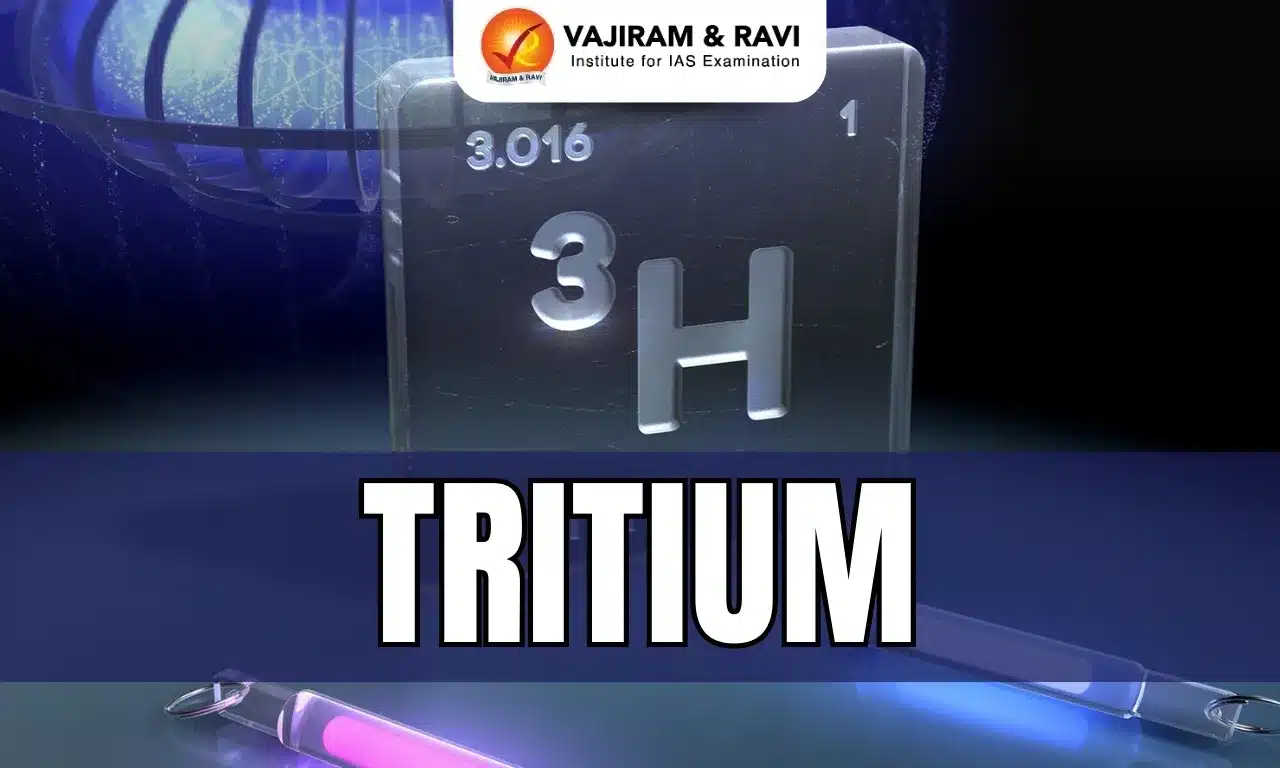
  • Tritium is a radioactive isotope of hydrogen.

Features of Tritium

  • It has the same number of protons and electrons as hydrogen but has 2 neutrons, whereas regular hydrogen does not have any. This makes tritium unstable and radioactive.
  • It is produced naturally from interactions of cosmic rays with gases in the upper atmosphere.
  • Tritium can also be produced by man during nuclear weapon explosions, in reactors intended to produce tritium for nuclear weapons.
  • It is the only radioactive isotope of hydrogen and like hydrogen it reacts with oxygen to form water.
  • The transformation of tritium to tritiated water is a complex and slow process. Tritium is a colorless, odorless gas with a half-life of 12.3 years.
  • As a liquid, tritium moves easily through the environment just like water.
  • It occurs naturally in the environment in very low concentrations.

Uses of Tritium

  • It can be combined with phosphor to create glow-in-the-dark lighting such as exit signs, emergency lighting in buildings, and airport runway lights.
  • Medical Field: It is also used as a tracer in biomedical research to study and diagnose heart disease, cancer and AIDS. 
  • Electricity Generation: It may also be used to generate electricity in fusion reactors.

Source: TH

Tritium FAQs

Q1: What is tritium used for?

Ans: It is used to make luminous dials and as a source of light for sarety signs.

Q2: Is tritium toxic to humans?

Ans: Tritium is a hazard only when taken inside the body.

Kodali Karuppur Silk Sari

Kodali Karuppur Silk Sari

Kodali Karuppur Silk Sari Latest News

The iconic Kodali Karuppur silk sari, a luxury garment once patronised by the Maratha kings of Thanjavur is facing a crisis as its traditional handloom weavers dwindle in number.

About Kodali Karuppur Silk Sari

  • It derived its name from Karuppur, a village near Kumbakonam, Tamil Nadu.
  • The handwoven silk saris, dhotis, and furnishings of Karuppur that combined hand painting, block printing, and brocade-weaving were popular up to the 19th Century.
  • History of Kodali Karuppur Silk Sari
    • These evolved under the patronage of the Maratha ruler Serfoji Raja Bhonsle Chhatrapati II in 1787-1832 and were made exclusively for the Ranis of Thanjavur up to the 19th century.
    • The ancestors of the weavers comprised about 400-500 families who migrated from Saurashtra to Madurai, Salem and Kancheepuram.
    • The Karuppur cloth was worn only by the Thanjavur nobility, who gifted some as khillat or clothes of honour.
    • In some Maratha states like Baroda, Kohlapur and Satara, the Karuppur sari was an essential part of the bride’s trousseau, as was the Karuppur turban for the groom.
  • Design: The design vocabulary of the Karuppur sari is limited, mostly geometric and linear patterns, vine-like designs, stars, veldarri and the thazhambu or screw pine flower design.
  • This saree does not have a GI (Geographical Indication) tag.

Source: TH

Kodali Karuppur Silk Sari FAQs

Q1: What is the history of Kodalikaruppur saree?

Ans: It emerged during the reign of Maratha ruler Serfoji Raja Bhonsle Chhatrapati II (1787-1832), exclusively crafted for the Ranis of Thanjavur until the 19th century.

Q2: Who gives GI tag India?

Ans: It is issued by the Geographical Indication Registry under the Department of Industry Promotion and Internal Trade, Ministry of Commerce and Industry.

Dhirio-Bull Fighting

Dhirio-Bull Fighting

Dhirio-Bull Fighting Latest News

Recently, during a discussion in the state Assembly legislators across party lines demanded the legalisation of bull fighting which is locally called Dhirio in Goa.

About Dhirio-Bull Fighting

  • Bull fighting, locally referred to as dhirio or dhiri, is an integral part of Goa’s cultural fabric.
  • It is organised after the harvest season.
  • These bull fights have traditionally been held in paddy fields and football grounds of Goa, with village shepherds bringing in their animals.
  • Dhiri was a “part and parcel of every Church fest” and villagers from miles around would gather to witness the popular sport.
  • These bull fights have traditionally been held in paddy fields and football grounds of Goa
  • A bull fight begins with two bulls dashing at each other and locking horns.
  • They head-butt each other and repeatedly charge and retreat, provoked by trainers standing behind.
  • Bull fights have been taking place in Goa for generations, going back to the time of the Portuguese.
  • The High court in 1997 directed the state to take immediate steps to ban “all types of animal fights including bull fights and ‘dhirios.

Source: IE

Dhirio-Bull Fighting FAQs

Q1: What is dhirio?

Ans: It is a popular form of traditional bull wrestling in the state of Goa, Coastal South West India.

Q2: Which country's famous sport is bull fighting?

Ans: Spain

Vitthal Rukhmini Temple

Vitthal Rukhmini Temple

Vitthal Rukhmini Temple Latest News

A Marathi-Hindi language row has emerged at Pandharpur's renowned Vitthal-Rukhmini temple recently.

About Vitthal Rukhmini Temple

  • It is a Hindu temple situated in Pandharpur, Maharashtra.
  • Located on the banks of the river Bhima, also known as Chandrabhaga, Sri Vitthal Rukmini Mandir is dedicated to Lord Vithoba, a form of the Lord Vishnu or Krishna, and his consort Rukhmini. 
  • The temple is classified as one among the 108 Abhimana Kshethrams of the Vaishnavate tradition. 

Vitthal Rukhmini Temple History

  • The temple was built by King Vishnuvardhana of the Hoysala Empire between 1108 and 1152 CE.
  • He built the temple after being persuaded by Pundalik, a historical figure, great devotee of Lord Krishna.
  • There is an inscription in the temple, of a Hoysala King Vira Someshwara dating back to 1237 CE, which grants the temple a village for its upkeep. 
  • An extensive temple was constructed in the second half of the 13th century following the Hemadpanti style of architecture. 
  • The temple was attacked by invaders and completely damaged.
  • The present temple was built in the 17th century & later in the Deccan style, with dome motifs and lobed arches by the contribution of Peshwas of Pune, the Shindes of Gwalior, and the Holkars of Indore.
  • The temple was the first shrine in India that welcomed people and women from backward categories as priests in 2014.

Source: TOI

Vitthal Rukhmini Temple FAQs

Q1: The Vitthal Rukhmini Temple is located in which place?

Ans: Pandharpur, Maharashtra

Q2: On the banks of which river is the Vitthal Rukhmini Temple situated?

Ans: It is located on the banks of the river Bhima, also known as Chandrabhaga.

Q3: Who built the original Vitthal Rukhmini Temple between 1108 and 1152 CE?

Ans: King Vishnuvardhana of the Hoysala Empire

Bhagirathi River

Bhagirathi River

Bhagirathi River Latest News

A water body resembling a lake, stretching over a kilometre, has formed on the Bhagirathi River near Harsil after the recent cloudburst in the Uttarkashi district of Uttarakhand, prompting authorities to launch urgent drainage operations.

About Bhagirathi River

  • It is a turbulent Himalayan river in the state of Uttarakhand.
  • It is one of the two main headstreams of the Ganges River, the other being the Alaknanda River.
  • According to Hindu mythology and culture, Bhagirathi is the source stream of the Ganges. 
  • But according to the hydrology, Alakananda is the source stream of the Ganges for its flow and length.
  • Course:
    • It originates from the Gaumukh Glacier located at the base of the Khatling and Gangotri Glaciers in the Garhwal Himalayas, where the melting ice gives birth to the river.
    • Further, the river passes through the Tehri Garhwal district, including the towns of Uttarkashi and Tehri, where it encounters cliffs, rapids, and waterfalls.
    • It is joined by tributaries such as – Kedar Ganga, Jadh Ganga, Kakora Gad, Jalandari Gad, Siyan Gad, Asi Ganga and Bhilangana.
    • Finally, the Bhagirathi River meets the Alaknanda River at Devprayag.
    • The combined waters of the two rivers then flow as the Ganges River, and this river eventually empties into the Bay of Bengal.
  • Major Dams: Maneri Dam, Koteshwar Dam, and Tehri Dam.
  • Religious Significance: 
    • The confluence of the Bhagirathi and Alaknanda rivers is considered a sacred site in Hindu mythology.
    • It is an essential part of the sacred Panch Prayag Yatra, which involves visiting the five holy confluences of Uttarakhand: Devprayag, Rudraprayag, Nandprayag, Karnaprayag, and Vishnuprayag.
    • The banks of the Bhagirathi are dotted with numerous sacred cities and sites such as Gangotri, the source of the river, which is one of the Char Dham pilgrimage sites.

Source: HT

Bhagirathi River FAQs

Q1: The Bhagirathi River is located in which Indian state?

Ans: Uttarakhand

Q2: The Bhagirathi River originates from which glacier?

Ans: It originates from the Gaumukh Glacier located at the base of the Khatling and Gangotri Glaciers in the Garhwal Himalayas.

Q3: Bhagirathi River meets the Alaknanda River at which place?

Ans: Bhagirathi River meets the Alaknanda River at Devprayag.

Q4: What is the total length of Bhagirathi River?

Ans: Bhagirathi River flows for a total length of approximately 205 km before joining the Alaknanda River.

Pneumococcal Disease

Pneumococcal Disease

Pneumococcal Disease Latest News

Drug firm Pfizer recently introduced its next-generation 20-valent pneumococcal conjugate vaccine (PCV20) for adults in India, offering protection against 20 serotypes responsible for a majority of pneumococcal diseases.

About Pneumococcal Disease

  • Pneumococcal disease refers to a range of illnesses that affect various parts of the body and are caused by infection with the bacterium Streptococcus pneumoniae, commonly known as pneumococcus.
    • Streptococcus pneumoniae is an encapsulated bacteria with a polysaccharide capsule, an essential factor in virulence. 
    • About 90 distinct pneumococcal serotypes have been identified throughout the world, with a small number of these serotypes accounting for most diseases.
  • Illnesses range from mild infections, such as ear infections, to pneumonia and life-threatening infections of the bloodstream and central nervous system, such as meningitis.
  • It is a major public health problem worldwide. 
    • In the developing world young children and the elderly are most affected. 
    • It is estimated that about one million children die of pneumococcal disease every year. 
  • Pneumococci are transmitted by direct contact with respiratory secretions from patients and healthy carriers.
  • Treatment
    • Treatment typically involves antibiotics
    • Vaccines can reduce the risk of infection, especially in young children and older adults.
    • Pneumococcal resistance to antimicrobials is a serious and rapidly increasing problem worldwide.

Source: ET

Pneumococcal Disease FAQs

Q1: Which organism causes Pneumococcal disease?

Ans: Pneumococcal disease is caused by the bacterium Streptococcus pneumoniae, commonly known as pneumococcus.

Q2: How is pneumococcal disease primarily transmitted?

Ans: It is transmitted by direct contact with respiratory secretions from patients and healthy carriers.

Q3: How is pneumococcal disease treated?

Ans: Pneumococcal disease is typically treated with antibiotics, but prevention is also important through vaccination, especially for young children and older adults.

Talaq-E-Hasan

Talaq-E-Hasan

Sukhna Lake Latest News

The Chandigarh Administration recently closed the floodgate at Sukhna Lake early morning after water levels receded.

About Sukhna Lake

  • It is an artificial lake located in the city of Chandigarh at the foothills of the Shivalik hills. 
  • This 3 sq.km. rain fed lake was created in 1958 by damming the Sukhna Choe, a seasonal stream coming down from the Shivalik Hills. 
  • The lake is 1.52 km long and 1.49 km wide. 
  • After completion in 1958, the water-spread area of the lake was 188 ha and the average depth was 4.69 m. 
  • It had a depth of 18 feet originally, but due to heavy silt deposits, the depth reduced to 8 feet 6 inches and the area to 1. 5 sq.km. 
  • The lake is fringed by a golf course to the south, and Nek Chand famous Rock Garden of Chandigarh to its west.
  • The lake is declared National  Wetland by the Government of India.
  • During winter, Sukhna Lake transforms into a haven for diverse migratory birds such as Siberian ducks, storks, and cranes, hosting around 30 resident and migratory species.
  • The lake is also a part of the Sukhna Wildlife Sanctuary.
  • Sukhna Lake has the longest channel for rowing and yachting events in Asia.

Source: IE

Sukhna Lake FAQs

Q1: Where is Sukhna Lake located?

Ans: It is located in the city of Chandigarh at the foothills of the Shivalik hills.

Q2: Sukhna Lake was created in 1958 by damming which seasonal stream?

Ans: It was created in 1958 by damming the Sukhna Choe, a seasonal stream coming down from the Shivalik Hills.

Q3: Which famous tourist attraction is located to the west of Sukhna Lake?

Ans: Nek Chand’s Rock Garden

Q4: Sukhna Lake is a part of which protected area?

Ans: Sukhna Wildlife Sanctuary

Talaq-E-Hasan

Talaq-E-Hasan

Talaq-E-Hasan Latest News

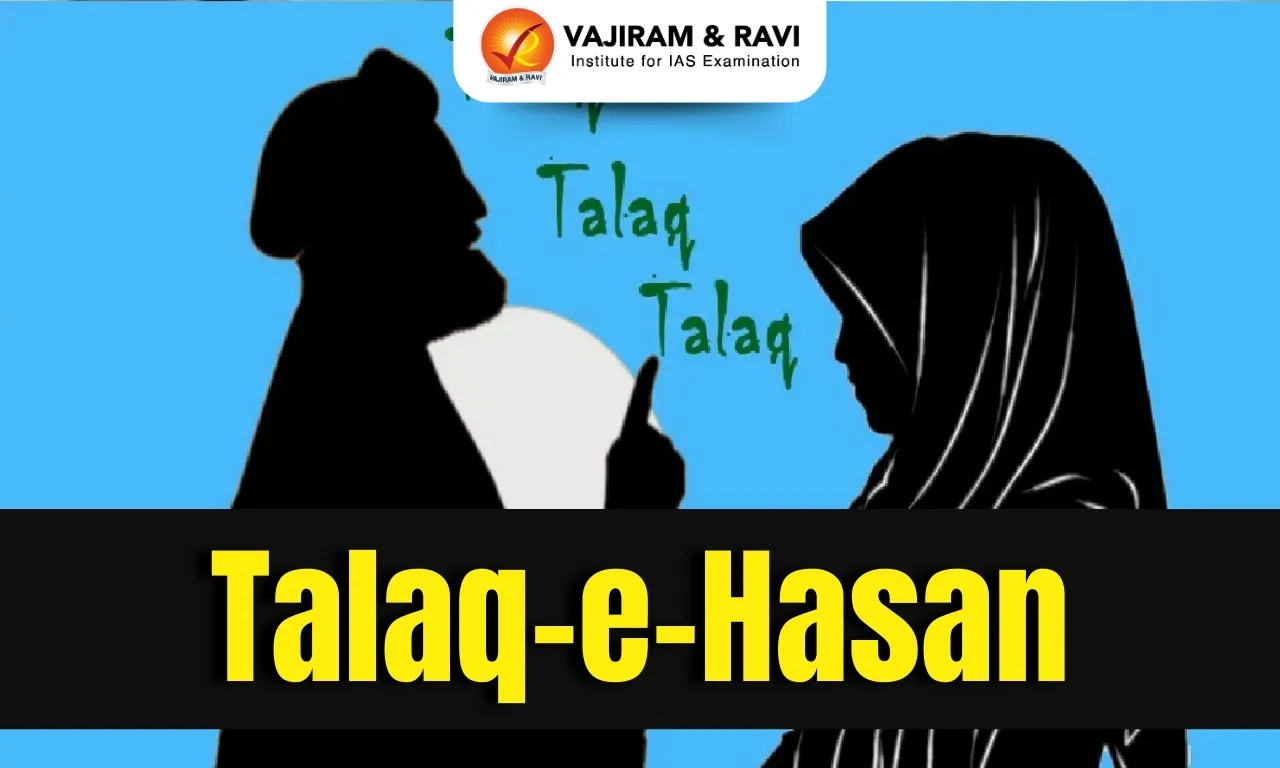
The Supreme Court recently agreed to hear a batch of petitions challenging the practice of talaq-e-hasan as unconstitutional.

About Talaq-E-Hasan

  • It is a type of extrajudicial form of divorce mentioned under Islam that only men can practice.
  • It is a revocable form of divorce. 
  • A traditional form of divorce, 'Talaq-e-Hasan is considered to be approved by Prophet Mohammad and is valid as per all schools of Muslim law.
  • To practice 'Talaq-e-Hasan, a man needs to pronounce talaq on his wife three turns at intervals of one month. 
  • The period of the gap between the three consecutive talaqs is called the period of abstinence or ‘iddat’ and its duration is 90 days. 
  • The divorce is assumed to be revoked if the couple begins to cohabit or be intimate during the period of abstinence. 

How is it Different from Triple Talaq?

  • Triple talaq or Talaq-e-Biddat was banned by the government in 2019. 
  • In this, a man can divorce his wife by pronouncing "talaq" thrice in one go. 
  • The divorce is instant and irrevocable. 
  • This is different from 'Talaq-e-Hasan as it does not have any waiting period and irrevocably terminates the marriage.

Source: TH

Talaq-E-Hasan FAQs

Q1: What is talaq-e-Hasan in Islam?

Ans: It is a type of extrajudicial form of divorce mentioned under Islam that only men can practice.

Q2: How to give talaq-e-hasan?

Ans: To practice 'Talaq-e-Hasan, a man needs to pronounce talaq on his wife three turns at intervals of one month.

Q3: What happens if the couple resumes cohabitation during the period of abstinence in Talaq-e-Hasan?

Ans: The divorce is automatically revoked.

Q4: Which type of talaq is banned in India?

Ans: Triple talaq or Talaq-e-Biddat was banned by the government in 2019.

Smooth-Coated Otter

Smooth-Coated Otter

Smooth-Coated Otters Latest News

Recently, the National Zoological Park (NZP) in Delhi welcomed a pair of smooth-coated otters from Surat in a rare animal exchange after 20 years.

About Smooth-Coated Otters

  • It is a species of otter, the only extant representative of the genus Lutrogale. 
  • Distribution: They live in southern and Southeast Asia, China, and India, and in Iraq there is a small population. 

Habitat of Smooth-Coated Otters

  • They are mostly found in lowlands, coastal mangrove forests, peat swamp forests, freshwater wetlands, large forested rivers, lakes, and rice paddies.
  • Although adapted for water, smooth-coated otters are equally comfortable on land and can travel long distances overland in search of suitable habitat. 

Features of Smooth-coated Otters

  • They are the largest otter in Southeast Asia.
  • As its name indicates, the fur of this species is smoother and shorter than that of other otters.
  • The fur is light to dark brown dorsally and light brown to almost gray ventrally.
  • They have short, tightly packed under fur and longer, water-repellant guard hairs.
  • They are strong swimmers and hunt in groups. When fishing, they travel in a V-formation going upstream.
  • Threats:  Loss of habitat, habitat degradation due to water pollution from fertilizers and pesticides and poaching.
  • Conservation Status: IUCN: Vulnerable

Source: IE

Smooth-Coated Otters FAQs

Q1: Where are smooth-coated otters found?

Ans: Southeast Asia

Q2: What is the status of smooth-coated otter in IUCN?

Ans: Vulnerable

Daily Editorial Analysis 12 August 2025

Daily Editorial Analysis

Reviving Civic Engagement in Health Governance

Context

  • In recent years, Indian states have experimented with ambitious initiatives aimed at bringing health care directly to people’s doorsteps.
  • Tamil Nadu’s Makkalai Thedi Maruthuvam scheme, launched in August 2021, and Karnataka’s Gruha Arogya scheme, introduced in October 2024 and expanded statewide in June 2025, are notable examples.
  • These programmes focus on delivering services, particularly for non-communicable diseases, directly to citizens’ homes.
  • While such measures mark significant progress toward proactive health care delivery, they raise an equally important question: as health systems strive to reach citizens physically, to what extent can citizens themselves reach into, engage with, and influence health governance?

The Imperative of Citizen Engagement and Its Benefits

  • The Imperative of Citizen Engagement

    • Health governance in India has evolved from a government-led domain into a more complex ecosystem involving civil society organisations, professional bodies, hospital associations, and trade unions.
    • It functions through both formal and informal processes, where power dynamics influence whose voices are heard.
    • Meaningful public engagement is not just a procedural nicety, it affirms dignity, counters epistemic injustice, and upholds democratic principles by enabling citizens to shape decisions affecting their health.
  • Tangible Benefits of Inclusive participation

    • It strengthens accountability and transparency.
    • It challenges elite dominance and reduces the scope for corruption.
    • It develops collaboration with frontline workers, improving service uptake and health outcomes.
    • It builds mutual trust between communities and providers.
    • Without such engagement, health governance risks becoming exclusionary, oppressive, and disconnected from community realities.

Existing Frameworks for Participation and Persistent Challenges

  • The National Rural Health Mission (NRHM), launched in 2005, institutionalised community participation through platforms like the Village Health Sanitation and Nutrition Committees (VHSNCs) and Rogi Kalyan Samitis.
  • Designed to be inclusive, especially of women and marginalised groups, these bodies were supported by untied funds for local health initiatives.
  • Urban parallels include Mahila Arogya Samitis, Ward Committees, and NGO-led committees.
  • However, despite their promise, these platforms face persistent challenges; In some areas, they have never been established.
  • Where they do exist, meetings are irregular and roles are poorly defined and funds are underutilised.
  • Intersectoral coordination is weak and deep social hierarchies undermine inclusivity.

Structural and Mindset Barriers

  • A fundamental obstacle lies in how policymakers, administrators, and providers perceive communities.
  • Too often, citizens are viewed as passive beneficiaries rather than active co-creators of health systems.
  • This language signals an underlying paternalism: citizens are framed as objects of intervention rather than rights-holders.
  • Performance metrics typically prioritise the number of people reached rather than the quality of engagement or the lived experience of service delivery.
  • Health governance structures remain dominated by medical professionals, mostly trained in western biomedical models, who often acquire administrative responsibilities without formal public health training.
  • Promotions are seniority-based rather than expertise-driven, entrenching a hierarchical and medicalised culture.

The Way Forward

  • The Need for a Mindset Shift

    • Addressing these challenges requires a fundamental shift in mindset. Community engagement should not be reduced to an instrumental strategy for achieving programme targets.
    • Treating people merely as a means to better health statistics diminishes their agency and dignity.
    • Participatory processes should be valued in their own right, not only for the outcomes they produce.
  • Empowering Communities

    • Disseminate accessible information on health rights and governance structures.
    • Develop civic awareness from an early stage.
    • Intentionally reach marginalised groups.
    • Equip citizens with the tools, skills, and resources to participate meaningfully.
  • Sensitising Health System Actors

    • Move beyond the narrative that low health service utilisation is simply due to poor awareness.
    • Avoid individualising blame for systemic issues.
    • Recognise and address structural determinants of health inequities.
    • Develop collaborative relationships where communities are treated as equal partners.

Conclusion

  • Doorstep health delivery programmes such as those in Tamil Nadu and Karnataka demonstrate the capacity of the Indian health system to innovate in service provision.
  • Yet, without corresponding progress in citizen engagement, such initiatives risk reinforcing a top-down model of care.
  • True transformation demands that communities are not only reached by services but are also empowered to shape them.
  • By investing in inclusive, functional, and participatory governance platforms, and by shifting the attitudes of health system actors, India can move from a model of medicine at people’s doorsteps to one of democracy in health governance.

Reviving Civic Engagement in Health Governance FAQs

Q1. What is the main goal of schemes like Makkalai Thedi Maruthuvam and Gruha Arogya?
Ans. Their main goal is to deliver health care services directly to people’s homes, especially for non-communicable diseases.

Q2. Why is citizen engagement important in health governance?
Ans. Citizen engagement ensures accountability, upholds democratic values, and allows people to shape decisions that affect their health.

Q3. What common problem affects community participation platforms like VHSNCs?
Ans. Many face issues such as irregular meetings, unclear roles, underused funds, and the influence of social hierarchies.

Q4. How are communities often perceived by policymakers and health providers?
Ans. They are often seen as passive beneficiaries rather than active partners in health system decision-making.

Q5. What two-pronged approach is suggested to improve engagement?
Ans. The approach involves empowering communities with knowledge and tools, and sensitising health system actors to treat communities as equal partners.

Source: The Hindu


A Court Ruling With No Room for Gender Justice

Context:

  • In July 2025, the Supreme Court of India delivered its judgment in Shivangi Bansal vs Sahib Bansal, effectively endorsing the suspension of arrests or coercive action under Section 498-A of the erstwhile Indian Penal Code (IPC).
  • Critics argue that this decision rests on false premises and poses a serious risk to both criminal justice and gender equality.
  • This article examines the law’s socio-legal context, the Court’s reliance on the “misuse” narrative without empirical backing, and the potential erosion of protections for women facing domestic cruelty.

Section 498-A

  • Section 498-A IPC (now Section 85 of the Bharatiya Nyaya Sanhita) penalises cruelty against a woman by her husband or his relatives, prescribing imprisonment of up to three years and a fine.
  • Cruelty includes dowry harassment, acts driving the woman to suicide, or causing injury to life or health.
  • The law was introduced in 1983 to address widespread domestic violence and dowry-related harassment.
  • Parliament expanded its scope to cover all forms of cruelty within marriage, following a surge in dowry deaths and recognising that extreme cases like suicides and murders represented only a small fraction of the problem.

Supreme Court Endorses Blanket Protection from Arrest in 498-A Cases

  • The Allahabad High Court had earlier directed that in cases under Section 498-A, no arrest or coercive action be taken against accused persons for a two-month “cool-off” period from the filing of the complaint.
  • It also directed that such cases be referred to district-level family welfare committees.
  • The Supreme Court has now endorsed these directions, effectively granting temporary blanket protection from arrest even when criminal law permits it.
  • This decision, made in an individual dispute without detailed examination of its socio-political impact or hearing the State government extensively.
  • This means that even with strong evidence of serious crimes, the police cannot make arrests for at least two months.
  • Critics argue this risks the safety of complainants, deters victims from lodging complaints, and legitimises police inaction in investigating marital violence.
  • While mediation and alternative dispute resolution may be beneficial in sensitive family matters like divorce or child custody, such approaches are unsuitable when serious allegations of violence, falling under penal law, are involved.

The Debate on ‘Misuse’ of the Anti-Cruelty Law

  • The perception that Section 498-A is often “misused” has found resonance even in Supreme Court judgments.
  • In Preeti Gupta vs State of Jharkhand (2010), the Court noted many non-bona fide cases, while in Sushil Kumar Sharma vs Union of India (2005), it warned of “legal terrorism” through misuse.
  • In Arnesh Kumar vs State of Bihar (2014), the Court issued strict guidelines against automatic arrests, directing police to assess necessity under Section 41 of the then Criminal Procedure Code.
  • These rulings have already made police action in such cases more cautious.

Lack of Empirical Evidence

  • Despite frequent references to misuse, courts have not relied on concrete empirical data to substantiate such claims.
  • Most cases before the Court involve specific disputes with conflicting narratives, making it difficult to generalise.
  • Given the complex social nature of marital cruelty, courts have limited institutional capacity to question the legislative wisdom that enacted such protections.

Conviction Rates and Misinterpretations

  • Arguments citing low conviction rates — around 18% as per NCRB 2022 data — are misleading. This rate is still higher than that for many other offences.
  • Moreover, low convictions do not inherently prove misuse; they often reflect challenges in investigation, systemic bias, familial pressure on victims to compromise, and the difficulty of proving offences occurring in private spaces.
  • High evidentiary standards in criminal law, combined with the reluctance of family members to testify, further explain lower conviction rates without undermining the law’s necessity.

Survey Evidence Counters Misuse Narrative

  • NCRB data shows 1,34,506 cases registered under Section 498-A in 2022.
  • However, the National Family Health Survey-5 reveals significant under-reporting of violence against women in many states.
  • According to the women’s centre Humsafar, the rise in reported cases is likely due to greater legal awareness among women, not necessarily an increase in incidents.
  • Even if some false cases exist, the possibility of misuse is inherent in any legislation. The truth of allegations can only be established through proper investigation.
  • By suspending the anti-cruelty law’s immediate applicability, the Court has heightened the vulnerability of victims and weakened their access to justice.

Conclusion

  • Placing certain criminal provisions under stricter scrutiny than others undermines the uniformity and consistency of the criminal justice system. This selective approach risks creating systemic imbalances.
  • In Sushil Kumar Sharma (2005), the Supreme Court upheld the law’s constitutional validity, emphasising that misuse is no reason to strike down legislation.
  • The current stance effectively contradicts that principle, restricting victims’ chances of obtaining meaningful justice.

A Court Ruling With No Room for Gender Justice FAQs

Q1. What was the Supreme Court’s decision in Shivangi Bansal vs Sahib Bansal?

Ans. The Court upheld a two-month “cool-off” period in Section 498-A cases, barring arrests and referring matters to family welfare committees.

Q2. Why was Section 498-A enacted in 1983?

Ans. To address rising dowry deaths and domestic violence, offering women legal recourse against cruelty by husbands or their relatives.

Q3. What concerns arise from the Court’s suspension of arrests?

Ans. It risks victim safety, deters complaints, legitimises police inaction, and undermines the urgency needed in serious violence cases.

Q4. Is there empirical evidence supporting the ‘misuse’ narrative of Section 498-A?

Ans. No substantial empirical data exists; most cases involve specific disputes, making generalised conclusions unreliable.

Q5. How does the ruling affect the consistency of criminal law?

Ans. It subjects Section 498-A to stricter scrutiny than other criminal provisions, creating systemic imbalance and weakening uniform justice standards.

Source: TH


Recurring Monsoon Disasters in the Himalaya - Beyond Climate Change Narratives

Context:

  • The lower Himalayan states of Uttarakhand and Himachal Pradesh have witnessed severe erosion and flash floods during the current monsoon season.
  • Public perception often attributes such events directly to climate change, overlooking historical recurrence and local anthropogenic triggers—especially unplanned construction and poor land use, which are key drivers of disaster vulnerability.

Historical Precedence of Himalayan Disasters:

  • 2013 Kedarnath floods: When Kedarnath and the Mandakini Valley were inundated by an unstoppable surge of water and debris caused by a glacial outburst that was triggered by excessive rain.
  • 2011 Assi Ganga floods near Uttarkashi: Washed away a hydropower project and labour camps.
  • 1970 and 1978 floods: When minor tributaries of the Alakananda and Bhagirathi were blocked by landslides, forming temporary dams that finally burst and carried a huge volume of water and rubble downstream.
  • 1880 Harsil flood: A major flash flood occurred near the site of this week’s disaster.

Structural and Environmental Vulnerabilities:

  • Natural vulnerability of the Himalaya:

    • Geologically young and unstable mountains.
    • Susceptibility to hydrological extremes, erosion, and seismic activity.
  • Human-induced risks:

    • Unplanned and illegal construction: Homes, hotels, ashrams, eateries built on riverbanks and flood-prone zones.
  • Tourism pressure:

    • Char Dham Yatra expansion via widened roads and helicopter services.
    • Rising pilgrim influx leading to mushrooming of hotels and dhabas in hazard zones.
  • Urban encroachment:

    • Dehradun and Mussoorie seeing construction in streambeds and landslide-prone areas despite earlier restrictions.

Political and Administrative Factors:

  • Bureaucratic complacency and political opportunism enabling unsafe development.
  • Ineffective enforcement of land use and building norms in ecologically sensitive zones.

Misplaced Attribution to Climate Change:

  • While climate change impacts (melting glaciers, altered precipitation) are real, attributing every disaster to it oversimplifies causation.
  • Avoidable, immediate triggers such as poor planning, deforestation, and encroachment play a more decisive role in disaster severity.

Way Forward:

  • Strengthen land-use planning: Enforce zoning laws and hazard mapping.
  • Regulate religious and adventure tourism: Introduce visitor caps in ecologically sensitive areas.
  • Eco-sensitive infrastructure: Prioritise resilient construction, away from flood plains.
  • Public awareness: Shift discourse from fatalism to accountability for unsafe practices.

Conclusion:

  • In the coming decades, safeguarding the fragile Himalayan ecosystem will require shifting from reactive disaster relief to proactive, science-based land-use planning that prioritises ecological security over unchecked development.
  • By integrating resilient infrastructure, regulated tourism, and community participation, the region can transform from a disaster-prone zone into a model for sustainable mountain governance.

Recurring Monsoon Disasters in the Himalaya FAQs

Q1. How have monsoon disasters historically recurred in the Himalaya?

Ans: Flash floods and landslides from 1880 to 2013 show a recurring hazard pattern requiring long-term resilience planning.

Q2. How does unplanned construction raise flood risks in Himalayan towns?

Ans: Riverbank encroachment and weak zoning enforcement increase vulnerability to floods.

Q3. How does religious tourism add to disaster risk in Uttarakhand?

Ans: Unregulated pilgrim influx drives unsafe construction in hazard-prone valleys.

Q4. Why is attributing all extreme events to climate change problematic?

Ans: It diverts focus from avoidable human-induced causes like deforestation and poor land use.

Q5. What steps can balance development and ecology in Himalayan states?

Ans: Eco-zoning, tourist caps, resilient infrastructure, and strict land-use laws.

Source: IE

Daily Editorial Analysis 12 August 2025 FAQs

Q1: What is editorial analysis?

Ans: Editorial analysis is the critical examination and interpretation of newspaper editorials to extract key insights, arguments, and perspectives relevant to UPSC preparation.

Q2: What is an editorial analyst?

Ans: An editorial analyst is someone who studies and breaks down editorials to highlight their relevance, structure, and usefulness for competitive exams like the UPSC.

Q3: What is an editorial for UPSC?

Ans: For UPSC, an editorial refers to opinion-based articles in reputed newspapers that provide analysis on current affairs, governance, policy, and socio-economic issues.

Q4: What are the sources of UPSC Editorial Analysis?

Ans: Key sources include editorials from The Hindu and Indian Express.

Q5: Can Editorial Analysis help in Mains Answer Writing?

Ans: Yes, editorial analysis enhances content quality, analytical depth, and structure in Mains answer writing.

National Sports Governance and Anti-Doping Bills Passed by Lok Sabha

National Sports Governance Bill 2025

Sports Governance Latest News

  • The Lok Sabha has passed the National Sports Governance Bill 2025 and the National Anti-Doping (Amendment) Bill 2025.

Introduction

  • The Lok Sabha has passed two landmark legislations, the National Sports Governance Bill 2025 and the National Anti-Doping (Amendment) Bill 2025, marking a major overhaul of India’s sports governance and anti-doping framework. 
  • Union Sports Minister Mansukh Mandaviya described the reforms as the “single biggest sports reform since independence”, underscoring their role in building a transparent, accountable, and high-performance sports ecosystem as India prepares to bid for the 2036 Summer Olympics.

About the National Sports Governance Bill 2025

  • The National Sports Governance Bill seeks to transform India’s sports administration through the establishment of New Bodies:
    • National Olympic Committee
    • National Paralympic Committee
    • National and Regional Sports Federations for designated sports
  • Creation of the National Sports Board (NSB):
    • The NSB will grant recognition to national sports bodies, register affiliated units, and monitor compliance. It will have power to de-recognise federations that fail to conduct fair elections, mismanage funds, or commit gross irregularities.
  • National Sports Tribunal:
    • A judicial body with civil court powers to resolve disputes involving selection, elections, or governance of federations. Tribunal decisions can only be challenged in the Supreme Court.
  • Accountability and Transparency Measures:
    • All recognised national sports bodies receiving government funding will fall under the Right to Information (RTI) Act, with some exceptions, such as the BCCI, which remains outside RTI unless substantially funded by the government.
  • Leadership Provisions:
    • Administrators aged between 70 and 75 can contest elections if permitted under international federation rules, a relaxation from the earlier age cap of 70 years.

About the National Anti-Doping (Amendment) Bill 2025

  • This amendment aligns India’s anti-doping laws with World Anti-Doping Agency (WADA) requirements:
  • Operational Independence for NADA: The National Anti-Doping Agency will function without direct government oversight to address WADA’s concerns over autonomy.
  • Changes in the National Anti-Doping Board: The Board remains but without powers to oversee NADA or influence its operations, ensuring compliance with global anti-doping norms.
  • Alignment with UNESCO Convention: Strengthens India's commitment to international anti-doping standards while protecting athlete rights and ensuring fair play.

Significance of the Reforms

  • Olympics 2036 Preparation: The legislation is part of India’s roadmap to bid for the Summer Olympics, requiring compliance with the Olympic Charter and international best practices.
  • Addressing Long-standing Gaps: Efforts to create a robust sports governance law date back to 1975, with multiple failed attempts due to political hurdles. This Bill finally delivers on decades of unfinished reforms.
  • Promoting Gender Inclusion: Provisions ensure greater participation of women in sports federations and leadership roles.
  • Enhancing Performance: By enforcing accountability and reducing political interference, the Bills aim to improve India’s performance in global sports events.

Future Outlook

  • The reforms are expected to:
    • Streamline governance in sports federations
    • Build stronger anti-doping mechanisms
    • Boost India’s medal prospects in international competitions
    • Lay the institutional foundation for India’s Olympic bid
  • However, successful implementation will depend on effective enforcement, autonomy for sports bodies, and sustained investment in athlete development.

Source: IE | TOI

Sports Governance FAQs

Q1: What is the National Sports Governance Bill 2025?

Ans: It is a law to create a transparent and accountable sports governance system through a National Sports Board, new federations, and a sports tribunal.

Q2: How does the Bill address transparency?

Ans: It brings government-funded sports bodies under the RTI Act and mandates audited accounts and fair elections.

Q3: What changes does the National Anti-Doping (Amendment) Bill 2025 bring?

Ans: It ensures the operational independence of NADA in line with WADA’s global standards.

Q4: Why are these reforms significant for India’s Olympics bid?

Ans: They align India’s sports governance with the Olympic Charter and international norms, a requirement for hosting the Games.

Q5: Will the BCCI be covered under RTI after the Bill’s passage?

Ans: No, unless it is substantially funded by the government.

Supreme Court Orders Permanent Removal of Stray Dogs from Delhi-NCR Streets

Stray Dog Ban

Stray Dog Ban Latest News

  • The Supreme Court has directed Delhi, Noida, Gurgaon, and Ghaziabad authorities to urgently round up and shift stray dogs to shelters, stressing the need to protect children from rabies attacks. 
  • The Bench emphasised that safety must outweigh sentiments and citizens should feel confident moving freely without fear of dog bites. 
  • While the order offers relief to many, experts note that without making pet owners accountable, the problem may persist, as stray dog issues in India are largely linked to irresponsible pet ownership.

India’s Stray and Pet Dog Population: Scale, Risks, and Industry Growth

  • India has over 60 million stray dogs, many succumbing to disease and accidents. 
  • Dog bites occur every 10 seconds, totaling 3 million annually, with around 5,000 fatalities. 
  • Rabies alone kills at least two people every three hours. 
  • Strays also pose environmental hazards, discharging 15,000 tonnes of feces and 8 million gallons of urine on roads and fields daily.
  • In contrast, the pet dog population stood at 30 million in 2024, growing 10-15% annually alongside the expanding dog food market. 
  • The Rs 300 crore pet dog industry is set to double by 2030, with rising demand for luxury services like dog hotels, grooming parlours, and pet insurance from firms like Bajaj Allianz and Future Generali.

Why India’s Stray Dog Control Efforts Have Failed

  • India’s past attempts to tackle stray dogs—through killing by electrocution, poisoning, shooting, or clubbing—proved ineffective, as partial elimination only reduced competition and spurred breeding.
  • Since 1992, sterilisation under the Animal Birth Control (Dogs) Rules, 2001 has been the preferred method. 
    • Animal Birth Control (ABC) Rules, 2023 replaced the earlier 2001 rules.
  • However, without sterilising at least two-thirds of the canine population within 6–12 months, the effort fails. 
  • With limited NGO capacity, cities rarely meet this target, and even when achieved, stray numbers may still rise due to abundant food sources.

How Irresponsible Pet Ownership Fuels India’s Stray Dog Crisis

  • With no national law mandating pet registration, sterilisation, or vaccination, many owners abandon unwanted dogs or let them breed with strays
  • This uncontrolled breeding adds significantly to the stray population, turning most “Indian street dogs” into crossbreeds.
  • Experts suggest targeting pedigreed pets in Animal Birth Control (ABC) drives, offering incentives for registration and sterilisation, and imposing heavy taxes on breeding pets.

Feeding Strays Without Ownership Worsens Aggression and Attacks

  • The growing trend of feeding stray dogs without adopting them makes them territorial and aggressive, often leading to attacks on non-feeders. 
  • Abandoned pets or proxy-fed dogs behave more aggressively than true strays, worsening public safety risks.
  • Experts link this behaviour to irresponsible pet ownership and stray feeding, urging accountability for both pet owners and neighbourhood feeders. 
  • The Supreme Court has warned that anyone obstructing its stray dog removal orders will face legal action and may extend accountability to feeders in upcoming hearings.

Key Highlights of the Judgement

  • Mandatory Capture & Detention: Strays to be picked up from all areas, prioritising vulnerable localities; resistance will invite contempt of court.
  • Infrastructure & Personnel: Authorities must set up shelters/pounds for at least 5,000 dogs within 6–8 weeks, with adequate staff.
  • Sterilisation & Immunisation: All captured dogs to be sterilised and vaccinated.
  • Permanent Confinement: Strict CCTV surveillance of shelters; no dog to be released — violation will attract stern action.
  • Public Safety Focus: Emphasis on protecting infants and children from rabies; no sentiments to interfere with public safety.
  • Rapid Response Mechanism: Helpline to be created; all dog bite incidents must be acted upon within four hours of reporting.
  • Victim Support: Authorities to ensure immediate medical assistance and maintain data on anti-rabies vaccine availability and usage.

Source: TH | IE | N18

Stray Dog Ban FAQs

Q1: Why did the Supreme Court issue the stray dog order?

Ans: Due to rising rabies cases and fatal dog attacks, the court prioritised public safety, especially protecting children from stray dog threats.

Q2: What does the order mandate for stray dog handling?

Ans: Strays must be captured, sterilised, vaccinated, and permanently housed in shelters under CCTV, with no release back to public spaces.

Q3: How many stray dogs are in India?

Ans: India has over 60 million stray dogs, causing around 3 million bites annually and 5,000 deaths, mainly due to rabies.

Q4: Why have past stray dog control measures failed?

Ans: Partial elimination boosts breeding, sterilisation drives miss targets, and irresponsible pet ownership fuels uncontrolled breeding with strays.

Q5: What penalties exist for obstructing the order?

Ans: Any person or organisation resisting stray dog removal faces contempt of court, with strict legal action to ensure public safety compliance.

Google vs CCI Case: Impact on India’s Android Ecosystem & Digital Market

Google vs CCI

Google vs CCI Latest News

  • Recently, the Supreme Court admitted Alphabet Inc.’s appeal against an NCLAT judgment that partly upheld Competition Commission of India’s (CCI) findings of Google abusing its dominance in the Android ecosystem through anti-competitive practices. 
  • The Court also admitted related petitions from the CCI and Alliance Digital India Foundation (ADIF), a coalition of Indian startups opposing Big Tech dominance.

CCI’s Case Against Google

  • The CCI began investigating Google in 2020.
  • This was after getting complaints from app developers and industry groups alleging that the company was exploiting its dominance in the Android ecosystem to promote its own services and curb fair competition.
  • By 2022, the CCI concluded that Google engaged in several anti-competitive actions:
    • Mandatory Google Play Billing System (GPBS): Developers selling in-app content on the Play Store were compelled to use GPBS, paying commissions of 15–30%, instead of integrating their own billing systems.
    • Preferential Treatment to YouTube: Google exempted YouTube from these billing requirements, granting it a cost advantage over competitors.
    • Bundling of Google Apps: Smartphone makers were required to pre-install Google apps (Search, Chrome, YouTube, etc.) to access the Play Store, limiting consumer choice and stifling innovation from alternative service providers.

Penalties and Directives

  • The CCI fined Google ₹936.44 crore and directed it to:
    • Decouple GPBS from Play Store access.
    • Ensure transparency in billing data.
    • Refrain from using billing data to unfairly advantage its own services.

Google’s Defence Against CCI’s Findings

  • Google dismissed the CCI’s conclusions, stating its practices aimed to improve user experience, ensure security, and sustain the Android ecosystem. 
  • It emphasised that Android is open-source and free for manufacturers, and OEMs can license the core platform without installing Google’s proprietary apps if they forgo Play Store access. 
  • Pre-installing Google apps, it argued, was for efficiency and convenience, without restricting users from downloading alternatives.
  • Regarding billing, Google claimed the Google Play Billing System (GPBS) ensured safe transactions, reduced fraud, and offered developers global infrastructure, distribution reach, and regular security updates. 
  • Commission fees, it said, were industry-standard. The exemption of certain in-house services from GPBS was presented as a reflection of different business models, not anti-competitive behaviour. 
  • Google also highlighted that leading Indian apps like PhonePe, Paytm, and Hotstar had thrived on Android, indicating a competitive market.

NCLAT’s Partial Ruling in Google’s Appeal

  • In March, the NCLAT partly upheld the CCI’s 2022 order, agreeing that Google’s mandatory billing policy and bundling of apps constituted abuse of dominance. 
  • However, it reduced the penalty from ₹936.44 crore to ₹216.69 crore, calling the original fine disproportionate. 
  • The tribunal also struck down some behavioural remedies for being over-broad or lacking sufficient evidence.
  • Following a review in May 2025, the NCLAT reinstated two key directions — requiring Google to be transparent in its billing data policies and prohibiting it from using such data to advantage its own services. 
  • This partial outcome left all sides dissatisfied: Google sought a full reversal, the CCI wanted the original penalties restored, and ADIF felt the tribunal was too lenient.

High Stakes in the Android Antitrust Battle

  • The Supreme Court’s ruling in the Google vs CCI case will shape the balance between platform control, market competition, and consumer choice in India’s digital ecosystem.

Impact on Consumers

  • A CCI win could increase app choice and lower prices by allowing developers to bypass GPBS for cheaper payment options. 
  • It may also enhance privacy and fairness by limiting Google’s use of billing data. 
  • However, reduced control could cause Android fragmentation, leading to inconsistent user experiences.

Impact on Smartphone Makers

  • An outcome favouring the CCI could give OEMs greater flexibility to pre-install rival apps and explore alternative Android versions without losing Play Store access — a potential boost for smaller Indian brands.

Impact on Startups and Developers

  • Indian startups could gain a level playing field, with more payment options and less bias in app promotion. 
  • ADIF views this as a chance to curb Big Tech dominance and improve local companies’ bargaining power.

Impact on Google

  • Beyond India, a loss could inspire similar regulatory actions globally, forcing Google to unbundle services or open its billing system, altering its core Android business model.

Supreme Court Verdict to Shape India’s Digital Market Future

  • The Supreme Court’s hearings will assess whether Google’s practices constitute “abuse of dominance” under Indian competition law and weigh the economic dynamics of platform markets. 
  • The ruling will influence how over 95% of Indian smartphone users access apps, make payments, and interact with mobile services. 
  • A verdict upholding the CCI’s original directions could position India as a global leader in strong digital market regulation outside the EU, while a decision in Google’s favour would maintain the current market structure.

Source: TH | ToI

Google vs CCI FAQs

Q1: What triggered the CCI’s investigation into Google?

Ans: In 2020, complaints from app developers and industry groups alleged Google abused Android dominance to push its services and limit fair competition.

Q2: What were CCI’s main findings against Google?

Ans: CCI found Google imposed its billing system, gave YouTube preferential treatment, and bundled apps, limiting competition and consumer choice.

Q3: What was Google’s defence against the allegations?

Ans: Google argued its practices enhanced user experience, ensured security, offered global reach, and allowed OEM flexibility in using core Android without proprietary apps.

Q4: How did NCLAT rule in the case?

Ans: NCLAT upheld abuse of dominance findings, reduced the fine to ₹216.69 crore, and reinstated transparency and data-use restrictions after review.

Q5: Why is the Supreme Court’s verdict important?

Ans: It will define platform control limits, competition enforcement strength, and India’s role as a global example in digital market regulation outside the EU.

Enquire Now