
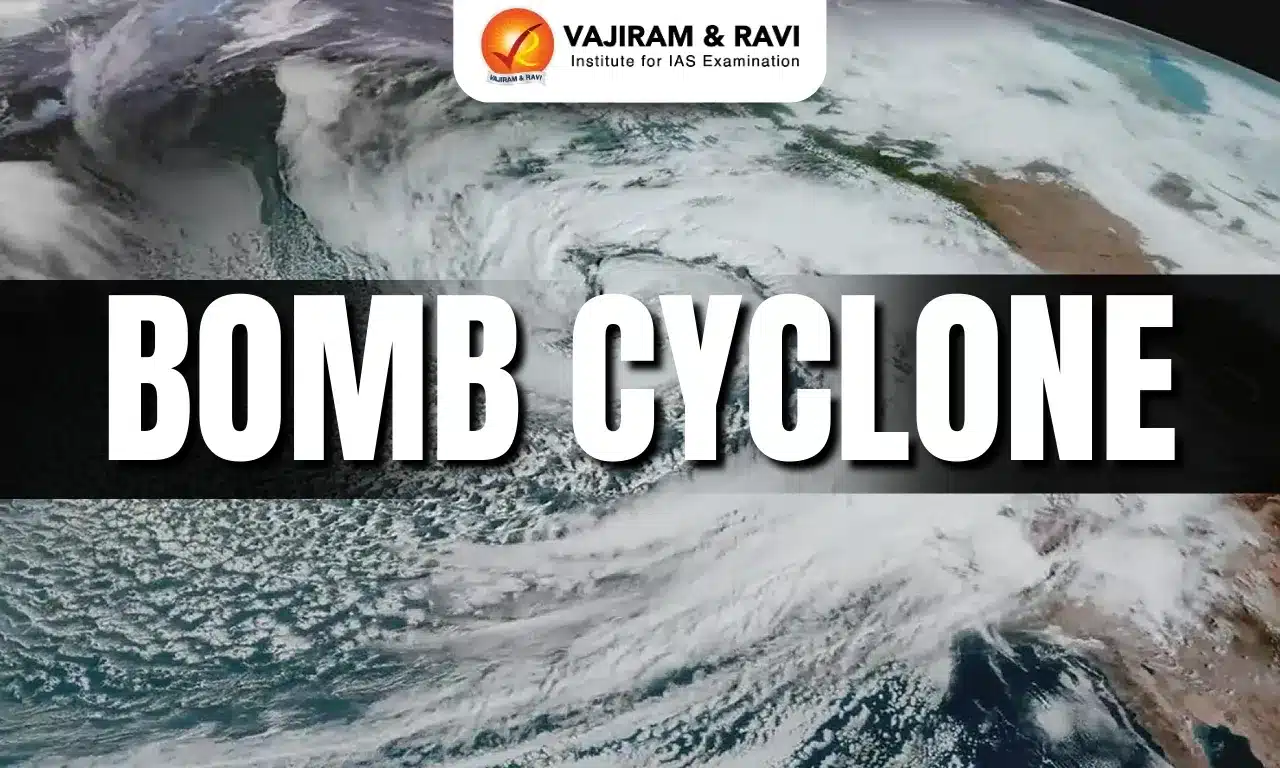
Bomb Cyclone Latest News
A powerful “bomb cyclone” barreled across the northern United States recently, triggering severe winter weather in the Midwest and the East Coast.
About Bomb Cyclone
- It is a large midlatitude storm resulting from explosive cyclogenesis (or, informally, bombogenesis), a type of accelerated extratropical cyclone development in which surface pressure falls substantially over a 24-hour period.
- In structure, a bomb cyclone is indistinguishable from any other intense midlatitude storm.
- The center of the storm is a low-pressure cell (or cyclone) that draws winds near the surface inward.
- However, a bomb cyclone is set apart by its rapid rate of intensification. The intensification required to classify as "bombogenesis" varies by latitude.
- For example, at 60 degrees latitude, the requirement is 24 millibars in 24 hours.
- Around 40 degrees latitude, a storm only has to intensify by 17.8 millibars in 24 hours.
- Bomb cyclones are often associated with atmospheric rivers and typically form in winter when cold and warm air masses collide.
- The four most active regions where extra-tropical explosive cyclogenesis occurs in the world are
- the Northwest Pacific,
- the North Atlantic,
- the Southwest Pacific, and
- the South Atlantic
- The precipitation associated with a bomb cyclone is intense, ranging from heavy downpours to strong thunderstorms to blizzards and heavy snowfalls, along with strong winds.
Source: IE
Bomb Cyclone FAQs
Q1: What causes Bombogenesis?
Ans: Collision of cold and warm air masses
Q2: What is a Bomb Cyclone?
Ans: A rapidly intensifying storm with a pressure drop of 24 millibars in 24 hours.
Q3: What drives the strong winds in a Bomb Cyclone?
Ans: Pressure gradients
