
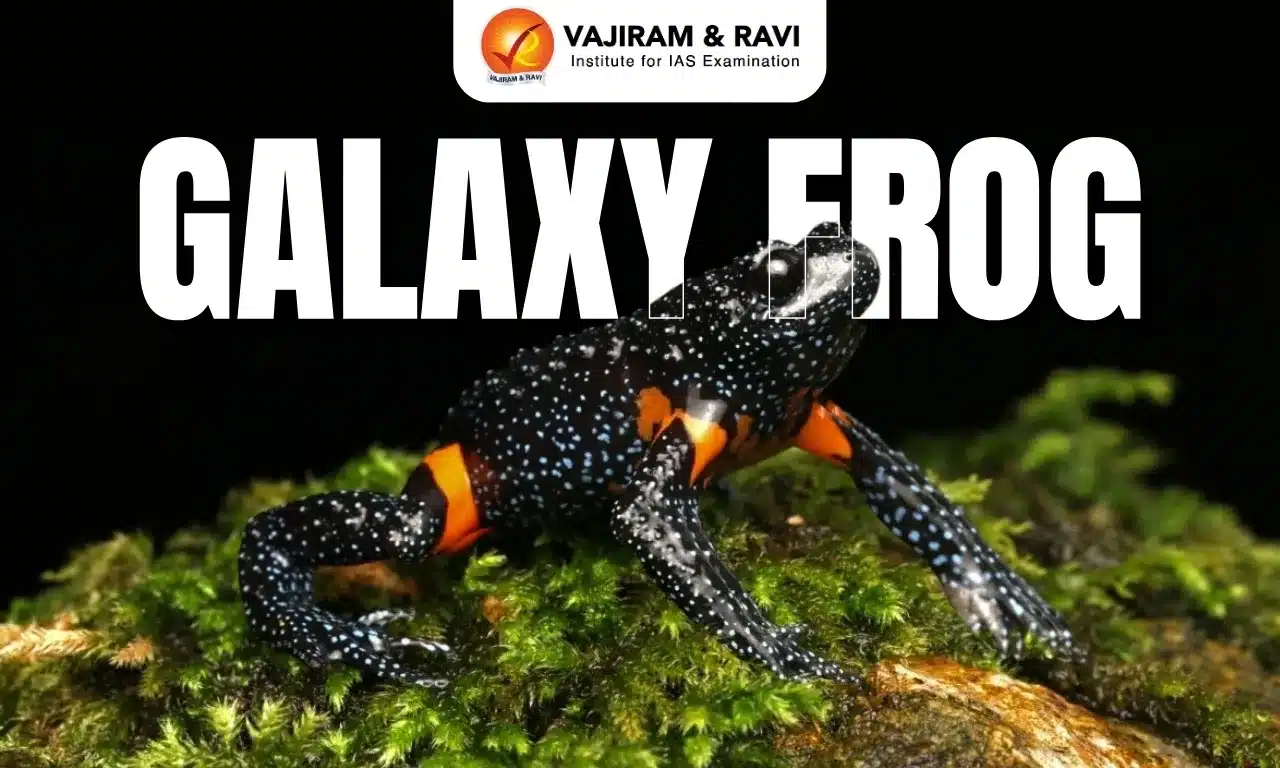
Galaxy Frog Latest News
According to the study, a group of seven galaxy frogs vanished, all likely to be dead, after multiple photographers descended on their habitat.
About Galaxy Frog
- Galaxy frogs (Melanobatrachus indicus) are one of the rarest and most dazzling amphibians in the world.
- The frog belongs to the family Microhylidae and sub-family Melanobatrachinae.
- Its dorsal region is warty and speckled with bluish-white spots that resemble stars in the night sky, hence the name 'Galaxy frog'.
- It has been declared the flagship species of Mathikettan Shola National Park in Idukki , Kerala
- Appearance: It measures just 2 centimetres-3.5 centimetres and has shiny black skin dotted with pale blue speckles, resembling a clear night sky studded with stars.
- Habitat: It nestles under logs and stones on the forest floor at elevations above 900 metres.
- Distribution: It is endemic to wet evergreen forests of southern Western Ghats in Kerala and Tamil Nadu states of India.
- Conservation Status: IUCN Red List: Vulnerable
Characteristics of Galaxy Frog
- Unlike other frogs, the Galaxy Frog doesn’t have a vocal sac and hence it can’t be identified through its calls.
- The bright-coloured spots are being inferred to aid the frog in communication.
- It is a nocturnal species and extremely sensitive to light.
- It absorbs water and oxygen through their skin, so moist air is a must for this species.
- They keep their skin moist by secreting a slimy secretion called mucus to breathe through the skin.
- Threats: Major threats to these creatures are the conversion of forest areas to farm land, firewood collection and landslide and Photo tourism has emerged as a new danger to galaxy frogs.
Source: IE
Galaxy Frog FAQs
Q1: What is the conservation status of the Galaxy Frog?
Ans: Vulnerable
Q2: Where is the Galaxy Frog primarily found?
Ans: Western Ghats
