Venezuela

Venezuela

Venezuela Latest News

Recently, the U.S. military has launched large-scale strikes inside Venezuela, with explosions heard in multiple areas, including the capital Caracas.

About Venezuela

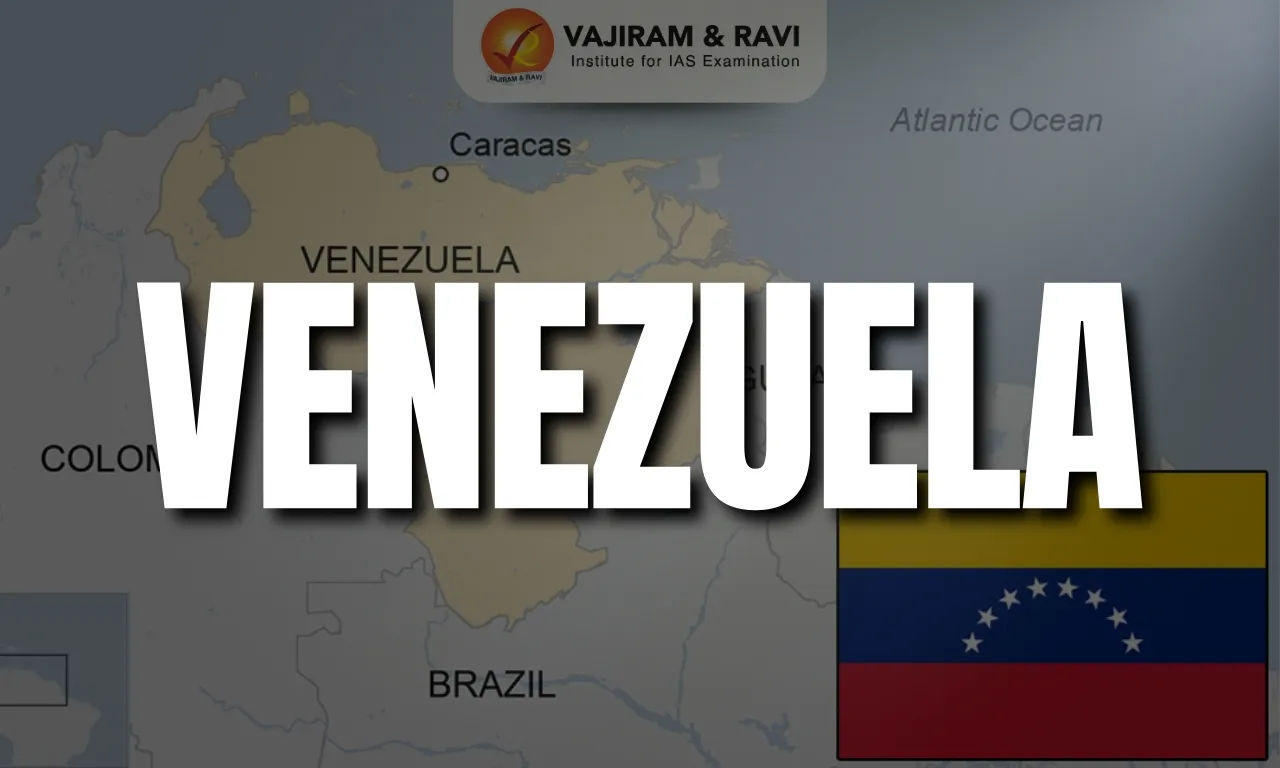
  • Location: It is located on the northern coast of South America.
  • Bordering Countries: It is bounded by Guyana to the east, Brazil to the south, and Colombia to the southwest and west. 
  • Maritime boundaries: It shares a border with the Caribbean Sea and the Atlantic Ocean to the north.
  • Capital: Caracas.

Geographical Features of Venezuela

  • Terrain: Andes Mountains and Maracaibo Lowlands in northwest; central plains (llanos); Guiana Highlands in southeast
  • Major Rivers: Rio Negro (shared with Colombia and Brazil) and Orinoco (shared with Colombia).
  • Major Lakes:  Lake Guri and Lake Maracaibo (the largest lake in South America).
  • Highest Point: Pico Bolivar 
  • The world’s highest waterfall – the Andes Mountains Angel Falls is located in the Guiana Highlands.
  • Natural Resources: It is home to the world’s largest oil reserves as well as huge quantities of coal, iron ore, bauxite, and gold.

Source: IE

Venezuela FAQs

Q1: Where is Venezuela located?

Ans: South America

Q2: What is the capital of Venezuela?

Ans: Caracas

Land Acquisition in India and Infrastructure Delays

Land Acquisition

Land Acquisition Latest News

  • Land acquisition has been flagged as the single largest cause of delays in major infrastructure projects reviewed under the PRAGATI mechanism

Understanding Land Acquisition in India

  • Land acquisition is the process through which the government acquires private land for public purposes such as infrastructure development, industrial corridors, housing, defence projects, and social infrastructure. 
  • In India, this process has long been sensitive due to tensions between development objectives and the rights of landowners, farmers, and local communities.
  • Given India’s ambitious infrastructure and industrial growth plans, land acquisition plays a foundational role in enabling economic expansion. 
  • However, it also remains one of the most contested areas of public policy.

Legal Framework Governing Land Acquisition

  • The present legal framework is governed by the Right to Fair Compensation and Transparency in Land Acquisition, Rehabilitation and Resettlement Act, 2013 (LARR Act)
  • This law replaced the colonial-era Land Acquisition Act of 1894 and aimed to make the acquisition process more humane, transparent, and participatory.
  • Key features of the Act include mandatory: 
    • Social Impact Assessment (SIA), 
    • Consent requirements for private and public-private partnership projects, 
    • Enhanced compensation linked to market value, 
    • Comprehensive rehabilitation and 
    • Resettlement provisions for affected families

Compensation and Rehabilitation Provisions

  • Under the LARR Act, compensation is calculated based on market value, with higher multipliers for rural areas and additional solatium. 
  • The law also mandates rehabilitation measures such as housing, employment or annuity options, and provision of basic infrastructure for displaced families.
  • These provisions were designed to address historical grievances where communities were displaced without adequate compensation or livelihood support.

Procedural and Administrative Challenges

  • Despite its progressive intent, land acquisition remains a slow and complex process. 
  • SIAs often take considerable time, consent requirements are difficult to fulfil in areas with fragmented landholdings, and valuation disputes frequently lead to litigation.
  • Additionally, coordination challenges between Central ministries, State governments, and district administrations further delay acquisition timelines. 
  • Since land is a State subject, differences in administrative capacity and political priorities across States add to implementation difficulties.

Impact on Infrastructure Projects

  • Large infrastructure projects such as highways, railways, power plants, industrial parks, and urban transport systems are especially vulnerable to land-related delays. 
  • In many cases, projects face cost overruns and time overruns due to unresolved land disputes, even after financial and technical approvals have been secured.
  • As a result, land acquisition has emerged as a structural bottleneck in India’s infrastructure-led growth strategy.

News Summary

  • Recent reviews of major infrastructure projects under the PRAGATI (Pro-Active Governance and Timely Implementation) mechanism have once again highlighted land acquisition as the single largest cause of project delays.
  • Official assessments indicate that nearly 35% of unresolved issues in large infrastructure projects are directly related to land acquisition, making it the most significant impediment compared to forest clearances, environmental approvals, utility shifting, or law-and-order issues.

Government’s Current Policy Position

  • Despite the scale of the problem, the government has clarified that there is no proposal to amend or dilute the existing land acquisition law
  • Instead, the focus is on improving administrative coordination, timely escalation of disputes, and strengthening Centre–State cooperation.
  • Through PRAGATI, unresolved issues are escalated from line ministries to higher institutional levels, enabling faster decision-making and accountability.

Role of Monitoring and Coordination Mechanisms

  • The PRAGATI platform has reviewed over 3,300 projects involving investments worth approximately Rs. 85 lakh crore. 
  • Many long-pending projects, some dating back to the 1990s, have been completed due to sustained monitoring and inter-governmental coordination.
  • Although precise fiscal savings have not been quantified, faster project execution has helped unlock stalled investments and reduce economic losses caused by delays.

Way Forward

  • The recent reviews reinforce that while strong legal safeguards for landowners are necessary, efficient administration, early stakeholder engagement, and cooperative federalism are equally critical. 
  • Rather than legislative changes, the emphasis is on better implementation, dispute resolution, and institutional coordination.
  • For India to meet its infrastructure and development goals, land acquisition reforms must focus on execution efficiency while maintaining the balance between development needs and social justice.

Source: TH | IE

Land Acquisition FAQs

Q1: Which law governs land acquisition in India?

Ans: The Right to Fair Compensation and Transparency in Land Acquisition, Rehabilitation and Resettlement Act, 2013 governs land acquisition.

Q2: Why does land acquisition delay infrastructure projects?

Ans: Delays arise due to consent requirements, Social Impact Assessments, disputes over compensation, and litigation.

Q3: What is PRAGATI in infrastructure governance?

Ans: PRAGATI is a monitoring platform that reviews and resolves implementation issues in major infrastructure projects.

Q4: What share of project delays is linked to land acquisition?

Ans: Around 35% of unresolved issues in large projects are related to land acquisition.

Q5: Is the government planning to change the land acquisition law?

Ans: No, the government has stated that there is no plan to amend the existing land acquisition law.

Carbon Credits: A New Income Stream for Rice Farmers via AWD

AWD

AWD Latest News

  • Getting farmers to adopt climate-friendly practices is challenging, especially when it involves high upfront costs, new machinery, or risks of yield loss. The challenge is sharper in India, where over 86% of farmers are small or marginal, holding 2 hectares or less. 
  • In this context, low-effort, high-impact agricultural practices become crucial. One such practice in rice cultivation is Alternate Wetting and Drying (AWD), which offers climate benefits without heavy investment or productivity losses.

Traditional Rice Cultivation and Methane Emissions

  • In traditional rice cultivation, paddy seeds are first raised in nurseries and transplanted after 25–30 days into the main field, which is about ten times larger than the nursery area. 
  • After transplantation, the crop typically grows for 90–100 days, extending to 120 days or more for some varieties.
  • For nearly the first 65 days of the cropping period, fields are kept continuously flooded with 4–5 cm of standing water. 
  • This practice mainly helps suppress weeds by creating oxygen-deficient conditions that prevent weed seed germination. 
  • Flooding becomes less necessary after the vegetative growth and tillering stage, when panicle formation begins.

Methane Formation in Flooded Fields

  • Continuous flooding creates an anaerobic soil environment, ideal for methanogenic microbes that decompose organic matter. 
  • During this process, carbon from plant residues reacts with hydrogen from water, producing methane.
  • Methane is a highly potent greenhouse gas, with a global warming potential about 28 times greater than carbon dioxide over a 100-year period, making flooded rice cultivation a significant contributor to agricultural emissions.

Alternate Wetting and Drying (AWD): A Climate-Friendly Alternative

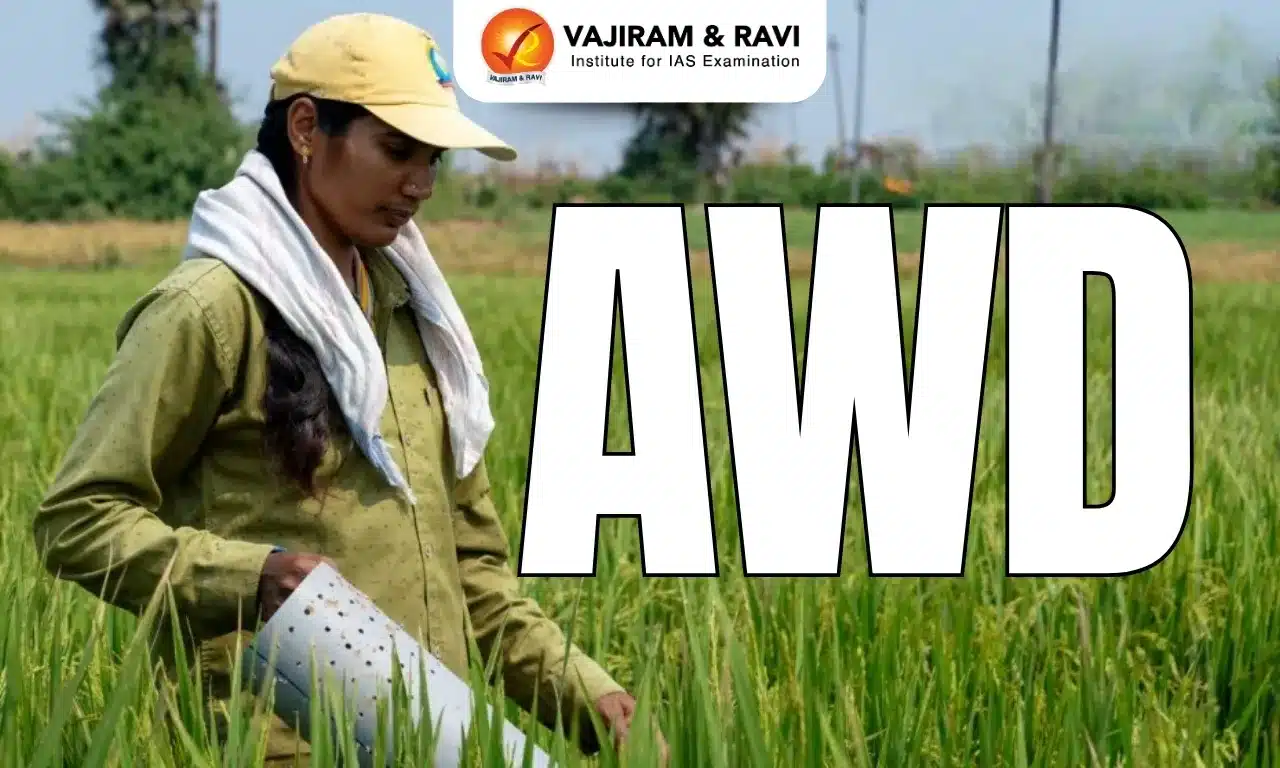
  • Alternate Wetting and Drying (AWD) replaces continuous flooding with periodic drying and re-flooding of paddy fields. 
  • This breaks the anaerobic conditions that favour methane-producing microbes, thereby reducing emissions.

AWD Schedule in Practice

  • Farmers are advised to:
    • Keep fields flooded for the first 20 days after transplantation
    • During days 21–65, allow the field to dry for two cycles of six days each, draining water to 10–15 cm below the soil surface before re-flooding

Field Evidence from Telangana

  • A study by Mitti Labs Ltd during the 2024 kharif season covered 30 paddy fields across three villages in Warangal district.
    • 15 fields followed AWD
    • 15 fields followed continuous flooding (CF)
  • Water use: AWD fields used 3.14 million litres per acre, compared to 4.96 million litres under CF
  • Methane emissions: AWD emitted 3.5 tonnes CO₂-equivalent per hectare, versus 6 tonnes under CF
  • Crucially, grain yields remained unchanged at about 2.5 tonnes per acre under both AWD and CF.
  • This makes AWD a low-effort, high-impact practice that conserves water and cuts emissions without affecting productivity.

Carbon Credits: A New Income Stream for Rice Farmers

  • Alternate Wetting and Drying (AWD) offers farmers more than resource efficiency. 
  • Experts highlight AWD’s potential to generate carbon credits, enabling farmers to monetise methane reductions.
  • Carbon credits are built on direct methane measurements using field chambers, laboratory analysis, geo-tagging, boundary mapping, and satellite imagery—creating a rigorous monitoring, reporting, and verification (MRV) system suitable for domestic and international markets.
  • Data centres, airlines, and other energy- and water-intensive industries purchase credits to offset emissions and meet net-zero targets, driving demand for verified agricultural abatement.

Farmer Earnings Potential

  • Methane abatement credits trade at $15–25 per tonne CO₂e.
  • With ~2.5 tCO₂e/ha reduced per crop, farmers can earn ~$37.5/ha—about ₹3,367 per hectare (₹1,363 per acre) per crop.
  • With India the world’s largest rice producer and exporter, AWD-linked carbon markets present a scalable, farmer-friendly pathway to raise incomes while cutting emissions—an opportunity whose time has arrived.

Source: IE | IREF

AWD FAQs

Q1: Why are carbon credits relevant for rice farmers in India?

Ans: Rice farming emits methane, a potent greenhouse gas. By reducing emissions through improved practices, farmers can earn carbon credits and generate additional income.

Q2: What is Alternate Wetting and Drying (AWD)?

Ans: AWD is a rice cultivation method that periodically dries fields instead of continuous flooding, reducing methane emissions and water use without lowering crop yields.

Q3: How does AWD reduce methane emissions?

Ans: Periodic drying disrupts anaerobic soil conditions, limiting methane-producing microbes and significantly lowering greenhouse gas emissions compared to continuously flooded fields.

Q4: How much can farmers earn from methane reduction?

Ans: With about 2.5 tonnes of CO₂-equivalent reduction per hectare, farmers can earn roughly ₹3,300 per hectare per crop through carbon credit markets.

Q5: Who buys carbon credits generated from rice farming?

Ans: Carbon credits are purchased by data centres, airlines, and other energy-intensive industries to offset emissions and meet net-zero carbon targets

Export Bottlenecks: States Flag Testing and Logistics Gaps

Export Bottlenecks in India

Export Bottlenecks in India Latest News

  • Beyond high US tariffs, India’s goods exports are being hit by costlier raw materials, a shortage of testing facilities to meet global quality standards, and inadequate availability of shipping containers, the Union Commerce and Industry Ministry said in response to an RTI application.
  • These concerns were raised by exporters at a Board of Trade meeting chaired by Commerce and Industry Minister Piyush Goyal on November 25, 2025.

Board of Trade(BoT)

  • The Board of Trade (BoT) is an advisory body under the Ministry of Commerce & Industry, chaired by the Commerce Minister. 
  • It serves as a key forum for shaping India’s Foreign Trade Policy (FTP) by bringing together the Centre, States, industry, and trade bodies.
  • The Board of Trade acts as a bridge between policy and practice, ensuring that trade policies reflect ground realities and support export growth across regions and sectors.

Composition of the BoT

  • Chair: Minister for Commerce & Industry
  • Members: Government officials, trade experts, and representatives from:
    • Export Promotion Councils
    • Chambers of Commerce and Industry
    • Financial and trade institutions such as SBI, ECGC, and EXIM Bank

Backdrop: US Tariffs and Stalled Trade Talks

  • The BoT meeting took place amid slowing exports, driven by steep US tariffs of 50% and the failure of India and the United States to conclude a trade deal by fall 2025.
  • India had been among the first countries to initiate trade talks after PM Modi visited Washington in February 2025.
  • The tariffs, which came into effect on August 27, 2025, led to order cancellations, delayed payments, and fears of export diversion to competitors such as Bangladesh, Vietnam, and China.

Export Trends and Sectoral Impact

  • Exports declined in October but rose 19% in November, driven by products outside the tariff net.
  • Labour-intensive sectors such as garments and footwear face the risk of losing market share as shipments are increasingly replaced by competitors.
  • Rajasthan reported that US tariffs led to order cancellations in the gems and jewellery sector, along with delayed payments.
  • Spices Board: Flagged a crisis due to a 50% US duty on oleoresin, a key input for flavour and aroma in food products.
  • Pharmaceuticals: Despite generic drugs being excluded, Goa highlighted that pharma exports were still affected by tariffs.
  • Seafood: The Seafood Exporters Association reported a significant drop in exports to the US.

India’s Strategy

  • To offset pressure from the US market, New Delhi is actively pursuing new markets. 
  • In 2025, India signed three free trade agreements with Oman, New Zealand, and the United Kingdom, signalling a push towards export diversification.

Anti-Dumping and Countervailing Duties

  • Beyond tariffs, exporters raised concerns over anti-dumping duties:
    • Gujarat expressed apprehension over export losses due to US anti-dumping actions.
    • Spices Board highlighted issues arising from anti-dumping and Countervailing Duties (CVDs).
  • Although the United States has initiated most anti-dumping investigations against China, it has launched nine probes against Indian industrial exports since July last year, including:
    • Hexamine
    • Oleoresin paprika
      • Oleoresins help manufacturers achieve flavour and aroma in their final products.
    • Certain freight rail couplers
    • Overhead door counterbalance torsion springs

Other Major Bottleneck

  • Assam flagged hurdles in tea exports due to shipping line levies on empty containers, given the state’s landlocked geography.
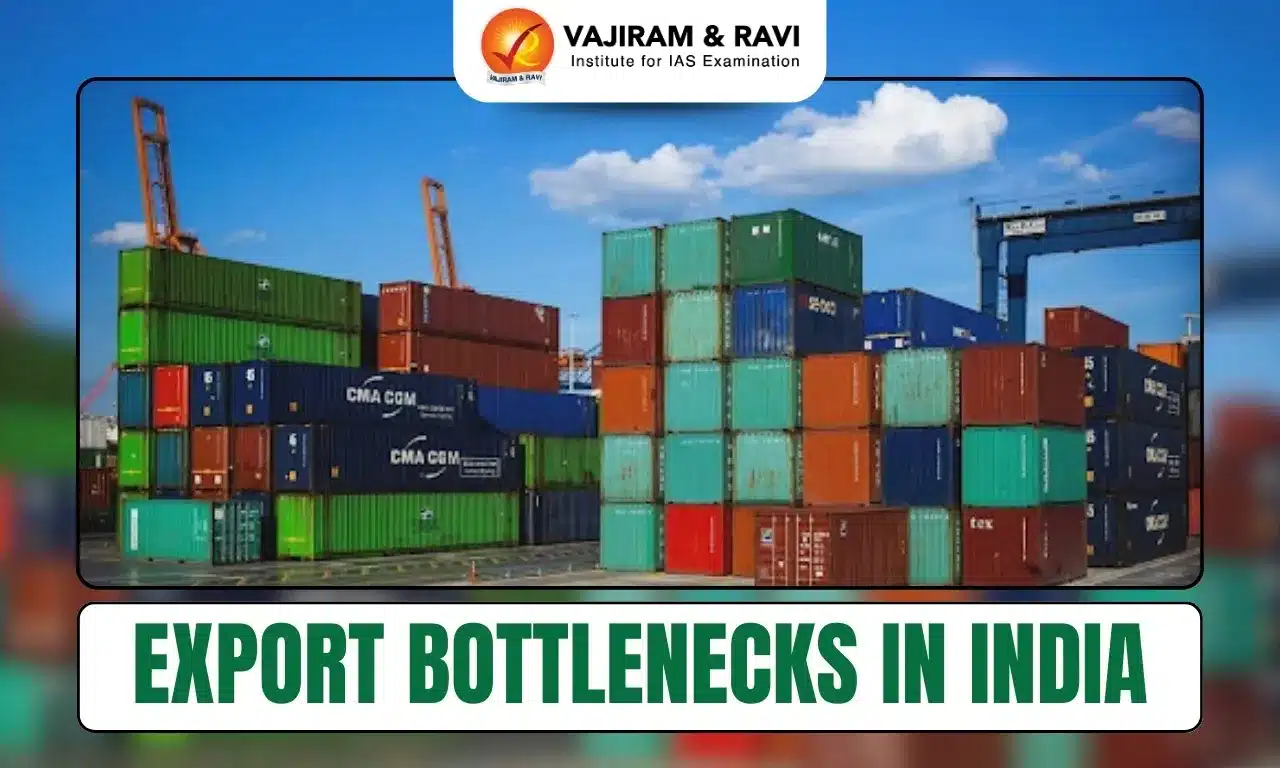
  • Gujarat also highlighted a shortage of shipping containers, affecting exporters across sectors.

Lack of Testing Facilities

  • Rajasthan noted that export samples are sent to Surat and other states due to the absence of local testing labs.
  • Uttarakhand reported no testing labs, forcing exporters to rely on facilities in Uttar Pradesh.
  • Labour-intensive sectors stressed that inadequate testing capacity leads to delays and higher costs.
  • There is need for more labs accredited by the Marine Products Export Development Authority and National Accreditation Board for Testing and Calibration Laboratories.
    • This is due to insufficient capacity with the Export Inspection Council.

Access to Inputs and High Cost Pressures

  • MSME representatives stated that domestic raw material prices are 15–20% higher than international levels.
  • Textile exporters highlighted energy costs for spinning and manufacturing being 15–20% higher, seeking compensation or relief.

Regulatory and Compliance Burdens

  • Exporters pointed out that Bureau of Indian Standards (BIS) norms are being applied even for exports to the US and EU, despite differing standards—raising compliance complexity and costs.
  • MSMEs flagged difficulties with Quality Control Orders (QCOs), seeking a more facilitatory inspection approach.

Sector-Specific Issues

  • The Gem and Jewellery Export Promotion Council (GJEPC) raised concerns over restrictions on gold, platinum, and silver, seeking an automatic import route where duty benefits are unavailable; restrictions have made component imports costlier.
  • Ceramics industry representatives noted that District Export Committees are not meeting regularly and need better monitoring.

Source: IE | NDTVP

Export Bottlenecks FAQs

Q1: What export bottlenecks were flagged at the Board of Trade meeting?

Ans: Exporters highlighted shortages of testing labs, lack of shipping containers, high raw material costs, and regulatory burdens affecting competitiveness.

Q2: How have US tariffs affected Indian exports?

Ans: Steep US tariffs led to order cancellations, delayed payments, and fears of export diversion to competitors like Bangladesh, Vietnam, and China.

Q3: Why are testing facilities crucial for exporters?

Ans: Testing labs ensure compliance with international quality and safety standards, preventing shipment rejections, delays, and financial losses for exporters.

Q4: Which sectors are most affected by current export challenges?

Ans: Labour-intensive sectors such as garments, footwear, seafood, gems and jewellery, and MSME-driven industries face the greatest impact.

Q5: What steps is India taking to offset export pressures?

Ans: India is diversifying markets by signing FTAs with Oman, New Zealand, and the UK, while reviewing trade facilitation and infrastructure gaps.

Enquire Now