
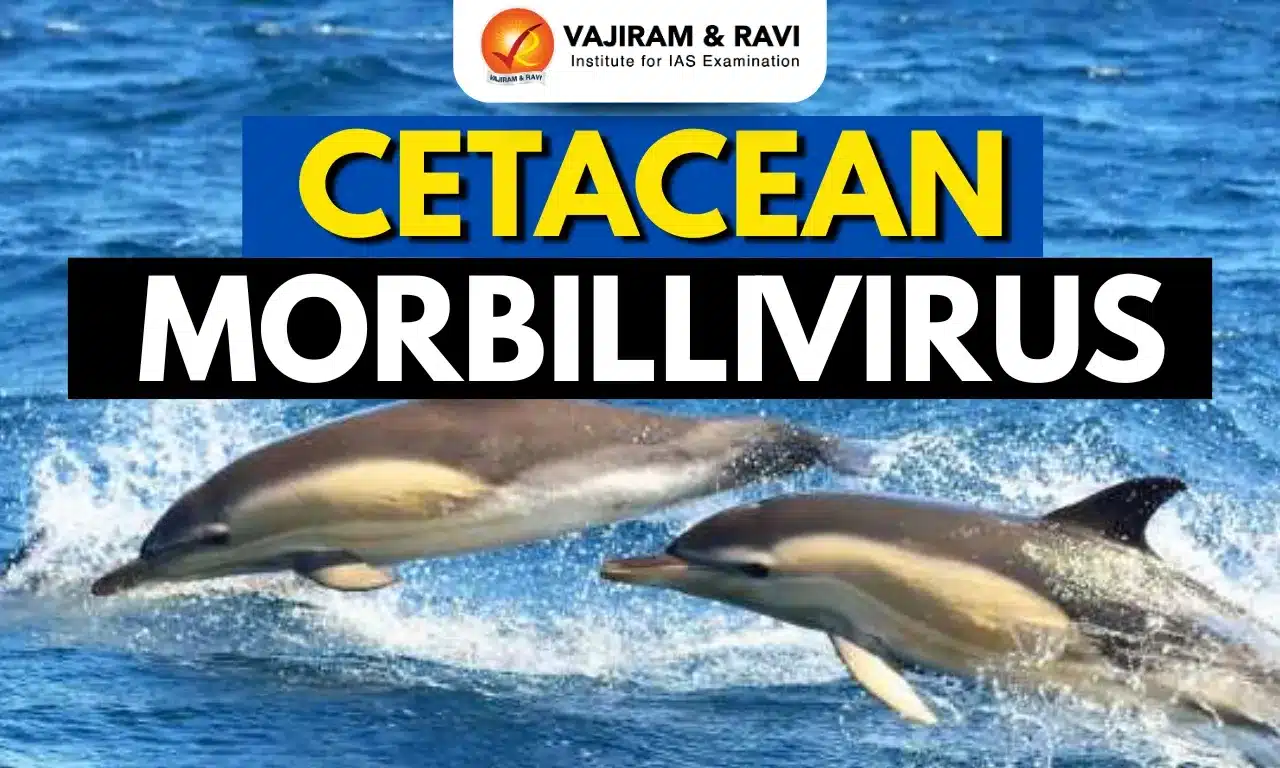
Cetacean morbillivirus Latest News
Recently, scientists used drones to find a dangerous Cetacean morbillivirus among whales in the Arctic.
About Cetacean morbillivirus
- Cetacean morbillivirus (CeMV) refers to a viral infection affecting marine mammals, particularly cetaceans.
- It belongs to the family Paramyxoviridae, which affects marine mammals such as dolphins, whales, and porpoises.
- Characteristics: These viruses are enveloped, negative-sense single-stranded RNA viruses.
- History: Morbilliviruses were first identified in marine mammals in 1987.
- It has been responsible for numerous outbreaks across the world, especially in the North Atlantic and the Mediterranean.
- Transmission: It is highly infectious and spread by the respiratory route and direct contact. The virus is shed by infected animals in ocular and respiratory secretions, urine, feces, and sloughed skin.
- It impacts the respiratory and neurological systems of the marine mammals, and can lead to mass strandings and deaths.
- Treatment: There is no treatment for morbillivirus infections in marine mammals, only supportive care.
What are Cetaceans?
- The Cetacea are one of the most distinctive and highly specialized orders of mammals.
- Cetaceans (order Cetacea) are aquatic mammals, including whales, dolphins, and porpoises.
- Cetaceans are entirely carnivorous and are distributed in all of the world's oceans.
Source: IE
Cetacean morbillivirus FAQs
Q1: Which marine mammals are affected by Cetacean morbillivirus?
Ans: Dolphins, whales, and porpoises
Q2: How is Cetacean morbillivirus transmitted?
Ans: Direct contact and respiratory droplets
