
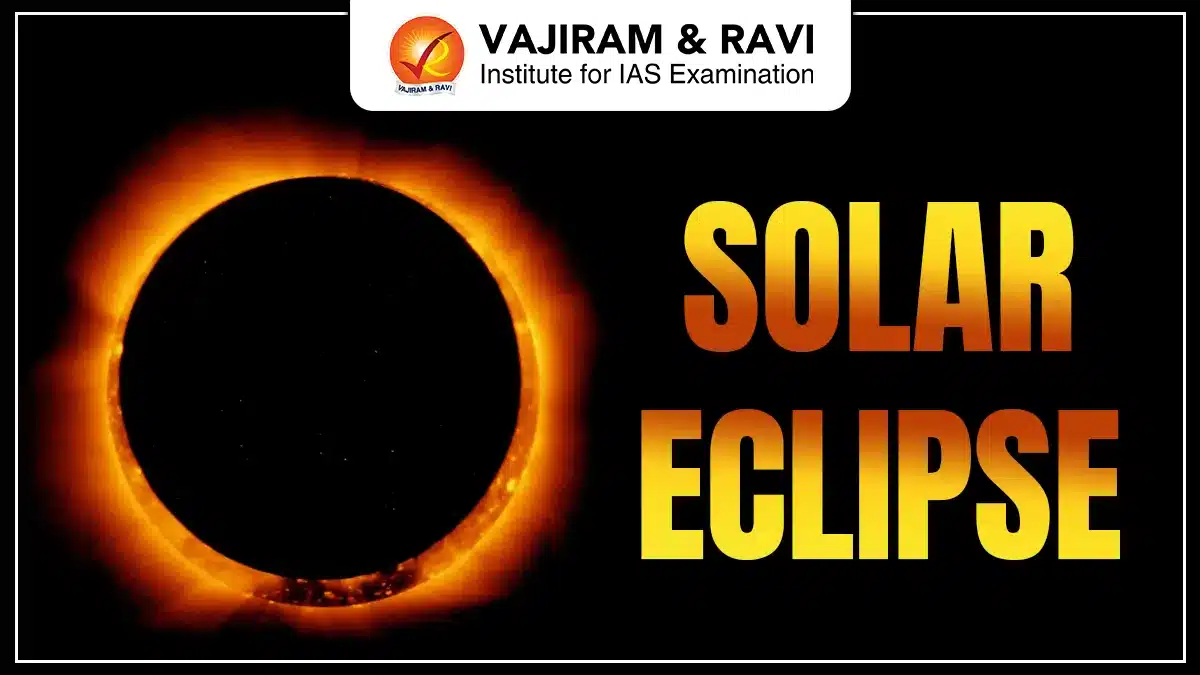
A Solar Eclipse is a natural astronomical phenomenon that occurs when the Moon passes between the Sun and the Earth, blocking sunlight partially or completely. This alignment happens only during a New Moon phase and only during specific periods called eclipse seasons, which occur twice every year. As the Moon’s orbit is tilted by about 5° relative to Earth’s orbit around the Sun, solar eclipses do not occur every month.
Solar Eclipse Features
A Solar Eclipse shows precise celestial alignment where the Moon’s shadow falls on Earth, creating observable changes in sunlight, temperature and sky brightness.
- New Moon Alignment: Solar eclipses occur exclusively during the New Moon when the Moon lies between the Sun and Earth, blocking solar radiation.
- Eclipse Season: Eclipses happen only during eclipse seasons occurring approximately every 173 days when lunar nodes align with the Sun.
- Limited Visibility Zone: Unlike lunar eclipses, solar eclipses are visible only from narrow geographic regions due to the Moon’s small shadow.
- Shadow Based Phenomenon: The type of eclipse depends on whether observers fall within the umbra, penumbra or antumbra shadows.
- Rare Totality: Total solar eclipses occur globally once every 18 months on average, but any location experiences one roughly every 360 to 410 years.
Solar Eclipse Predictions
Solar Eclipses are predicted using precise orbital mechanics, shadow geometry and Earth’s rotational parameters accumulated through centuries of astronomical observation.
- Orbital Geometry: Predictions rely on the alignment of the Sun, Moon and Earth near lunar nodes during New Moon phases.
- Besselian Elements: Astronomers use Besselian elements to calculate eclipse timing, magnitude, and shadow path with high accuracy.
- Eclipse Limits: Solar eclipses occur only when the Sun lies within 15° to 18° of a lunar node.
- Earth’s Rotation Factor: Long term predictions adjust for Earth’s irregular rotational slowing using ‘ΔT’ calculations.
- High Accuracy Forecasts: Modern eclipse predictions can determine eclipse paths centuries ahead, though exact longitude precision decreases far into the future.
Solar Eclipse Phases
The Phases of a Solar Eclipse are defined by the position of the Moon relative to the Sun. The five stages of the solar eclipse are:
- First Contact: The Moon begins covering the Sun, creating a growing crescent as partial eclipse starts.
- Second Contact: Nearly complete coverage occurs, producing Baily’s beads and the diamond ring effect.
- Totality: The Sun is fully obscured, revealing the corona while daylight dims dramatically.
- Third Contact: The Moon moves away, ending totality as sunlight reappears.
- Fourth Contact: The Moon fully leaves the Sun’s disc, restoring normal daylight.
Solar Eclipse Shadow Regions
Solar eclipses depend on three distinct shadows formed by the Moon when blocking sunlight.
- Umbra: The darkest shadow ranging 100 - 160 km, where the Sun is completely blocked, producing a total solar eclipse.
- Penumbra: The lighter outer shadow with width more than 6400 km, where the Sun appears partially covered.
- Antumbra: The region beyond the umbra where the Moon appears smaller, creating annular eclipses.
Solar Eclipse Types
Solar eclipses are classified based on alignment precision and Moon - Earth distance.
- Total Eclipse: Moon fully covers the Sun when near perigee.
- Annular Eclipse: Moon appears smaller due to apogee distance, forming a bright solar ring.
- Partial Eclipse: Only part of the Sun is blocked due to imperfect alignment.
- Hybrid Eclipse: Eclipse shifts between total and annular along its path.
Total Solar Eclipse
A Total Solar Eclipse occurs when the Moon completely covers the Sun, allowing rare solar atmospheric observations.
- Complete Obscuration: The Sun’s photosphere is entirely blocked by the Moon.
- Corona Visibility: The Sun’s outer atmosphere becomes visible only during totality.
- Temperature Drop: Local temperatures can fall noticeably within minutes.
- Short Duration: Totality lasts between a few seconds and a maximum of about 7 minutes.
- Safe Viewing Window: Only during totality is it safe to view without eye protection.
Also Read: Solar System
Annular Solar Eclipse
An Annular Solar Eclipse occurs when the Moon is too distant to cover the Sun completely.
- Apogee Position: The Moon is near its farthest point from Earth.
- Ring of Fire: A bright annulus of sunlight surrounds the Moon.
- No Totality: Due to no totality, the Sun’s corona is not visible.
- Higher Frequency: Annular eclipses occur more often than total eclipses.
- Continuous Eye Protection Needed: Direct viewing remains unsafe throughout.
Partial Solar Eclipse
A Partial Solar Eclipse happens when only part of the Sun is obscured by the Moon.
- Imperfect Alignment: Sun, Moon, and Earth do not align centrally.
- Crescent Appearance: The Sun appears partially covered.
- Wide Visibility Area: Partial eclipses are seen over large regions.
- Minimal Light Reduction: Darkening becomes noticeable only beyond 90% coverage.
- Most Common Type: Partial eclipses occur approximately twice each year.
Hybrid Solar Eclipse
A Hybrid Solar Eclipse changes type along its path due to Earth’s curvature.
- Mixed Nature: Appears annular at some locations and total at others.
- Rare Event: Hybrid eclipses are the least common eclipse type.
- Narrow Path: Totality duration is short and localized.
- Magnitude Variation: Eclipse magnitude shifts above and below one.
- Recent Example: The April 20 2023 eclipse exhibited hybrid characteristics.
Solar Eclipse Observations
Solar Eclipses reveal rare solar features and dynamic atmospheric phenomena as detailed below:
- Solar Corona: Plasma-rich outer atmosphere visible only during totality, reaching millions of degrees.
- Chromosphere: Thin red hydrogen layer observed briefly during totality.
- Prominences: Pink magnetic plasma arcs extending thousands of kilometres from the Sun.
- Baily’s Beads: Sunlight beads caused by lunar surface irregularities.
- Diamond Ring Effect: Brilliant flash before and after totality as last sunlight passes valleys.
Solar Eclipse Duration
The duration of Solar Eclipse varies based on celestial distances and observer location. The factors affecting the duration are:
- Moon Distance: Near-perigee Moon produces longer totality.
- Earth Distance: Near-aphelion Earth reduces Sun’s apparent size.
- Observer Position: Central umbra observers see longest totality.
- Earth’s Rotation: Equatorial eclipses last longer due to higher surface velocity.
- Maximum Recorded: Longest calculated eclipse will occur on July 16, 2186, lasting 7 minutes 29 seconds.
Upcoming Solar Eclipse
The period 2026 - 2027 will witness multiple significant solar eclipses across different regions. These eclipses provide valuable opportunities for solar atmospheric research and orbital verification.
- February 17, 2026 (Annular): Visible in Antarctica, with partial views across Africa, South America, and Indian Ocean.
- August 12, 2026 (Total): Total eclipse visible in Greenland, Iceland, Spain, Russia, and parts of Portugal.
- February 6, 2027 (Annular): Occur over southern hemisphere regions.
- August 2, 2027 (Total): One of the longest upcoming total eclipses, visible across North Africa and parts of Europe.
Solar Eclipse FAQs
Q1: What is a Solar Eclipse?
Ans: A Solar Eclipse occurs when the Moon passes between the Sun and Earth, blocking sunlight partially or completely.
Q2: How many types of Solar Eclipse are there?
Ans: There are mainly four types of Solar Eclipse: Total, Partial, Annular and Hybrid.
Q3: Why doesn't the Solar Eclipse happen every month?
Ans: Because the Moon’s orbit is tilted about 5°, most new moons do not align perfectly with Earth and the Sun.
Q4: 4. Is it safe to look at a Solar Eclipse?
Ans: It is safe only during totality; otherwise, special solar viewing glasses or filters are required.
Q5: How often does a Total Solar Eclipse occur at one place?
Ans: A Total Solar Eclipse is visible from the same location roughly once every 360 to 400 years.
