
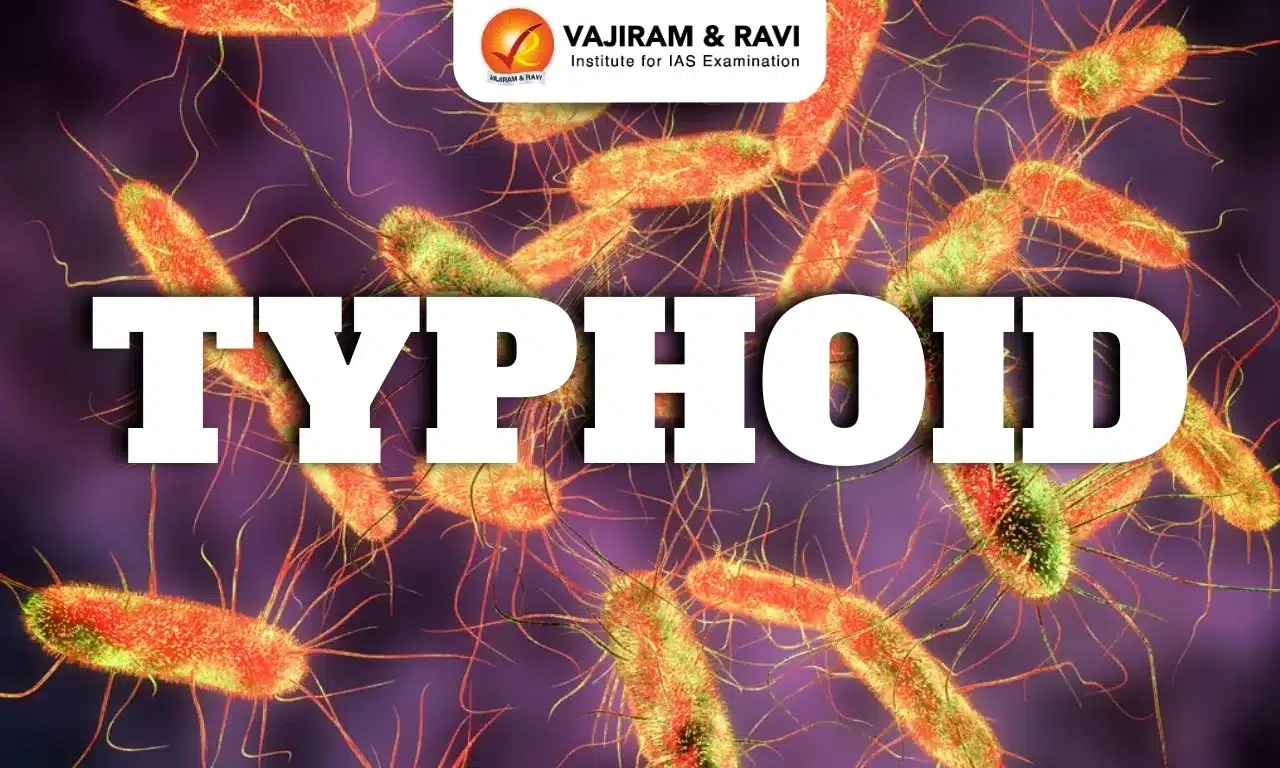
Typhoid Latest News
Gandhinagar is facing a surge in typhoid cases linked to contaminated drinking water, exposing serious flaws in the city's newly laid water supply system.
About Typhoid
- It is a life-threatening infection caused by the bacterium Salmonella Typhi.
- Transmission:
- No animals carry this disease, so transmission is always from human to human.
- A person typically contracts typhoid through contaminated food and drinking water.
- Once Salmonella Typhi bacteria are ingested, they multiply and spread into the bloodstream.
- These bacteria are shed in the stools and urine of infected people.
- Typhoid is more prevalent in places with less efficient sanitation and hygiene.
- It is most prevalent in South Asia, Southeast Asia, Latin America, and sub-Saharan Africa.
- Symptoms:
- Symptoms include prolonged high fever, fatigue, headache, nausea, abdominal pain, and constipation or diarrhoea.
- Some patients may have a rash.
- Severe cases may lead to serious complications or even death.
- Some people have typhoid without experiencing any symptoms.
- Others continue to harbor the bacteria after their symptoms have gone.
- Sometimes, the disease can appear again.
- Treatment:
- Typhoid fever can be treated with antibiotics.
- Antimicrobial resistance is common, with the likelihood of more complicated and expensive treatment options required in the most affected regions.
Source: TOI
Typhoid FAQs
Q1: What bacterium causes typhoid?
Ans: Salmonella Typhi
Q2: How is typhoid transmitted?
Ans: Through contaminated food and drinking water.
Q3: In what type of areas is typhoid more prevalent?
Ans: Areas with poor sanitation and hygiene.
Q4: What is the most common symptom of typhoid?
Ans: Prolonged high fever.
Q5: How is typhoid treated?
Ans: With antibiotics.
