
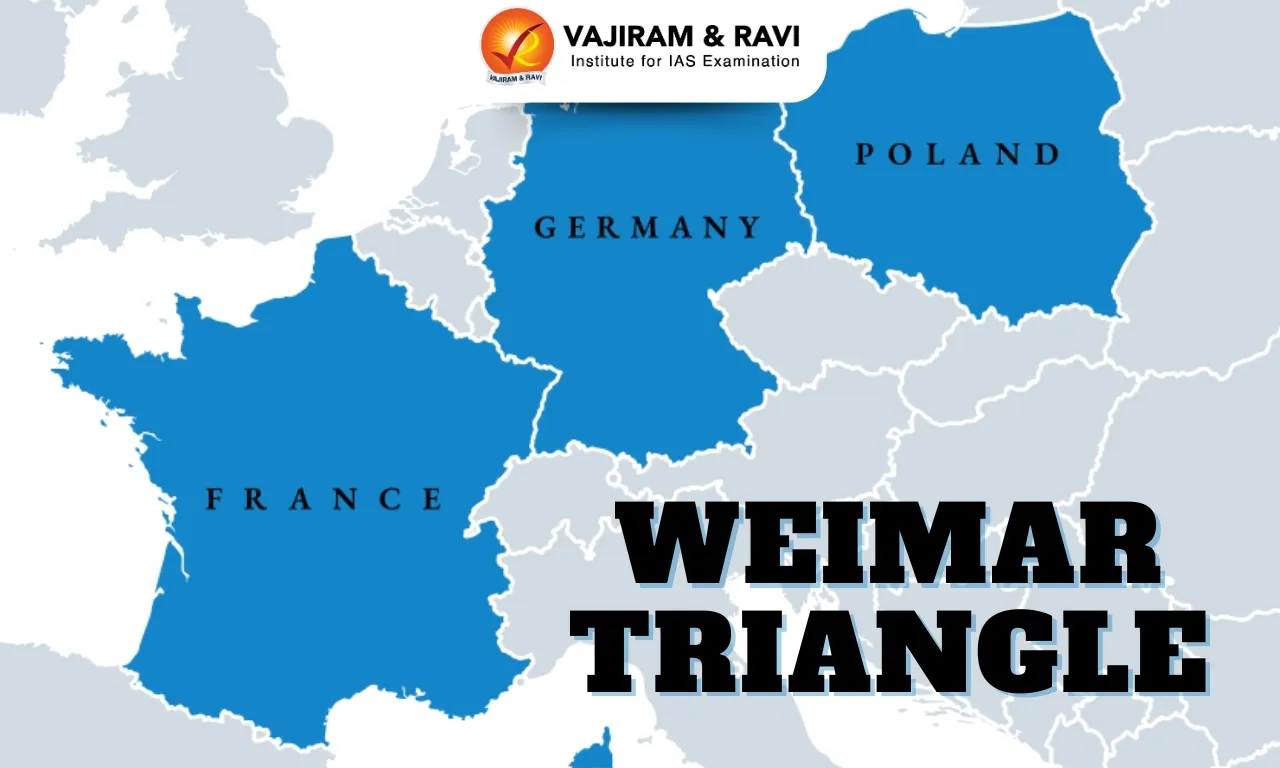
Weimar Triangle Latest News
India’s External Affairs Minister recently participated in India’s first-ever engagement in the Weimar Triangle, with French and Polish counterparts along with German representatives.
About Weimar Triangle
- It is a regional political grouping of France, Germany, and Poland.
- It was formed on 29 August 1991 by a joint declaration issued in Weimar, Germany, by the Foreign Ministers of the three countries.
- It had three objectives:
- To involve France in German-Polish reconciliation by building on the Franco-German experience;
- To strengthen dialogue and political cooperation between the three countries.
- To support Poland in its process of integration into NATO and the European Union (EU).
- Regular meetings at levels including heads of government, foreign ministers, and European affairs ministers have enabled coordination on EU policies, with notable outcomes including Poland's accession to NATO in 1999 and the European Union in 2004.
- Although the Weimar Triangle still has no institutional structure, it remains a framework of reference at the political level.
- Beyond diplomacy, it encompasses civil society efforts like youth exchanges, academic collaborations, and business networks to promote intercultural dialogue and mobility.
Source: HT
Weimar Triangle FAQs
Q1: What is the Weimar Triangle?
Ans: It is a regional political grouping of France, Germany, and Poland.
Q2: When was the Weimar Triangle formed?
Ans: It was formed on 29 August 1991.
Q3: What was the primary purpose of involving France in the Weimar Triangle?
Ans: To involve France in German-Polish reconciliation using the Franco-German experience.
Q4: What role did the Weimar Triangle aim to play in European cooperation?
Ans: It aimed to strengthen dialogue and political cooperation among France, Germany, and Poland
Q5: How did the Weimar Triangle support Poland’s international integration?
Ans: It supported Poland’s integration into NATO and the European Union.
