
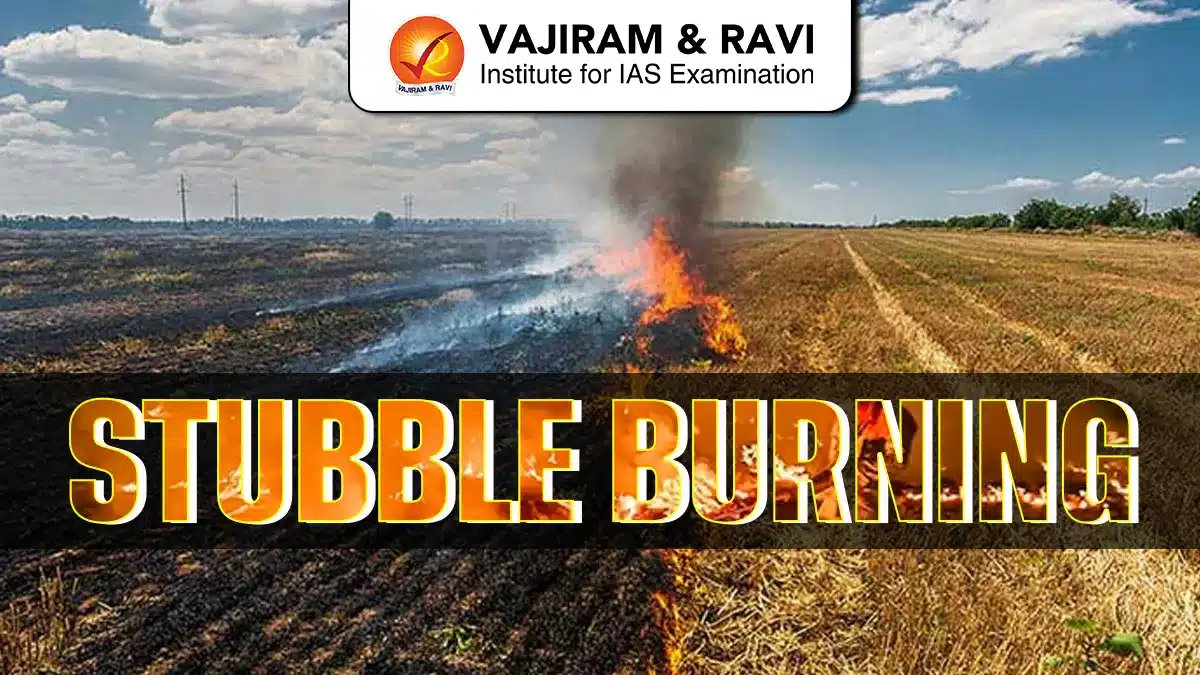
Stubble Burning is a recurring agricultural practice that significantly influences air quality, soil health and climate conditions in northern India. It occurs mainly after the harvest of rice and wheat, when farmers burn leftover crop residue to clear fields quickly for the next sowing cycle. This seasonal activity coincides with winter atmospheric conditions that trap pollutants, intensifying smog formation across the Indo-Gangetic plains. Scientific studies, satellite observations and policy reviews consistently identify Stubble Burning as a structural environmental and economic challenge rather than merely a behavioural issue.
Stubble Burning
Stubble Burning refers to the intentional burning of crop residue such as straw and stalks left after harvesting cereals like paddy and wheat using combine harvesters. These machines leave tall, silica-rich stalks that are difficult to remove manually or plough back into the soil. The practice is most visible between late September and November in Punjab, Haryana and western Uttar Pradesh, aligning with the short 15-20 day gap between paddy harvesting and wheat sowing, making rapid residue removal critical for farmers.
Read about: Biomass Energy
Stubble Burning in India
India produces nearly 600-700 million tonnes of crop residue annually, with around 35 million tonnes burned in northern states during October-November. Punjab records the highest rice Stubble Burning incidents, followed by Haryana, while Uttar Pradesh leads in wheat residue burning. A 2023 IIT-TERI study estimated that Stubble Burning contributes 22% - 35% of seasonal air pollution, rising to 40% - 70% on specific days under stagnant meteorological conditions.
Satellite data shows mixed trends. Punjab reported a 70% decline in fire incidents in 2024, yet the total burnt area remained nearly unchanged at around 19.17 lakh hectares. This discrepancy arises because satellites like MODIS and VIIRS miss short duration evening fires, now increasingly lit between 4 pm and 6 pm. Optical sensors such as Sentinel-2 reveal burn scars even when thermal sensors fail, highlighting under reporting challenges.
Stubble Burning Reasons
Stubble Burning persists due to intertwined agronomic, economic and policy constraints that limit farmers’ practical alternatives despite legal bans and environmental costs.
- Short Cropping Window: The 15-20 day gap between paddy harvest and wheat sowing leaves insufficient time for manual or mechanical residue management, directly affecting wheat yield schedules.
- Cost Constraints: Hiring machines like Happy Seeders costs ₹4,500-5,000 per acre, unaffordable for most small farmers who constitute nearly 85% of landholders.
- Mechanisation Pattern: Combine harvesters leave 25-30 cm tall stubble, making ploughing difficult and increasing dependence on burning for rapid field clearance.
- Policy Induced Mono Cropping: MSP driven rice-wheat cycles discourage crop diversification, leading to repetitive accumulation of paddy straw with limited reuse options.
- Low Market Value of Straw: Paddy straw has high silica content, making it unsuitable for fodder and reducing incentives for collection or commercial sale.
- Infrastructure Gaps: Biomass plants are often 20-50 km away, making straw transport economically unviable due to storage and logistics costs.
Stubble Burning Impacts
The impacts of Stubble Burning extend beyond local farms, affecting air quality, soil productivity, climate systems and public health across regions.
- Air Pollution Load: Burning one tonne of crop residue releases about 1,400 kg CO₂, 58 kg CO, 11 kg particulate matter and 4.9 kg nitrogen oxides.
- PM2.5 Concentration Rise: Each detected farm fire is associated with an average 112.44 unit rise in PM2.5 levels in Delhi NCR during peak season.
- Smog Formation: Emissions interact with winter fog and industrial pollutants, forming dense smog that reduces visibility and solar radiation.
- Soil Nutrient Loss: Burning destroys nitrogen, phosphorus, potassium and beneficial microbes, reducing soil organic carbon and long term fertility.
- Microbial Damage: High soil temperatures kill bacteria and fungi essential for nutrient cycling, affecting moisture retention and crop resilience.
- Public Health Risks: Exposure increases respiratory infections, aggravates COPD, raises eye disorders and intensifies vulnerability among children and elderly populations.
Stubble Burning Prevention Initiatives by Government
The government has adopted regulatory, technological and financial measures to curb Stubble Burning while attempting to reduce farmer distress.
- Legal Framework: The Air Act 1981 and Environment Protection Act 1986 empower penalties, while National Green Tribunal enforces compliance measures.
- CAQM Coordination: The Commission for Air Quality Management coordinates actions across Delhi NCR states using satellite monitoring and district level enforcement.
- CRM Scheme: Crop Residue Management scheme supplies Happy Seeders, Super SMS, mulchers and balers for in-situ residue management.
- Pusa Decomposer: A microbial solution developed by IARI converts stubble into compost within 20-25 days, improving soil organic carbon.
- Financial Incentives: Haryana provides ₹1,200 per acre to farmers who avoid burning and adopt sustainable residue practices.
- Mechanisation Support: SMAM offers subsidies to small and marginal farmers through Custom Hiring Centres for affordable machine access.
Stubble Burning Alternatives
Sustainable alternatives focus on converting crop residue into economic resources while improving soil health and reducing emissions.
- In-Situ Decomposition: Bio-decomposers break down stubble into organic manure, reducing fertiliser dependence and improving soil moisture retention.
- Biomass Power Generation: Straw is pelletised and used in power plants, supporting renewable energy while reducing open field burning.
- Ethanol and Bio-CNG: Paddy straw is processed into second generation ethanol and biogas, contributing to clean energy targets.
- Cattle Feed Processing: Straw is treated and pelletised for fodder use in regions facing feed shortages, despite silica limitations.
- Paper and Packaging: Crop residue replaces wood pulp in paper, disposable plates and packaging, reducing deforestation pressure.
- Gauthans Model: Chhattisgarh’s community collection system converts residue into organic fertiliser using cow dung and natural enzymes.
Stubble Burning FAQs
Q1: What is Stubble Burning?
Ans: Stubble Burning is the practice of burning leftover crop residue like paddy or wheat straw after harvesting to quickly clear fields.
Q2: Why do farmers burn crop stubble?
Ans: Farmers burn stubble due to a short sowing window, high residue management costs, labour shortages and limited affordable alternatives.
Q3: How does Stubble Burning affect air quality?
Ans: It releases particulate matter and harmful gases, significantly increasing smog, PM2.5 levels and respiratory health risks.
Q4: Is Stubble Burning illegal in India?
Ans: Yes, Stubble Burning is banned under environmental laws and monitored by the National Green Tribunal and CAQM.
Q5: What are the alternatives to Stubble Burning?
Ans: Alternatives include in-situ decomposition, use of Happy Seeders, biomass energy production and converting residue into compost or biofuel.
