
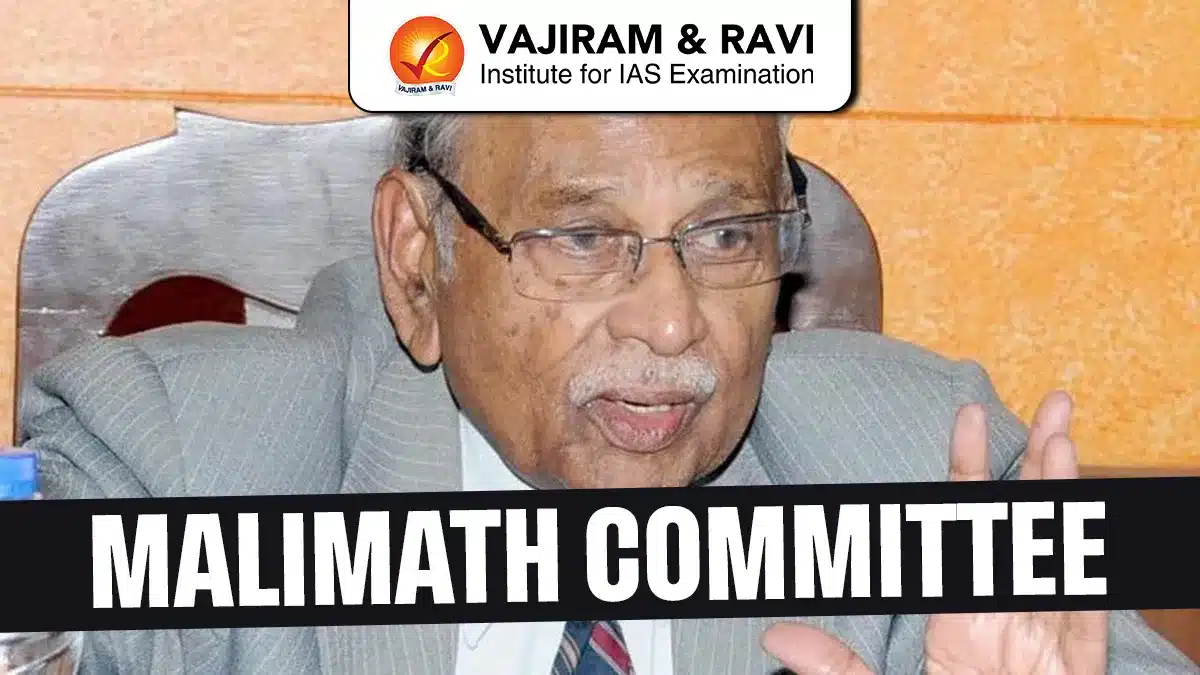
The Malimath Committee represents one of the most comprehensive and authoritative attempts by the Indian State to overhaul the Criminal Justice System, which has long suffered from delay, low conviction rates and declining public confidence. Constituted at the turn of the millennium, the Committee undertook a deep examination of criminal jurisprudence, constitutional safeguards, investigation standards, trial procedures and victim justice. Its report, submitted in 2003, remains a central reference point in debates on criminal justice reforms in India, especially regarding police investigation, victim rights and judicial accountability.
Malimath Committee
The Malimath Committee, officially called the Committee on Reforms of the Criminal Justice System, was constituted by the Ministry of Home Affairs on 24 November 2000 to recommend systemic reforms. Headed by Justice V.S. Malimath, former Chief Justice of Karnataka and Kerala High Courts, the Committee examined foundational principles of criminal law, procedural inefficiencies and institutional coordination. Its two-volume report, containing 158 recommendations, sought to make the system faster, fairer and more credible while restoring citizens’ faith in justice delivery.
Malimath Committee Objectives
The objectives of the Malimath Committee focused on restructuring criminal jurisprudence to address delays, inefficiency, low conviction rates and imbalance between accused rights and victim justice.
- Review of Criminal Jurisprudence: The Committee examined core principles such as presumption of innocence, burden of proof and right to fair trial to assess whether constitutional or legal modifications were required.
- Legal Framework Modernisation: It evaluated the need to amend the Indian Penal Code, Code of Criminal Procedure and Indian Evidence Act to align them with contemporary social realities and crime patterns.
- Simplification of Procedures: The Committee aimed to reduce procedural complexity so that justice delivery becomes faster, cheaper and more accessible to ordinary citizens across the country.
- Institutional Coordination: It sought to improve synergy among police, prosecution and judiciary to eliminate fragmented functioning and improve investigation and trial outcomes.
- Accountability for Delays: The Committee proposed mechanisms to fix responsibility on police, prosecutors and courts for delays at investigation and trial stages.
- Victim-Centric Justice: It aimed to rebalance the system by ensuring victims are adequately protected, heard and compensated during criminal proceedings.
- Examination of Federal Crimes: The Committee studied the feasibility of introducing “Federal Crimes” under the Union List for organised, inter-state and transnational crimes.
Malimath Committee Historical Background
The Malimath Committee emerged against the backdrop of mounting concern over the near-collapse of India’s Criminal Justice System due to delays and inefficiencies.
- The Committee was constituted on 24 November 2000 by the Ministry of Home Affairs to consider measures for revamping the Criminal Justice System.
- Justice V.S. Malimath had earlier served as Chief Justice of Karnataka and Kerala High Courts, Chairman of the Central Administrative Tribunal and Member of the Human Rights Commission.
- The Committee included Sri S. Varadachary, former Planning Commission advisor and Sri Amitabh Gupta, former Director General of Police, Rajasthan.
- Sri Durgadas Gupta, Joint Secretary (Judicial), Ministry of Home Affairs, served initially as Secretary and later as Member Secretary of the Committee.
- Justice T.S. Arunachalam and Prof. N.R. Madhava Menon were co-opted for judicial and academic expertise, later replaced by Sri D.V. Subba Rao after resignation.
- Sri C.M. Basavarya, former District Judge and Registrar of Karnataka High Court, was appointed Executive Director to provide trial-level insights.
- Initially given six months, the Committee’s tenure was extended until 31 March 2003 due to the vast scope of reforms examined.
- The Committee was formed when pendency and low conviction rates in serious crimes had encouraged violent and organised crime nationwide.
Malimath Committee Recommendations
The recommendations of the Malimath Committee aimed at improving investigation quality, speeding up trials, strengthening victim rights and enhancing institutional efficiency.
- Inquisitorial Elements: The Committee recommended borrowing features from inquisitorial systems like Germany and France, allowing judges to actively supervise investigations for truth-seeking.
- Court Authority in Investigation: Courts should have the power to summon any person for questioning if necessary to discover the truth during criminal proceedings.
- Right to Silence Modification: It proposed allowing courts to draw adverse inference if the accused refuses to answer questions, subject to judicial safeguards.
- Accused Written Statement: The accused should submit a written statement outlining their defence position to assist courts in understanding contested facts.
- Police Investigation Separation: The investigation wing should be separated from law-and-order duties to improve professionalism, focus and evidence collection quality.
- National Security Commission: The Committee recommended establishing National and State Security Commissions to insulate police from political interference.
- Police Establishment Board: A Board should manage postings, transfers and promotions to ensure stability and professionalism in police functioning.
- Extended Police Custody: Police custody limit should increase from 15 to 30 days for serious crimes, with extended timelines for filing charge sheets.
- Victim Participation Rights: Victims or their legal representatives should be allowed to participate in serious criminal trials as parties to proceedings.
- Victim Compensation Mandate: Compensation should be mandatory in all serious crimes, irrespective of conviction, acquittal, or offender identification.
- Victim Compensation Fund: A statutory fund should be created, including confiscated assets from organised crime, to finance victim rehabilitation.
- State-Funded Legal Aid: Victims unable to afford lawyers should be provided advocates of their choice at state expense.
- Court Vacation Reduction: Judicial vacations should be reduced by 21 days to increase annual working days and reduce pendency.
- Increased Court Sitting Days: The Supreme Court should sit for 206 days and High Courts for 231 days annually to handle backlog.
- Arrears Eradication Scheme: Long-pending cases beyond two years should be prioritised through daily hearings, mainly via Lok Adalats.
- Organised Crime Law: A federal law should address organised crime, terrorism and transnational offences requiring central coordination.
- Department of Criminal Justice: A permanent department should periodically review criminal laws and procedural effectiveness.
- Economic Crime Sentencing: Punishments for economic offences should run consecutively to enhance deterrence and accountability.
- Witness and Informant Protection: Strong legal safeguards should protect informants and witnesses from intimidation and retaliation.
- Forensic and Scientific Methods: Investigation should rely more on forensic science and admissible evidence rather than confession-based practices.
Malimath Committee Criticism
Despite its comprehensive scope, the Malimath Committee faced serious criticism from legal scholars, civil society and human rights advocates.
- Police Confession Admissibility: Allowing confessions to senior police officers was criticised due to documented custodial abuse and coerced statements.
- Lowering Proof Standard: Proposals to dilute the “beyond reasonable doubt” standard were seen as undermining accused rights and judicial fairness.
- Right Against Self-Incrimination: Drawing adverse inference from silence was viewed as conflicting with Article 20(3) of the Constitution.
- Human Rights Risks: Critics warned that enhanced police powers without safeguards could worsen custodial violence and evidence manipulation.
- Inquisitorial System Burden: Shifting towards inquisitorial methods may overload courts already struggling with vacancies and infrastructure shortages.
- Death Penalty Concerns: Recommendations easing restrictions on capital punishment were opposed as contrary to global abolitionist trends.
- SC and ST Crimes Omission: The report did not adequately address crimes against Scheduled Castes and Scheduled Tribes, limiting inclusiveness.
- Implementation Vacuum: Despite 158 recommendations, most proposals remain unimplemented due to judicial resistance and bureaucratic inertia.
- International Obligations Conflict: Several recommendations were argued to conflict with India’s commitments under the International Covenant on Civil and Political Rights.
- Practical Feasibility Issues: Critics highlighted lack of investment plans for judges, police, forensic labs and infrastructure required for reforms.
Criminal Justice System in India
India’s Criminal Justice System consists of interlinked institutions responsible for crime prevention, investigation, adjudication and correction.
- Core Subsystems: The system includes Legislature, Police, Judiciary and Correctional institutions, each performing distinct yet interconnected functions.
- Colonial Legacy: India’s criminal laws, including IPC of 1860 and procedural frameworks, were largely shaped during British rule.
- Code of Criminal Procedure: Enacted in 1973 and effective from 1974, CrPC governs investigation, trial and sentencing processes nationwide.
- Persistent Pendency: Huge backlog of cases at investigation and trial stages continues to delay justice and weaken deterrence.
- Low Conviction Rates: Serious crimes often see low convictions due to weak investigation, poor coordination and evidentiary lapses.
- Supreme Court Observations: The Court has repeatedly stressed the need for consistent and dependable investigation standards to prevent acquittals.
- Law Commission Findings: The 2012 Law Commission report cited unscientific police investigations and prosecution failures as key reasons for low convictions.
- Victim Marginalisation: Historically, the system prioritised accused rights, often sidelining victims’ participation and compensation needs.
- Reform Imperative: The Malimath Committee underscored that without systemic reform, public confidence and rule of law would continue eroding.
- Contemporary Relevance: Even today, debates on police reforms, victim justice and investigation quality draw heavily from Malimath Committee insights.
Malimath Committee FAQs
Q1: What was the Malimath Committee?
Ans: The Malimath Committee was a government-appointed panel formed in 2000 to recommend comprehensive reforms in India’s Criminal Justice System.
Q2: Who chaired the Malimath Committee?
Ans: The Committee was chaired by Justice V.S. Malimath, former Chief Justice of the Karnataka and Kerala High Courts.
Q3: Why was the Malimath Committee constituted?
Ans: It was constituted to address delays, low conviction rates and declining public confidence in India’s Criminal Justice System.
Q4: When did the Malimath Committee submit its report?
Ans: The Committee submitted its final report in 2003 to the Ministry of Home Affairs.
Q5: How many recommendations did the Malimath Committee make?
Ans: The Malimath Committee made 158 recommendations aimed at reforming investigation, trial and sentencing processes.
