
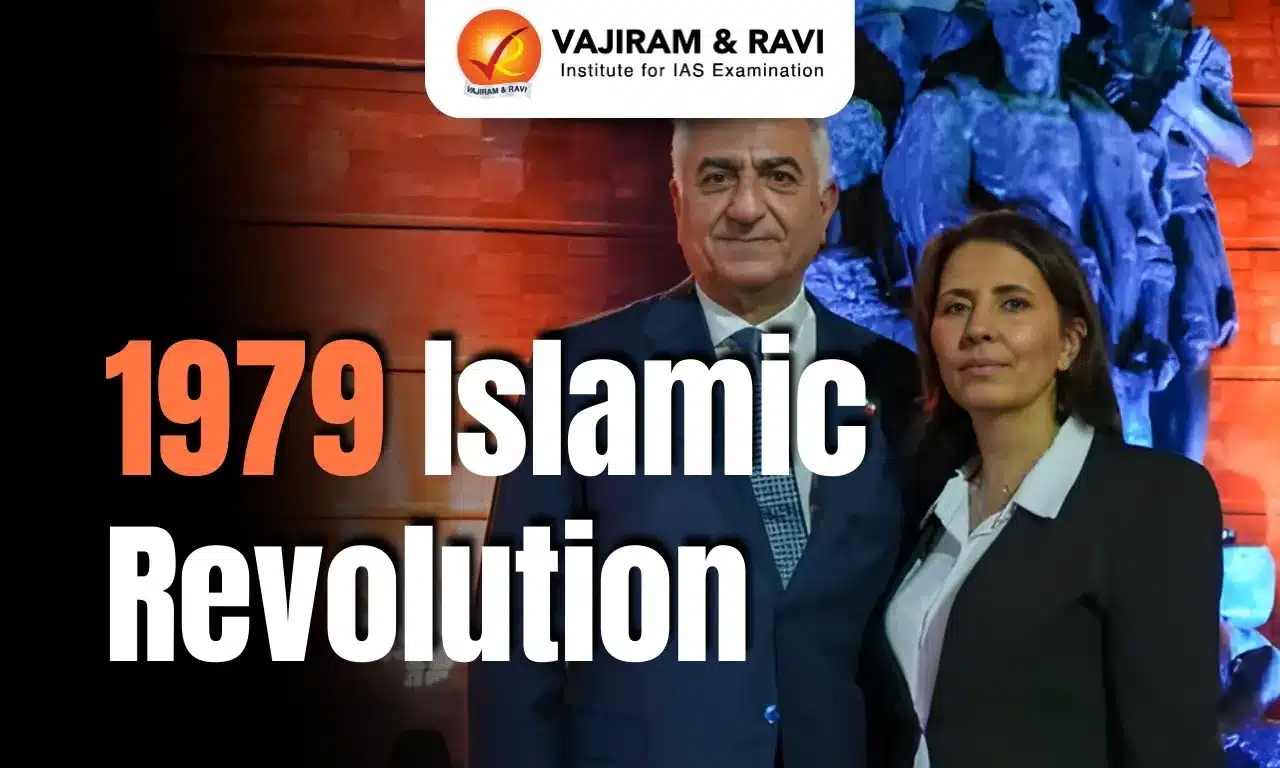
1979 Islamic Revolution Latest News
- Protests that erupted in Iran in late December over rising inflation and economic distress have turned deadly, with at least 42 deaths reported by January 9.
- While authorities acknowledge economic hardships, they have responded with a strong crackdown on dissent.
- The unrest has created political space for Reza Pahlavi, son of the last Shah of Iran, Mohammad Reza Pahlavi, who was overthrown in the 1979 Islamic Revolution.
- Living in exile, Pahlavi has sought to position himself as a rallying figure amid the turmoil.
Origins of the Pahlavi Dynasty
- Reza Shah Pahlavi, grandfather of Reza Pahlavi, rose from a military background and seized power in 1925 after a coup against Ahmad Shah Qajar.
- His takeover occurred amid imperial pressures, with Britain and Russia vying for influence in Iran.
Foreign Influence and Economic Concessions
- Iran’s vulnerability was underscored by sweeping concessions to foreign powers.
- In 1872, a British company secured extensive industrial and mineral rights from the Qajar dynasty—later criticised by Lord Curzon as an unprecedented surrender of national resources.
- Though revoked, the episode highlighted Iran’s subjugation to external interests.
Abdication and Wartime Upheaval
- Reza Shah abdicated in 1941 after Allied forces invaded Iran, citing its ties with Germany.
- This shifted national sentiment toward democratic leadership and sovereignty.
Mossadegh and the Oil Nationalisation Drive
- Mohammed Mossadegh, a Western-educated jurist, became Prime Minister (1951–1953) and championed nationalising Iran’s oil to benefit its people.
- His stance antagonised Western powers, particularly Britain, which had controlled Iranian oil through the Anglo-Iranian Oil Company (later British Petroleum).
The 1953 Coup and Restoration of the Shah
- Fearing loss of strategic and economic interests, Britain—with US backing—engineered regime change in 1953.
- Mossadegh was arrested, and Mohammad Reza Pahlavi was restored to power, entrenching the Pahlavi monarchy under Western support.
Iran under Mohammad Reza Pahlavi
- Mohammad Reza Pahlavi pursued social and economic modernisation, but his rule remained authoritarian.
- A key instrument of repression was SAVAK, the secret police notorious for surveillance, arrests, and torture of dissidents.
- Independent political and civic institutions were not allowed to function.
- As noted by historians, political parties, unions, student groups, and civic organisations were suppressed, forcing dissent into mosques and giving the opposition a growing religious character.
Rise of Mass Protests and Collapse of Monarchy
- By the 1970s, widespread dissatisfaction culminated in protests involving diverse groups, from communists to Islamists.
- Despite harsh crackdowns, sustained agitation weakened the regime’s hold on power.
- In 1979, the Shah and his family fled Iran.
- A referendum soon after established an Islamic Republic with Ayatollah Khomeini as Supreme Leader.
- While the new regime promised change, it soon mirrored many authoritarian practices of the past, compounded by religious fundamentalism.
1979 Islamic Revolution
- The 1979 Islamic Revolution overthrew the monarchy of Mohammad Reza Pahlavi, ending over five decades of Pahlavi rule in Iran.
Context and Causes
- The revolution was not a single event but a culmination of decade-long grievances against Shah Mohammad Reza Pahlavi.
- Political Autocracy: The Shah ruled as a secular dictator, suppressing dissent through his brutal secret police, SAVAK.
- The "White Revolution": Launched in 1963, these were aggressive modernization and land reforms. While intended to modernize Iran, they alienated the traditional Ulema (clergy) and the rural peasantry.
- Westernization & Cultural Identity: Rapid Western-style modernization was perceived as "Westoxification" (Gharbzadegi), undermining Iran's Islamic and cultural fabric.
- Economic Disparities: Despite high oil revenues, the gap between the rich (elite) and the poor (urban working class/migrant peasants) widened, fueled by corruption and inflation.
- Foreign Influence: The Shah was seen as a "puppet" of the US, especially after the 1953 CIA-backed coup that ousted the democratically elected PM Mohammad Mossadegh.
Key Events of the Revolution (1978–1979)
- Jan 1978: Protests ignited in Qom after a state-sponsored article insulted Ayatollah Ruhollah Khomeini, who was in exile.
- Black Friday (Sept 1978): Security forces fired on protesters in Tehran’s Jaleh Square, leading to massive casualties and making the revolution irreversible.
- Shah’s Departure: On January 16, 1979, the Shah fled Iran for Egypt.
- Khomeini’s Return: On February 1, 1979, Khomeini returned from exile to a rapturous welcome.
- Proclamation of the Republic: On April 1, 1979, following a national referendum, Iran was declared an Islamic Republic.
Post-Revolutionary Governance: Velayat-e Faqih
- The new political system was based on Khomeini’s doctrine of "Guardianship of the Islamic Jurist":
- Theocracy + Democracy: It blended republican elements (Parliament/Majlis, President) with theocratic ones (Supreme Leader, Guardian Council).
- Sovereignty: Unlike Western democracies where sovereignty lies with the people, here it is derived from Divine Will, interpreted by the Supreme Leader.
1979 Islamic Revolution FAQs
Q1: What was the 1979 Islamic Revolution?
Ans: The 1979 Islamic Revolution overthrew Iran’s monarchy, ended Pahlavi rule, and established an Islamic Republic under Ayatollah Khomeini, fundamentally transforming Iran’s political system.
Q2: What role did the Pahlavi dynasty play before the 1979 Islamic Revolution?
Ans: Before the 1979 Islamic Revolution, the Pahlavi dynasty ruled Iran with Western backing, pursuing modernisation but suppressing dissent through authoritarian governance and the SAVAK.
Q3: Why did oil nationalisation contribute to the 1979 Islamic Revolution?
Ans: Oil nationalisation symbolised resistance to foreign control and Western dominance, deepening resentment that later fuelled mass support for the 1979 Islamic Revolution.
Q4: How did religion shape the 1979 Islamic Revolution?
Ans: Religion unified opposition forces, with clerical leadership mobilising masses, making Islam the ideological core of the 1979 Islamic Revolution against secular authoritarianism.
Q5: What political system emerged after the 1979 Islamic Revolution?
Ans: After the 1979 Islamic Revolution, Iran adopted a theocratic system based on velayat-e faqih, combining republican institutions with supreme clerical authority.
